http://www.jscdss.com
Vol.6 No.5 October 2019: 23-30 Article history:
Accepted 19 August 2019 Published online 19 August 2019
Journal of Soft Computing and Decision
Support Systems
Travellers Segmentation and Choice Prediction through Online Reviews:
The Case of Wellington’s Hotels in New Zealand
Ali Ahani a,b, Mehrbakhsh Nilashi c,*, Othman Ibrahim d
a
Department of Business Strategy and Innovation, Griffith Business School, Griffith University, Brisbane, Australia
b
Department of Marketing, Griffith Business School, Griffith University, Gold Coast, Australia
c
School of Computing, Faculty of Engineering, Universiti Teknologi Malaysia (UTM), Skudai Johor 81310, Malaysia
d
Azman Hashim International Business School, Universiti Teknologi Malaysia (UTM), Skudai Johor 81310, Malaysia
* Corresponding author email address: [email protected]
Abstract
Customer choice and segmentation through online reviews can help hotels to improve their marketing strategy development. Neve rtheless, old-style approaches are unproductive in analysing online data generated by customers because of size, dissimilar proportions and structures of online review data. Therefore, this research aims to develop a method for 5-star hotels segmentation and travellers’ choice forecast through online reviews analysis using machine learning methods. Assessment of method was directed through the gathering of data from travellers’ ratings of Wellington’s 5-star hotels on different features in TripAdvisor. Results confirm that the projected hybrid machine learning approaches can be applied as a progressive recommender mediator for 5-star hotel segmentation by applying ‘big data’ obtained from online social media settings.
Keywords: Market Segmentation, Online Reviews, MCDM, TOPSIS, Choice Prediction, Wellington’s 5-star hotels, New Zealand
1. Introduction
Hotel managers are constantly trying to make tourists happy, but, tourists are dissimilar as classically they display varied preferences depending on the aim of travel, style of travel, and previous understandings (Berezina, Bilgihan, Cobanoglu, & Okumus, 2016). Customer satisfaction is a valuable degree that can help hoteliers to evaluate hotel performance by diverse groups of travellers (Neirotti, Raguseo, & Paolucci, 2016). Thus, hotel managers are increasingly aiming to identify methods to recognize the relationship between travelers’ preferences and their satisfaction degrees to advance their marketing strategy. Hotel managers want to understand customer preferences and needs in attaining well marketplace (De Pelsmacker, Van Tilburg, & Holthof, 2018). However, the development of social media practice, questions the traditional technique of customer relationship management and customer behavior analysis (Ahani, Nilashi, Yadegaridehkordi et al., 2019; Ahani, Rahim, & Nilashi, 2017b).
For Instance, TripAdvisor as a popular social media platforms delivers opportunities for following travelers to assessing their behavior and thus can be efficiently applied in market segmentation analysis (Ahani, Nilashi, Ibrahim, Sanzogni, & Weaven, 2019). Undeniably, tourist
researchers and the tourist businesses are in need of data-driven market segmentation examination not only for knowledge expansion but also to understand marketplace (Ernst & Dolnicar, 2018). Therefore, online reviews are a significant source of valued data and information about tourists, their preferences, and experiences that disclose the customers' feelings of service satisfaction (Gao, Li, Liu, & Fang, 2018). Furthermore, the online rating study is a type of Multi-Criteria Decision Making (MCDM) matter as they deliver preferences of clients based on their diverse perspectives on the hotels valuation (Ahani, Nilashi, Yadegaridehkordi et al., 2019). Tourists’ expectancy of hotel services usually differs based on hotel star rating, which effects their overall satisfaction (Tefera and Govender, 2016). Although quality of services and satisfaction are substantial in the hotel and hospitality business, they are more vital in 5-star hotel since tourist supposed to receive luxury service and higher quality form this type of hotels (Lu, Berchoux, Marek, & Chen, 2015; Mohsin & Lockyer, 2010). Nevertheless, inadequate attention has been paid to the advance of novel approaches for market segmentation based on online reviews of 5-star hotels. Furthermore, online reviews and ratings have been produced a big volume of data over the last decades. It has been predictable that the quantity of data will continue to
growth principally in the coming years. Hence, there is a need of smart methods using MCDM and soft computing approaches to aid application of big data in different industries (Yadegaridehkordi et al., 2018) including tourism and hospitality. Hence, this study is aiming to address this research gap by propose a novel machine learning method to apply available big data from the TripAdvisor to development a new market segmentation approach for 5-star hotels. This study develops a two-stage machine learning method to recognize different travellers’ segments from TripAdvisor website. Our findings will help in classifying the preferences, and behaviours of tourists who visit wellington 5-star hotels to notify marketing strategy and enhance the efficiency of upcoming marketing operations. Moreover, this study delivers a basis for following hypothetical and experiential research on 5-star hotels and their travellers’ preferences based on online ratings. Therefore, this research aims to progress a technique for 5-star hotels segmentation and travel choice forecast by using machine learning technique.
The rest of this study is ordered into three parts. Review of literature is discussed in the next part. The following parts introduce the data collection and methods applied in this research. The findings parts explain the market segments of Wellington’s five-star hotels and their satisfaction and preference regarding hotels’ features. Finally, the implications of this research, the limitations of this study, and couple of suggestions for future research presented in conclusion part.
2. Literature review
2.1 Wellington’s hotels in New Zealand
New Zealand is one of the island countries that is surrounded by water and located in the southwestern Pacific Ocean. It is a famous global traveler destinations because of diverse natural resources and inheritance (Balli & Tsui, 2016; Ryan, 2002; Tsui, 2017). Tourism is acting a vital part in the New Zealand national economy to create income for this country. New Zealand hotels are diverse from different perspectives, however the standard of hospitality in New Zealand is usually higher than other countries (Yeoman & McMahon‐Beattie, 2015). The popular hotel brands such as Hilton, Hyatt, and Intercontinental are placed in the major cities of New Zealand including Auckland, Christchurch and Wellington. Hence, this study selects Wellingtons Hotels in New Zealand as a case of this research. This study focuses on Wellington’s hotels since this city is the capital of New Zealand and it is a beautiful tourism destination in the world. Furthermore, the focus of this research narrows down on 5-star hotels since tourists usually have higher prospect regarding 5-star hotels and their services. Indeed, there is a need for novel marketing analytics tools and smart management of the relationship with tourists of 5-star hotels to increase the effectiveness of the tourism industry of Wellington.
2.2 Hotel Features, Online Rating and Customer
satisfaction
Travellers shows different responses to hotel features since they have dissimilar preferences. Hotel features could be divided into various subgroups to include all small characteristic of hotels’ magnetisms or disruptions to visitors. Travellers usually display their satisfaction based on their observations of the hotels features that they think most significant. On the other hand, the features of hotels characterize proportions of satisfaction. Many marketing scholars have projected that customer satisfaction acts a significant part in motivating customers' behavioural loyalty, such as sharing helpful reviews, or creation of a recommendation (Chen & Tsai, 2007; Cronin Jr, Brady, & Hult, 2000; Hallowell, 1996). Various factors are important in creation of consumer satisfaction, and it is so a multi-dimensional concept containing of dissimilar features or sub-concepts similar to service quality (Oliver, 2014). Past scholars classically trust on old-style methods like survey to identify the proportions of satisfaction, and then develop experiential dimension gauges.
Today, the development of social media practice, questions the traditional technique of customer relationship management and customer behavior analysis (Ahani, Rahim, & Nilashi, 2017a; Ahani et al., 2017b). Social media technology has had substantial influences on the hotel and hospitality industry. For instance, online traveller reviews through different social media platforms provide valuable sources of data for the traveller’s decision-making process in social media websites (Nilashi, Yadegaridehkordi, et al., 2019). Travel online review channels empower customers by offering mathematical ratings for feature of each hotel including location, cleanliness, and quality of room. These features obviously show particular sentiments and understandings of travellers about the hotel they stayed at and reflect the hotel quality (Xia, Vu, Lan, Law, & Li, 2019). The feature ratings can be used as measures of hotel quality to assess hotel attractiveness. Such hotel features are usually used by many travel websites such as TripAdvisor in measuring hotel visitors’ individual assessment on hotel. Online ratings and reviews can help hoteliers to understand customer preferences and gain an improved understanding of how hotels differ and where enhancements should be happened to advance the satisfaction levels of tourists (Nilashi, Ahani, et al., 2019). Therefore, hoteliers are progressively targeting to recognize approaches to distinguish the relationship between preferences of tourists and their satisfaction scores to enhance their marketing plan. However, hotel managers need to understand how much different features of are important for travellers.
2.3 MCDM studies in the tourism context
MCDM is a dynamic research technique to answer the real-life decision procedures. It delivers comprehensive and organized assessment criteria to answer the decision-making issue (Ahani, Nilashi, & Ahmadi, 2016; Nilashi, Ahmadi, Ahani, Ravangard, & bin Ibrahim, 2016). Commonly, MCDM is about answering decision matters involving various criteria. For example, customers regularly have several criteria that need to be satisfied concurrently, thus, multi-criteria decision-making approaches can be used to analyse customers preferences and satisfaction. MCDM methods are grounded on a
deterministic method which have been applied extensively in different research discipline where decision making is recognized to be impacted by numerous factors (Jafari-Moghadam, Zali, & Sanaeepour, 2017; Peng & Tzeng, 2019; Zavadskas, Turskis, & Kildienė, 2014). Between the MCDM approaches, TOPSIS (Technique for Order Preference by Similarity to an Ideal Solution) is widespread technique as it has clear logic that signifies the basis of customer choice. There are many applications of the TOPSIS method in the literature including travel and hospitality fields (see Table 2).
Table 2
TOPSIS practice in travel and hospitality studies
Authors Method Findings
(Ahani, Nilashi, Yadegaridehkordi, et al., 2019)
Self-Organizing Map (SOM) and TOPSIS The findings of this study support identifying customer segments for hotels in Canary Islands.
(Nilashi, Samad, et
al., 2019) A DEMATEL-Fuzzy TOPSIS approach
This study displayed that human and technological aspects are the most significant factors for Malaysian medical tourism.
(Pahari, Ghosh, & Pal,
2018) Intuitionistic Fuzzy TOPSIS Method
Proposed an intuitionistic fuzzy TOPSIS technique to rank hotels based on online reviews to help tourists find hotels on TripAdvisor.com.
(Morteza, Reza, Seddiq, Sharareh, & Jamal, 2016)
ANP and fuzzy TOPSIS This research develops an assessment to aid the stockholders in travel industry, for the choice of the optimal tourism site in an uncertain situation.
(Zhang, Gu, Gu, &
Zhang, 2011) TOPSIS & information entropy
The TOPSIS technique providing an operative technique for grading competing alternatives in terms of their general performance regarding indices.
(Wu, Lin, & Lee, 2010)
Analytic network process (ANP) and (TOPSIS)
This study delivers a direction for hoteliers to develop marketing strategies to obtain a competitive advantage by assessing their precise and restricted marketing capitals.
(Hsu, Tsai, & Wu, 2009)
The Analytic Hierarchy Process (AHP), Fuzzy set theory and TOPSIS,
This study provides the preference of the assumed tourism destinations consistent to each criterion.
Hence, this study uses six hotel features including value, location, sleep quality, rooms, cleanliness, and service to detect the variations of their relative rank levels as stated by overall ratings, which resulting six hotel features based on a comprehensive review of prior literature on hotel attributes.
3. Method
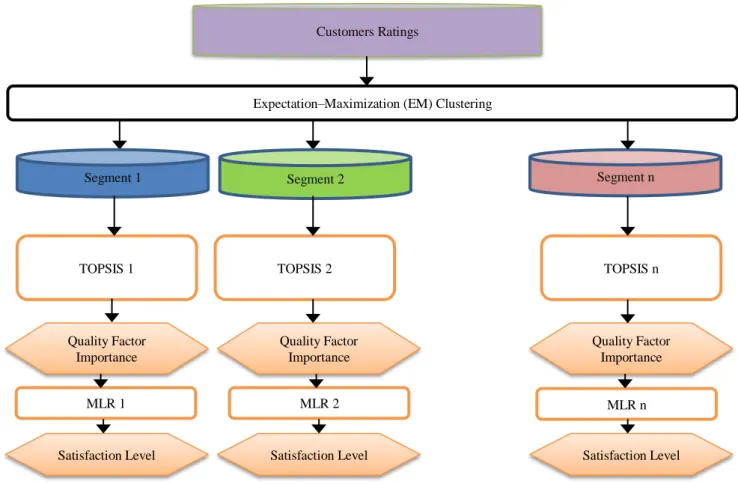
This study count on the use of Expectation Maximization (EM) (Nilashi et al., 2015; Nilashi et al., 2016a; Nilashi et al., 2017a; Nilashi et al., 2017b) for clustering, and TOPSIS (Ahani, Nilashi, Ibrahim, et al., 2019; Nilashi, Ahani, et al., 2019; Nilashi, Bin Ibrahim, Mardani, Ahani, & Jusoh, 2018a). Method assessment is
directed through collection of data sets from online ratings of Wellington 5- star hotels on six important features in TripAdvisor.
Fig. 1. Research Method
4. Results
We applied EM algorithm to cluster the craweled data. It was imporatnt to cluster the data befor ranking the quality factors, Value, Location, Check-in/Front Desk, Rooms, Service, Sleep Quality, and Cleanliness, as clustering could improve the effectiveness of TOPIS in ranking the factors. Accoridngly, different clustering sizes were tried for EM to
find the high quality clusters for customer segmentation according to their ratings on the quality factors of spa hotels. We found that four clusters provide the best clustring quality according to the approach developed by Davies-Bouldin value to quantity intra-cluster distance and discover the perfect number of clusters (Davies & Bouldin, 1979). The The results of EM clustering is presented in Table 2.
Table 2
Cluster Centroids.
Attribute Cluster 1 Cluster 2 Cluster 3 Cluster 4
Value 2.986 3.004 2.787 3.966
Location 3.226 2.975 2.925 3.373
Service 3.285 2.880 2.603 3.821
Rooms 3.080 2.837 2.707 3.905
Cleanliness 2.911 2.898 3.330 3.573
Sleep Quality 3.253 2.840 2.880 3.514
The customers ratings clustered by EM algorithm were used in TOPSIS technique to rank the quality factors in each segment. The results of TOPSIS are presented in Table 3. The results of this table clearly show that which factors are important for the customers in each segment. It can be found that in Segment 1, Service, Sleep Quality and Location, in Segment 2, Value, Location and Cleanliness, in Segment 3, Cleanliness, Location and Sleep Quality, in Segment 4, Value, Rooms and Service are the most important quality factors. The most important factors are
used in Multiple Linear Regression (MLR) for customer satisfaction prediction. We applied MLR technique on each segment. The results are shown in Fig. 2. It can be found that the use of clustering and TOPSIS have been effective in the prediction of customer satisfaction in 5-star hotels. The R2 values were above than 0.7 which reveal that the method is accurate in predicting the level of customer satisfaction from their online reviews on the hotels’ quality aspects.
Quality Factor Importance
Quality Factor Importance
Quality Factor Importance
Satisfaction Level Satisfaction Level Satisfaction Level
Customers Ratings
Expectation–Maximization (EM) Clustering
TOPSIS 1
Segment 1 Segment 2 Segment n
TOPSIS 2 TOPSIS n
Table 3
Results of TOPSIS technique
Fig. 2. Results of MLR for four segments
y = 1x - 2E-06 R² = 0.8447
0 0.5 1 1.5 2 2.5 3 3.5 4 4.5 5
1.8 2.8 3.8 4.8
O
ve
ra
ll
R
at
in
g
Predicted Overall Rating
y = 1x - 8E-06 R² = 0.7135
0 0.5 1 1.5 2 2.5 3 3.5
1.5 2 2.5 3 3.5
O
vera
l R
at
in
g
Predicted Overall Rating
y = 1x - 3E-06 R² = 0.8621
0 0.5 1 1.5 2 2.5 3 3.5 4 4.5
1.5 2 2.5 3 3.5 4
O
ve
ra
ll
R
at
in
g
Predicted Overall Rating
y = 1x + 7E-06 R² = 0.9551
0 1 2 3 4 5 6
2.2 3.2 4.2 5.2 6.2
O
vera
ll
R
at
in
g
Predicted Overall Rating
Hotel Featurs Segment TOPSIS Rank
Service Segment 1 1
Location 2
Sleep Quality 3
Rooms 4
Value 5
Cleanliness 6
Value Segment 2 1
Location 2
Cleanliness 3
Service 4
Rooms 5
Sleep Quality 6
Cleanliness Segment 3 1
Location 2
Sleep Quality 3
Value 4
Rooms 5
Service 6
Value Segment 4 1
Rooms 2
Service 3
Location 4
Cleanliness 5
5. Conclusions
This is substantial for hoteliers to understand customers satisfaction and preferences to make a better decision and advance their marketing strategy. Therefore, the aim of this research is studying of Wilmington 5-satar hotels’ travelers by measuring their preferences and satisfaction over online ratings composed from TripAdvisor. By linking EM clustering, and MCDM method, TOPSIS, the travelers’ online ratings were examined, and valued findings exposed which are a set of segments and ranking of hotels' features in each segment. Hence, the findings of this study can assist hoteliers to recognize the preference of different travlers segments to recover marketing plans to satisfy the needs of travelers of 5-star hotels. One of the main novel theoretical implications of this study is application of online reviews when to identify customers’ preferences and satisfaction. Past researchers have not segmented 5-Star hotel customer grounded on online reviews satisfaction and preferences for hotel attributes. However, the information available through online hotel ratings are more unbiased, massive, and without sample bias, as online reviews are shared naturally unlike old-style questionnaires (Schuckert et al., 2015). The results of this research help hoteliers to recognize travelers’ features, prospects, and behaviours traveler segment to guarantee effective marketing plan. The findings of this study also can support summarizing of travelers features in the context of 5-star hotels though applying accessible data from travle platforms such as TripAdvisor. The findings of this research are significance for managers of five-star hotels, in their mission to meet and exceed customer prospects. Hoteliers can use these findings, derived by the TOPSIS, in their decision making, particularly about customer preferences and satisfaction regarding hotel features. Moreover, the findings of this study are also valuable for policy maker in New Zealand tourism and hospitality management. This study is a primary effort for travellers’ choice and segmentation of 5-star hotels as it offers a general description of the features of travelers to Wellington’s five-star hotels. Indeed, this study utilized a suitability sample limited to tourist of five-star hotels in Wellington. Discovering and comparing the online ratings and associated reviews written in different languages can be deliberated as a further research avenue. To end, as online ratings can vary over time, thus, it is recommended that upcoming studies advance method to observe the online ratings over the time.
Acknowledgments
The authors would like to acknowledge this study as a respond to Australian and New Zealand Marketing Academy (ANZMAC) Conference 2019 call in Wellington, New Zealand, to join in this marketing schaolr conversation through this research.
References
Ahani, A., Nilashi, M., & Ahmadi, H. (2016). Evaluating the barriers of hospital information system implementation using analytic network processes (ANP) method. Journal of Soft Computing and Decision Support Systems, 3(4), 30-38.
Ahani, A., Nilashi, M., Ibrahim, O., Sanzogni, L., & Weaven, S. (2019). Market segmentation and travel choice prediction in spa hotels through tripadvisor’s online reviews. International Journal of Hospitality Management, 80, 52-77.
Ahani, A., Nilashi, M., Yadegaridehkordi, E., Sanzogni, L., Tarik, A.R., Knox, K., Samad, S. and Ibrahim, O., (2019). Revealing customers’ satisfaction and preferences through online review analysis: The case of Canary Islands hotels. Journal of Retailing and Consumer Services, 51, 331-343.
Ahani, A., Rahim, N. Z. A., & Nilashi, M. (2017a). Firm performance through social customer relationship management: Evidence from small and medium enterprises. Paper presented at the 2017 International Conference on Research and Innovation in Information Systems (ICRIIS).
Ahani, A., Rahim, N. Z. A., & Nilashi, M. (2017b). Forecasting social CRM adoption in SMEs: A combined SEM-neural network method. Computers in Human Behavior, 75, 560-578.
Balli, F., & Tsui, W. H. K. (2016). Tourism demand spillovers between Australia and New Zealand: evidence from the partner countries. Journal of Travel Research, 55(6), 804-812.
Berezina, K., Bilgihan, A., Cobanoglu, C., & Okumus, F. (2016). Understanding satisfied and dissatisfied hotel customers: text mining of online hotel reviews. Journal of Hospitality Marketing & Management, 25(1), 1-24. Chen, C.-F., & Tsai, D. (2007). How destination image and
evaluative factors affect behavioral intentions? Tourism Management, 28(4), 1115-1122.
Cronin Jr, J. J., Brady, M. K., & Hult, G. T. M. (2000). Assessing the effects of quality, value, and customer satisfaction on consumer behavioral intentions in service environments. Journal of retailing, 76(2), 193-218.
Davies, D., & Bouldin, D. (1979). A cluster separation measure, IEEE transactions on patter analysis and machine intelligence. vol. In: PAMI-1.
De Pelsmacker, P., Van Tilburg, S., & Holthof, C. (2018). Digital marketing strategies, online reviews and hotel performance. International Journal of Hospitality Management, 72, 47-55.
Ernst, D., & Dolnicar, S. (2018). How to avoid random market segmentation solutions. Journal of Travel Research, 57(1), 69-82.
Guo, Y., Barnes, S. J., & Jia, Q. (2017). Mining meaning from online ratings and reviews: Tourist satisfaction analysis using latent dirichlet allocation. Tourism Management, 59, 467-483.
Hallowell, R. (1996). The relationships of customer satisfaction, customer loyalty, and profitability: an empirical study. International journal of service industry management, 7(4), 27-42.
Hsu, T.-K., Tsai, Y.-F., & Wu, H.-H. (2009). The preference analysis for tourist choice of destination: A case study of Taiwan. Tourism Management, 30(2), 288-297.
Jafari-Moghadam, S., Zali, M., & Sanaeepour, H. (2017). Tourism entrepreneurship policy: a hybrid MCDM model combining DEMATEL and ANP (DANP). Decision Science Letters, 6(3), 233-250.
Lu, C., Berchoux, C., Marek, M. W., & Chen, B. (2015). Service quality and customer satisfaction: qualitative research implications for luxury hotels. International Journal of Culture, Tourism and Hospitality Research, 9(2), 168-182.
Mohsin, A., & Lockyer, T. (2010). Customer perceptions of service quality in luxury hotels in New Delhi, India: an exploratory study. International Journal of Contemporary Hospitality Management, 22(2), 160-173.
Morteza, Z., Reza, F. M., Seddiq, M. M., Sharareh, P., & Jamal, G. (2016). Selection of the optimal tourism site using the ANP and fuzzy TOPSIS in the framework of Integrated Coastal Zone Management: A case of Qeshm Island. Ocean & coastal management, 130, 179-187. Neirotti, P., Raguseo, E., & Paolucci, E. (2016). Are
customers’ reviews creating value in the hospitality industry? Exploring the moderating effects of market positioning. International Journal of Information Management, 36(6), 1133-1143.
Nilashi, M., Ahani, A., Esfahani, M.D., Yadegaridehkordi, E., Samad, S., Ibrahim, O., Sharef, N.M. and Akbari, E., (2019). Preference learning for eco-friendly hotels recommendation: A multi-criteria collaborative filtering approach. Journal of Cleaner Production, 215, 767-783. Nilashi, M., Ahmadi, H., Ahani, A., Ravangard, R., & bin Ibrahim, O. (2016). Determining the importance of hospital information system adoption factors using fuzzy analytic network process (ANP). Technological Forecasting and Social Change, 111, 244-264.
Nilashi, M., Bin Ibrahim, O., Mardani, A., Ahani, A., & Jusoh, A. (2018a). A soft computing approach for diabetes disease classification. Health Informatics Journal, 24(4), 379-393.
Nilashi, M., bin Ibrahim, O., Ithnin, N., & Sarmin, N. H. (2015). A multi-criteria collaborative filtering recommender system for the tourism domain using Expectation Maximization (EM) and PCA–ANFIS. Electronic Commerce Research and Applications, 14(6), 542-562.
Nilashi, M., Ibrahim, O., & Ahani, A. (2016a). Accuracy improvement for predicting Parkinson’s disease progression. Scientific reports, 6, 34181.
Nilashi, M., Ibrahim, O., Ahmadi, H., & Shahmoradi, L. (2017a). A knowledge-based system for breast cancer classification using fuzzy logic method. Telematics and Informatics, 34(4), 133-144.
Nilashi, M., Bagherifard, K., Rahmani, M., & Rafe, V. (2017b). A recommender system for tourism industry using cluster ensemble and prediction machine learning techniques. Computers & industrial engineering, 109, 357-368.
Nilashi, M., Salahshour, M., Ibrahim, O., Mardani, A., Esfahani, M. D., & Zakuan, N. (2016b). A new method for collaborative filtering recommender systems: the case of yahoo! movies and tripadvisor datasets. Journal of Soft Computing and Decision Support Systems, 3(5), 44-46.
Nilashi, M., Samad, S., Manaf, A. A., Ahmadi, H., Rashid, T. A., Munshi, A., . . . Hassan, O. (2019). Factors Influencing Medical Tourism Adoption in Malaysia: A DEMATEL-Fuzzy TOPSIS Approach. Computers & Industrial Engineering, 106005.
Nilashi, M., Yadegaridehkordi, E., Ibrahim, O., Samad, S., Ahani, A., & Sanzogni, L. (2019). Analysis of Travellers’ Online Reviews in Social Networking Sites Using Fuzzy Logic Approach. International Journal of Fuzzy Systems, 21(5), 1367-1378.
Nilashi, M., Ibrahim, O., Yadegaridehkordi, E., Samad, S., Akbari, E., & Alizadeh, A. (2018b). Travelers decision making using online review in social network sites: A case on TripAdvisor. Journal of computational science, 28, 168-179.
Oliver, R. L. (2014). Satisfaction: A behavioral perspective on the consumer: A behavioral perspective on the consumer: Routledge.
Pahari, S., Ghosh, D., & Pal, A. (2018). An Online Review-Based Hotel Selection Process Using Intuitionistic Fuzzy TOPSIS Method. In Progress in Computing, Analytics and Networking (pp. 203-214): Springer. Peng, K.-H., & Tzeng, G.-H. (2019). Exploring heritage
tourism performance improvement for making sustainable development strategies using the hybrid-modified MADM model. Current Issues in Tourism, 22(8), 921-947.
Ryan, C. (2002). Tourism and cultural proximity: Examples from New Zealand. Annals of Tourism Research, 29(4), 952-971.
Tsui, K. W. H. (2017). Does a low-cost carrier lead the domestic tourism demand and growth of New Zealand? Tourism Management, 60, 390-403.
Wu, C.-S., Lin, C.-T., & Lee, C. (2010). Optimal marketing strategy: A decision-making with ANP and TOPSIS. International Journal of Production Economics, 127(1), 190-196.
Xia, H., Vu, H. Q., Lan, Q., Law, R., & Li, G. (2019). Identifying hotel competitiveness based on hotel feature ratings. Journal of Hospitality Marketing & Management, 28(1), 81-100.
performance: An integrated DEMATEL-ANFIS approach. Technological Forecasting and Social Change, 137, 199-210.
Yeoman, I., & McMahon‐Beattie, U. (2015). New Zealand's future: the potential for knitting tourism. Journal of Tourism Futures, 1(2), 152-155.
Zavadskas, E. K., Turskis, Z., & Kildienė, S. (2014). State of art surveys of overviews on MCDM/MADM methods. Technological and economic development of economy, 20(1), 165-179.