www.ijtes.net
Students’
Perceptions
of
Using
MyMathLab
and
WebAssign
in
Mathematics Classroom
Derar Serhan1, Farouq Almeqdadi2 1
Arizona State University
2
Emirates College for Advanced Education
To cite this article:
Serhan, D. & Almeqdadi, F. (2020). Students’ perceptions of using MyMathLab and
WebAssign in mathematics classroom. International Journal of Technology in Education and
Science (IJTES), 4(1), 12-17.
Volume 4, Issue 1, Winter 2020
ISSN: 2651-5369
Students’ Perceptions of Using MyMathLab and WebAssign in
Mathematics Classroom
Derar Serhan, Farouq Almeqdadi
Article Info
Abstract
Article History
Received: 20 December 2018
Enhancing students’ conceptual understanding and increasing student motivation to effectively participate in classroom discussions are important for instructors of mathematics. Web-based homework management systems provide alternatives to the traditional pen-and-paper based approaches. In addition, these tools facilitate the creation of a student-centered environment which allows instructors to assign work based on students' needs while using a variety of multimedia materials that can include animation, video, and/or audio in order to enhance student learning and facilitate student-instructor communications. These systems provide flexible instructional tools that not only offer students immediate feedback, but also track student performance. The goal of using these programs is to enhance student understanding and learning of different mathematical concepts. The purpose of this paper is to present students’ perceptions of the advantages and disadvantages of using two web-based homework management systems; MyMathLab and WebAssign. In addition, it sheds light on students’ habits of using these systems and their perception of the optimal number of attempts that should be allowed to complete the homework assignments.
Accepted: 25 February 2019
Keywords
Mathematics education MyMathLab
WebAssign Web-based systems Students’ perceptions
Introduction
The importance of homework and the relationship between homework and academic performance have already been the focus of several studies (Cooper, Robinson & Patall, 2006; Eren & Henderson, 2008; Keith & Cool, 1992; Peters, Kethley & Bullington, 2002; Warton, 2001). Web-based homework systems can provide an alternative to the traditional paper-based homework (Dufresne, Mestre, Hart, & Rath, 2002). Many studies have been conducted using web-based homework in chemistry, mathematics, physics and statistics courses (Bliwise, 2005; Bonham, Beichner, & Deardorff, 2001; Cole & Todd, 2003; Dufresne, Mestre, Hart, & Rath, 2002; Freasier, Collins, & Newitt, 2003; Hauk, & Segalla, 2005; Lenz, 2010; Lin, 2009; Pascarella, 2004; Penn, Nedeff, & Gozdzik, 2000; Pennington, 2013; Toback, Mershin, & Nazimova, 2005; York, Hodge & Richardson, 2008; Zerr, 2007). Some studies focused on students’ perceptions of their learning using web-based homework systems (Demirci, 2007; Hauk & Segalla, 2005; Picciano, 2002). Other studies compared between the use of web- based homework systems and the use of paper-and-pencil homework (Dufresne, Mestre, Hart, & Rath, 2002; Thoennessen & Harrison, 1996).
Two of these web-based systems are WebAssign & MyMathLab. WebAssign was developed by Dr. John Risley in 1997 to enhance student learning and support instructors in their classroom. WebAssign is a flexible web-based instructional system that allows students more practice as well as easy access to their performance assessment. Using WebAssign, students can work on their assignments multiple times until they get the correct answer. Student performance can be assessed regularly. MyMathLab is an online textbook resource that is used to generate online homework assignments. MyMathLab offers instant feedback, step-by-step examples, videos, tutorials. MyMathLab creates a personalized adaptive study plan based on the collected data targeting each student’s individual strengths and weaknesses. The goal of the adaptive plan is to improve student conceptual understanding of the mathematical concepts.
13
International Journal of Technology in Education and Science (IJTES)
homework in a traditional fashion using paper and pencil. Gok found that there was no significant difference between the exam scores for the two sections. However, he found that students in the experimental section performed better on their homework.
Pennington (2013) conducted a study that investigated the use of ALEKS as a web-based homework system on student achievement in a college algebra course. To access the online quiz, students were required to achieve a 75% correct completion level for the online homework assignments. Pennington collected the data using a pretest, posttest, pre-survey and post-survey. The pre-test was used to measure students’ prior knowledge of the material before taking the course. The pre-survey was used to gather demographic information including gender. The post-survey was used to gain information on students' work ethic, their feelings about the use of ALEKS. The researcher found that using ALEKS did not raise final exam grades but that it improved students’ online quiz grades.
Lin (2009) conducted a study to investigate the comparative efficiency of Web-based instruction and traditional teaching methods on preservice teachers’ fraction knowledge. Forty- two preservice teachers who were enrolled in two classes (21 students each) participated in this study. The experimental class used Web-based Instruction, the other class was given traditional instruction. The researcher collected the data using pre- and posttest. The test consisted of 32 items that aimed at assessing students’ knowledge of fractions. The other class that was assigned as a control group (n = 21) was given traditional instruction. The analysis of results showed that there was a statistically significant difference between the experimental and the control groups’ posttest mean scores in favor of the experimental group.
York, Hodge & Richardson (2008) conducted a study that examined students' perceptions of the effects of the use of web-based homework on their learning and motivation. Participants in study were 376 students who were enrolled in a college algebra class at the university level. Participants completed the majority of their homework online. The researchers evaluated students' perceptions of the web-based homework through a survey containing both Likert-scale items and open-ended questions. The researchers found that few students appreciated the immediate feedback, but that most of them felt more accountable for completing the assigned work.
In a study that focused on the number of attempts that a student should be allowed to solve numerical free-response problems, Kortemeyer (2015) argued that the “number should be large enough to allow learners mastery of concepts and avoid copying, on the other hand, granting too many allowed tries encourages counter-productive behavior”. The researcher investigated data from an introductory calculus-based physics course that allowed different numbers of attempts in different semesters. He found that the probability for students to complete a problem successfully decreases with the number of allowed attempts, which might be, as he indicated, due to increased carelessness or guessing. Based on his findings he predicted an optimum number of five allowed tries.
The focus of this paper is on students’ perceptions of the advantages and disadvantages of using MyMathLab and WebAssign in learning mathematics in addition to their perceptions of the optimum number of attempts needed to complete homework assignments. In addition, the study investigated students’ habits of completing homework and the number of hours needed to complete the homework.
Research Questions
The aim of this study was to answer the following questions:
1. How many hours per week do students spend doing web-based homework? 2. Where do students complete their web-based homework?
3. What is the optimal number of attempts that students should be allowed to complete each homework assignment?
4. What are students’ perceptions of the advantages and disadvantages of using MyMathLab and WebAssign in learning mathematics?
Method
an answer to the research questions, data were collected using a survey asking students to provide answers to the following questions:
1. How many hours per week did you spend doing your web-based homework? 2. Where do you complete your web-based homework? (campus, home, both, ….)
3. How many attempts should be allowed for each question before assignment submission? 4. What are the advantages of using a web-based homework system?
5. What are the disadvantages of using a web-based homework system?
Findings
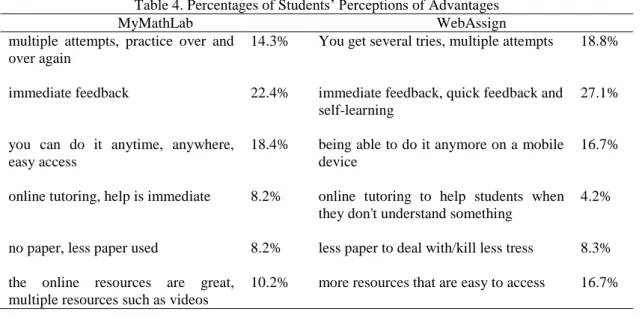
In this section we discuss the findings to provide a response to the research questions regarding the students’ perceptions of the advantages and disadvantages of using MyMathLab and WebAssign in learning mathematics as well as their use of these web-based homework systems. Participants’ responses were summarized and tabulated as follows: Table 1 provides the number of hours students spent working on these systems per week, Table 2 provides the location of where students completed their assignments, Table 3 provides students perceptions of the ideal number of attempts per question, Table 4 provides students’ perceptions of advantages using MyMathLab and Webassign, and Table 5 provides students’ perceptions of disadvantages of using MyMathLab and WebAssign. To answer the first question regarding the number of hours that student spend working on their homework using either Webassign or MyMathLab, the collected data were tabulated into four categories as seen in Table 1. As indicated in the table, the majority of students spend 3-6 hours per week working on their web-based homework (MyMathLab: 78%; WebAssign: 69%).
Table 1. Percentages for Working Hours
Hours spent per week MyMathLab WebAssign
Less than 3 hours 10% 17%
3-6 hours 78% 69%
7-10 hours 10% 12%
More than 10 hours 2% 2%
To answer the second question regarding the location where students worked on their homework, the collected data were tabulated into three categories as seen in Table 2. The majority of students either worked at home or both home and campus. Students could choose to work on these assignments anywhere they liked since they could access the homework easily anywhere and anytime. This means that accessing either one of the web-based systems was not an issue for students.
Table 2. Percentages for Place of Access
Place of Access MyMathLab WebAssign
Home 43% 35.4%
Campus 14% 8.3%
Both 43% 56.3%
To answer the third question about the optimal number of attempts for each question, the majority of students as seen in Table 3 indicated that they would like to have unlimited number of attempts. It seems that, students like to be on the safe side and they prefer to keep trying until they get the correct answer.
Table 3. Percentages for Optimum Number of Attempts Total number of attempts MyMathLab WebAssign
1-5 29% 10.4%
6-10 2% 31.3%
11- 30 0% 10.4%
Unlimited 69% 47.9%
15
International Journal of Technology in Education and Science (IJTES)
indicated saving trees as one advantage of using web-based homework systems. Other advantages mentioned include online tutoring and the availability of multiple resources including videos.
Table 4. Percentages of Students’ Perceptions of Advantages
MyMathLab WebAssign
multiple attempts, practice over and over again
14.3% You get several tries, multiple attempts 18.8%
immediate feedback 22.4% immediate feedback, quick feedback and self-learning
27.1%
you can do it anytime, anywhere, easy access
18.4% being able to do it anymore on a mobile device
16.7%
online tutoring, help is immediate 8.2% online tutoring to help students when they don't understand something
4.2%
no paper, less paper used 8.2% less paper to deal with/kill less tress 8.3% the online resources are great,
multiple resources such as videos
10.2% more resources that are easy to access 16.7%
The major disadvantages, as listed by students, of using MyMathLab and WebAssign were: having technical difficulties and no internet access (34.7%, 33.3%), less interaction with instructor (8.2%, 2.1%) and forgetting to complete the assignment (4.1%, 2.1%). Other disadvantages that students mentioned include matching the system format by entering the exact answer and being less friendly in case of asking a question in the tutoring center.
Table 5. Percentages of Students’ Perceptions of Disadvantages
MyMathLab WebAssign
technical difficulties, issues with the internet
34.7% technical difficulties, technology failure- Wi-Fi/network is down
33.3%
system glitch, you enter the correct answer but the system doesn’t accept it
8.2% sometimes your answer is a little off and not approved by the system
2.1%
instructor isn't available, no teacher help, less interaction with professor
8.2% less interaction with the professor 2.1%
less friendly than using a paper submission
2% if you do not understand something it is really hard to bring your laptop around places to seek help rather than a piece of paper
2.1%
you have to remember to get it done, easy to forget to do your homework
4.1% you forget about it 2.1%
Conclusion
References
Bliwise, N.G. (2005). Web-Based Tutorials for Teaching Introductory Statistics. Journal of Educational Computing Research, 33(3), 309-325. Retrieved from https://www.learntechlib.org/p/69286/.
Bonham, S., Beichner, R., & Deardorff, D. (2001). Online homework: Does it make a difference? The Physics Teacher, 39(5), 293–296. https://doi.org/10.1119/1.1375468
Cole, R. S., & Todd, J. B. (2003). Effects of web-based multimedia homework with immediate rich feedback on student learning in general chemistry. Journal of Chemical Education, 80, 1338-1343.
Cooper, H., Robinson, J., & Patall, E. (2006). Does homework improve academic achievement? A synthesis of research, 1987-2003. Review of Educational Research, 76, 1-62.
Demirci, N. (2007). University students' perceptions of web-based vs. paper-based homework in a general physics course. Eurasia Journal of Mathematics, Science & Technology Education, 3(1), 29-34. Retrieved from https://pdfs.semanticscholar.org/5df3/526c48645d7e8a0b5a5843f3ebd29faa41d9.pdf Dufrense, R., Mestre, J., Hart. D., & Rath, K. (2002). The effect of webbased homework on test performance in large enrollment introductory physics courses. Journal of Computers in Mathematics and Science Teaching, 21(3), 229-251.
Eren, O., & Henderson, D. (2008). The impact of homework on student achievement. Econometrics Journal, 11, 326-348.
Freasier, B., Collins, G., & Newitt, P. (2003). A web-based interactive homework quiz and tutorial package to motivate undergraduate chemistry students and improve learning. Journal of Chemical Education, 80, 1344-1347.
Gok, T. (2011). Comparison of student performance using web- and paper- based homework in large enrollment introductory physics courses. International Journal of the Physical Sciences Vol. 6(15), 3778-3784.
Retrieved from
http://citeseerx.ist.psu.edu/viewdoc/download?doi=10.1.1.1006.8630&rep=rep1&type=pdf
Hauk, S., & Segalla, A. (2005). Student perceptions of the web-based homework program WebWorK in moderate enrollment college algebra classes. Journal of Computers in Mathematics and Science Teaching, 24(3), 229-253.
Keith, T., & Cool, V. (1992). Teaching models of school learning: Effects of quality of instruction, motivation, academic coursework, and homework on academic achievement. School Psychology Quarterly, 7, 209-226.
Kortemeyer, G. (2015). An empirical study of the effect of granting multiple tries for online homework. American Journal of Physics, 83, 646. Retrieved from https://doi.org/10.1119/1.4922256
Lenz, L. (2010). The effect of a web-based homework system on student outcomes in a first-year Mathematics course. The Journal of Computers Mathematics and Science Teaching 29: 233-246.
Lin, C.Y. (2009). A comparison study of web-based and traditional instruction on pre-service teachers’ knowledge of fractions. Contemporary Issues in Technology and Teacher Education, 9(3), 257-279. Waynesville, NC USA: Society for Information Technology & Teacher Education. Retrieved from https://www.learntechlib.org/primary/p/28318/.
MyMathLab (http://www.pearsonmylabandmastering.com/northamerica/my mathlab/).
Pascarella, A. M. (2004). The influence of web-based homework on quantitative problem-solving in a university physics class. In Proceedings NARST (National Association for Research in Science Teaching) Annual Meeting, Vancouver, Canada. April 1-3.
Penn, J. H., Nedeff, V. M., & Gozdzik, G. (2000). Organic chemistry and the Internet: A web-based approach to homework and testing using the WE_LEARN System. Journal of Chemical Education, 77, 227-231. Pennington, K. (2013). Improving College Algebra Grades Using Online Homework Completion as a
Prerequisite for Quizzes. Retrieved from
https://etd.ohiolink.edu/pg_10?0::NO:10:P10_ACCESSION_NUM:akron1367337306
Peters, M., Kethley, B., & Bullington, K. (2002) The Relationship Between Homework and Performance in an Introductory Operations Management Course, Journal of Education for Business, 77:6, 340 344, DOI: 10.1080/08832320209599686
Picciano, A. G. (2002). Beyond student perceptions: Issues of interaction, presence, and performance in an online course. Journal of Asynchronous Learning, 6(1). Retrieved January from http://www.anitacrawley.net/Resources/Articles/Picciano2002.pdf
Tang, G., & Titus, A. (2002, June), Increasing Students' Time On Task In Calculus And General Physics Courses Through Webassign. Paper presented at 2002 Annual Conference, Montreal, Canada. https://peer.asee.org/10436
17
International Journal of Technology in Education and Science (IJTES)
Toback, D., Mershin, A., & Nazimova, I. (2005). Integrating web-based teaching tools into large university physics courses. The Physics Teacher, 43, 594-597.
Warton, P. M. (2001). The forgotten voices in homework: Views of students. Educational Psychologist, 36 (3), 155–165.
Web Assign (www.webassign.com).
York, C., Hodge, A. & Richardson, J. (2008). Web-based Homework in University Algebra Courses: Student Perceptions of Learning and Motivation to Learn. In K. McFerrin, R. Weber, R. Carlsen & D. Willis (Eds.), Proceedings of SITE 2008--Society for Information Technology & Teacher Education International Conference (pp. 4618-4624). Las Vegas, Nevada, USA: Association for the Advancement of Computing in Education (AACE). Retrieved from https://www.learntechlib.org/primary/p/27989/. Zerr, R. (2007). A quantitative and qualitative analysis of the effectiveness of online homework in first-semester
calculus. Journal of Computers in Mathematics and Science Teaching, 26(1), 55-73.
Author Information
Derar SerhanArizona State University Tempe, AZ
USA
Contact e-mail: derar@asu.edu
Farouq Almeqdadi
Emirates College for Advanced Education Abu Dhabi