http://www.3com.com/ Part No. DUA1720-3AAA08 Published December 2004
SuperStack
®3
Switch 4400 Family
Getting Started Guide
Switch 4400 (3C17203) Switch 4400 (3C17204) Switch 4400 PWR (3C17205) Switch 4400 SE (3C17206) Switch 4400 FX (3C17210)
3Com Corporation 350 Campus Drive Marlborough, MA 01752-3064
Copyright © 2001, 2002, 2003, 2004 3Com Corporation. All rights reserved. No part of this documentation may be reproduced in any form or by any means or used to make any derivative work (such as translation, transformation, or adaptation) without written permission from 3Com Corporation.
3Com Corporation reserves the right to revise this documentation and to make changes in content from time to time without obligation on the part of 3Com Corporation to provide notification of such revision or change. 3Com Corporation provides this documentation without warranty, term, or condition of any kind, either implied or expressed, including, but not limited to, the implied warranties, terms or conditions of merchantability, satisfactory quality, and fitness for a particular purpose. 3Com may make improvements or changes in the product(s) and/or the program(s) described in this documentation at any time.
If there is any software on removable media described in this documentation, it is furnished under a license agreement included with the product as a separate document, in the hard copy documentation, or on the removable media in a directory file named LICENSE.TXT or !LICENSE.TXT. If you are unable to locate a copy, please contact 3Com and a copy will be provided to you.
UNITED STATES GOVERNMENT LEGEND
If you are a United States government agency, then this documentation and the software described herein are provided to you subject to the following:
All technical data and computer software are commercial in nature and developed solely at private expense. Software is delivered as “Commercial Computer Software” as defined in DFARS 252.227-7014 (June 1995) or as a “commercial item” as defined in FAR 2.101(a) and as such is provided with only such rights as are provided in 3Com’s standard commercial license for the Software. Technical data is provided with limited rights only as provided in DFAR 252.227-7015 (Nov 1995) or FAR 52.227-14 (June 1987), whichever is applicable. You agree not to remove or deface any portion of any legend provided on any licensed program or documentation contained in, or delivered to you in conjunction with, this User Guide.
Unless otherwise indicated, 3Com registered trademarks are registered in the United States and may or may not be registered in other countries.
3Com, the 3Com logo and SuperStack are registered trademarks of 3Com Corporation.
Intel and Pentium are registered trademarks of Intel Corporation. Microsoft, MS-DOS, Windows, and Windows NT are registered trademarks of Microsoft Corporation. Novell and NetWare are registered trademarks of Novell, Inc. UNIX is a registered trademark in the United States and other countries, licensed exclusively through X/Open Company, Ltd.
IEEE and 802 are registered trademarks of the Institute of Electrical and Electronics Engineers, Inc. Netscape Navigator is a registered trademark of Netscape Communications.
JavaScript is a trademark of Sun Microsystems.
All other company and product names may be trademarks of the respective companies with which they are associated.
ENVIRONMENTAL STATEMENT
It is the policy of 3Com Corporation to be environmentally-friendly in all operations. To uphold our policy, we are committed to:
Establishing environmental performance standards that comply with national legislation and regulations. Conserving energy, materials and natural resources in all operations.
Reducing the waste generated by all operations. Ensuring that all waste conforms to recognized environmental standards. Maximizing the recyclable and reusable content of all products.
Ensuring that all products can be recycled, reused and disposed of safely.
Ensuring that all products are labelled according to recognized environmental standards. Improving our environmental record on a continual basis.
End of Life Statement
3Com processes allow for the recovery, reclamation and safe disposal of all end-of-life electronic components. Regulated Materials Statement
3Com products do not contain any hazardous or ozone-depleting material. Environmental Statement about the Documentation
The documentation for this product is printed on paper that comes from sustainable, managed forests; it is fully biodegradable and recyclable, and is completely chlorine-free. The varnish is environmentally-friendly, and the inks are vegetable-based with a low heavy-metal content.
ENCRYPTION
This product contains encryption and may require U.S. and/or local government authorization prior to export or import to another country.
C
ONTENTS
A
BOUTT
HISG
UIDE Before You Start 7Release Notes 7 About Your CD-ROM 8 Conventions 8
Related Documentation 9
Accessing Online Documentation 10 Documentation Comments 10
1
I
NTRODUCING THES
UPERS
TACK3 S
WITCH4400
About the Switch 4400 14Summary of Hardware Features 14 Switch 4400 — Front View Detail 15
10BASE-T/ 100BASE-TX Ports 16 100BASE-FX Ports 16
LEDs 17
Switch 4400 — Rear View Detail 19 Power Socket 19
Redundant Power System Socket 19 Console Port 19
Expansion Module Slots 19 Default Settings 20
2
I
NSTALLING THES
WITCH Package Contents 24 Choosing a Suitable Site 24 Rack-mounting 25Placing Units On Top of Each Other 27 Stacking Units 27
Rules For Stacking Units 28 The Power-up Sequence 30
Powering-up the Switch 4400 30
Checking for Correct Operation of LEDs 30 Connecting a Redundant Power System 30 Using Power over Ethernet 31
Choosing the Correct Cables (Switch 4400, 4400 SE and 4400 PWR) 31
Choosing the Correct Cables (Switch 4400 FX) 32
3
S
ETTINGU
PFORM
ANAGEMENTSetting Up Overview 34 IP Configuration 35
Preparing for Management 36 Manually Configuring IP Information 37
Connecting to a Front Panel Port 37 Connecting to the Console Port 40
Viewing Automatically Configured IP Information 44 Using 3Com Network Supervisor 44
Connecting to the Console Port 44 Methods of Managing a Switch 47
Command Line Interface Management 47
Command Line Interface Management using SSH 48 Web Interface Management 48
SNMP Management 48
Setting Up Command Line Interface Management 49 CLI Management via the Console Port 49
CLI Management over the Network 49
Setting Up Command Line Interface Management using SSH 50 Setting Up Web Interface Management 51
Pre-requisites 51
Web Management Over the Network 52 Setting Up SNMP Management 52
Pre-requisites 53
Default Users and Passwords 53 Changing Default Passwords 53
4
P
ROBLEMS
OLVINGSolving Problems Indicated by LEDs 56 Solving Hardware Problems 57 Solving Communication Problems 59 Solving Software Upgrade Problems 61
A
S
AFETYI
NFORMATIONPower Cord Set — Japan 64 Important Safety Information 64 L’information de Sécurité Importante 66 Wichtige Sicherheitsinformationen 68 Información de seguridad importante 70 Importanti Informazioni di Sicurezza 73
B
P
IN-
OUTSNull Modem Cable 77 PC-AT Serial Cable 77 Modem Cable 78
RJ-45 Pin Assignments 78
C
T
ECHNICALS
PECIFICATIONSSwitch 4400 (24-port) and Switch 4400 SE 81 Switch 4400 PWR (24-port) 83
Switch 4400 (48-port) 85 Switch 4400 FX 87
D
O
BTAININGS
UPPORTFOR YOURP
RODUCT Register Your Product 89Purchase Value-Added Services 89 Troubleshoot Online 90
Access Software Downloads 90
Telephone Technical Support and Repair 90 Contact Us 91
I
NDEXA
BOUT
T
HIS
G
UIDE
This guide provides all the information you need to install and use the following switches in their default state:
■ SuperStack® 3 Switch 4400 (3C17203)
■ SuperStack® 3 Switch 4400 (3C17204)
■ SuperStack® 3 Switch 4400 PWR (3C17205)
■ SuperStack® 3 Switch 4400 SE (3C17206)
■ SuperStack® 3 Switch 4400 FX (3C17210)
All procedures described in this guide apply to all models except where stated.
The guide is intended for use by network administrators who are responsible for installing and setting up network equipment;
consequently, it assumes a basic working knowledge of LANs (Local Area Networks).
Before You Start
This section contains information about the documents and CD-ROM that accompany your Switch 4400.Release Notes The Release Notes provide important information about the current software release, including new features, modifications, and known problems. You should read the Release Notes before installing the Switch in your network.
If the information in the Release Notes differ from the information in this guide, follow the instructions in the Release Notes.
About Your CD-ROM The CD-ROM contains the following:
■ Online documentation for the Switch 4400 — refer to Related
Documentation on page 9 for details.
■ A number of other useful applications.
Most user guides and release notes are available in Adobe Acrobat Reader Portable Document Format (PDF) or HTML on the 3Com World Wide Web site:
http://www.3com.com/
Conventions
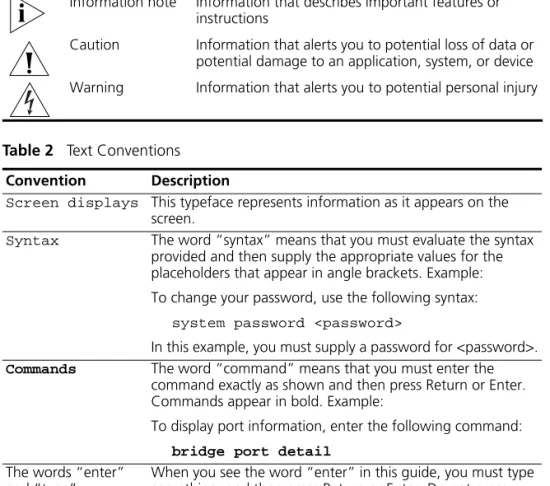
Table 1 and Table 2 list conventions that are used throughout this guide. Table 1 Notice IconsIcon Notice Type Description
Information note Information that describes important features or
instructions
Caution Information that alerts you to potential loss of data or
potential damage to an application, system, or device
Warning Information that alerts you to potential personal injury
Table 2 Text Conventions Convention Description
Screen displays This typeface represents information as it appears on the screen.
Syntax The word “syntax” means that you must evaluate the syntax provided and then supply the appropriate values for the placeholders that appear in angle brackets. Example: To change your password, use the following syntax:
system password <password>
In this example, you must supply a password for <password>.
Commands The word “command” means that you must enter the
command exactly as shown and then press Return or Enter. Commands appear in bold. Example:
To display port information, enter the following command:
bridge port detail
The words “enter” and “type”
When you see the word “enter” in this guide, you must type something, and then press Return or Enter. Do not press Return or Enter when an instruction simply says “type.”
Related Documentation 9
Related
Documentation
In addition to this guide, each Switch documentation set includes the following:
■ SuperStack 3 Switch Implementation Guide
This guide contains information on the features supported by your Switch and how they can be used to optimize your network. It is supplied in PDF format on the CD-ROM that accompanies the Switch.
■ SuperStack 3 Switch Management Quick Reference Guide
This guide contains:
■ a list of the features supported by the Switch.
■ a summary of the web interface and command line interface
commands for the Switch.
■ SuperStack 3 Switch Management Interface Reference Guide
This guide provides detailed information about the web interface and command line interface that enable you to manage the Switch. It is supplied in HTML format on the CD-ROM that accompanies the Switch.
Keyboard key names If you must press two or more keys simultaneously, the key
names are linked with a plus sign (+). Example: Press Ctrl+Alt+Del
Words in italics Italics are used to:
■ Emphasize a point.
■ Denote a new term at the place where it is defined in the
text.
■ Identify menu names, menu commands, and software
button names. Examples:
From the Help menu, select Contents.
Click OK.
Table 2 Text Conventions (continued) Convention Description
■ Release Notes
These notes provide information about the current software release, including new features, modifications, and known problems. The Release Notes are supplied in hard copy.
The latest release notes are available in Adobe Acrobat Reader Portable Document Format (PDF) on the 3Com World Wide Web site: http://www.3com.com/
There are other publications you may find useful, such as:
■ Documentation accompanying the Advanced Redundant Power
system.
■ Documentation accompanying the Expansion Modules.
Accessing Online Documentation
To access the documentation on the CD-ROM supplied with your Switch, do the following:
1 Insert the CD-ROM into your CD-ROM drive. If your PC has auto-run
enabled, a splash screen will be displayed automatically.
2 Select the Documentation section from the contents page.
If the online documentation is to be accessed from a local drive or server, you will need to access the CD-ROM contents via the root directory and copy the files from the CD-ROM to a suitable directory.
■ The HTML Reference Guide is stored in the Docs/reference
directory on the CD-ROM. The documentation is accessed using the contents.htm file.
■ The PDF Implementation Guide is stored in the
Docs/implementation directory of the CD-ROM.
3Com recommends that you copy the Docs/reference directory as a
whole to maintain the structure of the files.
Documentation
Comments
Your suggestions are very important to us. They will help make our documentation more useful to you. Please e-mail comments about this document to 3Com at:
Documentation Comments 11
Please include the following information when commenting:
■ Document title
■ Document part number (on the title page)
■ Page number (if appropriate)
Example:
Part Number DUA1720-3AAA08
SuperStack 3 Switch 4400 Family Getting Started Guide Page 21
Please note that we can only respond to comments and questions about 3Com product documentation at this e-mail address. Questions related to technical support or sales should be directed in the first instance to your network supplier.
1
I
NTRODUCING
THE
S
UPER
S
TACK
3 S
WITCH
4400
This chapter contains introductory information about the Switch 4400 and how it can be used in your network. It covers summaries of hardware and software features and also the following topics:
■ About the Switch 4400
■ Switch 4400 — Front View Detail ■ Switch 4400 — Rear View Detail ■ Default Settings
About the Switch
4400
The Switch 4400 is a stackable 10/100 Mbps Ethernet switch and provides high-performance workgroups with a backbone to server connection. The Switch 4400 allows Cascade, Gigabit Ethernet or Fast Ethernet Fiber connections when expansion modules are installed in the expansion slots on the rear of the unit. You can also add the Switch 4400
to any SuperStack® system as your network grows.
The Switch 4400 PWR (3C17205) supports Power over Ethernet on all front panel ports. If you plug in a compatible (IEEE 802.3af compliant) device, it will be automatically detected and power supplied to it. Power over Ethernet is enabled on each port by default.
The Switch 4400 FX (3C17210) has 24 100BASE-FX MT-RJ ports. These allow easy connection of 100 Mbps fiber-optic links.
Summary of Hardware Features
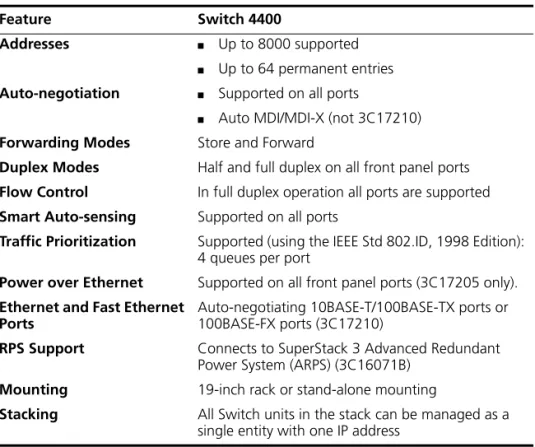
Table 3 summarizes the hardware features that are supported by the Switch 4400.
Table 3 Hardware features
Feature Switch 4400
Addresses ■ Up to 8000 supported
■ Up to 64 permanent entries
Auto-negotiation ■ Supported on all ports
■ Auto MDI/MDI-X (not 3C17210)
Forwarding Modes Store and Forward
Duplex Modes Half and full duplex on all front panel ports
Flow Control In full duplex operation all ports are supported
Smart Auto-sensing Supported on all ports
Traffic Prioritization Supported (using the IEEE Std 802.ID, 1998 Edition): 4 queues per port
Power over Ethernet Supported on all front panel ports (3C17205 only).
Ethernet and Fast Ethernet Ports
Auto-negotiating 10BASE-T/100BASE-TX ports or 100BASE-FX ports (3C17210)
RPS Support Connects to SuperStack 3 Advanced Redundant Power System (ARPS) (3C16071B)
Mounting 19-inch rack or stand-alone mounting
Stacking All Switch units in the stack can be managed as a single entity with one IP address
Switch 4400 — Front View Detail 15
Switch 4400 —
Front View Detail
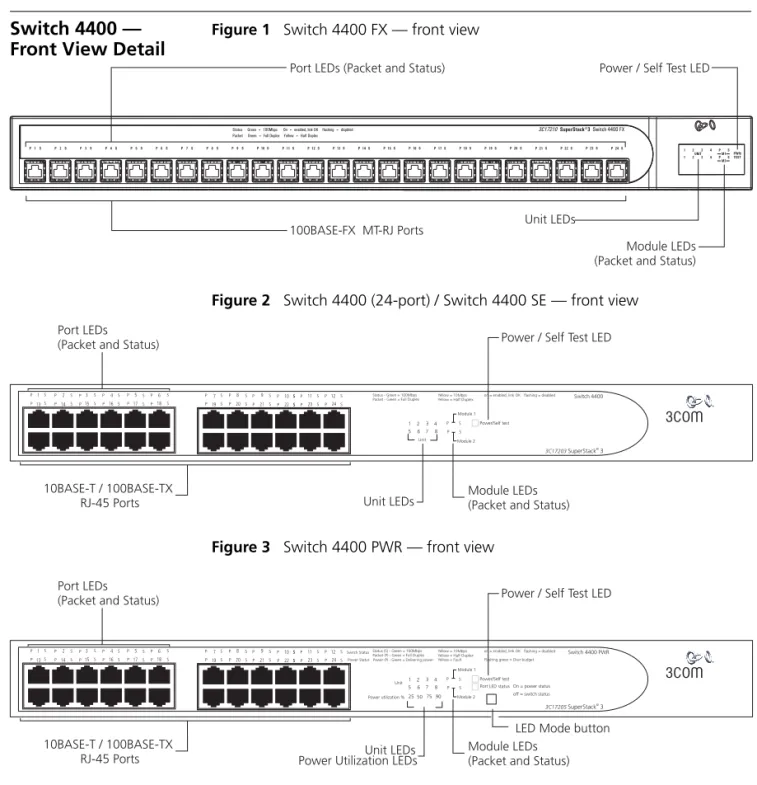
Figure 1 Switch 4400 FX — front view
Figure 2 Switch 4400 (24-port) / Switch 4400 SE — front view
Figure 3 Switch 4400 PWR — front view
3 5 4 7 6 8 11 12
3 4 5 6 7 8 9 10 1 2
13 14 15 16 17 18 19 20 21 22 23 24
3C17203SuperStack 3©
Power/Self test
Module 1
Module 2
Switch 4400
1234
on = enabled, link OK Yellow = 10Mbps Status Green =- 100Mbps Packet -Green =Full Duplex
Unit LEDs
Power / Self Test LED
Yellow =Half Duplex
Unit P P S S S S S S S S S S S S S S S S S S S S S S S S S S S S P P P P P P P P P P P P P P P P P P P P P P P P
10BASE-T / 100BASE-TX RJ-45 Ports Port LEDs (Packet and Status)
Module LEDs (Packet and Status)
flashing = disabled
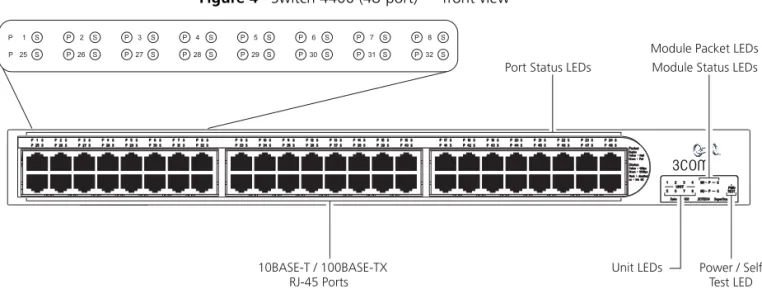
Figure 4 Switch 4400 (48-port) — front view
WARNING: RJ-45 Ports. These are shielded RJ-45 data sockets. They cannot be used as standard traditional telephone sockets, or to connect the unit to a traditional PBX or public telephone network. Only connect RJ-45 data connectors, network telephony systems, or network telephones to these sockets.
Either shielded or unshielded data cables with shielded or unshielded jacks can be connected to these data sockets.
10BASE-T/ 100BASE-TX Ports
The Switch 4400, 4400 SE and 4400 PWR have 24 or 48
auto-negotiating 10BASE-T/100BASE-TX ports configured as Auto MDIX (cross-over). These ports automatically provide the appropriate
connection. Alternatively, you can manually set these ports to 10BASE-T half duplex, 10BASE-T full duplex, 100BASE-TX half duplex or
100BASE-TX full duplex. The maximum segment length is 100 m (328 ft) over Category 5 twisted pair cable.
The 4400 PWR will supply up to 15.4W of power through any of the 24 front panel ports in conformance to the 802.3af specification. The Switch 4400 PWR incorporates a LED Mode Button on the front panel, which when pressed changes the mode of the front panel port LEDs
functionality between Switch and Power mode.
100BASE-FX Ports The Switch 4400 FX has 24 100BASE-FX MT-RJ ports. These are
100 Mbps fiber-optic ports that can use standard multi-mode fiber-optic cable of up to 2 kilometers (1.2 miles). They use the standard MT-RJ
Switch 4400 — Front View Detail 17
connector that allows both the transmit and the receive fibers to be connected in the same space as an RJ-45 port.
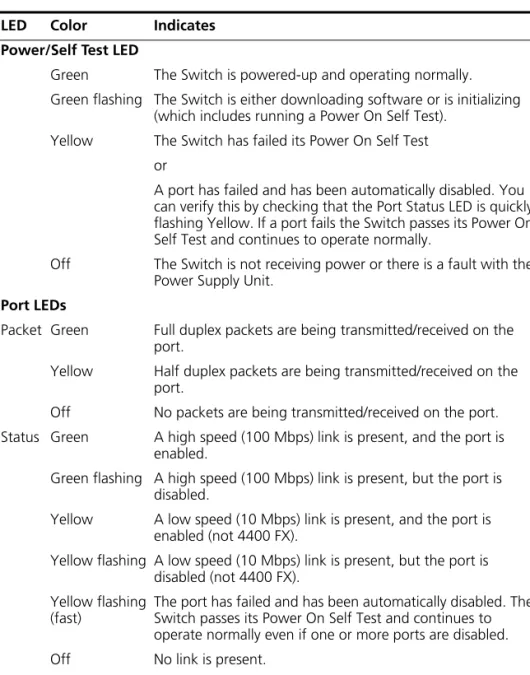
LEDs Table 4 lists LEDs visible on the front of the Switch, and how to read their status according to color. For information on using the LEDs for problem
solving, see “Solving Problems Indicated by LEDs” on page 56.
Table 4 LED behavior
LED Color Indicates Power/Self Test LED
Green The Switch is powered-up and operating normally.
Green flashing The Switch is either downloading software or is initializing (which includes running a Power On Self Test).
Yellow The Switch has failed its Power On Self Test
or
A port has failed and has been automatically disabled. You can verify this by checking that the Port Status LED is quickly flashing Yellow. If a port fails the Switch passes its Power On Self Test and continues to operate normally.
Off The Switch is not receiving power or there is a fault with the
Power Supply Unit.
Port LEDs
Packet Green Full duplex packets are being transmitted/received on the
port.
Yellow Half duplex packets are being transmitted/received on the
port.
Off No packets are being transmitted/received on the port.
Status Green A high speed (100 Mbps) link is present, and the port is
enabled.
Green flashing A high speed (100 Mbps) link is present, but the port is disabled.
Yellow A low speed (10 Mbps) link is present, and the port is
enabled (not 4400 FX).
Yellow flashing A low speed (10 Mbps) link is present, but the port is disabled (not 4400 FX).
Yellow flashing (fast)
The port has failed and has been automatically disabled. The Switch passes its Power On Self Test and continues to operate normally even if one or more ports are disabled.
Port LEDs — Power over Ethernet mode (3C17205 only)
Packet Green Power is being delivered to the port.
Green flashing Exceeded port power limit (overCurrent MIB state) or unable to supply power due to unit over budget (denyLowPriority MIB state).
Yellow Power over Ethernet error, no power supplied on port.
Off No power is being delivered.
Status Yellow flashing Power over Ethernet POST error on port. Flash rate is 4 Hz
Module LEDs
Packet Refer to the user documentation accompanying the module,
if installed.
Status Refer to the user documentation accompanying the module,
if installed.
Off There is no module installed in the expansion module slot.
Yellow flashing (fast)
The module has failed and has been automatically disabled. The Switch passes its Power On Self Test and continues to operate normally even if one or more modules are disabled.
Unit LEDs
1–8 Green When the Switch forms a stack with other Switch 4400
units, the LED indicates the position of the unit in the stack and that a link is present.
When the Switch is stand-alone and not part of a stack, LED 1 is on.
Green/Yellow rotational
When a software upgrade is in progress, the LEDs of the unit that is being upgraded ‘rotate’ in an clockwise and
anti-clockwise sequence. Green
flashing
The Switch physically forms a stack with other Switch 4400 units, but cannot be managed as part of that stack until all units have been upgraded to software version 2.0 or later.
Off A fault has occurred.
Port LED Status LED (3C17205 only)
Green Port LEDs are operating in power mode
Yellow flashing Port LEDs are operating in normal mode. One or more ports has a Power over Ethernet error.
Off Port LEDs are operating in normal mode.
Power Utilization LEDs (3C17205 only)
Green 4 LEDs showing total power being delivered as a percentage
of maximum possible.
Switch 4400 — Rear View Detail 19
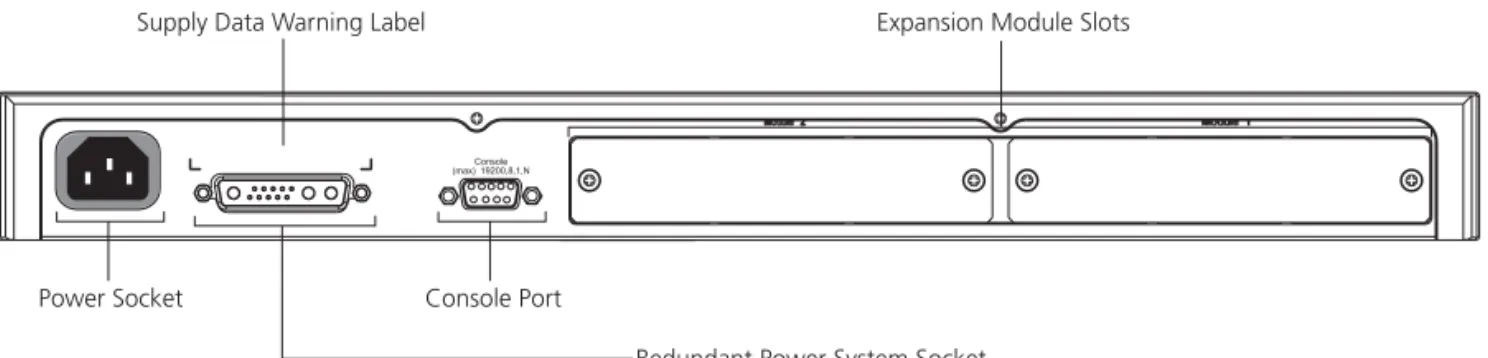
Switch 4400 — Rear
View Detail
Figure 5 Switch 4400 (all models) — rear view
Power Socket The Switch automatically adjusts its power setting to any supply voltage in the range 90-240 VAC.
Redundant Power System Socket
To protect against internal power supply failure, you can use this socket to connect a Switch 4400 to a SuperStack 3 Advanced Redundant Power
System (RPS). See “Connecting a Redundant Power System” on page 30.
Console Port The console port allows you to connect a terminal and perform remote or local out-of-band management. The console port uses a standard null modem cable and is set to auto-baud, 8 data bits, no parity and 1 stop bit.
Expansion Module Slots
You can use these slots to install Expansion Modules. These allow the Switch to support various forms of connection and add extra functionality to your Switch. For example you can install a Cascade module to enable the Switch to be stacked with other Switches. Please note that Power over Ethernet is not supported on expansion modules on the Switch 4400 PWR (3C17205). Contact your supplier for more information.
WARNING:When an Expansion Module is not installed, ensure the
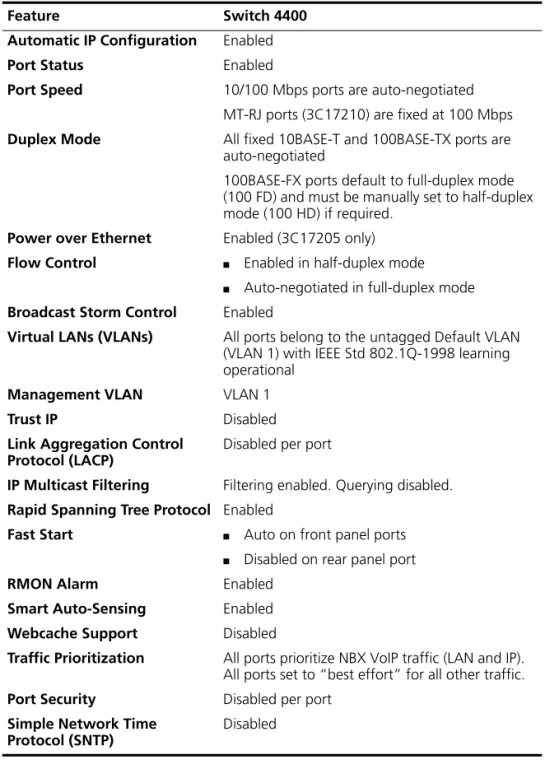
Default Settings
Table 5 shows the default settings for the Switch 4400: Table 5 Default SettingsFeature Switch 4400
Automatic IP Configuration Enabled
Port Status Enabled
Port Speed 10/100 Mbps ports are auto-negotiated MT-RJ ports (3C17210) are fixed at 100 Mbps
Duplex Mode All fixed 10BASE-T and 100BASE-TX ports are auto-negotiated
100BASE-FX ports default to full-duplex mode (100 FD) and must be manually set to half-duplex mode (100 HD) if required.
Power over Ethernet Enabled (3C17205 only)
Flow Control ■ Enabled in half-duplex mode
■ Auto-negotiated in full-duplex mode
Broadcast Storm Control Enabled
Virtual LANs (VLANs) All ports belong to the untagged Default VLAN (VLAN 1) with IEEE Std 802.1Q-1998 learning operational
Management VLAN VLAN 1
Trust IP Disabled
Link Aggregation Control Protocol (LACP)
Disabled per port
IP Multicast Filtering Filtering enabled. Querying disabled.
Rapid Spanning Tree Protocol Enabled
Fast Start ■ Auto on front panel ports
■ Disabled on rear panel port
RMON Alarm Enabled
Smart Auto-Sensing Enabled
Webcache Support Disabled
Traffic Prioritization All ports prioritize NBX VoIP traffic (LAN and IP). All ports set to “best effort” for all other traffic.
Port Security Disabled per port
Simple Network Time Protocol (SNTP)
Default Settings 21
To make Advanced Traffic Prioritization, RADIUS Based Auto QoS Assignment, and Traffic Shaping available on the SuperStack 3 Switch 4400 SE, upgrade the product to the Switch 4400 SE Enhanced Software Upgrade (3C17207).
If you initialize a Switch unit by selecting System > Control > Initialize in
the Web interface or by entering system control initialize in
the Command Line Interface, the following settings are retained to allow you to connect to and manage the Switch:
■ IP Address
■ Subnet Mask
2
I
NSTALLING
THE
S
WITCH
This chapter contains the information you need to install and set up the Switch 4400. It covers the following topics:
■ Package Contents ■ Choosing a Suitable Site ■ Rack-mounting
■ Placing Units On Top of Each Other ■ Stacking Units
■ The Power-up Sequence
WARNING: Safety Information. Before installing or removing any components from the Switch 4400 or carrying out any maintenance
procedures, you must read the safety information provided in Appendix A
of this guide.
AVERTISSEMENT: Consignes de sécurité. Avant d'installer ou d'enlever tout composant du Switch 4400 ou d'entamer une procédure de
maintenance, lisez les informations relatives à la sécurité qui se trouvent dans l'Appendice A de ce guide.
VORSICHT: Sicherheitsinformationen. Bevor Sie Komponenten aus dem Switch 4400 entfernen oder dem Switch 4400 hinzufuegen oder Instandhaltungsarbeiten verrichten, lesen Sie die Sicherheitsanweisungen, die in Appendix A (Anhang A) in diesem Handbuch aufgefuehrt sind.
Package Contents
■ Switch unit■ CD-ROM (includes documentation related to your Switch)
■ Getting Started Guide (this guide)
■ Management Quick Reference Guide
■ Release Notes
■ Unit Information Labels
■ Warranty Information
■ Power Cord
■ 2 x Mounting brackets
■ 4 x Screws
■ 4 x Rubber feet
Choosing a Suitable
Site
The Switch is suited for use on a desktop, either free standing or
mounted in a standard 19-inch equipment rack. Alternatively, the Switch can be mounted in a wiring closet or equipment room, as an aggregator for other Hubs and Switches. A rack-mounting kit containing two mounting brackets is supplied with the Switch.
CAUTION: Ensure that the ventilation holes are not obstructed. When deciding where to position the Switch, ensure that:
■ Cabling is located away from:
■ sources of electrical noise such as radios, transmitters and
broadband amplifiers.
■ power lines and fluorescent lighting fixtures
■ The Switch is accessible and cables can be connected easily.
■ Water or moisture cannot enter the case of the Switch.
■ Air flow is not restricted around the Switch or through the vents in the
side of the Switch. 3Com recommends that you provide a minimum of 25mm (1in.) clearance.
■ Air temperature around the Switch does not exceed 40 °C (104 °F).
If the Switch is installed in a 19-inch rack or closed assembly its local air temperature may be greater than room ambient temperature.
Rack-mounting 25
■ The air is as free from dust as possible.
■ The unit is installed in a clean, air conditioned environment.
■ No more than eight Switch units are placed on top of one another, if
the units are free-standing.
■ The Switch is situated away from sources of conductive (electrical)
dust, for example laser printers.
■ The AC supply used by the Switch is separate to that used by units
that generate high levels of AC noise, for example air conditioning units and laser printers.
Rack-mounting
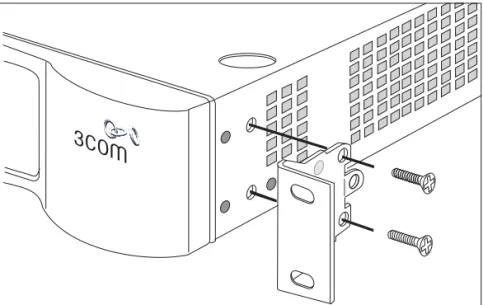
The Switch 4400 is 1U high and will fit in most standard 19-inch racks.CAUTION:Disconnect all cables from the Switch before continuing.
Remove all self adhesive pads from the underside of the Switch if they have been fitted.
To rack-mount your Switch:
1 Place the Switch the right way up on a hard flat surface, with the front
facing towards you.
2 Locate a mounting bracket over the mounting holes on one side of the
Figure 6 Fitting a bracket for rack-mounting
3 Insert the two screws and tighten with a suitable screwdriver.
You must use the screws supplied with the mounting brackets. Damage caused to the unit by using incorrect screws invalidates your warranty.
4 Repeat steps 2 and 3 for the other side of the Switch.
5 Insert the Switch into the 19-inch rack and secure with suitable screws
(not provided). Ensure that ventilation holes are not obstructed.
6 Connect network cabling.
7 Finally place a unit information label on the unit in an easily accessible
position. The unit information label shows the following:
■ The 3Com product name of the Switch
■ The 3Com 3C number of the Switch
■ The unique MAC address (Ethernet address) of the Switch
■ The serial number of the Switch
Placing Units On Top of Each Other 27
Placing Units On
Top of Each Other
If the Switch units are free-standing, up to eight units can be placed one
on top of the other. If you are mixing a variety of SuperStack® 3 Switch
and Hub units, the smaller units must be positioned at the top.
If you are placing Switch units one on top of the other, you must use the self-adhesive rubber pads supplied. Apply the pads to the underside of each Switch, sticking one in the marked area at each corner. Place the Switch units on top of each other, ensuring that the pads of the upper unit line up with the recesses of the lower unit.
Stacking Units
Switch 4400 units can be stacked together and then treated as a single manageable unit with one IP address. Any combination of 24-port and 48-port units is allowed in a single stack.The SuperStack 3 Switch 4400 SE can only be stacked with non-SE Switches if it has been upgraded using the Switch 4400 SE Enhanced Software Upgrade (3C17207). An upgraded Switch 4400 SE cannot be stacked with a normal Switch 4400 SE.
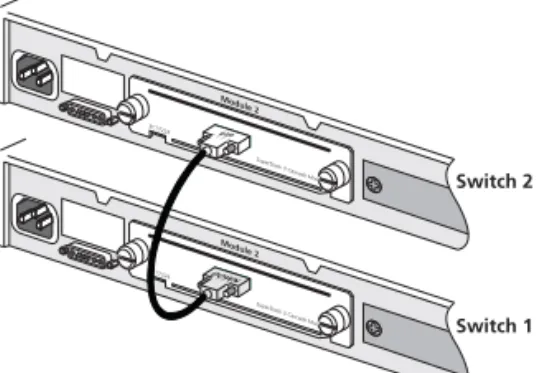
How To Stack Units To stack two Switch 4400 units you will need to order the SuperStack 3 Switch Cascade Stacking Kit (3C17227). The kit consists of two Cascade Modules and a Cascade Cable. Both Switches must have an unused expansion slot to allow a Cascade Module to be fitted.
Figure 7 Stacking two Switch 4400 units
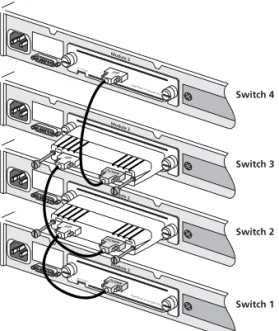
To stack more than two Switch units you will need to order one SuperStack 3 Cascade Extender Kit (3C17228) for each additional unit. This Kit consists of one Cascade Module, one Cascade Cable and one
SuperStack 3 Cascade Module 3C17224
SuperStack 3 Cascade Module 3C17224
DOWN UP
Switch 1 Switch 2
Module 2
Cascade Extender Unit. The Cascade Module is installed into the expansion slot at the rear of the Switch and the Cascade Extender Unit plugs into the Cascade Module.
Figure 8 Stacking more than two Switch 4400 units
For information on ordering the Cascade Kits contact your supplier. For illustrations and information on how to install the Cascade Kits, refer to the user documentation that accompanies these Kits.
Rules For Stacking Units
This information is also provided in the user documentation that accompanies the Cascade Kits.
■ The maximum number of Switch units in a stack is limited to 8. The
stack may contain a combination of 24 and 48 port units.
■ Only one Cascade Module can be installed per Switch. If Cascade
Modules are fitted to both expansion slots in a Switch then both Modules will be disabled.
■ Cascade Modules are NOT hot-swappable or hot-insertable. Ensure
that the Switch is powered off before inserting or removing a Cascade Module.
SuperStack 3 Cascade Module 3C17224
Switch 1
SuperStack 3 Cascade Module 3C17224 UP Switch 2 3C17224 DOWN 3C17224
SuperStack 3 Cascade Module
DOWN UP
SuperStack 3 Cascade Module 3C17224
UP
Switch 4
SuperStack 3 Cascade Module 3C17224 UP Module 2 Module 2 Switch 3 3C17224 DOWN UP Module 2 Module 2
Stacking Units 29
■ The Cascade Extender Unit is hot-insertable. This allows its host
Switch unit to be removed and replaced without disturbing the rest of the stack.
■ Only 3Com® Cascade Cables can be used to connect between
Cascade Modules/Cascade Extender Units.
■ Due to the length of the Cascade Cables, you must insert all of the
Cascade Modules into Expansion Module Slot 1 or all of the Cascade Modules into Expansion Module Slot 2 on the Switches.
■ It is not possible to stack a Switch 4400, Switch 4400 SE,
Switch 4400 PWR or Switch 4400 FX unit with SuperStack II or other SuperStack 3 products using the Cascade Stacking Kit (3C17227) or Cascade Extender Kit (3C17228).
■ 3Com strongly recommends that you upgrade all Switch 4400 units
(24-port and 48-port) in a stack to the latest software agent.
■ 3Com recommends that you initialize a Switch 4400, Switch 4400 SE,
Switch 4400 PWR or Switch 4400 FX unit that has previously been used elsewhere in your network before you add it to an existing stack. If you do not initialize the unit, problems may be caused by conflicting Switch configurations.
■ When the Switch 4400s are stacked together they are assigned a unit
number from bottom-to-top for management purposes. When further Switches are added to the stack, they can be positioned at the bottom of the stack or at the top. Either way, the Switch management software will re-order the Switch unit numbers into a logical order again (from bottom to top).
The Power-up
Sequence
The following sections describe how to get your Switch 4400 powered-up and ready for operation.
Powering-up the Switch 4400
Use the following sequence of steps to power-up the Switch.
1 Plug the power cord into the power socket at the rear of the Switch.
2 Plug the other end of the power cord into your power outlet.
The Switch powers-up and runs through its Power On Self Test (POST), which takes approximately 10 seconds.
Checking for Correct Operation of LEDs
During the Power On Self Test, all ports on the Switch are disabled and the LEDs light in a set sequence.
When the POST has completed, check the Power/Self Test LED to make sure that your Switch is operating correctly. Table 6 shows possible colors for the LED.
Table 6 Power/Self Test LED colors
If there is evidence of a problem, see “Solving Problems Indicated by
LEDs” on page 56.
Connecting a Redundant Power System
You can connect a SuperStack 3 Advanced Redundant Power System (3C16071B) to the Switch. This unit, which is also known as an RPS, is designed to maintain the power to your Switch if a power supply failure occurs.
For normal redundancy, the Switch 4400, Switch 4400 SE, and
Switch 4400 FX require one Type 2A Power Module (3C16074A). For full redundancy, the Switch 4400, Switch 4400 SE, and Switch 4400 FX require two type 2A Power Modules combined using a Type 2 Y-Cable. The Switch 4400 PWR (3C17205) requires one Type 3 Power Module (3C16075) for normal redundancy and two Type 3 Power Modules for full redundancy.
Color State
Green The Switch is powered-up and operating normally.
Yellow The Switch has failed its Power On Self Test.
The Power-up Sequence 31
CAUTIONThe Switch has no ON/OFF switch; the only method of
connecting or disconnecting mains power is by connecting or disconnecting the power cord.
CAUTION:The Switch can only use a SuperStack Advanced Redundant
Power System output.
Using Power over Ethernet
The Switch 4400 PWR can power any IEEE 802.3af compliant device through any of its front panel ports. For the latest list of supported devices, go to the product page on the 3Com web site:
http://www.3com.com/.
For further information about Power Over Ethernet, refer to “Power Management and Control” in the Switch Implementation Guide supplied on the CD-ROM that accompanies your Switch. Power over Ethernet management is available using the web interface or the command line interface (CLI).
Choosing the Correct Cables (Switch 4400, 4400 SE and 4400 PWR)
All of the ports on the front of the Switch 4400, 4400 SE and 4400 PWR are Auto-MDIX, that is they have a cross-over capability. The port can automatically detect whether it needs to operate in MDI or MDIX mode. Therefore you can make a connection to a port with a straight-through (MDI) or a cross-over cable (MDIX).
The Auto-MDIX feature only operates when enabled per port and if auto-negotiation is enabled.
If auto-negotiation is disabled, all the Switch ports are configured as MDIX (cross-over). If you want to make a connection to another MDIX port, you need a cross-over cable. Many ports on workstations and servers are configured as MDI (straight-through). If you want to make a connection to an MDI port, you need to use a standard straight-through cable. See Table 7.
WARNING: The 4400 PWR (3C17205) supports Power over Ethernet on all front ports. These ports should only be used for Ethernet wiring within the same building. The Rear Module ports of the Switch 4400 PWR can be used for ethernet wiring between buildings.
3Com recommends that you use Category 5 twisted pair cable — the maximum segment length for this type of cable is 100 m (328 ft).
Table 7 Cables required to connect the Switch 4400 to other devices if auto-negotiation is disabled
CAUTION:If you want to install the Switch using a Category 5E or
Category 6 cable, 3Com recommends that you briefly connect the cable to a grounded port before connecting network equipment. If you do not, the cable’s Electrostatic Discharge (ESD) may damage the Switch’s port. You can create a grounded port by connecting all wires at one end of a UTP cable to an earth ground point, and the other end to a female RJ-45 connector located, for example, on a Switch rack or patch panel. The RJ-45 connector is now a grounded port.
Choosing the Correct Cables (Switch 4400 FX)
All of the ports on the front of the Switch 4400 FX are 100BASE-FX MT-RJ multi-mode ports. The MT-RJ port is a small form factor fiber-optic port with the transmit and receive fibers in the same cable. Unlike many fiber-optic systems, only one MT-RJ cable is needed to connect two MT-RJ ports together.
To connect a front-panel port to another 100BASE-FX MT-RJ multi-mode port, or to a patch panel, a single MT-RJ multi-mode pinless jumper cable is required. Since standard MT-RJ cables are cross-over cables, no
Auto-MDIX sensing is required. The maximum cable length is 2 kilometers (1.24 miles).
CAUTION:Do not connect pinned MT-RJ connectors into any port on the
Switch 4400 FX as this may damage the unit. The ports have locator pins fitted and are designed for standard (pinless) connectors.
To connect a front-panel port to a 100BASE-FX single mode port, or to a port that does not have an MT-RJ connector, an adaptor will be required. It is not possible to connect a front panel port to a 1000BASE-FX port.
Cross-over Cable Straight-through Cable
Switch to Switch
(MDIX to MDIX)
✓
✕
Switch to Hub
(MDIX to MDIX)
✓
✕
Switch to PC (NIC)
3
S
ETTING
U
P
FOR
M
ANAGEMENT
Your Switch can operate in its default state, that is, you can install it and it will work straight away (plug-and-play). However, to make full use of the features offered by the Switch, and to change and monitor the way it works, you have to access the management software that resides on the Switch. This is known as managing the Switch.
Managing the Switch can help you to improve the efficiency of the Switch and therefore the overall performance of your network. This chapter explains the initial set up of the Switch and the different methods of accessing the management software to manage a Switch. It covers the following topics:
■ Setting Up Overview
■ Manually Configuring IP Information
■ Viewing Automatically Configured IP Information ■ Methods of Managing a Switch
■ Setting Up Command Line Interface Management
■ Setting Up Command Line Interface Management using SSH ■ Setting Up Web Interface Management
■ Setting Up SNMP Management ■ Default Users and Passwords
Setting Up
Overview
This section gives an overview of what you need to do to get your Switch set up and ready for management when it is in its default state. The
whole setup process is summarized in Figure 9. Detailed procedural steps
are contained in the sections that follow. In brief, you need to:
■ Configure IP information manually for your Switch or view the
automatically configured IP information
■ Prepare for your chosen method of management
Figure 9 Initial Switch Setup and Management Flow diagram
Plug and Play
Set up In it ia l IP In fo rm a ti o n S e tu p Featur e Management
Power Up the Switch.
IP Information is automatically configured. See page 35
Do you want to manually configure the IP information?
Connect to a front panel port and use the
Web Interface or Command Line Interface.
See page 37
How do you want to manage your Switch? See
SNMP See page 52
Command Line Interface
Connect via the console port.
See page 49
Web Interface
Connect over the network via Telnet.
See page 49
Connect over the network. See page 52
How do you want to view the automatically configured IP information? How do you want to connect to the Switch?
Connect to the console port and use the
Command Line Interface. See page 37
Use 3Com Network Supervisor (3NS).
See page 44
Connect to the console port and use the
Command Line Interface. See page 44
Setting Up Overview 35
CAUTION:To protect your Switch from unauthorized access, you must
change all three default passwords as soon as possible, even if you do not intend to actively manage your Switch. For more information on default
users and changing default passwords, see “Default Users and
Passwords” on page 53.
IP Configuration You can use one of the following methods to allocate IP information to your Switch (essential if you wish to manage your Switch across the network).
Manual IP Configuration
You can choose to configure the IP information yourself. The Switch remembers the information that you enter until you change it again or set the configuration method to Automatic.
You should use the Manual IP configuration method if:
■ you do not have a DHCP or BootP server on your network, or
■ you want to remove the risk of the IP address ever changing, or
■ your DHCP or BootP server does not allow you to allocate static IP
addresses. (Static IP addresses are necessary to ensure that the Switch is always allocated the same IP information.)
For most installations, 3Com recommends that you configure the Switch IP information manually. This makes management simpler and more reliable as it is not dependent on a DHCP or BootP server, and eliminates the risk of the IP address changing.
If you wish to manually enter IP information for your Switch, work
through the “Manually Configuring IP Information” section on page 37.
Automatic IP Configuration
By default the Switch tries to configure itself with IP information without requesting user intervention. It tries to obtain an IP address from a DHCP or BootP server on the network.
If neither server is found, the Switch will configure itself with its default IP address 169.254.100.100 if it is operating in a standalone mode, and/or no other Switches on the network have this IP address. If this default IP address is already in use on the network then the Switch detects this and configures itself with an IP address in the range 169.254.1.0 to
This process is known as Auto-IP and is the same mechanism used by Windows 98 and Windows 2000. IP addresses configured by Auto-IP are temporary as they cannot be routed but are useful for small networks which are not connected to other networks, or for initial configuration. However, as soon as a DHCP or BootP server is detected, the Switch will configure itself with the IP address allocated by that server.
When using automatic IP configuration it is important that the IP address of the Switch is static, otherwise you will not know what the IP address is and it will be difficult to manage. Most DHCP and BootP servers allow static IP addresses to be configured so that you know what IP address will be allocated to the Switch. Refer to the documentation that accompanies your DHCP/BootP server.
For a detailed description of how automatic IP configuration operates, please refer to the Implementation Guide on the CD-ROM that accompanies your Switch or on the 3Com Web site.
You should use the automatic IP configuration method if:
■ your network uses DHCP or BootP to allocate IP information, or
■ flexibility is needed. If the Switch is re-deployed onto a different
subnet, it will automatically reconfigure itself with an appropriate IP address, instead of you having to manually reconfigure the Switch. If you use the automatic IP configuration method, you need to discover the automatically allocated IP information before you can begin
management. Work through the “Viewing Automatically Configured IP
Information” section on page 44.
Preparing for Management
Once your Switch’s initial set up is complete you can set up your chosen
management method as described in “Methods of Managing a Switch”
on page 47.
For detailed information about the specific web interface operations and command line interface commands and problem solving, refer to the
“SuperStack3 Switch Management Interface Reference Guide” on the
Manually Configuring IP Information 37
Manually
Configuring IP
Information
You can manually configure the Switch IP information in the following ways:
■ Connecting to a front panel port — Connect a workstation using an
Ethernet cable to a front panel port of the Switch. You can then manually enter IP information using the web interface or the command line interface (CLI).
■ Connecting to the console port — Connect a workstation using a
console cable to the console port of the Switch. You can then manually enter IP information using the command line interface (CLI).
Connecting to a Front Panel Port
To set up your Switch manually you can make a connection to a front panel port. You must do this whilst the Switch is offline, that is, before you connect the Switch to a network.
The procedure described in this section assumes the unit has been powered up in standalone mode and has the default IP address of 169.254.100.100.
Pre-requisites
■ A workstation running Windows 95/98/2000, Windows NT or
Windows XP.
■ A Network Interface Card (NIC).
■ A Category 5 twisted pair Ethernet cable with RJ-45 connectors.
■ A suitable Web browser — refer to “Choosing a Browser”on page 51.
■ You need to have the following so that you can manually set up the
Switch with IP information:
■ IP address
■ subnet mask
■ default gateway
Connecting the Workstation to the Switch
1 Connect the workstation to a front panel port using an Ethernet cable as
shown in Figure 10.
Figure 10 Connecting a workstation to the Switch via a front panel port
To connect the cable:
a Attach an RJ-45 connector at one end of the Ethernet cable to the
Network Interface Card (NIC) in the workstation.
b Connect the RJ-45 connector at the other end of the cable to one of
the front panel ports on the Switch.
Do not interconnect the Switch to any other unconfigured Switch.
Configuring the Workstation with IP Information
You need to change the IP address and subnet mask of the workstation that you have connected to the Switch. Make a note of the existing settings so you can return to them later. Change the workstation to the following settings:
■ IP address — 169.254.100.99
■ Subnet mask — 255.255.0.0
Setting Up the Switch with IP Information
You are now ready to manually set up the Switch with IP information. You can do this using the Web interface or the command line interface (CLI) via telnet.
Using the Web Interface
1 Power-up the Switch. This takes approximately one minute.
2 Open a suitable Web browser and enter 169.254.100.100 in the
Location Address field. This is the default IP address that is automatically assigned to an offline unit.
Manually Configuring IP Information 39
If there is no response, wait for one minute then re-enter the default IP address.
3 At the login and password prompts, enter admin as your user name and
press Return at the password prompt (default user name and password). If you have logged on correctly, a set of Getting Started pages are displayed.
4 The Getting Started pages allow you to enter basic setup information for
the Switch. Select Manual and then enter the IP address, subnet mask,
and default gateway that you want the Switch to use when it is connected to the network. The final page displays a summary of the information entered.
The initial set up of your Switch is now complete and the Switch is ready
for you to set up your chosen management method. See “Methods of
Managing a Switch” on page 47.
Using Command Line Interface via Telnet
1 To start a Telnet session to the unit, click Start in Microsoft Windows
95/98/2000/NT/XP.
a Click Run.
b In the dialogue box that appears type the default IP address of the
unit, that is: Telnet 169.254.100.100
c Click OK.
2 Press Enter to open a login prompt.
If the login prompt does not begin immediately, press Return a few times until it starts.
3 At the login and password prompts, enter admin as your user name and
press Return at the password prompt. If you have logged on correctly, the top-level menu of the command line interface is displayed as shown in the example in Figure 11.
Figure 11 Example top-level command line interface menu
4 At the Select menu option prompt you can either:
■ enter the protocol ip basicConfig command. At the Enter
configuration method prompt enter manual. The screen prompts you to enter IP information.
or
■ enter the gettingStarted command. At the Enter
configuration method prompt enter manual. The screen prompts you to enter IP information.
5 Enter the IP address, subnet mask, and gateway IP address for the Switch.
The screen displays a summary of the information entered.
If using the gettingStarted command you will then be prompted to
enter system information, change passwords, and then given the option to carry out advanced configuration.
The protocol ip basicConfig command will prompt you for the management VLAN ID. If the unit is new there is only one VLAN (VLAN 1) to choose from.
The initial set up of your Switch is now complete and the Switch is ready
for you to set up your chosen management method. See “Methods of
Managing a Switch” on page 47.
Connecting to the Console Port
To set up your Switch manually you can alternatively make a connection to the console port (this example describes a local connection to the console port, rather than a remote one via a modem). You can do this whilst the Switch is offline, that is, before you connect the Switch to a network, or whilst the Switch is online, that is, connected to a network.
Manually Configuring IP Information 41
Pre-requisites
■ A workstation with terminal emulation software installed, such as
Microsoft Hyperterminal. This software allows you to communicate with the Switch via the console port directly, or through a modem.
■ Documentation supplied with the terminal emulation software.
■ A suitable cable:
■ A standard null modem cable — if you are connecting directly to
the console port, or
■ A standard modem cable — if you are connecting to the console
port using a modem.
You can find pin-out diagrams for both cables in Appendix B on page 77.
■ You need to have the following so that you can manually set up the
Switch with IP information:
■ IP address
■ subnet mask
■ default gateway
■ management VLAN ID, normally set to the default value (1)
Connecting the Workstation to the Switch
1 Connect the workstation to the console port using a standard null
modem cable as shown in Figure 12.
Figure 12 Connecting a workstation to the Switch via the console port
To connect the cable:
a Attach the female connector on the cable to the male connector on
the console port of the Switch.
b Tighten the retaining screws on the cable to prevent it from being
loosened.
c Connect the other end of the cable to one of the serial ports (also
2 Open your terminal emulation software and configure the COM port settings to which you have connected the cable. The settings should be set to match the default settings for the Switch, which are:
■ 19,200 baud
■ 8 data bits
■ no parity
■ 1 stop bit
■ no hardware flow control
Refer to the documentation that accompanies the terminal emulation software for more information.
Setting Up the Switch with IP Information
You are now ready to manually set up the Switch with IP information using the command line interface.
1 The command line interface login sequence begins as soon as the Switch
detects a connection to its console port.
If the login prompt does not begin immediately, press Return a few times until it starts.
2 At the login and password prompts, enter admin as your user name and
press Return at the password prompt. If you have logged on correctly, the top-level menu of the command line interface is displayed as shown in the example in Figure 13.
Manually Configuring IP Information 43
Figure 13 Example top-level command line interface menu
3 At the Select menu option prompt you can either:
■ enter the protocol ip basicConfig command. At the Enter
configuration method prompt enter manual. The screen prompts you to enter IP information.
or
■ enter the gettingStarted command. At the Enter
configuration method prompt enter manual. The screen prompts you to enter IP information.
4 Enter the IP address, subnet mask, and gateway IP address for the Switch.
The screen displays a summary of the information entered.
If using the gettingStarted command you will then be prompted to
enter system information, change passwords, and then given the option to carry out advanced configuration.
The protocol ip basicConfig command will prompt you for the management VLAN ID. If the unit is new there is only one VLAN (VLAN 1) to choose from.
The initial set up of your Switch is now complete and the Switch is ready
for you to set up your chosen management method. See “Methods of
Managing a Switch” on page 47.
If you do not intend to use the command line interface via the console port to manage the Switch, you can disconnect the serial cable and close the terminal emulator software.
Viewing
Automatically
Configured IP
Information
If you allow the Switch to automatically configure its own IP information you need to discover and view the IP information before you can begin to manage the Switch. You can discover the IP information in two ways:
■ Using 3Com Network Supervisor — This application will auto-discover
the Switch and display the automatically allocated IP information assigned to the Switch.
■ Connecting to the Console Port — Connect a workstation using a
console cable to the console port of the Switch. You can then view the IP information automatically assigned to the Switch using the
command line interface (CLI).
Using 3Com Network Supervisor
You can use the 3Com Network Supervisor application provided on the CD-ROM that accompanies your Switch to discover the automatically allocated IP information.
1 Connect your Switch to the network.
2 Power-up the Switch and wait for two minutes.
3 Launch 3Com Network Supervisor and run the Auto-discovery wizard.
3Com Network Supervisor will auto-discover the new Switch and display the IP information that has been automatically allocated to the Switch. Most DHCP and BootP servers allow static IP addresses to be configured so that you know what IP address the Switch will be given. Refer to the documentation that accompanies your DHCP or BootP server.
If your network does not have a DHCP or BootP server, the workstation running 3Com Network Supervisor must be on the same subnet as the Switch, because Auto-IP addresses are non-routable.
Connecting to the Console Port
Alternatively, you can view the automatically configured IP information via the command line interface (CLI) through a connection to the console port. (This example describes a local connection to the console port, rather than a remote one via a modem.)
Pre-requisites
■ A workstation with terminal emulation software installed, such as
Microsoft Hyperterminal. This software allows you to communicate with the Switch via the console port directly, or through a modem.
Viewing Automatically Configured IP Information 45
■ A suitable cable:
■ A standard null modem cable — if you are connecting directly to
the console port, or
■ A standard modem cable — if you are connecting to the console
port using a modem.
You can find pin-out diagrams for both cables in Appendix B on page 77.
■ A Category 5 twisted pair Ethernet cable with RJ-45 connectors to
connect your Switch to the network.
Connecting the Workstation to the Switch
1 Connect the workstation to the console port using a standard null
modem cable as shown in Figure 14.
Figure 14 Connecting a workstation to the Switch via the console port
To connect the cable:
a Attach the female connector on the cable to the male connector on
the console port of the Switch.
b Tighten the retaining screws on the cable to prevent it from being
loosened.
c Connect the other end of the cable to one of the serial ports (also
known as a COM port) on your workstation.
2 Open your terminal emulation software and configure the COM port
settings to which you have connected the cable. The settings should be set to match the default settings for the Switch, which are:
■ 19,200 baud
■ 8 data bits
■ no parity
■ 1 stop bit
■ no hardware flow control
Refer to the documentation that accompanies the terminal emulation software for more information.
Viewing IP Information via the Console Port
You are now ready to view the automatically allocated IP information using the command line interface.
1 Connect your Switch to the network using an Ethernet cable. As soon as
a network connection is made the Switch begins the automatic IP configuration process.
The automatic IP configuration process usually completes within one minute.
If there is no response from a DHCP server within 30 seconds, the Auto-IP configuration mechanism attempts to allocate the default IP address 169.254.100.100. If this address is not available, it then allocates an IP address in the range of 169.254.x.y (where x is in the range 1 to 254, and y is in the range 0 to 255).
2 The command line interface login sequence begins as soon as the Switch
detects a connection to its console port.
If the login prompt does not begin immediately, press Return a few times until it starts.
3 At the login and password prompts, enter admin as your user name and
press Return at the password prompt. If you have logged on correctly, the top-level menu of the command line interface is displayed as shown in the example in Figure 15.
Figure 15 Example top-level command line interface menu
4 At the Select menu option prompt enter the protocol ip
interface summary command. At the Select IP interfaces
prompt enter all. A summary of the automatically allocated IP
Methods of Managing a Switch 47
The initial set up of your Switch is now complete and the Switch is ready
for you to set up your chosen management method. See “Methods of
Managing a Switch” on page 47.
If you do not intend to use the command line interface via the console port to manage the Switch, you can logout, disconnect the serial cable and close the terminal emulator software.
Methods of
Managing a Switch
Once you have completed the initial set up of your Switch, you can decide how you wish to manage the Switch. You can use one of the following methods:
■ Command line interface management
■ Command line interface management using SSH
■ Web interface management
■ SNMP management
Command Line Interface Management
Each Switch has a command line interface (CLI) that allows you to manage the Switch from a workstation, either locally via a console port
connection (see Figure 16), or remotely over the network (see Figure 17).
Figure 16 CLI management via the console port
Figure 17 CLI management over the network
Refer to “Setting Up Command Line Interface Management” on
Command Line Interface Management using SSH
The Switch 4400 supports Secure Shell version 2 (SSHv2), allowing secure access to the Command Line Interface of the Switch.
If you use SSH to administer your Switch and the network traffic is intercepted, no passwords or configuration information will be visible in the data. To securely adminster the Switch using the Command Line Interface you need a third party SSH client.
Web Interface Management
Each Switch has an internal set of web pages that allow you to manage the Switch using a Web browser remotely over an IP network (see Figure 18).
Figure 18 Web interface management over the network
Refer to “Setting Up Web Interface Management” on page 51.
SNMP Management You can manage a Switch using any network management workstation running the Simple Network Management Protocol (SNMP) as shown in Figure 19. For example, you can use the 3Com Network Supervisor software that is provided on the CD-ROM that accompanies your Switch. Figure 19 SNMP management over the network