Analyzing the Effectiveness of Tutorial Learning Aids
in a Course Management System
Joan M. Raines (Corresponding author) Middle Tennessee State University
P.O. Box 16, Murfreesboro, TN, 37132 United States Tel: 1-615-898-5554 E-mail: [email protected]
Linda M. Clark
Middle Tennessee State University
P.O. Box 16, Murfreesboro, TN, 37132 United States Tel: 1-615-904-8234 E-mail: [email protected]
Received: July 25, 2012 Accepted: August 15, 2013 Published: August 15, 2013 doi:10.5296/jse.v3i3.4055 URL: http://dx.doi.org/10.5296/jse.v3i3.4055
Abstract
While there is an abundance of literature regarding the value of assigning homework in mathematics and the benefits students receive when completing homework, whether online or traditionally; there seems to be a lack of research examining specific courseware systems and their tutorial learning aids. The purpose of this study was to determine if tutorial learning aids used when completing homework online using the course management system MyMathLab improved mathematics learning and achievement. A quasi-experimental pre/posttest design was used to examine data for 84 college students enrolled in multiple sections of a redesigned elementary algebra course at a large university. Students were either in the control group with access to two learning aids when completing homework or in the experimental group with access to only one learning aid. Data analysis revealed there were no statistically significant differences between the two groups and our results suggest that homework, unit test, and final exam grades are not affected by the use of tutorial learning aids available in MyMathLab. Student survey results were also discussed.
Keywords: Online homework, Tutorial learning aids, MyMathLab, Course management systems, Learning aids
1. Introduction
Homework is a key component in most mathematics courses. Past research has examined the effectiveness of homework assignments to facilitate student learning in mathematics, and has shown that homework is extremely beneficial and students who typically complete homework have greater mathematics achievement (Bruce & Singh, 1996; Cartledge & Sasser, 1981; Cooper, 1989; Cooper, Robinson & Patall, 2006; Paschal, Weinstein & Walberg, 1984). Additionally, graded homework has a positive effect on student learning and appears to raise learning from the 50th percentile to the 79th percentile (Walberg, Paschal, & Weinstein, 1985). Homework is essential and its importance has been established by these studies and numerous others.
The use of textbook-based computer courseware or course management systems is a growing trend in college mathematics courses. These courses are using an online format for homework completion instead of having students complete the usual handwritten homework assignments. Many of these systems include tutorial learning aids to assist students in completing assignments. However, the question of concern is: When these learning aids are used, do they improve mathematics learning and achievement or hinder it?
2. Prior Literature
Clearly there is value in assigning homework in mathematics courses, and students who complete assigned homework have increased retention and understanding of content, and generally outperform students who do not complete homework (Cooper, 1994; Walberg, Paschal, & Weinstein, 1985). Studies have also been conducted examining the use of textbook-based computer courseware and course management systems to complete homework online and students’ perceptions of this courseware and its effects on their mathematics learning. Some of these studies have shown that completing homework online did not significantly improve student performance; however, many others concluded students do derive multiple benefits from completing online assignments.
Hirsch and Weibel (2003) examined homework from 1175 students in general calculus classes at Rutgers University. The control group of 368 students submitted only written homework assignments while the 807 students in the experimental group also did the written homework but had approximately 11 written problems each week replaced with web-based homework. Results showed students doing web-based work had a small (4%) but statistically significant improvement on the final exam for the course. Their results also indicated that students who completed over 80% of the web-based homework showed more improvement on the final exam. Hodge, Richardson, and York (2009) investigated students’ motivation and perceptions of learning when using a web-based homework tool. The researchers collected survey data from 1333 students enrolled in a college algebra course and found that students were motivated to complete more homework using the web-based tool than completing homework in the traditional paper and pencil manner. Additionally, one-third of the students felt the web-based homework improved their mathematical learning and understanding more so than traditional homework methods. Burch and Kuo’s (2010) yearlong study at Indiana University of Pennsylvania compared students who completed homework online with those
turning in traditional paper homework. They analyzed exam scores for students in multiple sections of college algebra and found that students who did online homework performed better on exams, and there was a statistically significant difference in the exam scores for the two groups of students. The students completing online homework also had much higher rates of retention of material than their counterparts.
Several studies have also reviewed the mathematics learning and achievement of those students who are not prepared for college-level mathematics when they use an online courseware or course management systems. In a comparison of online students in beginning and intermediate algebra who used an online courseware system to complete homework with those in traditional on-campus classes at Onondaga Community College, Testone (2005) found that the passing rate on the departmental final exam was higher for the online students than for the traditional students. The online system was then made available to all students, and instructors reported that those students who used the system had greater success rates. Testone and other developmental math instructors felt the success of the students was related to the students completing homework online while using the system and its accompanying ancillaries. Testone stated that “it appears that the interactive homework tutorials improve student learning and provide a better homework experience than typical textbook assignments” for underprepared students (p 2). Baker and Dias’s (2008) study at Hostos Community College reviewed pass rates on the elementary algebra portion of the ACT/COMPASS exam students were required to take to exit from remediation. The researchers introduced web-based software as a supplement for homework into elementary algebra courses they were teaching and compared their students’ results on the exit exam with the results of students not using the software. Baker and Dias found there was an increase in students’ pass rates on the exam after the introduction of the software and this increase was statistically significant. Their students’ pass rates went from below the departmental average to above it; demonstrating “the power and influence that technology can have in improving student’s learning in the mathematics classroom” (p 37). Furthermore, the web-based homework was a significant part of the students’ success in passing the exit exam. Vezmar (2011) examined the effects of an online courseware system on student achievement in elementary algebra at Delaware Technical and Community College. Her study included 178 students who completed all aspects of the course at the campus in Fall 2010. The results showed the system had a significant effect on student achievement as measured by final exam scores, and there was a statistically significant correlation between homework grades and final exam grades.
Additionally, studies have examined specific textbook-based course management systems, in particular MyMathLab (MML), and its effects on mathematics learning and achievement. Kodippili and Senaratne (2008) conducted a study at Fayetteville State University to determine if students doing online homework using MML would have increased academic performance in a college algebra course over students completing traditional paper and pencil homework. Seventy-two students in four sections of the course taught by two different instructors participated in the study. The researchers discovered the final course averages were higher for the students using MML, but not statistically significant. Yet, students’
success rates, defined by the researchers as a final grade of A, B or C, were significantly higher for those completing homework in MML (70%) than for students completing traditional homework (49%). Buzzetto-More and Ukoha (2009) reviewed survey data from 692 students enrolled in a remedial mathematics course at the University of Maryland Eastern Shore. The results of their study did show that 63% of the students felt MML was a valuable learning tool, 56% felt the system helped them to learn concepts in the course, and 53% felt it helped them perform better on their assignments. An analysis of the data indicated there was a significant decrease in student withdrawals and an increase in pass rates in the remedial math course. Speckler (2012) compiled 77 case studies from two- and four-year colleges that used MML in some way in the mathematics courses they offered. These case studies found that the courseware increased student achievement and improved learning outcomes. It was also found that retention and pass rates increased along with increased levels of success in subsequent mathematics courses.
While numerous studies have been conducted with regards to homework in general, online homework versus traditional homework, and the effectiveness of specific courseware such as MML; very few, if any, studies have examined specific components of textbook-based courseware. Studies that were found were qualitative in nature using survey data to better understand students’ perceptions regarding the use of one online homework system, MML, as a learning tool. The surveys generally asked questions about specific components of the courseware, in particular the tutorial learning aids “Help Me Solve This” and/or “View an Example”, that were available. Law, Sek, Ng, Goh, and Tay (2012) used survey data from 450 pre-university students enrolled in a pre-calculus course at Multimedia University to investigate students’ satisfaction after using MML. The 23-item survey given at the end of the trimester showed 68.2% of the students said using MML increased their understanding of the course material. Additionally 49.6% of the students felt using MML helped them achieve a higher grade in the course; while 63.3% said regardless of their grade, they felt MML helped them to better understand the subject matter. Furthermore, their study revealed 38.9% of the students stated they used the learning aids/help features that were available (“Help Me Solve This”, “View an Example”). Holt, Holt, and Lumadue’s (2012) qualitative study explored students’ perceptions regarding the use of MML in an intermediate algebra course at a regional state university in northeast Texas. The 28-question survey was available to 149 students enrolled in six sections of the course; though, only 58 completed the survey. Results revealed 57% of the students felt they had a better understanding of the math concepts after using MML to complete homework, and 69% agreed that the time spent on the online homework was beneficial to them. Additional survey questions asked respondents to rank which features of the program were helpful. Sixty-seven percent and 66% stated “Help Me Solve This” and “View an Example”, respectively, were the most beneficial to them. Overall, students perceived the system to have a positive impact on their mathematics understanding. Speckler (2012) also reported survey data from students using MML to complete online homework. Results from survey data covering two semesters completed by 3,863 students at 674 institutions revealed 81% of students felt MML helped them better understand the subject matter and helped them achieve a higher grade in their course. Eighty-five percent of those surveyed were very satisfied or satisfied with the system. It was also noted that one of
the most commonly used features of the system was “View an Example”, and students felt the learning aids helped them persevere and not become discouraged. Vezmar (2011) also noted that 66% of students responding to survey items reported the most beneficial aspect of MML was one of the learning aids, “Help Me Solve This” or “View an Example”.
Although some of the literature is divided on whether or not students have greater success and increased mathematics learning when using online courseware systems, most indicate students do no worse in mathematics courses employing online systems. Results may show there are no significant differences between groups doing homework online and those doing traditional paper and pencil homework; yet, students doing homework online usually score higher on some measure of learning. Research is lacking when it comes to reviewing how students are using the ancillaries that accompany these online courseware systems, particularly how and to what extent students use tutorial learning aids.
3. The Study 3.1 Purpose
Postsecondary institutions continue to search for effective instructional methods to meet the needs of and retain a growing population of incoming students who require mathematics remediation. The availability of textbook-based computer courseware and course management systems is becoming an attractive and promising intervention for these students. While there is a plethora of research concerning the effects on student learning and achievement of doing homework in general and completing homework online, what appears to be lacking are studies examining specific courseware systems and the effects of their tutorial learning aids on student learning and achievement especially for those underprepared students. Our study adds to the literature on homework by directing attention to one of those systems, MyMathLab, and the learning aids available while examining possible benefits for student learning and achievement.
Thus, the purpose of this quantitative study was to determine if tutorial learning aids used when completing online homework would benefit those students who are already at risk. The following research questions were used to guide the study:
1. Do tutorial learning aids make a difference in students’ unit homework grades?
2. Do tutorial learning aids make a difference in students’ mathematics learning as measured by unit tests?
3. Do tutorial learning aids make a difference in students’ mathematics understanding in Essentials of Mathematics as measured by posttest scores?
4. Is there a pre/posttest difference among students who had access to all tutorial learning aids versus those whose access is limited?
In addition to examining outcomes on homework and tests, students were surveyed regarding their perceptions about doing homework in general, doing homework online, and using the online homework system MyMathLab.
3.2 Setting
This study occurred at a coeducational, comprehensive public institution of higher learning located in the central southeast region of the United States. The university awards both undergraduate and graduate degrees and has a Carnegie classification as doctoral/research. The total enrollment at the university for fall 2012 was 25,394 students. Of these, 11,754 were male (46%) and 13,640 female (54%), and 5,486 of those enrolled at the institution were freshmen. The average overall ACT composite score was 21.8 with an average mathematics test score of 20.3. There were 240 freshmen (8.16%) with math test scores between 11 and 15, and 1,401 (47.65%) freshmen with math test scores between 16 and 20.
3.3 Participants and Background of the Course
The participants in this study were students enrolled in four sections of Essentials of Mathematics (N= 99) taught by two different instructors and offered during fall 2012 semester. Students self-register for courses at the university; therefore, random assignment to the control group or the experimental group could not be made. Students who did not complete the course were eliminated from the study (n = 15) and only those that completed or attempted the homework and took the final exam for the course were included. There were 53 females and 31 males in the final sample of 84 participants. The participants consisted of both traditional students, those entering college right after graduating high school and between the ages of 18 and 22, and non-traditional students, those attending college either full time or part-time and over 23 years old.
All students in the study used MyMathLab to complete homework online. The control group (n = 39) for the study were those students who had access to the learning aids “Help Me Solve This” and “View an Example” when completing homework. The experimental group (n = 45) had access to “View an Example” only. Of the 65 students responding to a survey given, 54 self-reported that they had never used MyMathLab before. All students received similar instruction through traditional lecture in the classroom, completed similar homework, had access to the same unit test reviews and practice tests, and took the same unit tests, pretest and course final exam (posttest).
The mathematics course used in the study was Essentials of Mathematics, which is a redesigned elementary algebra course that is three credit-hours for which students receive elective credit. Students enrolled in this course have not met the university’s criteria for enrollment in college-level credit mathematics courses. Therefore, it serves as an introduction to learning mathematics at the university level and encompasses objectives and techniques to do so. Topics covered in the course include order of operations, solving linear equations and inequalities, graphing lines, writing equations of lines, exponents and scientific notation, polynomials and factoring, along with a required technology component. Students are required to take this course if they have an ACT mathematics test score of 15 or 16, or if additional placement testing scores, required for some students, put them in the course.
3.4 MyMathLab
All sections of Essentials of Mathematics require the use of MyMathLab, a customizable online textbook-based course management system developed by Pearson Education and used
in conjunction with the required text for the course by Marvin L. Bittinger, David J. Ellenbogen, and Barbara L. Johnson. After students purchase an access code and are given a course ID by their instructor, they register and can access the system 24 hours a day from any computer that has an internet connection. MyMathLab contains a multimedia e-text, video presentations, animations, interactive tutorials, practice exercises, and sample quizzes and tests.
Homework assignments are created from an online exercise bank that correlates to textbook exercises, and the questions are algorithmically generated, which allows for unlimited practice and mastery. This correlation between online homework exercises and textbook exercises is important for students because it makes it easier for them to use the textbook as a resource when completing their homework online. Baker and Dias (2008) also found this correlation to be important in their research; when “web-assisted exercises closely followed the textbook, students’ mathematics performance on an end of course exit exam was significantly enhanced” (p 37).
After attempting to work a problem, students receive immediate feedback. The system informs students if the problem is correct along with encouraging remarks such as “Nice Work!” or informs them they are not correct and provides some type of instructional hint. Instructors can set the number of attempts students have to complete a single problem, which has both advantages and disadvantages. The default in the system is three attempts. If a problem is incorrect after the third attempt, the correct solution is given and students have the option of working a similar problem. This allows students to continue working a problem until they completely understand the concept and also lets them improve their grades by working a problem until they get it correct. This may also allow students to simply keep guessing until they get a correct solution for the problem. If a student decides to work a problem again (if they answered incorrectly or want additional practice on the same type of problem), the student would get the same type, difficulty, and scope of problem as the original one they worked.
In addition to the immediate feedback, students have several learning aids to further assist them. Figure 1 illustrates the “Help Me Solve This” feature. When students click on the button, another widow opens and they are walked step by step through the same problem they are trying to solve, answering questions along the way. After students have gone through this problem, when they return to the homework, they are given a similar problem to do on their own. They can no longer work the original problem for credit.
Figure 1. Screenshot of a sample problem using “Help Me Solve This” from Pearson Education’s MyMathLab. Problem from Elementary and Intermediate Algebra: Graphs and
Models, 4th ed., by M.L. Bittinger, D.J. Ellenbogen, and B.L. Johnson. Copyright 2012 by Pearson Education, Inc. Reprinted with permission
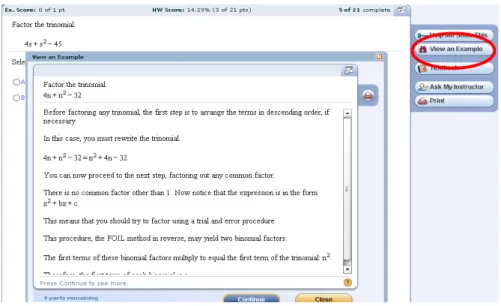
Figure 2 demonstrates the “View an Example” feature that shows students a completely worked out example of the same type and scope of problem they are attempting to solve. After viewing the example, students can then return to work on their original problem and receive credit once it is correct.
Figure 2. Screenshot of a sample problem using “View an Example” from Pearson Education’s MyMathLab. Problem from Elementary and Intermediate Algebra: Graphs and
Models, 4th ed., by M.L. Bittinger, D.J. Ellenbogen, and B.L. Johnson. Copyright 2012 by Pearson Education, Inc. Reprinted with permission
For web-based instruction to be effective, it must be interactive, provide intelligent feedback, and provide connectivity – link students to instructors (Kaput & Thompson, 1994), which are all characteristics of the MyMathLab system. The attempt-feedback-reattempt component of the system allows students to become more thoroughly engaged when they are not in the classroom and can provide the learning activities students might encounter when they have an instructor present engaging them and evaluating their work.
4. Method 4.1 Introduction
During a typical fall semester, the university offers approximately 30 sections of Essentials of Mathematics, each with a maximum of 25 students. Students are able to enroll in any section of the course they choose through a standard course registration system. Therefore, it was not possible to randomly assign participants to either the control or experimental group. Consequently, this study used a quasi-experimental, pre/posttest design to answer the research questions.
4.2 Instrumentation
Two different instructors taught two sections each of Essentials of Mathematics during the fall 2012 semester. The sections of the course for this study were face-to-face lecture-based classes meeting three contact hours each week. Each instructor had a control group and an experimental group for this study, with random assignment of groups being made. The control group (n = 39) consisted of those students who completed homework online with the addition of the learning aids “Help Me Solve This” and “View an Example”. The experimental group (n = 45) also completed homework online but only had the learning aid “View an Example” available.
There were a total of 24 online homework assignments and the number of questions per assignment ranged from 10-30. The homework assignments were similarly aligned, and the questions on each assignment were a mixture of multiple choice and free response questions. The unit tests were constructed by the two instructors of the sections of the course in the study. The content on these tests matched the objectives of the course and were a mixture of multiple choice and free response questions, with each test consisting of 20-25 questions. Since the sections of the course met at different times on different days, the instructors gave the unit tests during the same weeks of the semester. Mathematics learning (did students acquire new knowledge from the material in each unit) was defined as the scores on these unit tests.
The final exam was a two-hour test that contained 40 multiple choice questions with four answer choices each. The final was a common departmental exam given to all students taking Essentials of Mathematics. It was developed by a committee of faculty in the department to match the objectives of the course that provided face validity for the exam and was reviewed by faculty teaching the course to ensure the exam questions assessed defined course content which provided content validity; however, it was not reviewed for reliability. The posttest
used in the study was a modified version of the final exam. In order to make pre/post comparisons, the posttest had to align with the pretest. Thus, the posttest consisted of the same number and type of questions as the pretest. Mathematics understanding (did students learn and comprehend the course material overall) was then defined as the scores on the posttest.
The pretest was a 45-minute test which consisted of 30 multiple choice questions with four answer choices each. These questions were aligned with the objectives of the course and were of the same type, scope, and difficulty as questions on the final exam. This provided face validity for the exam but it was not reviewed for content validity or reliability.
The survey consisted of 19 statements and students were asked if they strongly agreed, agreed, neither agreed or disagreed, disagreed or strongly disagreed with each statement. There was a question asking students if they had ever used MyMathLab before along with two open-ended questions regarding their thoughts on doing homework online, using MyMathLab, and beneficial features of the system.
4.3 Data Analysis
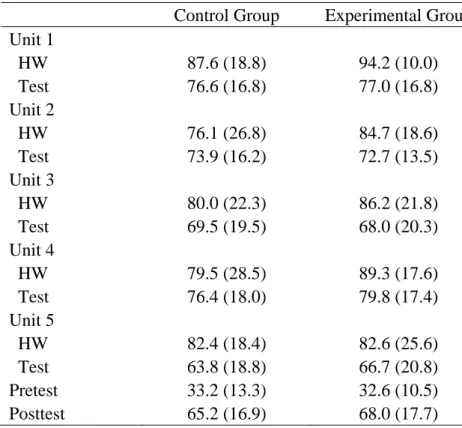
Means and standard deviations for unit homework, unit test grades, pretest scores, and posttest scores are shown in Table 1. Data on students who did not complete the course and take the final exam were omitted. There were 96 students who took the pretest and of these, 84 took the final exam.
Table 1. Pretest, Posttest, Homework and Test Averages by Group
Control Group Experimental Group Unit 1 HW Test 87.6 (18.8) 76.6 (16.8) 94.2 (10.0) 77.0 (16.8) Unit 2 HW Test 76.1 (26.8) 73.9 (16.2) 84.7 (18.6) 72.7 (13.5) Unit 3 HW Test 80.0 (22.3) 69.5 (19.5) 86.2 (21.8) 68.0 (20.3) Unit 4 HW Test 79.5 (28.5) 76.4 (18.0) 89.3 (17.6) 79.8 (17.4) Unit 5 HW Test 82.4 (18.4) 63.8 (18.8) 82.6 (25.6) 66.7 (20.8)
Pretest 33.2 (13.3) 32.6 (10.5)
Posttest 65.2 (16.9) 68.0 (17.7)
A pretest to measure students’ prior mathematics knowledge was given on the second day of class to ensure the groups were homogenous. Results of an unpaired t-test (t=0.23, p=.821) for the pretest data revealed there was no statistically significant difference in the mathematical ability of the students between the groups.
After verifying that the assumptions for t-tests were met, unpaired t-tests were performed to determine if tutorial learning aids made a difference in students’ unit homework grades, students’ mathematics learning as measured by unit tests, and to compare differences in posttest scores between the two groups. Another unpaired t-test was run in order to compare differences in the overall gain in student learning using the differences between the pretest and posttest scores between the two groups. Minitab was used for the quantitative data analysis with an alpha = .05 level of significance used throughout the study.
Looking at the comparisons of unit homework and unit test averages in Table 1, the experimental group had higher homework averages on all five homework units. This would appear to suggest that the experimental group would have higher test grades also; but, this group had higher test averages on only three of the five unit tests. Prior research suggests there should be a positive correlation between homework grades and tests grades. However, there were very low correlations between unit test scores and unit homework grades. This could be explained by various factors. For example, some students did not complete homework yet had high test scores. These students may have chosen not to do homework due to time constraints or outside influences such as work or family issues, and instead chose to do reviews and/or practice tests to prepare for unit tests and the final exam. Other students had high homework scores and low test scores which seem to suggest these students may have been receiving too much assistance with their homework. These students could be over relying on the tutorial learning aids in MyMathLab or on personal tutor assistance to complete homework problems. They also may not be the ones who are completing their homework. Allowing multiple attempts on homework questions so as not to penalize students for the learning process also may have been a contributing factor for some high homework scores.
At mid-term, students were asked to complete a survey regarding their perceptions about mathematics, doing homework in general and online, and on using MyMathLab. There were 65 complete survey responses with a 77.4% response rate. Data from the survey were tabulated listing frequencies by group.
5. Results and Discussion
This study examined the effects of using tutorial learning aids when completing online homework using a textbook-based course management system. Four research questions were answered along with an examination of survey data. The null hypotheses were as follows: 1. There is no significant difference in unit homework averages of students having access to either one or two tutorial learning aids when completing online homework.
2. There is no significant difference in students’ mathematics learning between students having access to either one or two tutorial learning aids when completing online homework.
3. There is no significant difference in students’ mathematics understanding in Essentials of Mathematics between students having access to either one or two tutorial learning aids when completing online homework.
4. There is no significant difference in the overall gain between the pretest and posttest scores for students having access to either one or two tutorial learning aids when completing online homework.
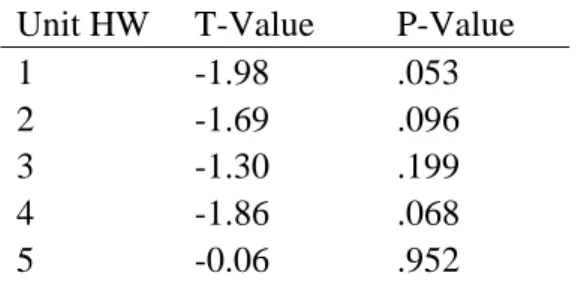
To determine whether tutorial learning aids made a difference in students’ unit homework grades, unpaired t-tests were run with unit homework grades as the dependent variable and the group, control or experimental, as the grouping variable. The tests revealed all p-values were greater than .05, therefore null hypothesis 1 was retained and there were no statistically significant differences in unit homework grades for the two groups of students (see Table 2). These results suggest that tutorial learning aids have no effect on homework grades. Specifically, our results suggest that homework grades were not affected by whether students had two specific learning aids available (“Help Me Solve This” and “View and Example”) to use when completing online homework or only one (“View an Example”).
Table 2. Unpaired T-Test Results for Unit Homework (HW)
Unit HW T-Value P-Value
1 -1.98 .053
2 -1.69 .096
3 -1.30 .199
4 -1.86 .068
5 -0.06 .952
The second research question addressed whether tutorial learning aids made a difference in students’ mathematics learning as measured by unit tests. Unpaired t-tests were completed using test scores as the dependent variable and the group as the grouping variable. Table 3 reveals the results of the tests with all p-values greater than .05. Thus, null hypothesis 2 was not rejected and no statistically significant differences exist in unit test scores between the two groups of students. These results also suggest that tutorial learning aids used when completing online homework have no effect on test scores. It appears that whether students have one or two learning aids available when completing online homework, it does not influence their mathematics learning as measured by test grades.
Table 3. Unpaired T-Test Results for Unit Tests
Unit Tests T-Value P-Value
1 -0.11 .912
2 0.38 .705
3 0.34 .733
4 -0.88 .382
5 -0.65 .517
An unpaired t-test was performed to determine whether tutorial learning aids made a difference in students’ overall performance in the course as measured by posttest scores with posttest scores as the dependent variable and the group as the grouping variable. The t-test (t= -0.73, p=.465) did not reveal any statistically significant difference in the posttest scores between the two groups of students. Thus, null hypothesis 3 was not rejected and these results suggest that tutorial learning aids have no effect on posttest scores. In particular, our results suggest that the specific tutorial learning aids used in this study made no difference in students’ overall mathematics understanding in the course Essentials of Mathematics.
The final research question examined the difference between the pretest and posttest scores for students in the two groups. To determine whether there was a difference in overall gain as measured by the difference between the pretest and posttest scores for students who had access to both learning aids and students whose access was limited to only one, an unpaired t-test was run. The dependent variable was the difference between the pre/posttest grades with the group as the grouping variable. Results of the test (t= -0.82, p=.413) revealed that there was no statistically significant difference between the pretest and posttest scores between the two groups, and null hypothesis 4 was retained. The results suggest that students who complete online homework with access to one learning aid performed as well as those with access to two learning aids. Specifically, our results suggest that the type of learning aids students used when completing online homework had no effect on the measure of student learning in the course.
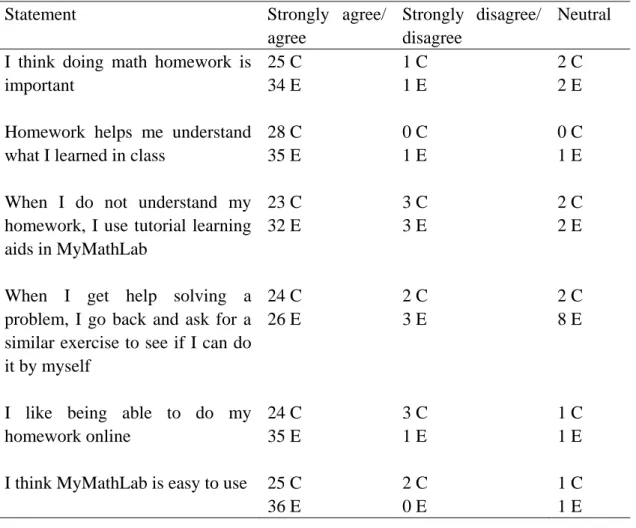
Responses to survey statements (see Table 4) revealed students in both groups overwhelmingly reported that doing math homework is important (90.8%) and that homework helped them understand the material in the class (96.9%). Additionally, 90.8% of the students preferred doing homework online and 93.8% thought the course management system was easy to use. When students had trouble with homework, 83.1% stated they used the tutorial learning aids in MyMathLab for help. However, there is no way to track which aid was used and how often. Of the students surveyed, 76.9% reported that they went back and worked similar problems if they received help solving a homework problem. Students were also asked a few open-ended questions. When asked what the most beneficial feature of MyMathLab was, the most frequent response was the extra help that was provided, especially “View an Example”. The second most popular feature was the ability to have multiple attempts when solving homework problems.
By the above responses, these students seem to understand that doing homework is important yet several chose not to complete it. Others reported that they worked similar problems if they received help when working homework problems, but homework grades do not necessarily reflect this claim.
Table 4. Survey Responses
Statement Strongly agree/
agree
Strongly disagree/ disagree
Neutral I think doing math homework is
important 25 C 34 E 1 C 1 E 2 C 2 E Homework helps me understand
what I learned in class
28 C 35 E 0 C 1 E 0 C 1 E When I do not understand my
homework, I use tutorial learning aids in MyMathLab
23 C 32 E 3 C 3 E 2 C 2 E
When I get help solving a problem, I go back and ask for a similar exercise to see if I can do it by myself
24 C 26 E 2 C 3 E 2 C 8 E
I like being able to do my homework online 24 C 35 E 3 C 1 E 1 C 1 E I think MyMathLab is easy to use 25 C
36 E
2 C 0 E
1 C 1 E
Note. C = control group; E = experimental group.
6. Limitations
Several limitations did exist within this study. The findings of the study may have limited generalizability since data were drawn from a single institution. Additionally, it focused solely on students in one course, Essentials of Mathematics.
Although the classes used in this study met at approximately the same time of day, they did meet on different days of the week so there could be differences due to the amount of time students spent in class. Another limitation is that homework grades may not align with actual student learning. Since homework is done outside of class, some students may be going to math tutoring for assistance or getting help from friends instead of using any of the system’s
learning aids. Also, there is no way to track if students did use any learning aids and for the control group, which ones. Information on the use of learning aids was self-reported on a survey conducted near the mid-term of the semester. Since survey results were self-reported with all respondents from the same institution results may not be generalized to students in other institutions.
Performance on unit tests is used to measure mathematics learning and posttest scores are used to measure overall performance in the course. It is possible that students benefited from using learning aids in ways not measured by these tests.
7. Conclusions
The purpose of this study was to determine if the tutorial learning aids that are available for students to use when completing homework online in MyMathLab improved mathematics learning and achievement. To address this issue, four research questions were posed and students’ scores were collected and analyzed during the fall 2012 semester.
Based on the results of our findings, when used for Essentials of Mathematics classes, the tutorial learning aids “Help Me Solve This” and “View an Example” appear to have no effect on mathematics learning and overall performance in the course. That is, students appear to do as well in the course if they had access to only one learning aid or both, and just having access to the learning aids did not significantly improve test scores. Students who had access to “View an Example” only had higher homework averages than students who were able to use both “View and Example” and “Help Me Solve This”, yet there was no statistical significance between the groups.
As prior research has shown, students generally perform better when completing mathematics homework online rather than doing written homework. Additionally, academic performance and course pass rates increased when students used specific textbook-based course management systems, especially MyMathLab. After comparing students’ homework and test grades in Essentials of Mathematics, it appeared that being able to use the learning aids in MyMathLab influenced some students’ outcomes in the course. Therefore, this study was conducted to determine if the tutorial learning aids available in MyMathLab actually had any significant effect on student outcomes when completing homework online using the system. As the results showed, the learning aids students had access to during this study did not have any significant effect on student outcomes in the course. However, since so many institutions are using these course management systems, it is important to look at what tools are available in them, how they are used by students, and what effects they can have on student learning and achievement.
A future study will examine changing students’ access to which learning aid they can use or not allowing use of either learning aid to see if there are any significant increases in mathematics learning and improvement in students’ performance in the course. To more fully assess the effectiveness of these learning aids, more data will be needed. Other questions and observations that arose during this study will be developed in future work. An underlying
question still remains- are students using these learning aids to gain a better understanding of course material or just as a quick fix to get homework completed?
References
Baker, W. & Dias, O. (2008). The effect of supplemental web-assisted exercises on student performance in remedial algebra. Mathematics Teaching Research Journal Online, 2(3), 27-40.
Bruce, F.A., & Singh, K. (1996). Academic achievement: A model of school learning for eighth grade students. Research in Middle Level Education Quarterly, 19(3), 95-111.
Burch, K.J. & Kuo, Y. (2010). Traditional vs. online homework in college algebra.
Mathematics and Computer Education, 44(1), 53-63.
Buzzetto-More, N. & Ukoha, O. (2009). The efficacy of a web-based instruction and remediation program on student learning. Issues in Informing Science and Information Technology, 6, 285-298.
Cartledge, C.M., & Sasser, J.E. (1981). The effect of homework assignments on the
mathematics achievement of college students in freshman algebra. Retrieved from ERIC
database. (ED206495)
Cooper, H. (1989). Synthesis of research on homework. Educational Leadership, 47(3), 85-91.
Cooper, H. (1994). Homework research and policy: A review of literature. Retrieved from http://www.hisparks.com/MathHelpers/Homework_Research_and_Policy.pdf
Cooper, H., Robinson, J.C., & Patall, E.A. (2006). Does homework improve academic achievement? A synthesis of research, 1987-2003. Review of Educational Research, 76, 1-62. http://dx.doi.org/10.3102/00346543076001001
Hirsch, L., & Weibel, C. (2003). Statistical evidence that web-based homework helps.
FOCUS: Newsletter of the Mathematical Association of America, 23(2), 14.
Hodge, A., Richardson, J.C., & York, C.S. (2009). The impact of a web-based homework tool in university algebra courses on student learning and strategies. MERLOT Journal of Online Learning and Teaching, 5, 618-629.
Holt, D., Holt, W., & Lumadue, R. (2012). At cross-purposes with a developmental mathematics course: Perceptions of students on the use of MyMathLab. Focus on Colleges, Universities, and Schools, 6(1), 1-26.
Kaput, J.J., & Thompson, P.W. (1994). Technology in mathematics education research: The first 25 years in the JRME. Journal for Research in Mathematics Education, 25(6), 676-684. http://dx.doi.org/10.2307/749579
Kodippili, A., & Senaratne, D. (2008). Is computer-generated interactive mathematics homework more effective than traditional instructor-graded homework? British Journal of Educational Technology, 39(5), 928-932.
Law, C.Y., Sek, Y.W., Ng, L.N., Goh, W.W., & Tay, C.L. (2012). Students’ perceptions of MyMathLab as an online learning tool. International Journal of e-Education, e-Business, e-Management and e-Learning, 2(1), 22-27.
Paschal,R.A., Weinstein, T., & Walberg, H.J. (1984). The effects of homework on learning: A quantitative synthesis. The Journal of Educational Research, 78(2), 97-104.
Speckler, M.D. (2012). Making the Grade, V.5: Data-driven Case Studies Illustrating How the MyMathLab Family of Products Supports Student Achievement. Boston, MA: Pearson.
Testone, S. (2005). Using publisher resources to assist developmental mathematics students.
Research and Teaching in Developmental Education, 21(2), 1-4.
Vezmar, K.A. (2011). Analyzing the effects of MyMathLab on student achievement in
elementary algebra (Doctoral dissertation). Available from ProQuest Dissertations and
Theses database. (UMI No. 3465766)
Walberg, H.J., Paschal, R.A., & Weinstein, T. (1985). Homework’s powerful effects on learning. Educational Leadership, 42(7), 76-79.