On the Security of Three Public Auditing
Schemes in Cloud Computing
Yang Ming
1and Yumin Wang
2(Corresponding author: Yang Ming)
School of Information Engineering, Chang’an University1
Xi’an, Shaanxi 710064, China (Email: [email protected])
State Key Laboratory of ISN, Xidian University2
Xi’an, Shaanxi 710071, China
(Received Apr. 13, 2015; revised and accepted May 20 & June 4, 2015)
Abstract
Cloud computing provides a scalability environment for growing amounts of data and processes that work on var-ious applications and services by means of on-demand self-services. It is necessary for cloud service provider to offer an efficient audit service to check the integrity and availability of the stored data in cloud. In this paper, we study three auditing schemes for stored data including the public auditing scheme with user revocation, the proxy provable data possession and the identity-based remote data possession checking. All three mechanisms claimed that their schemes satisfied the security property of cor-rectness. It is regretful that this comment shows that an active adversary can arbitrary alter the cloud data to generate the valid auditing response which can pass the verification. Then, we discussed the origin of the security flaw and proposed methods to remedy the weakness. Our work can help cryptographers and engineers design and implement more secure and efficient auditing mechanism in the cloud.
Keywords: Bilinear pairings, cloud computing, provable data possession, storage auditing
1
Introduction
In recent years, cloud computing is a promising comput-ing model that enables convenient and on-demand net-work access to a shared pool of computing resources [12]. It provided a flexible, dynamic, resilient and cost effec-tive infrastructure for both academic and business envi-ronments, it rapidly expands as an alternative to con-ventional office-based computing. Cloud computing of-fers various types of services, including, Infrastructure as a Service (IaaS, Amazon’s Elastic Cloud), Platform as a Service (PaaS, Microsoft Azure) and Software as a Service (SaaS, Google Web Mail Service) [1]. The cloud storage
is an important service of cloud computing, which allows data owners to move data from their local computing sys-tem to the cloud. Thus, it relieves the burden for storage management and maintenance for the data owners.
Although cloud storage service (CSS) provided many appealing benefits for the user, it also prompts a number of security issues, because the user data or archives are stored into an uncertain storage pool outside the enter-prises. Firstly, data owners would worry their data could be mis-used or accessed by unauthorized users. Secondly, the data owners would worry their data could be lost in the cloud. Therefore, it is necessary for cloud service providers to offer an efficient audit service to check the integrity and availability of the stored data in the cloud. The traditional cryptographic technologies for data in-tegrity and availability, based on hash functions and sig-nature schemes, cannot work on the outsourced data with-out a local copy of data. In addition, it is not a practical solution for data validation by downloading them due to the expensive communications, especially for large size files. Therefore, it is crucial to realize public auditabil-ity, so that data owners may resort to a third party au-ditor (TPA), who has expertise and capabilities that a common user does not have, for periodically auditing the outsourced data.
To achieve this goal, two novel approaches called prov-able data possession (PDP) [2] and proofs of retrievabil-ity (POR) [7]. The new techniques are such a proba-bilistic proof technique for a storage provider to prove the integrity and ownership of user’s data without down-load data. In 2007, Ateniese et al. [2] firstly proposed the PDP model for ensuring possession of files on un-trusted storages and provided an RSA-based scheme for the static case They also proposed a publicly verifiable version, which allows anyone, not just the owner, to chal-lenge the servers for data possession. In 2008, Ateniese et al. [3] proposed a dynamic PDP called scalable PDP which can support dynamic data operations. The new
Wang et al. [22] presented a dynamic scheme with by integrating above CPOR scheme and Merkle Hash Tree in DPDP. Wang et al. [17] provided a privacy-preserving auditing protocol. This scheme achieves batch auditing to support efficient handling of multiple auditing tasks. In 2011, based on fragment structure, random sampling and index-hash table, Zhu et al. [28] propose a dynamic audit service for verifying the integrity of an untrusted and outsourced storage, which supporting provable up-dates to outsourced data, and timely abnormal detec-tion. Since then, many other auditing mechanisms such as [13, 14, 15, 16, 18, 19, 23, 24, 25, 26, 27] have been proposed for protecting the integrity of the data in the cloud.
In 2013, Wang boyang et al. [15] proposed a novel public auditing mechanism for the integrity of shared data with efficient user revocation. By utilizing proxy re-signatures, it allows the cloud to re-sign blocks on be-half of existing users during user revocation phase, so that existing users do not need to download and re-sign blocks by themselves. In addition, a public verifier is always able to audit the integrity of shared data without retriev-ing the entire data from the cloud, even if some part of shared data has been re-signed by the cloud. Wang [19] proposed the concept of proxy provable data possession (PPDP), which is a matter of crucial importance when the user can not perform the remote data possession check-ing. Based on bilinear pairings, he gives an efficient and provable secure PPDP protocol. In 2014, Wang et al. [20] firstly formalized the model of identity based remote data possession checking (ID-RDPC) protocol for secure cloud storage. Based on bilinear pairings, they proposed the first concrete ID-RDPC protocol which was proven secure under the CDH assumption.
In this paper, we study the above three auditing mech-anisms for secure cloud storage, including public auditing mechanism with user revocation [15], proxy provable data possession [19] and identity based remote data possession checking [20]. We show that the three schemes do not sat-isfy the property of correctness. When the active adver-saries can arbitrarily tamper the cloud data and produce a valid auditing response to pass the verification. There-fore, the adversaries can cheat the auditor to believe that the data in cloud are well-maintained while in fact the
with the following properties:
1) Bilinearity: e(ua, vb) =e(u, v)ab for all u, v ∈ G1
and for alla, b∈Zp;
2) Non-degeneracy: e(g, g)6= 1G1;
3) Computability: There exists an efficient algorithm
to computee(u, v) for allu, v ∈G1.
We note the modified Weil and Tate pairings associated with supersingular elliptic curves are examples of such admissible pairings.
2.2
System Model
The system model of public auditing mechanism with user revocation can be shown in Figure 1 [15]. The three enti-ties: the cloud, the third party auditor (TPA), and users are involved in public auditing mechanism. The cloud of-fers data storage and sharing services to users. The TPA is able to publicly audit the integrity of shared data in the cloud for users. In a group, there is one original user and a number of group users. The original user is the original owner of data. This original user creates and shares data with other users in the group through the cloud. Both the original user and group users are able to access, download and modify shared data. Shared data is further divided into a number of blocks. A user can modify a block in shared data by performing an insert, delete or update op-eration on the block.
The system model of proxy provable data possession (PPDP) can be shown in Figure 2 [19]. The PPDP sys-tem consists of three different entities: user, public cloud service (PCS), and proxy. The user moves the massive data to the remote PCS, the PCS has significant storage space and computation resource to maintain the users’ data; the proxy, which is delegated to check user’s data possession.
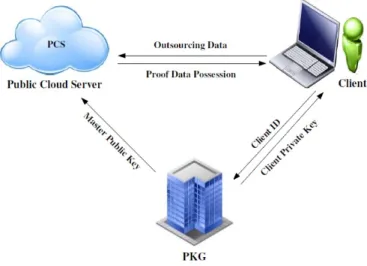
The system model of identity based remote data possession checking (ID-RDPC) can be shown in Fig-ure 3 [20]. The ID-RDPC protocol consists of three dif-ferent entities: private key generator (PKG), public cloud service (PCS) and client. The PKG generates the public parameters and master public key and client’s private key. The client moves the data to be stored on the public cloud
Figure 1: System model of public auditing mechanism
Figure 2: System model of PPDP
for maintenance and computation. The PCS has signifi-cant storage space and computation resource to maintain the users’ data.
3
The Security of Three Auditing
Mechanisms
In this section, we firstly review public auditing scheme with user revocation [15], proxy provable data posses-sion [19] and identity based remote data possesposses-sion check-ing [20], and then give the security analysis of three mech-anisms in active adversaries.
3.1
Overview of Wang et al.’s Scheme
This scheme consists of six procedures: KeyGen,
ReKey, Sign, ReSign, ProofGen and ProofVerify.
The reader can refer to [15] for detailed description. Let G1 andG2 be two groups of order p, g be a
gen-erator of G1, e: G1×G1 → G2 be a bilinear map, ω
be a random element of G1. The global parameters are
{e, p,G1,G2, g, ω, H, H0}, whereHis a hash function with
H: {0,1}∗ →
G1 and H0 is a hash function with H0:
{0,1}∗→
Zp. The total number of blocks in shared data isn, and shared data is described asM = (m1,· · ·, mn).
Figure 3: System model of ID-RDPC
The total number of users in the group isd.
KeyGen. For user ui, he/she generates a random xi ∈
Zp, and outputs his/her public key pki = gxi and private key ski = xi. Without loss of generality, we assume user u1 is the original user, who is the
creator of shared data. The original user also creates a user list (UL), which contains ids of all the users in the group. The user list is public and signed by the original user.
ReKey. The cloud generates a re-signing key rki→j as
follows:
1) The cloud generates a randomr∈Zpand sends it to userui;
2) Userui sendsr/xi to useruj, where ski =xi; 3) Useruj sendsrxj/xi to the cloud, whereskj =
xj;
4) The cloud recoversrki→j=xj/xi.
Sign. Given private key ski = xi, block mk ∈ Zp in
shared data M and its block identifier idk, where
k∈[1, n], the userui outputs the signature on block
mk asσk= (H(idk)ωmk)xi.
ReSign. When user ui is revoked from the group,
the cloud is able to convert signatures of user
ui into signatures of user uj on the same block. More specifically, given re-signing key rki→j, pub-lic key pki, signature σk, block mk and block iden-tifier idk, the cloud first checks that e(σk, g) =
e(H(idk)ωmk, pki). If the verification result is 0, the cloud outputs⊥; otherwise, it outputsσk0 =σrki→j
k =
(H(idk)ωmk)xi·xj/xi= (H(idk)ωmk)xj. After the re-signing, the original user removes user ui’s id from UL and signs the new UL.
ProofGen. To audit the integrity of shared data, the
L1, L2,· · ·, Ld, whereLiis the subset of selected blocks signed by user ui. And the number of elements in subset Li is ci. Clearly, we have
c=Pd
i=1ci,L=L1∪ · · · ∪LdandLi∩Lj= Φ fori6=j;
2) For each set Li, the cloud computes αi =
P
l∈Liylml∈Zp andβi=
Q
l∈Liσ yl l ∈G1;
3) The cloud outputs an auditing proof {α, β,{idl}l∈L}, and sends it to the verifier, whereα= (α1,· · ·, αd) andβ= (β1,· · ·, βd).
ProofVerify. With an auditing proof {α, β,{idl}l∈L}, an auditing message {(l, yl)}l∈L, and all the exist-ing users’public keys (pk1,· · · , pkd), the TPA checks the correctness of this auditing proof as
e(Qd
i=1βi, g) =Q d i=1e(
Q
l∈LiH(idl)
yl·ωαi, pk i). If the result is 1, the verifier believes that the in-tegrity of all the blocks in shared data M is correct. Otherwise, the verifier outputs 0.
3.2
Security Analysis on Wang et al.’s
Scheme
As the audit scheme for shared data with efficient user revocation in cloud, Wang boyang et al.’s scheme enjoys many desirable security properties. Informally, this mech-anism needs that it be infeasible to fool the TPA into ac-cepting false statements, i.e. the TPA is able to correctly detect whether there is any corrupted data.
However, we show that when an active adversary, such as a bug planted in the software running on the cloud server by a malicious programmer or a hacker, is involved in the auditing process. Specifically, the adversary can arbitrarily modify or tamper the outsourced data and fool the TPA to believe the data are well preserved in the cloud.
All the information the adversary has to know is how the data are modified. The details are described as fol-lows:
1) For each setLi, the adversaryA firstly modifies the block mlto m∗l =ml+fl forl∈Li and records the valuesfl, i.e. how the shared data are modified.
3) The adversary A intercepts the auditing proof (α∗, β,{idl}l∈L) from the cloud to TPA, and mod-ifies eachα∗i toαi=α∗i −
P
l∈Liylfl forl∈Li.
By performing such a modification, the adversary A derives a correct proof with respect to the original data blocks M, and sends it to the TPA. As a result, in
ProofVerify phase, the modified auditing proof can
make the equation hold and, thus the TPA believes that shared data are all well-maintained, while the data have been polluted by the adversaryA.
3.3
Overview of Wang’s Scheme
This scheme consists of six procedures: SetUp,TagGen,
SignVerify,CheckTag,GenProof andCheckProof.
The reader can refer to [19] for detailed description. Suppose the maximum number of the stored block-tag pairs isn. Let f: Z∗q × {1,2,· · ·, n} →Z∗q and Ω: Z∗q × {1,2,· · · , n} →Z∗q be two pseudo-random functions, and let π: Z∗q × {1,2,· · ·, n} → {1,2,· · ·, n} be a pseudo-random permutation andH: G2× {0,1} →Z∗q,h: Z∗q →
G1 be cryptographic hash functions.
Let g be a generator of G1. We assume that the
file F (maybe encoded by using error-correcting code, such as, Reed-Solomon code) is divided into n blocks (m1, m2,· · · , mn) where mi ∈ Z∗q and q is the order of G1 and G2. Without loss of generality, we denote
F= (m1, m2,· · ·, mn).
SetUp. The user picks a random number x ∈ Z∗
q as its private key and computes X = gx as its pub-lic key. The PCS picks a random number y ∈ Z∗
q as its private key and computes Y =gy as its pub-lic key. The proxy picks a random number z ∈ Z∗
q as its private key and computes Z =gz as its pub-lic key. The user picks a random element u ∈ G1
and a secure signature/verification algorithm pair (SigGen, SignV erif y). Finally, the system parame-ter isparam={G1,G2,e,f,Ω,π, H, h, X, Y, Z, u, q,
(SigGen,SignV erif y)}.
TagGen. Given F = (m1, m2,· · · , mn) and the warrant
ω, the user generates the tagTmi of the blockmi as
1) Client computes t = H(e(Y, Z)x, ω), W i = Ωt(i);
2) Client computes Tmi = (h(Wi)u
mi)x for i ∈
[1, n];
3) Client computes the signature Sign =
SigGenx(ω) on the warrantω.
Then the user sends the the block-Tag pairs col-lection {(Tmi, mi), i ∈ [1, n]} and the warrant ω to
the PCS. The PCS stores the block-tag pairs and the warrant ω. The user deletes the block-tag pairs {(Tmi, mi), i∈[1, n]} from its local storage. At the
same time, the user sends the warrant-signature pair (ω, Sign) to the proxy.
SignVerify. Upon receiving (ω, Sign), the proxy
per-forms the verification algorithm SignV erif y(ω,
Sign, X). If it is valid, the proxy accepts this war-rantω; otherwise, the proxy rejects it and queries the user for new warrant-certification pair.
CheckTag. Given {(Tmi, mi), i∈[1, n]}, PCS performs
the procedures for every i,1≤i≤n, as follows: 1) PCS computes ˆt = H(e(X, Z)y, ω) and ˆWi =
Ωˆt(i);
2) PCS verifies whethere(Ti, g) =e(h( ˆWi)umi, X) holds.
If it holds, then PCS accepts it. Otherwise, PCS rejects it and queries the user for new block-tag pair.
GenProof. Let the challenge bechal= (c, k1, k2) where
1 ≤ c ≤ n, k1 ∈ Z∗q, k2 ∈ Z∗q. In this phase, the proxy asks the PCS for remote data possession proof of c file blocks whose indexes are randomly chosen using a pseudo-random permutation keyed with a fresh randomly chosen key for each challenge. On the other hand, the proxy sends (ω, Sign) to PCS. PCS verifies whether the signature Sign is valid. If it is valid, PCS compares this ω with its stored warrant
ω0. When ω = ω0 and the proxy’s queries comply with the warrantω, PCS performs the procedures as follows. Otherwise, PCS rejects the proxy’s query.
1) For 1≤j ≤c, PCS computes the indexes and coefficients of the blocks for which the proof is generated: ij =πk1(j),aj =fk2(j);
2) PCS computes T = Qc
j=1T
aj
mi, mˆ =
Pc
j=1ajmij.
PCS outputsV = ( ˆm, T) and sendsV to the proxy as the response.
CheckProof. Upon receiving the responseV from PCS,
the proxy performs the procedures as follows: 1) Proxy computest=H(e(X, Y)z, ω);
2) Proxy checks whether the following formula holds
e(T, g) =e(Qc
i=1h(Ωt(πk1(i)))
fk2(i)umˆ, X).
If it holds, then the proxy outputs “success”. Other-wise the proxy outputs “failure”.
3.4
Security Analysis on Wang’s Scheme
As the proxy provable data possession (PPDP) in pub-lic cloud, Wang’s scheme enjoys many desirable security properties of a PPDP scheme including correctness and unforgeability. Informally, correctness property means that it be infeasible to fool the proxy into accepting false statements, i.e. the proxy is able to correctly detect whether there is any corrupted data.
Similar to the analysis of Wang boyang et al.’s scheme, we show that the Wang’s scheme is not secure in active adversary, who can arbitrarily modify or tamper the out-sourced data and fool the proxy to believe the data are well preserved without being detected by the proxy in the cloud. The details are described as follows:
1) The adversary A firstly modifies the block mi,j to
m∗i,j=mi,j+di,j fori∈[1, n],j∈[1, c] and records the values di,j.
2) When PCS receiving the challengechal = (c, k1, k2)
from the proxy, the PCS honestly executes Gen-Proof algorithm to compute V∗ = ( ˆm∗, T) as fol-lows:
ˆ
m∗=Xc j=1ajm
∗
ij =
Xc
j=1aj(mi,j+di,j)
= ˆm+Xc
j=1ajdi,j
T =Yc j=1T
aj mij.
Then it sends the V∗= ( ˆm∗, T) auditing proof to the proxy.
The adversary A intercepts the auditing proof V∗ = ( ˆm∗, T) and modifies ˆm∗ to ˆm= ˆm∗−Pc
j=1ajdi,j. By performing such a modification, the adversaryAobtains a correct proof with respect to the original datami,j for
i∈[1, n] andj∈[1, c]. As a result, the proof can pass the auditing verification, which makes the proxy believe that the shared data are well maintained by the PCS, while in fact the data have been corrupted.
3.5
Overview of Wang et al.’s Scheme
An ID-RDPC protocol is a collection of five polynomial-time algorithms: Setup,Extract,TagGen,GenProof
and CheckProof. The reader can refer to [20] for
de-tailed description.
Setup. PKG chooses a random numberx∈Z∗q and sets
Y =gx, wheregis a generator of the group
G1. PKG
chooses a random element u∈G1. Define two
cryp-tographic hash functions: H: {0,1} →Z∗
q, h: Z∗q →
G1. Letf be a pseudo-random function and letπbe a
sequentially according to the counter i. That is, the client generates a tag for a message block m2 after
m1, which implies that the client maintains the latest
value of the counter i. For mi, the client performs the TagGen procedure as follows:
1) ComputeTi= ((h(i)umi)σ; 2) OutputTi and send to the PCS.
GenProof. In this phase, the verifier (who can be the
client himself/herself) queries the PCS for a proof of data possession of c file blocks whose indices are randomly chosen using a pseudo-random permuta-tion keyed with a fresh random-chosen key for each challenge.
The numberk1∈Zq∗is the random key of the pseudo-random permutationπ. Also,k2∈Zq∗is the random key of the pseudo-random function f. Let the chal-lenge bechal= (c, k1, k2). Then, the PCS does:
1) For 1 6 j 6 c, compute the indices and co-efficients of the blocks for which the proof is generated: ij = πk1(j), aj = fk2(j). In this
step, the challenge chal defines an ordered set {c, i1,· · · , ic, a1,· · · , ac};
2) ComputeT =Qc j=1T
aj ij , ˆm=
Pc
j=1ajmij;
3) OutputV = (T,mˆ) and sendV to the client as the response to thechal query.
CheckProof. Upon receiving the response V from the
PCS, the verifier (who can be the client him-self/herself) does:
1) Check the equation: e(T, g) =
eQc
i=1h(πK1(i))
fk2(i)umˆ, R·YH(ID,R)
. 2) If the previous equation holds, output “success”.
Otherwise, output “failure”.
3.6
Security Analysis on Wang et al.’s
Scheme
As an Identity based remote data possession checking (ID-RDPC) protocol in the public clouds, Wang et al.’s
lows:
1) The adversary A firstly modifies the block mij to
m∗i
j =mij+dij for j∈[1, c] and records the values
dij.
2) When the PCS receiving the challenge chal = (c, k1, k2) from the client, the PCS honestly executes
GenProof algorithm to compute V∗ = ( ˆm∗, T) as
follows: ˆ
m∗=Xc j=1ajm
∗
ij =
Xc
j=1aj(mi,j+di,j)
= ˆm+Xc
j=1ajdi,j
T =Yc j=1T
aj mij.
Then it sends the responseV∗= ( ˆm∗, T) to the client. The adversaryAintercepts the responseV∗= ( ˆm∗, T) and modifies ˆm∗to ˆm= ˆm∗−Pc
j=1ajdij. By performing
such a modification, the adversary A obtains a correct proof with respect to the original datamij forj ∈[1, c].
As a result, the proof can pass the verification, which makes the client believe that the shared data are well maintained by the PCS, while in fact the data have been corrupted.
3.7
Discussion on the Origin and Method
Through the above analysis, it is known Wang boyang et al.’s scheme, Wang’s scheme and Wang et al.’s scheme can not satisfy the correctness. Taking use of our proposed attack methods, an active adversary can arbitrarily mod-ify or tamper the outsourced data in the cloud and fool the auditor (TPA, Proxy and client) to believe the data are well preserved in the cloud.
Why does the above three schemes have security flaw? There is no an authentication check on the auditing re-sponse about the challenge. This property incurs the se-curity flaws. It is important to clarity the security in order to design secure and practical auditing mechanism in cloud storage.
To solve the security problem, we can use the technique of digital signature. Specifically, in auditing response, the cloud service firstly uses the private key to compute a
signature for proof and, then send both the proof and the corresponding signature as the response to the chal-lenge. Receiving the response, the auditor first verifies whether the signature is valid or not. If it is valid, the auditor performs the auditing verification protocol; oth-erwise, the auditor discards the response. Therefore, if the shared data have been modified, the auditor must be able to detect it because of the employment of the digital signatures.
We can use HMAC technique [8], which also provided message authentication function. Meantime, the 3-move protocol [25, 26, 27]: commitment, challenge and response (for example Schnorr’s protocol [10]) is also used in au-diting response and prevent to the pollution attacks from active adversaries.
4
Conclusion
With the development of cloud computing, many people focused on the study of information security in Cloud En-vironments [5, 9, 21]. Wang boyang et al. [15], Wang [19] and Wang et al. [20] proposed a secure auditing mech-anisms for the stored data in cloud. However, through cryptanalysis, we show that their schemes still has secu-rity weakness. By giving a concrete attacks, we prove that the two schemes are not secure in active adversary envi-ronment. Specially, any adversary can modify the data without being detected by the auditor in the verification phase. Finally, we study the origin of the security flaw and propose a solution to remedy this weakness.
Acknowledgments
This work was supposed by the National Natural Sci-ence Foundation of China (No.61202438), the China Postdoctoral Science Foundation (No.2011M501427), the Key Project of Industry Science and Technology of Shaanxi Province (No.2015GY014) and the Project of Technology Transfer Promoting Engineering of Xi’an City (No.CXY1437(10)).
References
[1] M. Armbrust, et al, “A view of cloud computing,” ACM Communication, vol. 53, pp. 50–58, 2010. [2] G. Ateniese, R. C. Burns, R. Curtmola, J. Herring, L.
Kissner, Z. N. J. Peterson, and D. X. Song, “Provable data possession at untrusted stores,” inProceedings of the 2007 ACM Conference on Computer and Commu-nications Security (CCS’07), pp. 598–609, 2007. [3] G. Ateniese, R. D. Pietro, L. V. Mancini, G. Tsudik,
“Scalable and efficient provable data possession,” in Proceedings of the 4th ACM International Conference on Security and Privacy in Communication Networks (SecureComm’08), pp. 1–10, 2008.
[4] D. Boneh, B. Lynn, H. Shacham, “Short signatures from the Weil pairing,” Journal of Cryptology, vol. 17, no. 4, pp. 297–319, 2004.
[5] P. S. Chung, C. W. Liu and M. S. Hwang, “A study of attribute-based proxy re-encryption scheme in cloud environments,” International Journal of Network Se-curity,vol. 16, no. 1, pp. 1–13, 2014.
[6] C. C. Erway, A. Kpc, C. Papamanthou, R. Tamassia, “Dynamic provable data possession,” in Proceedings of the 2009 ACM Conference on Computer and Com-munications Security (CCS’09), pp. 213–222, 2009. [7] A. Juels and B. S. K. Jr, “PORS: Proofs of
retriev-ability for large files,” inProceedings of the 2007 ACM Conference on Computer and Communications Secu-rity (CCS’07), pp. 584–597, 2007.
[8] H. Krawczyk, M. Bellare and R. Canetti, HMAC: Keyed-hashing for Message Authentication, RFC 2104, Feb. 1997.
[9] C. C. Lee, P. S. Chung and M. S. Hwang, “A survey on attribute-based encryption schemes of access con-trol in cloud environments,”International Journal of Network Security, vol. 15, no. 4, pp. 231–240, 2013. [10] C. P. Schnorr, “Efficient identification and
signa-tures for smart cards,” in Advances in Cryptology (Crypto’89), LNCS 435, pp. 239–252, 1990.
[11] H. Shacham, B. Waters, “Compact proofs of retriev-ability,” in Advances in Cryptology (Asiacrypt’08), LNCS 5350, pp. 90–107, 2008.
[12] L. M. Vaquero, L. Rodero-Merino, J. Caceres, M. Lindner, “A break in the clouds: Towards a cloud def-inition,”ACM SIGCOMM Computer Communication Review, vol. 39, pp. 50–55, 2009.
[13] B. Wang, B. Li, H. Li, “ORUTA: Privacy-preserving public auditing for shared data in the cloud,” in Proceedings of the IEEE International Conference on Cloud Computing, pp. 293–302, 2012.
[14] B. Wang, B. Li, H. Li, “KNOX: Privacy-preserving auditing for shared data with large groups in the cloud,” in Applied Cryptography and Network Secu-rity (ACNS’12), LNCS 7341, pp. 507–525, 2012. [15] B. Wang, B. Li and H. Li, “Public auditing for shared
data with efficient user revocation in the cloud,” in Proceedings of IEEE INFOCOM’13, pp. 2904–2912, 2013.
[16] C. Wang, K. Ren, W. Lou, J. Li, “Toward publicly auditable secure cloud data storage services,” IEEE Networks, vol. 24, no. 4, pp. 19–24, 2010.
[17] C. Wang, Q. Wang, K. Ren, W. Lou, “Privacy-preserving public auditing for data storage security in cloud computing,” in Proceedings IEEE of INFO-COM’10, pp. 1–9, 2010.
[18] C. Wang, Q. Wang, K. Ren, N. Cao, W. Lou, “To-ward secure and dependable storage services in cloud computing,”IEEE Transactions on Services Comput-ing, vol. 5, no. 2, pp. 220–232, 2012.
[19] H. Wang, “Proxy provable data possession in public clouds,” IEEE Transactions on Services Computing, vol. 6, no. 4, pp. 551–559, 2013.
abling public auditability and data dynamics for stor-age security in cloud computing,”IEEE Transactions on Parallel Distribute System, vol. 22, no. 5, pp. 847– 859, 2011.
[24] K. Yang, X. Jia, “Data storage auditing service in cloud computing: Challenges, methods and opportu-nities,”World Wide Web, vol. 15, no. 4, pp. 409–428, 2012.
[25] Y. Zhu, G. J. Ahn, H. Hu, S. S. Yau, Ho G. An and C. J. Hu, “Dynamic audit services for outsourced storages in Clouds,” IEEE Transactions on Services Computing, vol. 6, no. 2, pp. 227–238, 2013.
[26] Y. Zhu, H. Hu, G. J. Ahn, S. S. Yau, “Efficient audit service outsourcing for data integrity in clouds”,The Journal of Systems and Software, vol. 85, pp. 1083– 1095, 2012.
[27] Y. Zhu, H. Hu, G. J. Ahn, M. Yu, “Cooperative prov-able data possession for integrity verification in multi-cloud storage,” IEEE Transactions on Parallel Dis-tribute System, vol. 23, no. 12, pp. 2231–2244, 2012. [28] Y. Zhu, H. Wang, Z. Hu, G.-J. Ahn, H. Hu, S.S.
Yau, “Dynamic audit services for integrity verifica-tion of outsourced storages in clouds,” inProceedings of the 2011 ACM Symposium on Applied Computing (SAC’11), pp. 1550–1557, 2011.
Currently he is a doctoral supervisor and professor of Xidian University. He is a fellow member of the Board of Governors of the Chinese Institute of Cryptography (preparatory committee) and a Senior Member (SM) of IEEE. His research interests include information theory, coding, and cryptography.