ORGANIZATIONAL DETERMINANTS OF MINORITY PARTICIPATION IN CLINICAL RESEARCH
Charles Micha Belden I
A dissertation submitted to the faculty of the University of North Carolina at Chapel Hill in partial fulfillment of the requirements for the degree of Doctor of Philosophy in the Department
of Health Policy & Management in the Gillings School of Global Public Health.
Chapel Hill 2014
Approved by: Bryan J. Weiner Paul R. Voss
2015
ABSTRACT
Charles Micha Belden I: Organizational Determinants of Minority Participation in Clinical Research
(Under the direction of Bryan Weiner)
Poor rates of minority participation in cancer clinical trials, and inequitable distribution of results from clinical research contribute to persistent disparities in cancer care outcomes. Systematic reviews of minority participation in clinical trials reveal extensive research on patient and provider-level barriers to participation; however, there is limited research on the
organizational drivers of minority enrollment in treatment trials. The goal of this dissertation is to enhance our understanding of the organizational determinants of minority participation in cancer treatment trials. The objectives of this dissertation are: (1) estimate the impact of organizational characteristics associated with black enrollment in National Cancer Institute (NCI) sponsored treatment trials offered by organizations participating in the NCI Community Clinical Oncology Program; (2) examine the strategies of organizations participating in the NCI Community Clinical Oncology Program resulting in high enrollment of minorities in National Cancer Institute (NCI) sponsored treatment trials; and (3) evaluate disparities in geographic access to organizations offering National Cancer Institute (NCI) sponsored treatment trials for minority populations in the continental United States.
comprised of tactics, which achieve high enrollment of minorities in treatment trials as defined by NCI officials. Finally, a network analysis approach was employed using ZIP code tabulation area (ZCTA) data, and geocoded locations of organizations offering NCI-sponsored trials in order to investigate disparities in geographic access to CTOs.
ACKNOWLEDGEMENTS
TABLE OF CONTENTS
LIST OF TABLES ...x
LIST OF FIGURES ... xii
LIST OF ABBREVIATIONS ... xiii
CHAPTER 1: INTRODUCTION ...1
CHAPTER 2: MANUSCRIPT 1: THE IMPACT OF ORGANIZATIONAL CHARACTERISTICS ON ENROLLMENT OF BLACK AMERICANS IN CANCER TREATMENT TRIALS ...13
Introduction ...13
Conceptual Framework ...15
Methods... 18
Results ... 24
Discussion ... 28
Conclusion ...32
Tables and Figures ...33
CHAPTER 3: MANUSCRIPT 2: A FUZZY-SET ANALYSIS OF ORGANIZATIONAL STRATEGIES PROMOTING MINORITY PARTICIPATION IN CANCER TREATMENT TRIALS ...39
Introduction ... 39
Methods ...41
Results ... 49
Discussion ...51
CHAPTER 4: MANUSCRIPT 3: GEOGRAPHIC ACCESS TO
CLINICAL TRIAL ORGANIZATIONS IN THE US ... 60
Introduction ...60
Clinical Trial Organizations ...62
Methods ...64
Results ...65
Discussion ...68
Tables and Figures ...74
CHAPTER 5: SUMMARY OF FINDINGS AND IMPLICATIONS FOR POLICY, PRACTICE AND RESEARCH ...78
APPENDIX ...85
LIST OF TABLES
Table 1. Descriptive Statistics of Analytical Sample, Aim 1 ...34
Table 2. Regression Results: Impact of Organizational Characteristics on Enrollment of Black Americans in Cancer Clinical Treatment Trials ...36
Table 3. Sensitivity Testing Results: Zero-inflated Negative Binomial Model ...37
Table 4. Sensitivity Testing Results: Add Median Family Wealth, Negative Binomial Model ...38
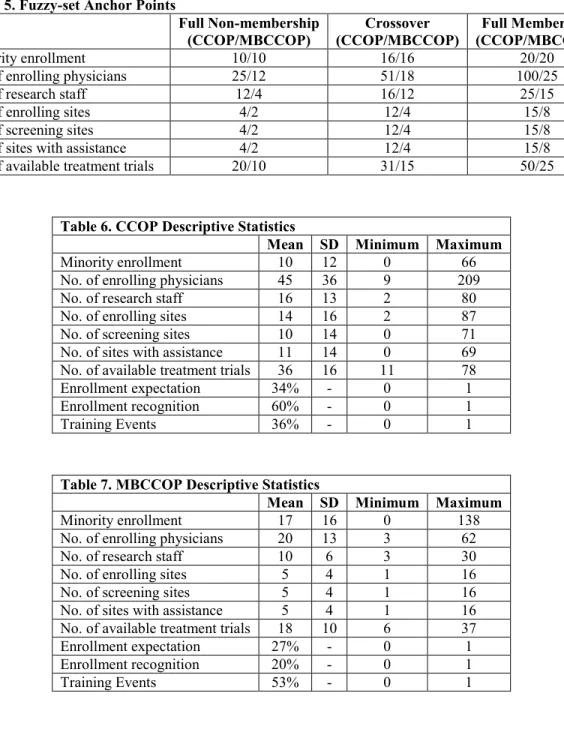
Table 5. Fuzzy-set Anchor Points ...56
Table 6. CCOP Descriptive Statistics ...56
Table 7. MBCCOP Descriptive Statistics ...56
Table 8. Summary Truth Table for Strategies Resulting in High Minority Enrollment ...57
Table 9. Simplified Strategies Resulting in High Minority Enrollment ...58
Table 10. Empirical Strategies for Achieving High Minority Enrollment ...58
Table 11. Detailed Organizational Characteristics of CCOP/MBCCOPs Achieving High Enrollment of Minorities to Treatment Trials ...59
Table 12. Proportion of US Population Across Categories of Travel Time to Nearest CT Organization ...75
Table 13. Median Travel Times to Clinical Trial Organizations for the US Population in the Continental US ...75
Table 14. Median Travel Times (IQR) to Any CTO for Racial/Ethnic Groups and RUCA Codes ...75
Table 15. Median Travel Times (IQR) to Any CTO for Racial/Ethnic Groups and RUCA Codes Without MBCCOP Enrolling Locations ...76
Table 17. Median Travel Times (IQR) to Any CTO for Racial/Ethnic
Groups and Regions without MBCCOP Enrolling Locations ...76 Table 18. Bivariate Relationships Between Variables ...85 Table 19. Regression Results: Impact of Environmental Factors on
Enrollment of Blacks in Cancer Clinical Treatment Trials
LIST OF FIGURES
Figure 1. Aim 1 Conceptual Framework (Ford, et. al., 2008) ...33 Figure 2. NCI Cancer Centers, CCOPs/MBCCOPs,
Commission on Cancer Hospitals, Academic Medical Centers ...35 Figure 3: Travel Times to Clinical Trial Organization from ZCTAs
LIST OF ABBREVIATIONS
ACS American Community Survey
ACS-COC American College of Surgeons Commission on Cancer AHRQ Agency for Healthcare Research & Quality
ASCO American Society of Clinical Oncologists BIC Bayesian Information Criteria
CCOP Community Clinical Oncology Program Organization CTO Clinical Trial Organization
fsQCA Fuzzy-set Qualitative Comparative Analysis
MBCCOP Minority-based Community Clinical Oncology Program Organization MSA Metropolitan Statistical Area
NCI National Cancer Institute NIH National Institutes of Health PBRN Provider-based research network
US United States
ZCTA ZIP Code Tabulation Area
CHAPTER 1: INTRODUCTION
Clinical treatment trials are considered the gold standard for evaluating the efficacy of
cancer therapeutic regimens. Racial and ethnic diversity among clinical trial participants is
critical in order to evaluate therapeutic effects, and ensure that the burdens and benefits of cancer
clinical research are equitably shared. However, disparities in minority participation in clinical
trials have been long-standing and well documented in the US. Estimates suggest that 3-5% of
adult cancer patients in the US participate in a clinical trial, but less than less than 3% of
minority cancer patients participate in trials despite extensive Federal efforts to promote the
development of organizations intended to enhance minority participation in clinical research
(NCI Cancer Bulletin, 2010). Moreover, studies have demonstrated an overall decline in
minority participation in clinical research in recent years (Murthy, et. al., 2004), which may
exacerbate disparities in the receipt of high-quality cancer care (Carpenter, et. al., 2011; Laliberte,
et. al., 2005; Johnson, et. al., 1994). In order to improve minority participation in clinical
research, and specifically treatment trials, it is essential that we improve our understanding of the
organizational determinants of minority participation in clinical treatment trials.
Cancer care organizations provide a wide variety of treatment and prevention services to
patients in the United States (US). The majority of cancer patients in the US seek care in
community-based cancer care organizations; and for over 30 years, the National Institutes of
Health (NIH) has promoted cancer care organizations that enhance overall and minority
participation in clinical trials by funding collaborations between academically based researchers
Community Clinical Oncology Program to foster the development of a provider-based research
network (PBRN), comprised of community-based clinical trial organizations (CTOs) located
throughout the US. The specific goals of this NIH endeavor have focused on promoting the
implementation of CTOs that: (a) advance scientific discoveries in cancer therapies through
conducting clinical trials in community-based locations; and (b) accelerate the translation and
dissemination of clinical trial results into community-based practice settings. In addition to
CTOs funded by the NCI Community Clinical Oncology Program, the American College of
Surgeons Commission on Cancer (ACS-COC) has a long history of efforts aimed at improving
cancer care, and specifically accredit cancer care organizations that offer clinical trials to patients
in both academic and community-based hospital settings. Cancer care organizations accredited
by ACS-COC that offer clinical trials to patients are included in the analysis presented in
Chapter 4 as CTOs.
CTOs are organizations of specialists, primary care physicians, and other staff linked to
NCI Cancer Centers and Research bases where treatment trials are initiated. Indeed, recent
research has shown that CTOs have demonstrated their ability to address disparities in cancer
care at the local level (Wheeler, et. al., 2012; Vicini, 2011). A physician principal investigator
provides overall leadership for the CTOs’ physicians and staff members; and CTO staffs vary in
their composition, and may include program coordinators, research nurses, clinical research
associates, data managers, and regulatory specialists. Staff members coordinate the review and
selection of clinical treatment trial, disseminate protocols to participating physicians, and other
staff members; and collect and submit study data. CTO physicians refer or enroll patients to
clinical trials, and typically include cadres comprise of medical, surgical and radiation
Through their collaboration with NCI research bases, CTO affiliated physicians may also
participate in the development of clinical trials by proposing potential study ideas, providing
input on study designs, and serving as a principal investigator or co-principal investigator for
trials (Macaulay & Nutting, et. al., 2006). However, CTOs are challenging to implement and
sustain. Challenges include obtaining sustainable funding, creating the infrastructure for clinical
trial enrollment, locating and opening appropriate clinical trials appropriate for the populations
served, managing complex regulatory compliance issues, and sustaining ongoing participation
from community-based physicians.
Patient and physician level factors associated with minority participation in clinical
research have been studied exhaustively, and included in several recent literature reviews (Rivers,
et. al., 2014; Schmotzer, 2012; Ford, et. al., 2008), however, limited research has investigated the
organizational characteristics associated with minority enrollment in clinical treatment trials (Lai,
et al., 2006). Studies have sought to identify organizational characteristics associated with
overall enrollment of patients to clinical trials at CTOs (Carpenter, et. al., 2012; Weiner, et. al.,
2012; Jacobs, et. al., 2013), but these studies did not examine minority enrollment. This gap in
research limits the ability to effectively develop policies and strategies to address disparities in
minority participation in clinical research, and thus, it is critical for further studies to examine the
impact of organizational factors associated with minority enrollment in clinical trials. This
dissertation seeks to enhance our understanding of the role of organizational characteristics
associated with the enrollment of minority populations in NCI-sponsored. The specific research
objectives are: (1) examine the organizational characteristics associated with African American
participation in NCI-sponsored clinical treatment trials; (2) examine the organizational strategies
trials; and (3) examine disparities in geographic access to cancer care organizations offering
NCI-sponsored clinical trials (CTOs) in the continental United States. The central hypothesis is
that organizational factors directly impact the enrollment of minorities in clinical research. This
central hypothesis is tested with three research aims:
Aim 1: Estimate the impact of organizational characteristics on African American
enrollment in NCI-sponsored clinical treatment trials available through PBRNs
participating in the Community Clinical Oncology Program.
Aim 2: Identify organizational strategies associated with high enrollment of
minorities in NCI-sponsored clinical treatment trials among PBRNs participating in
the Community Clinical Oncology Program.
Aim 3: Examine disparities in geographic access to CTOs for demographic groups
in the continental US.
Data for this dissertation were drawn from 7 sources: 1) 2010-2012 NCI Annual
Community Clinical Oncology Program Progress Reports; 2) 2011 Community Clinical
Oncology Program Administrator Survey; 3) 2010-2012 American Community Surveys; 4)
Kaiser Family Foundation; 5) National Cancer Institute website; 6) American College of
Surgeons Commission (ACSO) on Cancer database; and the 7) Association of American Medical
Colleges, Council of Teaching Hospitals database.
Annual counts of black patients enrolled in clinical treatment trials by CTOs participating
in the Community Clinical Oncology program were drawn from the NCI Annual Progress
Reports and used as the dependent variable for Aim 1. Annual counts of minority patients
enrolled in trials drawn from the reports are the outcome of interest for Aim 2. Names and
Reports and used in the development of the geographic information system (GIS) for Aims 1 and
3. A survey of CTOs delivered to program administrators, and conducted from 2011-2012,
collected detailed organizational characteristics of the CTOs participating in the Community
Clinical Oncology Program for Aims 1 and 2. American Community Surveys (ACS) provided
data on metropolitan statistical area (MSA) demographic characteristics for black populations in
the US for the multivariate regression analysis in Aim 1. Additional data for Aim 1 on CTO
environmental context were drawn from the Kaiser Family Foundation website. In addition to the
locations of enrolling sites of the Community Clinical Oncology Program for the GIS employed
in Aims 1 and 3, the National Cancer Institute’s website provided names and addresses for
NCI-designated Comprehensive Cancer Centers in the US; the American College of Surgeons
database provided names and addresses for accredited Commission on Cancer hospitals enrolling
patients in clinical trials; and the Council of Teaching Hospitals provided names and addresses
for academic medical centers.
This dissertation employs three distinct analytical approaches in order to examine
organizational determinants of minority participation in NCI-funded clinical treatment trials.
Aim 1 in this dissertation employs a multivariate regression approach in order to examine the
impact of organizational factors on the enrollment of black Americans in clinical treatment trials.
Aim 2 employs a fuzzy-set qualitative comparative analysis in order to identify the
organizational strategies resulting in high organizational enrollment of minorities to clinical
treatment trials. And Aim 3 employs a network geographic analysis in order to estimate median
travel times from zip code tabulation area (ZCTA) centroids to he nearest CTO for racial and
ethnic groups in the continental US. The geographic information system (GIS) capturing the
hospital competition for Aim 1, and was employed as the analytical tool used to investigate
disparities in geographic access to clinical trial organizations with estimated travel times for
populations in the continental US in Aim 3.
The multivariate regression approach of Aim 1 presented in Chapter 2 focuses on the
impact of organizational-level characteristics on black enrollment in clinical treatment trials.
Aim 1 follows on Carpenter and colleagues’ studies of organizational and market characteristics
associated with overall enrollment in treatment trials by CTOs participating in the Community
Clinical Oncology Program (2012, 2006). Organizational-level characteristics associated with
black enrollment are examined since previous studies have extensively studied patient and
provider-level data, and did not employ probabilistic analytical approaches. Moreover, detailed
information on race or ethnicity, geographic location, and other socioeconomic characteristics of
patients enrolled in clinical trials by specific physicians participating in the Community Clinical
Oncology program is not available. Disparities in minority enrollment in clinical trials is the
overall issue addressed in this dissertation; however, there is wide variation in the educational
attainment, insurance coverage, and unemployment by racial and ethnic minority groups, and by
region; thus Black enrollment was selected as the dependent variable of interest in Aim 1
because it specifically allows for the control of potentially endogenous socioeconomic factors
(education, insurance, unemployment) using metropolitan statistical area data linked to each
CTO. The multivariate regression approach employed in Aim 1 was also selected in order to
estimate the net impact (marginal effects) of organizational characteristics on black enrollment in
cancer clinical treatment trials. Examining the net impact of organizational characteristics on
black enrollment allows us to understand which organizational factors are associated with
effects of other organizational characteristics and potentially endogenous market-level factors
(Carpenter, et. al., 2006).
The contribution of Aim 1 is significant because it will improve our understanding of the
organizational factors that influence black participation in clinical treatment trials, and therefore
enhance efforts to increase black participation.Previous research examining the impact of
organizational characteristics of CTOs on overall treatment trial enrollment found that the
number of trials available and trial-enrolling physicians were significantly associated with
enrollment of patients in clinical treatment trials; and whereas greater hospital competition
resulted in lower enrollment, results indicated that managed care penetration was positively
associated with enrollment during early stages, and declined in later stages (Carpenter, et. al.,
2006). A more recent study by Carpenter and colleagues (2012) reexamining the CTOs found
that organizational characteristics remained significant; however, the only significant
market-level factor was the proportion of nearby hospitals with medical school affiliations.
Unfortunately, these studies did not examine black participation in clinical treatment trials, and it
is unknown whether organizational characteristics have the same impact on black enrollment.
For example, whereas a greater number of enrolling physicians are positively associated with
overall clinical treatment trial enrollment; it is possible that a few physicians located in a densely
populated minority region can enroll substantial numbers of black or minority patients in trials.
Aim 1 is particularly relevant to the current reorganization of NCI’s clinical trials infrastructure,
and its mandate to continue addressing disparities in cancer care. A specific policy concern
addressed in Aim 1 is the continued funding of CTOs that serve large minority populations.
Whereas the NCI has funded community-based organizations focused on enrolling minority
minority-based organizations is an effective approach to enhancing minority participation in
clinical research. Many of the CTOs examined in this study that serve large minority populations
fail to enroll the minimum number of patients per NCI guidelines; however, they typically have
fewer resources than CTOs that do not serve large minority populations. Aim 1 demonstrates that
holding other organizational characteristics constant, CTOs serving large minority populations
enroll significantly more blacks to clinical treatment trials. Additionally, in order to address the
substantial number of barriers that black participants face (George, et. al., 2014; Rivers, et. al.,
2013), a larger research staff may be necessary to enroll black patients in clinical treatment
trials (Ghebre, et. al., 2014; Green, et. al., 2013).
The fuzzy-set qualitative comparative analysis (fsQCA) approach presented in Chapter 3
focuses on organizational strategies resulting in high enrollment of minorities in treatment trials.
In this analysis, an organizational strategy consists of multiple tactics, and different combinations
of tactics may result in high enrollment of minorities in treatment trials. Aim 2 seeks to improve
our understanding of both the individual organizational design features, and combinations of
individual design features that result in high enrollment of minorities in clinical treatment trials.
The outcome of interest in Aim 2, minority enrollment in treatment trials, differs from Aim 1 due
to the strength of the fsQCA case study approach to examine the organizational design features
of PBRNs that achieve high minority enrollment without concerns for missing endogenous
individual or contextual socioeconomic determinants of enrollment. The fsQCA case study
approach differs from the probabilistic approach from Aim 1, and specifically utilizes Boolean
logic to investigate the individual organizational design features that are necessary for high
enrollment of minorities; and combinations of design features that are sufficient for achieving
The contribution of Aim 2 is significant because it provides a limited number of
evidence-based organizational strategies that result in high enrollment of minorities in clinical
treatment trials that may be employed to enhance overall minority participation in clinical
research. Previous research on Community Clinical Oncology Program CTOs suggest that
enrollment of patients in clinical trials varies with certain organizational factors (Teal, et. al.
2012; Clauser, et. al., 2009; McKinney, et. al., 2006; Weiner, et. al., 2006; Kaluzny, et. al., 1989).
For example, studies examining specific organizational design features resulting in minority
enrollment have suggested community-based participatory research approaches, outreach and
trainings (Vicini, et. al., 2011), or patient navigation programs (Holmes DR, et. al., 2012).
Results from a fuzzy-set analysis of organizational design features associated with high
enrollment to clinical trials among CCOP organizations indicated that a strategy of having many
available clinical trials in addition to a large number of patients results in high levels of
enrollment (Weiner, et. al, 2012). However, the study did not evaluate organizational strategies
associated with enrollment of minorities in clinical treatment trials. CTOs vary in the
organizational design features they implement, and it is unknown whether there are consistent
organizational strategies used by CTOs in order to achieve high enrollment of AA to clinical
treatment trials.
The study presented in Chapter 4 focuses on disparities in geographic access to clinical
trials organizations for populations in the continental United States. In this study, geographic
access is measured as the travel time from the centroid of ZIP Code Tabulating Areas (ZCTAs)
in which populations reside, to the nearest clinical trial organizations (CTOs). CTOs include the
enrolling sites of organizations participating in the NCI’s Community Clinical Oncology
on Cancer program. Aim 3 follows on Onega and colleagues (2008) study of geographic access
to specialized cancer care organizations in the continental US, and employees the geographic
network approach used in their study. Whereas our study examines disparities in geographic
access to CTOs (NCI Cancer Centers, CCOPs, MBCCOPs, ACS-COC hospitals), Onega and
colleagues (2008) study examined disparities in geographic access to specialized cancer care
organizations, including NCI Cancer Centers, academic medical centers, and community-based
oncology specialists. Overall, Onega and colleagues’ study estimated that 92% of the US
population has less than one hour of travel time to any oncologist-based specialty care. The study
also found that the overall median travel time to NCI Cancer Centers for all demographic groups
was 78 minutes (Interquartile range, 27-172); and overall median travel time to academic-based
cancer care organizations is 30 minutes (Interquartile range, 13-72). The study found that
disparities in geographic access to specialized cancer care organizations for racial and ethnic
minorities in the US are most pronounced in the regions with large minority populations and
limited cancer care organizations. With regards to minority populations, Onega and colleagues
(2008) study found that Asian populations experience the least disparities in geographic access to
specialized cancer care organizations, whereas Native Americans experience the greatest
disparities. Black populations in the US tend to reside closer to NCI Comprehensive Cancer
Centers than white and Hispanic populations; however all ethnic and racial minorities in the
South experience issues with geographic access to cancer care organizations (Onega, et. al.,
2008). However, Onega and colleagues (2008) study failed to include organizations participating
in the NCI’s Community Clinical Oncology Program, which may result in the misidentification
of regions with disparities in geographic access to CTOs. For example, Onega and colleagues’
study did not include CCOP, MBCCOP, or all ACOS-COC hospital locations, and
generalizations about geographic access to CTOs in the south cannot be made.
The contribution of Aim 3 is significant because it will enhance the ability of NCI,
AHRQ, existing CTOs, and other organizations to address disparities in geographic access to
CTOs in the continental US through identification of regions with high travel times to CTOs.
Research has demonstrated that travel times to cancer organizations is a substantial barrier to
minority participation in clinical research trials (Holmes JA, et. al., 2012; Ford et. al., 2008;
UyBico, et. al., 2007); therefore a detailed examination of disparities in minority populations’
geographic access to clinical trial organizations is necessary to address overall disparities in in
clinical research participation. Aim 3 utilizes the network geographic analysis methods employed
by Onega and colleagues (2008) with additional geocoded data on organizations participating in
the NCI Community Clinical Oncology Program and the American College of Surgeons
Commission on Cancer in order to estimate median travel times from ZCTAs to the nearest
location offering clinical treatment trials (CTO).
The following three chapters in this dissertation are manuscripts that align with the three
specific aims and are intended for submission for peer-reviewed publication. The first
manuscript follows-up on William Carpenter’s analysis (2012) of overall enrollment in clinical
trials with a focus on black enrollment in clinical treatment trials, and will be submitted to
Medical Care. The second manuscript is a follow-up to Bryan Weiner’s study (2012) of
organizational design features of CTOs participating in the Community Clinical Oncology
Program that result in high overall enrollment to clinical treatment trials, and will be submitted to
Clinical Trials. The third manuscript follows-up on a study by investigators at Dartmouth
services in the continental US, and will be submitted to Cancer. Chapter 5 concludes the
dissertation with a review of the findings from each of the three manuscripts, provides a
summary of the implications of study findings for policy, practice, and research, and a discussion
of the limitations of this dissertation. Tables and figures for each manuscript are located at the
end of each chapter. Finally, additional materials are provided in an Appendix followed by a
CHAPTER 2: IMPACT OF ORGANIZATIONAL CHARACTERISTICS ON ENROLLMENT OF BLACK AMERICANS IN CANCER TREATMENT TRIALS
INTRODUCTION
Disparities in minority participation in clinical research have been long-standing and well documented in the US. These disparities are particularly relevant for black Americans1 who have
the highest cancer mortality rates, poorest survival rates, and the lowest enrollment rates in clinical trials, even when compared with other minority groups (Chen, et. al., 2014; Murthy, et. al., 2004). Black Americans comprise over 10% of all new cancer cases in the US (US Centers for Disease Control), however only an estimated 2-3% participate in clinical treatment trials. After more than 20 years since the NIH Revitalization Act mandated the inclusion of minorities in NIH funded research, blacks remain disproportionately affected by cancer, and continue to experience substantial individual and systemic barriers to participating in cancer clinical trials when compared with non-Hispanic whites (Chen, et. al., 2014; Durant, et. al., 2014; Newman, et. al., 2008; Stewart, et. al., 2007; Murthy, et. al., 2004; Sateren, et. al., 2002).
Previous studies have extensively examined individual barriers and facilitators to blacks participation in clinical treatment trials;2 however, quantitative studies focused on organizational characteristics associated with black enrollment have been limited (Vickers and Fouad, 2014; Ford, et. al., 2008). In a recent systematic review of barriers and facilitators to minority participation in clinical research, George and colleagues (2014) discuss numerous distinct
1 Black Americans is a heterogeneous racial/ethnic group in the US, but hereafter simplified to ‘blacks.’
individual barriers to black participation in trials including: beliefs regarding conspiracies to harm blacks; knowledge of the Tuskegee Syphilis study; poor experiences with research staff cultural competency; and distrust of health care systems (Murphy and Thompson, 2009; Corbie-Smith, et. al., 2002; Freimuth, et. al., 2001). Rivers and colleagues’ (2013) systematic literature review focusing on factors associated with black participation in trials found similar results, and suggested that organizations focusing on targeted enrollment of minorities may be key to
addressing disparities in trial participation. However, no study has empirically examined the impact of organizational characteristics on black enrollment in trials. Empirical studies focusing on organizational characteristics associated with black participation in trials have been limited to descriptive studies examining mistrust and reputation of research organizations (Murphy and Thompson, 2009; Gadegbeku, et. al., 2008; Linden, et. al., 2007; BeLue, et. al., 2006); are focused on enrollment to a single trial (Cook, et. al., 2010; Cook, et. al., 2005); or are case studies of a single enrolling organization (Holmes, et. al., 2012; Paskett, et. al, 2011; Vicini, et. al., 2011; Baquet, et. al., 2006). Studies examining participation of black patients in clinical research with multiple organizations did not examine enrollment in trials (Cook et. al., 2010; Cook et. al., 2005); or did not include detailed characteristics of the enrolling organizations (Lara, et. al., 2005; Murthy, et. al., 2004). Results from other studies have suggested that more
organizational resources are necessary to establish community support, increase awareness, and alleviate barriers to participation (George, et. al., 2014; Ghebre, et. al., 2014; Green, et. al., 2013; McCaskill-Stevens, et. al., 2005; Kaluzny, et. al., 1993); and organizations with culturally
competent members are more likely to enroll blacks and minorities to trials (Durant, et. al., 2014; Ejiogu, et. al., 2011; Baquet, et. al., 2006). However, the qualitative approaches and lack of
The lack of empirical studies of organizational characteristics associated with black enrollment in trials limits our ability to develop, implement, and evaluate organizational strategies that enhance black participation in trials and address disparities in the receipt of
innovative cancer therapies. Due to the broad range of barriers to black participation in trials, and with the current restructuring of NCI’s clinical trials infrastructure, it is critical that we improve our understanding of the organizational characteristics associated with black participation in trials in order to address disparities in clinical research participation (Ford, et. al., 2008). The objectives of this study are to estimate and evaluate the impact of organizational characteristics on enrollment of blacks in NCI-funded trials. To our knowledge, this is the first study that
empirically estimates the impact of organizational characteristics on enrollment of blacks in trials.
CONCEPTUAL FRAMEWORK
Organizational characteristics were selected for this study based on their potential impact on black populations’ awareness of trials, opportunities to participate in a trial, and acceptance of an offer to enroll in a trial. Lack of education about clinical research is the most commonly cited barrier to awareness of trials (Ford, et. al., 2008), and previous studies have demonstrated the association between education and awareness (Lara, et. al., 2005; Advani, et. al., 2003; Lara, et. al, 2001). Formal education regarding clinical research is not commonly provided to populations in the US; therefore, implementation of annual CCOP or MBCCOP disparities themed training events may be a key organizational characteristic that improves awareness of trials amongst black populations. The targeted dissemination of trial information was also cited as a key factor in awareness for minority populations; and may be limited by the number of organizations or physicians offering trials in regions with specific racial or ethnic backgrounds (Ford, et. al., 2008). Indeed, studies have identified the impact of the number of enrolling physicians on overall enrollment in trials (Carpenter, et. al., 2012), and demonstrated the key role of physicians as resources in offering trials to patients (Schmotzer, 2012; Klabunde, et. al., 2011). Therefore, we would expect that organizational efforts to increase the number of training events, enrolling sites, and enrolling physicians to enhance awareness and result in greater enrollment of blacks in trials.
towards enrolling patients in trials such as an expectation for enrolling patients, or providing recognition for physicians who enroll patients in trials. Jacobs and colleagues’ (2014) study examining the impact of supportive policies on physician enrollment in trials suggests that a minimum enrollment expectation and recognition are both positively associated with overall enrollment. Whereas the study did not examine black enrollment specifically, we expect supportive policies to have the same positive impact on opportunities for black participation.
With regards to acceptance, the model posits that mistrust in health care systems and costs of participation are the most commonly cited barriers to accepting enrollment in a trial. Mistrust in health care systems and costs to the patients are commonly cited as barriers to acceptance of an offer to participate in literature reviews and supported by qualitative studies (Durant, et. al., 2014; Advani, et. al., 2003; Corbie-Smith, et. al., 2002). Therefore, it is expected that organizations which serve large minority populations and have tailored strategies for
enrolling minorities, may be associated with enhanced trust and overall higher enrollment of blacks in trials (McCaskill-Stevens, et. al, 2005). Furthermore, additional organizational
resources such as research staff may be made available to address patient issues with trust; or the costs of participating in a trial, and increase the likelihood that black patients will accept an offer to participate in a trial (Vickers and Fouad, 2014; Rivers, et. al., 2013).
The Ford model posits that socioeconomic factors mediate and moderate the impact of efforts to enhance awareness and opportunities and to address barriers to accepting participation in a trial, and therefore should be included as control variables in quantitative studies of
enrollment. Studies have found mixed results with regards to the impact of income on enrollment in trials (Linden, et. al., 2007; Lara, et. al., 2005; Ford, et. al., 2004; Advani, et. al., 2003);
black or minority enrollment (Brown and Moyer, 2010; Langford, et. al., 2010; Baquet, et. al., 2006; Lara, et. al., 2005; Trauth, et. al., 2005; Simon, et. al., 2004; Advani, et. al., 2003; Sateren, et. al., 2002). Studies have investigated the impact of competition, managed care, and state-level clinical trial insurance mandates on overall enrollment in trials (Carpenter, et. al., 2012;
Carpenter, et. al., 2006); however, were unable to locate any empirical studies examining the impact of competition, managed care penetration, or state insurance coverage mandates on black enrollment specifically.
METHODS
Setting and Sample Selection
Since 1983, the NCI Community Clinical Oncology Program has successfully
demonstrated the ability to implement over 60 provider-based research network organizations (PBRNs) in the US including Hawaii and Puerto Rico (Minasian, et. al., 2010; McCaskill-Stevens, et. al., 2005) (See Map 1). The Community Clinical Oncology Program is comprised of: (1) NCI’s Division of Cancer Prevention providing overall direction and funding, (2) Clinical Research Group Bases and NCI Cancer Centers designing and developing trials, and (3) the PBRN organizations. PBRNs are local networks of community-based oncologists and hospitals with the primary goals of: engaging patients in clinical research, disseminating clinical research findings into community practice, and enrolling patients in NCI-sponsored clinical trials.
in order to expand the NCI’s efforts to increase minority participation in clinical research. MBCCOPs tend to be smaller than CCOPs in terms of enrolling sites, enrolling physicians, number of available trials, and number of research staff. Whereas CCOPs may not be lead by a university hospital, MBCCOPs tend to be located at universities, or academic medical centers; and are in more urban regions (Jacobs, et. al., 2013). The primary tactics MBCCOPs employed to enhance minority participation in clinical trials were physician education, and tailored community outreach efforts (McCaskill-Stevens, et. al., 2005). Early efforts of the MBCCOPs were hindered by the lack of clinically relevant trial protocols, institutional support, and
community-specific factors (Kaluzny, et. al., 1993). However, the Community Clinical Oncology Program has been very successful, resulting in one-third of all patients, and one-fifth of minority patients enrolled in NCI-sponsored clinical treatment trials (Minasian, et. al., 2010).
CCOPs and MBCCOPs actively enrolling patients in trials from 2010-2012 in the continental US were included in this study. Each CCOP and MBCCOP was matched to a metropolitan statistical area (MSA) and state based on the geographic location of enrolling sites per Carpenter and colleagues (2006) in order to allow for the inclusion of independent variables that account for differences in demographic characteristics of patient populations. The analysis was restricted to CCOPs and MBCCOPs actively enrolling patients in trials in the continental US from 2010-2012 in order to reflect recent trends in clinical research. MBCCOPs located in
Puerto Rico and Hawaii were excluded from the analysis due to substantially different
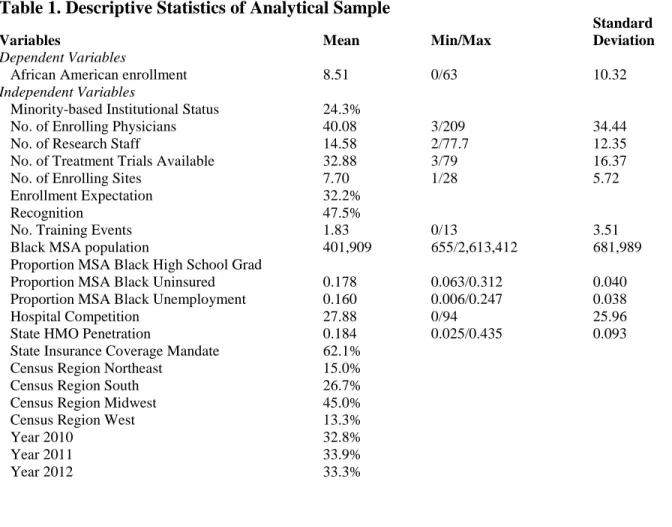
Descriptive statistics are included for the dependent variable and independent variables in
Table 1. CCOPs and MBCCOPs vary widely in their organizational characteristics and the environments in which they operate. CCOPs are typically larger research organizations than MBCCOPs, and have larger numbers of enrolling physicians, research staff, available trials, and enrolling sites. Moreover, MBCCOPs typically operate in resource-constrained environments, with wide variation in organizational characteristics depending on their organizational structure (Kaluzny, et. al., 1993).
Data Sources
NCI Comprehensive Cancer Centers in the US. The American College of Surgeons (ACoS) website provided names and addresses of Commission on Cancer certified hospitals with research nurses offering access to clinical trials. Names and addresses of academic medical centers in the US were drawn from the Association of American Medical Colleges data on Council of Teaching Hospitals members.
Dependent variable
The dependent variable of interest in this study is the annual count of black patients enrolled in NCI-sponsored trials offered by the sample CCOPs and MBCCOPs. Enrollment in trials is the primary measure of performance used by the NCI to evaluate CCOP/MBCCOPs PBRNs (Klabunde, et. al., 1994). CCOPs and MBCCOPs have minimum enrollment
requirements for trials, but do not have specific requirements for the minimum number of black patients enrolled. Black enrollment was selected for this analysis rather than minority enrollment due to the consistent availability of annual MSA-level community data to control for
confounding demographic effects. The dependent variable in this study remained in the natural count form rather than conversion to a logged form based on the results of Wooldridge tests of functional form (Wooldridge, 1994).
Independent variables of interest
training events; and count measures for the number of sites where patients can enroll in trials and the number of physicians enrolling patients for each CCOP or MBCCOP. Organizational
characteristics theorized to enhance opportunities to participate include a dichotomous variable designating an expectation for the physicians to annually enroll a minimum number of patients, and a dichotomous designation for CCOP or MBCCOP recognition of physicians’ enrollment in trials. Having a large menu of available trials for black populations to be eligible for is also expected to improve opportunities for participation in a treatment trial, and is included as the count of trials available at each CCOP or MBCCOP. Organizational characteristics expected to improve acceptance of an offer to participate include a dichotomous measure for MBCCOP status (serving a large minority population), and having a larger number of research staff available to help patients navigate the difficulties of participating in a trial.
Control Variables
competition for trial enrollment, CCOP/MBCCOP organizations, NCI Comprehensive Cancer Centers, academic medical centers, and hospitals recognized by American College of Surgeons (ACoS) Commission on Cancer that offer NCI trials were identified and geocoded in ArcGIS 12.1. Fifty-mile buffers were placed on each CCOP/MBCCOP organization, and the number of other cancer care organizations unaffiliated with the CCOP/MBCCOP that fell within these buffers were identified and tallied in order to generate the measure. Non-affiliated CCOP or MBCCOP enrolling locations in the fifty-mile buffers were also included as potential sources of competition. An interaction term between minority-based institutional status and MSA black population was included in the model to account for MBCCOPs in regions with particularly large black populations.
Analytic Model
The analysis examined black enrollment in trials using longitudinal, multivariate negative binomial count models with standard errors adjusted for clustering at the organizational level. Annual CCOP or MBCCOP enrollment of blacks was regressed on the independent variables. Skewness and kurtosis tests were used in order to evaluate normality of the error term. A
RESULTS
Bivariate analyses did not reveal problems with multicollinearity among the selected variables (Results available in Appendix).Marginal effects with bootstrapped standard errors for the models examining black enrollment in trials are presented in Table 2. Overall, CCOPs and MBCCOPs experienced declining enrollment of blacks in trials during the 2010-2012 study years. Results suggest that CCOPs and MBCCOPs in the South are associated with greater enrollment of blacks when compared with CCOPs and MBCCOPs in the Midwest; whereas CCOPs and MBCCOPs in the Northeast and West appear to have lower enrollment compared to CCOPs and MBCCOPs in the Midwest.
Annual black enrollment ranged from 0 to 63 in the sample (mean = 8.2, standard deviation = 10.3), and very few CCOPs and MBCCOPs enrolled more than 12 - 15 blacks to a treatment trial. The magnitude of the organizational characteristics on black enrollment also varies. The net impact of a training event, or an additional enrolling site or physician is between zero and one additional black participating in a treatment trial. An organizational expectation that physicians enroll a minimum number of patients appears to have a large negative impact on black enrollment. Organizations with enrollment expectations appear to enroll approximately 6 fewer blacks to treatment trials. Increasing the number of trials each CCOP or MBCCOP has available appears to have a negligible impact; however, efforts to provide recognition for physician enrollment appears to promote opportunities to participate, and may result in three or more black patients enrolling in a treatment trial. Finally, increasing the number of research staff may result in reducing barriers to acceptance of offers to clinical trials, but it appears that
organizations with tailored strategies to serving large minority populations have the largest impact on enrollment with 12 additional blacks enrolled by MBCCOPs.
significant impact on enrollment. The interaction terms between MBCCOP status and MSA black population is statistically significant; and the parameter coefficients included in Table 2 include the partial effect of the interaction since we sought to estimate marginal effects, and therefore analyzed the net impact of each organizational characteristic on black enrollment.
Sensitivity Analyses
In order to evaluate model fit and omitted variable bias, we conducted two sensitivity analyses. First, our analytical dataset included 24 (13.6%) observations with zero enrollments of blacks to trials. Zero-inflated negative binomial (ZINB) models are often used to account for excessive zeros in the dependent variable (Long and Freese, 2006). A ZINB model utilizes maximum likelihood estimates that are approximately normal in large samples, with standard errors and confidence intervals constructed to account for possible processes that result in a zero dependent variable (Cameron and Trivedi, 2010). The a priori assumption underlying the ZINB model lies in the probability that observations with a zero count are fundamentally different from other observations. Specifically, there is a 100% probability of always having a zero count for some of the observations. This requires the use of a separate modeling process predicting an outcome with a zero count. This study utilized the proportion of blacks in the MSA to explain observations that would have 100% probability of having zero enrollments of blacks. Standard and bias-corrected Vuong tests were used to compare negative binomial and zero-inflated negative binomial models, and results from each test indicated a better fit with the negative binomial model (Desmarais and Harden, 2013).
measure of black wealth was not included in the original analysis due to the correlations between income, education, insurance, and unemployment. Moreover, a parsimonious selection of
variables was included due to the small sample size of CCOPs and MBCCOPs. Since it is unclear if wealth is an endogenous factor in our model (Rivers, et. al., 2013; Baquet, et. al., 2006; Sateren, et. al., 2002), we collected data on median family wealth from U.S. Census American Community Survey 3-year estimates and added this variable to a post-hoc regression analyses to investigate potential omitted variable bias. Whereas MSA median black family income has very little impact on enrollment, and is not statistically significant, its inclusion in the model results in changes to other parameters, indicating model instability. The Bayesian
Information Criteria (BIC) goodness-of-fit measure for the model including MSA black family wealth is slightly higher than the model that does not include it, and the difference between the pseudo R2 for the models is very small. Overall, the impact of the potential model instability on
DISCUSSION
This study focused on the impact of organizational characteristics on enrollment of blacks in clinical treatment trials sponsored by PBRNs participating in the NCI Community Clinical Oncology Program from 2010-2012. Overall, our analysis provides support for Ford’s
conceptual framework, and demonstrates that organizational characteristics do have an impact on the enrollment of black patients in trials. This is the first study to find empirical support for the implementation of organizations with tailored strategies for serving minority populations on enrolling black patients using a multivariate statistical approach and detailed longitudinal data on organizations. On average, MBCCOPs enroll approximately 13 more blacks to trials than CCOPs. This may not appear a large number; however, this is no small number for an organization to enroll when considering the complexities of opening trials, and the multitude of individual-level barriers to black participation in clinical research (Chun & Park, 2012; Adams-Campbell, et. al., 2004). Therefore, our study suggests that policies further supporting the implementation of minority-focused clinical trials organizations may be critical to improve black participation in clinical research.
appears that organizational characteristics theorized to address opportunity barriers to enrollment have a larger net impact. For example, providing tokens of recognition to physicians for
enrolling patients may result in three or more black patients participating in trials annually. Implementing an enrollment expectation among physician appears to have a negative impact on black enrollment in trials. This was an interesting finding in light of recent research
demonstrating the impact of an expectation on individual-enrollment in clinical trials for all populations (Jacobs, et. al., 2014). We expect this is due to a subset of CTOs that have adopted strategies aimed at efficiently enrolling large number of patients. These “efficiency-oriented” CTOs typically do not open trials that are clinically relevant for minority populations; and more importantly, also implement an enrollment expectation as an approach to efficiently recruiting large numbers of overall patients to treatment trials. Considering findings from Jacobs and colleagues’ (2014) study, additional analyses may be necessary to understand the impact of expectations on overall trial enrollment versus minority trial enrollment. For example, a certain type of CCOP may enroll large numbers of blacks in trials with an enrollment expectation in combination with other organizational characteristics.
a PBRN; and is particularly relevant for organizations located in regions with sizable black or minority populations. This suggests that while MBCCOPs may have an edge in enrollment of black patients, non-minority focused organizations can employ strategies capable of enrolling blacks in clinical treatment trials. For example, in addition to promoting the development of MBCCOPs, promoting the development of focused research staff at CCOPs that are dedicated to enhancing minority participation may be an effective overall strategy for addressing barriers (Rivers, et. al., 2013; Vicini, et, al., 2011; Ford, et. al., 2008).
The positive and significant impact on enrollment of the number of other cancer care organizations in a CCOP or MBCCOP’s region suggests that nearby hospitals do not compete for black enrollment. Results from our study differ from previous studies on competition, which found that CCOPs had lower overall trial enrollment in communities with a larger presence of hospitals affiliated with a medical school (Carpenter, et. al., 2011). MBCCOPs are typically housed in, or closely affiliated with, an academic medical center. Thus, our findings may reflect the predominance of minority enrollment in academic organizations in regions with overall larger number of hospitals. Combined, these factors suggest that in order to enroll greater numbers of blacks to treatment trials, it may be appropriate to have both an MBCCOP and CCOP; or a CCOP with specific physicians and staff dedicated to enhancing minority participation located in regions with large minority populations.
2008), however, differs from a previous study on the impact of state insurance coverage mandates on minority trial participation (Chun & Park, 2012). However, the previous study examined enrollment of minorities from 2001-2007, which may have not have been enough time for policies regarding insurance coverage to have an impact on minority enrollment. Moreover, our study examined enrollment from 2010-2012, and our results may reflect the long-term impact of policies mandating coverage of clinical trials costs for minority populations.
Our study demonstrates that the environment in which CTOs operate are important for enrollment; however, we compared the pseudo R2 and BIC scores from our final model, and a model excluding organizational characteristics in post-hoc analyses. Estimates suggest that a model with only environmental variables explains approximately 9% of the variation in black enrollment in treatment trials (Appendix), whereas the model that includes organizational characteristics explains approximately 16% of the variation. Additionally, the BIC score for the model without organizational characteristics is greater than the BIC for the model with
organizational characteristics, indicating superior goodness-of-fit. However, based on results from post-hoc analyses, we urge caution in considering the net impact of an organizational characteristic on black enrollment in trials when it is possible that multifaceted strategies, comprised of combinations of tactics employed in specific environments, are responsible for high organizational enrollment of blacks to trials.
There are several limitations to this study. The relatively small sample of CCOPs and MBCCOPs is a limitation to the generalizability of our results to other clinical trials
regional demographic data, and detailed organizational characteristics. Additionally, there is a potential limitation in using spatially aggregated MSA variables in this analysis, including the potential for ecological fallacy if CCOPs and MBCCOPs operating environments are not accurately characterized by the MSAs in which they are located (Portnov, et. al., 2007; Openshaw, 1984). For example, hospital referral region data may reflect more accurately the demographics and market characteristics of each PBRN; however, those data were not available for the years of this study.
CONCLUSION
Figure 1. Aim 1 Conceptual Framework (Ford, et. al., 2008)
CCOP or MBCCOP
Awareness Acceptance
Awareness Barriers/ Promoters Training Events
Enrolling Sites Enrolling Physicians
Opportunity Barriers/ Promoters Expectation Recognition Trials available
Acceptance/ Refusal Barriers/ Promoters Minority-based
organization Research Staff
Opportunity
Enrollment Demographic/
Market Factors Black population
Educational attainment Health insurance
Unemployment Competition
Table 1. Descriptive Statistics of Analytical Sample
Standard
Variables Mean Min/Max Deviation
Dependent Variables
African American enrollment 8.51 0/63 10.32
Independent Variables
Minority-based Institutional Status 24.3%
No. of Enrolling Physicians 40.08 3/209 34.44
No. of Research Staff 14.58 2/77.7 12.35
No. of Treatment Trials Available 32.88 3/79 16.37
No. of Enrolling Sites 7.70 1/28 5.72
Enrollment Expectation 32.2%
Recognition 47.5%
No. Training Events 1.83 0/13 3.51
Black MSA population 401,909 655/2,613,412 681,989
Proportion MSA Black High School Grad
Proportion MSA Black Uninsured 0.178 0.063/0.312 0.040
Proportion MSA Black Unemployment 0.160 0.006/0.247 0.038
Hospital Competition 27.88 0/94 25.96
State HMO Penetration 0.184 0.025/0.435 0.093
State Insurance Coverage Mandate 62.1%
Census Region Northeast 15.0%
Census Region South 26.7%
Census Region Midwest 45.0%
Census Region West 13.3%
Year 2010 32.8%
Year 2011 33.9%
Year 2012 33.3%
Figure 2. NCI Cancer Centers, CCOPs/MBCCOPs, Commission on Cancer Hospitals, Academic Medical Centers
Table 2. Regression Results: Impact of Organizational Factors on Enrollment of Blacks in Cancer Clinical Treatment Trials
Variable
Marginal Effects
Standard
Error♯ P-value
95% Confidence Interval
Number of Training Events 0.496*** 0.194 0.011 0.116 0.876
Number of Enrolling Sites 0.159 0.191 0.403 -0.214 0.533
Number of Enrolling Physicians 0.035 0.030 0.253 -0.025 0.094
Enrollment Expectation -6.623*** 2.022 0.001 -10.585 -2.661
Enrollment Recognition 2.319 1.689 0.170 -0.992 5.631
Number of Treatment Trials Available 0.073 0.093 0.429 -0.108 0.255
MBCCOP 11.323** 5.165 0.028 1.199 21.466
CCOP - - - - -
Number of Research Staff 0.260** 0.113 0.022 0.038 0.483
MSA Black Population (1000s) 0.004** 0.002 0.012 0.001 0.008
MSA Proportion Black High School
Graduates 18.209 23.974 0.448 -28.780 65.197
MSA Proportion Black Uninsured 68.679** 34.633 0.047 0.799 136.558
MSA Proportion Black Unemployed -1.697 31.980 0.958 -64.376 60.982
Hospital Competition 0.219*** 0.055 0.000 0.111 0.328
State Managed Care Penetration 17.454 14.094 0.216 -0.181 45.078
State Insurance Coverage Mandate 3.335* 1.793 0.063 -0.181 6.850
Northeast -2.775 2.999 0.355 -8.654 3.105
South 7.799*** 2.845 0.006 2.222 13.377
West -4.756*** 1.769 0.007 -8.223 -1.289
Midwest - - - - -
2010 - - - - -
2011 -1.167 1.213 0.336 -3.543 1.209
2012 -2.193 1.331 0.100 -4.802 0.417
n = 172
Pseudo R2 = 0.1556; BIC = 1059.52
Table 3. ZINB Regression Results: Impact of Organizational Factors on Enrollment of Blacks in Cancer Clinical Treatment Trials
Variable
Marginal Effects
Standard
Error♯ P-value
95% Confidence Interval
Number of Training Events 0.397 0.301 0.188 -0.193 0.986
Number of Enrolling Sites 0.307** 0.140 0.028 0.033 0.580
Number of Enrolling Physicians 0.019 0.021 0.383 -0.024 0.062
Enrollment Expectation -3.768 1.950 0.053 -7.589 0.054
Enrollment Recognition 1.812 2.289 0.428 -2.673 6.298
Number of Treatment Trials Available 0.083 0.058 0.153 -0.031 0.196
MBCCOP 8.606* 5.145 0.094 -1.479 18.690
CCOP - - - - -
Number of Research Staff 0.165** 0.078 0.036 0.010 0.318
MSA Black Population (1000s) 0.026** 0.009 0.003 0.009 0.042
MSA Proportion Black High School
Graduates 8.776 22.887 0.701 -36.081 53.633
MSA Proportion Black Uninsured 58.928 42.460 0.165 -24.291 142.148
MSA Proportion Black Unemployed -7.961 37.631 0.832 -81.717 65.795
Hospital Competition 0.166*** 0.047 0.000 0.747 0.257
State Managed Care Penetration 21.518 14.121 0.128 -6.160 49.195
State Insurance Coverage Mandate 1.987 2.089 0.341 -2.107 6.081
Northeast -2.259 3.425 0.510 -8.972 4.454
South 4.424 3.022 0.143 -1.498 10.347
West -5.242*** 3.022 0.004 -8.799 -1.685
Midwest - - - - -
2010 - - - - -
2011 -0.851 0.832 0.307 -2.482 0.780
2012 -1.931*** 0.936 0.039 -3.766 -0.097
n = 172
Pseudo R2 = 0.1220; BIC = 1055.52
Table 4. Regression Results: Impact of Organizational Factors on Enrollment of Blacks in Cancer Clinical Treatment Trials (Add MSA Median Black Family Income)
Variable
Marginal Effects
Standard
Error♯ P-value
95% Confidence Interval
Number of Training Events 0.617*** 0.202 0.002 0.221 1.013
Number of Enrolling Sites 0.226 0.171 0.187 -0.11 0.562
Number of Enrolling Physicians 0.039 0.028 0.164 -0.016 0.093
Enrollment Expectation -6.295*** 1.899 0.001 -10.016 -2.573
Enrollment Recognition 2.815* 1.699 0.097 -0.514 6.145
Number of Treatment Trials Available 0.065 0.082 0.427 -0.095 0.225
MBCCOP 10.293** 5.061 0.042 0.373 20.213
CCOP - - - - -
Number of Research Staff 0.231** 0.097 0.017 0.041 0.421
MSA Black Population (1000s) 0.005** 0.002 0.031 0 0.01
MSA Proportion Black High School
Graduates 19.76 29.105 0.497 -37.285 76.805
MSA Proportion Black Uninsured 77.209** 34.555 0.025 9.482 144.935
MSA Proportion Black Unemployed 2.645 37.841 0.944 -71.523 76.813
MSA Median Black Family Income -0.0001 0 0.654 -0.001 0
Hospital Competition 0.139*** 0.047 0.003 0.046 0.232
State Managed Care Penetration 27.377* 14.911 0.066 -1.849 56.603
State Insurance Coverage Mandate 2.097 1.698 0.217 -1.231 5.425
Northeast -4.384 2.841 0.123 -9.953 1.184
South 4.768** 2.345 0.042 0.173 9.364
West
-5.0899*** 1.558 0.001 -8.144 -2.036
Midwest - - - - -
2010 - - - - -
2011 -0.813 1.16 0.483 -3.086 1.46
2012 -2.063 1.231 0.094 -4.476 0.35
n = 172
CHAPTER 3: A FUZZY-SET ANALYSIS OF ORGANIZATIONAL STRATEGIES PROMOTING MINORITY PARTICIPATION IN CANCER TREATMENT TRIALS
INTRODUCTION
More than 20 years since the NIH Revitalization Act mandated the inclusion of
minorities in NIH funded research, minorities remain disproportionately affected by cancer, and
continue to be underrepresented in cancer clinical trials when compared with non-Hispanic
whites (Chen, et. al., 2014; Durant, et. al., 2014; Newman, et. al., 2008; Stewart, et. al., 2007;
Murthy, et. al., 2004; Sateren, et. al., 2002). Overall, less than 3% of adult cancer patients
participate in trials, and minority populations represent less than 0.3% of participants (Vickers
and Fouad, 2014; Stewart, et. al., 2007). Moreover, research has also found an overall decline in
the proportion of minorities participating in clinical trials (Heller, et. al., 2014; Kwiatkowsky, et.
al., 2013; Newman, et. al., 2008).
For more than 30 years, the National Cancer Institute’s Clinical Oncology Program has
enrolled patients in clinical trials through the implementation of provider-based research network
(PBRN) organizations in community-based settings. These PBRN organizations are hereafter
referred to as “CCOPs,” or “MBCCOPs” for minority-based CCOPs, which specialize in serving
minority populations. CCOPs and MBCCOPs are collaborations between academic-based
physicians and oncology physicians in community-based hospitals and private practices. CCOPs
and MBCCOPs have been very successful, resulting in one-third of all patients, and one-fifth of
minority patients enrolled in NCI-sponsored clinical treatment trials (Minasian, et. al., 2010).
patient and provider-level barriers to participation in clinical trials; however, studies focusing on
organizational strategies to enroll minority populations in clinical treatment trials are limited.
(George, et. al.2014; Schmotzer, 2012; Ford et. al., 2008; Howerton, et. al., 2007). Barriers to
participation include lack of provider awareness of locally available trials, unfavorable provider
attitudes, patient mistrust and limited geographic access (George, et. al., 2014; Schmotzer, 2012;
Ford, et. al. 2008; Lara, et. al., 2001). Unfortunately, empirical studies focusing on strategies
associated with minority participation in clinical trials have been limited to descriptive studies
examining organizational staffing and resource barriers (McCaskill-Stevens, et. al., 2006;
Adams-Campbell, et. al., 2004); and single site case studies of minority outreach or patient
navigator programs (Holmes, et. al., 2012; Paskett, et. al, 2011; Vicini, et. al., 2011). Specific
studies on CCOPs and MBCCOPs suggest that enrollment of patients in clinical trials varies with
certain organizational strategies, comprised of tactics (Weiner, et. al. 2012; Teal, et. al. 2012;
Clauser, et. al., 2009; McKinney, et. al., 2006; Weiner, et. al., 2006; Kaluzny, et. al., 1989). In
this study, tactics are the organizational characteristics implemented by CTOs such as training
events, or a large research staff. For example, studies examining specific tactics resulting in high
minority enrollment have suggested community-based participatory research approaches,
outreach, and trainings (Vicini, et. al., 2011), or patient navigation programs (Holmes DR, et. al.,
2012) are associated with greater enrollment of minorities in treatment trials. Results from a
fuzzy-set analysis of strategies associated with high levels of overall enrollment in clinical
treatment trials among CCOP organizations indicated that the number of new patients, the
number of available treatment trials, and the number of enrolling sites are key tactics in
strategies or tactics consistently associated with high enrollment of minorities in clinical
treatment trials.
This gap in the research limits our ability to develop, implement, and evaluate strategies
in order to improve minority participation in clinical treatment trials. The aim of this study is to
examine the organizational strategies and tactics implemented by CCOPs and MBCCOPs that
result in high organizational enrollment of minority populations in NCI-sponsored clinical
treatment trials. In order to accomplish this aim, we collected detailed organizational data on
CCOPs and MBCCOPs actively enrolling patients in clinical trials from 2010-2012; and
employed a novel method, fuzzy-set qualitative comparative analysis to investigate the tactics,
and combinations of tactics that lead to high organizational enrollment of minorities to treatment
trials. Fuzzy-set qualitative comparative analysis (fsQCA) is used for this study based on results
from a multivariate analysis of organizational characteristics suggesting that CCOPs and
MBCCOPs may achieve high enrollment of minorities in trials based on the impact of
combinations of organizational characteristics (Belden, et. al., dissertation chapter 2 –
manuscript 1). Moreover, fsQCA is particularly appropriate when an outcome of interest (high
organizational enrollment of minorities to treatment trials) may be the result of varying strategies,
which are themselves combinations of different tactics. To our knowledge, this is the first study
to empirically examine the tactics that CCOP and MBCCOP organizations implement in order to
enroll high numbers of minorities to clinical treatment trials.
METHODS
Study Setting
This study focuses on provider-based research network (PBRN) organizations