Chapter 31
Branding, Packaging,
and Labeling
Chapter 31
Branding, Packaging,
and Labeling
•
Section 31.1 Branding Elements and Strategies
•
Section 31.2 Packaging and Labeling
•
Section 31.1 Branding Elements and Strategies
Branding Elements and Strategies
Objectives
Discuss the nature, scope, and importance of branding in product planning
Identify the various branding elements
List three different types of brands
Explain how branding strategies are used to meet sales and company goals
Key Terms brand brand name trade name brand mark trade character trademark national brands private distributor brands generic brands brand extension brand licensing mixed brand co-branding
Elements of Branding
A brand
is a name, term, design, symbol, or combination of these elements that identifies a product or service and distinguishes it from its competitors. Brands include elements such as:• Brand and trade names
• Trade and brand marks, and trade characters brand
Elements of Branding
A brand name , also called a product brand, is a
word, group of words, letters, or numbers that represent a product or service.
brand name
A word, group of words, letters, or numbers that represent a product or service; also known as a product brand.
Elements of Branding
A trade name , or corporate brand, identifies and
promotes a company or a division of a particular corporation.
trade name
A phrase or symbol that identifies and promotes a company or a division of a particular
corporation; also known as a
Elements of Branding
A brand mark is a unique symbol, coloring,
lettering, or other design element. It is recognizable visually and does not need to be pronounced.
brand mark
A unique symbol, coloring,
lettering, or other design elements.
Elements of Branding
A trade character is brand mark that has human
form or characteristics. trade
character
A brand mark that has human form or
Elements of Branding
A trademark is a word, name, symbol, device, or
combination of these elements that is given legal protection by the federal government. Trademarks are used to prevent other companies from using a similar element that might be confused with the trademarked one.
trademark
A brand name, brand mark, trade name, trade character, or a combination of these
elements that is given legal
protection by the federal
government.
Importance of Brands in Product
Planning
The use of brands is important in product planning for several reasons:
• To build product recognition and customer loyalty
• To ensure quality and consistency
Generating Brand
Names
Companies will generate brand names by using specialized
computer software, or by hiring:
• Branding agencies
• Naming consultants
• Public relations firms
Marketing Essentials Chapter 31, Section 31.1
Types of Brands
There are three classifications of brands, one for each type of company that brands its products:
• National brands (manufacturers)
• Private distributor brands (wholesalers and retailers)
Types of Brands
National brands are owned and initiated by
national manufacturers or by companies that provide services, such as:
• Hershey • Whirlpool • Ford national brands Brands that are owned and initiated by national manufacturers or service companies; also known as producer brands.
Types of Brands
Private distributor brands
are developed
and owned by wholesalers and retailers. The
manufacturer’s name does not appear on the
product, for example:
•
Wal-Mart’s Great Value
•
Target’s Mossimo
private distributor brands
Brands that are developed and owned by
Types of Brands
Generic brands are products that do not carry a
company identity. They are generally sold in supermarkets and discount stores.
Companies that manufacture and sell generic brands do not heavily advertise or promote these products, and therefore they can pass on savings to customers. generic
brands
Products that do not carry a
company identity.
Branding Strategies
Some branding strategies used to meet sales and company objectives are:
• Brand extensions
• Brand licensing
• Mixed branding
Brand Extension
Brand extension is a branding strategy that uses
an existing brand name to promote a new or improved product in a company’s product line.
This strategy’s risk is overextending a product line and diluting the brand with too many products.
brand
extension
A branding strategy that uses an existing brand name to promote a new or improved product in a company’s product line.
Brand Licensing
Brand licensing involves a legal licensing
agreement for which the licensing company receives a fee, such as a royalty, in return for allowing
Mixed Brands
Some manufacturers and retailers use a mixed-brand strategy to sell products. They offer a
combination of manufacturer, private distributor, and generic brands. For example, a manufacturer of a national brand might agree to make a product for sale under another company’s brand.
mixed-brand
Selling a
combination of manufacturer, private
distributor, and generic brands.
Co-Branding
A co-branding strategy combines one or more
brands in the manufacture of a product or in the
delivery of a service. It can also happen when two or more retailers share the same location.
co-branding
A combination of one or more
brands in the manufacture of a product or in the delivery of a
Packaging and Labeling
Objectives
Explain the functions of product packaging
Identify the functions of labels Key Terms package mixed bundling price bundling blisterpacks aseptic packaging cause packaging label brand label descriptive label grade label
Factors Involved In Price Planning
Graphic Organizer
A package is the physical container or wrapping
for a product. Developing a product’s package is an integral part of product planning and promotion because the package is a selling tool.
package The physical container or wrapping for a product.
Packaging
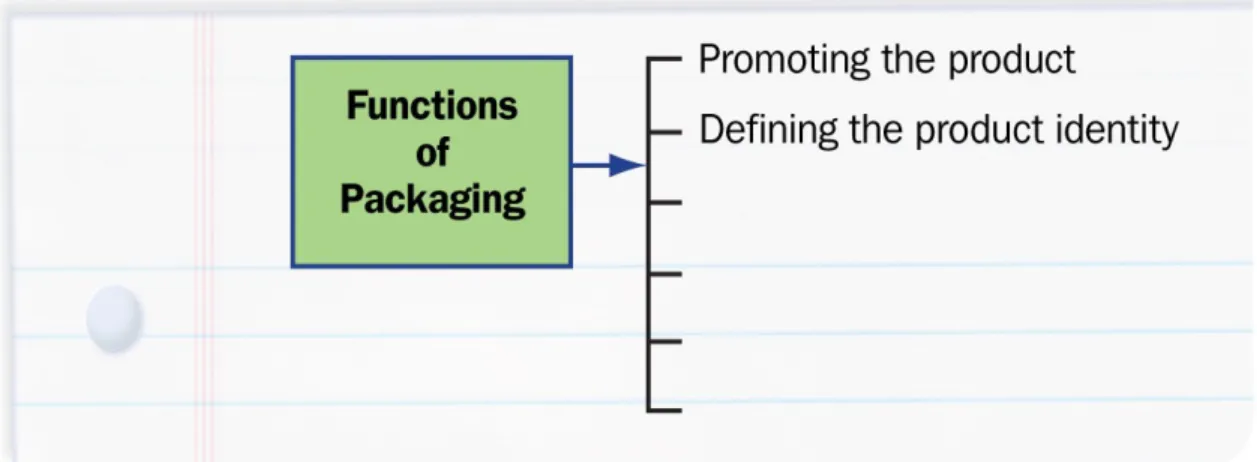
Packaging fulfills several functions, including:
• Promoting and selling the product
• Defining product identity
• Providing information
• Expressing benefits and features
• Ensuring safe use
Sometimes multiple complementary items are bundled together in one package. The practice of packaging different products and services together is known as mixed bundling .
Price bundling occurs when two or more
products are placed on sale for one package price. mixed
bundling
The practice of packaging different products and services together. price bundling Two or more similar products are placed on sale for one package price.
Functions of Packaging
Attractive, colorful, and visually appealing
packages have promotional value and can carry important messages about the product’s
performance, features, and benefits.
Packages often promote an image such as
prestige, convenience, or status. They also give directions for using the product and information about:
• Contents and nutritional value
• Product guarantees
• Potential hazards
Functions of Packaging
Packaging comes in different sizes to meet the needs of different market segments, from
individuals to families.
Packaging can help improve product safety for the customer. Many products formerly packaged in glass now come in plastic containers. To
encourage customer safety, goods such as non-prescription drugs, cosmetics, and food items are sold in tamper-resistant blisterpacks.
Functions of Packaging
Blisterpacks are packages with preformed
plastic molds surrounding individual items arranged on a backing.
blisterpack Packaging with preformed plastic molds
surrounding individual items arranged on a cardboard backing.
Packaging needs to protect a product during
shipping, storage, and display. The package design should also prevent or discourage tampering,
prevent shoplifting, and protect against breakage and spoilage.
Functions of Packaging
Packaging gives companies the opportunity to incorporate the latest technologies and address lifestyle changes as well as environmental, social, and political concerns.
Aseptic packaging involves separately
sterilizing the package and the food product, and filling and sealing the package in a sterile
environment. Canning and bottling are examples of this method, which keeps food fresh for up to six months.
aseptic packaging
A food storage process that
keeps foods fresh without
refrigeration for up to six months.
Contemporary Packaging Issues
Companies are trying to develop packages that respond to consumer demand for environmentally sensitive designs. Many companies that
manufacture spray products have switched to pump dispensers to cut back on the release of ozone-damaging chlorofluorocarbons (CFCs).
Cause packaging involves using packages to
promote social and political causes. The issues on the packages may be totally unrelated to the
products inside. cause
packaging
Packaging that is used by
companies to promote social and political causes.
Contemporary Packaging Issues
A label is an information tag, wrapper, seal, or
imprinted message that is attached to a product or its package. Its main function is to inform
customers about the product’s contents and give directions for its use.
label
An information tag, wrapper, seal, or
imprinted
message that is attached to a product or its package.
There are three kinds of labels:
• Brand
• Descriptive
• Grade
Labeling
The brand label gives the brand name,
trademark, or logo. It does not supply sufficient product information.
brand label Label giving the brand name, trademark, or logo.
A descriptive label gives information about the
product’s use, construction, care, performance, and other features.
descriptive label
A label that gives information about the product’s use, construction, care, performance, and other features.
Labeling
A descriptive label includes date and storage
information for food items. Instructions for proper use and product care are provided on nonfood
items.
A grade label states the quality of the product.
grade label
A label that
states the quality of the product.
The Fair Packaging and Labeling Act (FPLA) of 1966 established mandatory labeling
requirements. The federal Nutrition Labeling and Education Act enacted in 1994 requires that labels give nutritional information on how a food fits into an overall daily diet.
Labeling
Health claims on food items are monitored by the U.S. Food and Drug Administration (FDA), which also requires that manufacturers of certain
products place health warnings on their packages.
The Federal Trade Commission (FTC) monitors labels and advertising for false or misleading claims.
The U.S. Department of Agriculture (USDA) issues legal standards and certification requirements for organic labels.
Labeling
SECTION 31.2 REVIEW
-Section 31.1
Section 31.2
The functions of packaging include promoting and selling the product, defining product identity,
providing information, expressing benefits and features to customers, ensuring safe use, and protecting the product.
This chapter has helped prepare you to meet the following DECA performance indicators:
• Explain the nature of branding.
• Describe the uses of grades and standards in marketing.
• Explain the use of brand names in selling.