Norman I. Badler
Cary B. Phillips
1Bonnie L. Webber
Department of Computer and Information Science
University of Pennsylvania
Philadelphia, PA 19104-6389
Oxford University Press
c
1992 Norman I Badler, Cary B. Phillips, Bonnie L. Webber
March 25, 1999
1 Introduction and Historical Background
1
1.1 Why Make Human Figure Models? : : : : : : : : : : : : : : : : 4 1.2 Historical Roots : : : : : : : : : : : : : : : : : : : : : : : : : : : 7 1.3 What is Currently Possible? : : : : : : : : : : : : : : : : : : : : 11
1.3.1 A Human Model must be Structured Like the Human Skeletal System : : : : : : : : : : : : : : : : : : : : : : : 12 1.3.2 A Human Model should Move or Respond Like a Human 12 1.3.3 A Human Model should be Sized According to
Permis-sible Human Dimensions : : : : : : : : : : : : : : : : : : 14 1.3.4 A Human Model should have a Human-Like Appearance 15 1.3.5 A Human Model must Exist, Work, Act and React
Within a 3D Virtual Environment : : : : : : : : : : : : 15 1.3.6 Use the Computer to Analyze Synthetic Behaviors : : : 16 1.3.7 An Interactive Software Tool must be Designed for
Us-ability : : : : : : : : : : : : : : : : : : : : : : : : : : : : 18 1.4 Manipulation, Animation, and Simulation : : : : : : : : : : : : 19 1.5 What Did We Leave Out? : : : : : : : : : : : : : : : : : : : : : 20
2 Body Modeling
23
2.1 Geometric Body Modeling : : : : : : : : : : : : : : : : : : : : : 23 2.1.1 Surface and Boundary Models : : : : : : : : : : : : : : : 23 2.1.2 Volume and CSG Models : : : : : : : : : : : : : : : : : 25 2.1.3 The Principal Body Models Used : : : : : : : : : : : : : 27 2.2 Representing Articulated Figures : : : : : : : : : : : : : : : : : 28 2.2.1 Background : : : : : : : : : : : : : : : : : : : : : : : : : 29 2.2.2 The Terminology of Peabody : : : : : : : : : : : : : : : 30 2.2.3 The Peabody Hierarchy : : : : : : : : : : : : : : : : : : 31 2.2.4 Computing Global Coordinate Transforms : : : : : : : : 33 2.2.5 Dependent Joints : : : : : : : : : : : : : : : : : : : : : : 33 2.3 A Flexible Torso Model : : : : : : : : : : : : : : : : : : : : : : 34 2.3.1 Motion of the Spine : : : : : : : : : : : : : : : : : : : : 36 2.3.2 Input Parameters : : : : : : : : : : : : : : : : : : : : : : 37 2.3.3 Spine Target Position : : : : : : : : : : : : : : : : : : : 38 2.3.4 Spine Database : : : : : : : : : : : : : : : : : : : : : : : 38
2.4 Shoulder Complex : : : : : : : : : : : : : : : : : : : : : : : : : 39 2.4.1 Primitive Arm Motions : : : : : : : : : : : : : : : : : : 40 2.4.2 Allocation of Elevation and Abduction : : : : : : : : : : 41 2.4.3 Implementation of Shoulder Complex : : : : : : : : : : 41 2.5 Clothing Models : : : : : : : : : : : : : : : : : : : : : : : : : : 45 2.5.1 Geometric Modeling of Clothes : : : : : : : : : : : : : : 46 2.5.2 Draping Model : : : : : : : : : : : : : : : : : : : : : : : 48 2.6 The Anthropometry Database : : : : : : : : : : : : : : : : : : : 49 2.6.1 Anthropometry Issues : : : : : : : : : : : : : : : : : : : 49 2.6.2 Implementation of Anthropometric Scaling : : : : : : : 50 2.6.3 Joints and Joint Limits : : : : : : : : : : : : : : : : : : 51 2.6.4 Mass : : : : : : : : : : : : : : : : : : : : : : : : : : : : : 53 2.6.5 Moment of Inertia : : : : : : : : : : : : : : : : : : : : : 53 2.6.6 Strength : : : : : : : : : : : : : : : : : : : : : : : : : : : 54 2.7 The Anthropometry Spreadsheet : : : : : : : : : : : : : : : : : 54 2.7.1 Interactive Access Anthropometric Database : : : : : : 56 2.7.2 SASS and the Body Hierarchy : : : : : : : : : : : : : : 57 2.7.3 The Rule System for Segment Scaling : : : : : : : : : : 57 2.7.4 Figure Creation : : : : : : : : : : : : : : : : : : : : : : : 59 2.7.5 Figure Scaling : : : : : : : : : : : : : : : : : : : : : : : 59 2.8 Strength and Torque Display : : : : : : : : : : : : : : : : : : : 60 2.8.1 Goals of Strength Data Display : : : : : : : : : : : : : : 61 2.8.2 Design of Strength Data Displays : : : : : : : : : : : : : 61
3 Spatial Interaction
67
4 Behavioral Control
101
4.1 An Interactive System for Postural Control : : : : : : : : : : : 102 4.1.1 Behavioral Parameters : : : : : : : : : : : : : : : : : : : 103 4.1.2 Passive Behaviors : : : : : : : : : : : : : : : : : : : : : : 109 4.1.3 Active Behaviors : : : : : : : : : : : : : : : : : : : : : : 114 4.2 Interactive Manipulation With Behaviors : : : : : : : : : : : : 116 4.2.1 The Feet : : : : : : : : : : : : : : : : : : : : : : : : : : 117 4.2.2 The Center of Mass and Balance : : : : : : : : : : : : : 117 4.2.3 The Torso : : : : : : : : : : : : : : : : : : : : : : : : : : 120 4.2.4 The Pelvis : : : : : : : : : : : : : : : : : : : : : : : : : : 123 4.2.5 The Head and Eyes : : : : : : : : : : : : : : : : : : : : 123 4.2.6 The Arms : : : : : : : : : : : : : : : : : : : : : : : : : : 123 4.2.7 The Hands and Grasping : : : : : : : : : : : : : : : : : 126 4.3 The Animation Interface : : : : : : : : : : : : : : : : : : : : : : 126 4.4 Human Figure Motions : : : : : : : : : : : : : : : : : : : : : : 128 4.4.1 Controlling Behaviors Over Time : : : : : : : : : : : : : 129 4.4.2 The Center of Mass : : : : : : : : : : : : : : : : : : : : 129 4.4.3 The Pelvis : : : : : : : : : : : : : : : : : : : : : : : : : : 130 4.4.4 The Torso : : : : : : : : : : : : : : : : : : : : : : : : : : 130 4.4.5 The Feet : : : : : : : : : : : : : : : : : : : : : : : : : : 130 4.4.6 Moving the Heels : : : : : : : : : : : : : : : : : : : : : : 131 4.4.7 The Arms : : : : : : : : : : : : : : : : : : : : : : : : : : 132 4.4.8 The Hands : : : : : : : : : : : : : : : : : : : : : : : : : 132 4.5 Virtual Human Control : : : : : : : : : : : : : : : : : : : : : : 132
5 Simulation with Societies of Behaviors
137
5.3.7 Evaluation of this Approach : : : : : : : : : : : : : : : : 173 5.3.8 Performance Graphs : : : : : : : : : : : : : : : : : : : : 173 5.3.9 Coordinated Motion : : : : : : : : : : : : : : : : : : : : 174 5.4 Collision-Free Path and Motion Planning : : : : : : : : : : : : 180 5.4.1 Robotics Background : : : : : : : : : : : : : : : : : : : 180 5.4.2 Using Cspace Groups : : : : : : : : : : : : : : : : : : : 181 5.4.3 The Basic Algorithm : : : : : : : : : : : : : : : : : : : : 182 5.4.4 The Sequential Algorithm : : : : : : : : : : : : : : : : : 183 5.4.5 The Control Algorithm : : : : : : : : : : : : : : : : : : 185 5.4.6 The Planar Algorithm : : : : : : : : : : : : : : : : : : : 186 5.4.7 Resolving Conicts between Dierent Branches : : : : : 186 5.4.8 Playing Back the Free Path : : : : : : : : : : : : : : : : 187 5.4.9 Incorporating Strength Factors into the Planned Motion 189 5.4.10 Examples : : : : : : : : : : : : : : : : : : : : : : : : : : 190 5.4.11 Completeness and Complexity : : : : : : : : : : : : : : 191 5.5 Posture Planning : : : : : : : : : : : : : : : : : : : : : : : : : : 192 5.5.1 Functionally Relevant High-level Control Parameters : : 196 5.5.2 Motions and Primitive Motions : : : : : : : : : : : : : : 197 5.5.3 Motion Dependencies : : : : : : : : : : : : : : : : : : : 197 5.5.4 The Control Structure of Posture Planning : : : : : : : 199 5.5.5 An Example of Posture Planning : : : : : : : : : : : : : 200
6 Task-Level Specications
207
7 Epilogue
243
7.1 A Roadmap Toward the Future : : : : : : : : : : : : : : : : : : 244 7.1.1 Interactive Human Models : : : : : : : : : : : : : : : : : 245 7.1.2 Reasonable Biomechanical Properties : : : : : : : : : : 245 7.1.3 Human-like Behaviors : : : : : : : : : : : : : : : : : : : 245 7.1.4 Simulated Humans as Virtual Agents : : : : : : : : : : : 246 7.1.5 Task Guidance through Instructions : : : : : : : : : : : 246 7.1.6 Natural Manual Interfaces and Virtual Reality : : : : : 246 7.1.7 Generating Text, Voice-over, and Spoken Explication
for Animation : : : : : : : : : : : : : : : : : : : : : : : : 247 7.1.8 Coordinating Multiple Agents : : : : : : : : : : : : : : : 247 7.2 Conclusion : : : : : : : : : : : : : : : : : : : : : : : : : : : : : 248
Bibliography
249
Preface
The decade of the 80's saw the dramatic expansion of high performance computer graphics into domains previously able only to irt with the tech-nology. Among the most dramatic has been the incorporation of real-time interactive manipulation and display for human gures. Though actively pur-sued by several research groups, the problem of providing a virtual or synthetic human for an engineer or designer already accustomed to Computer-Aided De-sign techniques was most comprehensively attacked by the Computer Graphics Research Laboratory at the University of Pennsylvania. The breadth of that eort as well as the details of its methodology and software environment are presented in this volume.
This book is intended for human factors engineers requiring current knowl-edge of how a computer graphics surrogate human can augment their analy-ses of designed environments. It will also help inform design engineers of the state-of-the-art in human gure modeling, and hence of the human-centered design central to the emergent notion of Concurrent Engineering. Finally, it documents for the computer graphics community a major research eort in the interactive control and motion specication of articulated human gures. Many people have contributed to the work described in this book, but the textual material derives more or less directly from the eorts of our current and former students and sta: Tarek Alameldin, Francisco Azuola, Breck Baldwin, Welton Becket, Wallace Ching, Paul Diefenbach, Barbara Di Eu-ngenio, Jerey Esakov, Christopher Geib, John Granieri, Marc Grosso, Pei-Hwa Ho, Mike Hollick, Moon Jung, Jugal Kalita, Hyeongseok Ko, Eunyoung Koh, Jason Koppel, Michael Kwon, Philip Lee, Libby Levison, Gary Monheit, Michael Moore, Ernest Otani, Susanna Wei, Graham Walters, Michael White, Jianmin Zhao, and Xinmin Zhao. Additional animation help has come from Leanne Hwang, David Haynes, and Brian Stokes. John Granieri and Mike Hollick helped considerably with the photographs and gures.
This work would not have been possible without the generous and often long term support of many organizations and individuals. In particular we would like to acknowledge our manycolleagues and friends: Barbara Woolford, Geri Brown, Jim Maida, Abhilash Pandya and the late Linda Orr in the Crew Station Design Section and Mike Greenisen at NASA Johnson Space Center; Ben Cummings, Brenda Thein, Bernie Corona, and Rick Kozycki of the U.S. Army Human Engineering Laboratory at Aberdeen Proving Grounds; James Hartzell, James Larimer, Barry Smith, Mike Prevost, and Chris Neukom of the A3I Project in the Aeroight Dynamics Directorate of NASA Ames
and Joseph Spann of Hughes Missile Systems (formerly General Dynamics, Convair Division); Ruth Maulucci of MOCO Inc.; John McConville, Bruce Bradtmiller, and Bob Beecher of Anthropology Research Project, Inc.; Ed-mund Khouri of Lockheed Engineering and Management Services; Barb Fecht of Battelle Pacic Northwest Laboratories; Jerry Duncan of Deere and Com-pany; Ed Bellandi of FMC Corp.; Steve Gulasy of Martin-Marietta Denver Aerospace; Joachim Grollman of Siemens Research; Kathleen Robinette of the Armstrong Medical Research Lab at Wright-Patterson Air Force Base; Harry Frisch of NASA Goddard Space Flight Center; Jerry Allen and the folks at Sil-icon Graphics, Inc.; Jack Scully of Ascension Technology Corp.; the National Science Foundation CISE Grant CDA88-22719 and ILI Grant USE-9152503; and the State of Pennsylvania Benjamin Franklin Partnership. Martin Zaidel contributed valuable LaTEX help. Finally, the encouragement and patience of
Don Jackson at Oxford University Press has been most appreciated. Norman I. Badler
University of Pennsylvania Cary B. Phillips
PDI, Sunnyvale Bonnie L. Webber
Introduction and
Historical Background
People are all around us. They inhabit our home, workplace, entertainment, and environment. Their presence and actions are noted or ignored, enjoyed or disdained, analyzed or prescribed. The very ubiquitousness of other people in our lives poses a tantalizing challenge to the computational modeler: people are at once the most common object of interest and yet the most structurally complex. Their everyday movements are amazingly uid yet demanding to reproduce, with actions driven not just mechanically by muscles and bones but also cognitively by beliefs and intentions. Our motor systems manage to learn how to make us move without leaving us the burden or pleasure of knowing how we did it. Likewise we learn how to describe the actions and behaviors of others without consciously struggling with the processes of perception, recognition, and language.
A famous Computer Scientist, Alan Turing, once proposed a test to deter-mine if a computational agent is intelligent [Tur63]. In the Turing Test, a sub-ject communicates with two agents, one human and one computer, through a keyboard which eectively restricts interaction to language. The subject attempts to determine which agent is which by posing questions to both of them and guessing their identities based on the \intelligence" of their answers. No physical manifestation or image of either agent is allowed as the process seeks to establish abstract \intellectual behavior," thinking, and reasoning. Although the Turing Test has stood as the basis for computational intelli-gence since 1963, it clearly omits any potential to evaluate physical actions, behavior, or appearance.
Later, Edward Feigenbaum proposed a generalized denition that included action: \Intelligent action is an act or decision that is goal-oriented, arrived at by an understandable chain of symbolic analysis and reasoning steps, and is one in which knowledge of the world informs and guides the reasoning." [Bod77]. We can imagine an analogous \Turing Test" that would have the
subject watching the behaviors of two agents, one human and one synthetic, while trying to determine at a better than chance level which is which. Human movementenjoys a universality and complexity that would denitely challenge an animated gure in this test: if a computer-synthesized gure looks, moves, and acts like a real person, are we going to believe that it is real? On the sur-face the question almost seems silly, since we would rather not allow ourselves to be fooled. In fact, however, the question is moot though the premises are slightly dierent: cartoon characters are hardly \real," yet we watch them and properly interpret their actions and motions in the evolving context of a story. Moreover, they are not \realistic" in the physical sense { no one expects to see a manifest Mickey Mouse walking down the street. Nor do cartoons even move like people { they squash and stretch and perform all sorts of actions that we would never want to do. But somehow our perceptions often make these characters believable: they appear to act in a goal-directed way because their human animators have imbued them with physical \intelligence" and behaviors that apparently cause them to chase enemies, bounce o walls, and talk to one another. Of course, these ends are achieved by the skillful weaving of a story into the crafted images of a character. Perhaps surprisingly, the mechanisms by which motion, behavior, and emotion are encoded into car-toons isnotby building synthetic models of little creatures with muscles and nerves. The requisite animator skills do not come easily; even in the cartoon world renements to the art and technique took much work, time, and study [TJ81]. Creating such movements automatically in response to real-time in-teractive queries posed by the subject in our hypothetical experiment does not make the problem any easier. Even Turing, however, admitted that the intel-ligence sought in his original test did not require the computationalprocess
of thinking to be identical to that of the human: the external manifestation in a plausible and reasonable answer was all that mattered.
So why are we willing to assimilate the truly articial reality of cartoons { characters created and moved entirely unlike \real" people { yet be skeptical of more human-like forms? This question holds the key to our physical Turing Test: as the appearance of a character becomes more human, our perceptual apparatus demands motion qualities and behaviors which sympathize with our expectations. As a cartoon character takes on a human form, the only currently viable method for accurate motion is the recording of a real actor and the tracing or transfer (\rotoscoping") of that motion into the animation. Needless to say, this is not particularly satisfying to the modeler: the motion and actor must exist prior to the synthesized result. Even if we recorded thousands of individual motions and retrieved them through some kind of indexed video, we would still lack the freshness, variability, and adaptability of humans to live, work, and play in an innite variety of settings.
expected to behave like them. How to accomplish this without a real actor showing the way is the challenge addressed here.
Present technology can approach human appearance and motion through computer graphics modeling and three-dimensional animation, but there is considerable distance to go before purely synthesized gures trick our senses. A number of promising research routes can be explored and many are tak-ing us a considerable way toward that ultimate goal. By properly delimittak-ing the scope and application of human models, we can move forward, not to re-place humans, but to substitute adequate computational surrogates in various situations otherwise unsafe, impossible, or too expensive for the real thing.
The goals we set in this study are realistic but no less ambitious than the physical Turing Test: we seek to build computational models of human-like gures which, though they may not trick our senses into believing they are alive, nonetheless manifest animacy and convincing behavior. Towards this end, we
Create an interactive computer graphics human model. Endow it with reasonable biomechanical properties. Provide it with \human-like" behaviors.
Use this simulated gure as an agent to eect changes in its world. Describe and guide its tasks through natural language instructions.
There are presently no perfect solutions to any of these problems, but sig-nicant advances have enabled the consideration of the suite of goals under uniform and consistent assumptions. Ultimately, we should be able to give our surrogate human directions that, in conjunction with suitable symbolic reasoning processes, make it appear to behave in a natural, appropriate, and intelligent fashion. Compromises will be essential, due to limits in computa-tion, throughput of display hardware, and demands of real-time interaccomputa-tion, but our algorithms aim to balance the physical device constraints with care-fully crafted models, general solutions, and thoughtful organization.
simultaneous constraints { provide extremely useful features for the conven-tional animator. Our software design has tried to take into account a wide variety of physical problem-oriented tasks, rather than just oer a computer graphics and animation tool for the already skilled or computer-sophisticated animator.
The remainder of this chapter motivates the human factors environment and then traces some of the relevant history behind the simulation of human gures in this and other domains. It concludes with a discussion of the specic features a human modeling and animation system should have and why we have concentrated on some and not others. In particular, we are not consid-ering cognitive problems such as perception or sensory interpretation, target tracking, object identication, or control feedback that might be important parts of some human factors analyses. Instead we concentrate on modeling a virtual human with reasonable biomechanical structure and form, as described in Chapter 2. In Chapter 4 we address the psychomotor behaviors manifested by such a gure and show how these behaviors may be interactively accessed and controlled. Chapter 5 presents several methods of motion control that bridge the gap between biomechanical capabilities and higher level tasks. Fi-nally, in Chapter 6 we investigate the cognition requirements and strategies needed to have one of these computational agents follow natural language task instructions.
1.1 Why Make Human Figure Models?
It is dicult to precisely characterize the types of problems a human fac-tors engineer might address. Diverse situations demand empirical data on human capabilities and performance in generic as well as highly specic tasks. Here are some examples.
Population studies can determine body sizes representative of some
group, say NASA astronaut trainees, and this information can be used to determine if space vehicle work cells are adequately designed to t the individuals expected to work there. Will all astronauts be able to t through doors or hatches? How will changes in the workplace design aect the t? Will there be unexpected obstructions to zero gravity locomotion? Where should foot- and hand-holds be located?
An individual operating a vehicle such as a tractor will need to see
the surrounding space to execute the task, avoid any obstructions, and insure safety of nearby people. What can the operator see from a par-ticular vantage point? Can he control the vehicle while looking out the rear window? Can he see the blade in order to follow an excavation line?
Specic lifting studies might be performed to determine back strain
limits for a typical worker population. Is there room to perform a lift properly? What joints are receiving the most strain? Is there a better posture to minimize torques? How does placement of the weight and target aect performance? Is the worker going to suer fatigue after a few iterations?
Even more specialized experiments may be undertaken to evaluate the
comfort and feel of a particular tool's hand grip. Is there sucient room for a large hand? Is the grip too large for a small hand? Are all the controls reachable during the grip?
The answers to these and other questions will either verify that the design is adequate or point to possible changes and improvements early in the design process. But once again, the diversity of human body sizes coupled with the multiplier of human action and interaction with a myriad things in the environment leads to an explosion in possible situations, data, and tests.
Any desire to build a \complete" model of human behavior, even for the human factors domain, is surely a futile eort. The eld is too broad, the literature immense, and the theory largely empirical. There appear to be two directions out of this dilemma. The rst would be the construction of a computational database of all the known, or at least useful, data. Vari-ous eorts have been undertaken to assemble such material, for example, the NASA sourcebooks [NAS78, NAS87] and theEngineering Data Compendium
start out as the smoother road, but it quickly divides into numerous sinu-ous paths pot-holed with data gaps, empirical data collection limitations, and population-specic dependencies. The alternative direction (using a compu-tational model underlying any data) may be harder to construct at rst, and may have many detours for awhile, but gradually it leads to more destinations with better roads.
This metaphor carries a philosophy for animating human movement that derives from a computer science rather than an empirical point of view. We cannot do without the eorts of the human factors community, but we cannot use their workper seas the starting point for human gure modeling. Com-puter scientists seek computationally general yet ecient solutions to prob-lems. Human factors engineers often analyze a succession of specic tasks or situations. The role we play is transforming the specic needs of the en-gineer or analyst into a generalized setting where some large percentage of situations may be successfully analyzed. There is sucient research required to solve general yet dicult problems to justify building suitable software in a computer science environment. The expectation is that in the long run a more specic case-by-case implementation approach will be economically impractical or technologically infeasible.
As we continue to interact with human factors specialists, we have come to appreciate the broad range of problems they must address: t, reach, visibility, comfort, access, strength, endurance, and fatigue, to mention only some of thenon-cognitiveones. Our approach is not a denial of their perception and
analysis, rather it is an alternative view of the problem asmodeling. Broadly speaking, modelingis the embodimentwithin computer databases or programs of worldly phenomena. Models can be of many types:
Mathematical formulations: physical equations of motion, limb strength
in tables of empirical data, evaluation formulas measuring workload or fatigue.
Geometric and topological models: structures representing workplace
objects, human body segments, paths to follow, joints and joint limits, spaces that can be reached, attachments, and constraints.
Conceptual models: names for things, attributes such as color,
The challenge to embed a reasonable set of capabilities in an integrated system has provided dramatic incentives to study issues and solutions in three-dimensional interaction methodologies, multiple goal positioning, visual eld assessment, reach space generation, and strength guided motion, to name a few. The empirical data behind these processes is either determined from reliable published reports or supplied by the system user. By leaving the actual data open to the user, the results are as valid as the user wishes to believe. While this is not a very pleasant situation, the inherent variability in human capability data makes some error unavoidable. Better, we think, to let the user know or control the source data than to hide it. This attitude toward validation is not the only plausible one, but it does permit exibility and generality for the computer and allows nal judgment to be vested in the user.
Lest there be concern that we have pared the problem down so far that little of interest remains, we change tactics for awhile and present an historical view of eorts to model humans and their movements. By doing so, we should demonstrate that the human factors domain mirrors problems which arise in other contexts such as dance, sports, or gestural communication. The criteria for success in these elds may be more stringent, so understanding the role and scope of human movement in them can only serve to strengthen our understanding of more mundane actions.
1.2 Historical Roots
Interactive computer graphics systems to support human gure modeling, manipulation, and animation have existed since the early seventies. We trace relevant developments with a sense more of history and evolution rather than of exhaustive survey. There are numerous side branches that lead to interest-ing topics, but we will sketch only a few of those here.
Three-dimensional human gure models apparently arose independently from at least six dierent applications.
1. Crash simulation. Automobile and aircraft safety issues led to the de-velopment of sophisticated codes for linked mass deceleration studies. These programs generally ran in batch mode for long hours on main-frame computers. The results were tabulated, and in some cases con-verted to a form that could animate a simple 3D mannequin model [Fet82, Wil82, BOT79]. The application was characterized by non-interactive positioning and force-based motion computations with anal-ysis of impact forces to aected body regions and subsequent injury assessment.
data could be ltered and dierentiated to compute velocities, accelera-tions, torques and forces. Visualization of the original data validated the data collection process, but required human gure models. Often just wire-frames, they served in a support role for athletic performance im-provement, biomechanical analysis, cartoon motion [TJ81], and training or physical therapy [Win90]. Related eorts substituted direct or active sensing devices for photographic processing [CCP80]. Presently, active motion sensing is used not only for performance analysis but gestural input for virtual environments (for example, [FMHR87, BBH+90] and
many others).
3. Workplace assessment. The earliest system with widespread use was SAMMIE [KSC81]. This problem domain is characterized by interac-tive body positioning requirements and analyses based on visual inspec-tion of 3D computer graphics models. Fast interacinspec-tion with wire-frame displays provided dynamic feedback to the workplace evaluator. Other modeling tools were developed, such as CAR II [HBD80], Combiman [BEK+81], and Crew Chief [MKK+88, EI91] to provide validated
an-thropometric or capability data for real populations.
4. Dance or movement notation. The specication of self-generated, pur-posive, aesthetically-pleasing, human movement has been the subject of numerous notational systems [Hut84]. Dance notations were consid-ered as a viable, compact, computationally tractable mode of expres-sion for human movement due to their renement as symbolic motion descriptions [BS79]. An animation was to be the debugging tool to val-idate the correctness of a given notated score. The direct creation of movement through a notational or numeric interface was also considered [CCP80, CCP82, HE78].
5. Entertainment. People (or at least animate creatures) are the favorite subject of cartoons and movies. Two-dimensional animation techniques were the most widely used [Cat72, BW76, Lev77, Cat78]. In an ef-fort to avoid rotoscoping live actors, early 3D modeling and animation techniques were developed at the University of Utah, Ohio State Univer-sity, and the New York Institute of Technology [Wes73, Hac77, Stu84, Gom84, HS85a].
6. Motion understanding. There are deep connections between human motion and natural language. One of these attempted to produce a sort of narration of observed (synthetic) movement by characterizing changes in spatial location or orientation descriptions over time [Bad75]. More recently, the inverse direction has been more challenging, namely, producing motion from natural language descriptions or instructions [BWKE91, TST87].
adverbials in such a way that image sequences of moving objects could be analyzed to produce English sentence motion descriptions [Bad75, Bad76]. We then extended the model to articulated gures, concentrating on graphically valid human gure models to aid the image understanding process [BOT79]. This eort led to the work of Joseph O'Rourke, who attempted model-driven analysis of human motion [OB80] using novel 3D constraint propagation and goal-directed image understanding.
To improve the motion understanding component we focused on motion representations specially designed for human movement [WSB78, BS79]. An in-depth study of several human movement notation systems (such as La-banotation [Hut70] and Eshkol-Wachmann [Hut84]) fostered our appreciation for the breadth and complexity of human activities. Our early attempts to re-formulate Labanotation in computational models reected a need to cover at least the space of human (skeletal) motion. We investigated input sys-tems for Labanotation [BS76, Hir77], although later they were discarded as a generally accessible means of conveying human movement information from animator to computer gure: there was simply too much overhead in learning the nuances and symbology of the notational system. Moreover, concurrent developments in three-dimensional interactive computer graphics oered more natural position and motion specication alternatives. The nal blow to us-ing Labanotation was its lack of dynamic information other than timus-ing and crude \accent" and phrasing marks.
The movementrepresentations that we developed from Labanotation, how-ever, retained one critically important feature: goal-directedness for ecient motion specication. Given goals, processes had to be developed to satisfy them. A simulation paradigm was adopted and some of the special problems of human movement simulation were investigated [BSOW78, BOK80, KB82]. Others studied locomotion [CCP82, Zel82, GM85, Gir87, Bru88, BC89], while we concentrated on inverse kinematics for reach goals [KB82, Kor85]. We were especially anxious to manage multiple reach and motion goals that mutually aected many parts of the body. Solving this problem in particular led to later re-examination of constraint-based positioning and more general and robust algorithms to achieve multiple simultaneous goals [BMW87, ZB89]. Chapter 4 will discuss our current approach in detail.
kinematic and inverse kinematic approach with a dynamic, force-based model [Bad89]. Major contributions to dynamics-based animation were made by others, notably [AG85, AGL87, WB85, Wil86, Wil87, IC87, HH87, Hah88]. Recently we combined some of the characteristics of the dynamics approach { the use of physical torques at the body joints { with goal-directed behavior to achievestrength guided motion([LWZB90] and Chapter 5).
While we were actively engaged in the study of motion representations, concurrent developments in interactive systems for the graphical manipula-tion of a computerized gure were being actively implemented at the Uni-versity of Pennsylvania. Implementation and development has been a strong experimental component of our research, from the early positioning language based on Labanotation concepts [WSB78], to the next generation frame buer-based system calledTEMPUS[Kor85, BKK+85], to the direct manipulation
of the gure with a 6-axis digitizer [BMB86], and nally to our present Silicon Graphics workstation-based systemJackTM1
[PB88, PZB90] (Chapters 2 and 4).
As our experience with interactive graphical manipulation of a gure ma-tured, we returned to the connections between language and motion we had begun in the mid-1970's. The manipulation of the gure for task analysis begged for more ecient means of specifying the task. So we began to in-vestigate natural language control for task animation [Gan85, BG86, Kar87, Kar88, Kal90, KB90, KB91]. New representations for motion verbs and tech-niques for dening and especiallyexecutingtheir semantics were investigated. A simple domain of panel-type objects and their motions were studied by Je Gangel. Robin Karlin extended the semantics to certain temporal adverbials (such as repetitions and culminations) in a domain of kitchen-objects. Our present eort is exemplied here by the work of Jugal Kalita and Libby Lev-ison. Kalita studied verbs of physical manipulation and used constraints in a fundamental fashion to determine generalized verb semantics. Levison makes explicit connections between a verb's semantic representation and the sorts of primitive behaviors and constraints known to be directly simulatable by the
Jackanimation system (Chapter 6).
Given that natural language or some other articial language was to be used to describe tasks or processes, a suitable simulation methodology had to be adopted. In his HIRES system, Paul Fishwick investigated task and process simulation for human animation [Fis86, Fis88]. Output was produced by selecting from among pre-dened key postures. For example, an animation of the famous \Dining Philosophers" problem using ve human gure models was produced by simulation of the petri net solution in the HIRES simula-tor. By 1989 we replaced HIRES by a new simulation system, YAPS, which incorporated temporal planning with imprecise specications [KKB88], task interruption, and task time estimation based on human performance models [EBJ89, EB90, BWKE91] (Chapter 6).
This brings us to the presentJacksystem structure designed to
accommo-1
date as many of the historical applications as possible within an integrated and consistent software foundation. To begin to describe that, we need to review what human modeling capabilities are needed and what problem im-plementation choices we might make.
1.3 What is Currently Possible?
Since we wish to animate synthetic human gures primarily in the human factors engineering domain, we should decide what features are essential, de-sirable, optional, or unnecessary. Only by prioritizing the eort can such a large-scale undertaking be managed. Given priorities, implementation tech-niques and trade-os may be investigated. Though we may often draw on ex-isting knowledge and algorithms, there are many fundamental features which we may have to invent or evolve due to the specic structure of the human gure, characteristics of human behavior, timing demands of real-time in-teraction, or limitations of the display hardware. Accordingly, a variety of human gure modeling issues will be examined here to introduce and justify the choices we have made in our broad yet integrated eort.
The embodiment of our choices for human modeling is a software system called Jack. Designed to run on Silicon Graphics 4D workstations, Jack is used for the denition, manipulation, animation, and human factors perfor-mance analysis of virtual human gures. Built on a powerful representation for articulated gures,Jackoers the interactive user a simple, intuitive, and yet extremely capable interface into any three dimensional world. Jack incor-porates sophisticated yet highly usable algorithms for anthropometric human gure generation, a exible torso, multiple limb positioning under constraints, view assessment, reach space generation, and strength guided performance simulation of human gures. Of particular importance is a simulation level which allows access toJackby high level task control, various knowledge bases, task denitions and natural language instructions. Thus human activities can be visualized from high level task understanding and planning as well as by interactive specication.
One can think ofJackas an experimental environment in which a number of useful general variables may be readily created, adjusted, or controlled: the workplace, the task, the human agent(s) and some responses of the workplace to internally or externally controlled actions. The results of specic instances of these input parameters are reported through computer graphics displays, textual information,and animations. Thus the eld of view of a 50thpercentile
male while leaning over backwards in a tractor seat as far a possible may be directly visualized through the graphic display. If the gure is supposed to watch the corner of the bulldozer blade as it moves through its allowed motion, the human gure's gaze will follow in direct animation of the view.
and their implementation constitute the bulk of the remaining chapters.
1.3.1 A Human Model must be Structured Like the
Hu-man Skeletal System
To build a biomechanically reasonable gure, the skeletal structure should resemble but need not copy that of humans. We can buer the complexity of actual bone shapes, joint types and joint contact surfaces with require-ments for interactive use and external motion approximations. For example, rotational joints are usually assumed to have a virtual center about which the adjacent body segments move. While such simplications would not be appropriate for, say, knee prosthesis design, there appears to be little harm in variations on the order of a centimeter or so. Of course, there are situ-ations where small departures from reality could aect the verisimilitude of the gure; accordingly we have concentrated on rather accurate models for the torso and shoulder complex. Many other software systems (or manual methods) presume a xed shoulder joint but it is obvious that this is not true as the arm is elevated.
1. Jackhas a fully linked body model including a 17 segment exible torso with vertebral joint limits. In general, individual joints may have one, two, or three degrees of freedom (DOFs). Related groups of joints, such as the spine or the shoulder complex, may be manipulated as a unit. The result is reasonable biomechanical realism with only modest computational overhead.
2. The Jack shoulder mass joint center is posture-dependent. Accurate shoulder motion is modeled through an explicit dependency between arm position and clavicle rotation. The gure therefore presents appro-priate shoulder and clavicle motions during positioning. The shoulder joint has spherical (globographic [EP87]) limits for improved motion range accuracy.
3. All joint rotations are subject to limits. During manipulation, rotations propagate when joint limits would be exceeded.
4. A fully articulated hand model is attached.
5. The foot is articulated enough to provide toe and heel exibility. If more DOFs were required, they could be easily added.
1.3.2 A Human Model should Move or Respond Like a
Human
goal is desirable but dicult to reach in a generalized motion model precisely because such a model must allow interpolation and extrapolation to situations other than those originally measured. Models are needed to provide reason-able interpretations of data that by necessity must be sampled rather coarsely, in specic situations, and with a collection of specic subjects. The closest we can get to the ideal is to provide generic mechanisms that incorporate when-ever possible empirical data that a user believes to be valid up to the degree of error permitted for the task. Rather than hide such data,Jack takes the view of an open database where reasonable default human anthropometric, strength or performance data is provided, but user customizing is the rule rather than the exception.
1. Jackpermits multiple gures to simultaneously inhabit an environment. Multi-person environments and operator interactions may be studied for interference, view, and coordinated tasks.
2. A number of active behaviors are dened for the gure and may be se-lected or disabled by the user. Among the most interesting is constrain-ing the center of mass of the entire gure durconstrain-ing manipulation. This allows automatic balance and weight-shifting while other tasks such as reaching, viewing, bending over, etc. are being performed. Spare cycles on the workstation are used inbetween human operator inputs to con-stantly monitor the active constraints and move the body joints towards their satisfaction.
3. People usually move in ways that conserve resources (except when they are deliberately trying to achieve optimum performance). If strength information as a function of body posture and joint position is available, that data maybe used to predict certain end-eector motionpaths under specied \comfort" conditions. Thus the exact motions involved in, say, lifting a weight are subservient to the strength model, comfort and fatigue parameters, and heuristics for selecting among various movement strategies. By avoiding \canned" or arbitrary (for example, straight line) motion paths, great exibility in executing tasks is provided.
1.3.3 A Human Model should be Sized According to
Permissible Human Dimensions
Eectively, there is no such thing as a \average" human. Statistically one must always prescribe a target population when talking about percentiles of size, weight, or stature. A person may be 50th percentile in stature, 75th
percentile in weight, but 40th percentile in lower leg length. Human
dimen-sional variability is enormous but not arbitrary. Within a given population, for example, 5th percentile legs might never be found on anybody with 95th
percentile arms, even though the population allows such sizes individually. Moreover, dimensions are not just limited to lengths, stature, and weight, but include joint limits, moments of inertia for each body segment, muscle strengths, fatigue rates, and so on. For proper behaviors, one must be able to instantiate a properly sized gure with appropriately scaled attributes, preferably from a known population suitable for the required task analysis.
1. TheJackanthropometric database is not proprietary. All data is readily available and accessible. Consequently, it is easily customized to new populations or sets of individuals. Some databases are available, such as NASA astronaut trainees, Army soldiers, and Society of Automotive Engineers \standard people."
2. A database may consist of either population statistics or individuals. If populations, then percentile data points are expected in order to de-ne body dimensions. If individuals, then explicit information for each person in the collection is separately stored. For example, the NASA astronaut trainees constitute an explicit list of individuals, while the Army soldier data is statistically derived.
3. Enough information about a human gure must be stored to permit body sizing, display, and motion. We use overall segment dimensions (length, width, thickness), joint limits, mass, moment of inertia, and strength. Geometric properties are used during graphical manipulation; physical properties aid active behaviors (balance), dynamic simulation, and strength guided motion.
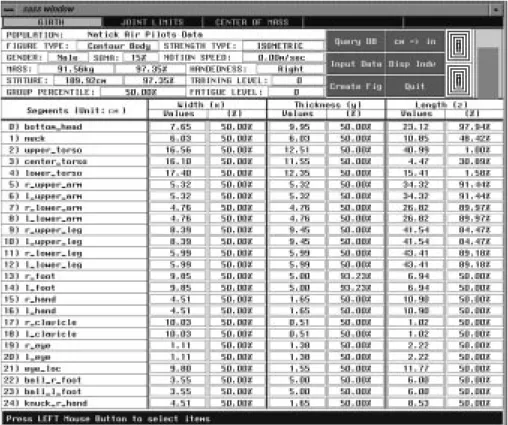
4. With so many DOFs in a body and many useful physical attributes, there must be a convenient way of accessing, selecting, and modifying any data. Jackuses a spreadsheet-like interface to access anthropometry data. This paradigm permits simple access and data interdependencies: for example, changing leg length should change stature; changing pop-ulation percentile should change mass distribution.
5. Seeing the results of changing body dimensions is important to under-standing how dierent bodies t, reach, and see in the same workplace.
5thpercentile, for example, creates interesting changes in foot position,
arm postures and view.
1.3.4 A Human Model should have a Human-Like
Ap-pearance
As we argued earlier, a human model's appearance has a lot to do with our perception of acceptable behavior. The more accurate the model, the better the motions ought to be. Providing a selection of body models is a convenient way to handle a spectrum of interactive analysis and animation requirements. For quick assessments, a human model with simplied appearance might be ne. If the skin surface is not totally realistic, the designer can move the view around to check for sucient clearances, for example. When the completed analysis is shown to the boss, however, an accurate skin model might be used so that the robotic nature of the simpler model does not obscure the message. Looking better is often associated (in computer graphics) with being better.
1. The \standard" or default body model inJackstrikes a balance between detail and interactive manipulation speed. It appears solid, has a 17 segment exible torso, has a reasonable shoulder/clavicle mass, has a full hand, and has a generic face. A hat is added to avoid modeling hairstyles. The gure is modeled by surface polygons to take advantage of the available workstation display capabilities.
2. There are times when more accurate skin surface models are needed. For that, computerized models of real people are used. These are derived from a database of biostereometrically-scanned bodies.
3. For extra realism, clothing is added to body segments by expanding and coloring the existing segment geometry. Besides the inherent desirability of having a virtual gure in a work environment appear to be dressed, clothing will also aect task performance if adjustments are made to joint limits or if collision tests are performed.
4. Facial features may be provided by graphical texture maps. By showing a specic face a particular individual may be installed in the scene, the gure may be uniquely identied throughout an animation, or generic gender may be conveyed. Moreover, if the face is animated, an entire communication channel is enabled.
1.3.5 A Human Model must Exist, Work, Act and React
Within a 3D Virtual Environment
human factors analysis to the list. Design importation facilitates up-front analyses before commitment to production hardware. Since geometric models are readily constructed, we must be sure that our body models and interactive software are compatible with the vast majority of CAD modeling schemes so the two can work together in the same virtual space.
1. Since Jack manipulates surface polygon geometry, simple features are provided to interactively construct and edit the geometry of the virtual workplace. Jack is not intended as a substitute for a good CAD sys-tem, but CAD features are provided for convenience. For example, if a designer nds a problem with the imported workplace, the oending region can be immediately edited in Jack. When the changes prove acceptable, the designer can use the data values from Jack to modify the \real" model in the external CAD system. While not optimal, this avoids any tendency to migrate the working model intoJackand bypass the more generalized CAD features provided by most CAD systems. 2. Standardized geometric data transfer to and fromJackwould be highly
desirable, but the state of standards in geometric modeling still leaves some important gaps. For example, few CAD systems adequately model articulated objects. Currently, Jackimports models from several com-mon CAD vendors through a less satisfactory scheme of explicit trans-lators from external geometry les. This situation will change to a standard as soon as possible.
1.3.6 Use the Computer to Analyze Synthetic Behaviors
What would a real person do in a real environment? How can we get a virtual human to behave appropriately and report similar experiences? People are constantly managing multiple simultaneous constraints or tasks, for example, staying balanced while reaching to lift a box, or walking while carrying a cup of coee. The essential parallelism of human motion demands an approach to behavior animation that does not just cope with parallelism but exploits it. We will be interested mostly in psychomotor and viewing behaviors; clearly auditory and cognitive tasks are worthy of inclusion but are not dealt with here.
use a global solution technique,inverse kinematics, to satisfy the given constraints subject to the inherent joint limits of the body.
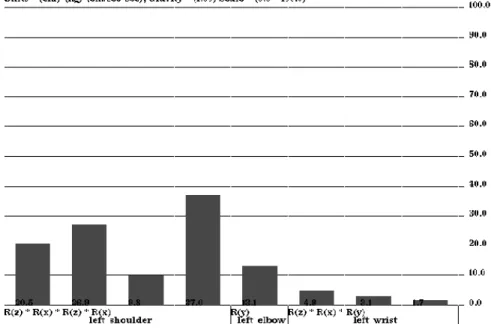
2. While in a posture, the strength requirements of the gure may be displayed on screen. This interactive strength data display shows all torque loads along any selected chain of body segments. If a load is attached to an end-eector, for example, it permits the easy visualization of the distribution of that additional weight on the body.
3. What the gure is looking at is often a critical question in human fac-tors analysis. In Jack, the direction of eye gaze is controlled through constraints to some environmental location or object site. If that site moves, the gaze will follow. Since eye movement will aect head orienta-tion, the eect of gaze direction can propagate (because of joint limits) to the neck and torso and hence inuence overall body posture. 4. InJack, the user can see what the gure sees from an internal or
exter-nal perspective. Interexter-nally, a separate graphics window may be opened which shows the view from the selected eye. The image appears nat-urally shaded and it moves as the gure's gaze is adjusted by direct manipulation or constraints. Concurrent changes to the environment and visible parts of the gure's own \self" are displayed in the view window. If eld of view is critical, a retinal projection may be used where a polar projection displays workplace features based on their an-gle from the fovea. Although the image thereby appears distorted, the actual eld of view may be superimposed to assess the range of foveal or peripheral perception. For the external perspective, a selected eld of view is displayed as a translucent pair of view cones, one for each eye. The cones move with the eyes. Objects in view are shadowed by the translucent cones. Any overlapped region is clearly in the area of binocular vision.
6. Sometimes it is valuable to visualize the entire reachable space of an end-eector of the gure. Empirical data is sometimes available in the literature [NAS78, NAS87], but it is collected on specic subjects and does not readily extend to gures with diering anthropometry or joint limits. By constructing the reach space for a given gure in a given posture as a geometric object, the reach space maybe viewed and objects may be readily classied as in or out of the reach space.
1.3.7 An Interactive Software Tool must be Designed for
Usability
A system to build, move, and analyze virtual humans should be usable by mere mortals with a modest training period. Isolating the potential user community by requiring unusual artistic skills would be counter-productive to our wider purposes of aiding design engineers. Existing interaction paradigms (such as pop-up menus or command line completions) should be followed when they are the most ecacious for a particular task, but new techniques will be needed to manage and control three-dimensional articulated structures with standard graphical input tools. The interface should be simple yet powerful, comprehensive but easy to learn.
1. The Jack user interface is designed for fast response to multiple con-straint situations. Real-time end-eector interactive dragging through arbitrary length joint chains means that the user can watch the gure respond to reach or movement tasks. The paradigm of manipulating one joint angle at a time is possible, but almost useless. The goal-directed behaviors provide an enormous benet to the user in allowing the spec-ication ofwhatis to be done while constraint satisfaction handles the
howthrough positioning interdependencies of the entire body structure. Dragging also permits quick experimentation with and manualoptimiza-tion of postures.
2. By taking advantage of the Silicon Graphics display hardware, Jack
shows the user shaded or wireframe displays during interaction for nat-ural images and easy real-time visualization.
3. For the highest quality images, Jack provides its own multi-featured ray-tracing and radiosity programs.
4. Besides direct user input,Jackmay be controlled through scripted com-mands (in theJack command language) built in the course of interactive manipulation. This saves time and trouble in setting up complex situa-tions, establishing a body posture, or trying a series of actions.
sharing a common virtual dataspace. Jackitself can share an environ-ment with other Jack's on the network. This could be used for novel cooperative workgroup applications.
6. The standard Jackuser interface consists of just a three button mouse and keyboard. It is simple to learn and no special hardware devices are required unless a virtual environment setup is desired. The interac-tion paradigms inJackinclude menu-driven or typed commands, on-line help, and command completion. It is easy to use after only a day or so of training.
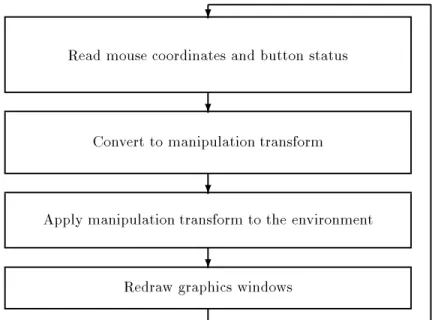
7. The direct manipulation interface into three dimensions implemented in Jack is both highly ecient and natural to use. Depending only on the mouse and keyboard, it oers a friendly, kinesthetic correspon-dence between manually comfortable hand motions, on-screen displays, and three-dimensional consequences. Three dimensional cursors, rota-tion wheels, and orthogonal projecrota-tions of the principal view provide excellent visual feedback to the user.
8. Jackprovides multiple windows with independent camera views for com-plex analyses, multiple points of view, and internal and external eye views.
1.4 Manipulation, Animation, and Simulation
There are important distinctions betweenmanipulation,animation, and sim-ulation. Geometric manipulation is the process of interactive scene composi-tion, or the interactive specication of positions and postures for geometric gures, usually on a trial and error basis. Manipulation usually involves move-ment of the gures, but the movemove-ment serves to assist in the control process and is generally not worth saving as a memorable motion sequence. Rather, the purpose of manipulation is to get the gures into a desired static posture, although the posture need not remain static afterwards. Manipulation is in-herently real-time: objects move as a direct response to the actions of the user. In short, interactive manipulation is not necessarily choreography.
Animation, on the other hand, is choreography. In computer animation, the goal is to describe motion, and the animator usually imagines the desired motion before beginning the animation process. Of course, experimentation may lead to revisions, like an illustrator who erases lines in a drawing, but the computer does not serve so much to answer questions as to obey orders. Animators measure the success of a computer animation system in terms of how well it serves as a medium for expressing ideas.
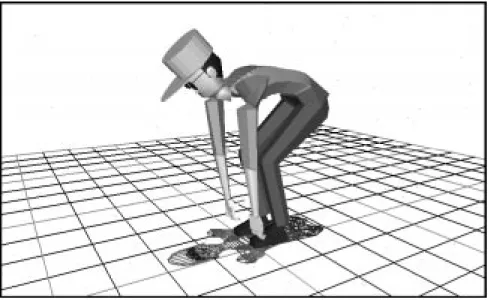
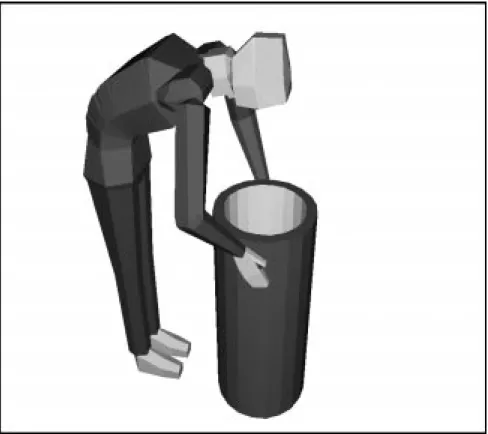
Figure 1.1: Is it the Motion or the Posture?
less about what motion should result. The job of the simulator is to predict what would happen under certain circumstances and inform the user of the results. Sometimes simulation can generate animation, as in the case of the animation of physics and natural phenomena. Simulation of human gures generally implies some modeling of human capabilities to deliberately o-load some of the low-level positioning overhead from the animator.
Animation and simulationhave been studied extensively, but manipulation of articulated gures has not received the attention it deserves. Volumes of research discuss animation techniques and simulation algorithms, but most research directed at interactive manipulation deals either with the low-level input mechanisms of describing 3D translations and rotations, or with the numerical issues of real-time dynamics. For example, consider the task of bending a gure over to touch its toes (Fig. 1.1. Is the bending motion important, or is it just the nal posture that is critical? In animation, it's the motion: the motion must look realistic. In simulation, the motion must
be realistic. In manipulation, the ner points of the posture are critical. Is the gure balanced? Are the knees bent? Where is the head pointed? How are the feet oriented? The motion through which the manipulation system positions the gure is not important in itself. It serves only to assist the user in arriving at the posture.
1.5 What Did We Leave Out?
the vastness of the human performance problem demands scope boundaries as well. There are fascinating problems remaining that we have not touched. Some of these problems are being examined now, but the early results are too premature to report. The activity in this eld is amazing, and there will surely be advances in modeling, animation, and performance simulation reported each year.
A glance at theEngineering Data Compendium [BL88], for example, will quickly show how much information has been collected on human factors and simultaneously how little is available interactively on a computer. But even without much thought, we can place some bounds on this study.
We have ignored auditory information processing, environmental
fac-tors (such as temperature and humidity), vibration sensitivity, and so on. While critical for harsh environments, we seek useful approxima-tions to rst order (geometric) problems to see if a gure can do the task in the absence of external signals, distress, or threats. The proba-ble degradation of task performance may be established from intelligent (manual) search through existing publications. While it would be at-tractive to include such data, we have not begun to acquire or use it yet.
We have bypassed super-accurate skin models because the eneshment
of a gure is so dependent on individual physiology, muscle tone, mus-cle/fat ratio, and gender. For the kinds of analyses done with whole body models, errors of a centimeter or so in skin surfaces are subordi-nate to anthropometric errors in locating true joint centers and joint geometry.
We have avoided injury assessment, as that is another whole eld
devel-oped from anatomy, crash studies, or national exertion standards. Of course, Jack could be used in conjunction with such systems, but we have not tried to connect them yet.
Because we have taken a generalized view of human factors and
re-stricted analyses to reach, t, view, and strength, we have necessarily avoided any workplace-specic performance data. For example, action timings will be most accurate when measured with real subjects in a real environment. We have concentrated on measurements in environ-ments prior to physical construction to save cost and possible personnel dangers.
We have only touched on perceptual, reactive and cognitive issues. Many
Finally, we are leaving issues of learning for later study. There is much to
be said for an agent who not only follows instructions but who also learns how to do similar (but not identical) actions in comparable situations in the future. Learning might rst occur at the psychomotor level, for example, to gure out the best way to lift a heavy weight. Later, learning can extend to the task level: to repeat a variant of a previously successful plan when the overall goals are encountered again.
Body Modeling
In order to manipulate and animate a human gure with computer graphics, a suitable gure must be modeled. This entails constructing a satisfactory surface skin for the overall human body shape, dening a skeletal structure which admits proper joint motions, adding clothing to improve the verisimil-itude of analyses (as well as providing an appropriate measure of modesty), sizing body dimensions according to some target individual or population, and providing visualization tools to show physically-relevant body attributes such as torque loads and strength.
2.1 Geometric Body Modeling
In computer graphics, the designer gets a wide choice of representations for the surfaces or volumes of objects. We will briey review current geometric modeling schemes with an emphasis on their relevance to human gures.
We classify geometric models into two broad categories: boundary schemes and volumetric schemes. In a boundary representation the surface of the object is approximated by or partitioned into (non-overlapping) 0-, 1-, or 2-dimensionalprimitives. We will examine in turn those representations relevant to human modeling: points and lines, polygons, and curved surface patches. In a volumetric representation the 3D volume of the object is decomposed into (possibly overlapping) primitive volumes. Under volumetric schemes we discuss voxels, constructive solid geometry, ellipsoids, cylinders, spheres, and potential functions.
2.1.1 Surface and Boundary Models
The simplest surface model is just a collection of 3D points or lines. Surfaces represented by points require a fairly dense distribution of points for accurate modeling. Clouds of points with depth shading were used until the early 1980's for human models on vector graphics displays. They took advantage of
the display's speed and hierarchical transformations to produce the perceptual depth eect triggered by moving points [Joh76] (for example, [GM86]).
A related technique to retain display speed while oering more shape in-formation is to use parallel rings or strips of points. This technique is used in LifeFormsTM1 [Lif91, Cal91]. Artistically positioned \sketch lines" were
used in one of the earliest human gure models [Fet82] and subsequently in a Mick Jagger music video, \Hard Woman" from Digital Productions.
Polygons
Polygonal (polyhedral) models are one of the most commonly encountered representations in computer graphics. The models are dened as networks of polygons forming 3D polyhedra. Each polygon (primitive) consists of some connected vertex, edge, and face structure. The polygons are sized, shaped, and positioned so that they completely tile the required surface at some res-olution. Polygon models are relatively simple to dene, manipulate, and dis-play. They are the most common models processed by workstation hardware and commercial graphics software. In general, polygons are best at model-ing objects meant to have at surfaces, though with a large enough number of polygons quite intricate and complex objects can be represented. \Large enough" may mean hundreds of thousands of polygons!
All viable interactive human gure models are done with polygons, pri-marily because the polygon is the primitive easiest to manage for a modern workstation such as the Silicon Graphics machines. With real-time smooth shading, polygon models of moderate complexity (several hundred polygons) can look acceptably human-like; accurate skin models require thousands. A realistic face alone may require two or three thousand polygons if it is to be animated and if the polygons are the only source of detail.
Polygon models are too numerous to cite extensively. Ones with an inter-esting level of detail have been used in Mannequin software from Biomechan-ics Corporation of America [Pot91], various movies such as \Tony de Peltrie" from the University of Montreal [Emm85], and detailed synthetic actor models of Marilyn Monroe and Humphrey Bogart from Daniel Thalmann and Nadia Magnenat-Thalmann [MTT90, MTT91b]. They even model details of skin de-formation by applying physical forces to polygon meshs [GMTT89, MTT91b]. The polygon models used inJackare polygonal with two dierent levels of detail. The normal models have a few hundred polygons. More accurate mod-els obtained from actual scans of real bodies have several thousand polygons. (See Section 2.1.3.)
Curved Surfaces
Since polygons are good at representing at surfaces, considerable eort has been expended determining mathematical formulations for true curved sur-faces. Most curved surface object models are formed by one or more
metric functions of two variables (bivariate functions). Each curved surface is called a patch; patches may be joined along their boundary edges into more complex surfaces. Usually patches are dened by low order polynomials (typically cubics) giving the patch easily computed mathematical properties such as well-dened surface normals and tangents, and computable continuity conditions between edge-adjacent patches. The shape of a patch is derived from control points or tangent vectors; there are both approximating and interpolating types. The former take the approximate shape of the control vertices; the latter must pass through them. There are numerous formulations of curved surfaces, including: Bezier, Hermite, bi-cubic, B-spline, Beta-spline, and rational polynomial [Far88, BBB87].
Various human gure models have been constructed from curved patches, but display algorithm constraints make these gures awkward for real-time manipulation. They are excellent for animation. provided that sucient care is taken to model joint connections. This is a good example of where increased realism in the body segments demands additional eort in smoothing and bending joint areas properly. Curved surface models were used in a gymnastic piece [NHK86] and the Academy Award-winning \Tin Toy" [GP88].
2.1.2 Volume and CSG Models
The volume and CSG models divide the world into three-dimensional chunks. The models may be composed of non-intersecting elements within a spatial partition, such as voxels or oct-trees, or created from (possibly overlapping) combinations of inherently 3D primitive volumes.
Voxel Models
The rst volumetric model we examine is the voxel model. Here space is completely lled by a tessellation of cubes or parallelopipeds called voxels (volume elements). Usually there is a density or other numerical value asso-ciated with each voxel. Storing a high resolution tessellation is expensive in space but simple in data structure (just a large 3D array of values). Usually some storage optimization schemes are required for detailed work (1K x 1K x 1K spaces). Special techniques are needed to compute surface normals and shading to suppress the boxiness of the raw voxel primitive. Voxel data is commonly obtained in the medical domain; it is highly regarded for diagnos-tic purposes as the 3D model does not speculate on additional data (say by surface tting) nor suppress any of the original data however convoluted.
low resolution image sets or special hardware [GRB+85].
Constructive Solid Geometry
One of the most ecient and powerful modeling techniques is constructive solid geometry (CSG). Unlike the voxel models, there is no requirement to regularly tessellate the entire space. Moreover, the primitive objects are not limited to (uniform) cubes; rather there are any number of simple primitives such as cube, sphere, cylinder, cone, half-space, etc. Each primitive is trans-formed or detrans-formed and positioned in space. Combinations of primitives or of previously combined objects are created by the Boolean operations. An ob-ject therefore exists as a tree structure which is \evaluated" during rendering or measurement.
CSG has been used to great advantage in modeling machined parts, but has not been seriously used for human body modeling. Besides the mechanical look created, real-time display is not possible unless the CSG primitives are polygonized into surfaces. When the set of primitives is restricted in one way or other, however, some useful or interesting human models have been built.
Single Primitive Systems
The generality of the constructive solid geometry method { with its multiplic-ity of primitive objects and expensive and slow ray-tracing display method { is frequently reduced to gain eciency in model construction, avoid Boolean combinations other than union, and increase display speed. The idea is to re-strict primitives to one type then design manipulation and display algorithms to take advantage of the uniformity of the representation. Voxels might be considered such a special case, where the primitives are all coordinate axis aligned and integrally positioned cubes. Other schemes are possible, for ex-ample, using ellipsoids, cylinders, superquadrics, or spheres.
Ellipsoids have been used to model cartoon-like gures [HE78, HE82]. They are good for elongated, symmetric, rounded objects. Unfortunately, the shaded display algorithm is nearly the same as the general ray-tracing process. Cylinders have also been used to model elongated, symmetric objects. El-liptic cylinders were used in an early human modeling system [Wil82]. These primitives suer from joint connection problems and rather poor representa-tions of actual body segment cross-secrepresenta-tions.
Superquadrics are a mathematical generalization of spheres which include an interesting class of shapes within a single framework: spheres, ellipsoids, and objects which arbitrarily closely look like prisms, cylinders, and stars. Simple parameters control the shape so that deformations through members of the class are simple and natural. Superquadrics are primarilyused to model man-made objects, but when overlapped can give the appearance of faces and gures [Pen86].
There are two methods of rendering spheres. Normally they are drawn as regular 3D objects. A human modeled this way tends to look like a large bumpy molecule. Alternatively, spheres may be treated like \scales" on the modeled object; in this case a sphere is rendered as a at shaded disk. With sucient density of overlapping spheres, the result is a smoothly shaded solid which models curved volumes rather well. A naturalistic human gure was done this way in our earlier TEMPUS system [BB78, BKK+85, SEL84]. We
stopped using this method as we could not adequately control the sphere/disk overlaps during animation and newer workstation display technology favored polygons.
Potential Functions
An interesting generalization of spheres which solves some major modeling problems is to consider the volume as a potential function with a center and a eld function that decreases monotonically (by an exponential or polynomial function) from the center outward. There is no \radius" or size of the potential function; rather, the size or surface is determined by setting a threshold value for the eld. What makes this more interesting is that potential functions act like energy sources: adjacent potential functions have overlapping elds and the resultant value at a point in space is in fact the sum of the elds active at that point. Thus adjacent elds blend smoothly, unlike the \creases" that are obtained with xed radius spheres [Bli82]. Recently, directional dependence and selective eld summation across models have been added to create \soft" models that blend with themselves but not with other modeled objects in the environment [WMW86, NHK+85]. Potential functions were originally used
to model molecules, since atoms exhibit exactly this form of eld behavior, but the models have an amazing naturalistic \look" and have been used to great eect in modeling organic forms including human and animal gures [NHK+85, BS91]. The principal disadvantages to potential functions lie in
properly generating the numerous overlapping functions and very slow display times. They remain an interesting possibility for highly realistic models in the future.
2.1.3 The Principal Body Models Used
2The default polyhedral human gure in Jack is composed of 69 segments,
68 joints, 136 DOFs, and 1183 polygons (including cap and glasses). The appearance is a compromise between realism and display speed. No one is likely to mistake the gure for a real person; on the other hand, the movements and speed of control are good enough to convey a suitably responsive attitude. The stylized face, hat, and glasses lend a bit of character and actually assist in the perception of the forward-facing direction.
For more accurate human bodies, we have adapted a database of actual body scans of 89 subjects (31 males and 58 females) supplied by Kathleen