BIA EDUCATION RESEARCH BULLETIN, YEAR1975
Vol. 3, No. 1, January 1975
Speech by Commissioner of Indian Affairs to National Indian Education 1 Association Conference, November 1974
Morris Thompson
A School for Me 5
Joseph H. Ramey and Thomas W. Sileo
An Examination of Children's Books on the American Indian 9 James A. Popp
Compensatory Education on the Navajo Reservation 18 Joseph H. Ramey and Thomas W. Sileo
DISSERTATION ABSTRACTS
Perception of Power Influentials in a Federal Indian School 25 Gabe Paxton
The Feasibility of Test Translation English to Navajo 26 Annabelle Scoon Rosenbluth
Vol. 3, No. 2, May 1975
Choctaw On-Campus Intensive Education Program At Mississippi 28 State University
Phillip Martin, John and Jan Peterson
A Demonstration Project To Train Navajo Teacher Aides To Provide Direct 36 Student Instruction In Specific Language and Reading Skills
Marvin Fifield and Lonnie Farmer
The Evolution of Haskell Indian Junior College, (1884-1974) 42 Charles A. O'Brien
Accelerated Process of Acculturation of Sub-Cultures 47 Miguel Leon-Portilla
Vol. 3, No. 3, September 1975
Study of Occupational Aspirations and Expectations of Choctaw 50 High School Students
The Use of Standardized Tests With High School Indian Students 53 Bruce S. Pray, Sr.
A Status Report of the Coalition of Eastern Native Americans, 55 Inc., July 1975
Patsy H. Stann
Education Research Programs, Bureau of Indian Affairs 60 Thomas R. Hopkins and Eugene Leitka
Brief Review, Indian Education History 67
SPEECH BY MORRIS THOMPSON COMMISSIONER OF INDIAN AFFAIRS AT
NATIONAL INDIAN EDUCATION ASSOCIATION CONFERENCE
November 1974
The 1970 census reports on Indian education reveal some interesting facts about the results of efforts by the Bureau and private and public schools over the last ten years. I would like to refer to some of the data from that census as they relate to the Bureau efforts in the 1970's and our projected plans for the rest of the decade.
In 1970, 95 percent of Indian people between the ages of 7 and 13 were attending school.
The number of Indians attending college doubled between 1960 and 1970—and I might add, according to recent BIA figures that number has doubled again between 1970 and the present.
In 1970, one-third of all Indians 25 years and over had completed high school. The 1960 census showed this figure to be less than one-fifth.
The median years of education Indian people had achieved in 1970 was 9.8 years which was an increase from 8.4 years in 1960, but still considerably behind the National median or 12.1 years. However, the median years of education for Indians in the age group 20-24 was 12.2 in 1970 which is above the National median.
Since the Bureau tightly controlled the elementary and secondary education of about one third of the Indian children between 1960 and 1970, it must bear at least one third of the responsibility, for good or for bad, for these 1970 census findings.
Let's look at what the Bureau is doing and will be doing in Indian education for the rest of this decade.
I think it is safe to say that from any angle you want to look at the Bureau's education program today — and increasingly so in the future — you will see emblazoned on the school walls: INDIAN CONTROL.
Do you want to talk management control? The Bureau has an FY 1975 objective of bringing at least 50 of its schools under local management option by the end of this fiscal year.
Do you want to talk total school control? Fourteen Bureau schools are now under contract to Indian people. Sixteen tribes are contracting to run their own higher education programs.
Do you want to talk program control? The Albuquerque Area has contracted out one hundred percent of its higher education and JOM monies to Indian tribes or groups. Navajo Area Office will probably follow suit soon. The Juneau and Minneapolis areas have substantial portions of these programs contracted out.
Do you want to talk administrative control? The JOM regulations we are now operating under were, in the main, developed by Indian people. We have begun to revise the manual of operations where it applies to Indian education for the first time since 1953. Before drafting the "Goals" section of that manual we surveyed 3,000 Indian parents, educators, students, and school boards to get their views on what these goals should be. Other parts of the revision will be sent out for tribal review before adoption by the Bureau as permanent parts of the BIA Manual.
Do you want to talk curriculum control? The Bureau has an Advisory School Board for all of its schools and they are becoming a potent force in the area of curriculum development. We are moving toward the creation of boards of regents for the off-reservation boarding schools.
Do you want to talk staffing control? Under the recent Man-can i decision, the number of Indian teachers in the classroom and in the administration of Bureau schools should increase significantly for the rest of the decade.
I would like to digress a moment to talk about one particular effort the Bureau is making toward increased tribal control. The Bureau has a Fiscal Year 1975 objective of having at least one fourth or 50 of its schools subject to the management option chosen by the tribe the school serves. Or to restate the proposition: Each of 50 tribes will have chosen by the end of FY 1975 whether they want one or all of the Bureau schools on their reservations to be managed by the Bureau, the tribe — under contract, the public school or a combination of these.
And by choice, we don't mean — eenie, meenie, minie, moe. We are talking about an informed choice. The Central Office Education Staff has put together a filmed presentation which describes the objective itself in depth, and then goes on to describe what each management option will entail and the pros and cons of each.
We are hopeful that, after our area and agency staff have set down with each tribe interested in the objective, the tribe will be able to make a choice of a management system knowing in complete detail what that selection means.
I might add for purposes of clarification that this is not, I repeat is not, a contracting objective. We don't care which option a tribe chooses as long as that choice is based on all the information the Bureau can make available to it about school management.
To get back to the subject of Indian control, I would like to describe to you for a moment just what it is Indians will be getting control over as the decade progresses.
As you know the )Bureau has a total school budget of over $200 million dollars spread across programs of school construction, school operation, JOM, higher education and adult education. The Bureau now directly educates about one fourth, or 49,500, of 200,000 Indian children in grades Kindergarten through 12th grade in 194 schools. We also supplement the funding of 486 school districts with JOM money which have an enrollment of 98,000 students. Under the new JOM regulations the parents will have veto power over the use of funds in the public schools or they can take the money and run their own out-of-school programs.
These and many, many more aspects of Indian education will be brought under the control of Indian people as the decade passes —If they so desire. We really mean it when we say we want Indians in control of the education of their young. It may not appear so because the pace of transition is so slow. But we want to ensure an orderly, firmly rooted transition.
Let me ask you, wouldn't we want to transfer control to Indian people? Don't you think the Commissioner's during the 1960's turned white when they saw in the 1970's census reports that they had increased the education of one third of the Indian children by only 1.4 grades in ten years. The education of young minds is an awesome responsibility. I as Commissioner feel it every time I hear statistics on the number of school age children who drop out, or take to drugs, or wind up in penal institutions. Let me warn you, it doesn't help you to sleep at nights. I am personally happy that Indian people are asking to share the responsibility for how Indian children are educated because, remember this: WITH CONTROL COMES RESPONSIBILITY.
I don't mean to suggest that the Bureau will be shirking or shrugging off its remaining responsibilities for Indian education. For those tribes who choose to remain under Bureau controlled schools, we will be constantly attempting to up grade the quality of education we are providing. We also intend to fully meet our responsibility to seek increased budget and staffing for Indian education — within the limits of tribal desires — so we will have adequately funded programs to turn over to Indian control.
We intend to meet our responsibility of monitoring the use of Federal funds that Indians are controlling. But the Bureau has reached the end of a very, very long road in Indian education. On that road the Bureau decided and had to live with the responsibility for deciding who should be educated, when they should be educated, for what purposes they would be educated, where they should be educated, and how they should be educated.
A SCHOOL FOR ME b y
Joseph H. Ramey Thomas W. Sileo
Leupp Boarding School, located in the Southwestern section of the Navajo Indian Reservation serves students residing within a forty mile radius. The Navajo people of this region live primarily in log hogans with mud chinking or small frame structures. The average annual income in this area of the reservation is less than $2,000.00, with the major source of earning derived from grazing small herds of sheep and cattle, which are not large enough to constitute self-sustaining economic units. Approximately seventy percent (70%) of the families in the Leupp service area, therefore, are receiving welfare benefits. Incidences of tuberculosis, alcoholism, and infant mortality are higher than the national averages. Concomitantly, the average life expectancy is below the national average.
Students who attend the school are defined as educationally disadvantaged since they function one or more years below grade level in the basic academic areas of language arts and mathematics, and require special educational assistance to raise their level of academic achievement. They are handicapped as a result of pov-erty, and non-Navajo cultural and linguistic factors. Regular school attendance is often sporadic, due to road conditions and the relative isolationism which exists in the area.
Approximately two thousand (2.000) children on the entire Navajo Reservation, categorized as trainable mentally handicapped, are functioning considerably below their chronological age in academic achievement. Fifteen (15) of the students whose intelligence range measures sixty (60) or below, as measured by the W.I.S.C. Performance Scale, are presently enrolled in an individualized instructional program at Leupp Boarding School. The major cause of their deficiencies is attributed to exogenous damage to the central nervous system resulting from malnutrition, spinal meningitis, middle ear infections, and upper respiratory ailments. These appear to be the most common causes of the problem on the Reservation. The students, whose chronological ages range from six to thirteen years of age, have approximate mental ages of two to seven years. They also exhibit physical and mental handicaps, and emotional and social disturbances. None of the students were enrolled in school prior to the inception of the program in 1971. When the students entered the program, they were not toilet trained nor were they able to perform any of the other self-care skills required of school age children. Behavior problems ranged from aggressiveness to passivity and were complicated by bizarre ritualistic behaviors, seizures, visual and auditory problems, and aphasia. Those students who did possess language were monolingual speakers of Navajo.
Elementary and Secondary Education Act is to provide each student the continual opportunity to arrive at his finest moment in the social, personal, physical, and academic areas. There are no fixed or arbitrary standards of measure that each student must attain. Individual behavioral objectives based on task analysis are established when the child enters the program. The behavioral objectives, written specifically for Navajo children, encompass all of the necessary skills to function at home, in school, and in society.
Programs follow a spiraling approach and are divided into four levels:
1. Pre-Academic stresses the development of self-care, social, and physical motor skills.
2. Academic emphasizes Navajo and English language development, survival sight words, and auditory skills;
3. Pre-Vocational includes the development of number concepts, money and simple word assignments, in preparation for future vocational training; and,
4. Vocational-sheltered workshop program enables the students to function as productive members of society. At present, there are no sheltered workshops on the Navajo Reservation and the students travel to Winslow or Flagstaff, Arizona for this training.
The need for a sheltered workshop on the Navajo Reservation, in which the students are able to function in a setting closely resembling their home environment and native language has been recognized by the Navajo Area Division of Education of the Bureau of Indian Affairs. Program development is presently in the planning stages and it is expected that a sheltered workshop to serve approximately fifty (50) students, will be funded under Title I during the 1975-1976 school year.
Language and physical motor skills are stressed at all levels of development in the present program. The language development program considers the acquisition of language for second language learners, language disorders, and delayed language development. Students are involved in individualized language programs founded on the hierarchy of language skills: listening, speaking, reading and writing.
Instructional areas in listening include:
1. auditory perception of non-language sounds to develop an awareness of sounds, sound contrasts, the location of sounds, and sound associations;
2. the discrimination of isolated language sounds necessary for reading readiness.
auditory sequencing, and following directions.
Instructional areas in speaking stress a developmental approach to language acquisition; building a speech vocabulary, producing speech sounds, internalizing language structures, formulating sentences, and practicing oral language skills.
The development of reading skills stresses a multisensory approach to reading readiness, sound-symbol association, left to right directionality, and the acquisition of a crucial sight vocabulary. The children utilize the visual, auditory, kinesthetic and tactile modalities to stimulate several areas of sensory input and to rein-force the acquisition of graphic language symbols.
The writing program at present, concentrates on the correct graphic form for each letter and word, the correct manipulation of the writing instrument to produce letter shapes, the integration of complex eye-hand relationships, and the development of visual motor memory.
Visual perception training is closely allied with the development of language skills. Instructional areas include:
1. the development of spatial relationships necessary for seeing words as separate entities in reading;
2. visual discrimination skills to enable the students to differentiate, visually,
between letters and words;
3. figure ground discrimination to enable students to distinguish objects from the surrounding background;
4. visual clozure skills to identify an object, despite the fact that the total stimulus is not present, and
5. object recognition of geometric shapes, alphabetic letters and numbers, and
words.
Activities for motor development are concerned with
1. gross motor activities to develop smoother, more effective body movement, and add to the child's sense of spatial orientation and body consciousness;
2. body image and body awareness to assist the child in developing accurate images
of the location and function of body parts; and
3. fine motor activities to develop eye-hand coordination and ocular control.
The students also participate in swimming and gymnastic lessons provided by students of special education at a nearby university.
homeliving program.
Parental involvement in the program is on-going. Parents visit and observe the program, and counsel with academic personnel about the personal, physical and social needs of their children. They assist in the program on a voluntary basis and help to rein-force the skills of home training. They are involved in workshops, conducted during the school year, by university consultants and special education personnel, to assist them in guiding their children in social and family relationships.
Evaluation reflects the nature of the program and is based on the attainment of specific objectives developed for each child. Those students who are more advanced have entered a readiness program and have begun work on developing a sight vocabulary through experience charts, the more complex English language patterns, and number concept and skill development.
Successful progress in the program of physical motor development, the primary purpose of which is to establish cerebral dominance, indicates that the majority of the students will enter a readiness program prior to the end of the school year.
Evaluation data, based on the attainment of specific behavioral tasks, indicate that the students have successfully completed the individual objectives outlined for them.
Area of Skill % of Objectives
Development Completed
Self Care 90%
Behavior 99%
Motor 99%
Social 92%
Health and Safety 85%
Readiness 81%
AN EXAMINATION OF CHILDREN'S BOOKS ON THE AMERICAN INDIAN
by James A. Popp
During the first week of school this year the teachers in the intermediate unit at the Acomita Day School decided the students would start the year off with the preparation for and the celebration of American Indian Day. The celebration would be on Friday, September 27th, four weeks away, and would concentrate on presenting great American Indian leaders of the past and present and contributions of the American Indian culture to the American culture.
Through our celebration of American Indian Day we hoped to achieve three goals. First, we felt school should begin on an exciting note which preparation for a parade and a feast would generate. Second, we wanted to instill self-pride within our students and the celebration of American Indian Day would be a celebration of the self for them. Third, we wanted our students to be able to demonstrate knowledge of great American Indian leaders and of American Indian contributions. The goals were set and our next move was to collect materials for reference and at this point, my involvement with children's books about the American Indian really began.
I collected children's books on the American Indian from our three main sources, The University of New Mexico Learning Materials Center, the Albuquerque Public Library, and our school library, and distributed them for use on our American Indian Day project.
To my group of students I began reading from a nice looking little book, Pueblo Indian Stories and on the second page I read, "Orange Cloud and her family lived in a house that you would think was queer. The Pueblo Indians lived in queer houses years ago. They made their homes on high rocks."1 Luckily I proof read silently as I read orally and changed Orange Cloud to Juanita, queer to beautiful, and rocks to mesas. I then decided I had better come back to that book.
After school that day two other teachers showed me books they had begun reading to their classes and had stopped because of the attitude expressed, derogatory language used or stereotyping presented. One of those books, Learning From the Indians by Wharton James, has a foreword entitled, "What the White Race May Learn From the Indian" and is filled with lines such as: "There are scores of things about the Indian that are reprehensible and to be avoided."2 The other book was Indian Friends and Foes by Dorothy Heiderstadt. The students wanted to know about the great Apache leader Geronimo so the teacher opened the book to chapter 13, and then suggested a different topic, for the chapter was entitled "Geronimo: The Last Barbarian."3
Sequoyah Myth by Traveler Bird in which the author and sixteen other direct heirs of George Guess, the white man's Sequoyah, try to correct historical guesswork about who George Guess was and what he did for his people. Was it possible that a great number of children's books on the American Indian were not based on true facts and in-depth research by the authors? Could it be that children's books on the American Indian were perpetuating false myths, stereotypes, and negative attitudes toward the American Indian people?
I was curious to look into these questions further and the remainder of this paper deals with my study, my findings, my conclusions and my suggestions.
American Indian Day at Acomita Day School was a great success but it would have been more so if the children's books on American Indians had been more useful.
Last summer and again this fall I have been fortunate to see a videotaped lesson on education across cultures by Dr. John A. Aragon from the College of Education at the University of New Mexico. In this lesson, Dr. Aragon brings forth what a delicate and responsible job teaching in any ordinary situation is and then, when it crosses back and forth between two cultures, teaching becomes extremely tenuous and requires a great deal of expertise and sensitivity on the teacher's part. He proposes the theory of perceiving, behaving, and becoming, which simply interpreted means a person perceives himself through the words and actions of others, shapes his behavior around those perceptions and will eventually become the person he behaves like.
If a teacher in New York reads the book Indian Friends and Foes to her non-Indian class some damage is done just from the title and the cover pictures which immediately stereotype the Indian men as being red skinned with hatchet features and the women as being the fairytale beautiful princesses. The non-Indian child thinks the Indian is either good or bad. The men are ugly and mean-looking so they must be bad. But the women must be friends because they are beautiful and kind-looking. By just using the word Indian, and not Indians, the author has already stereotyped the Indian people as not being distinguishable groups.
Think of the potential damage done as a teacher reads this book to a class of Indian children. The Indian child might perceive just from the title and cover pictures that Indian men are ugly and mean-looking and can either be friends or foes and nowhere in between. Therefore being an Indian man, or related to one, would gain a negative connotation.
with them, and blending the cultures as evenly as possible. They often need assistance and one place they rely on is the library and its collection of books.
A teacher cannot possibly know the contents and how useful every book in the school library will be. But if a teacher constantly chooses books written for children that cause the children to perceive themselves or others negatively then something is wrong and some action must be taken.
The American Indian Day project at Acomita Day School gave me the necessary incentive to read all the children's books on the American Indian in our school's library plus randomly selected books from the Albuquerque Public Library and from the Learning Materials Center at the University of New Mexico. I am by no means a licensed critic of children's literature or an expert on the life ways of the American Indian people. I am a teacher who teaches in a bi-lingual and a bi-cultural community and who is extremely sensitive to having the children I teach perceive themselves in a positive manner. Thus my work and study has been that of a concerned amateur.
After reading each of the books, I marked down its relevance to each of the following categories: attitude expressed, derogatory language, stereotyping by terminology and pictures, knowledge expressed by the author, the book's usefulness in the classroom, and if it is an in-depth or superficial report or study.
Attitude expressed is a category which judges the author's feelings towards the American Indian. It is very subjective and is marked either positive or negative.
Derogatory language is much more objective and is marked none, some, or a lot. Examples of what I consider derogatory language are the terms: warlike, savage, brown men, barbarians, pagans, redskins, etc.
Stereotyping is fairly clear and can or cannot be found in the author's terminology and in the illustrator's pictures. In the following charts T stands for terminology and P stands for pictures and they have a yes or no after them, yes indicating there is stereotyping and no indicating there is no stereotyping. Examples of terminology stereotyping are: "Very slowly they are adopting the white man's ways, but they cannot be rushed."4, "Tomorrow the sick man will go to the Public Health hospital, but he wanted the services of the medicine man first."5, "They thought they were chasing sickness away."6, "Indians — red savages, noble, perhaps, but savages all the same ..."7, "The plains Indians were very warlike, ..."8, "We must build an igloo ..."9, and "Their old way of living is ended and they haven't yet found a good new way. But they are still the Laughing People."10
and seals nearby; Indian men having war bonnets, buckskins, warpaint, a single feather, and a loincloth on and are shown riding bareback shooting buffalo; and Indian women shown grinding corn, scraping hides, or carry babies on their backs.
The category knowledge expressed is again very subjective and is marked excellent, fair, or poor. It is a feeling derived from how the author uses names, dates, places, and culturally relevant materials in the report or story.
Usefulness is a subjective category that would vary in relevancy from teacher to teacher and from class to class. I have based my markings on how beneficial and important it is to have the book at the Acomita Day School. I have thus marked the books as being extremely, fairly, or not useful.
The last category is marked in depth or superficial and I judged each book subjectively as to whether I thought the author had done research and had expressed it by going into informative detail or whether the author was using a little literary license and writing for capital gain alone.
The following five charts show how I have categorized the forty-nine books I read for this paper.
Out of the 49 books read, 7 seemed to definitely express a negative attitude toward American Indians. Six had some derogatory language and three had a lot of derogatory language. Twenty books had a little or some stereotyping in the terminology while twenty-seven had a little, some, or a lot of stereotyping in the illustrations. Eighteen of the books showed their authors had excellent knowledge of the subject, while twenty-three showed fair knowledge and eight showed poor subject knowledge. Twenty-three of the books rated extremely useful, four rated very useful, fourteen rated fairly useful, and eight rated not useful. Sixteen of the books were superficially written while thirty-three were written in depth.
As I previously stated I am not a professional critic and this was not that objective of a survey but it showed me what I was afraid of is true to a large degree. Well over half of the authors did not seem to have done any in-depth research for true facts on which to base their stories. And far too many of the books seemed to be perpetuating negative attitudes toward the American Indian people, false myths about great American Indian leaders, and stereotypes through terminology and pictures about the various aspects of the American Indian cultures.
Stereotyping
Attitude Derogatory Knowledge In depth
Title Expressed Language &
Pictures
Expressed Usefulness Superficial T:yes
Luke & The Indians Positive Some P:yes Poor Not useful Superficial
Teepee Days: Tales of T:yes
the Prairies Positive None P:yes Fair Fair In depth
T:yes Learning from the
Indians
Negative A 1ot P:no Excellent Very useful In depth
T:yes
The Talking Leaf Negative None P:yes Poor Not useful Superficial The Taos Indians &
Their T:no
Sacred Blue Lake Positive None P:no Excellent Extremely In depth
T:no
Little Sioux Girl Positive None P:no Excellent Extremely In depth
Antelope: A Navajo T:no
Indian Boy Positive None P:no Fair Fair Superficial
Leaping Trout: A
Little T:no
Iroquois Boy Positive None P:yes Fair Fair Superficial
Nigalek: A Little T:no
Eskimo Boy Positive None P:yes Fair Fair Superficial
Watlala: An Indian T:no
of the Northest Positive None P:yes Fair Fair Superficial
Sequoyah: Leader of T:yes
the Cherokees Negative Some P:yes Poor Not useful Superficial
Extremely T:yes
The True Book of
Indians Negative
A lot P:yes Poor Not useful Superficial
Extremely T:no
Eskimo of Little Diomede
Positive None P:no Excellent Extremely In depth
The First Book of
the T:no
Indian Wars Positive None P:yes Excellent Fair In depth
T:yes
The Indians Knew Positive None P:yes Poor Fair Superficial
Here is Your Hobby
... T:yes
Indian Dancing &
Stereotyping
Attitude Derogatory Knowledge In depth
Title Expressed Language &
Pictures
Expressed Usefulness Superficial
T: yes
Bird Girl: Sacagawea Positive None P: yes Fair Fair Superficial Getting to Know
American T:
littl e
Indians Today Positive None P: yes Fair Fair In depth
T: yes
Geronimo Positive None P: yes Fair Fair In depth
T: yes Friday: The Arapaho
Indian
Negative None P: yes Poor Not useful Superficial
Only the Names Remain: The Cherokees & the Trail
T: no
of Tears Positive None P: no Excellent Extremely In depth
American Indian Hopi & Zuni Pueblos - Read &
T: littl e
Color Positive None P: no Fair Extremely In depth
American Indian Navajo T: no
Read & Color Positive None P: no Fair Extremely In depth
5: Fair
The Apache Indians Poor Fairly Superficial
The Delaware Indians None no Excellent Extremely In depth
Horsemen of the Western
Plains: the Nez Perce T:no
Indians PositiveNone P:yes Fair Extremely In depth
The Navajo: Herders,
Weavers & T:yes Ch 1-5
Fair
Chl-5 In depth
Silversmiths PositiveNone P:no Ch 6 Poor Fair Ch6: Superficial
The Pueblo Indians
Farmers of the T:no Ch 1-6:
Fair
Chl-6extremely Ch 1-6 In depth
Rio Grande PositiveNone P:no Ch 7-8:
Poor Ch 7-8 Fair Ch7-8Superficial T:no
The Seminole Indians PositiveNone P:no Excellent Extremely In depth T:yes
The First Book of Eskimos PositiveSome P:
yes Fair Extremely In depth T:no
Attitude Derogatory Knowledge In depth
Title Expressed Language &
Pictures
Expressed Usefulness Superficial
Squanto: Friend of the T: no
White Men Positive None P: yes Fair Extremely In depth
T: no
The Story of Hiawatha Positive None P: yes Excellent Extremely In depth T: no
Little Herder in Autumn Positive None P: no Excellent Extremely In depth T: no
Runaway Boy Positive None P: no Excellent Extremely In depth
The True Book of T: yes
Little Eskimos Positive None P: yes Fair Not useful Superficial T: littl
e
Tepee Stories Positive None P: yes Fair Very useful In depth
T: no
Wigwam Stories Positive None P: yes Fair Very In depth
T: no
The Indian & His Pueblo Positive None P: no Fair Extremely In depth
Indian Two Feet & His T: no
Eagle Feather Positive None P: yes Poor Fair Very Superficial
T: yes Pueblo Indian
Stories
Positive None P:
yes Fair Very In depth
T: no
The Mighty Hunter Positive None P: yes Fair Fair Superficial
T: yes Biased &
Indian Friends &
Foes Negative
Lot P:
yes Poor Not useful Superficial
The Indian & the T: no
Buffalo Positive None P: no Excellent Extremely In depth T: no
Indian Games & Crafts
Positive None P: no Excellent
Extremely In depth T: no
Indian Hunting Positive None P: no Excellent Extremely In depth T: no
Indian Music Makers
Positive None P: no Excellent Extremely In depth T: no
Indian Picture Writing
Positive None P: no Excellent Extremely In depth T: no
Indian Sign
Footnotes
1. Wharton James, Learning From the Indians, p. 9. 2. Dorothy Heiderstadt, Indian Friends and Foes, p. 107.
3. Kay Bischoff, American Indian: Hopi and Zuni Pueblos - Read And Color, p. 14. 4. Hildegard Thompson, Getting to Know American Indians Today, p. 50.
5. Teri Martini, The True Book of Indians, p. 45.
6. Alice Marriot, Sequoyah: Leader of the Cherokees, p. 65. 7. Edward and Marguerite Dolch, Tepee Stories, p. v.
8. Donalda McKillop Copeland, The True Book of Little Eskimos, p. 22. 9. Benjamin Brewster, The First Book of Eskimos, p. 45.
BIBLIOGRAPHY
Anderson, A. M., Friday, the Arapaho Indian, Wheeler Publishing Co., 1951.
Bealer, Alex W., Only the Names Remain — the Cherokees and the Trail of Tears, Little, Brown & Co., 1972.
Bird, Traveller, Tell Them They Lie, Westernlore Publishers, 1971.
Bischoff, Kay, American Indian: Navajo - Read and Color, Eukabi Publishers, 1948. ________, Kay, American Indian: Hopi and Zuni Pueblos - Read and Color, Eukabi
Publishers, 1948.
Bleeker, Sonia, The Apache Indians, William Morrow & Co., 1951. ________The Delaware Indians, William Morrow & Co., 1953.
________Horsemen of the Western Plains: The Nez Perce Indians, William Morrow & Co., 1957.
________The Navajo: Herders, Weavers and Silversmiths, William Morrow & Co., 1958. ________,The Pueblo Indians: Farmers of the Rio Grande, William Morrow & Co.,
1955.
________The Seminole Indians, William Morrow & Co., 1954. Brewster, Benjamin, The First Book of Eskimos, Franklin Watts,, Inc., 1952.
Bulla, Clyde Robert, Eagle Feather, Thomas Y. Crowell Co., 1953. Squanto: Friend of the White Man, Thomas Y. Crowell Co., 1954.
Chaffee, Allen, The Story of Hiawatha, Random House, 1951. Clark, Ann, Little Herder in Autumn: 'AAK'EEDGO NA'NILKAADI YAZHI, U.S. Office of Indian Affairs, 1940.
Clarke, Thelma, Runaway Boy, Clarke Industries, 1969.
Copeland, Donalda McKillop, The True Book of Little Eskimos, Childrens Press, 1953. Dolch, Edward and Marguerite, Tepee Stories, Garrard Publishing Co., 1956.
Wigwam Stories, Garrard Publishing Co., 1956.
Floethe, Louise and ichard, The Indian and His Pueblo, Charles Scribner's Sons, 1960. Friskey, Margaret, Indian Two Feet and His Eagle Feather, Childrens Press, 1967. Gates and Peardon, Pueblo Indian Stories, MacMillan Co., 1940.
Hader, Berta and Elmer, The Mighty Hunter, MacMillan Co., 1943.
________Indian Hunting, William Morrow & Co., 1962. Indian Music Makers, William Morrow & Co., 1967.
________Indian Picture Writing, William Morrow & Co., 1959. ________Indian Sign Language, William Morrow & Co., 1956. Holberg, Ruth Langford, Luke & The Indians, Hastings House, 1969.
Hunkins and Allen, Teepee Days: Tales of the Prairies, American Book Co., 1941. James, Wharton, Learning From the Indians, Running Press, 1908.
Jones, Weyman, The Talking Leaf, The Dial Press, 1965.
Keegan, Marcia, The Taos Indians and Their Sacred Blue Lake, Juliun Messner, 1972. Lenski, Lois, Little Sioux Girl, J. B. Lippincott Co., 1958.
Lovell, Antelope: A Navajo Indian Boy, The Platt & Munk Co.
________, Leaping Trout: A Little Iroquois Boy, The Platt & Munk, Co. ________Nigalek: A Little Eskimo Boy, The Platt & Munk Co., ?. ________Watlala: An Indian of the Northwest, The Platt & Munk Co., ?. Marriot, Alice, Sequoyah: Leader of the Cherokees, E. M. Hale & Co., 1956. Martini, Teri, The True Book of Indians, Childrens Press, 1954.
Mayberry, Genevieve, Eskimo of Little Diomede, Follett Publishing Co., 1961. Morris, Richard B., The First Book of the Indian Wars, Franklin Watts, Inc., 1959. Pine, Tillie S., The Indians Knew, Scholastic Book Service, 1957.
Powers, William K., Here Is Your Hobby ... Indian Dancing and Costumes, G. P. Putnam's Sons, 1966.
Seymour, Flora Warren, Bird Girl: Sacagawea, The Bobbs-Merrill Co., 1945.
Stoutenburgh, John, Jr., Dictionary of the American Indian, Phil-osophical Library, Inc., 1960.
Thompson, Hildegard, Getting to Know American Indians Today, Coward-McCann, Inc., 1965.
COMPENSATORY EDUCATION ON THE NAVAJO RESERVATION
by
Joseph H. Ramey Thomas W. Sileo
The Navajo Reservation, which stretches across a geographical area comparable in size to the state of West Virginia, embraces 25,000 square miles of desert and mountainous terrain, from northeastern New Mexico, across Arizona, and north into the state of Utah. Recent census reports (January 1974) indicate that there are approximately 139,248 Navajos.
The Navajo Reservation has been designated by the United States Department of Commerce as an economically depressed area. Although there is some industry on the Reservation, the average annual family income is less than $2,000.00. Navajo people live primarily in log hogans with mud chinking, or in small wooden frame structures. Electricity and running water are virtually non-existent in most of the homes. Economic sustenance is scratched from the land, grazing small flocks of sheep and cattle, and from native arts and crafts. Navajos are renowned for their finely, hand-woven rugs and handcrafted silver and turquoise jewelry.
Navajo students attend either public schools, private mission schools, or schools operated by the Bureau of Indian Affairs (BIA). There are three schools contracted to Navajo Communities. The Bureau school system may be paralleled to that of a metropolitan area serving a comparable number of students, approximately 20,000. The primary differences between schools in a metropolitan area and BIA schools on the Navajo Reservation are seen in the type of school system, the number of miles separating the schools, and the distances which students live from the schools. The schools in a large metropolitan area usually serve students who are native speakers of English, reside within the areas contiguous to the school, and attend school on a daily basis. Due to its vastness, the Navajo Reservation is divided into five agencies, each of which is responsible for the education of the students who reside within the boundaries of the agency. The Navajo Area Division of Education, located in Window Rock, Arizona is responsible for overseeing curriculum development and program implementation within the Agency schools.
Navajo people are primarily mono-lingual speakers of Navajo, therefore, students entering school at six years of age often speak little or no English. Spolsky states that seventy-three percent (73%) of Navajo six year olds entering school do not speak English sufficiently to participate in first grade and to complete the course of study required of them. He also concluded that two major considerations may be attributed to the degree of Navajo spoken by the students when they enter schools, namely the distance and location of a school from an off reservation town, and the distance students reside from a school.1
Academic curricula of Bureau of Indian Affairs schools on the Navajo Reservation, therefore, is concerned primarily with the acquisition of English as a Second Language. Students are involved in academic and guidance programs especially intended to enrich their vast cultural experiences, and to complement their interests, needs, and talents. Language Arts curricula for Navajo students are based on a continuum of learning experiences representative of the hierarchy of language skills in listening, speaking, reading, and writing. Programs developed and implemented specifically for Navajo students are the CITE program (Consultants in Total Education) developed by Robert Wilson, Los Angeles, California, and NALAP (Navajo Area Language Arts Program) developed by Navajo Area Curriculum Specialists.
The CITE program was developed under the auspices of Title I of the Elementary and Secondary Education Act, 1965 for students in Beginner class, now equivalent to Kindergarten in a metropolitan school system through third grade. The "Beginners and First grade programs are designed to expose Navajo students to a total academic curriculum, through the Language Arts. Programs for second and third grades concentrate in the Language Arts and are complemented by specialized curriculum materials in the Social Sciences and other content areas. The objective of the CITE program is to enable Navajo students to understand and generate English language sentence structures in both oral and written expression, as would a native speaker of English after four years of exposure to the program. To accomplish this feat, the students are exposed to the phonology, morphology, lexicon, and syntax of the English language through structured and sequenced materials which teach the students the mechanics of learning in an individualized and unstructured manner; subject content areas; and the transfer and application of learning to other situations. The CITE program is highly structured. Lesson plans are prescriptively phrased and based on the need for cooperative planning by the teacher and education aide, in maximizing the effects of a team effort.
NALAP, too, is a structured, sequential program designed to develop competence in the English language. The program, an outgrowth of requests by B.I.A. teachers on the Navajo Reservation, presents grammatical structures based on a sequence suitable to Navajo students involved in the acquisition of English as a Second Language. NALAP materials are based on a continuum of structural objectives in English language skills. Unlike the CITE program, which is highly prescriptive, teachers possess the freedom to prescribe methods and techniques which allow students to internalize English language
1
structures. Student involvement on an individualized and small group basis, in experiencing innumerable language activities, enables them to capitalize on the thought processes involved in language.
Criterion referenced tests, developed for each of the above programs, in part under the auspices of ESEA, Title I, are designed to evaluate the effectiveness of the programs in attaining their stated objectives.
Program development on the Navajo Reservation has been positively affected by the implementation of Title I of the Elementary and Secondary Education Act. All Navajo students in BIA schools are eligible for Title I services since they are educa-tionally deprived and reside in an economically depressed area. Therefore, each of the sixty (60) BIA schools on the reservation, is involved in the implementation of a Title I project in one or more of the following basic academic areas of Language Arts, Reading, and Mathematics, and Special Education.
Project emphasis in the primary grades is on developmental programs for selected target students designed to complement regular classroom instruction in meeting the students' most critical needs in the subject areas noted above. Developmental programs are aimed at preventing academic deficiencies in Navajo students. Remedial programs are the basis for Title I project development in the middle and upper grade levels. Title I projects do not consider the remediation of students' lesser needs in other subject areas, until the students' most critical needs have been met.
Navajo education aides are a component part of each of the Title I projects in which they may function in self contained classrooms, continuous progress situations, Special Education programs or in Reading and Mathematics resource rooms to assist in the individualization of instructional activities. The education aides, who have been trained in program implementation, assist professional personnel by interpreting English language concepts into Navajo to facilitate students' understanding.
An integral part of all Title I projects is the establishment of a Parent Advisory Council at each school to work with the school's total academic staff in assessing students' academic deficiencies, establishing priorities, and in developing, implementing and evaluating programs for Navajo students. Parental involvement is of utmost importance to the effectiveness of Title I and regular program implementation to foster an improved attitude among students toward academic achievement. Parents involved as Parent Advisory Council members play an important role in maintaining liaison with the school community to develop further parental understanding of Title I as it effects the total education of their children.
Title I projects in all schools on the Navajo Reservation served a total of 11,740 students in grades kindergarten through twelve (K-12), during the 1973-1974 school year. The total expenditure in approved projects was greater than $5.5 Million. Student growth in the academic areas of Language Arts (Reading) and Mathematics was equivalent to 7 months and 1.1 years growth respectively, according to grade equivalent scores. Normal expected gain without Title I services is equivalent to four (4) months and five (5) months in each area.
Students enrolled in special education programs, the evaluation of which is based on the attainment of specific behavioral objectives, in general surpassed the number of individual objectives outlined in each project. Growth without Title I would have been negligible as determined by past pupil performance.
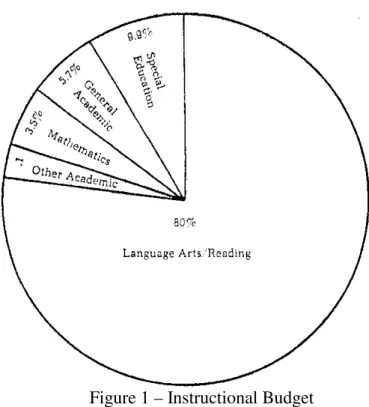
Figure 1 – Instructional Budget
The average expenditure per child in each of the academic areas noted above is as follows:
Language Arts/Reading $ 425.00 Special Education $ 750.00 General Academic $ 361.00
Mathematics $ 183.00
Other Academic Areas $ 61.00
Data extracted from approved Title I projects for the 1974-1975 school year indicates a major trend toward individualizing academic instruction for Navajo students. Approved Title I projects on the Navajo Reservation total more than $7.9 Million.
The total education of Navajo youth is a primary concern of the Navajo Area Division of Education of the Bureau of Indian Affairs. Giant steps have been taken in the areas of curriculum development and in the implementation of specialized programs under the auspices of Title I and regular program development, the ultimate goal of which is to enable Navajo students to function competently in the society which they choose — that of life on the Navajo Reservation or living in off reservation towns and other geographic areas in the United States.
The six hypotheses were rejected at the .01 level of confidence. The respondent groups differed significantly in their responses to the opinionnaire statements. The samples were non-congruent in their opinions.
The data also indicated that generally the students, staff, and parents of a Federal Indian school system view various actors or groups in the suprasystem as being the most influential in the decision-making process and perceive themselves as having the least influence in the decision-making process. Another significant findinging was that the students and parents view the Advisory School Board as being among the most influential while the school staff view the Advisory Board as having little influence.
The general conclusions of this study were: (1) system theory provides concepts which are useful for a study of Federal Indian school systems; (2) the respondent groups have non-congruent opinions regarding the relative power of the decision-making influential’s who affect the allocation of money, staff, and students to the system, and who affect the implementation programs of spending money and implementing curriculum; (3) the respondent groups perceive the actors and groups in the supra-system as being among the most influential in the decision-making process and perceive themselves as being among the least influential; (4) the students and parents perceive the advisory school board as being among the most influential while the staff members perceive the advisory school board as being among the least influential; (5) the respondents perceive the school superintendent as being among the most influential in the decision-making process; however, the principal and supervisors are perceived as having little influence; and (6) the state in which the Federal Indian school is located is viewed as having influence only on the curriculum.
PERCEPTIONS OF POWER INFLUENTIAL’S IN A FEDERAL INDIAN SCHOOL∗∗∗∗
by Gabe Paxton
System theory provided the theoretical framework of this study of a Federal Indian school system. The purpose of this study was to investigate the relationships among the opinions of students, staff, and parents of the school concerning (1) the relative power of the decision-making influential’s to affect the allocation of system resources and (2) the relative power of the decision-making influential’s to affect the implementation of programs. Hypotheses were postulated concerning the congruence of opinions of the students, staff, and parents of a selected Indian school system, as follows: (1) the students and staff, students and parents, and staff and parents, have congruent opinions regarding the relative power of the decision-making influential’s in affecting the allocation of system resources, and (2) the students and staff, students and parents, and staff and parents, have congruent opinions regarding the relative power of the decision-making influential’s in affecting the implementation of programs.
The investigator constructed an opinionnaire and administered it to samples of students, staff, and parents of the Indian school. The respondents were asked to state their opinions as to the relative influence of influential actors or groups in relation to ten stimulus statements. In a forced choice technique, the respondents were given ten to twenty possible response choices for each stimulus statement and were asked to rank the three most influential actors or groups or the three least influential actors or groups. The responses were weighted, ranked, and analyzed. Chi-squares were obtained for the students/staff, students/parents, and staff/parents data and conclusions were made to retain or reject the null hypotheses.
The six hypotheses were rejected at the .01 level of confidence. The respondent groups differed significantly in their responses to the opinionnaire statements. The samples were non-congruent in their opinions.
The data also indicated that generally the students, staff, and parents of a Federal Indian school system view various actors or groups in the supra-system as being the most influential in the decision-making process and perceive themselves as having the least influence in the decision-making process. Another significant finding was that the students and parents view the Advisory School Board as being among the most influential while the school staff view the Advisory Board as having little influence.
The general conclusions of this study were: (1) system theory provides concepts which are useful for a study of Federal Indian school systems; (2) the respondent groups have non-congruent opinions regarding the relative power of the decision-making influential’s who affect the allocation of money, staff, and students to the system, and who affect the implementation programs of spending money and implementing
curriculum; (3) the respondent groups perceive the actors and groups in the supra-system as being among the most influential in the decision-making process and perceive themselves as being among the least influential; (4) the students and parents perceive the advisory school board as being among the most influential while the staff members perceive the advisory school board as being among the least influential; (5) the respondents perceive the school superintendent as being among the most influential in the decision-making process; however, the principal and supervisors are perceived as having little influence; and (6) the state in which the Federal Indian school is located is viewed as having influence only on the curriculum.
THE FEASIBILITY OF TEST TRANSLATION ENGLISH TO NAVAJO∗∗∗∗
by
Annabelle R. Scoon Rosenbluth
The school beginner is expected to be able to follow the language of directions and explanations. Navajo children who enter school essentially monolingual in Navajo and shortly have to accomplish school learning tasks in English may face a double handi-cap if they have not yet labeled in Navajo the concepts needed in beginning English school work.
Measurement of school related concepts in Navajo was attempted by means of a translation of the Boehm Test of Basic Concepts, a test developed from analysis of early school language requirements. It was assumed that the semantic content of such basic concepts is universal, and that vocabulary and syntax in which to express them would be available in Navajo.
This study was made to determine whether the test could be translated into Navajo in a form suitable for assessing the language development of kindergarten, first and second grade Navajo students. The norms from the English test provided a means of comparison of difficulty and discrimination of the test.
Results of administration of the Navajo translated version of the Boehm Test of Basic Concepts strongly suggested that the translated test, though providing a measure of Navajo language development, did not in all cases measure the same concepts measured by the English test. The most important problems were differences of syntactic complexity, incommensurable semantic range, and unsuitability of the test pictures to illustrate slightly different nuances of concept meaning. Some items were discovered that received similar responses and yet tested somewhat different concepts in Navajo and in English.
It was concluded that the differences between the way Navajo and English organize language forms to express concepts make the maintenance of a similar level of difficulty between sentences with the same basic meaning extremely difficult. Since it has been shown that young children may not master the more complex aspects of their native-language syntax in the early school years, it seems likely that a test translated into Navajo could not be kept to an appropriate level of difficulty.
The translated test reached an acceptable degree of reliability and showed a reasonable distribution of scores and a steady increase of mean score through the three grade levels tested. This indicated that the test has potential value as a Navajo language test, and could be used in this way after removal of ambiguous and awkward items and pictures.
CHOCTAW ON-CAMPUS INTENSIVE EDUCATION PROGRAM AT MISSISSIPPI STATE UNIVERSITY
by Phillip Martin∗
Jan Peterson John H. Peterson, Jr.
The Choctaw On-Campus Intensive Education Program was initiated in the summer of 1973 with the objective of providing the most rapid possible advancement toward the goal of teacher certification of 10 Choctaw pre-service students who had previously completed approximately two years of college course work. The program was funded for a second year with the same objective but with a slightly larger number of students. Half way through the second year, the most direct evidence of program progress is in terms of student progress toward graduation as indicated in the following table. CHOCTAW STUDENT PROGRESS TOWARD A FOUR YEAR DEGREE
Anticipated Date Summer Fall Spring Fall Spring of Graduation 1975 1975 1976 1976 1977
Number of 1 5 2 2 3*
Students
*Note all three are replacement students not in the original program.
It was hoped that the original students would have completed approximately two years of college before entering the program, but the actual level upon program entry was somewhat lower. This was partially a result of students entering with fewer college credits than anticipated. An additional factor was the poor academic counseling received by many of the Choctaw students at junior colleges which resulted in many courses not counting toward a four year degree program. Thus, only one, rather than ten students, will be ready to enter the classroom at the end of the two year period. But it should be noted that an additional five students will reach the goal of a four year degree only one semester later than originally anticipated. This would seem to confirm the underlying assumption of the program that given necessary support services, Choctaw students could make rapid progress toward certification and meet the critical shortage of trained Choctaw teachers in
the Choctaw school system.
Students in the program whose anticipated graduation is more distant are largely of two types. First, there are those who entered the program for the first time at the beginning of the second year of operation (Fall, 1974) and hence have completed only one semester under the program as funded this year. Additionally, there are those students who entered the program at a later date as replacements for students who proved unable to carry out a four year college program. In general, the adjustment of both these additional and replacement students to college level work has been smoother during this year's program than was true during the preceding year.
A notable feature of the program this year, has been the establishment of a central area with space for offices for the director and secretary, and with adjacent space for a study area and tutorial sessions. The University has provided office equipment, study tables and general furniture for this area at no cost to the program. Students use this area to visit, drink coffee and study between classes. Student use of this area has increased during the year, and resulted in closer daily contact between the staff and the students.
With the replacement of two of the weaker students, there is every indication that this semester will result in equal or better progress during the spring and summer semester. Because of the lower level of readiness of the initial students, however, it appears that an additional year of funding will be required to meet the initial long range goals of the program as originally funded. A proposal has already been submitted under the Indian Education Act in the event that funding is not possible under this program. Additionally, program staff are assisting students in examining other individual avenues of support as a last resort. Nevertheless, it seems important to attempt to maintain the unity of the program as a whole because of the additional support given the students through a consolidated support program as has been developed.
Of the 13 students, who began this program year in the Fall, two students decided to withdraw from the program at the end of fall semester for personal reasons. Their academic performance in the fall was marginal, probably reflecting their declining interest in completing their course of study. Both students were replaced by new students with approximately two years of college work beginning this spring semester.
Only one student remaining on the program as of this time was in academic difficulty during the fall. This was a young married man who joined the program for the first time in the fall. Although his previous academic work indicated a high potential for success, he experienced severe adjustment problems to campus life which affected both his academic performance and his personal life.
While the overall progress of students under this program has been satisfactory during fall semester, certain problems did develop which have been largely resolved. As a result, we anticipate a higher level of achievement during the spring semester. The following sections indicate these problems and the actions that have been taken to correct them.
The most vexing problems faced by the project staff related to marital difficulties experienced by three students in the program. These problems not only affected the individual students, but because of the close knit nature of the Choctaw community both on campus and on the reservation, other students were drawn into these individual situations through kinship and friendship ties. As a result, class attendance and concentration on academic matters suffered.
Dealing with these problems proved extremely demanding on staff time, particularly since many problems arose at night and on the weekend. Part of the difficulty lay in the reluctance of the Choctaw students. to utilize specialized counseling services available in the area, even when the staff attempted to involve these trained personnel. Problems were resolved or at least stabilized with existing staff, although the staff did feel somewhat beyond their depth in attempting to deal with deep seated psychological and marital problems.
In order to be prepared for any possible future difficulties, arrangements have been made to have experienced graduate students in counseling psychology to work part-time in the Indian Programs Office where they will be in close daily contact with the Choctaw students. These men have had previous experience in counseling and two are on the staff of the University Counseling Center where they work under the direct supervision of a trained counseling psychologist. They have already demonstrated an ability to establish rapport with the Choctaw students by assisting in everyday matters. It is anticipated that with this established contact in the future, students will be willing to utilize the services of individuals who are more qualified to deal with major emotional or marital difficulties.
Two other factors which seemingly contribute to lower academic achievement on the part of some students was a tendency to miss class and not make full use of tutorial services. This was especially true of students living off campus and experiencing transportation difficulties. The marital problems mentioned above contributed to this problem. Students dependent on married students for transportation missed classes and tutorial sessions when a family argument resulted in the married couple not providing the expected transportation. This problem has been addressed by requiring all unmarried students to reside in dormitories on campus.