R E V I E W
Open Access
Calcium affects on vascular endpoints
Vaishali B Patel
1, James L Vacek
2, Leland Graves
1and Rajib K Bhattacharya
1*Abstract
Calcium is one of the most abundant minerals in the body and its metabolism is one of the basic biologic processes in humans. Although historically linked primarily to bone structural development and maintenance, calcium is now recognized as a key component of many physiologic pathways necessary for optimum health including cardiovascular, neurological, endocrine, renal, and gastrointestinal systems. A recent meta-analysis published in August 2011 showed a potential increase in cardiovascular events related to calcium supplementation. The possible mechanism of action of this correlation has not been well elucidated. This topic has generated intense interest due to the widespread use of calcium supplements, particularly among the middle aged and elderly who are at the most risk from cardiac events. Prior studies did not control for potential confounding factors such as the use of statins, aspirin or other medications. These controversial results warrant additional well-designed studies to investigate the relationship between calcium supplementation and cardiovascular outcomes. The purpose of this review is to highlight the current literature in regards to calcium supplementation and cardiovascular health; and to identify areas of future research.
Introduction
Calcium is one of the most abundant minerals in the body and its metabolism is one of the basic biologic processes in humans. Although historically linked pri-marily to bone structural development and maintenance, it is now recognized as a key aspect of many physiologic pathways necessary for optimum health including the cardiovascular, neurological, hormonal, renal, and gas-trointestinal systems. Calcium serves as a cofactor for many extracellular enzymes, most notably the enzymes of the coagulation cascade, and as a source of calcium ions that function as signaling molecules for a great diversity of intracellular processes. These processes include automaticity of nerve and muscle; contraction of cardiac, skeletal, and smooth muscle; neurotransmitter release; and various forms of endocrine and exocrine secretion. Our review will describe the biology and basic physiology of calcium metabolism in humans, the pre-sent status of recommendations for intake and supple-mentation, the traditional role of calcium for optimum maintenance of the skeletal system, and then discuss in
detail the relevance of calcium in cardiovascular health as well as several cardiac and vascular disease states.
Current status of knowledge
The body of the average adult contains about 1000 gram of calcium of which 99% is located in the mineral phase of bone as hydroxyapatite crystals [Ca10 (PO4)6(OH)2]. These crystals play a key role in the mechanical weight-bearing properties of bone, serves as a source of calcium to support a number of calcium-dependent biological systems and to maintain blood ionized calcium within normal range. The remaining 1% of total body calcium is located in the blood, extracellular fluid and soft tissues. Of the total calcium in blood, the ionized fraction (45%) is the biologically functional portion and can be mea-sured clinically. Most clinical laboratories report total serum concentrations. Forty-five percent of the total cal-cium in blood is bound to plasma, proteins notably albu-min and up to 10% is bound to anions such as phosphate and citrate. Concentrations of total calcium in normal serum generally range between 8.5 and 10.5 mg/dl (2.12-2.62 mM).
Mineral homeostasis
The skeleton, gut and the kidney play a major role in assuring calcium homeostasis. Overall in a typical indivi-dual, if 1000 mg of calcium is ingested per day, about 200 mg will be absorbed [1]. Approximately 10 gram of * Correspondence: [email protected]
1Division of Endocrinology, Metabolism & Genetics, The University of Kansas Medical Center, 3901 Rainbow Blvd, Mailstop 2024, Kansas City, KS 66160, USA
Full list of author information is available at the end of the article Patelet al.Nutrition & Metabolism2012,9:24
http://www.nutritionandmetabolism.com/content/9/1/24
calcium will be filtered daily through the kidney and most will be reabsorbed, with about 200 mg being excreted in the urine [1]. The skeleton, a storage site of approximately 1 kg of calcium, is the major calcium reservoir in the body. Ordinarily as a result of normal bone turnover, approximately 500 mg of calcium is released from bone per day, and the equivalent amount is deposited per day [1]. Parathyroid hormone (PTH) enhances bone resorption and liberates both calcium and phosphate from the skele-ton. PTH also enhances calcium re-absorption in the kid-ney while at the same time inhibiting phosphate re-absorption producing phosphaturia. Hypocalcemia and PTH itself can both stimulate the conversion of the inert metabolite of Vitamin D, 25-OH Vitamin D3 to the active moiety 1, 25-dihydroxy Vitamin D3 which in turn enhances intestinal calcium absorption (see Figure 1).
Background Dietary calcium
Adequate calcium and Vitamin D intake along with regular exercise is an important aspect of bone health. The body cannot produce calcium, which must be ingested orally either through foods naturally rich in calcium, calcium for-tified foods, or calcium supplements. Dairy products are naturally high in calcium. Milk, yogurt, and cheese are rich natural sources of calcium and are the major food sources of calcium in the United States [2]. Calcium-fortified foods and calcium supplements are helpful for people who are unable to get enough calcium in their regular diets.
IOM recommendations on calcium intake
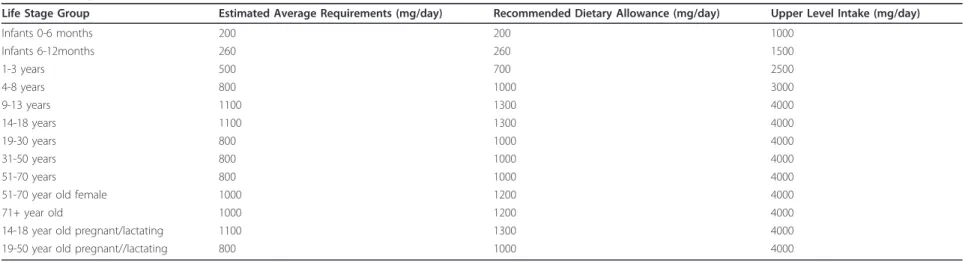
Intake recommendations for calcium and other nutrients are provided in the Dietary Reference Intakes (DRIs) developed by the Food and Nutrition Board (FNB) at
the Institute of Medicine of the National Academies (see table 1) [2].
Calcium intake and status
The Institute of Medicine defines the Adequate Intake (AI) of calcium as 1,000 mg/day for individuals aged 19 to 50 years and 1,200 mg/day for persons older than age 51 years, with the tolerable upper intake level (UL) of 2,500 mg/day. However, results from the National Health and Nutrition Examination Survey (NHANES) found that only 15% of men and eight percent of women older than 71 years had dietary calcium intakes meeting AI levels [3]. Mean calcium intake levels for males ranged from 871 to 1,266 mg/day depending on life stage group; for females the range was 748 to 968 mg/day [3]. Overall, females are less likely than males to get recommended intakes of cal-cium from food. About 43% of the U.S. population (almost 70% of older women) uses dietary supplements containing calcium [3]. Overall 60 percent of women over 60 report taking a dietary supplement containing calcium. About 30% of the calcium available in foods gets absorbed. Absorption varies depending upon the type of food consumed [2]. The efficiency of absorption decreases as calcium intake increases [2]. Absorption decreases to 15%-20% in adulthood (though it is increased during preg-nancy) and continues to decrease as people age; therefore, recommended calcium intakes are higher for females older than 50 years and for both males and females older than 70 years [2,4,5]. When calcium intake is low or ingested calcium is poorly absorbed, bone breakdown occurs as the body uses its stored calcium to maintain normal biological functions
Calcium supplements
Surveys have shown that many Americans are taking calcium supplements. The two main forms of calcium in these supplements are carbonate and citrate. Calcium supplements contain varying amounts of elemental cal-cium. For example, calcium carbonate is 40% calcium by weight, whereas calcium citrate is 21% calcium.
The amount of calcium absorbed from supplements depend on the total amount of elemental calcium con-sumed at one time; as the amount increases, the percen-tage absorption decreases. Absorption is highest in doses ≤500 mg of elemental calcium at one time [2]. Supple-menting calcium in a divided dose regimen can, for the same ingested total load as in a single dose regimen, deli-ver as much as 80%-100% more calcium into the body [6]. Absorption of calcium from carbonate requires an acidic environment and so calcium carbonate should be taken with meals. Individuals taking medications that decrease stomach acid like proton pump inhibitors or H2-blockers should use calcium citrate supplements. Cal-cium citrate should be used in individuals with suspected
achlorhydria, inflammatory bowel disease, or absorption disorders; however calcium carbonate is absorbed nor-mally if taken with food, even in the presence of these conditions [7].
Calcium and health
Calcium and bone health
Bone mass increases during periods of growth in child-hood and adolescence, reaching a peak around age 30 years. Adequate intake of calcium and Vitamin D is essen-tial throughout childhood, adolescence and early adult-hood. In pre-pubertal children whose average dietary intake of calcium approximated the recommended dietary allowance, calcium supplementation increased the rate of increase in bone mineral density [8]. If the gain persists, peak bone density should be increased thereby reducing risk of fracture.
Bone undergoes continuous remodeling, with constant resorption and deposition of calcium into new bone. In aging adults, particularly among postmenopausal women, bone breakdown exceeds formation, resulting in bone loss that increases the risk of osteoporosis over time [2]. Calcium supplements mitigate the aging-related bone loss. They also preserve bone in premenopausal women. A controlled 2 year longitudinal trial of 248 perimeno-pausal women observed that a daily supplementation with 1000 or 2000 mg of calcium significantly reduced bone turnover and bone loss from the lumbar spine in premenopausal and early menopausal women for the two years of study and an additional year of follow up [9]. The responsiveness of postmenopausal women to supple-mentation with calcium appears to depend on their menopausal age. In women who are within the first 5 years of menopause, bone loss is attenuated but not arrested by added calcium. The maximal effect appears to occur with supplement dosages of approximately 1000 mg elemental calcium per day [9].
Calcium supplementation and cardiac health
Calcium supplements are widely used in the United States and other developed nations, traditionally to avoid osteo-penia and its complications, but now often given along with vitamin D supplementation for maintenance of opti-mum health for other physiologic processes, including the cardiovascular system Many prior studies have shown varying results in regards to calcium supplementation and cardiovascular disease risk and outcomes.
Randomized placebo controlled trials A secondary analysis of a randomized placebo controlled trial of cal-cium supplements versus placebo in post-menopausal women for 5 years showed a statistically significant increase in MI [10]. The composite end point of myocar-dial infarction (MI), stroke or cerebrovascular accident (CVA), or sudden death was higher in the calcium supple-mented group (P = 0.008), relative risk was 1.66 [10]. Patelet al.Nutrition & Metabolism2012,9:24
http://www.nutritionandmetabolism.com/content/9/1/24
Table 1 Dietary Reference Intakes of calcium
Life Stage Group Estimated Average Requirements (mg/day) Recommended Dietary Allowance (mg/day) Upper Level Intake (mg/day)
Infants 0-6 months 200 200 1000
Infants 6-12months 260 260 1500
1-3 years 500 700 2500
4-8 years 800 1000 3000
9-13 years 1100 1300 4000
14-18 years 1100 1300 4000
19-30 years 800 1000 4000
31-50 years 800 1000 4000
51-70 years 800 1000 4000
51-70 year old female 1000 1200 4000
71+ year old 1000 1200 4000
14-18 year old pregnant/lactating 1100 1300 4000
19-50 year old pregnant//lactating 800 1000 4000
&
Metabolism
2012,
9
:24
metabolism.com
/content/9/1/2
4
Page
4
of
When the events were adjudicated, statistical significance was no longer found. The baseline characteristics of the participants in this study were not adjusted for cardiovas-cular risk nor was there adequate documentation for con-comitant cardiovascular medications.
The Women’s Health Initiative trial, another
rando-mized controlled study did not show any significant cardi-ovascular risk from calcium supplements. This was a RCT of calcium 500 mg plus Vitamin D 200 IU twice daily ver-sus placebo in 36,282 post-menopausal women 50 to 79 years at 40 clinical sites, where CVD was a pre-specified secondary efficacy outcome. This study revealed that cal-cium/vitamin D supplementation neither increased nor decreased the risk for CHD or stroke in generally healthy postmenopausal women throughout the 7-year duration of this randomized trial [11]. Alimitation of this trial was poor adherence to the supplements. At the end of the trial (mean follow-up, 7 years), 76% of participants were taking
“some”study pills, and 59% were taking-80% of their study medication. This may have played a role in neutral effects on the cardiovascular risk. Another limitation of the trial was that women in the placebo group were allowed to continue their own calcium supplements. About 54% of participants were taking personal calcium supplements at randomization, which could have masked the difference between the 2 groups on the effect of calcium and vitamin D on the risk of cardiovascular events. In addition a high percentage of women were using hormone replacement therapy, which may have an independent role in cardiovas-cular mortality.
A 5-year randomized, controlled trial (RCT) and 4.5 years of post-trial follow-up showed that 1200 mg of cal-cium (as calcal-cium carbonate) daily does not significantly increase the risk of atherosclerotic vascular disease in elderly women [12]. Further analysis of this RCT sug-gested that calcium supplementation may reduce the risk of hospitalization and mortality in patients with preexist-ing atherosclerotic cardiovascular disease [12]. In addition, the incidence of the heart failure outcome was reduced in calcium-treated patients at 9.5 years [12]. The strengths of this study over previous studies include the complete fol-low-up of all 1460 participants and that the adverse events were analyzed to provide clear end points [12].
Meta-analysis
A meta-analysis of 11 studies which included 12000 parti-cipants showed that allocation to calcium supplements (> 500 mg/day for more than a year) was associated with increased risk of MI and that calcium supplementation was associated with 30% increase in incidence of MI, and smaller non-significant increase in risk of CVA and death [13]. None of the trials had CV events as the primary end points and data on CV events were not gathered in a stan-dardized manner. Incomplete or no data on CV outcomes
were available in 7 trials comprising about 15% of partici-pants. None of the trials were designed to have the base-line characteristics of the subjects equalized in terms of cardiac risk factors. The trials did not have information about the use of statins, ACE inhibitor therapy or previous history of coronary artery disease. The studies which com-pared calcium plus Vitamin D with placebo were excluded, so the results may not apply to co-administered calcium and Vitamin D supplements. Many commonly used cal-cium supplements consumed or available currently in the United States have Vitamin D included.
Prospective cohort study
A prospective cohort study of 34,486 postmenopausal Iowa women 55-69 years old, without a history of ischemic heart disease was analyzed to investigate whether greater intakes of calcium, vitamin D, or milk products may pro-tect against ischemic heart disease mortality. Eight year follow up suggested that, among postmenopausal women, the risk of dying of ischemic heart disease may be reduced by consuming relatively high levels of calcium [14]. There was an estimated statistically significant 33 percent reduc-tion in risk for persons in the highest quartile of total cal-cium intake (i.e., high whether due to diet, supplements, or both). Limitation of the study was that the duration of supplemental vitamin and mineral use was not known.
Observational cohort study
An observational cohort study of 9910 women aged 60-89 years with no pre-existing heart disease or stroke history showed that after 2 years of calcium and vitamin D sup-plementation there was no increase in cardiovascular events or deaths compared to women who received mini-mal supplementation [15]. How do calcium supplements increase the risk of vascular events.
The mechanisms by which calcium supplements might increase the risk of myocardial infarction are unclear and speculative. A possible explanation is that calcium supple-ments acutely increase serum calcium levels to a modest degree stimulating the calcium sensing receptors on the cells of the vessel wall and have deleterious effects [16]. It is speculated that it may also increase vascular calcification and thereby cardiovascular events [13]. Other possible mechanisms may be increased coagulability, as the time to initiation of coagulation is inversely related to ionized cal-cium concentration [16]. Increased arterial stiffness may play a role in vascular events [16].
Calcium supplementation and arterial calcification The effect of calcium supplementation on arterial calcifi-cation is unclear. Post-trial coronary artery calcificalcifi-cation (CAC) measurements using cardiac CT were similar in women randomized to calcium/vitamin D supplementa-tion (calcium/D) and those receiving placebo. Treatment with moderate doses of calcium plus vitamin D3 did not Patelet al.Nutrition & Metabolism2012,9:24
http://www.nutritionandmetabolism.com/content/9/1/24
appear to alter coronary artery calcified plaque burden among postmenopausal women [17].
In subjects new to hemodialysis, baseline CAC (coronary artery calcification) score is a significant predictor of all-cause mortality. Use of calcium-containing phosphate bin-ders in patients new to hemodialysis is associated with a rapidly progressive increase in the extent of CAC with resultant higher mortality [18]. Total body calcium score and progression of CAC score in predialysis patients was shown to be higher with the use of calcium containing phosphate binders versus non calcium containing phos-phate binders [19]. Calcium supplementation can hypothe-tically increase arterial calcification and cardiovascular events, so calcium supplements should be used with cau-tion in patients with renal disease. People with impaired renal function who take calcium supplements may be at higher risk of cardiovascular problems [20].
Calcium supplementation and blood pressure
Relationship between calcium intake/supplementation and blood pressure or risk of hypertension is unclear. The Women’s Health Initiative study revealed that over a median follow-up time of 7 years, there was no signifi-cant difference in the mean change over time in systolic blood pressure (0.22 mm Hg, 95% CI -0.05 - 0.49 mm Hg) and diastolic blood pressure (0.11 mm Hg, 95% CI -0.04 - 0.27 mm Hg) between the active and placebo treatment groups [11]. In postmenopausal women, cal-cium plus vitamin D3 supplementation did not reduce either blood pressure or the risk of developing hyperten-sion over seven years of follow up.
A prospective cohort study of 28,886 US women aged 45 years, revealed that intakes of low-fat dairy products, calcium, and vitamin D were each inversely associated with risk of hypertension in middle-aged and older women, suggesting their potential roles in the primary prevention of hypertension and cardiovascular complica-tions during 10 years of follow-up [21]. This study was limited to white women.
Calcium and lipids
Limited data is available in regards to calcium intake/sup-plementation on lipid profile. RCT of supintake/sup-plementation of calcium citrate in normal older women showed beneficial changes in circulating lipids in post-menopausal women. After 12 months, HDL cholesterol levels and the HDL cholesterol to LDL cholesterol ratio had increased more in the calcium group than in the placebo group [21]. This was largely due to a 7% increase in HDL cholesterol levels in the calcium group, with a non-significant 6% decline in LDL cholesterol levels. There was no significant treatment effect on triglyceride level [22]. Calcium possibly binds to fatty acids and bile acids in gut resulting in poor fat absorption. Other possible mechanism include increased
lipolysis as a result of inhibition of PTH and 1, 25 (OH)2 Vitamin D.
Calcium and Diabetes
The available evidence on the role of calcium supplemen-tation in the development of diabetes is limited, but a sys-tematic review and meta-analysis suggests that combined vitamin D and calcium supplementation may have a role in the prevention of T2DM only in populations with glucose intolerance, who are at high risk of developing diabetes [23].
Conclusion
Osteoporosis is a growing health problem and a common cause of morbidity. Adequate calcium intake is essential for maintaining good bone health. As discussed above, calcium supplements are commonly used in US to satisfy the daily dietary recommendations of calcium. Calcium supplements modestly increase bone density and have marginal efficacy against fracture. The number of patients needed to treat with calcium and or Vitamin D supplementation for 5 years to prevent one fracture is estimated to be 48 [24].
Cardiovascular disease is the main cause of mortality and morbidity in US. Recently concern has been raised regarding an increased risk of MI associated with calcium supplements [10], raising questions about the safety of cal-cium supplements with respect to cardiovascular disease risk. Based on reported data, if 1000 people were given cal-cium supplements for 5 years, theoretically there would be an additional 14 myocardial infarction [10]. In the Iowa Women’s Health Study, higher calcium intake was asso-ciated with reduced ischemic heart disease mortality in postmenopausal women [14]. Another RCT revealed that calcium supplementation does not significantly increase the risk of cardiovascular events [12].
and identify the factors associated with risk and mechan-ism of adverse effects of calcium supplementation on car-diovascular disease in males and females.
Acknowledgements
Barbara Lukert MD, Shelley Bhattacharya DO, MPH and Christina Stephenson for their editorial review.
IOM for their recommendations on daily allowance of calcium.
Author details
1
Division of Endocrinology, Metabolism & Genetics, The University of Kansas Medical Center, 3901 Rainbow Blvd, Mailstop 2024, Kansas City, KS 66160, USA.2Mid America Cardiology, The University of Kansas Medical Center, 3901 Rainbow Blvd, Mailstop 4023, Kansas City, KS 66160, USA.
Authors’contributions
VP and RB did the literature search and drafted the manuscript, JV, RB and LG revised it and provided other necessary literature for drafting the manuscript. All authors read and approved the final manuscript.
Competing interests
Vaishali B. Patel, James Vacek, and Leland Graves III declare that they have no competing interests.
Rajib K. Bhattacharya: Speaker for Amgen: Bristol-Myers Squibb, Novartis: Solvay and Sanofi Aventis Auxilium: advisor/consultant, steering committee.
Received: 22 December 2011 Accepted: 27 March 2012 Published: 27 March 2012
References
1. Favus MJ, Goltzman D:Regulation of calcium and magnesium.InPrimer on the metabolic bone diseases and disorders of mineral metabolism.. Seventh edition. Edited by: Rosen CJ. The American Society for Bone and Mineral Research; 2008:104-108.
2. D CtRDRIfV, Calcium, Medicine Io:Dietary Reference Intakes for Calcium and Vitamin DThe National Academies Press; 2011.
3. Bailey RL, Dodd KW, Goldman JA, Gahche JJ, Dwyer JT, Moshfegh AJ, Sempos CT, Picciano MF:Estimation of total usual calcium and vitamin D intakes in the United States.J Nutr2010,140:817-822.
4. National Institutes of Health:Optimal calcium intake.Connecticut Med 1994,58:613-623.
5. Heaney RP, Recker RR, Stegman MR, Moy AJ:Calcium absorption in women: relationships to calcium intake, estrogen status, and age. Journal of bone and mineral research: the official journal of the American Society for Bone and Mineral Research1989,4:469-475.
6. Heaney RP, Berner B, Louie-Helm J:Dosing regimen for calcium supplementation.J Bone Miner Res: Official J Am Soc Bone Miner Res2000, 15:2291.
7. Straub DA:Calcium supplementation in clinical practice: a review of forms, doses, and indications.Nutr Clin Prac: Official Pub Am Soc Parenteral Enteral Nutr2007,22:286-296.
8. Johnston CC Jr, Miller JZ, Slemenda CW, Reister TK, Hui S, Christian JC, Peacock M:Calcium supplementation and increases in bone mineral density in children.N Engl J Med1992,327:82-87.
9. Elders PJ, Lips P, Netelenbos JC, van Ginkel FC, Khoe E, van der Vijgh WJ, van der Stelt PF:Long-term effect of calcium supplementation on bone loss in perimenopausal women.J Bone Miner Res: Official J Am Soc Bone Miner Res1994,9:963-970.
10. Reid IR, Bolland MJ:Calcium supplementation and vascular disease. Climacteric: J Int Menopause Soc2008,11:280-286.
11. Hsia J, Heiss G, Ren H, Allison M, Dolan NC, Greenland P, Heckbert SR, Johnson KC, Manson JE, Sidney S, Trevisan M:Calcium/vitamin D supplementation and cardiovascular events.Circulation2007,115:846-854. 12. Lewis JR, Calver J, Zhu K, Flicker L, Prince RL:Calcium supplementation
and the risks of atherosclerotic vascular disease in older women: results of a 5-year RCT and a 4.5-year follow-up.J bone Min Res: Official J Am Soc Bone Miner Res2011,26:35-41.
13. Bolland MJ, Avenell A, Baron JA, Grey A, MacLennan GS, Gamble GD, Reid IR:Effect of calcium supplements on risk of myocardial infarction and cardiovascular events: meta-analysis.BMJ2010,341:c3691. 14. Bostick RM, Kushi LH, Wu Y, Meyer KA, Sellers TA, Folsom AR:Relation of
calcium, vitamin D, and dairy food intake to ischemic heart disease mortality among postmenopausal women.Am J Epidemiol1999, 149:151-161.
15. Shah SM, Carey IM, Harris T, DeWilde S, Cook DG:Calcium
supplementation, cardiovascular disease and mortality in older women. Pharmacoepidem Dr S2010,19:59-64.
16. Manson JE, Allison MA, Carr JJ, Langer RD, Cochrane BB, Hendrix SL, Hsia J, Hunt JR, Lewis CE, Margolis KL,et al:Calcium/vitamin D supplementation and coronary artery calcification in the Women’s Health Initiative. Menopause2010,17:683-691.
17. Block GA, Raggi P, Bellasi A, Kooienga L, Spiegel DM:Mortality effect of coronary calcification and phosphate binder choice in incident hemodialysis patients.Kidney Int2007,71:438-441.
18. Russo D, Miranda I, Ruocco C, Battaglia Y, Buonanno E, Manzi S, Russo L, Scafarto A, Andreucci VE:The progression of coronary artery calcification in predialysis patients on calcium carbonate or sevelamer.Kidney Int 2007,72:1255-1261.
19. American Society for Bone and Mineral Research Statement on Potential Cardiovascular Risks Associated with Calcium Supplements.[http://www. asbmr.org/about/detail.aspx?cid =
80efb4d9-d696-46c8-b83b-3e0940c9dddd].
20. Wang L, Manson JE, Buring JE, Lee IM, Sesso HD:Dietary intake of dairy products, calcium, and vitamin D and the risk of hypertension in middle-aged and older women.Hypertension2008,51:1073-1079. 21. Reid IR, Mason B, Horne A, Ames R, Clearwater J, Bava U, Orr-Walker B,
Wu F, Evans MC, Gamble GD:Effects of calcium supplementation on serum lipid concentrations in normal older women: a randomized controlled trial.Am J Med2002,112:343-347.
22. Pittas AG, Lau J, Hu FB, Dawson-Hughes B:The role of vitamin D and calcium in type 2 diabetes. A systematic review and meta-analysis.J Clin Endocrinol Metab2007,92:2017-2029.
23. Tang BM, Eslick GD, Nowson C, Smith C, Bensoussan A:Use of calcium or calcium in combination with vitamin D supplementation to prevent fractures and bone loss in people aged 50 years and older: a meta-analysis.Lancet2007,370:657-666.
doi:10.1186/1743-7075-9-24
Cite this article as:Patelet al.:Calcium affects on vascular endpoints. Nutrition & Metabolism20129:24.
Submit your next manuscript to BioMed Central and take full advantage of:
• Convenient online submission
• Thorough peer review
• No space constraints or color figure charges
• Immediate publication on acceptance
• Inclusion in PubMed, CAS, Scopus and Google Scholar
• Research which is freely available for redistribution
Submit your manuscript at www.biomedcentral.com/submit
Patelet al.Nutrition & Metabolism2012,9:24
http://www.nutritionandmetabolism.com/content/9/1/24