AENSI Journals
Australian Journal of Basic and Applied Sciences
ISSN:1991-8178Journal home page: www.ajbasweb.com
Corresponding Author: Fauziah Noordin, Centre for Post Graduate and Professional Studies, Faculty of Business and Management, Universiti Teknologi MARA, 40450 Shah Alam, Selangor, Malaysia.
E-mail: [email protected]
Organizational Climate, Commitment, And Satisfaction: What’s The Story?
Fauziah Noordin, Zaini Abdullah, Normala Daud, Norhayati Mohamed, Azizan Abdullah, Khairul Anuar Hj. A. Rahim, Raja Mohamad Fikri Raja Azman, Zurita Akhma Abd Jalil, Zaidar Ruhain Mohamed Jan, Kamal Mustaqim Kamaruddin
Universiti Teknologi MARA
A R T I C L E I N F O A B S T R A C T Article history:
Received 30 September 2014 Received in revised form 17 November 2014 Accepted 25 November 2014 Available online 13 December 2014
Keywords:
Organizational climate, organizational commitment, job satisfaction
The objectives of the study are to assess the level of each component of the organizational climate, commitment, satisfaction as perceived by the staff of a public university in Malaysia. In addition, the study aimed to determine the influence of each component of organizational climate on the commitment, and job satisfaction of the staff of the university. The respondents consisted of staff (academic and non academic) of the university. Questionnaires were distributed to a total of 3370 staff who have agreed to participate in this research project. The results of the present study indicate moderate mean values for all the components of organizational climate, i.e., formal influence (mean = 3.63), communication (mean = 3.61), collaboration (mean = 3.61), organizational structure (mean = 3.63), work design/technology (mean = 3.78), and student focus (mean = 3.66). In addition, the findings of the study show that the respondents perceived affective, continuance, and normative commitment, job satisfaction, and university specific items to be moderate (mean values of 3.94; 3.06; 3.74; 3.46; and 3.70 respectively). Independent Group T-tests were conducted on all the organizational climate dimensions, job satisfaction, and university specific items based on the three selected demographic variables. The results indicate significant differences between academics and administrative staff on formal influence, communication, collaboration, organizational structure, work design/technology and student focus. Significance differences were also found in university specific items between male and female and academics and administrative staff. The study concludes with recommendation to management and suggestions for future studies.
© 2014 AENSI Publisher All rights reserved. To Cite This Article: Fauziah Noordin, Zaini Abdullah, Normala Daud, Norhayati Mohamed, Azizan Abdullah, Khairul Anuar Hj. A. Rahim, Raja Mohamad Fikri Raja Azman, Zurita Akhma Abd Jalil, Zaidar Ruhain Mohamed Jan, Kamal Mustaqim Kamaruddin., Organizational Climate, Commitment, And Satisfaction: What’s The Story?. Aust. J. Basic & Appl. Sci., 8(24): 392-400, 2014
INTRODUCTION
Organizational climate (Field and Abelson, 1982; Guion, 1973; Joyce and Slocum, 1982), organizational commitment (Meyer and Allen, 1997; Steers, 1975; Whitener, 2001, Rohani et al, 2004) and job satisfaction (Spector, 1988; Lambert, Hogan and Barton, 2001, Fauziah and Kamaruzaman, 2010) have been regarded as important constructs in organizational research for many years. Research has directly associated organizational climate with organizational commitment (e.g., Brown and Leigh, 1996; Welsch and LaVan, 1981, Fauziah et al., 2010a). The findings of these studies are of significant to employers. For example, a study by Watson (1999) has shown that organizations with highly committed employees experienced greater 3-year returns to shareholders than organizations with low employee commitment (Watson Wyatt, 1999). Another study (c.f. Welsh and LaVan, 1981) found that lack of employees’ commitment is related to employer high costs and poor performance. In terms of satisfaction, Lambert, Hogan and Barton (2001) found that job satisfaction acts as a mediating variable between work setting and intention to leave an institution.
Literature is proliferated with studies on organizational climate (e.g., McMurry et al., 2004; Fauziah et al., 2010b), organizational commitment (e.g., Meyer and Allen, 1990; Fauziah et al., 2011; Martin and Kaufman, 2013), and job satisfaction (Spector, 1988; Fauziah and Kamaruzaman, 2010; Akanbi and Itiola, 2014). In spite of the numerous organizational climate, commitment, and satisfaction studies, there appear to be a vacuum in these studies that used respondents in a developing country like Malaysia. More specifically, no research exists that examines these constructs in a university environment in countries other than in America or its closest neighbour, Canada.
administrative staff) perceptions not only their perception on the university organizational climate but also on organizational commitment, job satisfaction, and university specific items. Existing research (for example, James & Jones, 1974; Moran & Volkwein, 1988; Putti, Aryee, & Phua, 1990, Fauziah et al., 2010b) indicate discrepancies between perceptions of organizational climate by employees at different levels of the organization, thus, in this study the academics’ and administrative staff’s perceptions were surveyed in order to examine the levels or extent of these variables of interest as perceived by the employees of the university as whole. Based on the above discussion, the following objectives were formulated: (1) To examine the level of each component of the organizational climate, organizational commitment, job satisfaction, and university specific items among the staff of the university and (2) To determine the influence of gender and personal classification and job grade on each component of organizational climate, commitment, job satisfaction, and university specific items of the staff of the university.
Brief Literature Review:
The nature of climate is indicated in how employees feel about their work environment and the comments they make about their organizations. According to Schneider & Reichers (1983) the explanation for the existence of climates is that people cluster events into meaningful sets that serve a purpose in the work setting. The term climate has been operationalized in terms of individual member perceptions of routine organizational policies and practices (e.g., Ashkenasy, Wilderom, & Peterson, 2000; Schneider, 1990). The inputs gathered from the employees’ perceptions on climate studies provide baseline information to assist in the design of institutional changes that ultimately promote excellence in the organizations. Inputs from climate perceptions studies have benefited organizations in two ways. Firstly, it has enabled organizations to establish norms regarding acceptable behavior, as such, climate studies are commonly used in industry, business, and education as a means to gather data upon which managers base planning and decision-making efforts (Baker, 1992; Katz & Kahn, 1978; Likert, 1967; Litwin & Stringer, 1968) and secondly, organizations can better understand employee attitudes and behavior (Litwin & Stringer, 1968; Miner, 1988; Poole, 1985). Thus, it can be deduced that organizational climate can be considered to be a measurement of employee attitudes, values, and behavior, as such perceptions of climate can be used to gauge specific employee characteristics, for example, employee organizational commitment, which refers to an employee’s loyalty to the organization (Allen & Meyer, 1990; Mathieu & Zajac, 1990; Meyer & Allen, 1991, 1997; Fauziah et al., 2010b). According to Steers (1975), the significance of organizational commitment is that it is actually one measure of organizational effectiveness and is viewed as an instrument of organizational climate (Virtanen, 2000). This notion is supported by Kahn’s (1990) study which indicates that perceptions of a positive climate lead to commitment, while perceptions of a negative climate lead to disengagement from one’s job.
At present little research concerning the relationship between climate and commitment is limited as evidenced from the literature. Based on early findings commitment was found to develop as the goals of the individual and organizational goals become integrated or congruent (March & Simon, 1958). In their investigation on the relationship of organizational climate and commitment of study, Welsh and LaVan (1981) using professional technicians and administrative personnel at a Veterans Medical Center hypothesized that the more the perception of organizational climate is seen as participative, the greater the organizational commitment. In the study they identified several different variables such as communication, decision-making, leadership, motivation, and goal setting that could lead to increased organizational commitment such as job satisfaction, job characteristics, professional behavior, and organizational climate. They found that all climate variables were significantly and positively related to organizational commitment with communication demonstrating the highest significance.
Several significant studies on the relationship between organizational climate and organizational commitment were the ones conducted by Grant (2002), McMurray et al. (2004), and Fauziah et al. (2010b). In Grant’s (2002) study, correlations were found between seven of the nine climate dimensions and two of the commitment components. The climate dimensions of warmth and support, structure, organizational identity, approved practices, conflict, rewards, and ethical practices were found to be most strongly related to affective commitment. Whereas, the climate dimensions of rewards, conflict, warmth and support, approved practices, structure, and ethical practices were significantly related with normative commitment. It appears that for both affective and normative commitment, the climate dimensions of responsibility and risk showed no significant associations. In addition, no significant associations were found for continuance commitment and the nine climate dimensions. McMurry et al., (2004) in their study on the relationship between organizational commitment and organizational climate used Meyer and Allen’s (1990) questionnaire and Koys and Decotiis’s (1991) measure on organizational climate to assess employee perceptions at three automotive manufacturing companies in Australia. Their findings indicated a statistical significant relationship exists between organizational commitment and climate. Fauziah et al. (2010b), using Meyer and Allen’s (1990) assessment
no correlation with decision-making component of the organizational climate. Affective commitment has significant correlations with all the components of organizational climate (organizational design, communication, leadership, teamwork, job satisfaction, motivation, culture, and decision making).
Employee job satisfaction has been extensively studied as an independent and a dependent variable (Spector, 1988). Stum (1998) reported that job satisfaction was one of the main contributing factors leading to organizational performance. He wrote that job satisfaction affected quality and morale as well as productivity. Irving, Coleman, and Cooper (1997) found that job satisfaction was positively related to affective and normative commitment (with a stronger relation between satisfaction and affective commitment), but not with continuance commitment. Rosin and Korabik (1991), using Canadian women managers as their sample, reported that women who felt that their expectations had not been met, who described their jobs as limited in leadership, responsibility, variety, time flexibility, and autonomy and who cited office politics and being in a male dominated environment as potential factors in a leave decision, experienced low job satisfaction and organisational commitment and had a greater intention to leave. The next most frequently investigated relationship involved personal characteristics. Leong, Furnham, and Cooper (1996) reported that education was negatively correlated with job satisfaction. Mannheim, Baruch, and Tal (1997) found that age was related to job satisfaction. In their study, Fauziah and Kamaruzaman (2010), using academic staff of a public university, found that overall the academic staff of the university has a moderate level of job satisfaction and that current status, marital status, age and salary appear to have significant impact on the respondents’ level of job satisfaction. Significant relationships between employee job satisfaction and organizational commitment were also found in a study conducted by Martin and Kaufman (2013).
In conclusion, the few studies that investigated organizational climate, commitment, and job satisfaction in higher education seem to agree with the overall literature findings. However, there are hardly any studies that have investigated the levels of organizational climate, commitment, job satisfaction, and university specifics (environment) particularly in a public university. Therefore, the purpose of this study is to fill the vacuum that currently exists in this area with the hope that the findings will further enhance our understanding of staff’s perceptions on these constructs. It is hoped that the findings of this study would provide data to the administrators of the university that can be used for informed decision making, to begin the on-going process of self-assessment and critical evaluation in order to continue to improve the university climate, staff commitment and job satisfaction, and to establish a baseline from which future university climate, commitment, and satisfaction assessments can be compared to.
Methodology:
A quantitative research methodology was utilized to assess the level of each component of the organizational climate (PACE; NILIE, 1999), the level of affective, continuance, and normative commitment (Meyer and Allen, 1997), the level of job satisfaction (Spector, 1994), and university specific items; and to determine the influence of selected demographic variables on each component of organizational climate, commitment, job satisfaction, and university specific items of the staff (both academic and administrative staff) of a public university in Malaysia. Questionnaires were distributed to a total of 3370 staff who had agreed to participate in this research project.
RESULTS AND DISCUSSION
Respondents’ Profile:
The respondents for the current study are made up of 44.4% male and 55.6% female. Majority (34.8%) of the respondents are in the 31-44 years of age category, followed by more than 44 years of age category (33.8%), and 31.4% are from less than 31years of age category. Academics made up the majority of the respondents (59.2%) while administrative staff made up of only 40.8 % of the total number of respondents.
Reliability Coefficients, Means and Standard Deviations:
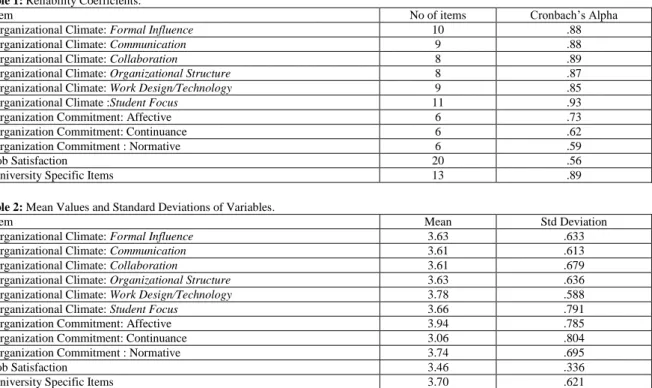
In order to describe the responses for the major variables under study, descriptive statistics such as mean and standard deviations on all major variables were obtained. Table 1 shows the overall results of reliability coefficients of organizational climate, organizational commitment, job satisfaction, and university specific items.
According to Nunnally (1967), the reliability score range from 0.50 to 0.60 is considered sufficient for the early stage of the study. Based on that, a reliability test had been carried out and as shown in Table1, the Cronbach’s Alpha coefficient value for all variables in the study revealed a range of coefficient values from 0.56 to 0.93 accordingly. Thus, the measures can be said to be acceptable and reliable.
and a value of 4.00 to 5.00 indicates a high level of satisfaction. The mean values for all variables appear to be moderate.
Table 1: Reliability Coefficients.
Item No of items Cronbach’s Alpha
Organizational Climate: Formal Influence 10 .88
Organizational Climate: Communication 9 .88
Organizational Climate: Collaboration 8 .89
Organizational Climate: Organizational Structure 8 .87
Organizational Climate: Work Design/Technology 9 .85
Organizational Climate :Student Focus 11 .93
Organization Commitment: Affective 6 .73
Organization Commitment: Continuance 6 .62
Organization Commitment : Normative 6 .59
Job Satisfaction 20 .56
University Specific Items 13 .89
Table 2: Mean Values and Standard Deviations of Variables.
Item Mean Std Deviation
Organizational Climate: Formal Influence 3.63 .633
Organizational Climate: Communication 3.61 .613
Organizational Climate: Collaboration 3.61 .679
Organizational Climate: Organizational Structure 3.63 .636
Organizational Climate: Work Design/Technology 3.78 .588
Organizational Climate: Student Focus 3.66 .791
Organization Commitment: Affective 3.94 .785
Organization Commitment: Continuance 3.06 .804
Organization Commitment : Normative 3.74 .695
Job Satisfaction 3.46 .336
University Specific Items 3.70 .621
Organization climate is defined as a set of assumptions that can be perceived by an individual about an organization and/or its unit and may be described by the practices, processes, and ways of dealing with the members of the unit and its environment and only when these perceptions are shared with the other organizational members can a climate be evident (Field & Abelson, 1982; Hellriegel & Slocum, 1974; Joyce & Slocum, 1984, Fauziah et al., 2013). Organizational climate is measured through six different components which are formal influence, communication, collaboration, organizational structure, work design/technology and students focus.
NILIE (2005) defines formal influence as employee’s perception of their manager’s confidence, feedback and support in their work, and perceptions of the institutional mission and overall institutional management, and their place within it. A high level of satisfaction will indicate that the respondents feel that their work and opinion are valued by their superiors; they are able to contribute toward shaping the direction of the university and that their performance and personal development have been influenced and supported by the organization (NILIE, 2005; Fauziah et al, 2013). The mean value of 3.63 for formal influence shows that there is a moderate level of satisfaction among the respondents.
According to NILIE (2005), communication is defined as employees’ perception of the quality of communication within their work area, between themselves and their manager and among peers, and within the institution as a whole. The finding shows the mean value for communication as 3.61 indicating a moderate level of satisfaction.
Collaboration is defined as employee’s perception of the quality of interaction in working jointly and in problem-solving among their work team and the institution as a whole (NILIE, 2005). The level of satisfaction for this component is 3.61 indicating a moderate level of satisfaction as well.
Organizational structure is defined by NILIE (2005) as employees’ perception of their individual job, the amount and variety of work, feedback and policies that guide them and decision-making at the institution. The mean value of 3.63 for organizational structure shows that there is a moderate level of satisfaction among the respondents.
NILIE (2005) defines work design or technology as employees’ perception of their individual job, its relevance to the institutional mission, administrative processes, training and development, and availability of technology. The mean value is 3.78 which is slightly higher than the mean of the first four components, however, it is still considered as a moderate level of satisfaction.
very much feel that the university is highly supportive of its students. The result shows a mean value of 3.66, which is also a moderate level of satisfaction.
Affective commitment refers to employees’ emotional attachment, identification and involvement in the organization (Mowday et al., 1979; Meyer and Allen, 1993). According to Porter et al. (1974) affective commitment are related to belief in and acceptance of the organization’s goal, effort on helping organization achieve its goals and desire to maintain organizational membership. In this study, it appears that the respondents perceived the affective commitment to be at a moderate level (m= 3.94). This means that they have a moderate sense of emotional attachment and involvement in the organization.
According to Reichers (1985) continuance commitment relates to willingness to stay with organization due to non-transferable investment (eg. retirement and benefit). It is very difficult for employees to leave organization if they share continuance commitment with employer (Meyer and Allen, 1997). The respondents indicate a moderate level of continuance commitment (m=3.06). This shows their willingness to stay with the organization is moderate. It is possible that if they receive better job offer outside organization, there is a possibility that they would leave their current organization.
Normative commitment on the other hand defines as a feeling of obligation to the organization (Bolon, 1993, Meyer and Allen, 1991). Wiener (1982) proposed that normative commitment normally relates to moral obligation to the organization. The result indicates a moderate level (m=3.74) of normative commitment. This shows that the reason the respondents stay with the organization is due to some form of obligations and not due to loyalty to the organization.
Job satisfaction refers to the extent to which people like (satisfaction) or dislike (dissatisfaction) their jobs (Spector, 1997). This definition suggests job satisfaction is a general or global affective reaction that individuals hold about their jobs. From the result showed in Table 2, it seems that the respondents have a moderate level of satisfaction (m=3.46). This indicates that they are not very satisfied with several aspects of their jobs.
Finally, the respondents indicate a moderate level (m=3.70) on the university specific items such as direction of the university, career path, policies, mission, governance, learning opportunities, professional development programmes, and workload. This is also an indication that the respondents are not satisfied with the current situation with regard to the university specific items.
In conclusion, all the variables investigated showed moderate levels of satisfaction or agreement. This should indicate to the management of the university that improvements need to be done to improve the current situation with regard to the components of organizational climate, commitment, job satisfaction, and also the university specific items.
Independent Group T-Test: Organizational Climate, Job Satisfaction, and University Specific Items:
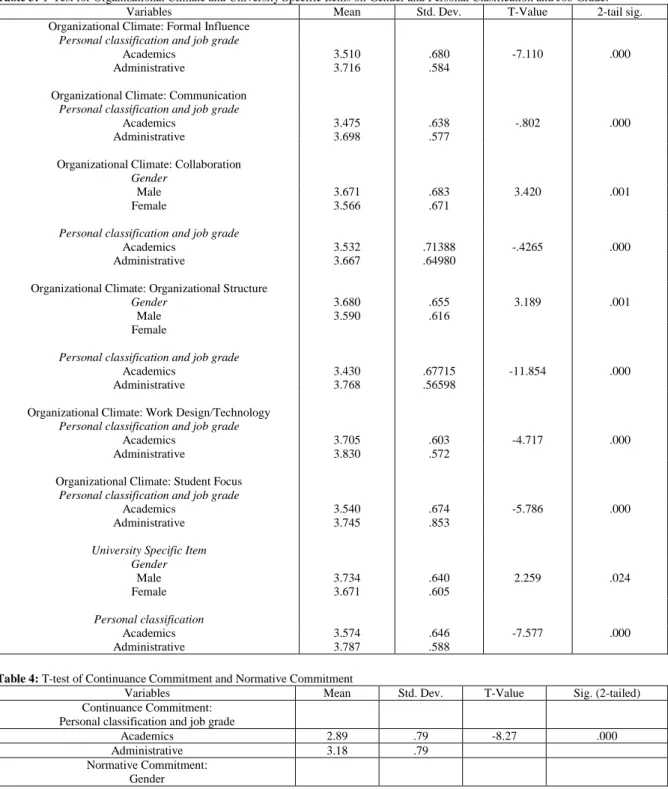
Table 3 shows results of t-test that were conducted on all the organizational climate components, organizational commitment components, job satisfaction, and university specific based on the 2 demographic variables, that is, gender and personal classification and job grade. There were significant differences (p< .01) between academic and administrative on formal influence, communication, collaboration, organizational structure, work design/technology and student focus. Significance differences (p< .01) were also found in university specific items between male and female and academics and administrative.
Independent Group T-Test: Affective Commitment, Continuance Commitment, and Normative commitment:
There is no significant differences in the affective commitment mean values for gender, citizenship and personal classification and job grade.
T-test analysis for continuance commitment (see Table 4) shows that personal classification and job grade for both academics and administrative shows significant difference with continuance commitment (t= -8.27, p=0.00). For normative commitment, the results suggest that gender and personal classification and job grade (academics and administrative) has significant difference with normative commitment (t=1.55, p=0.01; t=-2.31, p=0.021).
The results of the survey have revealed very interesting results. In analyzing whether there was any significant difference in the level of satisfaction between categories under gender, citizenship, and personal classification and job grade, the findings show that the category that are significant are personal classification and job grade (whether they are academic or administrative staff). The findings also show that the administrative staff appear to have a higher level of satisfaction/agreement compared to the academics for majority of the variables.
Conclusions and Recommendations:
The results of the study have revealed very interesting results. The findings indicate moderate mean values for all the components of organizational climate, i.e., formal influence (mean = 3.63), communication (mean = 3.61), collaboration (mean = 3.61), organizational structure (mean = 3,63), work design/technology (mean = 3.78), and student focus (mean = 3.66). In addition, the findings of the study show that the respondents perceived affective, continuance, and normative commitment, job satisfaction, and university specific items to be moderate (mean values of 3.94; 3.06; 3.74; 3.46; and 3.70 respectively).
Independent Group T-tests were conducted on all the organizational climate dimensions, job satisfaction and university specific items based on the 3 demographic variables. The results indicate significant differences between academics and administrative staff on formal influence, communication, collaboration, organizational structure, work design/technology and student focus. Significance differences were also found in university specific items between male and female and academics and administrative staff. Based on the findings of the present study in which all the mean values of the variables of interest appear to be moderate, it is recommended that the management of the university should consider the suggestions made by Fouts (2004).
Table 3: T-Test for Organizational Climate and University Specific Items on Gender and Personal Clasification and Job Grade.
Variables Mean Std. Dev. T-Value 2-tail sig.
Organizational Climate: Formal Influence Personal classification and job grade
Academics 3.510 .680 -7.110 .000
Administrative 3.716 .584
Organizational Climate: Communication Personal classification and job grade
Academics 3.475 .638 -.802 .000
Administrative 3.698 .577
Organizational Climate: Collaboration Gender
Male 3.671 .683 3.420 .001
Female 3.566 .671
Personal classification and job grade
Academics 3.532 .71388 -.4265 .000
Administrative 3.667 .64980
Organizational Climate: Organizational Structure
Gender 3.680 .655 3.189 .001
Male 3.590 .616
Female
Personal classification and job grade
Academics 3.430 .67715 -11.854 .000
Administrative 3.768 .56598
Organizational Climate: Work Design/Technology Personal classification and job grade
Academics 3.705 .603 -4.717 .000
Administrative 3.830 .572
Organizational Climate: Student Focus Personal classification and job grade
Academics 3.540 .674 -5.786 .000
Administrative 3.745 .853
University Specific Item Gender
Male 3.734 .640 2.259 .024
Female 3.671 .605
Personal classification
Academics 3.574 .646 -7.577 .000
Administrative 3.787 .588
Table 4: T-test of Continuance Commitment and Normative Commitment
Variables Mean Std. Dev. T-Value Sig. (2-tailed)
Continuance Commitment: Personal classification and job grade
Academics 2.89 .79 -8.27 .000
Administrative 3.18 .79
Male 3.77 .71 1.55 .001
Female 3.72 .79
Normative Commitment: classification and job grade
Academics 3.70 .78 -2.31 .021
Administrative 3.77 .63
According to Fouts (2004; c.f. Fauziah et al, 2013) the university management should seriously review the findings of the study that is related to organizational climate and incorporate them into strategic decision-making and strategy development processes to maintain, sustain, and enhance the university’s climate. The university management should examine the current involvement of academics and administrative staff in major or important organizational goal-setting as a move to ensure that a climate of involvement is felt, achieved, and valued in friendly, cooperative interactions with high levels of collegiality, congeniality, confidence, and trust displayed by top management to and with the academics as well as administrative staff. In addition, the management should also recognize and reward teamwork on decision making input and efforts and implement change systems to communicate problems and find accurate resolutions or strategies at the level where the most relevant information is available and consequences of the decision will be felt or implemented. The university management should clearly communicate responsibility and hold all the university personnel (academics and administrative staff) responsible and accountable for achieving the university’s goals and decisions that they have helped to make. Furthermore, the university management should strive to clearly communicate organizational vision, mission, goals, values, challenges, threats, and achievements on a regular basis and seek to enhance the flow of information about and recognition for the progress that various work groups (both academics and administrative staff) and the university are making to meet the university vision, mission, goals, and objectives. The university management should increase efforts to communicate promotion or career progression opportunities and criteria for advancement for both academic and administrative staff. Finally, the university management should develop strategies to respond in a timely manner to external and internal emerging issues or challenges to resolve the academics and administrative staff’s perceptions on matters related to organizational climate, commitment, and job satisfaction in the university. The only thing that is constant in life is change, thus, the management of the university must be sensitive to the changes that are taking place at work that are related to its human resources – their most valuable assets.
Knowledge of one’s organization is of utmost important as decisions and plans are developed and implemented based on one’s knowledge of one’s organization. The inputs on the perceptions of the employees of their organization are of utmost importance in the plans that involve human resources after all employees are the most valuable assets in any organization, thus, their inputs matter in decisions made in an organization. It is hoped that the findings of this study will provide data to the administrators / management of the university that can be used for informed decision making in order to continue to improve the university climate, staff commitment and job satisfaction. It is also recommended that future studies should further investigate the relationships between organizational climate, organizational commitment, job satisfaction, and university specific items in both public and private institutions of higher learning in Malaysia. The findings of these future studies would aid the administrators of these institutions of higher learning to better understand their employees and further enhance the employer-employee relations in these organizations.
ACKNOWLEDGEMENT
This article is extracted from the research project financed by the Research Management Institute, Universiti Teknologi MARA, Malaysia, under the Excellence Fund Scheme.
REFERENCES
Akanbi, A.P. and K.A. Itiola, 2013. Exploring the Relationship between Job Satisfaction and rganizational
Commitment among Health Workers in Ekiti State, Nigeria. Journal of Business and Management Sciences, 1(2): 18-22.
Allen, N. and J. Meyer, 1990. The measurement of antecedents of affective, continuance, and normative commitment to the organization. Journal of Occupational Psychology, 63: 1-18.
Ashkenasy, N., C. Wilderom and M. Peterson, (Eds.). 2000. Handbook of organizational culture and climate. Thousand Oaks: Sage.
(Ed.), Cultural leadership: Inside American’s community college (1-16). Washington, D.C.: Community College Press.
Eisenberger, R., P. Fasolo and V. Davis-Lamastro, 1990. Perceived organizational support and employee diligence, commitment, and innovation. Journal of Applied Psychology, 75: 51-5.
Eisenberger, R., F. Singlhamber, C. Vandenberghe, I.L. Sucharski and L. Rhoades, 2002. Perceived supervisory support: Contributions to perceived organizational support and employee retention. Journal of applied Psychology, 87(3): 565-573.
Fauziah, N., A. Zaini, D. Normala, M. Norhayati, A. Azizan, H.R. Khairul Anuar, A.J. Zurita Akhma, R.A. Raja Mohamad Fikri, M.J. Zaidar Ruhain and K. Kamal Mustaqim, 2013. Organizational climate: A case of academics and administrative staff. International Journal of Science, Commerce, and Humanities, 1: 8.
Fauziah, N., A.R. Abdul Rahman, I. Abu Hassan and O. Mohd Shukri, 2011. Career stages and organizational commitment: A case of Malaysian managers. International Journal of Humanities and Social Science, 1: 8.
Fauziah, N. and J. Kamaruzaman, 2010. Individualism-collectivism and job satisfaction between Malaysia and Australia. The International Journal of Educational Management, 24: 159-174.
Fauziah, N., O. Safiah, S. Syakirarohan and I. Shukuriyah, 2010a. Organizational Climate and Its Influence on Organizational Commitment. International Business and Economics Research Journal, 9(2): 1-9.
Fauziah, N., M.R. Rahmah, G. Rohani, A. Rasimah and D. Zabani, 2010b. Teacher Professionalization and Organizational Commitment. International Business and Economics Research Journal, 9(2): 49-57.
Field, R.H.G and M.A. Abelson, 1982. Climate: A reconceptualization and proposed model. Human Relations, 35(2): 181-201.
Fouts, H.M., 2004. Organizational Climate of North Carolina Cooperative Extension. Unpublished dissertation. U.S: North Carolina State University.
Guion, R., 1973. A note on organizational climate. Organizational Behavior and Human Performance, 9: 120-125.
Grant, W.S., 2002. Organizational climate and commitment: A case study of an urban non-profit organization. Unpublished doctoral dissertation, university of Florida, Gainesville.
Gormley, D.I.L., 2005. Organizational climate, role ambiguity, role conflict, and nurse faculty work role balance: Influence of organizational commitment and turnover intention. Unpublished doctoral dissertation, university of Cincinnati, OH.
James, L.R., and A.P. Jones, 1974. Organizational climate: A review of theory and research. Psychological Bulletin, 81(12): 1096-1112.
Joyce, W.F. and J.W. Slocum, 1982. Climate discrepancy: Refining the concepts of psychological and organizational climate. Human Relations, 35(11): 951-972.
Kahn, W.A., 1990. Psychological condition of personal engagement and disengagement at work. Academy of Management Journal, 33: 692-724.
Katz, D. and R.L. Kahn, 1978. The social psychology or organization. New York: Wiley.
Koys, D.J. and T.A. Decotiis, 1991. Inductive measures of psychological climate. Boston Division of Research, Harvard Business School.
Lambert, E.G., N.L. Hogan and S.M. Barton, 2001. The impact of job satisfaction on turnover intent: A test of a structural measurement model using a national sample of workers. Social Science Journal, 38(2): 233-246.
Likert, R., 1967. The human organization. New York: McGraw Hill.
Litwin, G.H, and R.A. Stringer, Jr. 1968. Motivation and organizational climate. Human Relations, 44: 265-285.
March, J. and H. Simon, 1958. Organizations. New York: Wiley.
Martin, J and E.K. Kaufman, 2013. Do Job Satisfaction and Commitment to the Organization Matter When It Comes to Retaining Employees? Journal of Extention, 51: 4.
Mathieu, J.E. and D.M. Zajac, 1990. A review and meta-analysis of the antecedents, correlates, and consequences of organizational commitment. Psychological Bulletin, 108: 171-194.
McMurry, A.J., D.R. Scott and R.W. Pace, 2004. The relationship between organizational commitment and organizational climate in manufacturing. Human Resource Development Quarterly, 15(4): 473-488.
McNabb, D.E. and F.T. Sepic, 1995. Culture, climate, and total quality management: Measuring readiness for change. Public Productivity and Management Review, 18(4): 369-385.
Meyer, J. and N. Allen, 1991. A three-component conceptualization of organizational commitment. Human Resource Management Review, 1(1): 61-89.
Meyer, J. and N. Allen, 1997. Commitment in the workplace: Theory, research, and application. Thousand Oaks, CA: Sage.
Miner, J.B., 1988. Organizational behaviour: Performance and productivity. New York: Random House. Moran, E.T., and J.F. Volkwein, 1988. Examining organizational climate in institutions of higher learning. Research in Higher Education, 28: 367-383.
Poole, M.H., 1985. Communication and organizational climates: Review, critique, and a new perspective. In R.D. McPhee and P.K. Tomplins (Eds.), 13: 74-108. Thousand Oaks, CA: Sage Annual Review of Communication Research.
Putti, J.M., S. Aryee and J. Phua, 1990. Communication relationship satisfaction and organizational commitment. Group and Organizational Studies, 15: 44-52.
Rohani, A.G., N. Fauziah and M. Illias, 2004. Organisational Commitment Among the Academic staff in the Distance Education Program, InED. The International Journal of Education Development, 1: 29-44.
Schneider, B., 1990. Organizational climate and culture. San Francisco: Jossey-Boss.
Schneider, B. and A.E. Reichers, 1983. On the etiology of climates. Personnel Psychology, 36: 19-39. Shore, L.M. and S.J. Wayne, 1993. Commitment and employee behaviour: Comparison of affective commitment and continuance commitment with perceived organizational support. Journal of Applied Psychology, 78: 774-780.
Spector, P.E., 1988. Job satisfaction: Application, assessment, causes and consequences. Thousand Oaks, CA: Sage.
Steers, R., 1975. Problems in the measurement of organizational effectiveness. Administrative Science Quarterly, 22: 46-56.
Virtanen, T., 2000. Commitment and the study of organizational climate and culture. In N.M. Ashkanasy, C.P.M. Wilderon, and M.F. Peterson (Eds.), Handbook of organizational culture and climate (pp 339-354). Thousand Oaks, CA: Sage.
Watson, W., 1999. WorkUSA 2000: Employee commitment and the bottom line. Bethesda, MD: Watson Wyatt.
Welsch, H.P. and H. LaVan, 1981. Inter-relationships between organizational commitment, job characteristic, job satisfaction, professional behaviour, and organizational climate. Human Relations, 34: 1079-1089.