UNDERSTANDING GREEK EQUESTRIAN IMAGERY IN THE ARCHAIC THROUGH HELLENISTIC PERIODS
Angelina D. Phebus
A thesis submitted to the faculty of the University of North Carolina at Chapel Hill in partial fulfillment of the requirements for the degree of Master of Arts in the Department of Classics (Classical Archaeology).
Chapel Hill 2013
iii. ABSTRACT
ANGELINA PHEBUS:Understanding Greek Equestrian Imagery in the Archaic Through Hellenistic Periods
(Under the direction of M.C. Sturgeon)
This study analyzes equestrian imagery from the Archaic through Hellenistic periods in Greece. I investigate why horse depictions were employed in the contexts of votive offerings, funerary sculpture, and architectural sculpture. I consider whether horses’ renderings can be related to socio-political phenomena respective of their physical and historical context by looking at horses in terms of type, conformation, and scale. While athletic monuments, represented by the Delphi charioteer and the Artemision Horse and Jockey in this project, promote individualism of aristocratic victors through portrait-like depictions of competition horses, Classical reliefs are idealized. Prinias A, the Siphnian Treasury, the Parthenon frieze, and Classical Athenian funerary reliefs show the development of the composite type. The Horse and Groom Relief demonstrates the return to
iv.
v.
ACKNOWLEDGEMENTS
While this work bears my name as its primary author, it could not have been
completed without the help of many people. First and foremost, Dr. Sturgeon’s expertise and mentorship were invaluable to this research. In addition to guiding me intellectually, her positivity, compassion and encouragement fueled this work. The faculty of the Classics Department at UNC-Chapel Hill, especially Dr. Haggis and Dr. Sams have provided valuable insights, and have helped me to grow intellectually. It is an honor to have the blessing of such a committee.
Ms. Horioka and Mr. Bethel of Hedgesville High School, thank you for being the first to believe in me, and for continuing to support me in a variety of capacities though I have been away for so long. I could never have come this far without you.
vi.
Table of Contents
List of Tables………vii.
List of Figures………..viii.
List of Abbreviations………..x.
Chapter 1 ... 1
Introduction ... 1
Methods ... 2
Art in Context ... 2
Domestication... 3
Skeletal Material and DNA studies ... 5
Horse Types in Greece ... 8
Asiatic type ... 11
Western/ Libyan type ... 11
European type ... 13
Composite type ... 13
Vase Painting... 14
Chapter 2: ... 19
Early Horse Votives and Athletic Monuments ... 19
Athletic Monuments ... 23
The Delphi Charioteer ... 27
Olympia Chariot Horse ... 30
Artemision Horse and Jockey ... 32
Issues of Scale ... 34
Chapter 3: ... 37
vii.
Prinias Reliefs ... 37
Siphnian Treasury ... 39
Parthenon Frieze ... 44
The Dexileos Stele, the Berlin Relief, and the Vatican Stele ... 52
Horse and Groom, late 4th c. B.C.E., Athens NM 4464 ... 54
Chapter 4 ... 57
Conclusions ... 57
APPENDIX 1: Tables ... 61
APPENDIX 2: Texts ... 63
APPENDIX 3: Images ... 66
viii.
LIST OF TABLES Table
ix.
LIST OF FIGURES Figures
Fig. 1. Modern equids and their facial characteristics………66
Fig. 2. Equine anatomical terms………..67
Fig. 3. Black-figure amphora, Painter of the Vatican Mourner………..68
Fig. 4. Black-figure amphora, Painter of the Vatican Mourner………..69
Fig. 5. Panathenaic amphora with a chariot race scene………...70
Fig. 6. Attic black-figure neck amphora, Bucci Painter………..71
Fig. 7. Red figure column krater, Painter of the Louvre Centauromachy…………..72
Fig. 8. Attic red-figure volute krater, Painter of the Wooly Satyrs………73
Fig. 9. Attic red-figure neck amphora in the manner of the Dinos Painter………….74
Fig. 10. Red-figure neck-handled amphora, Suessula Painter………...75
Fig. 11. Geometric horse votives, Olympia……….76
Fig. 12. Bronze votives, Olympia………77
Fig. 13. Chariot votives, Olympia………78
Fig. 14. Bronze tripod cauldron with horses on rim-handles………...79
Fig. 15. Bronze ring handles with horses, Olympia……….80
Fig. 16. Delphi Charioteer, front and rear views……….81
Fig. 17. Delphi charioteer, details………82
Fig. 18. Delphi charioteer, detail……….83
Fig. 19. Reconstructions of chariot group, Delphi………...84
Fig. 20. Bronze fragment of a horse, Delphi………85
x.
Fig. 22. Artemision Horse and Jockey group, Athens……….87
Fig. 23. Artemision Horse and Jockey group, Athens……….88
Fig. 24. Artemision Jockey, detail………...89
Fig. 25. Artemision Horse and Jockey group, study of proportions………...90
Fig. 26. Artemision Horse, detail………91
Fig. 27. Artemision Horse and Jockey group, front and rear views………92
Fig. 28. Relief from Prinias A……….93
Fig. 29. Siphnian Treasury reconstruction of façade, Delphi………..94
Fig. 30. East frieze, Siphnian Treasury, Delphi………..95
Fig. 31. South frieze, Siphnian Treasury, Delphi………96
Fig. 32. South frieze, Siphnian Treasury, Delphi……….97
Fig. 33. South frieze, Siphnian Treasury, Delphi……….98
Fig 34. West frieze, Siphnian Treasury, Delphi………...99
Fig. 35. West frieze, Siphnian Treasury, Delphi………100
Fig. 36. West frieze, Parthenon………..101
Fig. 37. North frieze, Parthenon……….102
Fig. 38. North frieze, Parthenon……….103
Fig. 39. Dexileos Relief, Athens………104
Fig. 40. Vatican Relief………...105
Fig. 41. Berlin Relief……….106
Fig.42. Horse and Groom Relief, Athens………..107
Fig 43. Horse and Groom Relief, Athens………..108
xi.
LIST OF ABBREVIATIONS Abbreviations
AJA American Journal of Archaeology
AntP Antike Plastik
ARV J.D. Beazley, Attic Red-Figure Vase-Painters. 2nd ed. (Oxford 1963) BCH Bulletin de correspondance hellénique
BSA Annual of the British School at Athens
CJ Classical Journal
ClAnt Classical Antiquity
CVA Corpus Vasorum Antiquorum
GRBS Greek, Roman, and Byzantine Studies
JCS Journal of Cuneiform Studies
JHS Journal of Hellenic Studies
JPR Journal of Prehistoric Religion
JRAI Journal of the Royal Anthropological Institute
MMAJ Metropolitan Museum Journal
ScAnt Scienze dell’Antichita: Storia, archeologia, antropologia
Chapter 1:
Introduction
This study provides a discussion of equestrian imagery from Archaic through Hellenistic periods in Greece. I explore the reasons why and to what end horse depictions were employed in the contexts of votive offerings, funerary sculpture, and architectural sculpture. I investigate whether particular details of horses’ renderings can be related to social or political phenomena with respect to their physical and temporal or historical context. By examining the horse in terms of type, conformation, and scale, one can assess ties between the horse’s place of origin and the location of its depiction.
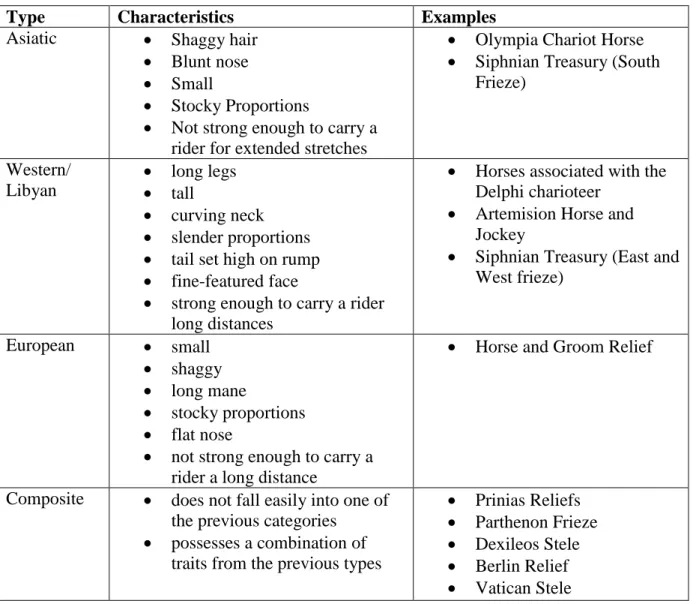
The horse-type framework that is employed for this study was established by S.D. Markman, who divides horse stock in antiquity into three main categories: European, Western/ Libyan, and Asiatic, as defined below (table 1).1 To this framework, I propose the addition of a Composite type. Through the preexisting typology, equestrian imagery can be appreciated in new ways. Building on Markman’s work allows one to understand the socio-political significance and semiotic value of horses via a careful examination of their forms on various monument types. I demonstrate this point through the use of a few well-published examples from the different categories of monuments. Previous studies tend to focus on individual horse depictions or contexts, whether funerary monument, votive relief, or athletic
1
2.
monument, but no studies to this author’s knowledge have compared horse depictions on various types of monuments together.
Small scale horse votives are highly schematized and generic in nature, which could be a function of their mass production and the egalitarian ideals that they represent.2 The emphasis on careful and individualized renderings of horses in athletic monuments is a reflection of the significance of the patron and his or her victory.3 For continuous friezes and grave reliefs, a Composite type is most often employed to reinforce notions of corporate and polis identity. On such patriotic monuments, horses are deemphasized in favor of riders. Sculptors of funerary reliefs were likely influenced by the Parthenon frieze, and the
Composite type continues into the early fourth century B.C.E. In the early Hellenistic period, represented by the Horse and Groom relief, there is a change in the manner in which horses are depicted once again, as evidence shows that some renderings are individualized without regard for reflecting roles within the polis.
Methods
Art in Context
Select examples have been chosen to illustrate various modes of equine
representation. In order to engage in analysis that is interpretive rather than descriptive, the
2
This will be further explicated in the section entitled “Early Horse Votives and Athletic Monuments.”
3
3.
works considered must be carefully contextualized. I also use the social and political context of the sculpture – in addition to the physical context – to support these interpretations. By juxtaposing horse imagery from different types of monuments through time, one can understand the manner in which these representations were used to reinforce the social and political ideals at the time in which they were created. The discussion begins with bronze votive figurines that comprise one component of the Olympia assemblage. I then address horse imagery in athletic monuments, and set out some general conventions and conclusions about horses that participated in those events. Following that, I discuss the reliefs on Temple A at Prinias, the Siphnian Treasury at Delphi, and the Parthenon in Athens to provide
different contexts in which horse imagery occurs. Finally, I end by examining select grave stelai. The final category of sculpture demonstrates consonance with the Parthenon frieze in appearance and meaning, but funerary reliefs change in character by the Hellenistic period.
By considering the purpose for which these images were created, assessing their type based upon conformational standards, and addressing their scale in reference to their context, I provide a framework for understanding equestrian imagery. While a refined assessment of breed is not possible, several inferences about scale and the presence of an ideal type can be made. The function of the image, not merely its appearance, is crucial to interpretation.
Domestication
4.
horse (Equus caballus) from donkeys (Equus asinus), onagers (Equus hemionus), and wild horses (Equus ferus) constitute an active branch of scholarship that exists between the realm of archaeology and biology (fig. 1). There is much debate over the origins of horses, with particular emphasis on where they were first domesticated.4 It is agreed that the earliest equids came from the Steppe and dispersed into the Near East and Western Europe.5
Evidence for the domesticated horse does not surface in the Near East before 1800 B.C.E.6 In the Near East, equids were first used to pull carts, for the earliest identified specimens were too diminutive for riding on a regular basis.7 Through selective breeding, the hardy characteristics of donkeys and onagers were introduced to the less-robust horse.8
Horses reached Greece through various means. Dispersion southward and westward from Europe and the Steppe is one possible means of the spread of equines and equestrian technology.9 Exchange between Greeks, Anatolians, and North Africans also provides a likely means for explaining entry of horses into Greece. The four horses buried at Lefkandi in
4
All images are found in Appendix 3. A full discussion of domestication is beyond the scope of this project. For additional information on horse domestication, see Simpson 1951; Downs 1961; Levine 2002. The Dereivka stallion, found in Ukraine, was alleged to provide the first E. caballus skeletal material demonstrating evidence of domestication. This assertion has since been disproven.
5
Drews 1988, 4-8; Clutton-Brock 1994, 148-149.
6
Downs 1961, 1196; Anthony and Brown 1991, 36; Benecke 2009, 13.
7
Downs 1961, 1194. The first wild horses were approximately 13hh (the average today is 15hh), making them equivalent to the size of a large pony today, and hardly fit for being ridden for long stretches. The horse was used as a draft animal prior to its use as a mount.
8
Littauer and Crouwel 1979, 12; Drews 1988, 74; Hyland 2003, 9.
9
5.
Euboea provide evidence that advanced horse-husbandry occurred in Greece prior to 950 B.C.E., owing to the presence of iron bits in the mouths of two of the animals.10
Skeletal Material and DNA studies
Horse burials represent an impressive resource for the study of equine domestication as well as funerary ritual. The four horses from the Toumba burial at Lefkandi are among the most famous. The burial itself dates to just before 950 B.C.E., and the horses it contains stood at roughly 11.25 hh. Another burial, in Tomb 68 of the Toumba Cemetery in Lekandi, consists of the skeletal remains of two horses.11
Understanding the physical forms of equids as they developed under the influence of human intervention is crucial for recognizing how horse-types may have looked and how they may have changed through time. Faunal evidence provides some insight into this domestication process and demonstrates the difficulty of differentiating between E. caballus, E. ferus, E. hemionus, and E. asinus. When Markman established his three horse-types, equid
skeletal remains were scanty or unstudied.12 Today a greater focus on faunal remains in archaeological assemblages supports new research in horse domestication and analyses of the various subspecies of Equus. The bulk of detailed study has been conducted in northern
10
Popham et al. 1993, 21-22. It should additionally be noted that these four horses stood at a mere 11 hh, which constitutes a tall pony by today’s standards. See Langdon (2008, 162-164) for mention of horse-leader imagery.
11
Popham et al. 1989-1990; Popham et al. 1993:21-22.
12
6.
Greece, the Balkans, and Anatolia. As an outgrowth of the careful study of skeletal material, new focus has been placed on understanding subspecies via DNA.13
Indicators for subspecies or domestication in the archaeological record are based largely on size of the skeletal material. Wild varieties of Equus tend to be smaller than their domesticated counterparts. Asses are the smallest equid, onagers are slightly larger, and the true horse is the largest. The process of domestication, though, can also cause an animal to decrease in size, especially during the earliest generations of domesticated varieties.14 An understanding of subspecies and level of domestication is further muddled by the propensity of equids to crossbreed.
Crossbred animals are difficult to differentiate from zooarchaeological remains, and it must be understood that the condition of an equine exists along a spectrum in which there are a number of possible outcomes resultant from domesticity and subspecies. While some crossbreeds may be sterile, their presence does not suggest that their occurrence was
accidental. The mule, for example, is a crossbreed of a horse and a donkey. The offspring of the pairing is almost always sterile, but the combination is replicated because of the favorable outcome of an animal with the hardiness of a donkey and the strength and size of the horse. The mule has been bred since antiquity and is a common equine variant, but because of its sterility, it cannot be considered its own subspecies.15 The skeletal remains of E. caballus and
13
Levine 2002; Benecke 2009, 14. Studies of ancient horse DNA can also reveal phenotypic characteristics, such as coat color.
14
Benecke 2009, 18.
15
7.
the mule are virtually indistinguishable in an archaeological context. In art, however, once a certain amount of realism is undertaken, it is easy to tell the animals apart.
While identifying various subspecies from equids can be difficult depending upon taphonomy and research methods, some studies have successfully differentiated between subspecies. Cognizance of the development of equids through time, and the influence that domestication had on the subspecies’ bone structure adds to our understanding of horse types that were defined by Markman and will be used throughout this study. The oldest equine skeletal material comes from the Balkans.16 Extensive study has been conducted on the 306 horse bones and teeth from Turkish Thrace at the site of Kirkareli-Kanligecit. The subspecies identified at Kirkareli-Kanligecit appears to be domesticated, and is dated between 2600-2300 calibrated B.C.E.17 From the faunal remains at this site, it is clear that these horses were used as draught animals, and the age at which they were slaughtered is apparent.18 Horse remains dating to the mid third millennium have been identified from Katsanas in Macedonia. 19 Several examples of Early Bronze Age remains were identified at Tiryns, Lerna, and Nichoria.20
16
Benecke 2009, 13.
17
Benecke 2009, 13, 16. These dates are based on radiocarbon dates from five bones. These dates align with the dates of archeobotanical samples taken from the same area.
18
Benecke 2009, 13. The horses were slaughtered between the ages of seven and ten in most cases. By modern standards, and Classical period standards, these horses would have been in their prime. Perhaps the nature of the work or the earliness of the domestication process caused the animals to have a shorter lifespan.
19
Benecke 2009, 14.
20
8.
At Çatalhöyük, three types of equid have been identified and studied extensively.21 One of the types has been identified as E. caballus. In addition, Neolithic remains of E. ferus have been identified at Pulur Höyük, Norsuntepe, Tulintepe, and Tepecik.22 Onagers have been recognized at such sites as Arslantepe.23 By the Early Bronze Age, wild horses were no longer extant in Anatolia, but it is believed that pockets of domesticated stock persisted.24
An exhaustive catalog of horse remains indicated at archaeological sites in Greece and Cyprus from the Geometric period onward has been constructed. This results from the developing interest in the subject of equids in archaeological assemblages, especially over the last two decades. 25
Horse Types in Greece
Greece does not possess ideal territory for raising horses as they require extensive amounts of land. Since they are herd animals, horses should be kept with other horses. Modern equestrians estimate that one needs approximately one acre of good grassland per capita to ensure an adequate food supply.26 The conditions in northern Greece would have been more favorable for horse-tending than the Peloponnese and islands. Horse keeping and training require specialized knowledge and an added investment of time and labor. On account of time and cost, raising equines was an activity for the elite.
21
Summers 2001, 286.
22
Littauer and Crouwel 1979, 110; Summers 2001, 289-290.
23
Summers 2001, 289.
24
Summers 2001, 290.
25
Kosmetatou 1993. Reese 1995 presents an addendum to Kosmetatou’s work.
26
9.
One concern that has risen in the study of Greek horses is determining which breeds are depicted in sculpture. Discerning breed from sculpture in the round and in relief is difficult, and some have stated that it is an impossible feat.27 The reasons for this are
manifold. The rigorous documentation practices associated with horse breeding today did not occur in antiquity in Greece.28 The issue of determining the breed is compounded by
variability between sculptural media and artistic convention.29 While it may not be possible to identify ancient horse breeds with the level of accuracy that one may obtain today through detailed records and regulated breed standards, some reasonable assumptions and
observations can still be made. Proper analysis of equine sculpture requires a consideration of time, media, and the context in which the piece of art was created.
The types of horses found in antiquity can be assigned to one of three categories established via literary evidence by Markman: Asiatic, Western/ Libyan, and European.30 Markman’s schema provides a useful model upon which to base interpretation, and it is roughly in agreement with Richter’s general characterization of horses as either “stocky ponies” or “racehorses.”31
Richter’s categories correspond to the modern horse designations
27
Markman 1943, 3; Downs 1961, 1196.
28
Even today, horse breeding in Greece is not a widely practiced enterprise. One modern study on the Skyros Pony states that studbooks have only been maintained since the 1980s, and these records are full of unknown sires (Bömcke et al. 2011, 73). Troy, as we know from the Iliad, gained a reputation for breeding horses during the Late Bronze Age. Hittites were avid horse trainers and breeders, and were careful to breed for a tall and long-legged stock (Drews 1988, 82, 89). There are clear examples of sire records from Egypt (Littauer and Crouwel 1979, 83).
29
Benson 1970, 33; Eaverly 1986, 156.
30
10. of “hot-blooded” and “cold-blooded.”32
To seek a more nuanced approach, such as attempting to track Richter’s six ancient breeds would not only be impossible, but would likely not bear more fruit than using Markman’s tripartite framework. When discussing Greek art, a fourth type – the Composite type – is a useful addition to this framework.
In order to place horses into Asiatic, Western/Libyan, European, and Composite categories, various points of horse conformation must be considered. Fig. 2 demonstrates a modern equine with the anatomy labeled. In discussing equestrian sculpture, most focus is placed on the head, its carriage, and the way it joins the neck. The stoutness of the body is assessed qualitatively, with the general goal of discerning a draught horse, the equivalent to Markman’s European type from a finer-boned race horse, like the Western/ Libyan horse, both of which will be discussed in the sections that follow.
The style of the forelock, mane, and tail will also be included in analysis of conformation. In some cases, a mane that stands upright is indicative of an ass, onager, or Asiatic horse. In other cases, close-cropping of the mane is a matter of fashion or practicality. Tails may also be distinctive in a number of ways. I refer to tails as “high-set” and “low-slung” on several occasions. Where a tail is described as “high-set,” it is situated high on the croup. In some cases, a high-set tail structure is a distinctive feature.33A tail that is “low-slung” sits low on the croup, and commonly occurs in stockier breeds.
31
Richter 1930, 14-15. Richter lists the following breeds: Persian, Scythian, Libyan, Thracian, Thessalian, and Theban.
32
Azzaroli 1985, 170. Hot blooded horses are from warmer climates and are lighter and faster than the shaggier and stockier cold-blooded varieties of Europe.
33
11.
Asiatic type
Broadly speaking, the Asiatic type is likely to be most closely related to stock identified in Russia. Herodotus offers a description of the horses of the Sigynnae, a
Caucasian group: “Their horses are said to be covered all over with shaggy hair five fingers' breadth long, and to be small, blunt-nosed, and unable to bear men on their backs, but very swift when yoked to chariots. It is for this reason that driving chariots is the usage of the country” (Hdt. 5.9.2).34 The closest modern parallel is the endangered breed identified as Przewalski's Horse (pronounced Prevalski) or the Tarpan, which is native to Russia and Central Asia.35 This breed stands at an average 13hh, and is characterized by its dun color, thick neck, large head, and a mane that stands on end.36 The Przewalski’s horse, much like the horses described by Herodotus, would be better suited for draught work than for use as a mount owing to its conformation.37 The stocky Asiatic type is depicted frequently in art from the Far East.38 Examples of this type include the Bronze Statuette from Olympia and horses from the Siphnian Treasury South Frieze.
Western/ Libyan type
34
Trans. by A. D. Godley 1920. See Appendix 2.
35
Blakely 1997, 197-199; Levine 2002, 195. Despite modern conservation efforts, the Przewalski’s horse is dying out due to its unwillingness to breed in captivity.
36
Blakely 1997, 198; Dietz 2003, 191.
37
Levine 2002, 197.
38
12.
The Western type, also referred to as Libyan, is the stock favored in Sicily and Magna Graecia. Western horses are characterized by their long legs, height, and slender form. “The Libyan horse was superior to the Greek, for it could be ridden horseback without any loss of speed.”39
Since the stock originated in North Africa, for the purposes of this discussion the terms “Western” and “Libyan” will be used interchangeably as first practiced by Markman. Libyan horses were some of the most prized, and were often among the most successful in athletic competitions.40
Descriptions of the Western/Libyan type seem to reflect closely another ancient breed, the Arabian. The Arabian is easily recognizable by a thick, curving neck, small triangular head with delicate features, and a high-set tail.41 The curvature of the neck and tail are especially distinctive because this breed has twenty-three vertebrae instead of twenty-four like other breeds.42 The abridgement of the spine leads to a distinctive contraction and
curvature of the neck as well as a raising of the tail bone. Most of our modern hacks can be traced to the Arabian lineage. Such breeds as the Thoroughbred, the modern race horse par excellence, are descended from this fine-boned stock.43 Western/ Libyan type horses, which bear characteristics similar to Arabians, are easily distinguished in sculpture. The Artemision Horse and Jockey to be discussed later, epitomizes the type. Other examples include the horses associated with the Delphi Charioteer and some of the horses on the East and West friezes of the Siphnian Treasury.
39
Markman 1943, 9.
41
Markman 1943, 10-11, 18. Markman describes horses that fit this description precisely in Egyptian art, but is reluctant to connect these depictions with the Arabian breed.
42
Blakely 1997, 89.
43
13.
European type
The European type horses would have been smaller than their Western/ Libyan counterparts, and would have been stocky like the Asiatic type. A description of these animals was offered by Markman: “Generally the ‘European’ horse seems to have been a small, shaggy animal with a long mane and a flat nose.” 44
The Shetland Pony seems to be the closest modern parallel to this type. European and Asiatic horses are difficult to distinguish from one another in sculpture. The equine in the Horse and Groom relief is discussed as an early Hellenistic variant of this type.
Composite type
To the three aforementioned types, which have foundations in actual lineages, I would add a fourth type – a Composite type. There are two main reasons why the additional designation seems necessary. The international character of Greece, beginning especially in the Archaic period, fueled by colonialism, trade, and athletic competitions, would have resulted in an exchange of many types of objects and ideas, and livestock might be counted among these things. Interbreeding of different stock would result in horses bearing a mixture of features outlined above. The Composite type, while not linked to a specific ancient
lineage, is a synthetic construct that will aid in and add nuance to our discussion.
The Composite category is broad and encompasses any depiction that does not fit neatly into categories in Markman’s schema. The Composite type may reflect a physical reality, as when crossbreeds result in hybrids. It may also be used to describe a depiction that is beyond the realm of realism, but that has characteristics that can be associated with
44
14.
multiple types. The type consists of a combination of characteristics from the other three categories. For example, a horse may be long-legged, a conformational characteristic associated with the Western type, but it may also have the thick body of an Asiatic or European horse. Some artists present idealized animals, which combine the finest features from the three types. The purpose of this may be to demonstrate the power and superiority of the stock of a particular area. The generic quality of horses on the Prinias and Parthenon friezes may be a means of deemphasizing horses in favor of focusing on the riders, so there are considerations beyond artistic choice that may go into such rendering. The homogeneity of horse body-types on patriotic monuments and grave stelai may also be a mechanism for establishing unity among multiple groups.45
Vase Painting
Equestrian images, which occur frequently in vase painting, provide a means of understanding how horses were conceived in a two dimensional medium in Greece. While the focus of this project is horses on sculpture, equines were popular subjects in other media. Horses appear in scenes related to battle, mythology, and athletic events. In Greek vase painting, details are more easily rendered than they would be in marble, limestone or bronze. Since the figures are not required to support themselves, their poses are often more dynamic and have greater variety. A brief description of selected horses on vases from the sixth through fourth centuries B.C.E. demonstrates that equestrian imagery experiences its own developmental trajectory independent of changes in sculpture.
45
15.
The first example of equestrian imagery on vase paintings is a black-figure amphora by the Painter of the Vatican Mourner in the Boston Museum of Fine Arts dating to 530 B.C.E.46 On both sides of the amphora, the horses serve as mounts (Fig. 3). Fig. 3 shows a horse ridden bareback being controlled with a bridle. Musculature is demonstrated through white incision, and emphasis is added along the mane and shoulder in brown. The horse’s neck is thick and curved, and the head is small and triangular. The horse has a thick body with strong quarters and a heavily-muscled shoulder. The legs are spindly, and the front right knee is depicted as a bulbous protrusion.
The reverse of the vase (fig. 4) shows a more evenly proportioned animal, also ridden bareback. The body is still thick, and muscles are still outlined in white, but the musculature has not been over-emphasized at the shoulder. The mane is closely cropped to stand upright, and is rendered by a series of incised lines. The neck on this second equine is more gently curved, and the head sits squarely on the neck. The tail is set low on the rump, especially in comparison to the horse on the other side. As is evident from this piece alone, there is considerable variation in horse depiction, even on the same vase.
A Panathenaic amphora from the British Museum dated to 520 B.C.E. shows a charioteer controlling a team of four horses (fig. 5). 47 Only two of the horses are immediately visible due to the artist’s use of overlapping perspective. It is only through counting the legs and observing thin slivers of muzzle that we understand that the amphora
46
Museum of Fine Arts, Boston: 1970.8; Beazley # 310353; Stansbury-O’ Donnell 2006, 131-133, fig. 34; CVA: 1, 4-5, fig G.8, Pl.(628) 6.1-2.
47
16.
depicts a quadriga rather than a biga.48 Like the previously discussed black figure amphora, the horses themselves are black with white incisions emphasizing musculature. Details on the manes, tail, and the chest on the visible lead horse are in a deep red. The overall composition of the head and neck is similar to that of the horse in the Museum of Fine Arts in Boston (Fig. 3), though the Panathenaic amphora horses discussed here are shown in motion. The bodies are stocky in comparison to the legs, and the thick necks terminate in unnaturally small triangular heads. The animals are shown in the act of competition, with the front legs upraised while the back legs propel the animals forward in unison. The front legs are significantly shorter than the hind legs.
A red-figure column krater in the Warsaw Museum and attributed to the Painter of the Louvre depicts a youth in Thracian garb departing with a woman holding an oinochoe and phiale (475-425 B.C.E.; fig. 7).49 The horse on this vase is lacking the detail that is evident in previous examples. The head is thick, and the muzzle has a heavy, flat quality. The ears are long, and pinned back, providing some expressiveness to the otherwise stoic face. The mane is stylized and close-cropped. Musculature is outlined in sweeping incisions across the neck and shoulder. The hind quarters are less well defined, but two curved lines offer some definition. The legs are marked out at the knee and hock joints with black incision, and the fetlocks are carefully defined. The chestnut on the horse’s left front leg is also marked, signaling that the artist was aware of fine details in horse anatomy even if he chose not to render them.
48
A similar rendering is seen on the black-figure neck amphora in the Ackland Art Museum (fig. 6). By the Bucci Painter, inv. 88.15.
49
17.
The red figure volute krater by the Painter of the Wooly Satyrs housed in the Metropolitan Museum of Art dates to ca. 450 B.C.E (fig. 8). It depicts a horse ridden by an Amazon.50 The horse has more realistic proportions than the black-figure examples. Muscles are outlined in black, and particular emphasis is placed on the shoulder. The mane is
schematized, standing straight on end and textured with a series of tic marks. The forelock flutters unnaturally in front of the forehead to show that the horse is in motion. Although roughly contemporary with the red-figure column krater (Fig. 7), the rendering of the equine is entirely different, demonstrating the variation that exists in horse images rendered with the same technique.
An Attic red-figure neck-amphora in Arezzo (Fig. 9) is dated to approximately 410 B.C.E.51 This example shows Pelops and Hippodamia in a four-horse chariot. It seems possible that the artist is influenced by the horses on the Parthenon frieze. The thickness and strength of the bodies is matched by a strong neck and a head carried proudly. The manes are the most clearly Parthenonian feature of the horses on this vase, as they are short-cropped and stand upright. Many manes on the Parthenon frieze and those on the Dexileos stele, Berlin Stele, and Vatican relief discussed in Chapter 3 are marked by the same texture and a similar amount of detail. The perspective employed in this scene allows us to view all four horses pulling the quadriga.
The neck-handled amphora by the Suessula painter depicting a gigantomachy, includes a scene of Ares and Aphrodite in a quadriga (420-390 B.C.E.; fig. 10) It is roughly contemporary with the Arezzo vase, and the perspective similar, but the four-horse chariot is
50
New York, Metropolitan Museum of Art, Beazley # 207099; ARV2, 613, 1.
51
18.
rendered differently.52 Equine bodies are thick with muscles emphasized across the legs and chest. The heads are held high, and the base of the neck expands outward in an exaggerated convex manner. The horses’ faces are more expressive than in previous examples. The Parthenonian mane arrangement has been modified such that rather than having a ridge textured with incisions to indicate locks, the individual hairs of the manes are rendered in the close-cropped upright style. The forelocks are blown back to demonstrate the speed of chariot. Despite the dynamic pose of the figures, the front and back legs are proportional to one another and to the rest of the animals’ bodies, in contrast to the horses on the Panathenaic amphora (fig. 5).
Identifying horse-type from these renderings is problematic. The artistic conventions of black and red-figure techniques consist of physical exaggerations not found in nature or sculpture. The column krater by the Painter of the Louvre Centauromachy (fig. 7) lacks the delicate facial features one might associate with the Western type, and the presence of an individual in Thracian garb suggests that the animal may be of European stock. We cannot assume that vases with racing quadrigas depict western horses although Western/Libyan stock appears with greatest frequency in victory commemorations. Although equines on vase paintings are unlike sculpted horses in many cases, the ideological rational behind rendering them is similar.
52
Chapter 2:
Early Horse Votives and Athletic Monuments
Before engaging in a discussion about horse imagery in the Archaic through
Hellenistic periods, it is important to consider how equine images were used previously. In particular, I focus on horse votive miniatures, though horses do appear in other contexts, such as plastic decorations on pyxis lids and in Geometric vase painting. Horses and horse-related items are ubiquitous in Iron Age sanctuary contexts, when there is a surge in votive
practices.53 The increase in offerings corresponds to an increase in sanctuary architecture where previously little or none had existed.54 In fact, horses dominate votive assemblages in this period, vastly outnumbering other contemporary votive animals.55 The choice to use the horse as the symbol for veneration is striking if one recalls the physical landscape of Greece and how it would have affected one’s ability to engage in horsemanship.
Paucity of monumental sculptural material from approximately 700-525 B.C.E. necessitates that one turn to small votives and paintings for information on the horse.56 These
53
Snodgrass 1989, 90, 287; Sourvinou-Inwood 1993, 11. I am omitting a vast body of scholarship on the dedication of horse trappings in funerary and sanctuary contexts as well as studies on equine sacrifice. For additional information on sacrifice see Kosmetatou (1993) and Reese (1995).
54
Simon 1997,125.
55
20.
votives lack the realism required to ascertain horse type, and the general convention is a highly schematized rendering.57 These votives were often produced in mass quantities and exhibit stylistic similarities within given assemblages.58 It seems that sculptors and bronze casters were not trying to depict particular equine specimens, but rather were providing generic representations of horses. It is the idea of horses or the artists’ memories of horses that are represented in sanctuaries. The reasons for their prominence are likely tied to their association with wealth during the Iron Age.59
Conformational aspects and elaboration of horse votives vary by region, but
Geometric bronze horse votives have a readily recognizable form. The bronze assemblage at Olympia serves as a good basis for discussion. Horses in this assemblage appear primarily as votive miniatures (figs. 11-13), but also appear on tripod ring handles (figs 14-15).
Sometimes horses were associated with people, especially on ring handles. In other instances, charioteers with chariots and without horses were dedicated (fig. 13).
Bronze horse votives at Olympia demonstrate common characteristics that define their region, but will also be used here as a reflection of bronze horse votives across Greece. Horse proportions differ by votive, and each object offers varying degrees of schematization. The Olympia figurine in Fig. 11a and 11b dates to the last quarter of the 8th century B.C.E.60
56
First noted by Markman (1943, 41).
57
Benson 1970, 37; Zimmerman 1989, 2.
58
See Zimmerman (1989) for a comprehensive catalog of equestrian Geometric Bronzes. The study details finds by region.
59
21.
Details are spare, but an equid is clearly depicted. Ears are short and tabby, the muzzle is cylindrical, and the mouth is demarcated by a single incision. The neck is unnaturally long and uncharacteristically thick. The animal is supported by stubby legs that do not reflect any of the anatomical features of an actual equine leg. Other examples (Fig. 11c and 11d) dating to the third quarter of the 8th century B.C.E. show different levels of elaboration that may be found within the same region.61 In Fig. 11c, the ears are longer than in the previous example, and the snout is again cylindrical, but disproportionally lengthy. The neck is thick and long and connects to an attenuated body. Legs are long and straight, but additional variation was used to denote the hooves. The figurine in Fig.11d shows an even finer level of elaboration than the votive in Fig. 11c. The muzzle is cylindrical, but is proportional to the head. The breast is also emphasized in a manner not shown on the previous examples. The belly is drawn and thin in relation to the rest of the animal. More attention has been paid to the hind quarters, such that the gaskin and hocks are marked out from the rest of the leg. The elbow is also emphasized, unlike the previous examples. Thus it is clear that elaboration may be individualized, but the votives are schematized.
Additional variations in horse renderings occur, as the pair of yoked horses in Fig. 12a dating to the mid-8th century B.C.E.62 This example demonstrates that horses are
sometimes depicted in action on objects of veneration.63 Another common variant of bronze 60
Fig.11a. Zimmerman 1989, 81, 109, pl. 14.fig. ELI 184; Fig. 11b. Zimmerman 1989, pl. 14, fig. ELI 184b; Olympia Museum.
61
Fig. 11 c. Zimmerman 1989, 84, pl. 16, fig. ELI 251, Genève, Museé Barbei- Müller, n 27; fig. d. Maas 1978,pl. 46, fig.198 Olympia Museum B 1565.
62
Fig. 12. a. Zimmerman 1989, 76, pl. 12, fig. ELI 82, Berlin A. O. 6552.
63
22.
votive horse figurines is the stand-alone type attached to a base from the second half of the 9th century B.C.E. (Fig. 12b). 64
Chariots and charioteers without associated horses were also commonly deposited in sanctuaries. The human figures, like the horses, possess exaggerated and unrealistic features. Charioteer figurines of the Geometric period are epitomized by charioteer type figures from the early third quarter of the 8th century B.C.E. (Fig.s 13a and b).65 The charioteers’ facial features typically include incised eyes and large bulbous noses. Ears protrude from the sides of the head, and often the figures wear high conical caps. The limbs are stiff and lacking naturalism. The chariots are equally schematized, and the details on these vehicles are spare. Often they do not include wheels, but rather are flat bottomed. The yoke mechanism and the manner in which the charioteer controls the horses is usually shown.
In addition to small scale stand-alone equestrian votives, votive horses in action, and charioteer figurines, horses also appear on rim handles (fig. 14).66 They are featured either alone (Fig. 15a) or in association with human figures (Fig. 15b).67 Ring-handle horses and humans hold the same characteristics as the votive miniatures.
further depicts games in honor of the gods on its roof, presenting a second level of devotional
sentiment.
64
Fig. 12.b. Zimmerman 1989, 76, pl. 12, fig. ELI 98, Genéve – Fondation Thétis.
65
Fig. 13 a: Schweitzer 1969, Pl. 176, 177, Olympia, Museum, inv. B 3005; Fig 13 b. 182-184, Olympia, Museum inv. B 1670; Schweitzer 1969, 147-151.
66
Fig. 14, Maas 1978, pl. 48, fig. 201 (No inventory number listed in Maas).
67
23.
The rich body of Geometric horse votives demonstrates a fascination with equestrian activities that is carried forth in subsequent periods. Unlike many of the horses in periods to follow, these horses are too abstract to be categorized by type. The interest in horses likely stems from their association with elites. The aforementioned skeletal remains from Lefkandi support the association between prominent figures in settlements and equines. While the meaning of votive offerings in sanctuaries is open to a variety of interpretations, and likely reflects several ideals beyond economic and political concerns, it is the socio-economic and political dimension of equestrian imagery that carries forth into subsequent periods.
Athletic Monuments
Many athletic competitions in antiquity centered on horsemanship, and as a result horses are described or shown in media depicting victories at these events. Participation in athletic games carried serious social and political implications. Competitions were a means to earn fame and legitimize one’s wealth and power, and equestrian competitions were the most prestigious of all events.68 Given the political ramifications of athletic victories, analyzing athletic monuments commemorating equestrian events illuminates a lively aristocratic discourse.69 To these ends, I discuss the Delphi Charioteer (figs. 16-20), the bronze chariot horse from Olympia (470 B.C.E., fig. 21), and the Artemision Horse and Rider (figs. 22-28).
For athletic monuments, scalar differences between horses and humans as well as horse-type are of utmost importance in addressing the multivalent relationship between the
68
For a detailed discussion of the “value” of different types of athletic competitions, see Golden (2008: 8-10). See Nicholson (2005, 10) for the comparative values of individual athletes performing physical feats vs. equestrian victory.
69
24.
dedicator, the athlete, the dedicator’s social and political standing, and the dedicator’s involvement in the training and care of the animals. Equestrian events were exclusionary on account of the expenses associated with horses.70 It can be ascertained from cavalry records in lead found in Athens, that in the Classical period that a high quality racehorse would have been valued at approximately 1,200 drachmas, which was four times the average value of a cavalry horse during the same period.71 A horse owner would be responsible for purchasing horses and financing the maintenance and training of an animal or team of animals, but would also need the means to support travel for the horse or horses should they compete in one of the Panhellenic games. Where a horse team was involved, an owner would inevitably require back-up animals in case one of the team fell ill. Further, the horse owner would have to find a jockey or charioteer, positions which were typically for hire.72
The first recorded Olympic games took place in 776 B.C.E., though evidence
suggests that they could have been in existence since the 9th century B.C.E.73 Quadriga races, which were among the first equestrian events established, were featured at the Olympics beginning around 680 B.C.E.74 Libyans are believed to have introduced Greeks to the quadriga race. Libyans had a supreme stock of animals and practical knowledge of
70
Golden 2008, 6-7.
71
Kroll 1977, 89; Bugh 1988, 57. The two caches of lead tablets record cavalry horses from the Classical and Hellenistic Period.
72
Nicholson 2005, 2-9, 95-96, 100-103; Golden 2008, 12-13. See Nicholson for the development of the roles of jockeys and charioteers.
73
Crowther 2007, 46.
74
25.
horsemanship, which they passed on to the Cyreneans.75 Libyan or Western stock was comprised of animals far superior to their Asiatic and European counterparts where racing was concerned. As stated in the discussion of horse types, Western/Libyan stock were large enough and strong enough to bear the weight of a rider without sacrificing speed, making them the ideal race horse. For this reason, Sicilians imported the Western stock from Libya, and within a short time their horses, too, were considered top-contenders in equestrian competitions.
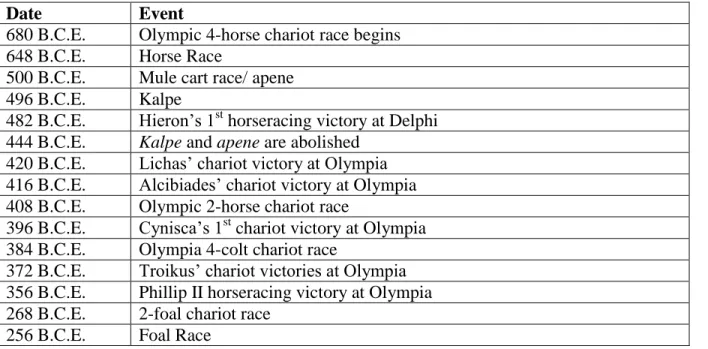
While competitions vary by locale, after the 4-horse chariot race, a number of other equestrian events were included such as the horse race, mule-cart race (apene), mare race (kalpe), 2-horse chariot race, 4-colt chariot race, 2-foal chariot race, and the foal race.76 Equestrian competitions were divided into separate events for mares and stallions, and were further separated by the age of the horses. Some competitions were specific to one location, such as the kalpe and apene, which were only performed at Olympia, and only for a brief period of time. In addition to the Panhellenic competitions at Olympia, Delphi, Nemea, and Isthmia, many cities had their own competitions. Major festivals including the Panathenaic festival also included equestrian events such as the apobates race, in which a warrior in a chariot would jump in and out of the vehicles while it was moving. The antihippasia, a mock cavalry battle, is another competitive military equestrian display.77
Jockeys and charioteers are essential components in any equestrian victory, but their inconspicuousness or invisibility in monuments is a testament to the political connotations of
75
Hdt. IV. 169.3. Markman1943, 8-9; Mitchell 2002, 97. See Appendix 2.
76
Christopoulos 1975, 494-495; Golden 2008.
77
26.
the competitions and associated victory monuments. Jockeys by virtue of their craft had to be small and were often young boys. Their careers were naturally short- lived as a result of the size and weight restrictions of the position. As a result, many jockeys were hired from local families who lived near the game sites.78 Racing individual horses was less prestigious than chariot racing. The small size of jockeys on monuments must also have some basis in reality, and thus cannot be justified through purely political motives. It is fitting that an individual with no connection to the patron would be denied attention in the commemoration of the victory. It would not have been advantageous to the patron to honor another individual, though undoubtedly trainers, jockeys, and charioteers would have gained more localized and ephemeral acclaim for victories.79
Among charioteers, greater flexibility was allowed with respect to the driver’s age and weight. Early charioteers were often friends or relatives of the patron or even the patron himself.80 For some events, such as the apobates race of the Panathenaic festival and the kalpe at Olympia, the owner was not permitted to hire a driver, but had to compete himself.81 With the commodification of the charioteers, patrons would have likely been forced to
choose from a group of experienced charioteers rather than employing their own family members.82 Charioteers received commemorative minimization similar to jockeys, especially in later periods when the athlete was less likely to the patron.
78
Nicholson 2005, 109.
79
Nicholson 2003, 103.
80
Nicholson 2003, 100-103 and 2005, 2-9, 95-96, and Golden 2008, 12-13.
81
27.
In addition to the particulars of the sporting events and the participants, it is important to remember that there are multiple meanings for large scale bronzes as sanctuary
dedications.83 First, the dedication provides a physical manifestation of the victory, and maintains the memory of the event. Often the memorials were portable, as in the case of victory odes, which could be recited periodically, or prize amphorae.84 Monuments were erected not only at the site of the victory, but also in the victor’s hometown.85
Additionally, the games were a means of venerating the gods, and renderings of such action serve as a reminder of the individual’s piety. Thirdly, the physical value of the material used to
construct the monuments must be fully appreciated to understand the ideological value of the sculptures.86 The horse in these athletic monuments was a physical proclamation of the status of the victorious dedicator’s wealth and political prestige. The commoditized positions of jockeys and charioteers cause their representations to be understated, and the horse becomes the proxy image for the elite sponsor.
The Delphi Charioteer
82
Nicholson (2003) discusses the absence of charioteers in several types of commemorative media including odes, vases, coins, and sculpture. He observes that charioteers are either absent from memorials or their images are manipulated to suit the victor better.
83
Hemingway 2004, 140.
84
Nicholson 2003, 103.
85
Hemingway 2004, 126.
86
Camp 1998, 25, 26; Tiverios 2007, 8. Vases given as prizes for athletic victories constituted part of the value of the victory. The contents of a victory vase, usually olive oil, would have been a
28.
The Delphi Charioteer (figs. 16-17) and the lost monument (figs. 18 and 19) associated with it provide one example on which to focus the discussion.87 The figure is dated to 474 B.C.E., and was found beneath the Sacred Way at Delphi.88 The charioteer stands at 5’11” high, making him life- sized or slightly larger than life-sized.89
He is an ephebe, with the beginnings of a beard evident on his cheeks (fig. 17-18).90 The charioteer’s face is placid, which marks him as the embodiment of a well-trained and objective-driven athlete.91 He wears the traditional long garment (xystis) of a charioteer, and stands tall with reins in his hands.92 Reconstructions suggest that there would have been four horses and one or two grooms or youths in the figural group (fig. 19). 93
The Delphi charioteer has often been linked to an inscription on a base which was found in close proximity to the charioteer and associated fragments.94 The reading of this inscription is problematic, but many have taken the charioteer to be a depiction of Polyzalos,
87
Delphi Charioteer: Delphi Archaeological Museum inv. 3484, 3520, 3540. For a comprehensive discussion of the monument, see Chamoux (1955).
88
Boardman 1991, 52. The commonly held date is 474 B.C.E. Adornato (2008, 29) dates him between 470 and 450 B.C.E.
89
Adornato 2008, 51.
90
Chamoux 1955, 51.
91
Adornato 2008, 48.
92
Chamoux 1955, 51.
93
Boardman 1991, 52; Adornato 2008, 35, fig. 5. Reconstructions of this monument are problematic. Adornato (2008, 49) states that fragments from three horses can be readily associated with the charioteer based upon the style of their execution.
94
29.
who is described on the base.95 Owing to the subject of the sculpture as well as early
reconstructions, many believe that the sculpture commemorates an athletic victory. Based on Adornato’s assertions, we must be cautious about associating the inscription with the
charioteer.96
Regarding the horses associated with the charioteer, only fragments, such as the rear legs of one of the horses, remain (fig. 20).97 The Delphi charioteer’s group leaves little room for discussion with reference to horse type owing to poor preservation. From these leg
fragments, we cannot gain much insight into conformation characteristics of chariot horses in this monument, though they have been interpreted as life-sized renderings.98 The lack of feathering on the fetlocks or pastern, however, indicates that the horse was not of the
European type, where such a characteristic would be expected. Given the context, it is likely that the horses in the group were the Western/Libyan type.
While an analysis of the type of horse shown on this monument can only be performed to a limited degree, the monument does illuminate some political ideologies relevant to this study. Disassociating the inscription from the charioteer cannot strip the monument of its splendor or make the motives for its creation seem less politically driven. Athletic monuments allow for the memory of a victory to be perpetuated for at least as long
95
See Appendix 2 for two reconstructions of the text on the inscription. For a detailed discussion of the inscription, see Adornato 2008, 31-37.
96
Adornato 2008, 28, 31-41. One of the problems with reading the inscription is determining who the dedicator would have been. Gelon and Hieron, tyrants of Gela have been proposed, but then the inscription cannot be associated with the sculpture. Inscriptions dedicated by Gelon and Hieron would have preceded the charioteer by at least a decade.
97
See Chamoux (1955, 39-43) for a complete list, descriptions, and inventory numbers of fragments associated with and/or found in close proximity to the charioteer.
98
30.
as the monument stands. We are still talking about the Delphi charioteer after all. The cost of constructing such a monument demonstrates the large financial stake that a patron would have had in the games. When this monument was intact, it would have presented a powerful image in which the horses – and proxy the wealthy sponsor – predominated.
Olympia Chariot Horse
The large bronze chariot horse statuette (470 B.C.E.) from Olympia provides another example of a bronze dedication (Fig. 21).99 The figure is well preserved, and is only missing its rear legs below the hocks. Some of its features are found in nature, while others are highly schematized. Markman indicates that the horse’s head is very realistic though a bit large and is especially naturalistic around the nostrils and ears.100 The eyes protrude to an excessive degree. The forelock is a projecting knob, and the mane is carved as a block that stood
straight on end.101 While the mane could easily be seen as a representation of the Asiatic type of mane, the forelock protrusion seen in this figure is not found in nature. The stylized
forelock is probably related to an earlier convention that can be seen in Geometric figurines. The horse’s neck is smooth and thick, but does not possess the distinctive curve associated with the Western type. The back is flat with little definition afforded to the withers and only a slight bump to indicate the croup. The shoulders and hindquarters are strong, but definition of
99
Markman 1943, 120; Lullies and Hirmer 1960, 32, pl. 106; Mallwitz and Herrmann 1980, 159-160, pl. 111; Andronicos 1994, 67, fig. 52. Markman dates it to 455-445 B.C.E. based on stylistic grounds, but Mallwitz and Hermann as well as Andronicos date it between 470-460 B.C.E. I follow the more recent dating. The statuette is 22.8 cm high.
100
Markman 1943, 120.
101
31.
musculature is spare in comparison with later examples. The front legs are slightly too long in comparison with the hindlegs.102 A great deal of effort was placed on detailed rendering of the leg muscles. The horse’s proportions are stocky, which is either an indication of type or a reflection of its place of origin.103 This statuette also provides a good example of chariot equipment including the bit, harness, and chest piece which often do not survive because they are often rendered as separate attachments, are lost by the time of discovery.104
Stylization in horse depiction is evident even in this period. As has been noted with Geometric bronze horses, a sculptor may be executing an equine in the sculpture without depicting the likeness of a specific victorious horse.105 When considered against other
examples of horses from Olympia, such as the horses from the quadriga on the east pediment of the Temple of Zeus (460 B.C.E.), one can see evidence for various horse types. 106 While the horses on the pediment have a body type which reflects the western horse, the bronze horse considered here represents an all-around different type. The thickness of the body and the configuration of the head, neck, and mane suggest that this is likely a stylized example of the Asiatic type.
102
Markman 1943, 120.
103
According to Lullies and Hirmer (1960, 32) the bulky proportions are a trait of northeastern Peloponnesian sculpture.
104
See Waywell (1978, pl. 5) for an example of a carved chest piece and attached bit from an impressive example from the Mausoleum of Halicarnassos. The chest piece is carved onto the horse, while the bit, frontlet, and head piece would have been attachments. The Artemision horse would have also had a bit and bridle attachment (Hemingway 1998, 115-116).
105
Nicholson 2005, 16.
106
32.
Artemision Horse and Jockey
The Artemision horse and jockey group (BI5177) from around 150-140 B.C.E is an example of a large-scale bronze athletic monument from the late Hellenistic period. 107 In this monument, the long-limbed horse is shown in the midst of action (figs. 22-23).108 This horse is slightly smaller than life-size, though he is of a larger scale than the jockey.109 The small jockey, believed to be of Libyan origin, is crouched with reins in hand (fig. 24). Although found separately, Hemingway and others have convincingly argued that they are correctly reconstructed as a group.110 While diminutiveness is a prerequisite for a jockey, the contrast in size between the horse and rider is emphasized.111
The proportions of the horse itself are not naturalistic, but exaggerated, especially in the area of the limbs. There is pronounced disparity between the length of the front and rear legs of the horse (fig. 25). This distortion of features, which includes the lengthening of the
107
Schuchhardt 1978: 91; Smith 1991, 54; Hemingway 2004, 89, 149; Smith, reminds us that this is the first example of a large scale bronze monument commemorating a horse race. I accept
Hemingway’s dating of the group to the second half of the second century B.C.E.
108
See Hemingway (2004) for discussion of the recovery and reconstruction of this monument.
109
Hemingway 2004, 50. The horse stands at 2.05 m when measured from the floor to the top of its head. The 2.05m measurement is the equivalent of approximately 20 hh, but horses are typically measured with their feet planted on the ground. Their height is measured to from the ground to the withers rather than the top of the head. The horse’s dynamic pose makes him seem larger than he is.
110
Hemingway 2004, 141; Karouzou (1978) mentions the uncertainty of the pairing in his discussion of the groups, which is partly due to the separation of the figures and damage sustained around the area of the join. Hemingway resolves this uncertainty largely through matching the drapery on the jockey to a fragment on the horse’s withers. See Hemingway 2004 (76, fig. 50) for an image of this match.
111
33.
rear legs and the shortening of the front legs, is also evident on the Panathenaic amphora in the British Museum (fig. 5).
This animal is depicted in full motion; in addition to the position of the legs the open mouth and flaring nostrils give the viewer a sense of the dynamism of the group (fig. 26). The sculptural group is meant to be viewed from the group’s left, which is the direction in which the jockey is facing, at a three-quarter perspective. The odd configuration of the legs is not noticeable from this angle, but the optical correction makes a frontal view of the group awkward (fig. 27). The horse’s head is narrow and finely featured and the ears are pinned back. The position of the ears combined with the indications of effort in the muzzle, demonstrate the effort exerted by this animal. . The pronounced curve of the neck often shown in vase paintings of the preceding centuries is nonexistent on this monument.112 The long and slender neck is met by a chest that appears deep, but is deemphasized in favor of a strong shoulder. A similar level of modeling is used to define the muscles on the flanks and hindquarters, perhaps reinforcing the propulsive power of his limbs. The right hindquarter is the site of a brand depicting a winged Nike bearing a crown.113 The Nike brand is believed to be a reference to the wealthy horse-owner, which further reinforces both the importance of the owner in this monument and occasion for which the monument was constructed.114
112
See the previous section on vase paintings. In figs. 5, 9, and 10, though the horses are in motion, their necks remain arched, whereas on this monument, the horse’s neck is fully extended.
113
Hemingway 2004, 101, fig 59. For more information on brands, see Kroll 1977, 87-88. The Nike was one of several common brand types described in the 3rd century tablets from the Dipylon courtyard.
114
34.
The Artemision horse is a definite example of the Western/ Libyan type. The horse closely resembles the modern Thoroughbred, which is prized for its speed and spiritedness.115 This horse lacks the short and shaggy appearance of horses of European and Asiatic origin. This does not imply that the horse depicted came from North Africa, however, but its predecessors may have. It is conceivable that by thesecond century B.C.E, with increased mobility and demand for animals with particular traits, the horse could have been raised anywhere in the Mediterranean provided that resources were available.116 By the time that this depiction was made, equestrian competition had been in existence for several centuries. Selective breeding would have emphasized traits favorable for particular events. Artists may have also given emphasis to particular traits in their renderings, which, for this example, might include the elongation of the neck in addition to the rear legs. This horse stands in stark contrast to the bronze horse from Olympia discussed in the previous section, which is undoubtedly the result of differences in the time in which the sculptures were made, but is also likely a product of the changing reality of horses by the Hellenistic period.
Issues of Scale
The emphasis on the horse and a de-emphasis on charioteers and riders has been noted in various types of commemorative media.117 Despite the scarcity of well-preserved large scale bronze victory monuments, it seems that the same principle is true in sculpture.
115
Smith 1991, 54.
116
Hemingway 2004, 146-148. The details of the shipwreck in which this group was found, as well as theories about the origin of the ship and its contents are given.
117
35.
Even in the case of the Delphi charioteer, where most of the accompanying members of the sculptural group are lost, the charioteer’s slender proportions suggest that he was to be
considered as part of a larger sculptural unit rather than the main focus of the monument. The charioteer’s height and elevation in the reconstruction enabled him to be seen over the
horses. He was not the primary focus of the piece, however, for the monument was meant to be viewed from the front, where four impressive horses would have dominated the viewer’s visual field.118
The scalar disparity in athletic monuments which gives favor to the horse rather than the rider or charioteer appears consistently through time. 119 In the case of the Delphi
charioteer, the slender figure, while beautifully rendered, would have been dwarfed by the team of horses. This case is more subtle than that of the Hellenistic Artemision horse and jockey group. The victorious horse commemorated here is given center stage, and is the byproduct of the careful breeding by the patron rather than the efforts of a jockey or charioteer. The jockey is a smallish addendum to this marvelous and dynamic animal, and while carefully rendered and equally dynamic, he is dwarfed considerably by his equine counterpart. Regarding the bronze horse at Olympia, there is no way to be certain of its scale in relation to human figures, as none are preserved in association with it.
118
Adornato 2008, 33. The frontal orientation of the charioteer and his slender proportions support this claim. Reconstruction as a team of four is reasonable, given that the quadriga predominated.
119
Nicholson 2005, 109-110; Golden 2008, 12. As Hemingway (2004, 50) asserts, the racehorse in the Artemision group is described as smaller than life-size, but still of significantly greater
Chapter 3:
Horses in Relief
While intact examples of large-scale horse sculpture in the round are few, equines in relief are common. The four main contexts in which horses appear in relief are as part of the sculptural programs of buildings, as grave reliefs, as victory monuments, and as figures on statue bases. Of these contexts, I will focus on horses featured in architectural sculpture and on funerary reliefs.
Prinias Reliefs
Despite its poor preservation, the Archaic (mid-7th century B.C.E.) Temple A at Prinias bears a frieze featuring a line of mounted horsemen (fig. 28).120 The Temple A frieze is the second oldest relief of its type in stone.121 The building appears to hold echoes of a North Syrian and Near Eastern style.122 The position of the frieze in relation to Temple A has been debated. It is typically reconstructed as part of the entablature, but it has also been
120
Beyer 1976, 32-34, 37. The date of the temple is contested. Beyer suggests an early date (735-680 B.C.E.) based upon the construction and style. Others give the temple a later date of ca. 650 B.C.E.
121
Ridgway 1993, 380.
122