LOAN ME THE MONEY: HOW COGNITIVE ABILITIES AND FINANCIAL KNOWLEDGE INFLUENCE CONSUMERS’ INFORMATION BEHAVIORS
Kathleen N. Brennan
A dissertation submitted to the faculty at the University of North Carolina at Chapel Hill in partial fulfillment of the requirements for the degree of Doctor of Philosophy in the School of
Information and Library Science.
Chapel Hill 2018
iii ABSTRACT
Kathleen N. Brennan: Loan Me the Money: How Cognitive Abilities and Financial Knowledge Influence Consumers’ Information Behaviors
(Under the direction of Diane Kelly)
For most people, financial well-being depends on the ability to make sound decisions about many aspects of personal finance. This is especially true in the United States (U.S.), when it comes to consumer loan products such as mortgages and student loans. Consumers who lack strong financial knowledge can unwittingly expose themselves to bad information when
searching online. Without understanding people’s searching behaviors, information
professionals cannot know whether personal finance-related information systems adequately meet the needs of the people using them. Interactive Information Retrieval (IIR) is well-suited to study this, yet there has been little research in this area. One approach that makes sense for studying debt-related information searching is to investigate the role individual differences play in people’s searching. This is because individual differences are testable constructs that can be associated with differences in search performance outcomes.
The purpose of this dissertation research is to understand influences that cognitive abilities and financial knowledge have on outcomes related to search, assessment, and mental workload of adults searching online for debt-related personal finance information. A theoretical model is proposed in which financial knowledge acts as a moderating variable on the effect that cognitive abilities have on search and evaluation behaviors as well as mental workload.
The results of the study were mixed. The testing of hypotheses on the model were unsuccessful and provide information for informing future model designs and hypothesis
iv
topic of personal finance, specifically in the realm of financial loans such as mortgages, student loans, and payday loans, is more challenging for people than they realize. Participants reported low prior knowledge of all task topics and used simple search strategies such as avoiding
v
To my beautiful wife, Alaina.
vi
ACKNOWLEDGEMENTS
I am very grateful to many people who helped me earn my doctorate at UNC’s School of Information and Library Science (UNC-SILS).
Thank you to my advisor, Dr. Diane Kelly. Your mentorship started on my first day at UNC-SILS and now, years later, I find it almost impossible to sum up its great value in just a few words. On the days I feel most competent as a researcher, I know it is because of your training I can feel this way. Thank you for helping me become a scholar. Thank you for your guidance, support, loyalty, and patience. Thank you for your friendship.
Thank you to the members of my dissertation committee members, Drs. Jaime Arguello, Rob Capra, Jacek Gwizdka, and Javed Mostafa. You have each played a special and unique role in guiding me through the dissertation process. As I go forward, I bring your insights with me into new directions and approaches for this research.
vii
me about qualitative coding and for being an example of authenticity and strength. Thank you to all the administrative staff at UNC-SILS but especially to Lara Bailey – somehow you manage to help all the doctoral students with every aspect of university minutiae without ever losing your cheerful demeanor. That is a true gift that you have.
I was fortunate to be able to attend numerous research conferences during my doctoral program, thanks to student travel scholarships from ACM-SIGIR, ASIS&T, and others. During these events I was often humbled by the amount of time, attention, and interest that international scholars graciously gave me to talk about my research, even in its most nascent stages. My thanks go to these researchers for that: Drs. Leif Azzopardi, Pia Borlund, Katriina Byström, Pertti Vakkari, Heather O’Brien, Luanne Freund, George Buchanan, Cathy Smith, and Howard White.
I was also fortunate to have many excellent current and former peers from the doctoral program at UNC-SILS who shared this journey with me, providing valuable input and feedback throughout the milestones in my PhD program. These peers included Dr. Ashlee Edwards-Brinegar, Anita Crescenzi, Leslie Thomson, Dr. Earl Bailey, Dr. Wan-ching Wu, Dr. Laura Sheble, Sandeep Avula, Shenmeng Xu, Yinglong Zhang, Yuan Li, Bogeum Choi, and Austin Ward. I hope I have not left anyone out. Thank you, to all of you.
There are numerous funders to thank for their financial support. These include UNC-SILS, the Kalp Fellowship, the Lester Asheim Fellowship, the Louis Round Wilson Fellowship, and the Monning Family Fund. I thank Phi Beta Mu for the Eugene Garfield Dissertation scholarship during the last year of my program. I thank my parents, Edward and Sheila Brennan, for financial help during some lean semesters. I also thank my wife, Alaina Kupec, who
supported me financially through the last few years of my program.
viii
know it was a bigger task than you expected and I greatly appreciate your work. I also thank my 47 anonymous participants.
I am grateful to numerous friends who gave me so much moral support, including Marne, Melissa, Amber, Kendra, Tom, and many others. I am also indebted to many of my family members. I thank my parents for teaching me to value education through their inspiring examples and for instilling in me the values of persistence and patience. I thank all the rest of the Brennans and Kupecs who put up with me working on vacations, working while they were visiting, and generally not always being fully present. Your patience and support throughout my doctoral program was nothing short of amazing. Finally, I thank my wife, Alaina Kupec,
ix
TABLE OF CONTENTS
LIST OF TABLES ... XVII LIST OF FIGURES ... XX
CHAPTER 1: INTRODUCTION ... 1
1.1. Background ... 1
1.2. Statement of the Problem ... 2
1.3. Purpose of the Study and Research Questions ... 5
1.4. Organization of the Dissertation ... 7
CHAPTER 2: LITERATURE REVIEW ... 8
2.1. Cognitive Abilities ... 8
2.1.1. Definition of cognitive abilities. ... 8
2.1.2. Theory of cognitive abilities. ... 9
2.1.3. Perceptual speed... 11
2.1.4. Memory span. ... 14
2.2. Domain Knowledge and the Domain of Personal Finance ... 17
2.2.1. Domain knowledge, search, and evaluation behaviors. ... 17
2.2.2. The domain of personal finance topics. ... 20
2.2.2.1. Search and evaluation behaviors in the personal finance domain. ... 20
2.2.2.2. Influence of cognitive abilities in the personal finance domain. ... 22
2.3. Mental Workload ... 25
2.3.1. The mental workload of querying. ... 25
2.3.2. Mental workload created by features of the SERP. ... 27
2.3.3. Mental workload of evaluating documents. ... 28
x
2.4. Information Searching and Evaluation ... 30
2.4.1. Information searching. ... 30
2.4.1.1. Search behaviors. ... 30
2.4.1.2. Search strategies... 33
2.4.2. Information evaluation. ... 37
2.4.2.1. Evaluation behaviors. ... 37
2.4.2.2. Evaluation strategies. ... 38
CHAPTER 3: RESEARCH QUESTIONS AND THEORETICAL MODELS ... 41
3.1. Research Questions ... 41
3.2. Research Question #1 – Theoretical Model, Hypotheses, and Statistical Models ... 42
3.2.1. Perceptual speed model... 43
3.2.1.1. Perceptual speed - influence on search behaviors... 43
3.2.1.2. Perceptual speed - influence on relevance assessments. ... 44
3.2.1.3. Perceptual speed - influence on mental workload. ... 44
3.2.1.4. Statistical model showing the influence of perceptual speed on the dependent variables. ... 45
3.2.2. Working memory model. ... 45
3.2.2.1. Working memory – influence on search behaviors. ... 45
3.2.2.2. Working memory – influence on relevance assessments. ... 46
3.2.2.3. Working memory – influence on mental workload. ... 46
3.2.2.4. Statistical model showing the influence of working memory on the dependent variables. ... 47
3.2.3. Financial knowledge model. ... 47
3.2.3.1. Financial knowledge - influence on search behaviors. ... 47
3.2.3.2. Financial knowledge - influence on relevance assessments. ... 48
3.2.3.3. Financial knowledge - influence on mental workload. ... 48
xi
3.2.4. Interaction of perceptual speed and financial knowledge on the dependent
variables. ... 49
3.2.4.1. Statistical model for interaction of perceptual speed and financial knowledge on search performance... 50
3.2.4.2. Statistical model for interaction of perceptual speed and financial knowledge on relevance assessments. ... 51
3.2.4.3. Statistical model for interaction of perceptual speed and financial knowledge on mental workload. ... 51
3.2.5. Interaction of working memory and financial knowledge on the dependent variables. ... 52
3.2.5.1. Statistical model for interaction of working memory and financial knowledge on search performance... 52
3.2.5.2. Statistical model for interaction of working memory and financial knowledge on relevance assessments. ... 53
3.2.5.3. Statistical model for interaction of working memory and financial knowledge on mental workload. ... 54
3.3. Research Question #2 – Strategies for Finding and Evaluating Information ... 54
CHAPTER 4: METHODS ... 55
4.1. Study Design ... 55
4.1.1. Cognitive abilities. ... 55
4.1.1.1. Perceptual speed measurement. ... 55
4.1.1.2. Memory span measurement. ... 56
4.1.3. Financial knowledge measurement. ... 57
4.1.4. Search behavior measures. ... 58
4.1.5. Relevance assessments... 59
4.1.6. Mental workload measures. ... 61
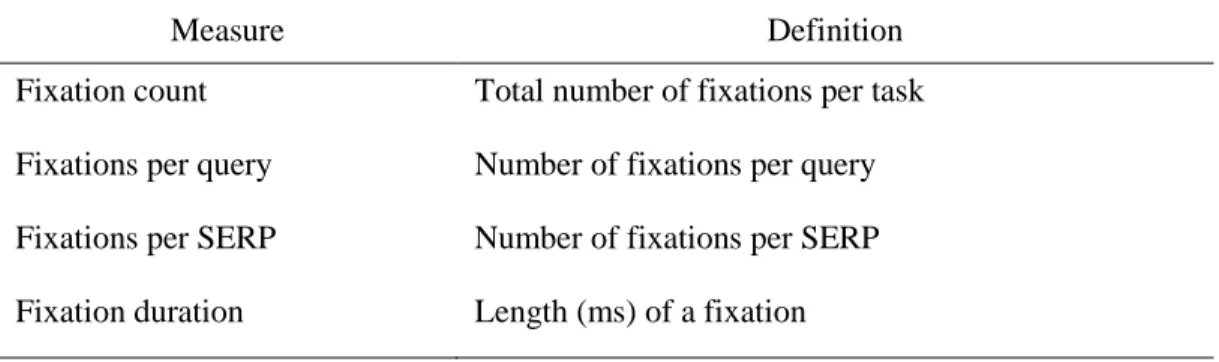
4.1.7. Eye gaze measures. ... 62
4.1.8. Search strategy measures. ... 63
4.2. Search Tasks ... 64
xii
4.2.2. Design goals. ... 65
4.2.3. Selection of task topics. ... 66
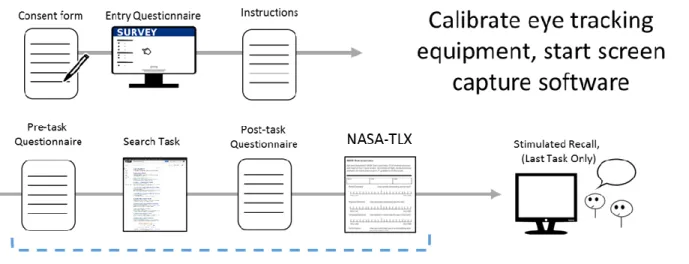
4.3. Procedure ... 66
4.4. Participants ... 70
4.4.1. Demographics. ... 71
4.4.2. Self-rating of financial knowledge. ... 72
4.4.3. Financial product experience. ... 73
CHAPTER 5: RESULTS ... 76
5.1. Data Overview and Analytic Assumptions ... 76
5.1.1. Sample data excluded. ... 76
5.1.2. Search logging issues. ... 77
5.1.3. Probability level for hypothesis testing... 78
5.1.4. Nature of the data variables. ... 78
5.1.5. Data distributions. ... 79
5.1.6. Assumption about scores on cognitive abilities and financial knowledge tests. ... 81
5.1.7. Assumption about search task differences. ... 81
5.2. Descriptive Statistics ... 82
5.2.1. Pre- and post-task questionnaires... 82
5.2.2. Cognitive abilities. ... 86
5.2.3. Financial knowledge. ... 88
5.2.4. Search behaviors. ... 89
5.2.4.1. Clicks. ... 90
5.2.4.2. Queries. ... 90
5.2.4.3. SERPs and webpages. ... 91
5.2.5. Relevance assessments... 92
xiii
5.2.7. Eye movement data. ... 98
5.3. Hypothesis and Exploratory Results with Corresponding Statistical Models ... 100
5.3.1. Perceptual speed model... 100
5.3.1.1. Hypothesis #1... 100
5.3.1.2. Hypothesis #2a and b. ... 100
5.3.1.3. Hypothesis #3... 103
5.3.2. Working memory model. ... 103
5.3.2.1. Hypothesis #4a and b. ... 103
5.3.2.2. Hypothesis #5... 104
5.3.2.3. Exploratory Measure #1. ... 105
5.3.3. Financial knowledge model. ... 106
5.3.3.1. Hypothesis #6... 106
5.3.3.2. Hypothesis #7... 106
5.3.3.3. Exploratory measure #2. ... 107
5.3.4. Perceptual speed and financial knowledge interaction model. ... 107
5.3.4.1. Hypothesis #8a, b, and c. ... 107
5.3.4.2. Hypothesis #9a and b. ... 108
5.3.4.3. Exploratory measure #3. ... 109
5.3.5. Working memory and financial knowledge interaction model... 109
5.3.5.1. Exploratory measure #4. ... 109
5.3.5.2. Exploratory measure #5. ... 110
5.3.5.3. Exploratory measure #6. ... 110
5.4. Qualitative Data Analysis and Results ... 110
5.4.1. Strategies and tactics for finding information. ... 112
5.4.1.1. Task start tactics and strategies. ... 112
xiv
5.4.1.3. Finding and excluding tactics and strategies. ... 122
5.4.1.4. SERP tactics and strategies. ... 127
5.4.1.5. Exploration tactics. ... 128
5.4.1.6. Querying tactics. ... 130
5.4.2. Strategies for evaluating information... 130
5.4.2.1. Starting the evaluation process. ... 131
5.4.2.2. Evaluation strategies. ... 132
5.4.2.3. Criteria participants used for evaluating websites. ... 134
5.4.2.4. Reasons for relevance decisions. ... 138
5.4.2.5. General viewpoints. ... 139
CHAPTER 6: DISCUSSION AND IMPLICATIONS ... 141
6.1. Discussion of Findings Related to the Models and Hypotheses (RQ1) ... 141
6.1.1. Perceptual speed model... 141
6.1.1.1. Hypothesis #1... 141
6.1.1.2. Hypothesis #2a and b. ... 143
6.1.1.3. Hypothesis #3... 146
6.1.2. Working memory model. ... 147
6.1.2.1. Hypothesis #4a and b. ... 147
6.1.2.2. Hypothesis #5... 149
6.1.2.3. Exploratory measure #1. ... 150
6.1.3. Financial knowledge model. ... 151
6.1.3.1. Hypothesis #6... 151
6.1.3.2. Hypothesis #7... 152
6.1.3.3. Exploratory measure #2. ... 152
6.1.4. Interaction model for perceptual speed and financial knowledge. ... 153
xv
6.1.4.2. Hypothesis #9a and b. ... 153
6.1.4.3. Exploratory measure #3. ... 154
6.1.5. Interaction model for working memory and financial knowledge... 154
6.1.6. Additional data analysis techniques. ... 154
6.2. Discussion of Findings Related to Qualitative Analysis (RQ2) ... 154
6.2.1. Finding information. ... 155
6.2.2. Evaluating information. ... 158
6.2.3. Qualitative analysis of cognitive abilities and financial knowledge. ... 160
6.3. Limitations of the Methods ... 161
6.3.1. Study design. ... 162
6.3.2. Search tasks. ... 169
6.3.3. Procedure. ... 170
6.3.4. Participant characteristics. ... 171
6.3.5. Data analysis techniques. ... 172
CHAPTER 7: CONCLUSION ... 173
7.1. Contributions... 174
7.2. Future Directions of the Work ... 176
APPENDIX A: DEMOGRAPHIC QUESTIONNAIRE ... 178
APPENDIX B: FINANCIAL KNOWLEDGE SELF-RATING QUESTIONNAIRE ... 179
APPENDIX C: FINANCIAL EXPERIENCE QUESTIONNAIRE ... 180
APPENDIX D: PRE-TASK QUESTIONNAIRE ... 181
APPENDIX E: SEARCH TASKS ... 182
APPENDIX F: POST-TASK QUESTIONNAIRE ... 183
APPENDIX G: NASA-TLX MENTAL WORKLOAD QUESTIONNAIRE... 184
APPENDIX H: RECRUITMENT EMAIL ... 185
xvi
APPENDIX J: PARTICIPANTS’ ON-SCREEN INSTRUCTIONS ... 187
APPENDIX K: STIMULATED RECALL MODERATOR’S GUIDE ... 192
APPENDIX L: EXPERT ASSESSORS’ INSTRUCTIONS ... 195
xvii
LIST OF TABLES
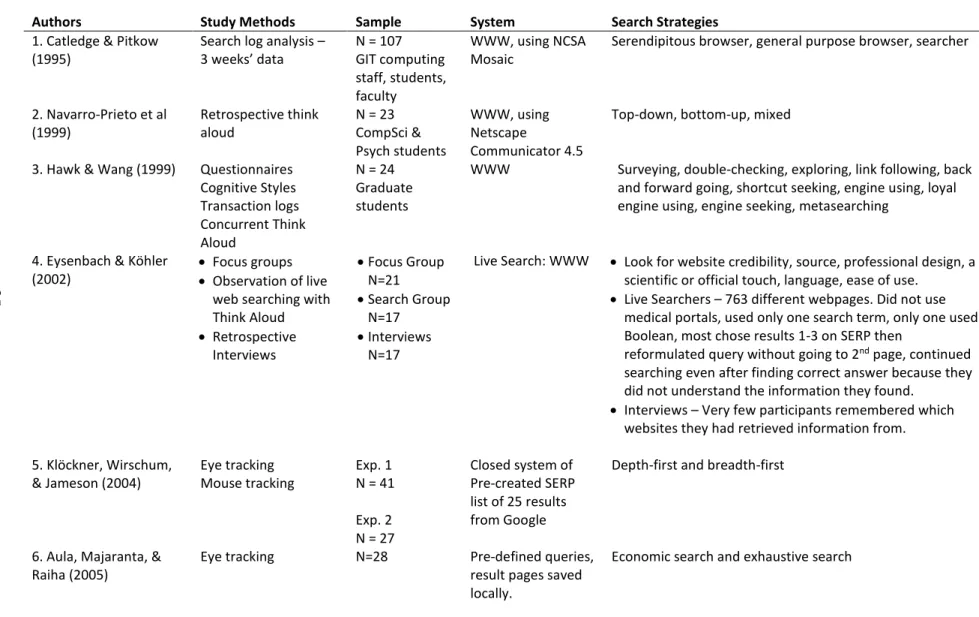
Table 1. Summary of Search Strategies for Web Searching found in ILS Research ... 35
Table 2. Search Behavior Measures and Definitions ... 59
Table 3. Evaluation Behavior Measures ... 61
Table 4. Eye Gaze Measures ... 62
Table 5. List of Study Participants’ Occupations ... 72
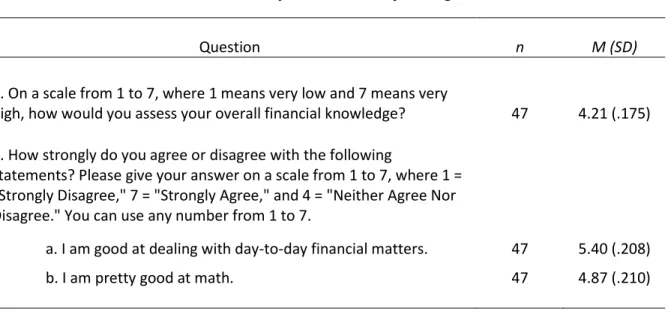
Table 6. Means and Standard Deviations for Financial Self-Rating Scores ... 73
Table 7. Frequencies for Financial Product Experience Questions ... 74
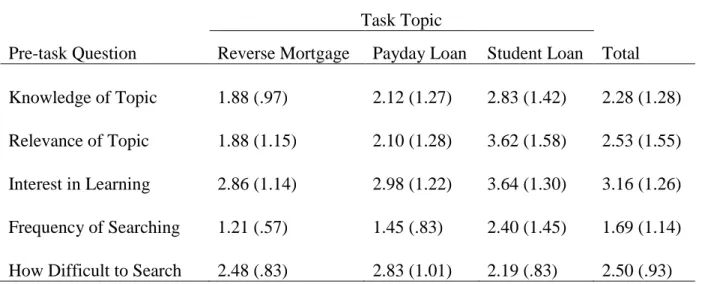
Table 8. Means and Standard Deviations for Pre-Task Questionnaire Responses ... 82
Table 9. Results of ANOVA for Pre-Task Questionnaire, Using Brown-Forsythe F-ratio ... 84
Table 10. Means and Standard Deviations for Post-Task Questionnaire Items ... 85
Table 11. Means and Standard Deviations of Perceptual Speed Test (N=42) ... 86
Table 12. Means and Standard Deviations of Memory Span Test (N=42) ... 87
Table 13. Descriptive Statistics, Financial Knowledge Scores (N = 42) ... 89
Table 14. Means and Standard Deviations for Click Data ... 90
Table 15. Means and Standard Deviations for Query Behaviors ... 91
Table 16. Means and Standard Deviations for SERPs and Webpages Viewed ... 92
Table 17. Means and Standard Deviations for Bookmarks by Relevance Grade ... 93
Table 18. Cross-tabulated Results of Expert Assessor’s Relevance Judgments ... 93
Table 19. Means and Standard Deviations for NASA-TLX Mental Workload Questionnaire .... 95
Table 20. Total Variance Explained, NASA-TLX Component Analysis ... 96
Table 21. Communalities for the NASA-TLX Mental Workload Questionnaire ... 97
Table 22. Means and Standard Deviations for Eye Fixation Data ... 99
xviii
Table 24. Means and Standard Deviations for Time to 1st Click by Perceptual Speed Level .... 102
Table 25. Means and Standard Deviations of Average Queries per Task by Financial Knowledge and Perceptual Speed Groupings ... 108
Table 26. Means and Standard Deviations of Total Bookmarks by Financial Knowledge and Perceptual Speed Groupings ... 109
Table 27. Main Coding Nodes for Research Question #2. ... 111
Table 28. Primary Code Categories for “Finding Information,” Number of Participants, Number of Uttered References ... 112
Table 29. Nodes and Subnodes for Starting the Search Task ... 113
Table 30. Codes for Formulating a Query ... 114
Table 31. Codes for Looking for Specific Kinds of Websites ... 115
Table 32. Codes for Gathering General Information ... 116
Table 33. Codes for Finding Specific Information ... 117
Table 34. Codes for Employing Exclusion Criteria ... 117
Table 35. Codes for Applying Task to Self ... 118
Table 36. Codes for Resources and Sources Tactics and Strategies ... 118
Table 37. Top 10 Websites Mentioned During Information Searching... 121
Table 38. Codes for Finding and Excluding Tactics and Strategies ... 122
Table 39. Codes for Finding Criteria ... 122
Table 40. Codes for Webpage Content Attributes ... 123
Table 41. Codes for Types and Kinds of Webpage Content ... 124
Table 42. Codes for Source Attributes ... 125
Table 43. Codes for Source Types ... 125
Table 44. Codes for Excluding Information ... 127
Table 45. Codes for SERP Tactics and Strategies ... 128
xix
Table 47. Codes for Querying Tactics ... 130
Table 48. Code Categories of Strategies for “Evaluating Information” Node, by Number of Participants, Number of Uttered References ... 131
Table 49. Codes for Starting the Evaluation Process: Understand the Financial Product ... 132
Table 50. Codes for Evaluation Strategies ... 134
Table 51. Codes for Website Domain and Content Criteria ... 134
Table 52. Word Describing Government Websites and Information ... 135
Table 53. Codes for Website Quality Criteria ... 137
Table 54. Codes for Website Attributes ... 138
Table 55. Codes for Relevance Decisions ... 139
Table 56. Codes for General Viewpoints ... 140
Table 57. Means and Standard Deviations for Time Spent on Tasks in Minutes ... 142
Table 58. Responses to Financial Self-rating Questions. ... 179
xx
LIST OF FIGURES
Figure 1. Three-Stratum Theory Model (Carroll, 1993). ... 10
Figure 2. Compilation of user-defined relevance criteria from the ILS literature. ... 40
Figure 3. Theoretical model showing the influence of two independent variables – cognitive ability and domain knowledge (as the moderating independent variable) – on three dependent variables: search performance, relevance assessments, and mental workload. ... 43
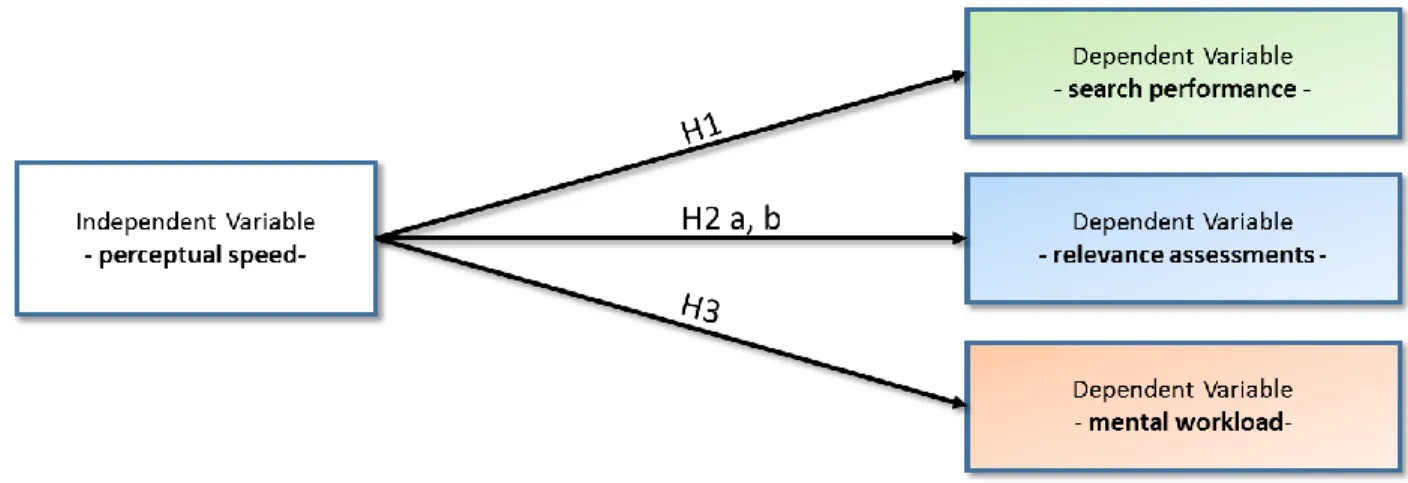
Figure 4. Statistical model showing the influence of perceptual speed on the dependent variables, with arrows labelling the hypotheses. ... 45
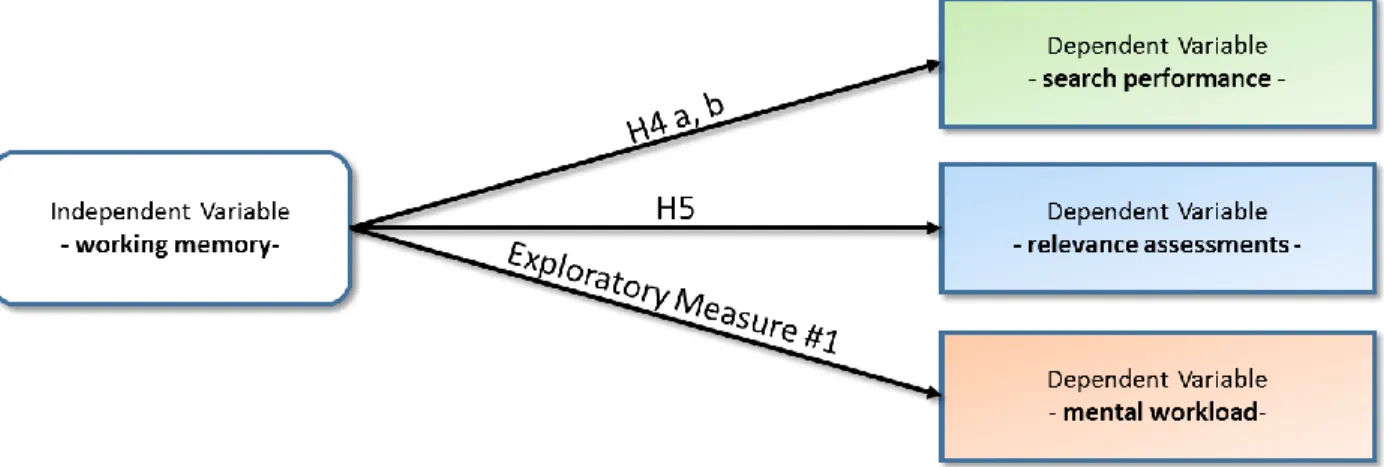
Figure 5. Statistical model showing the influence of working memory on the dependent variables, with hypotheses and the exploratory relationship labelled. ... 47
Figure 6. Statistical model showing the influence of financial knowledge on the dependent variables, with arrows labelling the first two hypotheses and a possibly third relationship labelled Exploratory. ... 49
Figure 7. Statistical model showing the interaction of perceptual speed and financial knowledge (as the moderator) on the influence of search performance, with hypotheses labelled. ... 50
Figure 8. Statistical model showing the interaction of perceptual speed and financial knowledge (as the moderator) on the influence of relevance assessments, with hypotheses labelled. ... 51
Figure 9. Statistical model showing the possible interaction of perceptual speed and financial knowledge (as the moderator) on the influence of mental workload, with the exploratory relationship labelled. ... 52
Figure 10. Statistical model showing the possible interaction of working memory with financial knowledge (as the moderator) on the influence of search performance, labelled Exploratory. ... 53
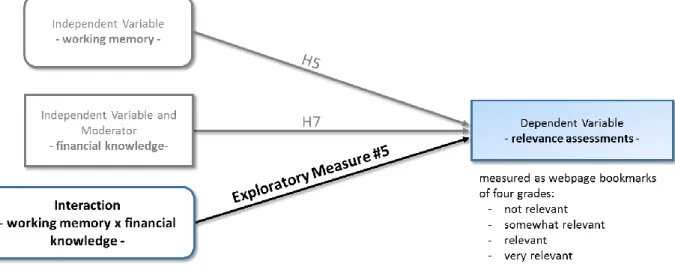
Figure 11. Statistical model showing the possible interaction of working memory with financial knowledge (as the moderator) on the influence of relevance assessments, labelled Exploratory. 53 Figure 12. Statistical model showing the possible interaction of working memory with financial knowledge (as the moderator) on the influence of mental workload, labelled Exploratory. ... 54
Figure 13: Illustration of experiment procedure for the dissertation study, in two sessions. ... 67
Figure 14. Score distribution for participants on the perceptual speed test. ... 87
Figure 15. Score distribution for participants on the memory span test. ... 88
Figure 16. Score distribution for participants on the financial knowledge test. ... 89
xxi
1
CHAPTER 1: INTRODUCTION 1.1. Background
For most people, financial well-being depends on the ability to make consistently sound, informed decisions about many aspects of personal finance. This is especially true in the area of consumer loan products such as mortgages and student loans in the United States (U.S.), where consumer debt holdings are currently more than $10.4 Trillion1. Even though there is an
abundance of high quality information about personal finance available online, the growing array of financial concepts and debt products has become so complex that it is increasingly challenging for people to sort through the broad expanse of choices to make the best-informed financial decisions for themselves and their families. The growing alternative financial services (AFS) industry (e.g., payday lending, rent-to-own leasing, and subprime mortgage lending) makes the situation worse, with its often aggressive marketing practices that can crowd-out safer competing products (McCoy, 2009). The potential for making suboptimal financial choices in this
environment is high.
Debt needs to be properly managed. This is backed up by evidence from research indicating that too much debt can be a source of financial stress (Kim, Sorhaindo, & Garman, 2006) and can negatively impact physical health (Drentea & Lavrakas, 2000). Not all debt is the same, however, with research showing that debt related to credits cards causes people greater psychological stress than debt related to owning a home, such as mortgage debt (Brown, Taylor,
2
& Wheatley-Price, 2005). At the heart of good personal debt management is the need to understand core aspects of debt and debt products. This is a kind of financial literacy that
includes grasping financial concepts such as compound interest rates and inflation risk and being able to discern the advantages and disadvantages of specific kinds of debt products based on one’s own particular financial needs and circumstances. Access to accurate, up to date,
contextually appropriate information is paramount for individuals to maintain adequate levels of financial literacy for success when it comes to managing personal debt.
1.2. Statement of the Problem
While there are many ways that people can acquire information about debt products and debt management, the main way people go about doing this is by searching the Internet (Bricker et al., 2014). People seek out information sources online before they talk to family members, associates, accountants and financial advisors (Bricker et al., 2014). This is problematic because the Internet is an unregulated, open environment where information can be posted by anyone and where financial transactions are instantaneous. The problem is that consumers who lack strong financial knowledge can unwittingly expose themselves to bad information, whether it simply be advice that does not fit their own personal financial situations or worse, the schemes of bad actors seeking to prey upon them. While the exact size of the consumer population lacking adequate financial knowledge is not known, a recent survey of financial capability in the U.S. (N = 27,564) found that two-thirds of Americans could not pass a basic financial literacy test (Lin, Bumcrot, Ulicny, Lusardi, Mottola, Kieffer, & Walsh, 2016). Financial illiteracy is also more prevalent in some demographic groups than others, such as women and the less-educated.
3
The main approach to date for understanding consumers behaviors around debt and debt management has been for consumer finance and behavioral economics researchers to conduct secondary analyses of large public surveys like the Survey of Consumer Finance2 or the American Housing Survey3. These analyses are used for developing basic insights about high-level trends in generic consumer behaviors, but they tell us nothing about the actual behaviors of people who open up their Internet browsers on a daily basis and search for everything from the cost of a pair of shoes to the interest rate they might qualify for on a mortgage loan. This should matter to Information Science and all its subdisciplines because without understanding people’s online searching behaviors in this realm, there is no way to know whether personal finance-related information systems adequately meet the needs of the people using them. Interactive Information Retrieval (IIR) is particularly well-suited to study consumers’ online debt-related information searching because the foundations of IIR research methods are aimed specifically at evaluating human interactions with information systems. Yet there has been very little research on this in IIR or information and library science (ILS). Occasional studies have appeared in the ILS literature but they have either been related only to personal investing (e.g., (Kuhlthau, 1997; Mezick, 2002)) or, if debt-related, have been about consumers in countries other than the U.S., where regulatory requirements can differ greatly (e.g., (Biza-Khupe, 2014)).
One approach to studying information searching online in IIR has been to look at the role that individual differences play in search behaviors. This makes logical sense as an approach for studying debt-related information searching because individual differences are testable
constructs of cognitive, demographic, and interpersonal characteristics that can be associated
4
with differences in search performance outcomes. At the same time, investigating individual differences in the context of debt-related information searching opens a new pathway for contributing to the existing body of individual differences research and heeds the recent call for more research of general or specialized adult populations to understand unique considerations of people with different levels of literacy (O'Brien, Dickinson, & Askin, 2017), in this case,
financial literacy.
In addition, many studies investigating individual differences look for behavioral signals that can be used to predict outcomes for users, and it is still largely unclear if these signals are valid and reliable. There is no overarching body of research that tells us a coherent story about individual differences (O'Brien et al., 2017). Part of the problem is that actions taken during information searching, such as the number of users’ clicks, search queries, and webpage views can be ascribed divergent meanings depending on the user’s circumstances (e.g., the user is experiencing difficulty versus the user is actively engaged). Relevance judgments are also tricky because the construct of relevance can be defined from more than one point of view (e.g.,
system, user, or topic domain) and also because webpages retrieved based on the system’s algorithm of relevance may not match what the user judges as relevant, nor what an expert views as relevant (e.g., consider the case of ambiguous queries such as “jaguar,” “zenith,” or “mont blanc”). Mental workload is another area on which individual differences have an influence, but research to date has only uncovered parts of the picture when it comes to what creates, adds to, and reduces mental workload for users as well as whether or not there may be a need to
5
Even in cases where researchers seem to consistently determine a particular individual difference is responsible for a set of actions in study after study, the value of that knowledge outside the search lab has yet to be determined. For example, in the case of individual difference measures for cognitive speed, there is strong evidence that users with high levels of cognitive speediness interact more with search systems (c.f., (Al-Maskari & Sanderson, 2011; Brennan, Kelly, & Arguello, 2014)) and exhibit differing eye gaze patterns (Steichen, Carenini, & Conati, 2013), but there is little evidence of the real-world impact these differences might make in terms of outcomes like relevance judgments, decision-making accuracy, or time savings.
1.3. Purpose of the Study and Research Questions
The purpose of this dissertation is to introduce the study of debt-related information searching to IIR by investigating the ways in which individual differences are manifested in behavioral signals during search and assessment tasks. Similar to early efforts by researchers to increase knowledge about health information seeking to information research, the larger goal of this work is to introduce personal finance information seeking to IIR by offering an empirical approach for studying its dimensions within established research frameworks. The specific aspect of personal finance for this study is consumers’ information searching about debt-related information. The context for understanding this kind of searching is through the investigation of the role that individual differences play, specifically cognitive abilities and financial knowledge. Through this approach, it will hopefully be possible to distinguish ability-related influences from domain knowledge-related influences on search and assessment behaviors.
6
different kinds of financial loans. It focuses on two main areas of inquiry, which can be expressed as the research questions for the study:
1. How do cognitive abilities and financial knowledge influence the search performance, relevance assessments, and mental workload of adults searching the Internet for information about different kinds of financial loans?
2. What are users’ strategies for finding and evaluating information on the Internet about different kinds of financial loans? How do users’ cognitive abilities and financial knowledge influence these strategies?
The approach of the two questions is to use both quantitative and qualitative research methods. Since this topic and combination of variables has not been attempted prior to this dissertation research, data collection and analyses are broadly focused so as to understand general areas of debt-related information searching behavior that will be meaningful for future study. Research goals may reflect exploratory, descriptive, and explanatory methods to gathering and analyzing data (Kelly, 2009) and the research for this dissertation addresses all three. The exploratory aspects are related to the qualitative analysis of the stimulated recall sessions as well as some search interactions captured in the eye tracking logs that have to do with time, search engine results pages (SERPs), and eye fixation count. The qualitative coding and analysis is also in part descriptive because it documents and describes the phenomenon of users searching online for personal finance tasks. The numerous hypotheses related to research question #1 are explanatory.
7
dissertation seeks to introduce to information and library science a set of models and specific to the domain of personal finance.
1.4. Organization of the Dissertation
The dissertation is organized into seven chapters, including this one. Chapter two summarizes the literature related to the current dissertation research study. Chapter three provides the research questions, models, and hypotheses of the study. The fourth chapter provides a detailed explanation of the research methods, including the study design and
8
CHAPTER 2: LITERATURE REVIEW
This chapter contains a review of literature related to cognitive abilities, domain
knowledge and the domain of personal finance, mental workload, and information searching and evaluation. It reviews studies of variables that have been found to influence aspects of users’ information searching and evaluation, specifically those related to cognitive abilities, topic domain knowledge, and mental workload.
2.1. Cognitive Abilities
Certain cognitive abilities have been found to play important roles in users’ search and evaluation behaviors. In this section, I define the term cognitive abilities, explain the particular theory of cognitive abilities used in this dissertation, and provide a review of studies that investigated the impact of two abilities, perceptual speed and memory span, on the search and evaluation behaviors of users searching the Internet.
2.1.1. Definition of cognitive abilities. Cognitive ability is defined in this dissertation as follows: a cognitive ability is a person’s inherent and acquired intellectual capacity to
comprehend the requirements of a cognitive task within its context and successfully achieve the
9
has to be some kind of task performed and a way to measure its successful completion. Thus, a cognitive task is one in which proper mental functioning is required for understanding the expected outcomes of the task and for performing the task successfully toward that end (Carroll, 1993). The third addresses the context of the task, that the task should be part of a group of tasks sharing similar attributes (Carroll, 1993). The final sources stress that cognitive abilities “are generally assumed to be fairly stable, to have a biological basis, and to be both learned and innate” (Dik, 2007, p. 2) and that cognitive abilities vary across individuals (Carroll, 1993).
2.1.2. Theory of cognitive abilities. The theoretical basis for the measurement of cognitive abilities in this study is the Three-Stratum Theory (Carroll, 1993). It depicts cognitive abilities in a hierarchical structure using a factor-analytic model of human intelligence belonging to three strata or layers. The technique of factor analysis reduces large correlational matrices of original variables, called first-order factors, to a smaller set of factors, called second-order factors, that may then be reduced again to a third-order. Figure 1 shows the Three-Stratum Theory model.
The model depicts the first-order factors at the bottom of the diagram as Stratum I, labeled “Narrow”. It shows the name of each original variable and its abbreviation in
parentheses. First-order factors are “distinct, but correlated concepts” (Cattell, 1966, p. 225) divided in this figure into their groupings based on a correlation matrix (not shown). In the factorial rotation the correlated first-order factors load onto the eight factors shown above them on Stratum II. These eight “Broad” second-order factors load onto a single factor above them on Stratum III, the “General” factor of general intelligence. The “g” represents the “g” general
Figure 1. Three-Stratum Theory Model (Carroll, 1993).
11
Three Stratum Theory is useful for studying individual differences because the approach makes different abilities separable, measurable, and distinguishable. By using an approach based on a factored method, it is possible to select and test only those attributes of ability that are believed most important to specific activities of information search and relevance assessment. For example, while some abilities may be more important in relevance assessment, others may be more important in selecting search results or navigating information systems. This method of understanding abilities can allow for testing of specific kinds of abilities which can then be applied in different contexts of tasks, topic domains, interfaces, and systems in interactive information retrieval (IIR). Based on a review of the literature, the two cognitive abilities studied in this dissertation are perceptual speed and memory span (i.e., as the operationalization of working memory).
2.1.3. Perceptual speed. Perceptual speed has been found to play an important role in search and evaluation behaviors. It is defined as an ability “characterized by the task of finding in a mass of distracting material a given configuration which is borne in mind during the search” (Carroll, 1993, p. 308). In other words, perceptual speed enables us to stay focused on finding the thing we want to find.
12
chosen, participants with higher perceptual speed ability achieved higher precision and found higher quality information.
To better understand the role of perceptual speed, Allen conducted further studies. Allen (1994) created a system designed to enhance users’ learning of subject heading vocabulary. He found that participants with higher perceptual speed learned more vocabulary and completed higher quality searches than those with lower score perceptual speed. Learning was found to be a mediator variable between perceptual speed and searching performance. Allen also compared systems with different information display formats and found roles of perceptual speed (Allen, 1998a, 1998b, 1998c). One system displayed subject headings either as an alphabetical list or a visual word map. Another system displayed subject headings in a single or multi-window display. Search tasks followed the same procedure as in previous studies, that is, participants were asked to read a brief article and once finished, find as many articles as possible by searching the bibliographic databases subject headings, from which they were to select
13
linear subject heading list. While the word map helped all users with lower abilities, it actually hindered vocabulary learning for people with higher perceptual speed.
More recent studies have also investigated perceptual speed within the context of information searching. Al-Maskari and Sanderson (2011) investigated the impact of participants’ perceptual speed and search experience on search effectiveness. Search
effectiveness was defined using four variables: total number of relevant documents found, time taken to find the first relevant document, assessed satisfaction with the search, and self-assessed familiarity with the search topics. Participants searched a Text REtrieval Conference (TREC) collection using TREC topics on an interface called the Query Performance Analyzer, an experimental system which provided access to three retrieval systems (InQuery, Lemur, and Terrier). The researchers found that there was a significant correlation between perceptual speed and the time to find first relevant document variable of user effectiveness. Participants with higher perceptual speed spent less time finding the first relevant document than participants with lower perceptual speed (1.71 minutes versus 2.19 minutes). However, there was no difference in the total number of relevant documents found by participants based on their perceptual speed levels. So while participants with higher perceptual speed were faster at identifying relevant information, this did not contribute to them finding more instances (documents) of relevant information.
14
developed tasks based on Bloom’s Taxonomy (Anderson, Krathwohl, & Bloom, 2001). The cognitive complexity levels ranged from least complex remember tasks which required
participants to find a specific answer, to more complex analyze tasks which required participants to generate a list of items for comparing and contrasting, to the most complex create tasks that required participants to create new or original solutions from the results of their information searching. While there were no significant interaction effects between cognitive complexity and perceptual speed, there were significant main effects for perceptual speed group and search behaviors. Participants in the high perceptual speed group exhibited more search activity – they submitted more queries, wrote longer queries, made more clicks, visited more web pages, and visited more web pages per query than participants in the low perceptual speed group.
Turpin, Kelly, and Arguello (2016) compared search behaviors of those with high and low perceptual speed who used blended and non-blended search engine results page (SERP) interfaces. The blended interface used two application program interfaces (APIs) to present results from specialized search engines (known as verticals) of web pages, news stories, images, videos, and shopping sites. The non-blended interface only allowed participants to access vertical search engines by clicking on separate tabs. Participants (N=16) completed two search tasks using the blended interface and two search tasks with the non-blended interface.
Participants with higher perceptual speed rated both interfaces as having higher usability and ease of use than the participants with lower perceptual speed. Participants with lower perceptual speed also took longer on the tasks on the blended interface, while those with higher perceptual speed showed no difference in performance between the two interfaces.
15
memory studied is working memory, which is operationalized using tests for memory span. This form of memory has been defined as the ability to recall a number of distinct elements for
immediate reproduction (Ekstrom, French, Harman, & Dermen, 1976b, p. 101). Several studies have investigated working memory in IIR. MacFarlane, et al., (2012) designed a study to
understand the impact of impaired memory on information search behaviors by comparing participants with normal memory abilities to participants with dyslexia, a reading disorder caused in part by impairment in phonological processing and working memory. They found that participants with reduced working memory abilities judged fewer documents non-relevant than participants with higher working memory abilities. Participants conducted searches using the TIPSTER collection from TREC 7 and 8. The researchers identified phonological processing working memory as the ability that enables the person to retain words in memory for the several seconds it takes to process and map the meanings of the words to the printed text. Difficulties created by a deficiency in this ability hinder the person’s reading, spelling, and comprehension skills. The researchers tested the eight dyslexic and eight non-dyslexic participants for their reading, comprehension, and spelling abilities; working memory using the Wechsler Adult Intelligence “Digit Span” Scale; as well as for dyslexia using several established assessment instruments. Logged measures included total documents read, judged relevant, judged relevant, and examined. They also measured changes of judgments from relevant to non-relevant, level of agreement with TREC relevance judgments, session length, number of searches, hit-lists examined and pool views per iteration.
16
the researchers found that number of documents judged non-relevant was positively correlated with scores on the digit span test (i.e., the measure of phonological working memory).
Participants with higher digit span scores (i.e., the non-dyslexic participants) judged more documents non-relevant. They suggested that deciding a document is relevant requires less cognitive effort than determining that a document is not relevant. They based this on the notion that in order to determine a document non-relevant, one would have to read and maintain in working memory the contents of the entire document in order to determine if the document matched or did not match the topic, whereas in order to determine that a document is relevant, all one has to do is identify the satisfaction of the first instance of relevance without having to necessarily read the entire document. Thus, the demands on short-term working memory storage would be greater in the case of determining non-relevant documents.
17
and ‘physical moves’ or navigation actions to go back to a previous results list the other half. The interfaces were either a textual list of results with just tags and URLs or a list of results that also included a tag cloud overview. Once participants found their answers, they were instructed to write them in a message area on the screen, as if they were making a recommendation to their friend.
Participants were tested for working memory and were divided into high and low groups. The high memory span group interacted more with the search system by performing more
actions to find more information, while the low memory span group was the opposite – they looked at fewer websites and engaged less with the system. Thus, cognitive ability of working memory span interacted with task complexity by affecting the search interaction behaviors of the participants. Gwizdka suspected this to be a type of satisficing behavior on the part of the low working memory span participants. Similar to his earlier work in (Gwizdka, 2009), he found that the extra actions of the high ability working memory span users did not result in necessarily immediate better search task outcomes.
2.2. Domain Knowledge and the Domain of Personal Finance
This section covers domain knowledge in general and its role in search and evaluation behaviors. It also covers the specific domain of personal finance and search and evaluation behaviors in the domain of personal finance.
18
expertise in a subject area than undergraduates (Zhang, Anghelescu, & Yuan, 2005) or graduate students being seen in general as having high levels of domain knowledge (Wildemuth, 2004). In other cases, domain knowledge is self-identified, such as through rating of familiarity with terms in a subject domain thesaurus (Zhang et al., 2005) or by ranking one’s level of expertise on given search topics (Hembrooke, Granka, Gay, & Liddy, 2005).
Domain knowledge has been found to affect querying behaviors. Users with higher domain knowledge have been found to issue longer queries (Hembrooke et al., 2005; Zhang et al., 2005) or issue longer queries when searching their area of expertise versus other topics (Freund & Toms, 2006). There is also evidence that domain-specific vocabulary is more likely used in the queries of users with high domain knowledge (Vakkari, Pennanen, & Serola, 2003; Wildemuth, 2004; Zhang et al., 2005), while low domain knowledge has been associated with lower ability to select the best search terms for retrieving relevant documents (Wildemuth, 2004).
Higher domain knowledge has not always lead to greater measures of search
effectiveness. Zhang et al. (2005) found that users with higher domain knowledge were not more effective in their searches, as measured by Mean Average Precision (MAP). Higher domain knowledge as reflected in use of domain-specific search terms and tactics was also not associated with finding a greater amount of relevant documents (Vakkari et al., 2003), though it has been suggested that the combination of higher domain knowledge and sufficient knowledge of the search system positively impacts search performance (Vakkari et al., 2003).
19
Wildemuth (2004) found that users in low states of domain knowledge required more search moves to find relevant information for solving problems posted to them. Hembrooke et al. (2005) defined nine domain knowledge-related search strategies based on the notion that domain knowledge is reflected in querying characteristics related to elaboration (for higher domain knowledge) or redundancy (for lower domain knowledge). The nine querying strategies were: elaboration, redundancy, broadening, refining, backtracking, plural making/taking, kitchen sink, poke-n-hope, and topic terms. Users with low levels of domain knowledge used querying strategies deemed less effective, such as plural making/taking, redundancy, poke-n-hope, and backtracking, while users with high domain knowledge issued queries in the strategy of elaboration and their queries were also more complex.
It has been found that cognitive components of domain knowledge may contribute to domain-specific search knowledge that leads to better search performance. Bhavnani (2001, 2002) found that when domain experts in healthcare and shopping searched within their areas of expertise, they were able to engage procedural knowledge and declarative knowledge in their specific areas of expertise and this enabled them to search more effectively. When searching outside their domains, they used general commercial search engines, modified queries, returned to earlier websites until they found the answers. Expert searchers, on the other hand, went to specialized websites for their tasks (e.g., a shopping expert did not use a commercial search engine but went directly to a consumer product review website to read reviews on the product from the information task) and followed more sequenced approaches to fulfilling the tasks they were given (e.g., the same shopping expert read the reviews on the review website, then
20
may indicate that users with high domain knowledge hold certain kinds of advantages when searching in their areas of expertise, the small sample size of this study (five experts in one category, four experts in the second category) points to the need for more research to be done with larger sample sizes appropriate for statistical inferences to be made.
2.2.2. The domain of personal finance topics. This subsection reviews studies from the literature in ILS and consumer finance that specifically investigated effects of domain knowledge in personal finance on online search and evaluation behaviors. Domain knowledge for the
purpose of this proposal and the dissertation study is the domain of personal finance and is represented as the construct, financial knowledge.
21
needs changed to needing to provide intelligent insights to his clients, without the emphasis on needing to be right or be viewed as right. He also indicated as an expert that he thrived on the wrong information put out by other industry analysts, because it allowed him opportunities to promote discussions with clients with better information. Sources of information for the analyst at both novice and expert stages were broken down into internal sources such as journals and trade publications, external sources such as annual reports and company visits, and institutional sources such as libraries. As an expert, the analyst placed much greater importance on certain information sources, like annual reports and company visits, and he also added a new source of information, his clients.
In a survey of 100 securities analysts from 40 large investment banking firms in the United States and the United Kingdom, Baldwin and Rice (1997) investigated the influence of individual characteristics and institutional resources on the information sources and channels used by analysts. They found that individual characteristics such as age, gender, marital status, education, membership in professional associations, number of hours worked, years of
experience had little influence on the individuals’ use of information and communication channels, which also meant that they did not directly or indirectly influence the outcomes of analysts’ information activities (income, analyst ranking, number of industry reports written, and job satisfaction). However, institutional resources (e.g., staff size, budget, type and size of firm, location of firm, use of internal and external libraries and databases) were found to have a significant influence on analysts’ information outcomes.
22
top-level domains, and visited webpages that had greater amounts of technical content. Domain knowledge has been found to impact the query vocabulary of users. For example, in the area of financial expertise, White et al. (2009) found that users with higher domain knowledge used more domain-specific vocabulary in their queries.
In a study by Berger and Messerschmidt (2009), evidence was found that among a representative sample of German citizens, financial knowledge influenced information searching in the personal finance domain. In this study, people with more knowledge of personal finance searched more extensively for information about personal finance.
2.2.2.2. Influence of cognitive abilities in the personal finance domain. In the consumer finance literature, researchers have sought to analyze the impact of cognitive abilities by using traditional IQ-type measures or proxies for general intelligence. For example, Li, Baldassi, Johnson, and Weber (2013) conducted a study on cognitive abilities to understand how abilities influenced decision-making in older adults. The researchers proposed a “complementary capabilities hypothesis,” which means that increased levels of crystallized intelligence in older adults compensate for age-related declines in fluid intelligence, and that these stronger
capabilities provide an alternative pathway for older adults when it comes to decision-making. They tested 173 younger adults aged 18-29 and 163 older adults aged 60-82 using eight
23
debt literacy questions and exhibited more patience. They also found that individual differences in cognitive abilities explained age relationships for temporal discounting, financial literacy, and debt literacy, but not for loss aversion. The researchers suggest that there are additional
underlying aspects of the debt literacy trait which their measures did not capture such as domain knowledge or expertise.
24
$4,000 over the 5-year life of the loan, the mistakes have a high cost. Word knowledge was somewhat important in the home equity decision.
A similar study conducted by Gerardi et al. (2013), linked numerical ability to mortgage default. Using administrative data and the results of their telephone survey (in which they measured numerical ability over the phone), Gerardi et al. (2013) were able to distinguish between product choice and human behavior in the subprime market. That is, they were able to show whether subprime defaults were the result of mortgage product choice by the consumer or through the consumer’s behavior once they have the loan. The dataset was a proprietary dataset of subprime mortgage contracts from New England and total sample was N=339. Borrowers with the lowest numerical ability spent 25% of the first five years of their loans in delinquency while those with the highest ability only spent 12% of their first five years in delinquency. After re-estimating the relationship against other independent variables like age, sex, education, FICO score, labor market, etc., and finding that no other variables changed the outcome, the
researchers concluded that mortgage delinquency “seems specifically associated with numerical ability, not with general IQ levels or economic literacy” (Gerardi et al., 2013, p. 11269).
25 2.3. Mental Workload
There is no well-known, formal definition for the psychological construct called mental workload that is accepted in all disciplines that study it. One that is useful in the realm of interactive searching proposes that “mental workload is the operator’s evaluation of the
attentional load margin (between their motivated capacity and the current task demands) while achieving adequate task performance in a mission-relevant context” (Jex, 1988, p. 11). There are many aspects of interactive searching that produce mental workload for users. In this section, studies are reviewed that describe how mental workload is induced by different kinds of search interfaces, querying activities, document evaluation, task characteristics, and individual
differences.
2.3.1. The mental workload of querying. Several studies have investigated mental workload involved in querying search systems. Two studies found that when considering the stages of the user’s search process, the one that creates the greatest amount of mental workload is the query formulation stage (Gwizdka, 2010; Shovon, Nandagopal, Du, Vijayalakshmi, & Cocks, 2015). Gwizdka (2010) conducted a search study of 48 users and using a dual-task method for measuring mental workload (which he called cognitive load). He found that mean reaction times in the dual task were significantly longer for users during the query stage than during stages for viewing search results or page content. Shovon et al. (2015) used neuroimaging techniques to construct time series observations of users’ brains while conducting search tasks. They found that brain activity signifying mental effort was greatest during the query formulation stages of users’ search, versus the search results list viewing or content viewing stages.
26
search interface so that instead of typing query words and phrases into a blank white rectangular box, user would have to type one query word at a time into separate query word boxes. As was expected, the structured query interface influenced the search behaviors of users. They
submitted fewer queries, spent more time on SERPs, examined more documents per query, and viewed deeper levels of the SERP than users assigned to the standard query interface condition (i.e., the single, rectangular box). In this study the cost of search was operationalized as the time required to submit a query. Using the GOMS model, it was determined that the greatest cost or time to query would be associated with the structured interface or a query suggestion interface. Cost, as in time cost, of querying was greatest for the structured query interface; however, this cost did not translate into an experience of greater mental workload for users. The results of the analysis of the self-report mental workload measure, the NASA-TLX (Hart & Staveland, 1988) were not statistically significant, however, they did exhibit a consistent trend in mental workload. The NASA-TLX (TLX) measures the mental, physical, and temporal demands imposed on
individuals by tasks along with individuals evaluations of their performance, effort, and experienced frustration. In the study by Azzopardi et al. (2013), users who experienced the greatest mental demand were users of the standard query interface, followed by the structured query interface and the query suggestion interface. At the same time, users of the standard query interface posed the most queries, viewed the fewest documents per query, and investigated the SERPs at the shallowest levels. This may indicate that search cost measured in terms of time spent querying does not translate into perceived mental workload for users and interaction cost may not be equivalent to experiences of mental demand or mental workload.
27
by measuring users’ electrodermal activity and responses to a stress questionnaire. Users in the standard query interface condition reported greater mental demand, temporal demand, and effort than those in the structured query interface condition. While these findings were not significant, they supported similar findings in Azzopardi et al. (2013). The standard query interface users also reported feeling less successful in their searching than users in the structured condition, and this finding was significant. Also interesting is a comparison of some of the search behaviors between the two studies. In Azzopardi et al. (2013), users in the standard query interface condition submitted the most queries of all conditions, viewed the fewest documents per query, and were the shallowest in terms of the depth of their investigations of SERPs. Users in Edwards et al. (2015) also submitted the most queries of all conditions but hovered and went to greater depths on SERPs, a finding that is opposite to Azzopardi et al. (2013). This is a good example showing how individual measures of search behavior – in this case viewing depth on the SERP – can vary even in similar search situations, and so it is very important to use a variety of methods for measuring the complex construct of mental workload.
28
users searching on standard, rectangular search box/10-link search interfaces report greater mental workload than alternative search interfaces for entering queries and viewing SERPs.
In another study of SERP feature manipulations, Bota, Zhou, and Jose (2016)
investigated the effects of SERP entity cards on search behaviors and mental workload. Entity cards were defined as on- or off-topic and diverse or not diverse, where diversity was defined as a card showing information sections containing Wikipedia text, images, and links to similar search results. Cards were either present or not present on SERPs, depending on the
experimental condition. In conditions comparing SERPs showing entity cards versus SERPs not showing entity cards, researchers found that users experienced greater mental workload when viewing SERPs that showed entity cards if the cards were off-topic, than when they viewed SERPs that did no show any cards. This was not the case when entity cards were on-topic, in that mental workload was not greater for the card versus no card condition. In other words, information from the on-topic entity cards was integrated into users’ processing without
additional mental effort. In terms of information diversity of entity cards, researchers found that diverse cards created less mental workload for users than non-diverse cards and this was
especially the case when the cards were also on-topic. Overall, the findings emphasized the importance that summarized information on SERPs, in the form of entity cards, is on-topic and diverse, to ensure lower mental workload for users.
29
participants. They also found that mental workload tended to increase as document length increased.
Gwizdka (2014) investigated users’ binary relevance assessments of short, online news documents from the AQUAINT corpus in a laboratory experiment. Gwizdka’s interest was to understand the degrees to which relevance affected how people read documents, the amount of cognitive effort invested in reading documents, and the extent to which eye tracking data could be used to infer relevance. Using cognitive effort measures derived from eye fixation measures such as reaction time, length of reading sequences, duration reading, duration scanning, number of reading sequences, and total number of fixations, Gwizdka found that judging topically relevant documents required the most cognitive effort followed by relevant and not relevant (“irrelevant”) documents. He also measured regressions, which are eye movements that backtrack from their current location during the normal course of reading and found that the number of regressions for not relevant documents was 10%, followed by 20% for topically relevant documents, and 25% for relevant documents. This meant that participants did more re-reading of words than would be expected when re-reading topically relevant and relevant
documents (typical regressions during reading are about 10-15%). It was found that participants re-read the relevant word or phrase just prior to making the relevance judgment. In terms of pupil dilation measures, participants had the largest pupil dilation measures for relevant
documents and the smallest for not relevant documents, with pronounced effects during the one second prior to relevance judgment.
30
abilities on mental workload of adults searching tasks of varied complexity and found that participants with lower levels of the cognitive ability perceptual speed reported greater workload than those with higher levels of that ability, especially for the task considered most complex. In terms of the six dimensions of the NASA-TLX, the effect size was the greatest for physical demand and frustration dimensions, with participants who had lower levels of perceptual speed reporting more than twice the physical demand while completing analyze and create tasks (though this was still only rated near the midpoint of the scale). In terms of frustration, participants in the low perceptual speed group experienced more than twice the level of frustration while completing the create tasks (with the experience again rated only near the midpoint of the scale).
2.4. Information Searching and Evaluation
The literature on information searching and evaluation is vast and this brief section is not intended to review it all. Instead, this section focuses on a specific subset of studies that
motivated the design of the dissertation study.
2.4.1. Information searching. Information searching, as defined by Wilson (1999), describes the set of behaviors used by a person for interacting with a computerized search system to search for textual data.
2.4.1.1. Search behaviors. Search behaviors are typically studied by examining users’
interactions with the search system, analyzing users’ self-report data from questionnaires, and interpreting signals from physiological measures. This section examines literature about variables investigated in the dissertation study – queries, mouse clicks, search engines results pages (SERPs) and webpages.
31
differently than people searched bibliographic and other types of defined-corpus systems. In their querying behavior, users submitted shorter queries and rarely modified them (Silverstein, Marais, Henzinger, & Moricz, 1999). In large-scale search engine log studies, users submitted less than three terms per query (Jansen, Spink, & Saracevic, 2000). Longer queries have been proposed as having advantages in search systems (Aula & Käki, 2003) and efforts were made in the past (Belkin et al., 2003) to elicit longer queries from users. However, others have found that shorter queries work well with the exact-match term techniques of Internet search engines
(Downey, Dumais, Liebling, & Horvitz, 2008). Query length has been found to be affected by search expertise (Hölscher & Strube, 2000; Vakkari et al., 2003), topic familiarity and domain expertise (Hölscher & Strube, 2000; Vakkari, 2000), and task type (Toms et al., 2008).
Mouse clicks are used as implicit measures of engagement and interest. What people click on has been used as an implicit signal for what is important to them, to indicate what people think which results will meet their information needs. There is much evidence that users pay more attention to the top part of SERPs and exhibit “click-bias,” in that they tend to click on the higher-ranked results on the SERP to the detriment (or complete exclusion) of lower-ranked results (Buscher, Dumais, & Cutrell, 2010; Dumais, Buscher, & Cutrell, 2010; Joachims, Granka, Pan, Hembrooke, & Gay, 2005; Pan, Hembrooke, Joachims, Lorigo, Gay, & Granka, 2007). In a more recent study Thomas, Scholer, and Moffat (2013) used eye tracking and discovered that although users generally proceeded from the top of the SERP to the bottom as has long been assumed, they did so in a more sophisticated fashion in which they read several snippets in a “zone of interest,” moving forwards and backwards within that zone as they
32
downward on the page. More than 60% of the time, participants in the study (N=34) did not begin their investigations of the SERP with the first result. SERP results in the second and third rank on the page were actually the most common results viewed first by users. In addition to the finding itself being interesting (e.g., did users skip the first result because they thought it was an advertisement – i.e., maybe this is the discovery of a new form of ad banner blindness?), it also suggests an area where the study of individual differences could provide valuable information. For instance, individual differences in abilities may drive the size of the viewing range such that some users may maintain much broader or narrower “zones of interest.” This information could enable search engines to optimize SERPs for specific populations of their users to enhance selection of relevant results and to improve their overall search experience. More generally speaking, understanding behavior on SERPs is important to bear in mind as it might be the case that strategies may be driven by differences at the individual level, such as speed-related
processing factors, memory capacity, or other factors.
Click behaviors on SERPs have been found to reveal user characteristics. SERP clicks have been interpreted as indicators of how active users are in their searching (Arguello, 2015) and this has been done by measuring the frequency of clicks on SERPs (Brennan et al., 2014) as well as the number of clicked results (Jiang, He, & Allan, 2014). The amount of time taken before clicking on the first relevant result has been found to be related to cognitive ability (Al-Maskari & Sanderson, 2011).