INFANT LUNG FUNCTION TESTS AS ENDPOINTS IN THE ISIS
MULTICENTER CLINICAL TRIAL IN CYSTIC FIBROSIS
Stephanie D. Davis1,*, Felix Ratjen2, Lyndia C. Brumback3, Robin C. Johnson4, Amy G. Filbrun5, Gwendolyn S. Kerby6, Howard B. Panitch7, Scott H. Donaldson8, and Margaret Rosenfeld9 for the ISIS Study Group
1Department of Pediatrics, Section of Pediatric Pulmonology, Allergy and Sleep Medicine; Riley
Hospital for Children; Indiana University School of Medicine
2Division of Respiratory Medicine, Department of Pediatrics, the Hospital for Sick Children,
University of Toronto, Toronto, ON, Canada
3Department of Biostatistics, University of Washington
4Division of Pediatric Pulmonology, Department of Pediatrics, University of North Carolina at
Chapel Hill
5Department of Pediatrics, Pediatric Pulmonary Division, CS Mott Children’s Hospital, University
of Michigan School of Medicine, Ann Arbor, MI
6Department of Pediatrics, The Breathing Institute, University of Colorado and Children’s Hospital,
Aurora, Colorado
7Department of Pediatrics, The Perelman School of Medicine at The University of Pennsylvania
and Division of Pulmonary Medicine, The Children’s Hospital of Philadelphia
8Division of Pulmonary and Critical Care, Department of Medicine, University of North Carolina at
Chapel Hill
9Division of Pulmonary Medicine, Seattle Children’s Hospital and Department of Pediatrics,
University of Washington School of Medicine, Seattle, WA
Abstract
Background—The Infant Study of Inhaled Saline (ISIS) in CF was the first multicenter clinical trial to utilize infant pulmonary function tests (iPFTs) as an endpoint.
Methods—Secondary analysis of ISIS data was conducted in order to assess feasibility of iPFT measures and their associations with respiratory symptoms. Standard deviations were calculated to aid in power calculations for future clinical trials.
Corresponding Author and Address: Stephanie D Davis MD; Indiana University of Medicine, Riley Hospital for Children, 705 Riley Hospital Dr. ROC 4270; Indianapolis, IN 46202-5225
*During the conduct of this study, Dr. Davis was a faculty member in the Department of Pediatrics, Division of Pediatric Pulmonology, and University of North Carolina at Chapel Hill
Publisher's Disclaimer: This is a PDF file of an unedited manuscript that has been accepted for publication. As a service to our
HHS Public Access
Author manuscript
J Cyst Fibros
. Author manuscript; available in PMC 2017 May 01.Published in final edited form as:
J Cyst Fibros. 2016 May ; 15(3): 386–391. doi:10.1016/j.jcf.2015.10.007.
A
uthor Man
uscr
ipt
A
uthor Man
uscr
ipt
A
uthor Man
uscr
ipt
A
uthor Man
uscr
Results—73 participants enrolled, 70 returned for the final visit; 62 (89%) and 45 (64%) had acceptable paired functional residual volume (FRC) and raised volume measurements,
respectively. Mean baseline FEV0.5, FEF75 and FRC z-scores were 0.3 (SD: 1.2), −0.2 (SD: 2.0)
and 1.8 (SD: 2.0).
Conclusions—iPFTs are not appropriate primary endpoints for multicenter clinical trials due to challenges of obtaining acceptable data and near-normal average raised volume measurements. Raised volume measures have potential to serve as secondary endpoints in future clinical CF trials.
INTRODUCTION
Cystic fibrosis (CF) lung disease begins early and frequently prior to the onset of symptoms (1–6). Thus, chronic therapies may be most effective if initiated during infancy, in order to delay or prevent irreversible airway damage. This hypothesis is particularly important to test in the current era of cystic fibrosis transmembrane conductance regulator (CFTR) modulator therapy development. Unfortunately, the lack of well-developed and validated clinical trial endpoints in infants with CF has hindered the conduct of interventional studies in this age range. In infants with CF, early lung function abnormalities (diminished forced expiratory flows and gas trapping) have been demonstrated that could potentially be improved by therapeutic interventions (3–7). In preschool and school age children, the lung clearance index (LCI) measured by multiple breath washout is emerging as an exciting clinical trial endpoint, as it is clearly more sensitive than spirometry to early disease in this age range (8, 9). In some infants with CF who have normal forced expiratory flows, LCI is abnormal; however, in others, LCI is normal, despite abnormal forced expiratory flows (10). These findings suggest that forced expiratory flows and LCI are measuring different aspects of CF airway pathophysiology. Further, technical issues currently preclude the use of multiple breath washout as a multicenter clinical trial endpoint in infants. Thus, there is continued interest in lung function testing using the raised volume rapid thoracic compression (RVRTC) technique combined with plethysmography in clinical trials in infants with CF.(7, 11)
A recent multicenter clinical trial, the Infant Study of Inhaled Saline (ISIS) in CF, revealed that hypertonic saline inhaled twice daily for 48 weeks did not reduce the rate of pulmonary exacerbations in children <6 years of age (7), in contrast to the results of previous studies in older participants with CF (12). In a sub-study at selected sites, infant pulmonary function tests (infant PFTs: RVRTC and plethysmography) were evaluated as an exploratory endpoint. As previously reported, there was a treatment effect of hypertonic saline on the forced expiratory volume in 0.5 seconds (FEV0.5), though the clinical significance of this
finding is unknown (7).
While these results support the potential of infant PFTs as outcome measures for
interventional trials, the initial analysis was limited to the assessment of treatment effects. As the ISIS trial was the first multicenter clinical trial to utilize infant PFTs as an endpoint, it provides a unique opportunity to evaluate the feasibility and utility of these tests as endpoints for future clinical trials. Thus, the objectives of the current analyses were to (1) evaluate the feasibility of repeated infant PFTs in the multicenter clinical trial setting; (2)
A
uthor Man
uscr
ipt
A
uthor Man
uscr
ipt
A
uthor Man
uscr
ipt
A
uthor Man
uscr
provide standard deviations to aid in power calculations for future clinical trials; and (3) assess the associations between infant PFT measures and parent report of respiratory symptoms, as measured by the Respiratory Symptom Scale of the Cystic Fibrosis Questionnaire-Revised (CFQ-R), the most widely used disease-specific health related quality of life instrument for CF. Portions of this work have been published in abstract form (13).
METHODS
This is a secondary analysis of data from the ISIS trial (7). In brief, the ISIS trial was a 30-center randomized controlled trial comparing 7% hypertonic saline (active drug) to 0.9% isotonic saline (control) inhaled twice a day for 48 weeks in children 4 to 60 months of age with CF. A sub-study evaluating infant PFTs as an exploratory endpoint was performed in infants 4 to 15 months of age at enrollment at 15 sites. Institutional review board approval was obtained at each center and informed consent was signed by the parent or guardian of each participant. As previously described (7), participants underwent plethysmography (14, 15) (yielding measurement of functional residual capacity, FRC) and measurement of forced expiratory flows and volumes by the RVRTC technique (16, 17) (yielding measurement of FEV0.5; forced expiratory flows at 75% of forced vital capacity (FVC), FEF75 and forced
expiratory flows between 25 and 75% of FVC, FEF25–75) at enrollment and the final study
visit. Four sites also performed an additional infant PFT at the 4 week visit to evaluate potential early treatment effects.
Participating sites were trained and certified in research-quality infant PFTs. All sites used the Infant Pulmonary Laboratory (nSpire Health, Longmont, CO, USA) device and a study-specific standard operating procedure. Infant PFT data were transferred to the Therapeutics Development Network Infant PFT Resource Center at the University of North Carolina for expert over-reading. The Resource Center reviewed all PFT data from each site for identification of research-quality measurements for inclusion in the final analysis database and for quality assessment. Research-quality measurements were chosen from the raw data according to published guidelines (14, 16).
The CFQ-R Parent Report was administered at enrollment, 12, 24, 36 and 48 weeks. Responses were standardized from 0–100, with higher scores indicating better health-related quality of life (18). For purposes of this analysis, only the Respiratory Symptoms Scale score (6 items) at enrollment and 48 weeks was utilized.
Statistical Analysis
The feasibility of infant PFTs was described by numbers of participants who consented to the PFT sub-study, came to the study visit, initiated the PFT procedures, and had research-quality measurements. The probability of having acceptable measures at both baseline and 48 weeks was evaluated by logistic regression. The associations between each PFT parameter (FEV0.5, FEF75, FEF25–75, FRC) and the CFQ-R Respiratory Symptoms Scale
score at baseline, and between change in each PFT parameter and the change in CFQ-R Respiratory Symptoms Scale score over 48 weeks, were evaluated by linear regression. The estimated standard deviations in the 48-week change in each PFT parameter for both arms
A
uthor Man
uscr
ipt
A
uthor Man
uscr
ipt
A
uthor Man
uscr
ipt
A
uthor Man
uscr
combined, adjusted for baseline PFT parameter, gender, age, height, and weight, are reported to aid in sample size calculations for future clinical trials. P-values less than 0.05 were considered statistically significant.
RESULTS
Infant PFT feasibility and characteristics of the cohort
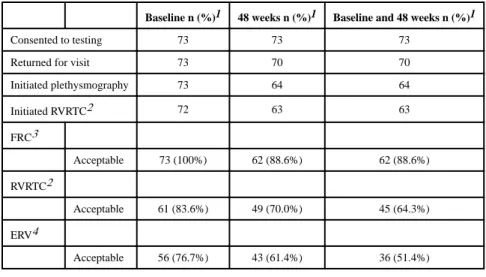
Of the total 321 participants in the ISIS study, 73 participated in the Infant PFT substudy. Measurement feasibility is shown in Table 1. All 73 participants initiated plethysmography and 72 initiated RVRTC at the baseline visit; 1 participant did not initiate RVRTC due to sedation failure. Seventy participants (96%) returned for the final study visit. Of these participants, 7 (10%) did not complete testing: 2 failed sedation and 5 met exclusion criteria for infant PFTs or exclusion criteria were not adequately assessed. FRC measurements were successful in 73/73 (100%) of participants at baseline, 62/70 (89%) at 48 weeks and 62/70 (89%) at both visits. RVRTC measurements were successful in 61/73 (84%) at baseline, 49/70 (70%) at 48 weeks and 45/70 (64%) at both visits. Feasibility of expiratory reserve volume (ERV) was lower (36 or 51%) at both visits because ERV calculation requires acceptable measurements of both FRC and RVRTC.
Baseline characteristics of the cohort are shown in Table 2. Among infants with acceptable RVRTC measurements at baseline and at 48 weeks, median weight percentile was 22.5 (IQR 11, 50.5) and mean FEV0.5, FEF75, FEF25–75, and FRC z scores were 0.3 (SD 1.2), −0.2 (SD
2.0), 0.2 (SD 1.4), and 1.8 (SD 2.0), respectively. The characteristics of infants with two acceptable RVRTC measurements were generally similar to those without two acceptable measurements, although two acceptable measurements were more likely among participants with higher baseline FEV0.5 z-scores (odds ratio (OR) per 1 higher z-score: 1.8; 95% CI:
1.7, 5.9); and less likely among participants with higher baseline RV/TLC (OR per 1% higher value: 0.89; 95% CI: 0.80, 0.98) or higher baseline CFQ-R respiratory score (OR per 1 higher score: 0.92; 95% CI: 0.85,0.98).
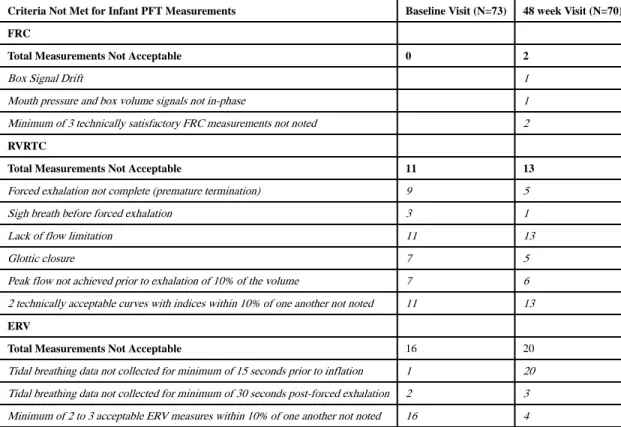
Among the infants in whom measurements were obtained but were not of research quality, reasons for failing to meet acceptability criteria are detailed in Table 3. The most common reasons for unacceptable RVRTC measurements were lack of flow limitation and lack of two technically acceptable curves with indices within 10% of one another. The most common reasons for unacceptable ERV measurements were tidal breathing data not collected for at least 15 seconds prior to inflation and lack of at least 2 to 3 acceptable measurements within 10% of one another. (The ERV criteria for acceptability was established specifically for this study since guidelines for this measurement have not been published.)
Infant lung function measurements for participants in the 4 week visit
Eighteen participants completed the additional 4-week infant PFT visit. Among the 11 participants (6 randomized to hypertonic saline and 5 to isotonic saline) with acceptable measurements at enrollment, 4 weeks and 48 weeks, the mean 4-week change in FEV0.5
(adjusted for baseline FEV0.5, gender, age, height and weight) was 34 ml (95% CI: −108,
176) greater among those randomized to hypertonic saline. Among those same 11
A
uthor Man
uscr
ipt
A
uthor Man
uscr
ipt
A
uthor Man
uscr
ipt
A
uthor Man
uscr
participants, the mean 48-week change in FEV0.5 was 59 ml (95% CI: −72, 190) greater
among those randomized to hypertonic saline. (For comparison, among all 45 infant PFT substudy participants with acceptable measurements at enrollment and 48 weeks, the adjusted mean 48-week change in FEV0.5 was 38 ml (95% CI 1, 76) (7) greater among those
randomized to hypertonic saline (7).)
Comparison of Infant lung function and parent-reported respiratory symptoms
We evaluated the association of lung function measures with the CFQ-R Respiratory Symptom Scale score both cross-sectionally at enrollment and longitudinally over the study period (Table 4). At enrollment, there was a significant association between FRC and the Respiratory Symptom Scale score: for each 1 point higher (better) Respiratory Symptom Scale score, there was a mean 1.5 ml (95% CI: 0.5, 2.6) lower (better) FRC, adjusted for age, weight, height, and gender; p =0.007. None of the other cross-sectional or longitudinal associations between PFT measures and the CFQ-R Respiratory Symptom Scale score were statistically significant.
Sample size planning for future clinical trials
Anticipated treatment effects in future clinical trials will be intervention-specific and not necessarily informed by the results of the ISIS trial However, the standard deviation of the 48-week change in the PFT parameters observed in the ISIS trial can be used to aid in sample size calculations for future trials. For FEV0.5, the estimated standard deviation
adjusted for baseline PFT parameter, gender, age, height and weight was 63 ml, for FEF75
119 ml/s, for FEF25–75 174 ml/s, for FRC 58 ml and for RV/TLC 5%.
DISCUSSION
In this secondary analysis of the ISIS infant pulmonary function sub-study, we assessed the feasibility and utility of various lung function parameters as endpoints in future clinical trials. Among the PFT parameters evaluated, the measurement acceptability rate for FRC was the highest but a significant treatment effect was not detected in the ISIS trial (7). Thus, FRC appears unlikely to be an appropriate clinical trial endpoint for future studies of drugs with a similar mechanism of action to hypertonic saline. There was a significant treatment effect detected with the RVRTC measurement FEV0.5, but the proportion of acceptable
measurements was low; only 64% of infants had two acceptable measurements. Missing data can lead to problems with efficiency and bias. Indeed, infants with and without two
acceptable measurements were not comparable: two acceptable measurements were more likely among participants with higher baseline FEV0.5 z-scores, lower RV/TLC values, and
lower CFQ-R scores. Finally, average lung function at baseline was normal or near normal for most infant PFT parameters, making it more difficult to detect a treatment effect.
While we found no evidence that demographic characteristics such as age or gender were associated with feasibility of infant PFTs, we did observe a difference in feasibility based on baseline lung function, in that infants with less airway obstruction (higher FEV0.5 and lower
RV/TLC) were more likely to have two acceptable measurements. Though preliminary, this observation suggests that bias could be introduced by missing data. Future investigators may
A
uthor Man
uscr
ipt
A
uthor Man
uscr
ipt
A
uthor Man
uscr
ipt
A
uthor Man
uscr
wish to assess the comparability of baseline lung function between those with and without acceptable lung function measurements.
The centers that participated in this substudy were experienced in infant PFTs and many had participated in our previous multicenter infant PFT study (6). In addition, the Infant PFT Resource Center provided rigorous training and certification to all sites as well as ongoing quality control and feedback. Despite this, feasibility was only fair, highlighting the importance of intensive education for infant PFT personnel. Feasibility of the RVRTC measurements may have been influenced by the sequence of measurements, as
plethysmography was always conducted first. However, given that the RVRTC maneuver may influence FRC values, FRC measurements need to be performed first.
To better understand the feasibility of infant PFTs, acceptability criteria were evaluated for each study performed across the 15 sites (Table 3). The acceptability of plethysmography was quite high. For the RVRTC technique, the main reasons for lack of acceptability were inability to achieve flow limitation and lack of two technically acceptable curves with indices within 10% of one another. Based on our findings, the concept of flow limitation should be emphasized in training sessions. ERV acceptability was even lower than that of RVRTC. The main reasons were failure to collect tidal breathing data for at least 15 seconds prior to inflation and failure to collect a minimum of 2 to 3 acceptable ERV measures within 10% of each other. However, there are no published guidelines for ERV and the ISIS criteria may have been too stringent. More studies are needed to better understand how current ERV acceptability criteria influence measurement results.
In order to determine an appropriate sample size for future clinical trials, estimates of the standard deviation of the outcome measure as well as the anticipated treatment effect are necessary. We therefore have included the standard deviation of the 48-week change in the PFT measures among the ISIS infant PFT sub-study participants. Anticipating treatment effects for future studies will be challenging, as there is currently no minimal clinically important difference (MCID) for infant PFT parameters. The clinical significance of the treatment effect observed with FEV0.5 in the ISIS trial is not known. Future studies relating
change in infant PFT parameters to changes in respiratory symptoms, PFTs at school age or other outcomes may help to begin to establish a MCID for these parameters.
Indeed, we did conduct an exploratory evaluation of the association of lung function with parent-reported respiratory symptoms: a lower (better) FRC value at baseline was associated with a higher (better) Respiratory Symptom Scale of the Cystic Fibrosis Questionnaire-Revised (CFQ-R)) score. Other infant lung function indices were not associated with parental report of respiratory symptoms. These results suggest that parental perception of respiratory symptoms may reflect physiologic changes consistent with obstructive lung disease but are not clearly helpful for determining the MCID for FRC. We previously reported in the entire ISIS cohort that worse CFQ-R respiratory symptom scores and physical functioning scores were associated with an increase in pulmonary exacerbation rate (19) and that parents were astute at reporting symptoms in young children with CF (20).
A
uthor Man
uscr
ipt
A
uthor Man
uscr
ipt
A
uthor Man
uscr
ipt
A
uthor Man
uscr
In the small subset of participants that participated in the 4-week infant PFTs, a treatment effect was not seen at 4 or 48 weeks, likely due to the small sample size (N=11). At 4 weeks, the mean (unadjusted) change for those randomized to hypertonic saline was 7.8 ml and the mean (unadjusted) change for those randomized to isotonic saline (control agent) was −11 ml. As expected, the 1 month change in forced expiratory volumes and flows predicted the final change in these lung function indices at 48 weeks (data not presented). In the Australian hypertonic saline study in older children and adults (12), a response in lung function was seen within 4 weeks and plateaued over the 48 week treatment period in those receiving hypertonic saline therapy. In the ISIS trial, a larger sample size might have helped to discriminate responders versus non-responders at this early time point. An improved understanding of responders within 4 weeks would certainly be beneficial during the infant and preschool years when adherence to therapy may be suboptimal.
Infant PFTs have historically been demonstrated to be abnormal in both conventionally-diagnosed and newborn-screened infant cohorts in Australia, and the UK (1, 3, 4, 10). In contrast, in our study the mean baseline RVRTC parameters were normal to near normal as highlighted in the baseline z-scores. Recently, near normal lung function was also reported in a newborn-screened infant cohort from the UK (21), which was in contrast to previous UK reports in infants diagnosed clinically. (3, 22) The measurement techniques were relatively similar in all these studies. It is unclear whether these differences in reported infant PFT results are due to different measurement devices, reference equations or true biologic and/or treatment differences.
Existing published reference equations for infant lung function have important limitations, including small sample sizes and possible differences in technique or devices. In the U.S., sedating healthy infants for the purpose of obtaining normative data is often not allowed, so contemporaneous controls cannot be obtained. We only utilized z scores to describe the baseline characteristics of our cohort. When evaluating a therapeutic response, we strongly recommend the use of raw values adjusted for weight, height, age, gender and baseline lung function, as was done in this trial.
While the lung clearance index as measured by multiple breath washout has clearly been shown to detect lung disease with greater sensitivity than spirometry in preschool and school-age CF patients (8, 9), in the infant population, multiple breath washout does not appear to be more sensitive to disease than RVRTC/plethysmography (10) and is indeed frequently in the normal range (23). Further, though abnormalities in RVRTC and MBW indices have been reported in the same infants with CF diagnosed clinically (3, 22), these two measurement abnormalities also differed in other infants, suggesting that these tests may be complimentary. Thus, there is not currently a physiologic endpoint in infants that is clearly superior; each technique has its pros and cons. The ISIS multiple breath washout substudy also found LCI to be normal in infants at baseline with worsening over time observed in the isotonic saline group. (23) Thus, for both the raised volume technique and multiple breath washout, maintaining lung function that is normal at baseline may be the more suitable outcome. It is likely that a multimodal approach assessing more than one outcome measure will be most suitable in evaluating treatment efficacy in infants with CF.
A
uthor Man
uscr
ipt
A
uthor Man
uscr
ipt
A
uthor Man
uscr
ipt
A
uthor Man
uscr
In conclusion, infant PFTs do not appear to be appropriate primary endpoints for multicenter clinical trials due to the near normal average raised volume measurements in infants with CF and the challenges of obtaining acceptable data. However, given that an effect of hypertonic saline on FEV0.5 was detected in the ISIS study (7) and improvements in feasibility may be
possible, infant PFTs may be useful as secondary endpoints in selected future clinical CF trials.
Acknowledgments
Sponsored by NIH (U01 HL 092931, P50 HL 084934) and CF Foundation Therapeutics Inc (ISIS07K1, DAVIS08). Study drugs were supplied by Pari Respiratory Equipment and Catalent, Inc., which were not otherwise involved in the study.
References
1. Sly PD, Brennan S, Gangell C, de Klerk N, Murray C, Mott L, Stick SM, Robinson PJ, Robertson CF, Ranganathan SC. Lung disease at diagnosis in infants with cystic fibrosis detected by newborn screening. Am J Respir Crit Care Med. 2009; 180:146–152. [PubMed: 19372250]
2. Sly PD, Gangell CL, Chen L, Ware RS, Ranganathan S, Mott LS, Murray CP, Stick SM. Risk factors for bronchiectasis in children with cystic fibrosis. The New England journal of medicine. 2013; 368:1963–1970. [PubMed: 23692169]
3. Ranganathan SC, Stocks J, Dezateux C, Bush A, Wade A, Carr S, Castle R, Dinwiddie R, Hoo AF, Lum S, Price J, Stroobant J, Wallis C. The evolution of airway function in early childhood following clinical diagnosis of cystic fibrosis. Am J Respir Crit Care Med. 2004; 169:928–933. [PubMed: 14754763]
4. Linnane BMHG, Nolan G, Brennan S, Stick SM, Sly PD, Robertson CF, Robinson PJ, Franklin PJ, Turner SW, et al. Lung function in infants with cystic fibrosis diagnosed by newborn screening. Am J Respir Crit Care Med. 2008
5. Pillarisetti NWE, Linnane B, Skoric B, Robertson CF, Robinson P, Massie J, Hall GL, Sly P, Stick S, Ranganathan S. Infection, inflammation, and lung function decline in infants with cystic fibrosis. Am J Respir Crit Care Med. 2011; 184:75–81. [PubMed: 21493738]
6. Davis SD, Rosenfeld M, Kerby GS, Brumback L, Kloster MH, Acton JD, Colin AA, Conrad CK, Hart MA, Hiatt PW, Mogayzel PJ, Johnson RC, Wilcox SL, Castile RG. Multicenter Evaluation of Infant Lung Function Tests as Cystic Fibrosis Clinical Trial Endpoints. Am J Respir Crit Care Med. 2010; 182:1387–1397. [PubMed: 20622043]
7. Rosenfeld M, Ratjen F, Brumback L, Daniel S, Rowbotham R, McNamara S, Johnson R, Kronmal R, Davis SD. Inhaled hypertonic saline in infants and children younger than 6 years with cystic fibrosis: the ISIS randomized controlled trial. JAMA. 2012; 307:2269–2277. [PubMed: 22610452] 8. Aurora P, Bush A, Gustafsson P, Oliver C, Wallis C, Price J, Stroobant J, Carr S, Stocks J. Multiple-breath washout as a marker of lung disease in preschool children with cystic fibrosis. Am J Respir Crit Care Med. 2005; 171:249–256. [PubMed: 15516530]
9. Aurora P, Gustafsson P, Bush A, Lindblad A, Oliver C, Wallis CE, Stocks J. Multiple breath inert gas washout as a measure of ventilation distribution in children with cystic fibrosis. Thorax. 2004; 59:1068–1073. [PubMed: 15563707]
10. Hoo AF, Thia LP, Nguyen TTD, Bush A, Chudleigh J, Lum S, Ahmed D, Balfour Lynn I, Carr SB, Chavasse RJ, Costeloe KL, Price J, Shankar A, Wallis C, Wyatt HA, Wade A, Stocks J. on behalf of the LCFC. Lung function is abnormal in 3-month-old infants with cystic fibrosis diagnosed by newborn screening. Thorax. 2012:874–881. [PubMed: 22752198]
11. Matecki S, Kent L, de Boeck K, Le Bourgeois M, Zielen S, Braggion C, Arets HG, Bradley J, Davis S, Sermet I, Reix P. Is the raised volume rapid thoracic compression technique ready for use in clinical trials in infants with cystic fibrosis? Journal of cystic fibrosis : official journal of the European Cystic Fibrosis Society. 2015
A
uthor Man
uscr
ipt
A
uthor Man
uscr
ipt
A
uthor Man
uscr
ipt
A
uthor Man
uscr
12. Elkins MR, Robinson M, Rose BR, Harbour C, Moriarty CP, Marks GB, Belousova EG, Xuan W, Bye PT. A controlled trial of long-term inhaled hypertonic saline in patients with cystic fibrosis. The New England journal of medicine. 2006; 354:229–240. [PubMed: 16421364]
13. Davis SDRM, Brumback L, Baines AC, Donaldson S, Johnson R, Rowbotham R, McNamara S, Daniel S, Kronmal R, Ratjen F. The ISIS Study Group. Pediatric Pulmonology Supplement. 2012 14. Stocks J, Godfrey S, Beardsmore C, Bar-Yishay E, Castile R. ERS/ATS Task Force on Standards
for Infant Respiratory Function Testing. European Respiratory Society/American Thoracic Society. Plethysmographic measurements of lung volume and airway resistance. ERS/ATS Task Force on Standards for Infant Respiratory Function Testing. European Respiratory Society/American Thoracic Society. Eur Respir J. 2001; 17:302–312. [PubMed: 11334135]
15. Castile R, Filbrun D, Flucke R, Franklin W, McCoy K. Adult-type pulmonary function tests in infants without respiratory disease. Pediatr Pulmonol. 2000; 30:215–227. [PubMed: 10973040] 16. ATS/ERS Statement. Raised Volume Forced Expirations in Infants. Am J Respir Crit Care Med.
2005; 172:1463–1471. [PubMed: 16301301]
17. Jones M, Castile R, Davis S, Kisling J, Filbrun D, Flucke R, Goldstein A, Emsley C, Ambrosius W, Tepper RS. Forced expiratory flows and volumes in infants. Normative data and lung growth. Am J Respir Crit Care Med. 2000; 161:353–359. [PubMed: 10673171]
18. Quittner AL, Sawicki GS, McMullen A, Rasouliyan L, Pasta DJ, Yegin A, Konstan MW. Erratum to: Psychometric evaluation of the Cystic Fibrosis Questionnaire-Revised in a national, US sample. Quality of life research : an international journal of quality of life aspects of treatment, care and rehabilitation. 2012; 21:1279–1290.
19. Brumback LC, Baines A, Ratjen F, Davis SD, Daniel SL, Quittner AL, Rosenfeld M. Pulmonary exacerbations and parent-reported outcomes in children <6 years with cystic fibrosis. Pediatr Pulmonol. 2014; 50(3):236–243.
20. Alpern AN, Brumback LC, Ratjen F, Rosenfeld M, Davis SD, Quittner AL. Initial evaluation of the Parent Cystic Fibrosis Questionnaire-Revised (CFQ-R) in infants and young children. Journal of Cystic Fibrosis. 2015; 14(3):403–411. [PubMed: 25443473]
21. Nguyen TT, Thia LP, Hoo AF, Bush A, Aurora P, Wade A, Chudleigh J, Lum S, Stocks J. Evolution of lung function during the first year of life in newborn screened cystic fibrosis infants. Thorax. 2014; 69:910–917. [PubMed: 24072358]
22. Lum S, Gustafsson P, Ljungberg H, Hulskamp G, Bush A, Carr SB, Castle R, Hoo AF, Price J, Ranganathan S, Stroobant J, Wade A, Wallis C, Wyatt H, Stocks J. Early detection of cystic fibrosis lung disease: multiple-breath washout versus raised volume tests. Thorax. 2007; 62:341– 347. [PubMed: 17121870]
23. Subbarao P, Stanojevic S, Brown M, Jensen R, Rosenfeld M, Davis S, Brumback L, Gustafsson P, Ratjen F. Lung clearance index as an outcome measure for clinical trials in young children with cystic fibrosis. A pilot study using inhaled hypertonic saline. Am J Respir Crit Care Med. 2013; 188:456–460. [PubMed: 23742699]
APPENDIX
We would like to acknowledge the participants and families as well as the ISIS sites that participated in the infant PFT substudy: Stephanie Davis (University of North Carolina; Chapel Hill, NC), Albert Faro, MD (CFF Care Center & Pediatric Program St. Louis Children’s Hospital; St. Louis, Missouri), Amy Filbrun, MD (CFF Care Center & Pediatric Program University of Michigan; Ann Arbor, Michigan), Peter Hiatt, MD (CFF Care Center & Pediatric Program Baylor College of Medicine; Houston, TX), Gwendolyn Kerby, MD (CFF Care Center & Pediatric Program Children’s Hospital; Denver, CO), Karen McCoy, MD (CFF Care Center & Pediatric Program Nationwide Children’s Hospital; Columbus, Ohio), Karen McDowell, MD and James Acton, MD (CFF Care Center & Pediatric Program Cincinnati Children’s Hospital), Carlos Milla, MD (CFF Care Center & Pediatric Program Stanford University: Palo Alto, California), Howard Panitch, MD (CFF Care Center &
A
uthor Man
uscr
ipt
A
uthor Man
uscr
ipt
A
uthor Man
uscr
ipt
A
uthor Man
uscr
Pediatric Program Children’s Hospital of Philadelphia; Philadelphia, Pennsylvania), Adrienne Prestridge, MD (CFF Care Center & Pediatric Program Children’s Memorial Hospital; Chicago, IL), Peggy Radford, MD (CFF Care Center & Pediatric Program Phoenix Children’s Hospital; Phoenix, AZ); Felix Ratjen, MD, PhD (CF Center Hospital for Sick Children; Toronto, Ontario, Canada), Clement Ren, MD (CFF Care Center & Pediatric Program University of Rochester Medical Center; Rochester NY), Margaret Rosenfeld, MD, MPH (CFF Care Center & Pediatric Program Seattle Children’s Hospital; Seattle,
Washington), Jack Sharp, MD (CFF Care Center & Pediatric Program Women and Children’s Hospital of Buffalo; Buffalo, NY). Further, we would like to thank Ron Rowbotham, our project manager at the CF Therapeutic Development Network.
A
uthor Man
uscr
ipt
A
uthor Man
uscr
ipt
A
uthor Man
uscr
ipt
A
uthor Man
uscr
Highlights
• We evaluated infant lung function as a clinical trial endpoint in cystic fibrosis.
• Challenges included obtaining feasible raised volume data across multiple sites.
• Infant lung function tests may be useful as secondary outcomes measures.
A
uthor Man
uscr
ipt
A
uthor Man
uscr
ipt
A
uthor Man
uscr
ipt
A
uthor Man
uscr
A
uthor Man
uscr
ipt
A
uthor Man
uscr
ipt
A
uthor Man
uscr
ipt
A
uthor Man
uscr
Table 1
Feasibility of Infant Pulmonary Function Testing
Baseline n (%)1 48 weeks n (%)1 Baseline and 48 weeks n (%)1
Consented to testing 73 73 73
Returned for visit 73 70 70
Initiated plethysmography 73 64 64
Initiated RVRTC2 72 63 63
FRC3
Acceptable 73 (100%) 62 (88.6%) 62 (88.6%)
RVRTC2
Acceptable 61 (83.6%) 49 (70.0%) 45 (64.3%)
ERV4
Acceptable 56 (76.7%) 43 (61.4%) 36 (51.4%)
1
The denominators used for percentages are the number of participants who returned for testing at each visit.
2
RVRTC, raised volume rapid thoracic compression
3
FRC, functional residual capacity, measured by plethysmography
4
A
uthor Man
uscr
ipt
A
uthor Man
uscr
ipt
A
uthor Man
uscr
ipt
A
uthor Man
uscr
ipt
Table 2
Baseline participant characteristics of the 73 participants enrolled in the ISIS infant PFT substudy
With acceptable RVRTC measures at baseline and 48 weeks
N=45
Without acceptable RVRTC measures at baseline and 48 weeks
N=28
% or mean (standard deviation)*
Treatment assignment
% Hypertonic Saline (HS) 49% 50%
Age (months) 9.0 (3.4) 10.2 (3.4)
Gender (% male) 55% 50%
Genotype1
F508del Homozygous 53% 50%
F508del Heterozygous 42% 32%
Other 4% 18%
Weight, kg* 8.1 (7.5, 9.6) 8.4 (7.4, 10.2)
Weight percentile* 22.5 (11, 50.5) 28.0 (10.4, 54.8)
Height, cm* 68.9 (66, 72.4) 70.7 (64.5, 73.5)
Height percentile* 28.7 (7.9, 45.5) 16.2 (5.7, 28.6)
FEV0.5. ml 284 (65) 266. (71)2
FEV0.5 z-score3 0.3 (1.2) −0.6 (1.3)2
FEF75, ml/sec 298 (119) 280 (116) 2
FEF75, z-score −0.2 (2.0) 2.0 (2.1)
FEF 25–75, ml/sec 595 (191) 556 (194) 2
FEF 25–75, z-score 0.2 (1.4) −0.4 (1.6)
FRC, ml 204 (52) 211 (60)
FRC, z-score4 1.8 (2.0) 2.0 (2.1)
RV/TLC, %5 27 (7) 33 (7)
CFQ-R respiratory score 87.5 (10.7) 93.8 (6.5)
*
Weights and heights reported as medians with interquartile ranges.
1
A
uthor Man
uscr
ipt
A
uthor Man
uscr
ipt
A
uthor Man
uscr
ipt
A
uthor Man
uscr
2
N=16 participants with acceptable FEV0.5, FEF75, and FEF25–75 at baseline but not 48 weeks.
3
Z-scores based on reference equations with length for FEF75 and FEF25–75; and with length and age for FEV0.5 of Jones et al (18).
4
Z-scores for FRC were based on reference equations similar to those reported in Castile et al (15) but computed from a non-repeated measures subset of the control data (6) consistent with Jones et al (17)
5
A
uthor Man
uscr
ipt
A
uthor Man
uscr
ipt
A
uthor Man
uscr
ipt
A
uthor Man
uscr
ipt
Table 3
Infant PFT Acceptability
Criteria Not Met for Infant PFT Measurements Baseline Visit (N=73) 48 week Visit (N=70)
FRC
Total Measurements Not Acceptable 0 2
Box Signal Drift 1
Mouth pressure and box volume signals not in-phase 1
Minimum of 3 technically satisfactory FRC measurements not noted 2
RVRTC
Total Measurements Not Acceptable 11 13
Forced exhalation not complete (premature termination) 9 5
Sigh breath before forced exhalation 3 1
Lack of flow limitation 11 13
Glottic closure 7 5
Peak flow not achieved prior to exhalation of 10% of the volume 7 6
2 technically acceptable curves with indices within 10% of one another not noted 11 13
ERV
Total Measurements Not Acceptable 16 20
Tidal breathing data not collected for minimum of 15 seconds prior to inflation 1 20
Tidal breathing data not collected for minimum of 30 seconds post-forced exhalation 2 3
A
uthor Man
uscr
ipt
A
uthor Man
uscr
ipt
A
uthor Man
uscr
ipt
A
uthor Man
uscr
Table 4
Cross-sectional and longitudinal associations between PFT measures and CFQ-R Respiratory Symptom Scale
Mean difference in PFT measure for one score higher CFQ-R respiratory score at enrollment
Mean 48 week change in PFT measure for one score higher change in CFQ-R respiratory score over 48
weeks
Lung Function Measure N Mean (95% CI) N Mean (95% CI)
FEV0.5 (ml) 45 −0.1 (−1.5, 1.4) 43 1.0 (−0.6, 2.6)
FEF75 (ml/s) 45 1.4 (−2.0, 4.9) 43 1.7 (−1.6, 4.9)
FEF25–75 (ml/s) 45 3.1 (−2.1, 8.3) 43 3.9 (−0.8, 8.7)
FRC (ml) 45 −1.5 (−2.6, −0.5) 43 0.7 (−0.9, 2.3)
RV/TLC (%) 42 −0.1 (−0.4, 0.1) 35 −0.0 (−0.3, 0.2)