RACIAL MATCHING AND THE MENTORING RELATIONSHIP: A COMPARISON STUDY
Keyma Clark
A thesis submitted to the faculty of the University of North Carolina at Chapel Hill in partial fulfillment of the requirements for the degree of Masters of Arts in the Department of Education
Chapel Hill 2014
Approved by: George Noblit
© 2014 Keyma Clark
ABSTRACT
KEYMA CLARK: Racial Matching and The Mentoring Relationship: A Comparison Study (Under direction of George Noblit)
The purpose of this thesis is to compare the experiences of two pairs of mentor-mentee
relationships in order to investigate the influence of racial matching on the mentoring relationship. I compare the mentoring experiences of two African-American male students
participating in the Blue Ribbon Mentor Advocate program, a school-based mentoring program. One student had an African-American mentor, while the other had a Caucasian mentor. Mentee and mentor interviews were compared to evaluate the personal perspectives on the Blue Ribbon
Mentor Advocate program and the mentoring experience. Mentees and mentors expressed overall satisfaction with the mentoring experience and positive comments on the mentoring
relationship. Differences in the mentoring experience based on the race of the mentor were found. Generally, the same race mentor was better able to discuss issues of race with his mentee and being a person of color. The white mentor was focused more on education and career
TABLE OF CONTENTS
LIST OF TABLES ... vi
INTRODUCTION ... 1
Overview ... 1
Statement of the Problem ... 2
LITERATURE REVIEW ... 4
The Purpose of Mentoring ... 5
The Mentoring Relationship ... 7
Racial Matching ... 9
METHODOLOGY ... 12
Research Questions ... 12
Research Procedures ... 12
FINDINGS ... 16
The Mentoring Experience ... 16
A Comparison ... 21
CONCLUSIONS AND IMPLICATIONS ... 24
Conclusions ... 24
Future research ... 26
Appendix 2: Rhodes model for youth mentoring ... 32
LIST OF TABLES
INTRODUCTION
We have to recognize that there cannot be relationships unless there is commitment, unless there
is loyalty, unless there is love, patience, and persistence.
~Dr. Cornell West Overview
There is a long history of interest in school- and community-based mentoring programs. Mentoring programs can be instrumental in fostering the development of minority youth.
Community-based and school-based mentoring programs have been around for several decades. Approximately five million American youth participate in community-based and school-based mentoring programs (McLearn, Colasanto, & Schoen, 1998). Research studies evaluating
mentoring programs have found them to be associated with positive outcomes such as peer and parent relationships, academic achievement, and lower rates of juvenile delinquency and
substance abuse (Davidson & Redner, 1998; Grossman & Tierney, 1998; LoSciuto, Rajala, Townsend et al., 1996; McPartland & Nettles, 1991; Reisner, Petry & Armitage, 1998). These positive outcomes are commonly thought of as a result of the mentoring relationships (Tierney &
Grossman, 2000; Goldner & Mayseless, 2009; Rhodes, 2008).
A critical aspect of the mentoring relationship that has not been given much focus is the
influence of racial matching on the mentoring relationship. The overall research question that
will be addressed in this study: How does same-race and cross-race pairing influence the mentoring relationship? Ultimately, the goal is to understand whether racial matching impacts
the mentoring experiences in order to establish successful, long-lasting mentoring relationships. Statement of the Problem
This thesis formed out of the frustration with the long-standing racial disparities in graduation and incarceration rates, particularly among young African American males. As of
2010-2011, the national adjusted cohort graduation rate (ACGR) was 79 percent; however, the rate for American Indian/Alaska Native, Black, and Hispanic students were below the national average at 65, 67, and 71 percent, respectively (Stetser & Stillwell, 2014). Although strides have
been made in the national graduation rate for male students, minority males still fall short of their White peers. A recent report showed that only 52% of Black males and 58% of Latino males
graduated from high school in four years, compared to 78% of non-Hispanic White males (Schott Foundation for Public Education, 2012). Subsequently, significant improvements have been made in dropout rates nationally, yet still the rate is highest among African American and
Hispanic students at 8.4 and 21.4 percent, respectively (Planty et al., 2009).
Incarceration of African American males is also of grave concern and has implication for
educators and administrators. Compared to whites, African Americans are almost six times as likely to be incarcerated (The Sentencing Project, 2007). These differences are also found in juveniles, where black juveniles are nearly four times as likely to be incarcerated as their White
which I believe are equally important to our education system. I contend that mentoring
relationships can help to combat these rates and improve the educational and community engagement for African American and minority males by providing positive role models and
LITERATURE REVIEW
The concept of mentoring can be traced back to ancient Greece (Sipe, 2002). In Homer’s “Odyssey”, Ulysses left Mentor in charge of his household and in particular Telemachus, his son. Mentor fails to be a positive mentor for Telemachus, and Ulysses’
household. Goddess Athene disguises herself in numerous forms, one being that of Mentor and helps Telemachus develop into the successor of the Ithaca Kingdom and his father’s throne
(Roberts, 1999; Sipe, 2002). In this publication the main character is Mentor, which gives catalyst to the meaning of mentor in the context, which it is used today (Roberts, 1999).
Today, mentoring is fundamentally one of the most ubiquitous programs available in US
schools. In 2005, a reported 2.5 million youth enrolled in formal one-on-one mentoring, which is a 19% increase from 2002 (MENTOR, 2006). Coinciding with the growing mentoring
population, federal funding for mentoring programs have increased with current annual congressional appropriations of $100 million since 2004 (Rhodes & Dubois, 2008). The attraction to mentoring youth is based upon the success of the juvenile court system’s programs
and the efforts of Big Brother Big Sisters of America. From these programs, the pairing of adults with youth has become even more popular with the goal of promoting supportive relationships
(Converse & Lignugaris, 2009). Researchers have identified several mentoring-related factors that influence positive outcomes including program support, mentor development, and parental involvement. Another central factor often cited in the literature as an important process for
the mentoring program is contingent upon nurturing close, long-lasting relationships that
promote positive development. The Purpose of Mentoring
Mentoring is often defined as a process of providing an individual support, while nurturing and giving guidance, from someone outside of the immediate and extended family (Hickman &Wright 2011; Jekielek, Moore, Kristin, Hair, & Scarupa 2002). Barondess (1995)
discusses Levinson’s view of the true purpose of a mentor stating that the mentor must nurture “the realization of the dream” (p.7). This essentially requires the creation of an environment that
fosters the development of the mentee’s dream. Fundamentally, mentoring is the idea that if caring, concerned adults are available to young people, youth will be more likely to become successful adults themselves (Jekielek et al., 2002).
The goals of mentoring programs vary based on the targeted population and desired outcome (Sipe, 2002). There are mentor programs that have a generalized broad approach to
accomplishing mentee goals, while others have a more concise structure of what types and techniques will be used to determine the desired goals of each mentee (Jekielek et al., 2002). The Big Brother Big Sister mentor program focuses on the development of individual goals for
mentees and the necessary steps to achieve these goals (Sipe 2002). Mentoring programs such as Project RAISE (McPartland & Nettles, 1991), Career Beginnings (Cave & Quint, 1990), and
Sponsor-A-Scholar (Johnson, 1998) were created with the goals of improving mentees’ attendance, grades, and aspirations to attend an institution of higher learning.
Many school-based mentoring programs also aim to provide guidance, support, and
block and indicator of socioeconomic status, therefore academic achievement is one of the main
focuses of many mentoring programs. An important reality of mentoring is that it extends beyond the immediate need of academic achievement, but instead lifetime achievement. A study
conducted in 1977 of the nation’s most prominent men found that the majority of the men that participated had a mentor present during early adulthood (Barondess, 1995). Findings from the evaluation of the Career Beginnings program showed that of youth enrolled in the program, 53
percent were enrolled in college the first year after high school graduation, compared to 49 percent in the control group (Cave & Quint, 1990). Mentorship programs are increasing
inclusion strategies by incorporating workshops for parents, life-skills curriculums, financial help for higher education, and community service opportunities (Jekielek et al., 2002; Sipe 2002).
Past studies have shown that at-risk students can benefit substantially from developing
relationships with adults, who are unrelated in the parental capacity, through services and trainings (DuBois & Karcher 2005). Additionally, mentoring programs serve as a layer of
protection for parents, as it is positive engagement for students before and after school. Ayers and Griffin (2005) found that students who are involved in a school-based mentoring program were less involved in fights, bullying, and nonattendance. In addition, the students involved in
mentoring programs are less likely to drop out, enabling them to attain their academic potential. In optimizing mentorship, it is important to develop balanced relationships with the mentee’s
The Mentoring Relationship
The impact of the mentoring relationship is influenced by several factors shaping the mentoring experience. Mentoring relationships have been associated with positive psychological
and behavioral outcomes, which are attributed to positive relationships. Rhodes (2008) explains that mentors can influence their mentees social skills and emotional well-being, cognitive skills, and identity development. Zand (2009) found that high quality mentoring relationships were
responsible for four domains of youth competency: family bonding, relationships with adults, school bonding, and life skills. However, this was mostly found in girls and not boys. Although
evidence supports an association between mentoring relationships and beneficial outcomes, the mechanisms that explain these relationships are not as well documented.
The foundation of mentoring programs has been described as coupling youth, who are
mainly from disadvantaged backgrounds, with capable and nurturing non-parental adults (Keller, 2005; Rhodes, Bogat, Roffman, Edelman, & Galasso, 2002). An important factor for fostering a
strong relationship with these youth is building a positive rapport that is based on trust and understanding (Rhodes et al., 2002). Building trust and understanding can be instrumental in building a positive rapport with minority youth. This trust can be developed in numerous
ways. Creating an environment where the mentee can share the private and personal information with their mentor is one way that Rhodes et al. (2002) suggests building trust. Another important
factor for facilitating a strong relationship includes establishing expectations from the onset for the mentee (Enscher, 2010). Lastly, Rhodes (2005) evaluated participants in Big Brothers/Big Sisters mentoring programs and found that successful mentoring relationships were mostly
Over time relationships develop and have more opportunity to succeed. Thus, one of the
most important pieces of the mentoring relationship is the duration of the relationship.
Grossman and Rhodes (2002) examined the predictors and effects of the mentoring duration in
youth participating in the Big Brother Big Sisters programs. They found that the relationship between the mentoring relationship and several outcomes differed by their duration in the program. Youth who terminated within the first three months showed decreases in their
self-worth and perceived scholastic competence, while youth who continued in the program longer than 12 months had significant increases their self-worth, perceived social acceptance, perceived
scholastic competence, parental relationship quality, school value, and also showed decreases in drug and alcohol use. The authors reported factors such as race, gender, and relationship quality as variables associated with early termination. In a meta-analysis of over 55 studies, relationship
duration was also found to be a significant predictor (Dubois, Holloway, Valentine, & Cooper, 2002).
The developmental stage of the mentee may also influence the mentoring relationship. Dubois and Karcher (2005) argue that adolescents entering adulthood may be less interested in developing emotional connections with mentors, but instead more interested in peers and
vocational skill-building activities, as older adolescents are often more peer oriented than younger children and less likely to maintain participation in mentoring programs. As Grossman
and Rhodes (2002) found older children are at a higher risk for early termination of the mentoring relationship.
Understanding family background can also be helpful in sustaining positive mentoring
outreach, family stability, and family mobility (Dubois et al., 2002; Rhodes, 2002). Dubois and
Karcher (2005) explain that the chance of youth forming strong ties with mentors is impacted by encouragement and opportunities from the parents.
For the relationship to flourish, the mentor must work to build trust. Rhodes (2002) contends that mutual trust, understanding, liking, and respect are critical in establishing the mentoring relationship. In order to build trust, the mentor must realize the mentee’s level of trust
from the start. One way trust could be built is through the sharing of personal stories (Rhodes, 2002). Bennetts (2003) also stressed the importance of the mutuality of trust in the initiation of
the relationship. Specifically, maintaining that confidentiality, mutuality, opting out mechanisms, and power relations need to be tackled for the relationship to mature.
Studying factors related to early termination of youth mentoring relationships could also
be helpful in establishing positive mentoring experiences. In a study of youth mentoring relationships with a short duration and identified six important factors associated with early
termination: mentor or protégé abandonment, perceived lack of protégé motivation, unfulfilled expectations, deficiencies in mentor relational skills, family interference, and inadequate agency support (Spencer, 2007). Variables associated with early termination, along with those that have
been found to improve the mentoring relationship, can all be utilized in mentor program development for effective mentoring experiences.
Racial Matching
Similar to the factors previously discussed, the racial and ethnic background of the
mentor is believed to be critical in forming effective mentoring relationships. The meaning of race and ethnicity is deeply rooted in an historical and cultural context. Steele (1997) identified
cultural mistrust minority youth may be less likely to initially connect with a mentor of another
background (Rhodes, Reedy, Grossman, & Lee, 2002).
Differences in values across racial/ethnic groups can have significant effects on the
mentoring relationship. The assumption is that a mentor of a different background cannot understand their mentees experiences or help them to achieve their goals. Researchers supporting same-race mentoring believe that a mentor that does not share the same racial or
ethnic background is not able to teach minority youth (Rhodes et al., 2002).
Advocates of racial matching believe that mentors without a shared racial or ethnic
background will subconsciously enact their own views onto the child (Rhodes & Reedy, 2002). As Rhodes et al. (2002) points out, many mentors are European American, and there is the idea that cross-race mentoring brings along the historical “symbolism of historical treatment that the
dominant Anglo culture has inflicted on minority youth” (p. 2116). Ogbu (1990) concluded after observing cross-race mentor relationships that mentors come into mentoring with the zeal of a
missionary to help at-risk youth from the dangers of their environments by introducing them to mainstream activities. However, the mainstream activities may not align with the child’s
realities. Such fears have propelled the use of racial matching in mentoring relationships. Racial
matching has also been used in mentoring programs as a means of providing minority youth with positive role models. Those advocating for racial matching in mentoring programs explain that
cross-race mentors may communicate the incorrect message that proper role models do not exist within their own communities (Ogbu, 1990).
Although racial matching is often used in mentoring programs, research evidence of its
present thesis will do just that to compare the mentoring experience of two African-American
METHODOLOGY
Data in this qualitative study were collected from two adolescent males and their mentors
through individual interviews. The selected method used was most appropriate for my study as the purpose was to explore the role of racial matching in the mentoring relationship and describe the mentees’ and mentors’ perspectives of their own experiences in the mentoring relationship.
Research Questions
The goal of this study was to investigate the overarching research question: How does
same-race and cross-race pairing influence the mentoring relationship? In order to explore this research question, the mentoring experience of two African-American male students and their mentors were compared. The following sub-questions were considered to explore the broad
research question:
1. What are the mentees’ and mentors’ perspective of the mentoring relationship? 2. Did the mentoring relationship have an effect on the mentees' life?
3. Does racial matching impact the mentoring relationship? Research Procedures
This thesis was based on data collected by researchers at UNC in the Department of Education as a response to a Request for Application from the Chapel Hill Carrboro City Schools
achievement of African-American and Latino students. Matching students with adults give them
given the support needed to attain their academic and personal goals. They are provided with mentoring, tutoring, advocacy, enrichment, leadership training, and scholarship support services.
BRMA has served more than 250 students over its tenure.
As the primary goal of this study was to explore role of racial matching on the mentoring relationship, two African American male siblings participating in the BRMA with incongruent
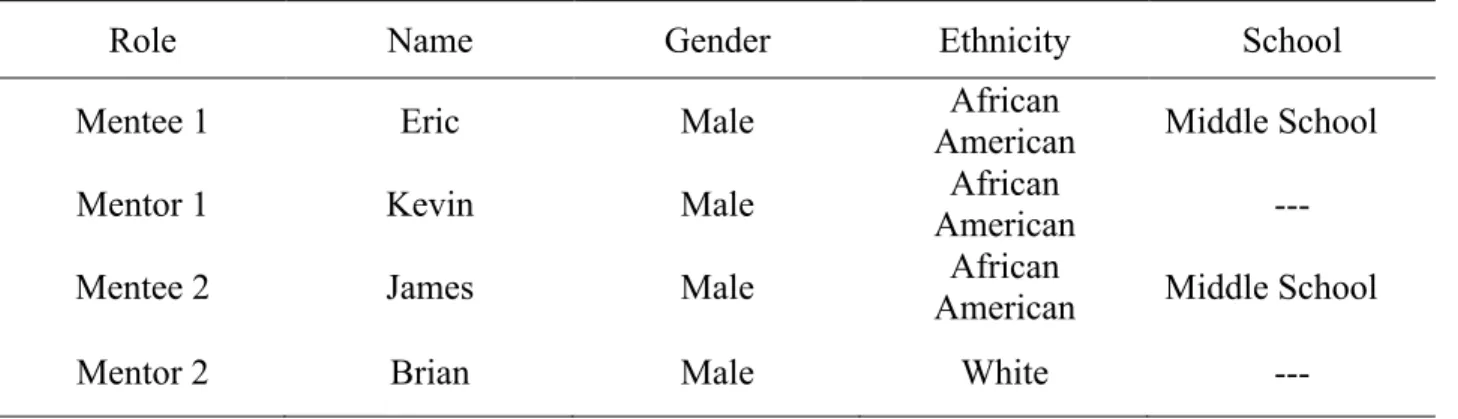
mentors were purposely selected. One mentor was an African American male and the other a Caucasian male. Table 1 provides brief background information of the four study participants.
To protect the identity of study participants, pseudonyms were used to replace their real names. Table 1. Participant Background Information
Role Name Gender Ethnicity School
Mentee 1 Eric Male American African Middle School
Mentor 1 Kevin Male African
American ---
Mentee 2 James Male American African Middle School
Mentor 2 Brian Male White ---
Qualitative data was collected from the students and mentors by trained staff using face-to-face interviews (See Appendix 1 for interview guides). The student interview guide assessed
their involvement in BRMA, extracurricular activities, family life, school life, mentor experience, family relationship with mentor, role of race in life and in the mentoring relationship, and overall perception of BRMA. The mentor interview guide collected information on their background
and language may have had on the mentee relationship, and their overall perception of BRMA.
For the purpose of my thesis, I focused on the following questions: From student interviews:
1) How did you become involved with Blue Ribbon?
2) How has Blue Ribbon and/or your mentor affected you or changed you? 3) What’s your relationship with your mentor like?
4) What is your relationship with your mentor like? 5) How often do you meet with your mentor?
6) What new people have you met through him?
7) How has your mentoring relationship helped you start to try to achieve some of those goals?
8) Do you think that race affects your life?
9) How do you think race or class or language has affected your relationship with your mentor?
10) Have you ever talked about race with your mentor?
From mentor interviews:
1) How did you get involved with Blue Ribbon and how did Blue Ribbon help you work with your mentee?
2) What is it that you bring to the mentoring relationship? 3) How would you describe your mentee?
4) So how in your mentor or mentee relationship has your mentee changed over time, and what changes do you feel are due to your mentoring relationship or other aspects of Blue Ribbon?
5) How do you and the family get along?
6) What are some things you and his family do together? 7) How did it start? How has it changed?
8) What do you feel he gets from the relationship?
9) How has race, ethnicity, class, well gender probably not, and language affected your relationship with your mentee?
10) So have you ever discussed race, ethnicity, gender, class with your mentee or your mentee’s family?
each question. Responses that specifically focused this qualitative study were included in the
data analysis.
This thesis uses cases of two mentoring relationships as its data. Although the mentors
varied by race, they were both college graduates and knowledgeable of the workings of the educational systems affecting the youth. The youth were brothers and thus difference in family background is not a confounding variable in the relationships. However, as brothers may talk
there is a possibility that the lessons from each mentor may be shared with the other’s mentee. Case studies such as this are not generalizable. The focus is on close description and comparison.
FINDINGS
The Mentoring Experience Mentee 1: Eric
Eric was introduced to the Blue Ribbon Mentor-Advocate Program by his mother in order to gain additional assistance in school. He comes from a family who has instilled in him the importance of school. He is encouraged by his family to always try his best and to be a good
student. As a result, Eric values his education and doing well in school. As a young boy, he enjoys being active in sports and video games.
Eric described his relationship with his mentor as a good and fun experience. His entire family likes his mentor. He spends time with his mentor at least once per week. He has met a number of people through his mentor including the mentor’s family and friends and a sports coach. The mentee entered the program with the expectation that Blue Ribbon would help him
become successful later in life and prepare for college. He credits Blue Ribbon with helping him become a better person and staying out of trouble. As described by Eric, this is because of the
goal setting and positive reinforcement that he receives through BRMA. He states, “If I do things good, I get to do something.”
Eric felt that the mentoring relationship helped him become successful by showing him
mentoring relationship. According to the mentee, his mentor discussed race issues with him,
specifically surrounding slavery. Mentor 1: Kevin
Friends presented Kevin with the opportunity to get involved as a mentor with the Blue Ribbon Mentor-Advocate Program. He brings experience to the program as an educator, which he feels is valuable to the mentoring relationship. As a mentor and as an African American, he is
able to provide guidance to his mentee because as he explains, “I know a lot of the things that, um, [he] will be going through eventually.” He described his mentee as an energetic and
outgoing young man that has some academic struggles. When the mentoring relationship first started, he observed that his mentee would only open up and be talkative when they were engaged in fun activities. He notes that his mentee does not often open up too much about his
personal feelings, but he hoped to one day reach that level in their relationship.
The mentoring relationship began with frequent meetings (at least once per week), but
later declined to meeting only once per month. In the interview, the mentor was asked how the mentoring relationship changed his mentee over time: “He’s gotten a lot more mature.” Earlier in the mentoring relationship, his mentee was having difficulties with behavior in school and was
suspended from school. However, as the mentoring relationship progressed, the number of incidents has decreased. He provided his mentee with individualized personal one-on-one time
and tries to be a calming voice in his mentee’s “chaotic environment that he has at home.” He says he has a great relationship with his mentee’s family. He has had them over to his house on several special occasions and spent time with the family during his mentoring sessions.
mentoring relationship, he believes “that our relationship as well as the resources that Blue
Ribbon provides…has had some positive affect on him.”
When asked what he feels his mentee gets from the mentoring relationship, Kevin felt
that his mentee received personal attention from him that he may not receive at home and recognizes that someone that cares about him. In contrast, when asked what he gets from the relationship, he explained that this experience “helped me learn the responsibility, um, I guess, of
a semi, quasi parenting role in a sense.” It helped him to become more patient and appreciative of the effect “that sowing into someone else’s house can have on, you know, their development
and growth.”
Through this mentoring relationship, Kevin wanted his mentee to have a positive African-American male role model to look up to. He states,
I think as an African American male, um, who has been successful in school and things like that, I would hope that, um, that’s been helpful for [him] to see that you can be intelligent and be black and be a male and still enjoy sports and all those different things. Um…I know one thing that he expressed even before I met him, he expressed to some folks is that…actually to one of his elementary counselors, is that he wanted to be white because he thought that being white meant, you know, you could be smart and you could have money and you could, you know, do all those other things. So, um, through our relationship, hopefully he’s learned that you don’t have to be white to have those attributes or, um…you know, to achieve things in life.
Kevin says that he has discussed race with both Eric and his family, specifically how he may stand out as an African-American male and the unfortunate standards that he may be held to.
Kevin reported advocating for his mentee in the school by meeting with teachers and to discuss how he’s doing in school and to help the teachers understand that his mentee is “a relationship-driven individual” that may require some extra attention. He explained to his
He has introduced his mentee to various people within his circle including friends,
associates, and church members. He strategically and purposely introduces his mentee to
African American males who have “achieved educationally.” He has tried to teach his mentee to
be respectful and honest, and importantly he wants to make sure he models the attributes that he tries to instill in his mentee.
Mentee 2: James
James was enrolled into the Blue Ribbon Mentoring Program by his mom, but was
actually introduced to the program through his brother who was also a participant in the program.
Seeing his brother participate, he became interested in doing “some of the fun things he got to do.” He meets with his mentor at least twice a week. The Blue Ribbon Mentoring Program has helped him make better decisions and be responsible. In describing how Blue Ribbon and his
mentor has affected his life, he says,
Blue Ribbon has helped me by like getting funds to…[and]…going to classes, like and…going to a banking camp where I learned how to cope with money…Blue Ribbon and my mentor, he helps me out with some of my homework and problems that I can’t do or, um, have trouble with. And um and experience things that a lot of other people don’t get to see or experience.
In the interview, James describes his relationship between him and his mentor as very friendly
and inclusive. He even says that he feels that he and his mentor are best friends. He has been introduced to many individuals through his mentor that will one day help him later in life with
his career and can help support him. James has goals of going to college, having a good career, and ways to handle money. He feels that the mentoring relationship has helped him to learn how to make good career decisions and be responsible with money.
Uh, yes. Um…it doesn’t…Uh, race, um, the fact that…that I am a man of color, um, makes me not be able to do a lot of things that I want to do and makes other people mad and try to push me down and, uh, um, and push me down and not try to achieve my goals.
His mentor has even discussed with him that being of an African-American male does not mean
that he will not be successful in life. He explains that his mentor took him to museums and workshops to help engage in conversations of race.
Mentor 2: Brian
Brian became involved in the Blue Ribbon Mentoring Program connections made while an undergraduate. With a passion to give back to his community, he saw this program as a great
opportunity. He describes his mentee, Mentee 2, as one with high aspirations, detail-oriented and passionate about equality. He wants to supplement his mentee’s education with fun activities as well. It was commonly expressed throughout the interview the importance of
providing his mentee with a better outlook through the mentoring relationship. Through trips and discussions, Brian seemed to always want to broaden his mentee’s perspective.
The mentee also has a good relationship with his mentee’s family. He explains that he has developed a great relationship with the mother over the duration of the mentoring
relationship. He has attended afterschool meetings and school events with his mentee’s mom.
The family has also come over to his house for dinner on a few occasions. One concern that Brian did express in his interview was making sure that he did not portray himself as trying to
fulfill paternal roles and he tried to make sure that his mentee’s father was not under that impression.
Through the interview, it seemed that the mentor had a difficult time discussing race with
an instance where they went on a field trip to see an exhibit on race and after his mentee was not
open to discuss race. He states,
[I] inquired specifically, like ‘How does race play out in his life, like can he think of times it has affected him?’ He says that he can’t think of any. Um, and I’m not sure what the genesis of saying that. Like he really has never experienced it or he doesn’t perceive it as a race-oriented.
The mentor explained from his point-of-view that it was not so much as race, but instead factors such as socioeconomic status that affected the mentoring relationship. He says,
…just because I’m fortunate enough to have the uh, the means, we can do things like a ski trip which would be out of reach as an activity for his family or for his mom. Um, and we’ll go to restaurants um, that also, would be a very rare event otherwise in his life. Um, so I’m definitely conscious of that and for me I try to separate the activity from the money part…
The mentor explains that he understands that race is present, but it is not clear how it influences the mentor-mentee relationship. However, he does want to be conscious of it.
Over the course of the mentoring relationship, Brian says that he has noticed his mentee’s
growth and maturity. He describes how his mentee is able to see the bigger picture and have discussions on “larger structural things.” For instance, he explained a conversation he had with
is mentee on the cost of a large hospital facility and the implications of spending money on the facility versus healthcare.
A Comparison
Summary of Mentees’ Experience
Overall, both mentees had positive comments about their mentoring experience. When
people through their mentors that they may otherwise have not met. One mentee was introduced
to a college sports coach, as this was one of his main interests. The second mentee described being introduced to church members, friends, and family members of his mentor.
In discussing race in the interviews, both mentees felt that race had an effect on their lives in some manner. However, the race of the mentor does not seem to reduce the effectiveness of the relationship. Both relationships were highly valued, yet race could be discussed in one
relationship and not the other. Summary of Mentor’s Experience
Based on the interviews, the mentors also had positive comments about the mentoring experience. In the interviews, it was evident that the mentors viewed their mentees as family. They each spent time with the mentees outside of the formal mentoring program. The families
of the mentees also welcomed the mentors into their lives. One mentor described accompanying his mentee’s mother to after-school meetings and events.
In the interview, it was evident that the mentors were invested in their education. The mentors reported personally meeting with their mentees teachers. One mentor described having a meeting with his mentee’s teacher to discuss his learning style because in order to help him be
more successful in the classroom. Kevin felt that it was important to introduce his mentee to successful African-American males to provide positive role models in his mentee’s life.
The influence of race on the mentoring relationship was explored in the interviews. Both mentors said they had discussions with their mentees about race. The mentors did not sense that race affected the mentoring relationship and were both comfortable about discussing race with
being an African-American males in society and the stereotypes that he may face. Brian was not
able to explore race as much with his mentee. He reported that his mentee was not interested in conversations of race. In probing further to understand why his mentee did not want to talk
about race, he felt that it could be because James had never experienced race issues in his life. Moreover, the Brian framed his differences from the mentee in terms of economics and social class. Race was not explicit in his understanding. Brian’s mentoring did discuss “structural issues”
CONCLUSIONS AND IMPLICATIONS Conclusions
The mentees’ responses from the data collected show that there is an overall satisfaction with BRMA and their mentoring experience. Eric and James spent quality time with their
mentors and had admiration and respect for them. Based on the interviews, BRMA mentoring program and the mentoring experience has had positive influences on both of the mentees’ life.
Mentor responses were also revealing of a positive mentoring experience. The mentor’s relationships with their mentees extended beyond the formal mentoring relationship to also include the families. Kevin and Brian discussed having great relationships with their mentee’s
family. They were also very involved in their mentee’s school life. Both mentor’s described meeting with teachers, attending school functions, and advocating in the classroom for their
mentees.
From the mentee interviews, Eric and James described being aware of race and the role it plays in their everyday life. As African-American males, they describe the difficulties and
stereotypes they are often confronted with. In fact, James explained that as a “man of color” he is often pushed down and viewed as being less likely to succeed. However, neither Eric nor
James expressed that race had an impact on their mentoring relationships.
Mentors were also asked about the impact of race on the mentoring relationship. Both Kevin and Brian described engaging in conversations about race with their mentees. As a White
African-American male in society; however, when posed with similar questions from his mentor
he was not as responsive, according to Brian. Brian explained that James did not want to talk about race with him and even when probed with specific questions about situations where race
played a part, James did not recall any. Unfortunately from the interview, it is not easy to discern whether James’s unresponsiveness was due to mentee-mentor differences in racial background. However, based on results from a study by Rhodes et al., (2002) where youth in the
cross-race matches reported feeling comfortable talking with their mentors and received their total support, it may be that James never experienced any situations where his race played a role,
which was Brian’s explanation, or that Brian was not seen as someone who could reasonably discuss what it meant to be ‘of color.’
From my thesis work, I would conclude that same and cross race mentoring relationships
can both be effective. Mentors and mentees expressed only positive comments regarding their mentoring experience and involvement in BRMA. There did not appear to be any differences in
the evaluation of the mentoring relationship by mentees or mentors when comparing interviews from the same-race and cross-race pairs. This is consistent with previous work presented in the literature. In a large outcome evaluation of the Big Brother Big Sister program, Rhodes et al.,
(2002) also did not find any consistent patterns to suggest that racial background of the match had any impact on the youth outcomes. They did find that cross-race matches had longer
durations, but this was ascribed to the large number of European American mentors available. Unfortunately, I was not able to corroborate this finding in my research. Similarly, a recent study investigating the effect of key components of social capital on the mentoring relationship
My study, though, does suggest that while effectiveness may not vary, same race
mentoring relationships may be able to discuss race more explicitly and to address aspects of being a person of color. Cross race relationships may focus more on the instrumental aspects of
college and careers. This difference may not determine the overall effectiveness of the
relationship but may be important for mentoring programs to consider which is most important for particular mentees, and determine if cross or same race matches may be preferable for the
particular mentee. Future research
This study was limited to only two mentor-mentee pairs, one same-race pair and one cross-race pair, to describe and compare their mentoring experiences and the potential influence of race on the relationships. Future research studies should compare qualitative the mentoring
experiences of a larger sample that specifically explores the role of racial background on the mentoring relationship. A larger sample would allow the researchers to better identify themes
and recognize differences.
Also qualitative studies should also be done that are more explicitly focused on aspects of the relationships and how race plays into them and not. Race was only a subtopic within a larger
scope of the study from which I drew my data. Going forward, a study with a primary focus on same-race versus cross-race mentoring could develop a more comprehensive interview tailored
to this topic.
As studies have focused primarily on pairs that were either African-Americans matched with Whites or African-Americans matched with African-American mentors, it would be
Implications
As Rhodes posits in her model (See Appendix 2) for effective mentoring relationships, a mentor that can promote social-emotional, cognitive, and identity development through
mutuality, trust, and empathy will have the greatest influence on positive outcomes for their mentees (Rhodes, 2005). Based on my findings from this comparison study, mentors that can encourage development and effectively establish mutuality, trust, and empathy can have positive
and successful mentoring relationships regardless of racial background.
To achieve a positive mentoring experience and sustainable mentoring relationship,
resources should be primarily allocated towards extensive mentor training on effective ways to establish mutuality and trust. I found that it was not easy for the cross-race pair to have an open dialogue about race. As Csiksizentmihalyi and Rathunde (1998) highlights, the connection made
is only as good as the mentee’s willingness to be open to share and engaged in the mentoring relationship. Therefore, mentor training should include cultural competency and compassion in
order to help the mentees feel confident enough to share their feelings with mentors. Exploration of ways to address sensitive subjects such as race is needed in the training. Mentor program directors can explore activities such as role-playing conversations of race, videos, and other
activities. BRMA used a field trip to the Museum of Life and Science where the American Anthropological Association presented an exhibit on race as a means to prompt discussion of
APPENDIX 1: MENTOR AND MENTEE INTERVIEW GUIDES BRMA Mentor Interview Guide
Thank you for agreeing to meet with me. As you read in the consent form, we will not reveal who says what to the BRMA. As you indicated, I will only take notes, not audiotape this interview.
OR
As you indicated, I will audiotape this interview, but you can ask that I turn it off at any time. 1. How did you get involved with BRMA? How did BRMA help you work with your
mentee(s) (training, support, etc.)?
2. Tell me about your mentee. (If more than one mentee do whole interview about the one we are focused on and then repeat for any others.) What is he or she like? What does he or she like to do? What is fun to do with him or her? What do hope for them? How has he or she changed? What changes are due to your mentoring and/or other aspects of BRMA?
3. Tell me about yourself. How did you grow up? What has your life been like? What “trials” would you say you have been through in life? What is important to you? What do you bring to the mentoring relationship? What should education be about in your mentee’s life? What is school like for your mentee?
4. Describe your mentee’s family. What do they hope for their child? What resources are they able to provide for the child? How do you and the family get along? What do you do together? What does your mentee learn from his or her family? Who does your mentee get to know through his or her family?
5. Walk me through your relationship with your mentee? How did it start? How has it changed? How would you characterize it now? Tell me about any “rough spots” and what happened with them? Describe a typical time spent with your mentee. How often do you meet and/or speak? For how long? How do you handle disagreements? Disappointments? What would your mentee say about you? What does he or she get from the relationship? What do you get from the relationship?
want them to meet or connect with?
9. What have you taught your mentee? (how to act, believe, value, speak, deal with others, relate to work and life?) What has your mentee taught you? What have you learned from the mentoring relationship? What have you learned from your mentee’s family?
10. Have you had other mentoring relationships? If so, how is that relationship like and/or different from the BRMA relationship? Have you ever changed mentee’s? Tell me about that.
11. What goals do you want your mentee to achieve? What roles have you and BRMA played in the achievement of these goals?
12. What would you change about BRMA? Are there any messages (without telling who said them of course) you would like the research team to share with mentees, the families, the BRMA program, schools and/or others?
13. What should I have asked that I did not? Is there anything else you would like to tell me? Thank you for sharing so much with me. We will use what you have told me to help the BRMA improve.
BRMA Mentee Interview Guide
Thank you for agreeing to meet with me. As you indicated, I will only take notes, not audiotape this interview.
OR
As you indicated, I will audiotape this interview, but you can ask that I turn it off at any time. 1. How did you become involved with BRMA? What is your understanding of the BRMA
program? Did the program meet your expectations? (probes: School? Camps? Workshops? Mentors? Preparing for college?)
2. What have you learned from your family? (probes: Family composition? How they help you? What do you do to help them? What do they want for you?)
3. What kinds of people have you met through your family? What kinds have people have you met in other places (church, job, neighborhood, community center, etc.)?
4. Tell me about yourself. (Probes: What is important to you? What do others see in you? What are you good at? What are you not so good at?)
5. What role has BRMA played in your life? How has BRMA and your mentor affected and/or changed you? What more could it have done?
6. What should education be about in your life?
7. What has school been like for you? Math is a subject a lot of people talk about—tell me a story about you and math. What have your experiences with teachers been like? What would your teachers say about you?
8. Tell me about the places you’ve been to school. If adult, how much education have you had? What jobs have you had and how did you get them?
9. What is/was your relationship with your mentor like? What is/was your family’s relationship with your mentor like? How often did you meet with your mentor? What new people have you met through your mentor? What would your mentor say about you?
12. How has race, ethnicity, class, gender, and language affected your relationship with your mentor? Have you ever discussed race, ethnicity, gender, class, or language with your mentor? What happened?
13. What would you change about BRMA? Are there any messages (without telling who said them, of course) you would like the research team to share with the BRMA program, BRMA mentors, schools and teachers, others?
14. What should I have asked that I did not? Is there anything else you would like to tell me? Any final thoughts on the program and/or on the interview itself?
Thank you for sharing so much with me. We will use what you have told me to help the BRMA improve.
APPENDIX 2: RHODES MODEL FOR YOUTH MENTORING
REFERENCES
Ayers, S. F., & Griffin, L. L. (2005). Introduction—The roles and process of mentoring. Journal of teaching in Physical Education, 24(4), 297.
Barondess, J. A. (1995). A brief history of mentoring. Transactions of the American Clinical and Climatological Association, 106, 1.
Bennetts, C. (2003). Mentoring youth: trend and tradition. British journal of guidance and counselling, 31(1), 63-76.
Cave, G., & Quint, J. (1990). Career Beginnings impact evaluation: Findings from a program for disadvantaged high school students. New York: Manpower Demonstration Research Corporation.
Children’s Defense Fund. (2008). America’s Cradle to Prison Pipeline. A Children’s Defense Fund Report. Retrieved April 28, 2014 from http://www.childrensdefense.org/child-research-data-publications/data/cradle-prison-pipeline-report-2007-full-lowres.pdf
Cohen, G. L., & Steele, C. M. (2002). A barrier of mistrust: How negative stereotypes affect cross-race mentoring. Improving academic achievement: Impact of psychological factors on education, 303-327.
Converse, N., & Lignugaris, B. (2009). Evaluation of a school-based mentoring program for at-risk middle school youth. Remedial and Special Education, 30(1), 33-46.
Csikszentmihalyi, Mihaly, and Kevin Rathunde. 1998. “The Development of the Person: An Experiential Perspective on the Ontogenesis of Psychological Complexity.” In Theoretical Models of Human Development, ed. Richard Lerner. Vol. 1 of Handbook of Child Psychology, ed. William Damon. New York: Wiley.
Davidson, W. S., & Redner, R. (1998). The prevention of juvenile delinquency: Diversion from juvenile justice system. In R. H. Price, E. L. Cowen, R. P. Lorion, & J. Ramos-McKay (Eds.), Fourteen ounces of prevention: Theory, research, and prevention (pp. 123-137). Elmsford, NY: Pergamon.
DuBois, D. L., Holloway, B. E., Valentine, J. C., & Cooper, H. (2002). Effectiveness of mentoring programs for youth: A meta-analytic review. American journal of community psychology, 30(2), 157-197.
DuBois, D. L., & Karcher, M. J. (2005). Youth mentoring. Handbook of youth mentoring, 2-11.
Gaddis, S. M. (2012). What's in a Relationship? An Examination of Social Capital, Race and Class in Mentoring Relationships. Social forces, 90(4), 1237-1269.
Grossman, J. B., & Tierney, J. P. (1998). Does mentoring work? An impact study of the Big Brothers Big Sisters program. Evaluation review, 22(3), 403-426.
Grossman, J.B., & Rhodes, J.E. (2002). The test of time: Predictors and effects of duration in youth mentoring relationships. American Journal of Community Psychology, 30(2), 199-219.
Goldner, L., & Mayseless, O. (2009). The quality of mentoring relationships and mentoring success. Journal of Youth and Adolescence, 38(10), 1339-1350.
Hickman, G. P., & Wright, D. (2011). Academic and School Behavioral Variables as Predictors of High School Graduation Among At-Risk Adolescents Enrolled in a Youth-Based Mentoring Program. Journal of At-Risk Issues, 16(1).
Jekielek, S. M., Moore, A, M., Kristin, A., Hair, E. C., & Scarupa, H. J. MS (2002). Mentoring: A Promising Strategy for Youth Development, Child Trends Research Brief.
Johnson, A. W. (1998). An evaluation of the long-term impacts of the Sponsor-A-Scholar
program on student performance. Final report to the Commonwealth Fund. Mathematica Policy Research.
LoSciuto, L., Rajala, A. K., Townsend, T. N., & Taylor, A. S. (1996). An Outcome Evaluation of across Ages An Intergenerational Mentoring Approach to Drug Prevention. Journal of
Adolescent Research, 11(1), 116-129.
Keller, T. E. (2005). The stages and development of mentoring relationships. Handbook of youth mentoring, 82-99.
Mauer, M., & King, R. S. (2007). Uneven Justice: State Rates of Incarceration by Race and Ethnicity. The Sentencing Project. Retrieved April 28, 2014
http://www.sentencingproject.org/doc/publications/rd_stateratesofincbyraceandethnicity.pdf
McLearn, K. T., Colasanto, D., & Schoen, C. (1998). Mentoring Makes a Difference: Findings from The Commonwealth Fund: 1998 Survey of Adults Mentoring Young People.
Commonwealth Fund.
McPartland, J. M., & Nettles, S. M. (1991). Using community adults as advocates or mentors for at-risk middle school students: A two-year evaluation of Project RAISE. American journal of education.
Ogbu, J. U. (1990). Minority education in comparative perspective. Journal of Negro Education, 45-57.
Planty, M., Hussar, W., Snyder, T., Kena, G., KewalRamani, A., Kemp, J., Bianco, K., Dinkes, R. (2009). The Condition of Education 2009 (NCES 2009-081). National Center for Health Statistics, Institute of Education Sciences, U.S. Department of Education. Washington, DC. Reisner, E. R., Petry, C. A., & Armitage, M. (1990). A review of programs involving college students as tutors or mentors in grades K-12. Policy Studies Associates.
Rhodes, J.E., Bogat, G.A., Roffman, J., Edelman, P., & Galasso, L. (2002). Youth mentoring in perspective: Introduction to the special issue. American Journal of Community Psychology, 30(2), 149-155.
Rhodes, J.E., Reedy, R., Grossman, J.B., & Lee, J.M. (2002). Volunteer mentoring relationships with minority youth: An analysis of same-versus cross-race matches. Journal of Applied Social Psychology, 32(10), 2114-2133.
Rhodes, J. E. (2005). A model of youth mentoring. Handbook of youth mentoring, 30-43
Rhodes, J. E. (2008). Improving youth mentoring interventions through research-based practice. American Journal of Community Psychology, 41(1-2), 35-42.
Rhodes, J. E., & DuBois, D. L. (2008). Mentoring relationships and programs for youth. Current Directions in Psychological Science, 17(4), 254-258.
Roberts, A., (1999). The Origins of the Term Mentor. History of Education Society Bulletin, no. 64, November 1999, pp. 313-329.
Schott Foundation for Public Education (2012). The Urgency of Now: The Schott 50 State Report on Public Education and Black Males. Retrieved April 27, 2014, from
blackboysreport.org/urgency-of-now.pdf
Sipe, C.L. (2002). Mentoring programs for adolescents: A research summary. Journal of Adolescent Health, 31(3), 251-260.
Spencer, R. (2007). "It's not what I expected": A qualitative study of youth mentoring relationship failures. Journal of Adolescent Research, 22(4), 331-354.
Steele, C. M. (1997). A threat in the air: How stereotypes shape the intellectual identities and performance of women and African-Americans. American Psychologist, 52, 613-629.
Tierney, J., & Grossman, J. (2000). What works in promoting positive youth development: Mentoring. In M.P. Kluger, G. Alexander, P. Curtis (Eds.), What Works in Child Welfare (323-328). Washington, DC: CWLA Press