Deborah Barreau
Information seeking research in Library and Information Science (LIS) has grown to encompass not only occupational situations, but non-work or everyday life situations. This sub-field has come to be known as everyday life information seeking (ELIS). In a discipline that continuously struggles to avoid appearing antiquated to the communities where it operates, researching information seeking in everyday contexts is a way for libraries to remain useful and viable to the general public.
This study explores the information seeking behavior of leisure movie watchers. People engage with movies as a form of recreation, entertainment, as well as knowledge. Through semi-structured interviews as well as assessing participants' information horizons, analysis will focus on emerging themes of information source preference as well as process. Results address implications for librarians, systems designers, film scholars, and ELIS researchers developing frameworks for leisure contexts.
Headings:
Information needs/Evaluation Motion Pictures
Recreation
Leisure Movie Watching: A New Context for Everyday Information Seeking
by Sarah M. Jorda
A Master's Paper submitted to the faculty of the School of Information and Library Science of the University of North Carolina at Chapel Hill
in partial fulfillment of the requirements for the degree of Master of Science in
Library Science.
Chapel Hill, North Carolina April 2009
Approved by
______________________________________
Table of Contents
Introduction………..2
Literature Review……….5
Methodology………..18
Results………24
Discussion………..36
Summary………47
References………..50
Appendix A: Interview Schedule………55
Introduction
How humans seek information is a widely researched topic in Library and Information Science (LIS). Interest in this topic ranges from how humans use computers, to information seeking by specific groups, for example: students,
professors, nurses, engineers. Another way to approach information seeking is to look at how people seek information in their daily lives; this vein of study has become known as everyday life information seeking (ELIS). Reijo Savolainen (1995) describes ELIS as the seeking of information when not bound by professional or full-time study tasks. Savolainen (1995) explains, “Broadly defined, the concept of ELIS refers to the acquisition of various informational (both cognitive and expressive) elements which people employ to orient themselves in daily life or to solve problems not directly connected with the performance of occupational tasks” (p. 266).
The topic of my research is information seeking of leisure movie watchers. With Internet sites such as Netflix, Internet Movie Database (IMDb), and Amazon.com, there are a variety of sources that people interact with on a daily basis to find out about new movies to watch as well as to answer questions about movies. Netflix boasts 8.7 million members and access to over 100,000 DVD titles
publicity excitement that sometimes surrounds movies, this topic has vast general appeal.
Researchers in ELIS examine how people find information in their daily lives for everyday purposes, for example, internet surfing, self-development, or how socio-economic status affects information seeking (Rieh, 2004; Savolainen & Kari, 2004; Chatman, 1996). Much of the ELIS research has focused on problem specific tasks or job-related behavior: when confronted with a problem how do people respond? Jenna Hartel (2003) describes the ELIS research as dispirited since it focuses on access to information in a challenging or compromising situation, such as, researching an illness or finding a new job. While this research is informative and necessary to solve
problems in order to make life better, it also excludes a majority of information seeking that occurs when there is not a problem. Much information seeking is ordinary or even pleasant, and the research in ELIS should reflect the diversity of situations and
contexts.
A small portion of ELIS research investigates the information seeking that surrounds more pleasurable tasks, for example, leisure reading or amateur chefs (Ross, 1999; Hartel, 2006). Truly innovative and new research can result from investigating behaviors that are pleasurable and inspiring in the everyday realm. One could think of finding a movie to watch a problem oriented task; however, there is more to it than that. Searching for movies can be much more related to pleasure and anticipating the
The idea of an "information horizon" is one tool researchers have used in their research of ELIS (Savolainen & Kari, 2004, p. 417). The concept was introduced by Sonnenwald as the context and situation in which we act to find information, and may include various sources including people, objects, and the Internet (Savolainen & Kari, 2004, p. 417). The information horizon framework they have developed is a series of three concentric rings. In the innermost ring participants place the information sources of most importance to them. Because of its ability to engage participants, the
information horizon framework will be used in this research to explore source priorities and information behavior of leisure movie watchers.
While it would probably be inaccurate to infer that everyone has seen a movie, it is preferable to assume that most people have. The Motion Picture Association of America (MPAA) reports 1.4 billion domestic ticket sales in 2007 with 603 different films in theatrical release (http://www.mpaa.org/researchStatistics.asp). Within this group of movie watchers there are some people who are more engaged and more
interested. Their interest goes beyond finding out when and where the new James Bond movie is showing: watching movies is their hobby. Stebbins (1998) defines hobbies as a form of serious leisure, "Serious leisure stands in contrast to 'causal' or 'unserious' leisure, which poses fewer challenges, is much simpler in structure and rarely requires a steady commitment to perform it well" (p. 18). This subsection of leisure movie
is what we want to do" ( p. 229). Specifically, this research is interested in how these movie watchers seek out information about movies.
The research question my study will address is: What are the information seeking behaviors of leisure movie watchers? The purpose of this research is to examine a different context for information seeking; seen as a pleasant arena for searching in which the people carrying out the searching are interested, engaged, and see it as a fun thing to do.
Literature Review Introduction
The purpose of this study is to explore the information seeking behavior of one aspect in everyday life information seeking (ELIS): leisure movie watching. The process, activities, and sources a person consults in order to watch a movie have never been directly studied, despite the need for more research in other facets of ELIS. There is also a need in ELIS research to study information seeking outside of a problem specific task, to look at information seeking that takes place in leisure and pleasurable contexts (Kari & Hartel, 2007). Movie watching behavior is an interesting
Leisure movie watching can be viewed within the context of the ELIS literature. This review will also illustrate where gaps and differences occur in ELIS research and how this research relates to previous studies. It also provides a brief background on information seeking literature in order to illustrate how ELIS has become a distinct field of study. Within the ELIS literature, there are several areas of interest relevant to this research, including information seeking by role, the Internet, and the hobbyist context. Finally this literature review will look at relevant video related research. Roots of ELIS
In their 1986 literature review Brenda Dervin and Michael Nilan make a case for a paradigm shift in the research of information needs and uses. They argue that much of the prior research studied how information systems worked and provided little guidance for practice (Dervin & Nilan, 1986). Criticisms of the research as well as the researchers themselves indicated a need to define the concepts being studied in order to form theories and frameworks. Dervin and Nilan outline the differences between the traditional assumptions and the alternative paradigm in a series of sub-headings:
• Objective vs. Subjective Information
• Mechanistic, Passive vs. Constructivist, Active Users • Trans-Situationality vs. Situationality
• Atomistic vs. Wholistic views of Experience • External Behavior vs. Internal Cognitions • Chaotic vs. Systematic Individuality
The alternative paradigm for information needs sees information as being constructed by human beings as a way for them to make sense of their surroundings. This
alternative viewpoint studies the information system through the user, with a focus on how information is understood in a particular circumstance and follows connections between systems.
Dervin and Nilan continue with three ways of implementing the new paradigm, one of which is Dervin and colleagues’ sense-making approach (1986). This approach sees the person in an information situation where their sense has “run-out”. The person must synthesize what has happened and make a new sense of the situation to carry on, illustrating a three step model: situation – gap – use. The authors point out that the model can be operationalized for definitional practice in research studies.
Everyday Life as a Context for Information Seeking
The idea of a gap in one's information is a concept easily relatable to work situations as well as non-work. A film student looking for a rare copy of a film shown in class experiences a gap, just as a leisure movie watcher does when looking for a recently released DVD. While the process they complete to find the information they are looking for could be quite different, each is still an information seeker. How many times a day is one confronted with a gap that must be crossed by accessing information, whether it is to find a soup recipe or to see a new dentist?
looked at social class and its affect on mastery of life; but, the concept of how people look for information in their everyday life is crucial to the context of movie watching because it is an everyday activity.
Traditionally, LIS has looked to academic and professional settings for their research contexts because of their structure and information rich situations as opposed to the wide and varied contexts that occur in everyday life (Hartel, 2003). While this LIS preference can be charted to the mid 20th century, the author also argues that many in the field have become curious about information outside of academic and
professional contexts (Hartel, 2003). Supporters of ELIS acknowledge the need to broaden the scope of information seeking research to include issues that affect general populations (Hartel, 2003). Case (2006) points out, "Investigations of 'citizens,' 'voters,' or 'consumers' may have practical outcomes (e.g., improving social services or
marketing efforts) yet also cover many other areas of interest to the average person," (p. 301).
Information Seeking by Role
Case (2004) organizes the review of recent (2001-2004) studies by categories: occupation, role, demographics, and theories or models. Within the category of information seeker by role, Case delineates the general public, student, patient, and hobbyist, and points out that much research has included the Internet and how it has impacted ELIS.
horizon. This will be a useful technique when investigating movie watching behavior. Combined with semi-structured interviews and a survey, this approach provided more in-depth analysis, as well as data triangulation, when looking at the information horizons of 11 undergraduate students of a lower socio-economic status. The authors based this technique on Sonnenwald's theoretical idea of information horizons. They explain, "This theoretical framework suggests that within a context and situation is an 'information horizon' in which we can act" (Sonnenwald & Wildemuth, 2001, p. 68). The researchers asked the students to talk about their information behavior and then asked them to draw a map placing the information sources they mentioned. The
students placed the resources and people they used for information seeking in reference to themselves. As they drew the students talked about their preferences for the sources as well as links between them. Of particular interest is that 8 out of the 11 students listed the Internet as an information source they accessed first.
While Polly Frank's (1999) research of art students' information behavior in an academic library can also be considered information seeking by role, some of the author's findings are relevant to leisure movie watching behavior. Frank’s findings related to image seeking and browsing are pertinent. The students she interviewed identified three specific types of image seeking situations: to broaden their
described as part of the creative process, something inherent to creating their own unique works.
While Amin, Ossenbruggen, Hardman, and Nispen's 2008 study of cultural heritage experts investigates an occupational role, many of the information activities the authors describe could be related to movie watchers' information behavior. One type of information activity the authors identified is recreational searching as a type of keeping-up-to-date task. However, the authors found little use of keeping-up-to-date tasks by their subjects. Since this activity is recreational, there is little time for it in a work context. The authors also identified exploration as a type of non-goal oriented information gathering task. The authors noticed that, “…the expert may associatively follow one train of thought after another” (Amin et al., 2008, p. 43). Despite the work context of cultural heritage experts’ information-seeking, recreational searching and exploration can describe leisure movie watchers’ information seeking behaviors.
Also within the occupational context is Myers’ (2004) Master’s Paper that studied film scholars’ library use. The survey indicated that film scholars rely heavily on the Internet; the most frequently used online sources were free databases such as IMDb.com. In addition, personal collections of audio/visual materials were ranked first as a source of information on materials for research and instruction, followed by the Internet and the library. These findings imply that some information activities might overlap work (film scholar) and leisure (movie watcher) contexts.
The Internet and Information Seeking
everyday contexts. With the growth of Internet resources like Netflix and IMDb.com, how Internet resources are used for everyday information seeking is crucial to the context of movie watching. Savolainen and Kari (2004) looked at how people value the Internet in a self-development context. The authors use the term self-development to refer to how a person gains abilities, skills, and knowledge to further their potential. They used Sonnenwald and Wildemuth's (2001) framework to conduct 18 semi-structured interviews.
The researchers developed a diagram of three concentric circles to be a visual model of the participants' information horizon or “…an imaginary field, which opens before the ‘mind’s eyes’ of the onlooker, for example, information seeker” (Savolainen & Kari, 2004, p. 418). With this exercise the information seeker is able to place
information sources in this field, near or close to themselves. If the information seeker is understood to be the center of the circles, the innermost circle is designated Zone 1, the middle Zone 2, and the outside ring is Zone 3. During the interviews the
participants were given the concentric circles diagram and asked to place the most important information sources in the innermost circle (Zone 1) and the least important in the outer most circle (Zone 3). Their findings suggest that human sources were valued most highly, followed by print media, and then the Internet.
has become an embedded part of the home environment and is relied on for a variety of tasks and goals (Rieh, 2004). Hektor (2003) used 10 case studies and a literature review to build a model of information behavior in a non-work setting. The author delineates eight information activities that take place in everyday life: search and retrieve,
browsing, monitoring, unfolding, information exchange, dressing, instruct activity, and publish. The activity of information exchange is made up of unfolding (or receiving) messages, and dressing (or giving) messages. The author's findings imply the Internet is used for taking care of the business of a household, keeping in contact with friends and family through email, and pursuing hobbies and interests.
the implications that this might have to other information seeking contexts. The authors conclude that the sources sought have not changed greatly, but rather access to the sources has changed.
Savolainen (2008) conducted another study that investigated preferences of sources when searching in a non-work context for problem specific information. Again, Savolainen draws on the ideas of information horizons (Sonnenwald & Wildemuth, 2001) and information pathways. Information horizons refer to how sources are mapped in a seeker's imaginary periphery and pathways are the order in which the sources are accessed. The author conducted 18 semi-structured interviews and seemed to find that the participants preferred human sources and the Internet the most. Source preferences related most to content of information and availability and accessibility. The author also found that the information pathway usually consisted of three-to-four sources (Savolainen, 2008). Investigating movie watching behavior offers another context to evaluate the growing importance and usefulness of the Internet. Hobbyists as Information Seekers
Another way of studying information behavior is to look at how people find information in relation to their hobbies. For many people watching movies could be considered a hobby. Case (2004) organized hobbyists as a separate, additional role in information seeking behavior. Kari and Hartel (2007) discuss hobbies in relation to what they classify as the “higher” things in life. They define higher things as the pleasurable or the profound, while the lower things are the things one does normally in life to get by (Kari & Hartel, 2007). Much of the research in LIS has framed
for job ads, or finding a new veterinarian. The authors argue that for a more holistic and complex view of how humans seek information, the phenomena surrounding pleasurable and profound things in life must also be studied (Kari & Hartel, 2007). The authors outline a contextual research area within information science to study the higher things in life, for example: art, leisure, hobbies, human development, and the paranormal. While the authors do set up this dichotomy, they believe that once more research has been conducted this schism can be reconciled. The phenomena
surrounding higher and lower things can be integrated to produce a richer model of information seeking.
Jenna Hartel (2003) sets out to place hobbies as a relevant and interesting topic for LIS research. The author gives background on hobbies as a form of serious leisure referencing Robert Stebbins's work in the field. Stebbins (1998) categorizes serious leisure into three possibilities: amateurs, hobbyists, and volunteers. In leisure science hobbyists are divided “… into five categories: collectors; makers and tinkers; activity participants; competitors in sports, games and contests; and enthusiasts in the liberal arts fields” (Stebbins, 1998, p. 19). Hartel (2003) also argues for research in this area because it is interesting and fun. It will benefit public libraries because lots of patrons have hobby interests, and it is a way for LIS public identity to throw off its
stereotypical "dowdy" reputation that some in the field have documented (Burgett, 1998; Mosely, 2002; Church (2002). This type of research is a way for LIS to be involved in everyday topics rather than always focusing on academic or work settings.
analysis of interviews and photographic artifact, the author tended to find a nine-step pattern to the gourmet cooking hobby. The evidence implied that the information activities (e.g. searching, seeking, use) and information resources (e.g. cookbooks, websites, recipes) were used continuously and iteratively throughout all nine steps (Hartel, 2006).
Yakel (2004) studied the information seeking patterns of another group of hobbyist: genealogists and family historians. Yakel places this activity within the realm of everyday information seeking, and notes that this particular group has rarely been studied outside of the archives context. Yakel found that factual information led to looking for background information and that genealogical searching was a way to find out about one’s own identity. The author’s findings also seemed to imply that the process of finding out about one’s family history is never over, and that it is an ongoing process of seeking meaning. In 1999 Ross analyzed interviews with people who read for pleasure. Several themes related to information seeking emerged during the analysis. These themes include engaging with the text to form meaning, emotion, trustiworthiness of recommendations, social context, and the patterns a reader uses for selecting reading material. These studies place hobbies as worthwhile area of study within ELIS.
Video Related Research
The Open Video Digital Library (OVDL) project team has conducted much research on video retrieval from a research/educational context (Marchionini &
digital video retrieval can span work and leisure situations. Yang, Marchionini, and Wildemuth (2004) found that concept-based or linguistic video retrieval was most successful for specific topics, while a hybrid system of concept and content-based retrieval, using an audio/visual aspect of the video worked best for general topics.
Marchionini’s 2006 paper focused on the content-based video surrogates the Open Video Project team has developed and how they can help video retrieval. Marchionini (2006) defines surrogates as data about the video that can stand in for the video, and uses a key-frame, a story board, or a fast-forward technique as examples. The author points out that their studies measure aspects of the surrogates’ use in a specific searching episode, but that human-video retrieval is a complex process and many more measurements must be studied to get at how these episodes fit into the bigger realm of information activities (Marchionini, 2006). The use of surrogates is one way a movie watcher can interact with metadata about a movie to decide if they want to watch it or not. For leisure movie watchers, there are summary rollover surrogates in Netflix and trailers in IMDb.com. The Open Video Team's work has looked at surrogates specifically for video retrieval in a digital library. How video surrogates influence information activities of movie watching in a leisure context remains to be seen. Studying leisure movie watchers information is a way to build on this previous research.
this study was to develop a technique to analyze viewing behavior which would be of use to professionals when evaluating the impact of the trailer on a consumer. Some of these activities are similar to the surrogates the Open Video Project is using. Whether for educational, entertainment, or work purposes, these are features people use when searching for and searching within a movie.
Breazeale's (2008) review of automatic video classification identifies three main ways of classifying video to help viewers find the videos they want: textual, audio, and visual. Since movie watchers can usually identify a genre or type of movie they want to identify, this type of classification is useful. However, because of the huge amount of video available, research has looked at ways this classification can be automated (Breazeale, 2008). How a movie is classified is one aspect relevant to movie watchers’ information seeking behavior. If the classifications are not used, or are not helpful, what is the point? While Breazeale’s study investigated how users interact with one specific system, the technique of classification is something leisure movie watchers come into contact with a variety of systems.
Summary
in everyday life and that people increasingly rely on it for a variety of tasks and goals. More recently there has been a push from within LIS researchers to study ELIS with a more holistic idea of how our everyday lives have become entwined with information. The need to study information seeking in a leisure or hobby context, is just as important as studying a problem specific situation. Researching all aspects of information
seeking, including the information behavior surrounding leisure movie watching, will not only lead to a more comprehensive view of how people find the information they need, but it will also help make LIS research more accessible and usable.
Methodology
The purpose of this research is to investigate the information seeking behavior of leisure movie watchers. This study used an ethnographic approach to examine the information seeking behavior of leisure movie watchers. This type of qualitative field research allows for a descriptive and comprehensive view into a specific social
phenomenon: leisure movie watching. A main goal of this research is to describe sources, processes, activities, and tasks of information seeking relating to leisure movie watching. Babbie (2007) explains, “In a sense, we do field research whenever we observe or participate in social behavior and try to understand it, whether in a college classroom, in a doctor’s waiting room, or on an airplane” (p. 286).
Many studies researching information seeking behavior have used ethnographic and field based observations. This study will use semi-structured interviews to question individuals about their information seeking practices concerning leisure movie
it allows researchers to gain a more comprehensive perspective. This is particularly crucial to researching leisure movie watching behavior because context, sources, personality, and tools are all potential factors for impact. Sonnewald et al. (2001) point out that ethnographic and semi-structured interviews help researchers respond
dynamically to participants. However s it can be hard to gain access to participants and the data collected can be unwieldy to analyze. Interviews will allow for more probing questions and for accessing information not easily elucidated, for example, from a set survey. Semi-structured questions will maintain a uniformity of questions being asked, while allowing for various answers and tangents that can also be gone into with more depth.
The population for this research is movie watchers. While it would be
inaccurate to say that everyone has seen a movie, it is fair to assume that most people in the United States watch movies for leisure. While one could do a random sample of the general public to try to interview, the process would be unwieldy and the data collected possibly diffuse. For the purposes of this study it is useful to think of leisure movie watching as a form of serious leisure or a hobby. Stebbins (1998) describes one type of hobbyist: “Liberal arts hobbyists love the systematic acquisition of knowledge for its own sake” (p. 19). These are people that go beyond casual movie watching and invest more time and effort. Their information seeking behavior can be expected to be more specialized and honed, making hobbyist movie watchers an appropriate study
population. The participants are self-described avid movie watchers. These are people who watch movies on a regular basis (at least one per week) and consider their movie watching to be an activity in which they actively engage. They are not people who go to the theater once a month or just pick up the newest release on Friday night. These are people that enjoy movies for their own sake and actively pursue information about movies beyond show times and theater addresses. Snowball sampling was used as a means of nonprobability sampling. Snowball sampling is when the researcher identifies initial members of the population and then asks those members to provide information to locate other members of the population. This technique is appropriate when certain members of a population are hard to locate (Babbie, 2007).
researcher asked for information and help locating other avid movie watchers. Ten participants, five male and five female over the age of 18 were identified and
interviewed. Considering the timeline for this research, the amount of data this number of participants generated was manageable, while still providing a variety of viewpoints and practices. Participant identification ceased when a saturation of data was reached.
An inducement for participation was the interest this research showed in the individuals' interests and hobby. No monetary inducements for participation were given, however participants were given a $10 gift certificate for a local video rental store. Costs borne by the participants include their time, approximately a half hour for the interview.
For data collection this study employed a digital sound recorder, in order to record the interview in its entirety, as well as to facilitate data analysis. This study also utilized an interview schedule outlining the procedure and questions to be asked during the semi-structured interviews (Appendix A). Part of the interview was the information horizon form which the participants were asked to fill out and explain (Appendix B). Following that a few other questions to illicit more specific information about the participants' movie watching behavior were asked. Finally the participants were asked to relate a recent movie watching experience. This critical incident allowed the
participants to relate to the researcher a true experience that gave extra insight into their movie watching practice.
interview. The researcher read to the participant a brief description of information horizons relating to movie watching behavior and showed the information horizon template to the participant. After that, the researcher asked the participant to fill out the template, placing the most important sources of information seeking of movie watching in the inner circle and the least important into the outer circle. The participant was asked to describe what they were placing where and why. Follow-up questions were asked to clarify and to probe more deeply. After this, the rest of the questions from the interview schedule were asked and the participant was asked to relate a recent movie watching experience. The semi-structured format allowed for a more conversational flow to the interview, as well as for information to be communicated that the researcher may not have covered with the questions on the schedule.
When conducting qualitative research with people, there are always possible ethical issues. The information sheet let participants know the researcher would be recording the interview. Another ethical issue is the subjectivity of the researcher. This topic is of great interest to the researcher and there is the possibility that this interest can lead the interview in a biased way. There was also a potential with the sampling technique used, that some participants were known to the researcher. Wording questions in an un-biased way as well as maintaining an adherence to the interview schedule limited the ethical issues. Also, pre-testing the questions helped to formulate a useful interview schedule.
importance of information sources in regards to movie watching behavior. The sources identified were coded into categories and then compared across participant responses. The interview transcripts were analyzed in order to discover patterns and to code the data into categories. These categories were suggested by the examination of the data through open coding.
Semi-structured interviews provided an advantage when investigating movie watching behavior because of its flexibility. This method allowed for a range of answers as well as the possibility of deep layers of information. For example, after the first few interviews the dichotomy of video store use became apparent as a topic mentioned by many participants, and so it became a question posed to subsequent participants. Qualitative field research's advantage is the depth of understanding that is possible and the ability to identify specific examples and subtleties (Babbie, 2007). A disadvantage to qualitative research is that it does not produce statistical descriptions for a general population. This study will not generalize to a larger population; however its findings can give insight into information seeking behavior of movie watchers.
interviewed. A different group of participants in a different geographic area, at a different time might produce completely different results. Although this study will produce in-depth data, the data is very personal to the participants involved and cannot be generalized to a larger population. Related to this is the limitation of the snowball sampling technique. The first participants were self-described movie watchers and the following participants were people known to them. While this method may provide valid data, it is not assumed to be reliable data. Further studies conducted in different communities with different people are needed, but are beyond the scope of this current research.
Results
The length is not what is important to the participants. The participants did not talk about shorter, half-hour television shows, such as sitcoms, and so those are not included in this research. A local video store in Carrboro, NC, Visart, was identified by a
majority of the participants and I have used it by name where appropriate. Because of the limitations of scope and sampling methodology the results of this research are not generalizable to a larger population.
Profiles
Participant A: Female, 27, food and beverage retail
This participant lives alone and watches 4-5 movies per week. She has a Netflix account and highly values the convenience and ease with which she can watch movies in her home. She mainly browses on Netflix or uses IMDb to look for information on new movies to watch. She was the only person to express great dislike of the video store and is happy that using Netflix is now her primary mode of finding, getting, and watching movies.
Participant B: Male, 34, restaurant manager
Participant C: Male, 34, bartender
This participant lives with his wife and on average watches 4 movies per week. He is an active user of Netflix and explained how the ease and convenience of Netflix has changed the way he physically watches movies. He also said his brother was someone he frequently went to for information about movies. This participant also stressed the importance of re-watching moves, that there are always new details to be seen.
Participant D: Male, 39, payroll services
This participant included Google searches, Netflix, and Visart as his main sources in the inner circle of his information horizon for movie watching. He watches about 2 movies per week and while he said it depended on his mood, he gravitated towards watching documentaries and news programs. He indicated browsing at Visart and the actual physicality of being able to pick up a DVD case was important for finding new things to watch.
Participant E: Male, 35, library technician
This participant is married (his wife is Participant J) and watches a movie everyday. The sources he listed in his inner circle are friends’ recommendations, Netflix, and reviews from The New Yorker and The New York Times. He said Netflix, due to their recommendations, selection, and the ability to keep a list of things to watch, was his most heavily used source. He also maintained the importance of video stores for serendipitous finds, but would only go to the video store for a specific movie. Participant F: Female, 35, artist
information. As an artist, movies are not just entertainment but also artistic inspiration for her work. She talked quite a bit about the video store as a place in the community which she values, and yet for her, Netflix has rendered the video store a bit obsolete. For her, Netflix is a controlled way to get movies, while with the video store there could be impediments or obstacles (for example, running into someone you know). Participant G: Female, 35, librarian
This participant watches at least 3 movies per week and listed Netflix and
recommendations’ in the inner circle of her movie watching information horizon. She stressed movies as a main way for her to relax in her leisure time and while she wanted to express “quality” as a main tenant in the movies she watches, she admitted that it is a hard term to identify, since many times she enjoys movies she knows are “bad”. She said she valued both Netflix and Visart for their selections, and still frequently uses Visart as a source for movies.
Participant H: Male, 34, server
Participant I: Female, 37, artist
This participant watches about 2 movies a week and listed movie reviews and friends’ recommendations as her main way of finding movies to watch. She indicated while she looked for certain directors or actors she did not like to know too much about a movie before she watched it. Learning too much about a movie might lead her to not see it. She also stressed the importance of browsing at the video store to find things one might not normally find.
Participant J: Female, 29, communications
This participant is married (Participant E) and watches a movie everyday. Her most important sources for movie watching information is Netflix, IMDb, and friends/family recommendations. Many of the sources her and her husband listed are the same, however many times the placement on the horizon form differed. Both placed Netflix and friends’ recommendations in the inner circle. This participant stressed good
writing and acting as important qualities in the movies she watched. She also expressed concern about video stores going out of business. She still rents movies from video stores, but the convenience of having movies delivered to her home is a huge benefit as a Netflix subscriber.
Movie Watching Information Horizon
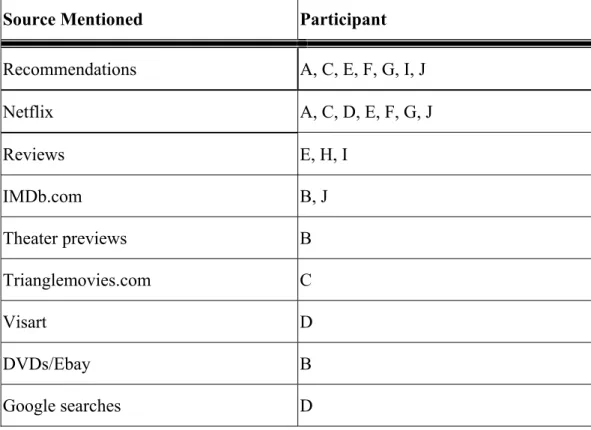
Table 1. Sources that participants placed in the Inner Circle
Source Mentioned Participant
Recommendations A, C, E, F, G, I, J
Netflix A, C, D, E, F, G, J
Reviews E, H, I
IMDb.com B, J
Theater previews B
Trianglemovies.com C
Visart D DVDs/Ebay B
Google searches D
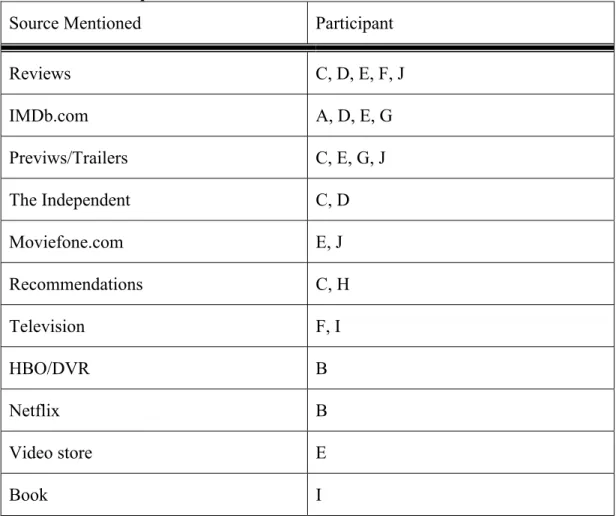
Table 2. Sources placed in the Middle Circle
Source Mentioned Participant
Reviews C, D, E, F, J
IMDb.com A, D, E, G
Previws/Trailers C, E, G, J
The Independent C, D
Moviefone.com E, J
Recommendations C, H
Television F, I
HBO/DVR B Netflix B
Video store E
Book I
The most mentioned source in the middle circle was reviews (5), followed by previews/trailers (4) and IMDB (4). The Independent (local newspaper),
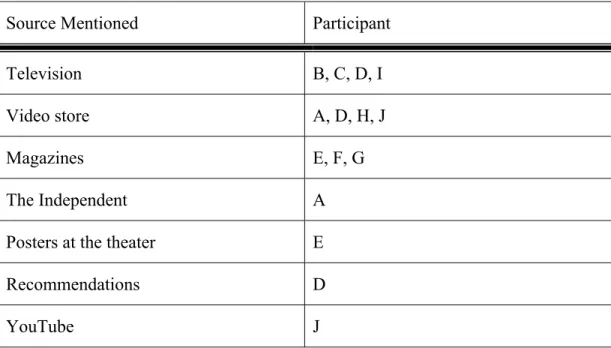
Table 3. Sources included in the Outer Circle
Source Mentioned Participant
Television B, C, D, I
Video store A, D, H, J
Magazines E, F, G
The Independent A
Posters at the theater E
Recommendations D
YouTube J
In the outer circle, television and video store (specifically, Visart and Redbox were each mentioned once) were the most mentioned sources with four participants listing each. Magazines were mentioned three times, and The Independent (local weekly newspaper, posters at theaters, recommendations, and YouTube were each mentioned once.
Overall the participants watched an average of 4.2 movies per week. Three of the participants said they watched a movie or part of a movie everyday. Two
participants mentioned they watch 4-5 movies per week, one participant said they watch 4 per week, one said 3 per week, and two participants said they watch on average 2 movies per week.
their movies are somewhat arranged by genre. Two of the participants did say their VHS tapes specifically were arranged alphabetically, however their DVDs were not. Two participants mentioned their collections have been limited due to space.
The majority of these collections are kept adjacent to the movie watching equipment. Seven participants said their collection is either next to or beneath the television.
Participant J: They’re right underneath now because I have less. They use to be like on a big bookshelf right next to my television, but I always keep…I’m kind of organized I like to keep everything in the same area.
Participant I said their collection is kept on a shelf in the same room as the television, but across the room. Another participant kept half of his movies right next to the television and the other half in his room (Participant D). The ones kept by his television were more frequently watched movies.
When asked what they look for in movies to watch four of the participants said it depended on their mood.
Participant A: Umm, well lately I’ve been into like more light-hearted comedies and stuff. It depends what mood I’m in.
Participant D: It does depend on the mood I’m in, of course, a lot of times I prefer things that, I mean if I could just watch good documentaries all the time I would, even news program type stuff, like Frontline and stuff like that, I’ve rented Frontline, I like that kind of stuff. But then of course, there are things that I’ve just rented for action, excitement. And then it’s really hard to find good sci fi escapist, stuff like that.
Participant J: Well sometimes I’m in the mood for comedy, like if I’ve been stressed out or you know kinda just want to relax I would go for comedy. If I want some adventure, but don’t wanna actually have to do the work to get it I would want like action or Battlestar Galactica or something like that.
Other participants listed genres of movies they seemed to gravitate towards, but what emerges from the data is an attention to technical aspects of the movies as well as emotional. The technical aspects participants are drawn to in movies include
characters, writing, acting, having lots of episodes, and cinematography.
Participant J: But as far as just general stuff, I think probably the writing is one of the biggest things for me….Acting definitely, but not quite as important as the writing….And then after that I guess would be, I’m not quite sure what you would call it, but the cinematography, the colors, and the mood stuff like that. That’s more of a subconscious kinda thing. Which is weird because when I really something I try to put my finger on what exactly it is and sometimes it’s that and I didn’t even realize, you know?
Participant B: But then there’s other times when I watch something a little more complex a little more artistic and for that I watch foreign movies you know, Bergman and Fellini, that’s if I definitely have time and I want to sort of be challenged, you know, and I love that sort of stuff.
Participant C: Cause I like to see, I do the same thing with music and books, I really like to see, to get every detail of the movie. And that’s what I find
everytime I watch 2001, there’s some little detail that I’d forgotten about that sort of notice for the first time. And I enjoyed it again.
The emotional aspects include satiating curiosity, learning new information, getting lost in the movie, being artistically inspired, and the complexity of emotions movies can produce, for example, being sad and happy at the same time. These findings seem to support what Ross (1999) found in relation to leisure reading.
Participant A: Because I mean it was really informative like a lot of things I didn’t know about Hunter S. Thompson, you know I found out and I don’t know, it was raw, witty. It was good, it was good, it kept my attention for a
documentary.
Participant D: I want to find something that makes me feel like wow, like Slumdog [Millionaire] made you feel like you were in India for a few hours, I mean, that I really, really,….I guess foreign films that make you almost feel like you went somewhere. Very cool.
Participant F: Yeah, inspiring artistically cause I’m an artist so I look for inspiration in movies.
Participant F: So we went in and it [Slumdog Millionaire] was horrible violence and horrible sad scenarios, social commentary, and then, but all in all in was wonderful and moving and loving and sweet and a love story. But I’m so amazed that it had so many downsides. But you were still able to go, oh wasn’t that a nice movie, even though you’re like brother dies and there’s blinding acid on the eyes, oh yeah. So that’s an experience.
to fall into it and not see something that I’ve already seen or not see a clip or the part that’s supposed to be funny.
Discussion Information Sources
The sources participants mentioned in this study are similar to the findings of other studies investigating source preference in ELIS. Similar to Savolainen and Kari's (2004) study, the findings of this research seem to suggest that people do highly value information from human sources. Recommendations were listed a total of 10 times across all circles on the information horizon form, with 7 of them being listed in the inner circle. Most often these recommendations would come from a friend, family member, or a known person. Several participants mentioned the buzz or hype that surrounds a movie, not only in the media, but around the community.
Participant I: I went and saw the Wrestler, maybe a week or so ago, umm, I think that was one that I was sort of like, had heard some of the hype and that he won, so I was sort of like, hmmm, I don’t really know what this story’s gonna be about, but I’m sort of intrigued.
The results of this study in relation to IMDb use, also seems to support the findings of previous ELIS research (Sonnenwald & Wildemuth, 2001; Rieh, 2004; Hektor, 2003; Ernest et al., 2005). Of the 27 sources listed in the inner circle, 15 of them were accessed through the Internet. In the middle circle, 9 of the 25 sources listed were accessed through the Internet, and in the outer circle only 1 of the 15 sources was accessed through the Internet. These findings suggest that not only has the Internet become embedded in the everyday searching of information for movies, but that the Internet is close to, easily accessible, and important to movie watchers. Of interest is that fact whether for leisure movie watching or work related film scholars (Myers, 1999) the Internet is an important source, for example, IMDb. A difference between these two contexts is that film scholars rely heavily on their own film collections for research purposes, while none of the participants of this research mentioned their own collections in the information horizon. This does not necessarily mean the participants do not use their own collections for information, but perhaps that the information in their collections is already part of their knowledge and they rely on it in other ways. For example, "Since I love The Big Lebowski I own a copy. What else have the Coen Brothers directed?" The movie watcher already knows who directed it, so they bypass the collection and go straight to IMDb or Netflix to search for other movies the Coen Brothers have directed.
Through the information horizon form and the recent movie watching
theme that emerged through the interviews is the idea of the video store as place and how Netflix and Internet movie watching has influenced a traditional source of movie watching information. Throughout the interviews, the concepts of browsing, selection, and convenience are interwoven with the themes. A discussion of the interview data in relation to these three themes is a useful way to analyze the results.
Flow
This idea of flow or the process by which the participants find out about and physically look for and retrieve the movie was a theme that continually arose from the interviews. Many times the statements were made in a list order, “Well I usually do this, and then that, or I might do this first.” Flow came about when looking for new information about movies, renting movies, adding movies to a Netflix queue, or going out to the theater to see a movie. These patterns seem to be similar to what Hartel (2006) found in relation to hobbyist gourmet cooks, however there was not a clear specific pattern with the participants interviewed for this research. Browsing was indicated as a useful technique in both Netflix and the video store.
Participant A: [I] Got on Netflix, looked through all of the Watch it now movies, went under the Comedy category, read descriptions of various movies, picked one…
Participant D: And so I went online and on the Netflix site actually, and just went on Classics and you know all those movies you hear about, hear
Madre, that was really good, so I knew I liked him and then so I put those in my first thing….
Participant E: Umm, if we’re going we’ll go there [video store] for one specific thing, but when we do go, we always browse.
Participant I: Yeah, definitely, we definitely discovered a lot of things by
browsing. We like documentaries a lot so a lot of times we’ll browse that section and like, you know find something we didn’t know at all about ahead of time. We definitely like to look in the new section too. And we definitely like certain TV shows that we can get and just watch ten of them in a row…But I do like the live browsing, just like going to a library or something you might discover something in the section right near where you are that you never would, you know look at, so….
Participant D also mentioned an interesting technique of a combination search and browse. He would do a Google search for top movie lists and then browse the results for
Within Netflix there was a specialized technique of browsing that many of participants mentioned; the ability to rate movies and then receive personalized
recommendations. Rating a movie, browsing through new suggestions, and rating more movies became a cycle of discovery.
I’ll IMDb it and then like check up the actors, what other things they’re in, it’s that kind of flow.
Participant E: And then probably like recommendations on Neflix, so the things that are, adding things to the queue from Netflix, like recommended things from there. Yeah I go through lots of cycles of you know, steps of select one movie and then if you like this, then this is recommended….
Participant F: I won’t even rent something unless I scroll over it and it pops up that really useful information and then because I rate all my movies, it says well you’ll probably like this one, they just automatically, of course, they know what I like, because I say I rate documentaries or whatever.
Participant J: Also the rating system is kind of addictive. It’ll just keep feeding you movies did you like this? Did you like this? What did you think about this? And so I, yeah, I get stuck on that sometimes.
One participant mentioned browsing a specific television station's listings (HBO) through the television for the convenience it offered.
Many times using one tool would be followed by using another tool in the searching process, for example, reading reviews, searching a particular actor or director in IMDb to see what other movies they were in, talking to friends, then looking to see if Netflix has those movies.
Participant A: I netflixed it and you know seeing reviews, reading reviews about it, seeing the trailer and you know because it’s kind of about Bob Dylan. Participant E: So out from there I guess would be IMDb, I use it fairly
frequently, but it’s not like a place that I go to look for movies, I’ll go look for somebody that was in a movie I just watched, and then I might add something to my Netflix queue or to my to watch list, so that would probably be secondary importance….And probably about the same for trailers on DVDs that we watch at home I would say that we follow through with more of those than with ones we see in the theater because we’re more likely to go to the computer and add them to our Netflix queue, but I wouldn’t put it up on the same level of word of mouth.
Whatever tools the participants used, it was apparent that they knew how to use them in a flow that was the most convenient for them. For the majority of the
participants the process of finding and watching movies was a well honed skill that they articulated readily.
Physicality of movie watching
Through the interviews an interesting theme emerged about how the participants physically watch a movie in their home for example, stopping and starting, completing other tasks.
Participant A: And then DVR because I can record movies I want to
see….Yeah, come back to them later...If I wanna watch it I can but often I might not get to it for awhile.
Participant C: Right, and it’s not like turn out the lights, shhhh the movies on, it’s nothing like that. It’s like I’m in the kitchen, making dinner with a movie on, it’s awesome….I watched it [2001] on Netflix instant viewer, so great and, which I really like, because you can sort of be watching and then, you know there’s some slow parts in 2001. Go check your email, it’s really sweet.
Participant F: Last night when XXXXXX [a friend] came over and we were just talking casually and next thing you know, while we were talking I was checking my email and went go ahead and pressed instant. Because we were hanging out for a couple hours and we were like well why don’t we chill and watch this movie a little bit. Whereas normally that would be impossible.
you know….Not a lot, but you know, cause then I don’t have to I, don’t watch the whole thing, it’s free, just like watch it, cause we don’t have cable or any television, so if I’m like bored I’ll put it on a little bit, eat some lunch, then turn it off. I think I watched ten minutes of Less than Zero the other day, it was pretty funny.
Participant J: We watched it, I kind of actually fell asleep toward the end cause it got late. But then I finished it the next day.
For these participants movie watching in the home has become a convenient and viable option. For a couple of participants, movies were already an activity they
engaged in while doing something else. But now, freed from worrying about returning movies on time, the participants can choose the terms of their movie watching
experience. They can stop the movie and handle more urgent tasks, or finish the movie the next day. The speed with which some of the participants can watch get a movie to watch through online watching instantly has changed the consumability of movies. With thousands of titles readily available, there can be a "fitting room" aspect to movie watching: try it on for a little while, if it is not what one wants, try something else. Specific to watching movies in the home, there is a flexibility and convenience which the participants valued.
Video Store as Place
aspects, but most seemed to agree it is not as convenient with new methods of movie watching like Netflix and watching online.
Participant A: Normally video store experiences are kind of annoying, especially if you go in not knowing at all. You can spend a lot of time in there, you know, a lot of time that you don’t want to be spending in there, you can just do it at home, you don’t find something right away, go do something else, come back, you know you’re not restricted like you would at the video store.
Participant B: I think it’s hard to be as creative with video stores as it was back then, sad but with that happening I think you find people also sort of caring less about the video store as a place that was sort of like, record stores, you wanted to go for a reason, it’s part of a whole community thing um I think now it’s pretty easy to go on Netflix and get any movie you want, like if it exists they probably have it you know so that’s really cool on one end. It kinda takes a little of the social aspect out of it, so I have friends that work at video stores, you go and visit them you and talk to them oh what do you like, you know, so that aspect gets lost a little bit, but I don’t know maybe the ease with which you can watch movies increases.
browse for the length of a movie, before I would pick something up. So I do kind of miss that experience, but I’ll take the trade off for the convenience, you know. Participant D: But I think that I hope that someplace like Visart can continue to do business, because there are definitely nights, where I walk in there not
knowing what I’m going to get at all and having a physical, so many physical little sections to look through. Be like well I know I like this director but I’ve never even heard of that movie by him. You know, it’s pretty cool and being able to pick up the box and check it out. So in my mind Netflix could never totally replace that but I could see I mean, they really got it obviously, you know everybody loves to get stuff in the mail, you know?
Participant E: I guess at the video store there’s a little bit more of serendipity, like finding something totally random that you’re just attracted to the cover of it, walking by…So yeah I definitely miss some of the serendipity with video store browsing…I guess the browsing at the video store should go on her somewhere too. Umm, probably in the middle circle, not for frequency so much as I enjoy it, umm, there’s probably a little bit of nostalgia in there too. It should be more important, but it isn’t as much anymore.
Participant G: And even though I have Netflix, I still use Visart, which I think is a testament to the fact that I do still like the video store. Umm I do like that’s there’s no late fees with Netflix because I can be forgetful. I mean I just returned something to Visart two days late last night, you know, but I’d like to still support them. I want them to still exist. I think it’s a shame what
Blockbuster did, you know going into little towns and opening these huge stores that nobody else could really complete. It’s kind of sad.
Participant J: So, I like going to the actual video store cause I don’t want them to go out of business, but it’s not quite as convenient as having them come to my house and not having to worry about late fees and stuff like that.
Summary
This research investigated an area of information seeking that is not always considered: information seeking behaviors of leisure movie watchers. While movies are a continual entity in our everyday lives and numerous people interact with them for pleasure, little research has been conducted in the arena of leisure movie watching. Looking into areas of pleasure and leisure is a needed facet in ELIS research. Researching problem specific tasks in ELIS is certainly valid and helps LIS make gains, change policies, and influence decisions. Researching leisure related information seeking also broadens the LIS horizon and brings a more holistic approach to the
discipline.
Previous literature provided a framework for studying leisure movie watching behavior, specifically the information horizon. While no previous studies have ventured on this topic, much research in information seeking allows leisure movie watching to be placed within a certain context. Ideas of how people make sense of gaps in their information led ELIS to investigate situations that happen to everyone. It is reasoned that context, environment, and one’s information horizon influences how one navigates their information seeking. Many of these studies look at problem specific situations, while other studies have looked to pleasurable or leisure situations to try to understand information seeking behavior, for example, avid readers and hobbyist gourmet cooks.
research could possibly add to that body of knowledge. This research also supports the idea of human sources as still being a frequently used and trusted source. Much of the research in video retrieval examines the interfaces users interact with and how
surrogates impact the relevance of videos retrieved. Researching leisure movie
watchers is a way to investigate information seeking in a pleasurable context, as well as making LIS research more usable and accessible. This research identified different sources and tools that movie watchers frequently used and their preference for those sources.
The method of this study employed qualitative semi-structured interviews and information horizon mapping to investigate the information seeking behavior of leisure movie watchers. For the purposes of this study, leisure movie watchers were defined as people who watch at least one movie a week. A snowball sampling technique lead to interviewing participants in a certain community of movie watchers and as such was limiting. The results of this study cannot be generalized to a larger population, however this research provides an in-depth look into a certain group of leisure movie watchers in able to identify movie watching behavior.
ensure that libraries are offering Internet access to their patrons. Beyond that libraries could include movie advisory guides, just as they do for traditional reading advisories. While in no way did this study meant to be a marketing tool, there are definite
implications for video rental stores. The findings of this study seem to suggest that receiving movies through the mail and watching online are preferred methods for leisure movie watchers. Perhaps the future of video stores lies in niche markets and catering to the physical flesh and blood communities that still support them.
References
Amin, A., Ossenbruggen, J., Hardman, L., & Nispen, A. (2008). Understanding cultural heritage experts' information seeking needs. Proceedings of the International Conference on Digital Libraries (JCDL '08), Pittsburgh, PA, 39-47.
Babbie, E. (2007). The practice of social research (10th ed.). CA: Wadsworth.
Beer, S. (2004). Information flow and peripherality in remote island areas of Scotland. Libri, 54(3), 148-157.
Burgett, S. W. (1998). Kentucky librarians: Do we fit the stereotype? Kentucky Libraries 62(3), 4-10.
Case, D. (2006). Information behavior. Annual Review of Information Science and Technology, 40(1), 293-327.
Chatman, E. A. (1996). The impoverished life-world of outsiders. Journal of the American Society for Information Science, 47(3), 193-206.
Ernest, D., Level, A., & Culbertson, M. (2005). Information-seeking behavior for recreational activities and its implications for libraries. Reference Services Review, 33(1), 88-103.
Frank, P. (1999). Student artists in the library: an investigating of how they use general academic libraries for their creative needs. The Journal of Academic
Librarianship, 25(6), 445-455.
Dervin, B., & Nilan, M. (1986). Information needs and uses. Annual Review of Information Science and Technology, 21, 3–33.
Hartel, J. (2003). The serious leisure frontier in library and information science: Hobby domains. Knowledge Organization, 30(3/4), 228-238.
Hartel, J. (2006). Information activities and resources in an episode of gourmet cooking Information Research, 12(1) paper 281. [Available at
http://InformationR.net/ir/12-1/paper282.html]
Hektor, A. (2003). Information activities on the internet in everyday life. The New Review of Information Behaviour Research, 4, 127-138.
Marchionini, G. (2006). Human performance measures for video retrieval. Proceedings of the 8th ACM international Workshop on Multimedia information Retrieval (MIR ’06) Santa Barbara, CA, 307-312. Retrieved on October 10, 2008 from
http://doi.acm.org.libproxy.lib.unc.edu/10.1145/1178677.1178720
Marchionini, G., Wildemuth, B. M., & Geisler, G. (2006). The open video digital library: A mobius strip of research and practice. Journal of the American Society for Information Science and Technology, 57(12), 1629-1643.
Mosely, P. A. (2002) Shedding the stereotypes: Librarians in the 21st century. The Reference Librarian, 37(78), 167-176.
Myers, A. (2004). Film Scholars’ Library Use Characteristics in Research
Universities. Unpublished Master's Paper, University of North Carolina, Chapel Hill, North Carolina. Retrieved September 30, 2008 from
http://sils.unc.edu/itrc/mpi/
Rieh, S. Y. (2004). On the web at home: Information seeking and web searching in the home environment. Journal of the American Society for Information Science and Technology, 55(8), 743-753.
Ross, C. S. (1999). Finding without seeking: The information encounter in the context of reading for pleasure. Information Processing and Management, 35(6), 783-799.
Savolainen, R. (1995). Everyday life information seeking: Approaching information seeking in the context of “way of life.” Library and Information Science Research, 17(3), 259–294.
Savolainen, R. (2008). Source preferences in the context of seeking problem-specific information. Information Processing & Management, 44(1), 274-293.
Savolainen, R., & Kari, J. (2004). Placing the internet in information source horizons. A study of information seeking by internet users in the context of
self-development. Library & Information Science Research, 26(4), 415-433. [refereed/empirical]
Stebbins, R. A. (1998). After work: The search for an optimal leisure lifestyle. Calgary: Detselig Enterprises Ltd.
Yakel, E. (2004). Seeking information, seeking connections, seeking meaning:
Genealogists and family historians. Information Research, 10. Retrieved October 1, 2008, from http://informationr.net/ir/lO-l/paper205.html
Yang, M., Wildemuth, B. M., and Marchionini, G. (2004). The relative effectiveness of concept-based versus content-based video retrieval. Proceedings of the 12th Annual ACM international Conference on Multimedia (MULTIMEDIA '04) New York, NY, 368-371. Retrieved on October10, 2008 from
Appendix A: Interview Schedule
1. Greet participant and thank them.
2. Have them read the information sheet and consent orally. 3. Begin recording audio.
4. General Outline: "I'm conducting this interview to get an idea about how you look for information in relation to movies you watch for leisure. I have a form I'd like you to fill out first that deals with sources of information and then I'll be asking you some questions. If it's allright with you I might take some pictures as we go."
5. Script to be read as instruction for completing the information horizon form: "This form is a way for you to show me the sources in your horizon that you use when looking for movie related information. The idea of an information horizon is any thing or person that you use to get information about movies. This form has three circles on it. Think of yourself as the center of the circle. Things you think are the most
important would go in the center. Things you think are the second most important would go in the middle circle, and things you think are the least important would go in the outermost circle. What I'd like for you to do is talk to me as you fill in the sources. Let me know what they are and why you are putting them in certain places. I might ask you questions as you go. Try to be as specific as you can for example, if you use IMDb write that and not just “the internet”. If you use the library let me know whether you search the online catalog or if you browse. If you use a magazine or newspaper, write down which one. Why don’t you start with the center and write the things that are most important to you to get information about movies."
6. Other questions:
How often do you watch movies?
What do you look for in a movie to watch? Do you have your own video/DVD collection? How do you organize it?
Tell me about one recent incident when you watched a movie. When was this?
What were the circumstances?
Were you alone? If not who did you watch it with? Did you hear about it from someone?
Where did you get it from?
Did you enjoy it? Why or why not? Is this incident typical?