A Computational Trust Model for
E-Commerce Systems: Concepts,
Definitions and Evaluation Method
Mehrnoush Divsalar
School of Computer Engineering, Iran University of Science and TechnologyMohammad
Abdollahi AzgomiSchool of Computer Engineering, Iran University of Science and Technology
Mehrdad Ashtiani
School of Computer Engineering, Iran University of Science and TechnologyReceived: October 26, 2014-Accepted: March 17, 2015
Abstract— Trust is a complex and multidimensional concept, which plays a key role in the success of electronic commerce. Assessing trust, specifically in the beginning of a commercial relation and the formulation of trust in general is a complex and difficult task. The researchers are often focused on a specific context for trust formulation and the relevant literature does not clearly distinguish between the factors involving in trust decision making process. With the aim of providing a basis for computational trust models and by consolidating a large body of studied contexts in the trust literature, this paper first tries to present a conceptual trust model for electronic commerce. Four types of trust that are used in the conceptual trust model are as follows: (1) institutional trust, (2) technological trust, (3) trading party trust, and (4) propensity trust. Then, a computational trust model is proposed in which the agents involved in a commercial transaction can consult with a trust manager agent (TMA), which is considered in a distributed fashion in the network. The proposed model is capable of evaluating a broad range of trust contexts and has two main features: (1) trust is evaluated dynamically (i.e., a change in any of the trust’s parameters will result in the re-calculation of trust values) and (2) the proposed model is capable of making partial studies for the trust contexts presented in the conceptual model of trust. Finally, the proposed model is evaluated and the results are presented in this paper.
Keywords- Trust model, trust evaluation, computational trust model, electronic commerce, trust manager agent (TMA)
I.INTRODUCTION
Recently and with the advancements of information technology and electronic commerce (e-commerce), many researchers have focused on trust formulation in this context. Like most of other computational domains, trust is still a challenge in e-commerce. An important reason for this statement is the lack of concentration in the researches performed on trust formulation in e-commerce. Other important existing
challenges are as follows: (1) the multiplicity of the dimensions of trust, (2) the prerequisites of trust, and (3) the complexities regarding the formulation of trust. These challenges are originated from the non-calculative and non-physical nature of social trust that has made the formulation of this concept in the settings of computational contexts, such as e-commerce, a complex task.
Trust in e-commerce fundamentally differs from the common understanding of trust in traditional commerce. In traditional commerce, trust is based on commercial and personal relations and the interactions of customers and merchants in individual or business level. However, in the setting of commerce on the Internet, online sellers will create a trusted environment in which the potential users feel convenience and certainty in every potential transaction. For creating such an environment, different infrastructural elements are required. Specifically, the models proposed for measuring trust in e-commerce can be highly effective.
To this aim, this paper tries to clarify and determine the dimensions affecting trust in electronic transactions and online businesses. To propose a general framework, we have considered the primary works regarding the foundational theories and the existing literatures on computational trust models. Then, the properties and features are presented in a computational manner and the relevant computational model is created and evaluated.
For the proposed model, first, based on the existing literature, a conceptual framework is introduced. The proposed model includes four general types, namely institutional trust, technological trust, trading party trust, and propensity trust. Then, a computational model, which is the basis of trust judgment for the trading partners (i.e. online vendors and customers), will be presented. Operations such as trust management and processing trust assessments are vested on reliable agents representing the trading parties which ultimately will lead to make decisions about the trustworthiness of the trading partners in e-commerce.
It is worth-mentioning that distrust is qualitatively different from trust. The lack of trust does not mean distrust because the lack of trust may be originated from the non-existence of trust-related information. This is an indication that the lack of distrust does not mean the existence of a high degree of trust and a low degree of trust is not equal to high distrust. Specifically, in the proposed model, an agent may be considered trusted in one context whereas it is distrusted in another context due to the lack of required information or bad history in the past transactions [8, 17].
In a previous paper [4], we presented the initial motivations and some preliminary results of our research towards a computational model of trust in e-commerce. In this paper, we concentrate on the relationships between different types of trust and their impacts on the trading parties and the effects of these types of trust on the process of online purchasing.
The remainder of this paper is organized as follows. The related works are briefly reviewed in Section 2. Studies about trust in e-commerce and some evaluation models are also discussed in this section. The proposed conceptual trust model, which is a basis for further evaluation of trust, is introduced in Section 3. In Section 4, a computational trust model based on the conceptual trust model proposed in Section 3 is presented and a case study is given to illustrate the
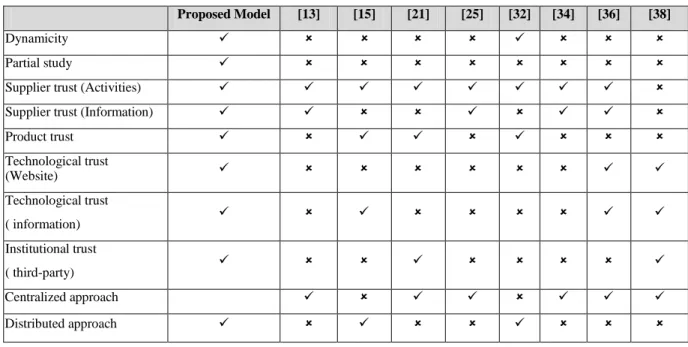
proposed trust evaluation model. In Section 5, we discuss about the operational model of TMAs as one of the core entities in the proposed model. In Section 6, in order to prove the stated hypotheses, the proposed model is evaluated by using the statistical information collected through a survey about online purchasing. The results of the data collection and the corresponding factor and regression analysis are also presented in this section. In Section 7, we give a final discussion about the proposed framework and discuss about its pros and cons. A comparison with other existing approaches in both the conceptual and computational levels is given in this section. Finally, in Section 8, concluding remarks are mentioned.
II.RELATED WORKS
In recent years, researchers working on trust have adopted a variety of different models with different classifications for e-commerce systems. Many of these models are theoretical and have studied and presented the dimensions and pre-requisites of trust. Also, a wide range of computational trust models are developed. In the existing models for online trading, the following two general categories in the e-commerce environments are considered: (1) conceptual trust models and, (2) computational trust models. In the first category, often a conceptual trust model is presented in a theoretical form and the verification of the model is performed by using e-commerce data. In the second category, the trust measurements are based on different approaches, such as mathematical methods or fuzzy logic. Some of these models will be introduced in the remainder of this section.
In [8], a model of trust and distrust in B2C e-commerce is proposed. In this model, trust and distrust are intended as separate entities and formation of trust and distrust are investigated with the aim of making it easier to reduce the complexity of social events. Particularly the effect of vulnerability and uncertainty on trust and distrust toward the behavioral motivations are assessed.
In [17], it is proposed that trust and distrust are distinct constructs. This paper has tested this statement and it tries to determine which of the trust or distrust concepts are more important to key online behaviors under various conditions.
In [10], a model of multi-dimensional trust formation for online exchange in B2C e-commerce is provided. In this model, trust in B2C e-commerce is formulated in six dimensions: (1) customer-oriented (2) behavior-oriented, (3) institutional, (4) informational, (5) product-oriented, and (6) transactional. Further, to study the relative importance of the dimensions between two expert groups (i.e.
academics and practitioners), two semantic networks are constructed and a range of content analyses are performed.
In [26] and [27], interesting researches are performed on trust decision making processes in B2B transactions. In [27], a conceptual framework in B2B e-commerce is proposed with two dimensions of trust, namely the technological trust and the trading party trust. Then, the impact of technological trust on business value in B2B e-commerce is studied and the
results of empirical studies about the impact of technological trust on successful B2B e-commerce are presented. The authors also identified three types of trading partner, including: (1) competence trust, (2) predictability trust and (3) goodwill trust.
The research presented in [26] contributes to a typology of trust from four different perspectives, namely technological, economical, behavioral and organizational. This paper proposes that trust in e-commerce transactions gradually evolves from technological trust to relationship trust.
In [8], a mechanism is presented by which the customer trust and distrust are formed. It is discussed that self-disclosure and commitment in B2C Internet exchange context are affected by this kind of trust. In particular, distinctions between trust and distrust regarding different aspects are discussed.
As for the second group (i.e. computational trust models), trust measurement and evaluation is performed by leveraging different methods such as the mathematical methods, probability theory, fuzzy logic and fuzzy cognitive maps. Some models such as ERC2G in [33] and models presented in [31], [32], [34] and [20] have used reputation systems for the evaluation of trust.
In [24], trust in B2C e-commerce is divided into direct and indirect trust and based on this division, an assessment model is presented. In the proposed model, the components of trust in B2C commerce are defined and categorized in the proposed framework in the following three groups:
1. The components related to trustee (i.e. e-commerce Websites, online firms and merchants),
2. The components related to trustor, and
3. The components related to environment (i.e.
technological and social factors).
Each of these components is divided into direct and indirect factors. The main formula used for representing trust is 𝑇 = 𝛼𝑇𝑑 + (1 − 𝛼)𝑇𝑖, where 𝑇𝑑 and 𝑇𝑖 denotes the direct and indirect trust respectively.
For measuring trust parameters and proving the trustworthiness of electronic transactions in a fuzzy manner, Manchala has proposed a computational trust model [15]. In this paper, the cost of a performed transaction, history of the transaction, the loyalty of the customer, his/her commitment to pay and the patterns of cost are defined as the trustworthiness parameters. Each parameter is measured by using semantic labels. Trust based communications are defined as e-commerce trust relationship matrices. The calculations are performed depending on the portions of trustworthiness matrices that are known. This model assesses the corresponding level of trust in e-commerce.
In [21] and for the aim of trust assessment, a method based on fuzzy logic is presented. The model of public trust consists of five modules in which four of them are introduced for measuring trust and the last one represents the final trust decision.
In [33], a computational trust model is proposed, which is mainly a model for measuring trust. The model combines the concepts of reputation trust and mathematical trust for measuring the trust level of an e-retailer. The model uses five sources of principal information. These sources are as follows: (1) trading’s trust, (2) customer’s trust, (3) certificate’s trust, (4) credential’s trust, and (5) system’s trust.
The model attaches different weights to these information sources for determining their importance.
In [29], sixteen features are defined for trust and a multi-branched model consisting of four types of trust is developed. These types are as follows: (1) dispositional trust, (2) institutional trust, (3) trusting beliefs and, (4) trusting intentions. For computing the final trust values, fuzzy cognitive map is used. Each node of the graph represents the information needed for the calculation of a subset of the final trust value in the range of 0 to 1. Also, each edge is weighed based on the effect of a node on the other nodes of the graph. In [23], a probabilistic theory of evidence is used to represent the trust between agents in terms of referrals and quality of services obtained.
In addition, a number of trust and reputation models are proposed for online environments. In the rest of this section, we will review the noticeable works with this regard.
In [32], a computational trust model is proposed to measure the trustworthiness of participants in online C2C auctions that combines five basic trust parameters including: (1) feedback rating, (2) trust value of the last period, (3) reliability of raters, (4) the decay of feedback rating and (4) the value of a transaction. Through devising simulation experiments, the authors have evaluated their approach by comparing their model with other existing approaches in C2C trust modeling domain such as eBay and Zacharia models.
In [34], a computational trust model based on Bayesian decision theory is proposed that combines prior experiences and reputation information to produce an assessment of an agent. It considers three types of cost in the trust evaluation process: (1) operational, (2) opportunity and (3) service charges. In this approach, users can combine several information sources to deal with uncertainties on semantic web. Each user may receive a personalized set of trustworthiness factors.
In [25], a trust model based on two sources of information is proposed that permits an agent to build trust. The two considered sources of information are confidence and reputation. Authors have applied the fuzzy set theory and fuzzy rules to evaluate the trustworthiness of the contractors fulfilling obligations that may be explicitly stated in the contract, or implicitly assumed in the environment. The reputation of contractors is taken as an aggregation of opinions of other agents with respect to the contractor over a particular issue.
In [20], a formal quantitative model for rating is proposed and based on this model a mathematical framework for modeling trust and reputation is built. This model is used for helping various members of a
social network to select their partner. In a similar work [21], authors have presented a trust model based on BAF-logic, a system of reasoning that was originally developed for belief augmented frames.
In [13], a computational framework for predicting trust connectivity between a pair of users based on user’s expertise and affinity for context is proposed. The approach employs user rating data to develop estimates of pair-wise trust. The framework is used in online communities and peer-to-peer (P2P) online service markets with a rating system.
In [36], the main objective is to identify the factors that influence the extent to which Saudi customer trust are satisfied. This study tries to build a conceptual framework which hypothesizes the relationships between three e-commerce constructs (i.e. customer satisfaction, trust and loyalty) and their antecedents. The user interface quality, service information quality, security risk perception, and privacy perception are the identified key factors in this paper.
The research reported in [37] has tried to analyze the factors that affect e-commerce customer’s loyalty in Surabaya. In the conceptual model of this research, three stages of analysis are performed. These analyses are as follows: (1) Analyzing the effect of ability, communications and vendor integrity parameters on trust e-commerce customers, (2) Analyzing the effect of ability, communication and vendor integrity parameters on the level of e-commerce customer’s loyalty, and (3) Analyzing the influence of the trust parameter on the level of e-commerce customer’s loyalty.
In [38], a theoretical framework for creating trust in customers toward e-commerce is proposed. Also, the role of trust in the development of e-commerce itself is studied. The related concepts in trust modeling from the individual and organizational perspectives and the corresponding strategies such as trust decision making process, pretest, buying heuristic, extended maintenance and warranty contracts are investigated. Then, a model was introduced for the development of e-commerce and its related concepts.
In [39], the authors have investigated the effect of security concerns on the establishment of trust amongst e-commerce users. In this work, five elements regarding the security factors are introduced: (1) the clear statement of returning policy, (2) the guaranteed information confidentiality, (3) the protection against viruses and malicious behaviors during online transactions, (4) the safety of online payment, and (5) the existence of an official entity to handle online transaction complaints. According to this research, these are the influential factors for the establishment of trust in potential customers in a similar work, the research reported in [40] aims at assessing the prospects and challenges of B2C e-commerce implementation in Nigeria from the customers’ perspective.
In this section, we provided an overview of various approaches for trust assessment in e-commerce. To summarize, the existing literature indicates a number of factors that poses great influence on trust establishment and trust assessment in the e-commerce environment.
In the proposed framework, we have taken into account the main factors affecting trust, quantifying these factors and using them in the evaluation process of trust for the e-commerce setting.
The dimensions of trust in e-commerce have already been addressed in many researches. Of course these dimensions are not consistent and well-categorized. After a precise study of the related works, we came to this conclusion that it is possible to create a conceptual trust model by integrating all the important aspects that affect the establishment and assessment of trust in the e-commerce setting. For this purpose, we propose a conceptual trust framework in the e-commerce context. The specific aim is to provide a model for making trust decision regarding the trading partners by using the trust factors based on the proposed conceptual framework.
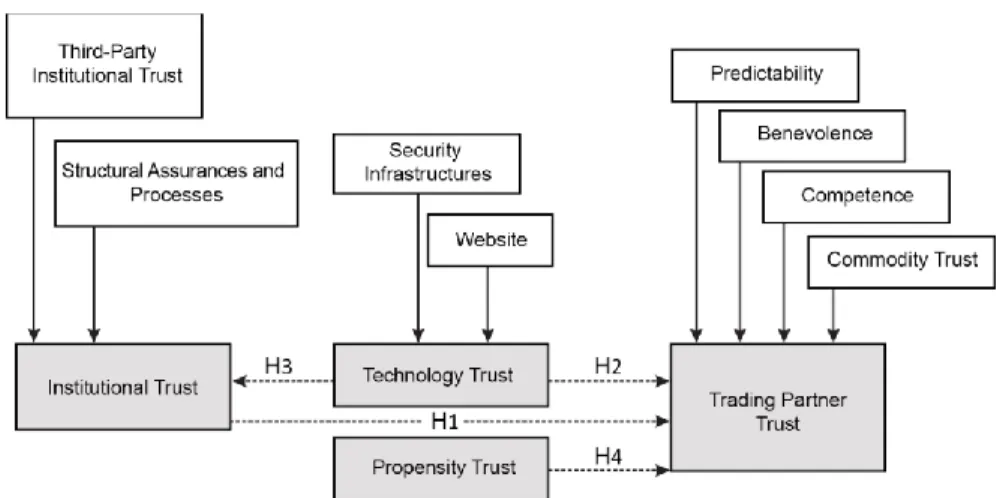
III.THE PROPOSED CONCEPTUAL TRUST MODEL In this section, we propose a conceptual trust model for e-commerce, which creates the basis for presenting the computational trust model. The architecture of the proposed model, the required components and their relationships is shown in Figure 1.
As shown in Figure 1, four general considered types of trust are as follows: (1) institutional trust, (2) technological trust, (3) trading party trust, and (4) propensity trust. We will further explain these types of trust in the following subsections.
A. Institutional Trust
The first type of trust in the proposed model is institutional trust. This type of trust is already studied in [10, 26, 29]. Institutional trust contains the laws and regulations that facilitate the commercial transactions. This type of trust consists of the following building-blocks: (1) the structural assurance and, (2) the certificates of third-parties plus the corresponding processes. This category of trust is mostly focused on B2B transactions and structurally decreases distrust and uncertainty.
This type of trust resembles the situation in which we do not trust the other parties and use the regulations and control mechanisms as a substitute for trust. The testimonies of third-parties assess an online trade with respect to the security or organizational and procedural reputation information. Subsequently, these data are released on Website for the potential customers to see. Based on the above definition, we can state the following hypothesis:
Fig. 1. The proposed conceptual trust model Hypothesis 1. Institutional trust has a positive effect
on the trading party trust.
Currently, there are a number of organizations which assess the commercial transactions according to their specific standards. Companies that coordinate their commercial processes with respect to these standards will receive the approval certificate of the organizations. In [22], the infrastructural dimensions of institutional trust are examined. The structural guarantees for trust establishment are as follows: (1) the agreements and instructions dealing with organizational processes and, (2) the standards and procedures which lead to the success of different services such as transportation and delivery.
B. Technological Trust
The second type of trust in the proposed model is technological trust. This type of trust is studied and used in [10, 26, 27, 28]. Technological trust may be studied from two points of view: (1) Website and (2) security infrastructure.
Website is the first thing that the customer faces (especially for a person who visits an e-commerce site for the first time) and can have desirable effect on visitor's purchasing decision. The facets that may attract the attention of the customer towards the Website include the appearance of the Website such as beauty, ease of use, accessibility and performance and the Website’s technical specifications such as being up-to-date with respect to the software and hardware aspects as well as transparency and standardization of the presentation of information. As an example for transparency, the complete specification of the product and the company, the company’s logo and the trade name should be presented in the Website and the laws and contracts should be observable to all the customers. Off-line attendance or contact (i.e. phone number, e-mail address, fax number and so on) is also an effective parameter in gaining the trust of the customers.
The security infrastructures provide safe connectivity mechanisms in order to deal with the security issues such as confidentiality of the information related to the individuals and organizations. For instance, the number of credit cards that a customer owns will not be disclosed to others when the customer is buying a product. Generally, the mechanisms introduced for creating a security
infrastructure can be categorized to: (1) integrity, (2) confidentiality, (3) non-repudiation, (4) access controls, (5) availability and, (6) authentication [26, 27]. Because the technical capability and the security services delivered by the Websites play an important role in customer trust establishment, the Website itself is the first demonstrator of the vendors' abilities and may increase the trust of the trading party. Therefore, we can state the following hypothesis:
Hypothesis 2. Technological trust has a positive effect on the trading party trust.
Technological trust is a prerequisite for institutional trust. This is because it provides the required technical and security framework for institutional trust. Further, reliable certificates regarding the technology of the e-commerce Website, are an indicator of the existence of reliable security infrastructures. This suggests the impact of institutional trust on technological trust. Hence, we can claim the following hypothesis:
Hypothesis 3. Technological trust has a positive effect on institutional trust.
C. Trading Party Trust
In our proposed model, we have considered three factors regarding the trading party trust. These factors are: (1) competency, (2) benevolence, and (3) predictability of the trading party. This approach is similar to some of the existing researches such as [26] and [27]. Competence emphasizes the reliance on the trading partners’ skills, technical knowledge and the ability to fulfill contracts. Predictability on the other hand emphasizes the belief in a trading partner’s consistent behavior that provides sufficient knowledge for other trading partners to make predictions on the other organization’s reliability, honesty, and predictability [27]. Benevolence denotes the reliance on trading partners to care about the customer’s interests and the concern about the welfare of users.
It can be argued that the magnitude of the cost of the transaction may justify the existence of control mechanisms with high overhead. On the other hand, in case of trivial purchases the security precautions may be neglected. Such approaches will be determined based on the rules of the online organization.
In trading a product or a service a very critical issue is that the satisfaction about a product may become the
root cause of other further decisions. In [10], Kim et al., has introduced the product as one dimension of a six dimensional model of trust in e-commerce. Since the aim of performing a transaction is the acquisition of a specific product (or a service), the existence of trust towards the product (or a service) is very critical. Therefore, product satisfaction is one of the primary prerequisites of trading party trust. This indicates that if the customer is satisfied with the purchased product, he/she will be also satisfied with the e-vendor. For measuring trust towards the product, the signature of at least one reliable reference or the product’s trust index based on the satisfied or dissatisfied customers may be given along with the specifications of the product.
D. Propensity Trust
Another dimension that may be considered for trust in its general sense is trust propensity. Disposition to trust is a measure of the extent to which an individual is willing to depend on others [28]. Trust propensity is not based upon previous experiences or a specific knowledge about a particular trusted party rather it is the result of the general life experience and socialization [14].
It seems that our disposition to trust is learned during the childhood and it is deeply rooted in our personality [14]. In [5, 7, 11, 18], this type of trust has been reviewed and studied.
Trust propensity has also considerable effects on other trustworthiness aspects and may not be assessed merely by measuring or calculation. This is because it differs from one person to another and depends on the family, social conditions and the surrounding environment. For instance, if there does not exist an eligible framework for the information and communication technology (ICT) and its corresponding infrastructure, people will not be attracted to electronic technologies and will tend to perform their jobs in traditional ways without using the services that ICT provides. Apart from the current issues existing in the computational domains, the philosophy of trust has roots in family and the individual characteristics of people. Based on this discussion, we can state the following hypothesis: Hypothesis 4. Trust propensity has a positive effect on the trading party trust.
IV.THE PROPOSED TRUST MODEL
In this section, we present a computational model based on the conceptual trust model proposed in the previous section. It is worth-mentioning that trust propensity is not included in the computational trust model. In other words, only the measurable dimensions are used. The proposed solution has the following important features:
1. In the proposed model, trust is formulated in a dynamic way and by changing the value of each of the existing parameters the final trust value will be re-calculated.
2. In contrast to most of the existing trust models, trust is modeled and calculated by combining a set of optional components. This means that the
customer may measure the properties or features that he/she wishes to know their value. The necessity for this aspect is based on the fact that since trust is a multi-dimensional issue, different individuals may concentrate on various dimensions. Hence, it is beneficial for the customers to measure the features they deem to be important.
Generally, there are two approaches to trust management. One is the centralized approach in which for storing and searching the data, centralized mechanisms are used. A noticeable example of the centralized approach is the eBay‘s reputation system. These mechanisms leverage a central database for trust assessment and a centralized control scheme is used. The second approach uses a distributed scheme. In this approach no centralized database exists. Thus, none of the agents have a general understanding of the entire system. Assessment and management of trust are performed locally by the agents without using any central control.
In the proposed model, for evaluating trust, we assume the existence of a reliable party which is trusted by both the vendor and the customer. This party plays the role of the fundamental core of the evaluation system that can control the commercial transactions. We call this trusted medium, the trust manager agent (TMA). We suppose that for each subset of the network nodes there exist a node marked as TMA. Hence, the trust management scheme is distributed between the trust manager agents.
It is possible that TMA asks for the help of other parties for perfecting its partial knowledge. In this case, the techniques of trust expansion and propagation can be used. Noticeable examples for the trust propagation mechanisms are introduced in [1], [2], [9], [16]. In addition, since the intrinsic nature of trust is of a temporary kind, an agent with a purchasing intention will have the opportunity to consult this TMA to gain more knowledge about the product or the vendor.
TMAs not only receive information about the performed transactions from the nodes in the current set, they also share information with other TMAs upon request. Neighboring TMAs are connected to each other and can confirm the validity of each other through using the cryptography and repudiation mechanisms.
There is a table in the TMA’s database for storing the information about the agents. The calculated trust value in each context is stored per agent. The table is updated dynamically with the occurrence of transactions or through the propagation of information from other nodes. TMAs also store the feedbacks of agents about an existing entity. This operation is performed periodically when e-vendors send information to TMAs about their transactions. Also, the customers reflect their assessment of the trading party’s trustworthiness. These reflections are also kept by TMA.
Based on the above discussions we give the following definitions:
Definition 1. Agent is defined as a set of active entities, which play a role in the trust model and
perform different activities toward meeting the requirements:
Agent = {𝑎1, … , 𝑎𝑛 | 𝐴𝑔𝑒𝑛𝑡(𝑎𝑖), 𝑖 [1, 𝑚]} Vendors, medium entities and trusted parties are examples of agents
Definition 2.Transaction is a unit of action which is taken place among at least two agents. The result of the transaction may be a failure or a success which can be denoted by a value in the interval [0, 1]. This interval determines the degree of success for the performed transaction.
Definition 3. Context in the proposed trust model is defined as the following set:
Context = {𝐼, 𝑇, 𝑇𝑝, 𝐵𝑒, 𝐶𝑜, 𝑃𝑟, 𝐺}
where, the parameters mentioned in the above set are defined in Table 1.
Table 1. The definitions for the parameters of the context in the proposed model
Parameter Definition
I Institutional Trust T Technological trust TP Trading Party Trust Be Benevolence Co Competence Pr Predictability
G Goods
One of the advantages of considering TMAs is that an agent may need to receive recommendation about an entity only in a particular context. For instance, the trustworthiness of a trading party may be certain, but the trustworthiness of his/her technology is not well-known. In this case, the customer can consult with TMA about that particular context. In order to include this functionality in the proposed trust model, we introduce a function denoted by 𝑇(𝑥) (𝑥 Context) to define the context that the TMA assesses the trustworthiness of 𝑎𝑖in.
A. Trading Party Trust Evaluation
In this section, we introduce the procedure for the evaluation of the trading party trust, which include the evaluation of the supplier trust and the product trust.
1) The Supplier Trust
In order to incorporate the supplier trust in the proposed formulation, we first refer to a well-cited definition given for the concept of trust. The definition is as follows:
“Trust is the subjective probability by which person A expects person B to fulfill an activity assigned to him/her in the direction of the welfare of person A.” [6]
The important element existing in the above definition is the activity. Activity is different from information. We can trust a person by considering a specific activity that he/she has performed or we can trust him/her based on the information that he/she has provided. In the computational model, both of the activities and information are considered. Therefore,
for evaluation of trading party trust, we will have the following formula:
𝑇𝑎(𝑇𝑝) = ∑ 𝛼𝑆(𝑖) 𝐼(𝑎) 𝐼(𝑎)
𝑖=1
+ ∑𝐷(𝑖) 𝐼(𝑎) 𝐼(𝑎)
𝑖=1
+ ∑𝐵(𝑎, 𝑖) 𝐼(𝑎) 𝐼(𝑎)
𝑖=1
+ ∑𝐺(𝑎, 𝑖) 𝐼(𝑎) 𝐼(𝑎)
𝑖=1
(1)
where, 𝐼(𝑎) is the total number of transactions corresponding to agent a. The formula ∑ 𝛼𝑆(𝑖)
𝐼(𝑎) 𝐼(𝑎)
𝑖=1 is constructed based on the past transactions history of the agent. Parameter 𝑆(𝑖) denotes the successfully completed transactions in which the customer is satisfied. Any successful transaction is graded with the value 1. Success in transactions may be determined by the feedback mechanisms of the e-commerce sites. Since the feedback mechanisms play an important role in studying the history of commercial transactions, we give a positive score to the commercial sites that incorporate a feedback mechanism. Parameter 𝛼 is a coefficient which is used for calculating the final history-dependent trust value based on the importance degree of satisfaction and success.
In formula (1), ∑ 𝐷(𝑖) 𝐼(𝑎) 𝐼(𝑎)
𝑖=1 denotes the information
sharing factor indicating the benevolence of the trading party. This formula determines the total number of files that are downloaded by e-customers for the total number of transactions of the agent 𝑎. Parameter 𝐷(𝑖) denotes the download in the ith
transaction and is determined with regard to the performed transactions and according to the standards adjusted by the corresponding TMA. For example, we can assume that each downloading act receives the grade of 0.5. Thus, the maximum value of information sharing factor in the integrated trust value is 0.5.
The ∑ 𝐵(𝑎,𝑖) 𝐼(𝑎) 𝐼(𝑎)
𝑖=1 part of formula (1) determines the positive behavior of the seller agent. As an example, giving prizes or prominence to some customers are some of the indicators for the positive behavior of the seller. Thus, 𝐵(𝑎, 𝑖) denotes the positive behavior of the vendor toward customer in the ith transaction.
Since this factor cannot be considered for all the customers, it is not applied to all the transactions and its value is between zero and one.
Legal commitment denoted by 𝐺(𝑎, 𝑖) is the guarantee given by the e-vendor to its trading party in the ith transaction and the ∑ 𝐺(𝑎,𝑖)
𝐼(𝑎) 𝐼(𝑎)
𝑖=1 formula calculates the number of commitments of the supplier in all the completed transactions. The commitments are not usually fulfilled for low-value transactions with limited time. In fact, they change with the conditions of transaction and types of services provided. We assume 0.5 as the maximum value of this factor in the integrated trust value.
The points mentioned above focused around the behavior of online sellers and the transactions history of e-vendors. The researchers have stated that trust has a positive effect on the disclosure of information and case studies performed on interpersonal exchanges confirmed that trust is a prerequisite for
disclosure. This is due to the decreases of risk towards the disclosure of personal information [19].
An important issue existing in the trust modeling domain is truthfulness. Truthfulness indicates the correctness and sincerity of information given to TMAs by the agents without the intention of deceit. This creates risk in the transaction that will be assessed based on the value of transaction and its expected revenue. For preventing fraud, customers are asked to reflect their opinions regarding the above issue after each transaction. It is worth-mentioning that since in the proposed trust model querying for a specific context is optional, the agent who sends request to TMAs may send the request on a specific context. For example, he/she may only request the assessment of benevolence. In this case, the sub-formulas related to the past history and legal commitment becomes disabled in formula (1). Thus, the formula (1) will be modified as below:
𝑇𝑎(𝐵𝑒) = (∑ 𝐷(𝑖) 𝐼(𝑎)
𝑖=1
+ ∑ 𝐵(𝑎, 𝑖) 𝐼(𝑎)
𝑖=1
)/𝐼(𝑎) (2)
(3) On the other hand, when the assessment for
competence of the trading party is requested, the formula will change as follows:
𝑇𝑎(𝐶𝑜) = ∑ 𝛼 𝑆(𝑖) 𝐼(𝑎) 𝐼(𝑎)
𝑖=1
(4) If the agent wants to assess the trading party’s predictability, TMA will consider the formula (1) in the following manner:
𝑇𝑎(𝑃𝑟) = ∑ 𝐺(𝑎, 𝑖)
𝐼(𝑎) 𝐼(𝑎)
𝑖=1
(5)
2) The Product Trust
In the proposed model, we assume that trust towards products, affects the trading party’s trust. When a customer makes his/her first electronic purchase and is not familiar with the products offered by the e-vendor, he/she sends a product trust request to TMA in order to get the corresponding information.
TMA is capable of evaluating products if it is signed by a trusted party or if the product has a satisfaction index. Organizations which have justified their capability in producing high-quality goods and services, achieve a high rank in the trustworthiness scale. If the total number of goods and services offered for sale by agent 𝑎 is denoted by 𝐺(𝑎), the grade of product trust will have the following form:
𝑇𝑎(𝐺) = ∑
𝑆𝑔(𝑎, 𝑔) 𝐺(𝑎) 𝐺(𝑎)
𝑔=1
(6) In the above formula, 𝑆𝑔(𝑎, 𝑔) indicates the signed goods and 𝑔 denotes the products. Any signed good is graded with the value of 1. Therefore, the maximum value for product trust will be equal to 1. The above formula can be added to the general formula (1). In this formulation it is assumed that TMA is able to verify the validity of the product signature.
B. Technological Trust Evaluation
Website plays the role of entrance to the realm of e-commerce. The appearance of Website may have considerable effects on the continuity of purchase. This is because the beauty and efficiency of a Website is tangible even by the non-professional users. For the evaluation of a Website, TMA makes a questionnaire accessible to the customers and when the questionnaire is completed by the users, it assigns points based on its policy and makes the points of the product publicly accessible to the agents. For different agents, the points assigned to the Website may differ. This difference is due to various personal factors, tastes, and social and contractual status of persons or organizations.
The assumed questionnaire has two sections: (1) section corresponding to Website and, (2) section corresponding to information. Let’s suppose that the points considered by TMA are as follows: (1) the points regarding the Website section are 0.4 and (2) the points corresponding to the information section are 0.6. If all the points are set to the maximum value, TMA assigns the value of 1 to the technological trust. The security infrastructure of the Website cannot be checked by using this approach and hence, for its evaluation, the acquired certificates should be analyzed. This analysis is performed in Section 4.3 accompanied by the analysis of the other certificates.
C. Institutional Trust Evaluation
Traditional commercial transactions mainly rely on legal commitments. These legal commitments are used for managing the existing uncertainties. Due to the non-transparent legal environment, this does not work well in online environments [22]. To decrease the uncertainties of online environments, a large number of third-parties are active for regulating the transactions performed by the organizations. Specifically-made structures, guarantees, and laws are used by these elements. Institutional trust is created based on the motives and behaviors regarding well-defined, safe and guaranteed situations. This type of trust is based on processes and routines. The trading parties coordinate their key processes relative to each other and apply common structures.
In the proposed model, two different forms of institutional trust are defined as follows:
1. Institutional third party trust, 2. Structural guarantees and processes.
In the first form, the mediums define the organizational supplies, but in the second form, the supplies are directed in a two-way relation and are not arranged by the medium (such as legal agreements between commercial agents and the standards such as commercial messages, product’s information, infrastructure of information technology and so on). The structural guarantees may be provided as they are requested for satisfying the requirements of the agent. In [22], bilateral institutionalized trust, substituting the structural guarantees is introduced and is divided into three groups: (1) structural guarantees, (2) facilitating conditions and, (3) situational normality. The states predicted in the contract between the trading agents shall be prepared in accordance to a procedure or
standard which TMA is able to evaluate. The relevant contracts shall be signed by the parties and shall bear the signature of TMA and a time stamp. TMA keeps these signed documents in its database. If a customer wants to know about institutional certificate of an e-vendor, TMA performs an evaluation using the following formula:
𝑇𝑎(𝐼) = 𝐼(𝐶) 𝛼 (7) where C stands for certificates and 𝐼(𝐶) denotes the number of acquired certificates. The security certificates are also evaluated by the above formula. Generally speaking, the score for the set of certificates acquired by online company is determined based on the importance of the certificate which is pre-defined for TMA. The importance degree is determined by 𝛼 and the maximum score we have chosen for it is 3.
D. Case Study
We have performed a case study for trust calculation on a local Internet service providers (ISP) company. We refer to this company as POL. Since it is not possible to have access to the information of this company concerning the sales (for gaining information about the number and items of transactions and the services of POL), we resort to the knowledge of people who had interactions with the company’s online store. We denote these people as A, B, and C.
Entity A represents a person who is a customer of the company for about three years. He/she has a contract with the company to use ADSL services, which is often extended per month. Person B has used the services of the company for six months in the form of hourly subscription of dial-up services, and person
C has used ADSL services for one year. First, we consider the trade partner trust whose calculations are presented in formula (1). In the past two recent years, person A had 24 interactions with this online store in general and was pleased with all these transactions except one. Therefore, trade partner trust is calculated as follows:
𝑇𝑎(𝐶𝑜) = ∑ 𝑆(𝑖) 𝐼(𝑎) 𝐼(𝑎)
𝑖=1
= 0.96 (8)
The corresponding values for B and C are 1.0 and 0.92 respectively. Concerning the information sharing factor, the information related to access contracts and other services are perfectly available. This information is uploaded in forms and is accessible to all the customers. Considering the activities of this company and the needs of customers, maximum score can be given to the information sharing factor. Scores that can be assigned for the positive behavior factor is based on two kinds of behaviors: (1) “little more” service permits the users to have access to POL services during a 5-day period after expiry of the contract period without paying an additional fee and (2) giving bonuses to any customer who introduces a new customer to the company. Person A, in his 24 interactions with this Website, used “little more” service of ADSL for 23 times and had one reward for introducing a new customer. Therefore, the positive behavior score of the company with customer A is 1. In a similar fashion and by assuming similar settings,
the corresponding score for person B is 0.83 and for person C is 0.92.
The obligations of POL are enumerated in the ADSL and dial-up services contracts. One obligation relates to the installation and commissioning the connection to the Internet via a modem for the subscriber. The second obligation relates to granting access right in each extension of the contract and rendering support services to the subscribers through telephone. It may be stated that, by considering the need of the customer with respect to having access to the services of the company, the company will receive maximum score for the category of legal obligations or
G(a, i).
Regarding the product trust, generally speaking, POL offers seven services. Although many of the customers are fully satisfied with the provided services, according to the solution proposed in the computational model, these services do not bear the signature of any specific reference nor the product satisfaction index is registered for them. Therefore, no score can be assigned to the product trust.
All the mentioned above scores are related to the evaluation of trust corresponding to the trade partner. For evaluating technological trust, a questionnaire was send to the selected persons. Based on the opinion of
A, a total of 0.95 points was assigned to the technology of the company. Persons B and C gave the points of 0.9 and 0.85 respectively regarding this aspect. Concerning organizational trust, there is no certificate coming from a specific reference for this company. Thus, no point can be allocated to the company for this type of trust.
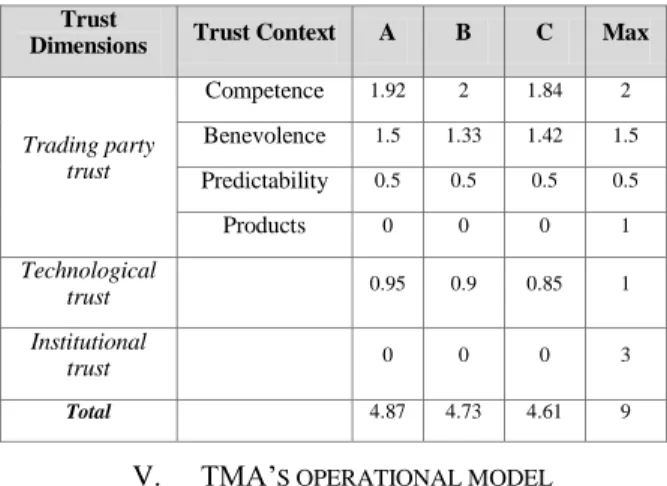
Since the competence of the company is an important element evaluated regarding the satisfaction of customers, high importance is attached to this aspect when points are given to trust. Therefore, in calculating the final score of trust, we have applied a coefficient of 2 for this aspect. Considering the above discussions and the presented computational model, we will have Table 2 for trust values of POL online store. The results indicate that the evaluation of A, B
and C are almost the same.
Table 2. The contexts of trust and their values Trust
Dimensions Trust Context A B C Max
Trading party trust
Competence 1.92 2 1.84 2 Benevolence 1.5 1.33 1.42 1.5 Predictability 0.5 0.5 0.5 0.5
Products 0 0 0 1
Technological
trust 0.95 0.9 0.85 1
Institutional
trust 0 0 0 3
Total 4.87 4.73 4.61 9
V. TMA’S OPERATIONAL MODEL
In this section, we discuss about the architecture and operational model of TMAs. As stated in the previous sections, TMAs are the entities that both the customers and e-vendors deem as credible. They perform the trust management and assessment tasks regarding the
various dimensions of trust. In figure 2, the general scheme and the architecture of TMAs is shown. As can be seen in the figure, each TMA is responsible for a subset of nodes in its neighborhood. TMAs can communicate with each other and propagate trust values about different entities in various domains. In the lowest level, each TMA stores the required information regarding the trust-based relationships in its databases. For example, it stores the feedbacks that agents have given about existing entities. It also stores the trustworthiness value of each agent for each context. Signed certificates database is used by the
Institutional Trust component and is returned with a time stamp when an institution-based trust establishment is required by the trading parties. Questionnaire database is used by the Technological Trust component and is returned as a response when a request for the evaluation of a Website or Information is sent to TMA.
The format of the request and response messages sent to and received from the TMA are as follows:
Req1: Supplier_Trust_Request (entity, context) Resp1: Supplier_Trust_Response (trustworthiness) Req2: Product_Trust_Request (product_id) Resp2: Product _Trust_Response (satisfaction_index) Req3: Website_Evaluation_Request (Website) Resp3: Website_Evaluation_Response (questionnaire) Req4: Information_Evaluation_Request (information_type) Resp4: Information_Evaluation_Response (questionnaire) Req5: Institutional_Trust_Request (list_of_trading_parties) Resp5: Institutional_Trust_Response (signed_certificate, time_stamp)
Trust Updating and Querying component is responsible for the dynamicity of the proposed computational trust model. It re-calculates the trust values for agents when new information becomes available or an event occurs. Finally, in the highest level, different components for evaluating the supplier trust, technological trust and institutional trust are constructed. These components leverage the formulas mentioned in the previous section in order to calculate the trust values.
Fig. 2. The architecture of the TMA
VI. EVALUATION OF THE PROPOSED MODEL In this section, in order to study the relationships between the trust dimensions, the hypotheses of the proposed model will be assessed. For assessing the proposed model, we have performed a survey and distributed questionnaires among the people who commonly use electronic transactions. For the analysis of the results we have used SPSS.
Regarding the model of Figure 1, we have the following hypotheses:
1. Hypothesis 1: Institutional trust has a positive effect on trading party trust.
2. Hypothesis 2: Technological trust has a positive effect on trading party trust.
3. Hypothesis 3: Technological trust has a positive effect on institutional trust.
4. Hypothesis 4: Trust propensity has a positive effect on trading party trust.
The first round of data collection was performed in two weeks commencing on February 22, 2010. Totally, 73 answers were received. We carried out another round of survey during September 1-25, 2011. We received 30 other answers and added them to the previous data resulting in a total of 103 answers. This procedure is assumed for examining the degree of effectiveness of the proposed trust model and the selected parameters within it. In addition, many of the trust’s parameters have already been measured in studies of researchers for various conditions.
The electronic questionnaires have been distributed via e-mail among three populations. The first group was Iranians residing in Iran. The second group was Iranians residing in USA and Canada. The third group was non-Iranian computer science graduate students at York University, Canada.
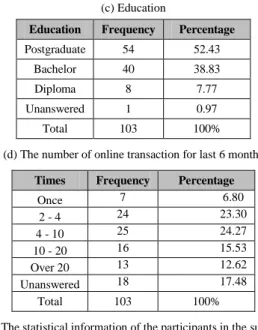
In Table 3 (e), the statistical information of these three groups is presented. All the people who have accepted to participate in the survey performed an e-shopping transaction in the last six months. Using a five point Likert scale ranging from “strongly disagree” (i.e. 1) to “strongly agree” (i.e. 5) responders were asked to rate the strength of their agreement with each of the questions about their perception of the overall trustworthiness for the e-vendor that they have purchased the most from it.
The questionnaire is shown in Appendix 1, and is comprised of four constructs:
1. Three items asking the responders about their trust propensity.
2. Four items about institutional trust.
3. Ten items about technological trust including the apparent and technical specifics of the Website and available information.
4. Six items about trading party trust.
In total, the measurement instrument contains 23 items for measuring trust in e-commerce. Table 3 shows the statistical information of responders related to gender, age, education and the number of online purchases.
The means and standard deviations for the items in the measurement model are shown in Table 4. Except for the third category, the mean of all the items are close to neutral.
Since the effects of trust propensity on electronic purchases are studied in various researches (such as [5, 7, 11, 18]) and because we have not used it in the proposed computational trust model, our statistical measurement is not focused on this trust dimension.
The collected data are analyzed using the SPSS approach and the check for the internal reliability of each construct is performed using Cronbach's Alpha values as stated in [3]. Cronbach's Alpha, determines the internal consistency of each construct. Large Cronbach's Alpha coefficients are usually a sign that the measures are reliable and the accepted value for the internal reliability is equal to 0.7 or higher [13]. Hence, except for the trust propensity, other constructs shows a high degree of internal reliability.
Trust propensity did not work well with this sample and Cronbach's Alpha for this construct is equal to 0.637. We have eliminated the third category from this construct and the new value for Cronbach's Alpha is equal to 0.793 which is acceptable. But, this construct is composed of only two items that indicates low reliability measure. Table 5 shows the internal reliability values for each construct.
Factor analysis and regression analysis are applied next to test the four hypotheses proposed in the model. The relations between variables are also evaluated.
Factor Analysis is primarily used for data reduction or structure detection. The purpose of structure detection is to examine the underlying relationships between the parameters.
For assessing the proposed model, factor analysis with the purpose of structure detection was performed by using the principle axis method. In the communalities table presented as Table 6, the Initial column is for the correlation analysis of the proportion of variance accounted for each parameter compared to the rest of the parameters.
The Extraction column is the estimates of the variance for each accounted parameter in the factor solution. Small values for Institutional trust 1,
Technological trust 1, Technological trust 2 and
Technological trust 5 indicate that these parameters do not fit well with the factor solution.
The test of variance explained by the initial solution also indicates that there are five main factors associated with online shopping in which, together, they account for almost 62% of the variation in the original parameters. This is a sign that these five latent factors describe the relationships between the considered parameters. These factors are used for explaining the correlation pattern within the set of displayed parameters.
The results from the factor analysis and relationships in the factor matrix show that except for 4 parameters out of 23, all the parameters have strong correlation and relationship with the model. Specially, there exist an effective relationship in the model, first
with the institutional trust and then with the technological trust.
In Table 7, the correlation matrix is an indicator of strong relationship between the trading party trust and the institutional trust and also, the trading party trust and the technological trust. Further, technological trust is related to institutional trust, which is analyzed at the end of this section. These results support the outcomes of the factor analysis. The result of trust propensity indicates small values which is a sign for weak relations. This supports the proposed model’s assumptions except the fourth hypothesis. Since this dimension of trust is evaluated in past researches, we concluded that weak results are an indicator of insufficiency of existing items for the model.
In order to test and show the effects of trust propensity, institutional trust and technological trust on trading party trust, regression analysis is also performed. Linear regression is useful for analyzing the relationships between a dependent variable and one or more independent variables. For this purpose, trading party trust is selected as dependent variable and three other constructs are selected as independent variables.
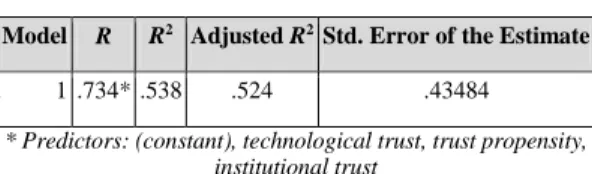
Table 8 suggests that the institutional trust variable has the highest effect on dependent variable trading party trust and the second most important variable is technological trust. The model summary table presented as Table 9 shows the strength of the relationship between the model and the dependent variable. The multiple-correlation coefficient R is the linear correlation between the observed and model-predicted values of the dependent variable. Its large value indicates a strong relationship. The coefficient of the determination R2 is the squared value of the multiple-correlation coefficients. It shows that about half of the variations in the trading party trust can be explained by the model.
By paying attention to the standard deviation of trading party trust reported in Table 5, which is equal to 0.63 and compare it with the standard error of the estimate in Table 8, which is 0.43484, it becomes clear that with the linear regression model, the error of our estimate gets lower.
Table 3. Characteristics of the samples (a) Gender
Gender Frequency Percentage
Male 61 59.22
Female 40 38.83
Unanswered 2 1.94
Total 103 100%
(b) Age
Age Frequency Percentage
20 -30 34 33.01
30 -40 52 50.49
40 - 50 8 7.77
Over 50 6 5.83
Unanswered 3 2.91
Total 103 100%
(c) Education
Education Frequency Percentage Postgraduate 54 52.43
Bachelor 40 38.83
Diploma 8 7.77
Unanswered 1 0.97
Total 103 100%
(d) The number of online transaction for last 6 months
Times Frequency Percentage
Once 7 6.80
2 - 4 24 23.30
4 - 10 25 24.27
10 - 20 16 15.53
Over 20 13 12.62
Unanswered 18 17.48
Total 103 100%
(e) The statistical information of the participants in the survey Percentage Frequency
Participants Groups
39.81 41
Iranian, reside in Iran
37.86 39
Iranian, reside in USA and Canada
17.48 18
Students, reside in Canada
4.85 5
No answer
100% 103
Total
Table 4. Descriptive statistics
Construct Items Mean Median Std.
Dev
Trust propensity
PT1 3.35 4 0.957
PT2 3.16 3 0.988
PT3 2.14 2 0.981
Institutional trust
IT1 3.57 4 0.966
IT2 3.51 4 0.850
IT3 3.49 4 0.917
IT4 3.47 4 1.046
Technological trust
TT1 3.43 4 0.935
TT2 3.95 4 0.845
TT3 3.65 4 0.871
TT4 3.44 4 1.054
TT5 3.33 4 0.943
TT6 3.50 4 1.037
TT7 3.17 3 1.001
TT8 3.36 3 0.979
TT9 3.21 3 1.026
TT10 3.39 3 0.962
Trading party trust
TPT1 3.15 3 0.954
TPT2 3.69 4 0.841
TPT3 3.59 4 0.822
TPT4 2.90 3 0.846
TPT5 3.38 3 0.887
TPT6 3.58 4 0.945
Table 5. Internal reliability
Construct Cronbach's
Alpha
Std. Deviation
Trust propensity 0.793 0.88 Institutional trust 0.705 0.69 Technological trust 0.819 0.6 Trading party trust 0.807 0.63
Table 6. Communalities* Trust Type values Initial Extraction
Trust propensity 1 .565 .597 Trust propensity 2 .583 .680 Institutional trust 1 .395 .297 Institutional trust 2 .490 .622 Institutional trust 3 .488 .535 Institutional trust 4 .625 .511 Technological trust 1 .387 .259 Technological trust 2 .384 .556 Technological trust 3 .519 .592 Technological trust 4 .460 .416 Technological trust 5 .410 .322 Technological trust 6 .424 .375 Technological trust 7 .581 .563 Technological trust 8 .708 .713 Technological trust 9 .739 .742 Technological trust 10 .551 .518 Trading party trust 1 .421 .343 Trading party trust 2 .571 .556 Trading party trust 3 .480 .396 Trading party trust 4 .416 .424 Trading party trust 5 .501 .456 Trading party trust 6 .797 .826 * Extraction method: principal axis factoring
Table 7. Correlations between constructs Construct PT IT TT TPT
PT 1.000 .333 .300 .336 IT 1.000 .659 .670
TT 1.000 .657
TPT 1.000
Table 8. Coefficients*
Model
Un-standardized Coefficients
Standardized Coefficients
t Sig.
B Std. Error Beta
1
(Constant) .555 .273 2.033 .045
PT .067 .052 .094 1.293 .199 IT .362 .084 .396 4.284 .000 TT .389 .097 .368 4.025 .000
* Dependent variable: trading party trust
Table 9. Model summary*+
Model R R2 Adjusted R2 Std. Error of the Estimate i. 1 .734* .538 .524 .43484
* Predictors: (constant), technological trust, trust propensity, institutional trust
+Dependent variable: trading party trust
The ANOVA table presented as Table 10 tests the acceptability of the model from a statistical perspective and is a useful mechanism to test the model’s ability for explaining any variation in the dependent variable.
Table 10. The ANOVA table*+ Model
Sum of Squares df
Mean
Square F Sig.
1
Regression 21.840 3 7.280 38.501 .000* Residual 18.720 99 .189
Total 40.560 102
* Predictors: (constant), technological trust, trust propensity, institutional trust
+Dependent variable: trading party trust
The Regression row displays the information about the variation taken into account in the model and the
Residual row displays the information about the variation that is not taken into account in the model. The sum of the squares of these two rows are approximately close, which indicates that more than half of the variation in the trading party trust is explained by the model. The significance of the F statistic is less than 0.05, which denotes that the variation explained by the model is based on chance.
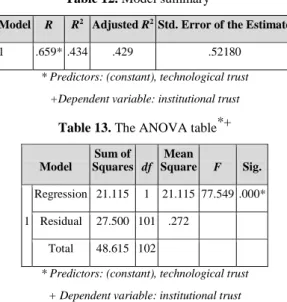
To investigate the impact of technological trust on institutional trust (as stated in Hypothesis 3), institutional trust is considered as a dependent variable and technological trust as an independent variable. Thus, the linear regression was carried out with this configuration. The corresponding results are presented in Tables 11 through Table 13 which determines the strong effect of technological trust on institutional trust.
In the model summary table (i.e. Table 12), the multiple-correlation coefficient R, is the linear correlation between the observed and model-predicted values of the dependent variable. Its large value indicates a strong relationship. The coefficient of determination R2 is the squared value of multiple- correlation coefficients. It shows that about half of the variation in institutional trust is explained by the model.
Table 11. Coefficients*
Model
Un-standardized Coefficients
Standardized Coefficients
t Sig.
B Std. Error Beta
1
(Constant) .884 .303 2.920 .004 TT .763 .087 .659 8.806 .000
* Dependent variable: institutional trust