Developing a Process to Identify Health Priorities for Translational Research in North Carolina
By
Tobias McNulty
A Master’s Paper submitted to the faculty of the University of North Carolina at Chapel Hill
in partial fulfillment of the requirements for the degree of Master of Public Health in
the Public Health Leadership Program.
Chapel Hill Fall 2016
_____________________________________ Advisor:
_____________________________________ Second Reader:
ABSTRACT
The current health status of the citizens of North Carolina is far from optimal. The state ranks 31st in overall health and 37th in life expectancy (America’s Health
Rankings, 2015; Kaiser Family Foundation, 2009). Collaborative, innovative approaches are a necessity for public and private organizations interested in addressing public health issues (American Public Health Association, 2016). Translational, academic health research institutions such as the North Carolina Clinical and Translational Sciences Institute (NC TraCS) have a mandate to expedite the delivery of health care solutions to the people they are intended to serve. Furthermore, effectively directing research in a resource-constrained environment is critical (McNulty, Marchenko, & Carter-Edwards, 2016; Rubio et al., 2010; Woolf, 2008). The need to define health priorities has been well established. In the past, the state’s health priorities were identified through a stakeholder engaged, qualitative series of town hall meetings (Jones et al., 2012). This paper reports an update of the community-level state health priorities through an alternative approach that relies on existing documentation in the state, namely, Community Health Assessments (CHAs) and Community Health Needs Assessments (CHNAs). Health priorities were extracted from the CHAs and CHNAs using a comprehensive methodology and validated from a research perspective. A systematic review of these documents and comparison to national health statistics reveals that the top five health priorities in North Carolina are obesity, substance abuse, healthcare access, mental health, and chronic disease management. Agreement
GLOSSARY
BRFSS Behavioral Risk Factor Surveillance Survey, a national survey administered by the CDC
CARES Community Academic Resources for Engaged Scholarship, one of the cores within NC TraCS
CDC Centers for Disease Control and Prevention
CHA Community Health Assessment, a document created by LHDs to assess the health needs of the population for which it is responsible CHNA Community Health Needs Assessment, a document created by
nonprofit hospitals to assess the health needs of the population for which it is responsible
CTSA Clinical and Translational Science Award HCP Healthy Carolinians Partnerships
IRB Institutional Review Board IRS Internal Revenue Service LHD Local Health Department
NC TraCS North Carolina Translational and Clinical Sciences Institute, one of 60 Clinical Translational Science Awards in the U.S.
NCATS National Center for Advancing Translational Sciences, one of the centers within the National Institutes of Health
NCDPH North Carolina Division of Public Health, the central authority that manages LHDs across the state
INTRODUCTION
Health status in North Carolina
The need for more focused health research and health promotion in North Carolina is evident. As of the 2015 report from America’s Health Rankings, the state ranks 31st for overall health in the U.S. Contributors to this low ranking include high infant mortality, health disparities based on level of education, smoking, diabetes, lack of funding for public health, and lack of health insurance (America’s Health Rankings, 2015). The state also ranks 37th in overall life expectancy (Kaiser Family Foundation, 2009). The leading causes of death in North Carolina are chronic diseases such as cancer, heart disease, lower respiratory disease (e.g., chronic obstructive pulmonary disease), and cerebrovascular disease. According to the State Center for Health
paramount and a core tenet for public health agencies, public and private (American Public Health Association, 2016).
The North Carolina Division of Public Health (NCDPH) is a central authority in Raleigh that manages 85 local health departments (LHDs) across 100 counties. Each LHD is accredited by the NCDPH independently. Of the 85 LHDs, 79 are responsible for public health services in a single county and 6 cover a wider region of 2 or more
counties. The state also includes several major academic health centers, 94 not-for-profit hospitals, and a multitude of other not-for-not-for-profit stakeholders with different research interests, goals, and approaches to addressing the health needs of North Carolina. While many and varied efforts exist to address the health needs of the state, they may not always share a common vision. One initiative that aims to bring unity to health goals across the state is the Healthy North Carolina 2020 objectives, a set of goals across the state to improve health and health behaviors, including reducing
Translational health research
Translational health research is an academic approach that helps clarify health issues and solutions in a way that enables communities to understand and act upon those issues. Translational research means different things to different people; for example, some might consider producing a new drug or device “translational research,” whereas public health oriented researchers may be more likely to investigate whether or not recommended treatments are actually reaching their intended populations (Woolf, 2008). One working definition developed by Rubio et al. in 2010 is that, “Translational research fosters the multidirectional integration of basic research, patient-oriented research, and population-based research, with the long-term aim of improving the health of the public” (p. 4). More simply, translational research means translating evidence-based research findings into everyday practices to directly benefit patients. Given the cross-disciplinary nature of translational research, a need exists for
researchers to engage stakeholders directly and respond to health concerns of the general public and health workers in local communities. Translational research aims to keep research efforts and community needs aligned by fostering frequent, direct
communications across the spectrum of stakeholders in public health, with trust as a core tenant of successful partnerships (Eder, Carter-Edwards, Hurd, Rumala, &
The NC TraCS Institute and CARES
The Clinical and Translational Science Award (CTSA) program is a national health research funding mechanism administered by the National Institutes of Health (NIH)’s National Center for Advancing Translational Sciences (NCATS) (NCATS, 2016). The CTSA program, launched in 2006, funds 60 research hubs across the country (CTSA Central, “CTSA Central: Home Page,” 2016). Each hub has a specific set of research foci that are intended to be complementary (NCATS, 2016). The University of North Carolina (UNC) at Chapel Hill houses one of the three CTSA research hubs in North Carolina, the North Carolina Translational and Clinical Sciences (NC TraCS) Institute. NC TraCS, started in 2008, is a partnership between UNC Chapel Hill, RTI International, and seven other academic institutions and medical centers across the state (CTSA Central, “CTSA Central: About NC TraCS,” 2016). The mission of NC TraCS is “to accelerate clinical and translational research from health science to
discovery to dissemination to patients and communities” (NC TraCS, “About Us,” 2016). NC TraCS has a wide range of research objectives covering topics from biomedical informatics to regulatory topics to education. The organization also offers small pilot grants ranging from $2,000 to $50,000 for community-academic research projects throughout the state.
Within NC TraCS, Community Academic Resources for Engaged Scholarship (CARES) is a core made up of three separate units targeting different aspects of the community-academic partnership. The Stakeholder Engagement unit provides
between providers, researchers, and community members, and works with primary care physicians to improve outcomes (NC TraCS, “Stakeholder Engagement,” 2016). The Research Methods unit assists implementation science investigators, both in grant preparation and with assessment and dissemination of results (NC TraCS, “Research Methodologies,” 2016). Finally, the Training and Outreach unit helps train stakeholders across the community-academic spectrum (including investigators, community
members, and clinical staff) in community-based research best practices (NC TraCS, “Training,” 2016). Together, these three CARES units develop different aspects of the community-academic partnership, seeking both to increase trust in academic research and fundamentally change how the partnership works (NC TraCS, “About CARES,” 2016). To achieve their goals, NC TraCS through CARES sought to gain a
comprehensive understanding of what the health priorities are in communities across the state.
Local, community-driven health priorities
At least two local, community-driven initiatives exist in North Carolina to help define and shape health priorities. Every 3-4 years, LHDs and hospitals conduct
(Nelson, Hensey, Matthews, & Rocco, 2015). They are typically 80-300 page
documents that are available for download from the NCDPH website or from individual hospital websites. Approximately 94 nonprofit hospitals exist in the State of North Carolina that are required by the IRS to complete CHNAs (Wade & Matthews, 2014).
CHAs are developed by the LHDs and provide an overview of the health factors and outcomes in each county/region. Generally, a CHA includes demographic and socioeconomic data (population information, education, income, employment, crime), health status and outcome parameters (health ranking, leading cause of death, life expectancy, etc.), clinical care parameters (primary care access, uninsured population, screening and prevention, dental services, mental health services), environmental assessment (air quality, drinking water, recreational activities, access to food), health resources and gaps, health priorities, and next steps (typically referring to the
dissemination process and creation of implementation plans).
In North Carolina, CHAs and CHNAs provide valuable insight into the health concerns of communities across the state. While these documents are required to maintain LHD accreditation and hospital 501(c)(3) status, they also serve as invaluable strategic planning tools and instruments for increasing transparency for their respective counties and hospitals. Given the community-driven methods used to compile both CHAs and CHNAs and the importance of trust in successful partnerships (Eder et al., 2013), they serve as a natural point at which to begin conversations around community-academic partnerships in translational research.
Prior efforts to establish health priorities for NC TraCS
In 2009 and 2010, Jones et al. (2012), conducted a phased, community-engaged initiative to discover and set health priorities for the state. The goal of the program was to tailor research efforts funded by NC TraCS using health priorities identified by the community. Jones et al. initially identified health priorities by coordinating three regional meetings with Healthy Carolinians Partnerships (HCPs). In the first phase, through a set of initial town-hall style meetings, HCPs were asked to discuss health issues in their community and perceived barriers to addressing those priorities. NC TraCS staff
identified the health priorities raised by two or more HCPs who attended these meetings and consolidated them into a list of twelve potential health priorities. NC TraCS staff cross-referenced the list of health priorities with state-level data from America’s Health Rankings, the US Census, and the North Carolina Comprehensive Assessment for Tracking and Community Health Systems. Through a qualitative methodological
“reflected a research orientation” (p. 342). The seven health research priorities identified by Jones et al. (2012) were: obesity, mental health and substance abuse, delivery and access to healthcare, youth issues, specific chronic disease (including cardiovascular disease, high blood pressure, stroke, and diabetes), cancer, and injury and violence.
In the second phase, after narrowing the list to seven health research priorities, Jones et al. (2012) coordinated a set of four regional meetings representing 46 of the state’s 100 counties to present findings and solicit feedback on the priorities identified. Through this process, researchers and community members reached consensus on the list of seven priorities and focus areas for those priorities (Jones et al., 2012). While Jones et al. contributed to the important body of literature on the health priorities in the state of North Carolina by clearly engaging stakeholders, two limitations in the approach are that: (a) priorities were not systematically ranked during regional meetings (they were included if mentioned at least twice); and (b) regional meetings did not include stakeholder representation from all 100 counties in the state. As Jones et al. (2012) readily suggest, “[CHAs] present a unique opportunity for NC TraCS to learn about local health needs to inform its research, funding, education, and dissemination agenda” (p. 341). Leveraging information from CHAs and CHNAs in a comprehensive,
Project overview and specific aims
As part of a practicum experience in the Public Health Leadership Program at UNC Chapel Hill in early 2016, this author led an effort to develop and assess the information in a database of North Carolina’s CHAs and CHNAs. The primary goal of the project was to comprehensively identify and summarize the current, community-driven health priorities and strategies across the state. The research team for the
project also included UNC Chapel Hill faculty member Lori Carter-Edwards, Ph.D. and a paid research assistant (RA), Victoria Marchenko. At the beginning of the project, we first familiarized ourselves with the work that had been done in the past, in particular, the work of Jones et al. (2012). We then brainstormed for potential data sources to analyze, reaching out informally to NC TraCS staff members to determine what primary and secondary data sources would best help identify health priorities. Sources
The project leveraged CHA and CHNA documents to create an informed and comprehensive picture of all health priorities, including any that may not have been discussed in town-hall meetings in the past. Using the CHAs and the CHNAs in this way is a new and innovative approach to cataloging health priorities that is both
comprehensive and community-driven. The specific aims of the practicum project were to:
Aim 1: Create a database of health priorities identified in all current and available CHAs and CHNAs in North Carolina;
Aim 2: Analyze the data collected for the health priorities database; and
Aim 3: Present findings to community stakeholders and conduct a pilot survey to solicit feedback.
The goals of this master’s paper are to describe the methodology used to achieve these three aims and to, ultimately, help inform the future direction of NC TraCS’ funding proposals and health research activities. The following section details the methods used to achieve each aim.
METHODS
Aim 1: Create health priority database
selected from the 72 hospitals they found to have completed both the assessment and the implementation strategy. The sample chosen represented “all areas of the state, from large and small jurisdictions, and from a variety of health systems” (Wade & Matthews, 2014, p. 4). Their work, however, does not include a comprehensive review of all the CHAs and CHNAs available in North Carolina. To the knowledge of this author, no such comprehensive effort to catalog the information available in the North Carolina CHAs and CHNAs had been published prior to this project. After deciding that the CHAs and CHNAs would be our source for data, the research team created a Microsoft Excel ® spreadsheet (Excel spreadsheet) to catalog common themes and priorities identified throughout the CHAs and CHNAs. The spreadsheet included the name, type of data source (e.g., hospital, county, or statewide), the public health issues covered by the data source (e.g., chronic disease, workforce development, maternal and child health, etc.), a qualitative description of the source, and a hyperlink to the data source itself.
We identified links to all county CHAs by navigating to the NCDPH download page for each county’s community health assessment (NCDPH, 2016). All CHAs are available directly via the NCDPH website; it is not necessary to navigate to the
links to each of the CHAs and any supporting documents into the Excel spreadsheet. While the CHAs are available from a central source, the CHNAs are created for local community use via each hospital’s website. We were not able to locate a consolidated list of links to hospital CHNAs other than in the earlier work by Wade & Matthews (2014), which did not include CHNAs that may have been published within the past 2 years. To identify the most current link to each available CHNA, we started with the URL available in Wade & Matthews (2014) then navigated to the hospital website to
determine if a more recent CHNA was available. In cases where the CHNA could not be easily found via the hospital website navigation links, we used Google© to find the CHNA, if possible. We copied the link to the most recent report for each hospital into the Excel spreadsheet. Some hospitals had a broken link or no link to a CHNA on their public website. In total, we successfully located 83 CHNAs out of the 94 that should be available across the state.
As described in the MPH practicum report for this project (McNulty et al., 2016), the Excel spreadsheet includes the following tabs: (a) Master Database, containing the information extracted from all the county CHAs and hospital CHNAs; (b) Data
copy/pasted into textual reports; and (e) Charts, which contains informational charts extracted from the Queries tab in a form that can be copy/pasted into textual reports.
The information we extracted from the CHAs and CHNAs included: health priorities; social priorities (i.e., social determinants of health such as education or poverty); special populations; strengths; weaknesses; assets; barriers; and
implementation plans (see Appendix A for a full list of column headings). The list of health priorities was built from the priority names listed in the CHAs and CHNAs themselves. Each health priority included its own column heading in the spreadsheet. We manually reviewed each report to locate the prioritized list of health priorities. In the spreadsheet, we entered the rank for each priority as listed in the CHA or CHNA. For example, each CHA would usually list 3-5 health priorities in order of highest to lowest priority. In the database, we included a “1” for highest priority, “2” for second priority, etc. In cases where multiple health issues were identified as the same priority in the document, we gave each the same priority in the database. For example, “mental health” and “substance abuse” were often listed together, and would receive the same numerical ranking in the database in such a case.
Specifically, we selected a random sample of roughly 10% (n=10) of the CHAs that had already been transcribed by one team member and had another team member review and transcribe those CHAs without seeing the priorities that had been identified by the first reviewer. The two independent reviewers had complete agreement of 85% of what was recorded, then discussed and came to consensus with the remainder of the
recorded information. The audit also confirmed that there was no systematic bias in the identified priority ranking between the two coders.
Aim 2: Analyze health priority data
After extracting the data, we developed several informational tables and graphs that updated when the underlying data changed. Our primary measure in analyzing priorities was the frequency of the priority, that is, the number of times that a priority was ranked by a CHA or CHNA, independent of the ranking level. Our secondary measure was the median rank assigned to the priority by those CHAs or CHNAs that listed it (which included the ranking level). Formulas were developed in the Excel spreadsheet to generate tables for the frequency and median rank of health priorities for the CHAs and CHNAs, resulting in two summary tables for the health rankings from all
documents. Although many health priorities were identified cumulatively throughout all the CHAs and CHNAs, we limited each table to the top ten priorities according to frequency.
we first prepared a list by county that indicated whether or not each county had included each of the top five statewide priorities on its priority list. In the case of hospitals, we used the county in which the hospital is physically located as the catchment area for that hospital, although noting that many hospitals may serve more than one county. Separate icons were assigned to each of the top five statewide priorities and placed on the map for those counties that listed the priority.
Aim 3: Present findings and solicit preliminary input
A list of 111 stakeholders as potential survey respondents was compiled and generated by CARES staff. Stakeholders included public health and medical
practitioners who were representative of the diverse partnerships NC TraCS has developed throughout the state. Respondent roles included academic researchers (14%), community leaders of formal or informal advocacy groups (47%), health
providers (6%), local health department staff (9%), state health department staff (3%), and other/unknown (22%). Respondents were selected from across the state, with approximately 38% of respondents serving the central region of North Carolina, 5% serving the western region, 5% serving the eastern region, 6% working statewide, and 47% with an unknown regional affiliation. The pilot survey was conducted in early April 2016 and respondents were given a 1-week timeline to respond to the survey (in order for the feedback to be used by TraCS leadership at its April 2016 retreat). Stakeholders ideally would have been given more time to respond to the survey, however, the survey was for pilot purposes only and the schedule was limited by the overall timeline of the project. After the conclusion of the survey, the team coordinated a 1-hour webinar with approximately 12 community partners to review the preliminary results from the CHAs and CHNAs and solicit more contextual feedback.
RESULTS
Health priorities
rank for the top ten health priorities identified across 97 of the 99 CHAs available for the state. In two of the CHAs, the health priorities were not clearly identified so they are excluded from the analysis. The five most frequently mentioned health priorities (and their median ranks) in the CHAs were obesity (Frequency=50, Rank=1.0), substance abuse (Frequency=50, Rank=3.0), healthcare access (Frequency=41, Rank=2.0), mental health (Frequency=34, Rank=3.0), and chronic disease management
(Frequency=33, Rank=1.0). Agreement across CHAs was high with 33-51% of the 97 CHAs agreeing on the top 5 health priorities in their priority lists. The median ranking of all top ten health priorities ranged from 1.0 to 3.0.
Table 1: Top Health Priorities in CHAs
Healthy Priority
Priority Frequency
(n=97)
Priority Rank (median)
Obesity 50 1.0
Substance Abuse 50 3.0
Healthcare Access 41 2.0
Mental Health 34 3.0
Chronic Disease Management 33 1.0
Physical Activity 32 2.0
Nutrition 28 2.0
Cardiovascular Disease / Hypertension 22 1.5
Diabetes 22 2.0
Cancer 20 2.0
results is that substance abuse and mental health are clustered in higher density in the western portion of the state.
Figure 1
Health priorities identified in hospital Community Health Needs Assessments (CHNAs) were also analyzed. Table 2 shows the frequency and the median rank for the top ten health priorities identified in the 83 CHNAs located across the state. The five most frequently mentioned health priorities in the CHNAs were healthcare access (Frequency=55, Rank=2.0), obesity (Frequency=51, Rank=2.0), chronic disease
Table 2: Top Health Priorities in CHNAs
Healthy Priority
Priority Frequency
(n=83)
Median Priority Ranking
Healthcare Access 55 2.0
Obesity 51 2.0
Chronic Disease Management 33 2.0
Substance Abuse 32 2.5
Mental Health 29 3.0
Diabetes 28 1.0
Cancer 24 3.0
Cardiovascular Disease / Hypertension 24 3.0
Nutrition 23 2.0
Physical Activity 17 2.0
The top five statewide health priorities from the CHNAs were also mapped
Figure 2
Stakeholder survey
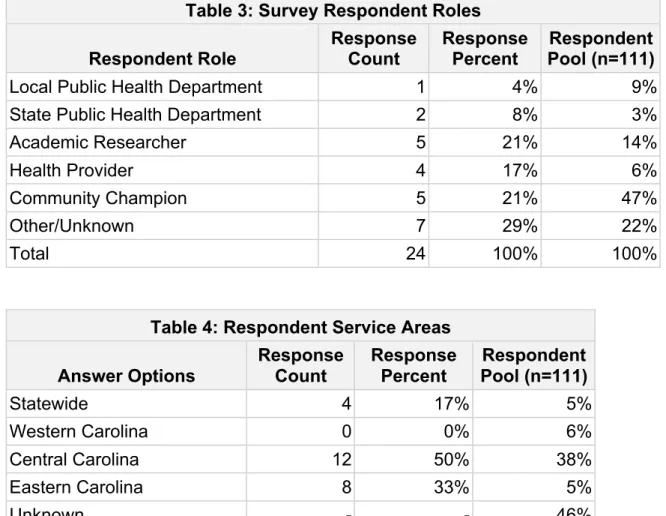
For the pilot stakeholder survey, we received 24 responses out of 111 invitations sent, for a response rate of 21.6%. Table 3 shows a summary of respondent roles, including the approximate percentages of potential respondents for each role in the original list of survey recipients. “Other” respondent roles included “volunteer /
areas identified by respondents. Respondents were well distributed throughout the state with the exception of Western North Carolina, from which we received no responses.
Table 3: Survey Respondent Roles
Respondent Role Response Count Response Percent Pool (n=111)Respondent
Local Public Health Department 1 4% 9%
State Public Health Department 2 8% 3%
Academic Researcher 5 21% 14%
Health Provider 4 17% 6%
Community Champion 5 21% 47%
Other/Unknown 7 29% 22%
Total 24 100% 100%
Table 4: Respondent Service Areas
Answer Options Response Count Response Percent Pool (n=111)Respondent
Statewide 4 17% 5%
Western Carolina 0 0% 6%
Central Carolina 12 50% 38%
Eastern Carolina 8 33% 5%
Unknown - - 46%
Total 24 100% 100%
Substance Abuse, which was frequently identified on the CHAs and CHNAs but not in the stakeholder survey.
Table 5: Stakeholder Respondent Health Priorities Relative to Priorities from the CHAs and CHNAs
Health Priority
Stakeholders
(n=24) CHAs CHNAs
# Responses Median Rank Counties# Median Rank Hospitals# Median Rank
Obesity 10 2.5 50 1.0 51 2.0
Healthcare Access 9 2.0 41 2.0 55 2.0
Chronic Disease
Management 8 2.0 33 1.0 33 2.0
Mental Health 8 3.0 34 3.0 29 3.0
Diabetes 7 1.0 22 2.0 28 1.0
Cardiovascular Disease /
Hypertension 7 2.0 22 1.5 24 3.0
Cancer 3 1.0 20 2.0 24 3.0
Substance Abuse 3 2.0 50 3.0 32 2.5
Tobacco 3 2 12 2.5 8 2.5
Lack of Insurance 2 1.5 1 4 0 n/a
“Other” health priorities identified by the stakeholders included lack of access to multilingual services, oral health, communicable diseases, stress, nutrition, and physical activity. In the open-ended question asking respondents to identify current research gaps, several themes around community engagement and bringing evidence to policymakers arose:
● “Collaborative efforts between clinics and communities to improve health. The clinics are often unaware of the community resources available to help with preventive and chronic disease management for their patients”
● “How to best reach out and help minority populations; i.e. the Latino community.”
● “There's a lot of information out there, but not enough is translated into different languages and not enough is available to minority groups.”
DISCUSSION
Health priorities aggregated from Community Health Assessments (CHAs) and Community Health Needs Assessments (CHNAs) provide a clear picture of what current health research priorities ought to be in North Carolina. In the 97 CHAs analyzed, the five most frequently mentioned health priorities were obesity (Frequency=50),
substance abuse (Frequency=50), healthcare access (Frequency=41), mental health (Frequency=34), and chronic disease management (Frequency=33). In the 83 CHNAs analyzed, the five most frequently mentioned health priorities were healthcare access (Frequency=55), obesity (Frequency=51), chronic disease management
(2015), which states that North Carolina ranks 26th for obesity and 22nd for poor mental health days. Although a direct comparison is not available for substance abuse,
healthcare access, and chronic disease management, the state also ranks poorly in related measures such as drug deaths (21st), lack of insurance (36th), and primary care physicians (27th) (America’s Health Rankings, 2015).
NC TraCS and the burden of the state’s top health issues
In the related research conducted by Jones et al. (2012), all of the top five health priorities identified through this project were listed as priorities. Mental health and
substance abuse were not originally listed as 2009 priorities in the Jones et al. (2012) work; however, they were added in 2010 as a combined research priority that included “access to services, mental health conditions, lack of best practices, healthy
relationships, relationship to economic decline, infrastructure, alcohol, illegal and prescription drug abuse” (Jones et al., 2012, p. 343). The CHAs and CHNAs were not used in the Jones et al. work, so the results from this project help contextualize the health research topics originally proposed by Jones et al. (2012). Obesity, substance abuse, mental health, healthcare access, and chronic disease management are clear health issues that must be addressed by the State of North Carolina.
deaths in the state in 2014 (CDC, 2015; SCHS, 2014). Obesity has been shown to be an independent risk factor for cardiovascular disease (Hubert, Feinleib, McNamara, & Castelli, 1983; Van Gaal, Mertens, & De Block, 2006). Effectively addressing
cardiovascular disease, obesity, and other risk factors requires a collaborative, population-level effort (Karwalajtys & Kaczorowski, 2010). Public health and
translational health research in particular, therefore, are particularly well-situated to direct research efforts that will help reduce the burden of cardiovascular disease and obesity on the state and the country as a whole.
Substance abuse, particularly alcohol abuse and illicit drug use, is an issue of national concern that affects not only adults but today’s youth (Lipari et. al, 2013). Since 2014, health insurance plans sold on healthcare.gov have been required to include coverage for substance use disorders; however, the specific services covered are still under consideration by the Department of Health and Human Services (Office of National Drug Control Policy, 2016). In the map of CHA health priorities (Figure 1), it is evident that substance abuse is considered a health issue across the state. Within NC TraCS, there may be a need to increase support and services around substance use and mental health research, including the translation of findings across the state to increase awareness and to identify the best collaborative strategies to address the burden.
Healthcare access is the most frequently listed health priority in the CHNAs and third most frequently listed health priority in the CHAs. The frequency with which
of the state (The Rural Center, 2016) indicates that the state still needs better methods for reaching the state’s remote or “hardly reached” populations (Sokol, Fisher, & Hill, 2015). Other statewide efforts have previously demonstrated improved healthcare access and quality of care (Szilagyi et al., 2004; Arora et al., 2011). Chronic disease management, also a top five health priority in the CHAs and CHNAs, is closely tied to healthcare access. Many of those without insurance in the US live with one or more chronic diseases and have poorer access to care than their insured counterparts (Wilper et al., 2008). Collaborative, innovative efforts to address the state’s healthcare access and chronic disease management needs, possibly in tandem as discussed by Arora et al. (2011), are clearly needed. Treating people with more than one disease may require different efforts than those with a single disease. One potential focus for translational research is understanding how to improve health for people with multiple chronic conditions (Beadles et al., 2015; Volls, Sleath, & Maciejewski, 2014; Domino et al., 2014).
to translational research is critical in a resource constrained environment, where more cost-effective measures are needed.
Strengths and limitations of the methodology and results
This paper and the project on which it is based have both strengths and
weaknesses worthy of discussion. First and foremost, it should be understood that the project was conducted on a compressed timeline with limited staff resources. Two part-time individuals were tasked with reviewing the CHAs and CHNAs and extracting health priorities within two months. This did not allow enough time to assess the focus areas within health priorities nor how different CHAs or CHNAs might place a greater
emphasis on certain focus areas. Before these data are used more widely, a larger effort ought to be undertaken to develop focus areas for each health priority based on how the CHAs and CHNAs articulate health priorities for their regions served.
Additionally, CHNAs could not be located for all nonprofit hospitals in the state. With more time and staff assigned to the project, it would be valuable to contact the hospitals directly to obtain the missing CHNAs whenever possible. Given the need in translational research to reduce the time taken from research to practice, however, the project team felt it was important to release these results as soon as possible for further study.
population of 111 survey recipients well (see Table 3). Although we were not able to obtain areas served for all survey recipients, the data we do have suggest that regions served by the 111 survey recipients were not represented well by actual survey
respondents. For example, no survey respondents identified themselves as serving Western Carolina, and a sample size of 24 may be insufficient from which to draw further conclusions. Given more time, it would have been beneficial to conduct the webinar before the survey; at least one respondent did not understand the work that had been performed to set health priorities using the CHAs and CHNAs and wrongly assumed that only the survey would be used to set health priorities. If or when the stakeholder survey is replicated, more time should be provided for survey responses and care must be taken to ensure the whole state, both in terms of job role and region, is represented by respondents.
successfully demonstrated that a stakeholder survey is feasible in reaching its intended audience and could be modified to improve response rates in the future.
CONCLUSION
These results, the underlying health priorities database, and the methodology used to create the database may be of value to health research organizations across the state. For NC TraCS and CARES in particular, several implications arise regarding the use of this methodology and its findings. The efforts undertaken by this project supplement the previous efforts by Jones et al. (2012) to summarize health priorities for the state. The results may be pertinent to NC TraCS when determining how to fund translational research or where stronger partnerships may be needed in the state. Using a comprehensive methodology, health priorities have been identified using pre-existing, community-based documentation and validated from a research perspective. As an organization that relies on strong partnerships to help fulfill its mission, leveraging a comprehensive resource such as the state’s CHAs and CHNAs and/or a methodology for setting health priorities such as the one discussed here may help improve trust and credibility with stakeholders. Determining exactly how NC TraCS might use these findings is beyond the scope of this master’s paper, however, it is hoped that both the methodology and results will be beneficial in NC TraCS’ effort to improve the translation of research to practice in meeting the needs of communities in North Carolina.
REFERENCES
American Public Health Association (2016). The Role of Public Health in Ensuring Healthy Communities. Retrieved November 16, 2016, from
http://www.apha.org/policies-and-advocacy/public-health-policy- statements/policy-database/2014/07/30/10/48/the-role-of-public-health-in-ensuring-healthy-communities
America’s Health Rankings (2015). Health Measures in North Carolina. Retrieved October 2, 2016, from http://www.americashealthrankings.org/explore/2015-annual-report/state/NC
ArcGIS Online (2016). Retrieved November 27, 2016, from http://www.esri.com/software/arcgis/arcgisonline
Arora, S., Kalishman, S., Dion, D., Som, D., Thornton, K., Bankhurst, A., … Yutzy, S. (2011). Partnering urban academic medical centers and rural primary care
clinicians to provide complex chronic disease care. Health Affairs (Project Hope), 30(6), 1176–84. http://doi.org/10.1377/hlthaff.2011.0278
Centers for Disease Control and Prevention (2014). BRFSS 2014 - North Carolina: (Now thinking about your mental health, which includes stress, depression, and problems with emotions, for how many days during the past 30 days was your mental health not good?). Retrieved September 18, 2016, from
http://www.schs.state.nc.us/data/brfss/2014/nc/all/MENTHLTH.html
Centers for Disease Control and Prevention (2015). Leading causes of death and numbers of deaths, by sex, race, and Hispanic origin: United States, 1980 and 2014. Retrieved November 16, 2016, from
http://www.cdc.gov/nchs/data/hus/hus15.pdf#019
CTSA Central (2016). CTSA Central: Home Page. Retrieved April 15, 2016, from https://ctsacentral.org/
CTSA Central (2016). CTSA Central: About NC TraCS. Retrieved September 18, 2016, from
https://ctsacentral.org/consortium/institutions/?institution=University_of_North_Ca rolina_at_Chapel_Hill
Denscombe, M. (2014). The good research guide : for small-scale research projects (5th ed.). Maidenhead, UK: Open University Press.
Eder, M. M., Carter-Edwards, L., Hurd, T. C., Rumala, B. B., & Wallerstein, N. (2013). A logic model for community engagement within the Clinical and Translational Science Awards consortium: can we measure what we model? Academic Medicine : Journal of the Association of American Medical Colleges, 88(10),
1430–6. http://doi.org/10.1097/ACM.0b013e31829b54ae
Hoyert, D. L. (2012). 75 Years of Mortality in the United States, 1935–2010. Retrieved November 16, 2016, from https://www.cdc.gov/nchs/data/databriefs/db88.pdf
Hubert, H. B., Feinleib, M., McNamara, P. M., & Castelli, W. P. (1983). Obesity as an independent risk factor for cardiovascular disease: a 26-year follow-up of participants in the Framingham Heart Study. Circulation, 67(5).
Jones, B., Lightfoot, A., De Marco, M., Isler, M. R., Ammerman, A., Nelson, D., …
Corbie-Smith, G. (2012). Community-responsive research priorities: health research infrastructure. Progress in Community Health Partnerships : Research, Education, and Action, 6(3), 339–48. doi:10.1353/cpr.2012.0045
Kaiser Family Foundation (2009). Life Expectancy at Birth. Retrieved October 2, 2016, from http://kff.org/other/state-indicator/life-expectancy/
Karwalajtys, T. & Kaczorowski, J. (2010). An integrated approach to preventing
Lipari, R. N., Crane, E. H., Cai, R., Strashny, A., & Dean, Jr., D. (2013). A Day in the Life of Young Adults: Substance Use Facts. The CBHSQ Report. Substance
Abuse and Mental Health Services Administration (US). Retrieved from http://www.ncbi.nlm.nih.gov/pubmed/27606406
Loshin, D. (2010). The practitioner’s guide to data quality improvement. Burlington, MA: Morgan Kaufmann.
McNulty, T., Marchenko, V. & Carter-Edwards, L. (2016). NC Health Priority Research Summary. Unpublished manuscript, North Carolina Translational and Clinical
Sciences (NC TraCS) Institute, University of North Carolina at Chapel Hill.
National Center for Advancing Translational Sciences (NCATS) (2016). About the CTSA Program. Retrieved September 18, 2016, from
http://www.ncats.nih.gov/ctsa/about
NC Division of Public Health (2016). NC Public Health: County Community Health Assessments. Retrieved October 30, 2016, from
http://publichealth.nc.gov/lhd/cha/reports.asp
NC TraCS Institute (2016). About CARES. Retrieved November 3, 2016, from https://tracs.unc.edu/index.php/services/cares
NC TraCS Institute (2016). Research Methodologies. Retrieved November 2, 2016, from https://tracs.unc.edu/index.php/services/cares/research-methodologies
NC TraCS Institute (2016). Stakeholder Engagement. Retrieved November 2, 2016, from https://tracs.unc.edu/index.php/services/cares/stakeholder-engagement
NC TraCS Institute (2016). Training. Retrieved November 2, 2016, from https://tracs.unc.edu/index.php/services/cares/training
Nelson, D., Hensey, E., Matthews, G., & Rocco, P. (2015). NC Division of Public Health Comparison of the ACA Hospital Requirements (Form 990H), Accreditation and NC Community Health Assessment Process required by Local Health
Departments (NC DPH interpretation). Retrieved November 21, 2016, from http://publichealth.nc.gov/lhd/cha/docs/IRS-HospitalandCHAComparisonFinal.pdf
North Carolina Institute of Medicine (2011). Healthy North Carolina 2020: A Better State of Health. Retrieved September 18, 2016, from
http://publichealth.nc.gov/hnc2020/docs/HNC2020-FINAL-March-revised.pdf
Office of National Drug Control Policy (2016). Substance Abuse and the Affordable Care Act | The White House. Retrieved November 2, 2016, from
https://www.whitehouse.gov/ondcp/healthcare
American Medical Colleges, 85(3), 470–5. http://doi.org/10.1097/ACM.0b013e3181ccd618
Sokol, R., Fisher, E., & Hill, J. (2015). Identifying Those Whom Health Promotion Hardly Reaches: A Systematic Review. Evaluation & the Health Professions, 38(4), 518–37. http://doi.org/10.1177/0163278715605883
SurveyMonkey (2016). Welcome to SurveyMonkey! Retrieved November 13, 2016, from https://www.surveymonkey.com/
Shih, T.-H. & Fan, X. (2008). Comparing Response Rates from Web and Mail Surveys: A Meta-Analysis. Field Methods, 20(3), 249–271.
http://doi.org/10.1177/1525822X08317085
Sollecito, W. & Fendt, K. (2006). Continuous Quality Improvement in Contract Research. In C. P. McLaughlin & A. D. Kaluzny (Eds.), Continuous quality improvement in health care (3rd ed., pp. 318–356). Sudbury, MA: Jones and
Bartlett.
State Center for Health Statistics (2011). Health Profile of North Carolinians: 2011 Update. Retrieved September 18, 2016, from
http://www.schs.state.nc.us/schs/pdf/healthprofile2011_web.pdf
State Center for Health Statistics (2014). Vital Statistics, 2014 -- Volume 2. Retrieved September 18, 2016, from
Szilagyi, P. G., Dick, A. W., Klein, J. D., Shone, L. P., Zwanziger, J., & McInerny, T. (2004). Improved Access and Quality of Care After Enrollment in the New York State Children’s Health Insurance Program (SCHIP). Pediatrics, 113(5).
The Rural Center (2016). North Carolina Rural Economic Development Center, Inc. - North Carolina Rural Economic Development Center, Inc. Retrieved November 16, 2016, from
http://www.ncruralcenter.org/index.php?option=com_content&view=article&id=75
Van Gaal, L. F., Mertens, I. L., & De Block, C. E. (2006). Mechanisms linking obesity with cardiovascular disease. Nature, 444(7121), 875–880.
http://doi.org/10.1038/nature05487
Voils, C. I., Sleath, B., & Maciejewski, M. L. (2014). Patient perspectives on having multiple versus single prescribers of chronic disease medications: results of a qualitative study in a veteran population. BMC Health Services Research, 14, 490. http://doi.org/10.1186/s12913-014-0490-8
Wade, K. & Matthews, G. W. (2014). Review of North Carolina Hospitals ’ Community Health Needs Assessments and Implementation Strategies Report prepared for the NC Community Health Improvement Collaborative. Retrieved September 18, 2016, from https://www.networkforphl.org/_asset/r1gg6w/Network-NC-CHNA-Report.pdf
in uninsured U.S. adults. Annals of Internal Medicine, 149(3), 170–6. Retrieved from http://www.ncbi.nlm.nih.gov/pubmed/18678844
APPENDIX A: DATABASE COLUMN HEADINGS
Top Health Priorities
Cardio Disease Diabetes Cerebrovascular Disease Kidney Disease Obesity Substance Abuse Tobacco Cancer
Maternal & Child Health Healthcare Access Physical Activity Nutrition
Chronic Disease Management Communicable Diseases (STDs) Mental Health
Dental Other
Top Social Priorities
Education Poverty Homelessness Domestic Violence Gang Activity Crime Teen Pregnancy Other Special Populations Children Elderly
Veterans
English as not a first language Geographically isolated Homeless
Special HC needs Poverty
Food Insecure Other
Other
Strengths/ Areas of Success Weaknesses/ Areas of Concern Assets
Barriers
Recommendations/Strategies/Next Steps Year
APPENDIX B: STAKEHOLDER SURVEY QUESTIONS
● What is your current role in the area or community that you serve?
● In what region do you primarily serve?
● How long have you served in that region?
● Is there one particular county you serve the most?
● If yes, which county?
● Is the county a Tier 1 County (county designated as highly economically distressed)?
● Thinking about the area where you primarily serve, in your opinion, what do you perceive
are the top three health priorities? Please rank your first, second, and third choice from
the list of priorities below.
● What, if any, are other important health priorities in the area?
● Social priorities are conditions in which people are born, work, live, and grow (e.g.,
education level, employment rate, physical environment, family support, etc.). These
conditions may impact health outcomes for an individual or community. In your opinion,
what are the top three social priorities in the area where you primarily serve? Please
rank your first, second, and third choice from the list of priorities below.
● What, if any, are other important social priorities in the area?
● Do you think research conducted on this health priority in the past five years has
contributed to a greater understanding of ways to improve health in your service area?
● What is the most important research gap that should be addressed to increase
understanding of the best strategies and activities to improve health in this priority area?
● On a scale of 1-10, 1 being the least feasible and 10 being the most feasible, what
impact do you think social priorities have on the ability to conduct health research in this
priority area?
● Do you think programs or initiatives conducted in the past five years have contributed to
a greater understanding of ways to improve health?
● What is the most important programmatic gap that should be addressed to increased
understanding of the best strategies and activities to improve health in this priority area?
Please explain your response.
● On a scale of 1-10, 1 being the least feasible and 10 being the most feasible, what
impact do you think social priorities have on the ability to deliver health programs in this
priority area?
● In the past three years, have you read or reviewed at least one County Community
Health Assessment or Community Health (or Hospital) Needs Assessment (a
county-level health or hospital report of identified strengths, needs, and opportunities for a
county)?
● Have you used information from one or more of these assessments to guide the services
(volunteered or paid) you provide as a stakeholder?
● Based on the health priorities you listed above, what would you recommend as the most
immediate plan of action?