1 2 3 4 5 6 7 8 9 10 11 12 13 14 15 16 17 18 19 20 21 22 23 24 25 26 27 28 29 30 31 32 33 34 35 36 37 38 39 40 41 42 43 44 45 46 47 48 49 50 51 52 53 54 55 56
1 2 3 4 5 6 7 8 9 10 11 12 13 14 15 16 17 18 19 20 21 22 23 24 25 26 27 28 29 30 31 32 33 34 35 36 37 38 39 40 41 42 43 44 45 46 47 48 49 50 51 52 53 54 55 56
Introduction
The older population is experiencing a dramatic increase in most developing countries, currently including more than 800 million individuals.[1] It is estimated to reach 1 billion by 2020 and approximately 2 billion by 2050.[2,3] Senility is a sensitive period of human life, as it mainly results in weakness of physical and psychosocial abilities.[4] These changes also impact the individual’s interactions with environmental
drivers. Furthermore, aging influences the
function of all human senses, including vision, olfactory, and hearing. Unlike the past, the increase in life expectancy has led the main challenge of the present century to “living a better life.”[5‑7] Studies have shown that the Quality of Life (QoL) drops in the people aged 60 years and over as a result of decreased physical activity and dependency.[8] Numerous interventions have been taken into account to improve the QoL in the older population, for example, shreds of evidence are suggesting that the multisensory stimulation improves the QoL in patients with dementia.[9,10]
Address for correspondence:
Mrs. Mahdieh Esmaeilnezhad, Master Science of Medical Surgical Nursing, Tabriz University of Medical Sciences, Tabriz, Iran.
E‑mail: esmaeilnezhad21@ gmail.com
Access this article online Website: www.ijnmrjournal.net DOI: 10.4103/ijnmr.IJNMR_172_19
Quick Response Code: Abstract
Background: Aging causes major changes that affect the performance of all senses, and as a result,
a critical change in the quality of life is expected. Falling and the fear of falling is one of the
major health risks that affect the quality of life among elderly, threatening their independent living.
This study was conducted to determine the role of sensory stimulation on the quality of life and
self‑efficacy in coping with fear in the elderly population. Materials and Methods: During this randomized controlled trial, 80 elderly volunteers from healthcare centers were divided into four intervention groups (music, photo album, aromatherapy, and hand massage) and one control group. Data collection was performed using the Older People’s Quality of Life Questionnaire and Falls
Efficacy Scale‑International tools. Data were analyzed using the Statistical Package for the Social
Sciences (SPSS) software program, version 16.0. Results: Comparing the scores of the quality of
life and self‑efficacy questionnaires, no statistically significant difference was reported among the
groups (p < 0.05). Conclusions: Sensory stimulation seems to have no impressive effect on the improvement of self‑efficacy in coping with the fear of falling and the quality of life in the older
population.
Keywords: Aging, physical stimulation, quality of life, self efficacy
The Effect of Sensory Stimulation on Quality of Life of the Elderly and
their Self‑efficacy for Coping with the Fear of Falling
Original Article
Alehe
Seyyedrasooli1,
Morteza
Ghojazadehm2,
Sakineh Goljaryan3,
Mohammad‑Salar Hosseini4,
Mahdieh
Esmaeilnezhad5
1Master Science of Faculty of Medical & Surgical Nursing, Tabriz University of Medical Sciences, Tabriz, Iran, 2MPH, PhD, Associated professor, Research Center for Evidence Based‑Medicine, Faculty of Medicine, Tabriz University of Medical Sciences, Tabriz, Iran, 3Assistant Professor, Physiotherapy Department, School of Rehabilitation Sciences, Tabriz University of Medical Sciences, Tabriz, Iran, 4Medical Student, Member of Student Research Center, Tabriz University of Medical Sciences, Tabriz, Iran, 5Master Science of Medical Surgical Nursing, Tabriz University of Medical Sciences, Tabriz, Iran
How to cite this article: Seyyedrasooli A, Ghojazadeh M, Goljaryan S, Hosseini MS, Esmaeilnezhad M. The effect of sensory stimulation on quality of life of the elderly and their self‑efficacy for coping with the fear of falling. Iran J Nurs Midwifery Res 2020;25:407-13.
Submitted: 14-Sep-2019. Revised: 31-Aug-2019. Accepted: 11-Jul-2020. Published: 01-Sep-2020. This is an open access journal, and articles are
distributed under the terms of the Creative Commons Attribution‑NonCommercial‑ShareAlike 4.0 License, which allows others to remix, tweak, and build upon the work non‑commercially, as long as appropriate credit is given and the new creations are licensed under the identical terms.
For reprints contact: [email protected]
One of the problems affecting the QoL
is the fear of falling. Repetitive falling episodes can also impair the QoL of older people by reducing their mobility and dependency.[11] Older people are prone to fall, and one out of three of them experience falling at least once a year.[12] The fall is
the first cause of death and the third cause
of poor health in the elderly population.[13] It is considered as a major public health issue, mainly leading to poor QoL and serious physical and emotional outcomes.[14] Falling is mostly experienced in the yards and bathrooms, and it is three‑time more probable to occur in women in comparison with men. However, the mortality rate is higher in men and is directly related to age.[15,16] The prevalence of fear of falling is reported to be between 21% and 85%.[14] The falling risk depends on many factors, such as the ability to maintain balance. Hence, it is not out of mind that age‑related muscle weaknesses result in an imbalance and consequently, an increase in the number of falls.[8,17]
1 2 3 4 5 6 7 8 9 10 11 12 13 14 15 16 17 18 19 20 21 22 23 24 25 26 27 28 29 30 31 32 33 34 35 36 37 38 39 40 41 42 43 44 45 46 47 48 49 50 51 52 53 54 55 56
1 2 3 4 5 6 7 8 9 10 11 12 13 14 15 16 17 18 19 20 21 22 23 24 25 26 27 28 29 30 31 32 33 34 35 36 37 38 39 40 41 42 43 44 45 46 47 48 49 50 51 52 53 54 55 56
Although different methods of complementary therapy, such
as aromatherapy, massage and touch therapy, and sensory stimulation are suggested to deal with the fear of falling and improve the QoL, no previous study has discussed the role of sensory stimulation in shifting the quality life and
affecting the fear of falling in the elderly population.[10,11] Sometimes the fear of falling and information about it can be a valuable component of nursing education, especially
for nurses working in the field of the elderly. Nurses are
ideally positioned to use sensory stimulation because of their greater contact with the elderly, the noninvasive
nature of sensory techniques, and their effective training
and caregiving.[18,19] Due to the cultural considerations of Iran and the precious dignity of the elderly, and the lack of proper studies to compare the mentioned interventions,
this study was conducted to determine the effect of sensory
stimulation on coping with the fear of falling, and quality life in the older population.
Materials and Methods
During this randomized controlled trial (IRCT201707026918N26), conducted in August and September 2018, 80 volunteers with the inclusion criteria of being over 60, awareness of time and place, no hearing, olfactory, and visual impairment, no orthopedic, rheumatologic and neurological disorders leading to pain, who actively participated in the healthcare centers’ activities (e.g., exercise, cooking, painting) were recruited. Lack of allergy to almond oil and lavender was also mentioned among inclusion criteria. The exclusion criterion was the absence for more than three times during the study and hospitalization. The hearing tests (Weber test and whisper) were conducted by the researcher. The ability to distinguish the smell of alcohol and water was also considered. Having a visual acuity of more than 0.6 was checked based on the medical records of the individuals. To determine the proper sample size, a pilot study with three individuals in each group was conducted. The sample size was calculated for each of the nine subheadings of the “Older People’s Quality of Life Questionnaire‑35”. Considering the power of 80%, α = 0.05 and the difference of 0.7 in the Home
and Neighborhood subheading––the variable with the highest sample size––the total sample size was calculated, and 14 individuals were estimated for each intervention group. To increase the study validation, 16 individuals for each group (a total of 64 individuals) were gathered using the simple random method [Figure 1]. They were assigned
into five equal groups (n = 16 in each group) by the randomized block method. The table of random numbers was used to generate random numbers. To avoid allocation concealment in the random assignment of the subjects to the groups, opaque and sealed envelopes were used. Five types of envelopes were available, including the audition, visual, olfactory, touch stimuli, and the control, and each subject would be randomly assigned to one of these groups.
The code was sealed by an independent monitor and was
not broken until the statistical analysis was finalized. The
intervention phase was conducted for 4 weeks, 3 sessions per week, and 10 min in each time. During the intervention phase of the study, one person from the aromatherapy group and one person from the massage group abandoned the study due to the feeling of nausea and wrist injury, respectively [Figure 1].
Older People’s Quality of Life (OPQOL)‑35 validated by Nikkhah et al.,[20] consisting of 35 statements with the participant being asked to indicate the extent to which he/ she agrees, with every single statement by choosing one of
five possible options among “strongly disagree,” “disagree,”
“neither agree nor disagree,” “agree” and “strongly agree.”
Each of the five possible answers is given a score of
1–5, where higher scores indicate a better QOL. Thus, the total score ranges from 35 (the worst possible QOL) to 175 (the best possible QOL). The 35 statements of the questionnaire consider the following aspects of QOL: life overall, health (score range 4–20), social relationships and participation, independence, control over life and freedom, home and neighborhood, psychological and emotional
well‑being, financial circumstances, leisure, activities,
and religion.[20,21] Falls Efficacy Scale (FES)‑I is a short, easy to administer tool that measures the level of concern about Falling during social and physical activities inside and outside the home whether or not the person actually does the activity. The level of concern is measured on a 4‑point Likert scale (1 = not at all concerned to 4 = very concerned. FES‑I is validated by Delbaere et al.[22‑24] The tools were once again appraised by ten experts from Tabriz University of Medical Sciences, and no major
modification was made in their contents. In all of the
groups, all the procedures were done in 10‑min sessions, three sessions per week and for 4 weeks, resulting in 12 sessions of therapy for each individual in the four intervention groups. The sessions were held between 11 am to 1 pm, at an Aging referral health center. In the massage therapy group, the assistant researcher–– who had been previously trained for 3 weeks on how to perform a proper massage––started the massage from the right hand with the slow rhythm and lowest pressure. In the following, the massage was continued in the direction of the heart with a slow rhythm and greater pressure for 5 min, and eventually ending to the extremity of the left hand. In the aromatherapy group, a couple of lavender droplets were placed in a glass, and the individuals were instructed to inhale it for 10 min, 1 h before bedtime with a 3–5 cm distance from their nose. During the intervention, the assistant researcher contacted the subjects to remind them to follow the procedure. In the music therapy group, subjects listened to their favorite music tracks, while lying on a chair in a dark room. Disposable headphones were also used to prevent environmental noises. In the photo album group, subjects individually watched 10–15 photos
1 2 3 4 5 6 7 8 9 10 11 12 13 14 15 16 17 18 19 20 21 22 23 24 25 26 27 28 29 30 31 32 33 34 35 36 37 38 39 40 41 42 43 44 45 46 47 48 49 50 51 52 53 54 55 56
1 2 3 4 5 6 7 8 9 10 11 12 13 14 15 16 17 18 19 20 21 22 23 24 25 26 27 28 29 30 31 32 33 34 35 36 37 38 39 40 41 42 43 44 45 46 47 48 49 50 51 52 53 54 55 56 for 10 min. This intervention was accompanied by memory
telling, and at the end of the 12th session, the album was given to them. In the control group, no intervention was
performed, and the subjects only were asked to fill out the
questionnaires [Figure 1].
To test the normality of data, the Kolmogorov–Smirnov test was used. Descriptive data were reported as mean (standard deviation) and frequency (%). To compare the quantitative variables in the studied groups, one‑way analysis of variance (ANOVA) and independent t‑test were used for qualitative variables. Chi‑square test was also used for qualitative variables. An analysis of covariance was
used to compare the different dimensions of QoL among
the studied groups, taking into account the pre‑intervention scores as a covariate. Data analysis was performed using Statistical Package for the Social Sciences (SPSS) software program, version 16.0 (SPSS, Chicago, Illinois) and a value of p < 0.05 was considered statistically significant.
Ethical considerations
This article was derived from a research project at Tabriz University of Medical Sciences (code: IR.TBZMED. REC.1396.671). All subjects were made aware of the study content, and a written informed consent document was obtained. The information of all patients was anonymous
and they could quit the study on personal desire, regardless of the study stage.
Results
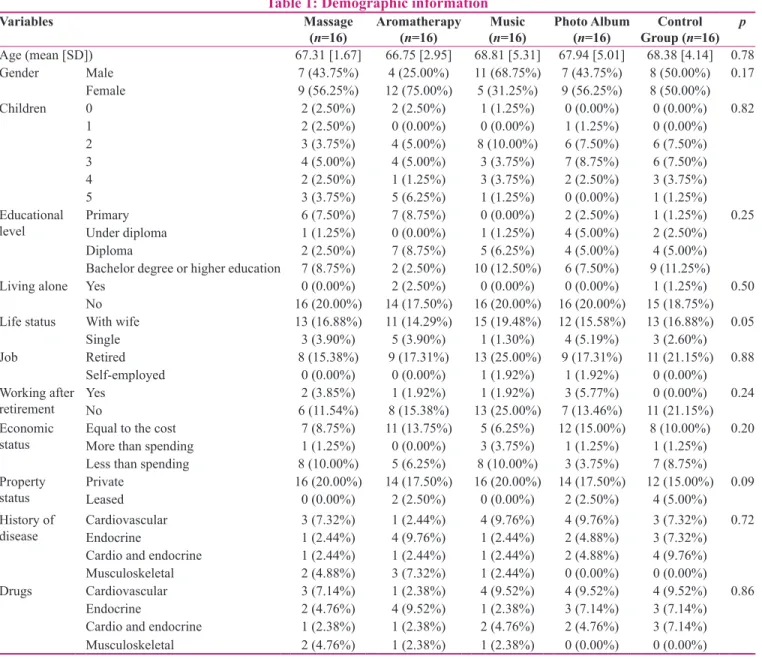
The mean (SD) age of participants in this study was 67.84 (4.90) years. In addition, 50 (62.50%) of them were retired employees, and 7 (8.75%) were still working, even after retirement. Based on the results, 31 (38.75%) had a low economic status, and 43 (53.75%) had an equal income and expense. It was reported that 34 (42.50%) of the subjects had an academic education, 19 (23.75%) had heart disease and 14 (17.50%) had gastrointestinal disease [Table 1]. No
statistically significant differences were reported among the
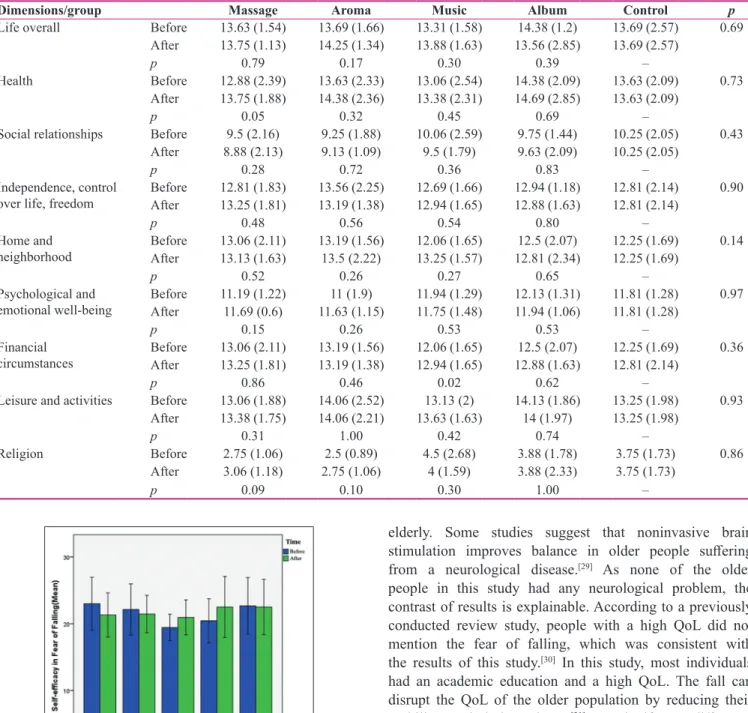
groups in terms of age (p = 0.78), education (p = 0.06), and economic status (p = 0.20). Table 2 indicates the
subjects’ QoL before and after the study in the five groups.
Also, the mean and standard deviation of the individuals’
self‑efficacy score in coping with the fear before and after
intervention are summarized in Figure 2. Comparison of
changes in the QoL scores and self‑efficacy in coping with fall before and after the intervention showed no significant differences in the changes of the components and the
total score (p > 0.05). Also, the Wilcoxon test showed no
statistically significant difference between the scores of the total QoL and self‑efficacy in coping with fall before and
Enrolment
Allocation
Follow
Analysi
s
Assessed for eligibility (n = 200)
Excluded (n = 120)
• Not meeting eligibly criteria (n = 40)
• Declined to participate (n = 60)
• Other reasons (n = 20) Randomized (n = 80)
Massage group
(n = 16) Aromatherapy group (n = 16) Music group (n = 16) Album group (n = 16) Control group (n = 16)
4 weeks after intervention Wrist injury (n = 1) Follow-up (n = 15)
4 weeks after intervention
Feeling of nausea (n = 1) Follow-up (n = 15)
4 weeks after intervention Follow-up (n = 16)
4 weeks after intervention Follow-up (n = 16)
After 4 weeks Follow-up (n = 16)
Follow-up analysis 4 weeks after intervention
(n = 15)
Follow-up analysis 4 weeks after intervention (n = 15)
Follow-up analysis 4 weeks after
intervention (n = 16)
Follow-up analysis 4 weeks after intervention
(n = 16)
Follow-up analysis after 4 weeks
(n = 16)
1 2 3 4 5 6 7 8 9 10 11 12 13 14 15 16 17 18 19 20 21 22 23 24 25 26 27 28 29 30 31 32 33 34 35 36 37 38 39 40 41 42 43 44 45 46 47 48 49 50 51 52 53 54 55 56
1 2 3 4 5 6 7 8 9 10 11 12 13 14 15 16 17 18 19 20 21 22 23 24 25 26 27 28 29 30 31 32 33 34 35 36 37 38 39 40 41 42 43 44 45 46 47 48 49 50 51 52 53 54 55 56 after the intervention between the intervention and control
groups (p > 0.05).
In response to an open‑ended question in the intervention group, the elderly mostly preferred to continue the massage,
because numbness and pain in fingers and wrists were reduced
during the massage sessions. On the other hand, they sensed
the softness of their fingers and felt more comfortable with
their hands. The individuals from the aromatherapy group declared they had remarkably fewer nightmares and were more comfortable with sleeping. The music group also stated that they had experienced less anxiety and were far from their previously common worries. In the photo album group, individuals recalled good memories of missed ones through viewing photos.
Discussion
This study was performed on 80 elderly adults referred
to a healthcare center to investigate the effect of sensory
stimulation on the QoL and self‑efficacy in coping
with the fear of falling. Most participants were women, employees, and highly educated. Organizational sensory
stimulation did not affect the QoL and self‑efficacy of the fear of falling. Previous studies had shown a significant
association between the fear of falling and the education level, which was consistent with the result of this study.[25,26] According to these studies, educated elderly subjects had a small number of previous falls. Therefore, the score of the fear of falling was low, but the interventions failed
to show significant differences. On the side of hearing stimulation, this study showed no significant impact on the QoL and self‑efficacy of the fear of falling. In contrast
with these results, a previously conducted randomized placebo‑controlled trial showed that live music played an
effective role in sensory stimulation compared to nonlive
music or silence.[27] This discrepancy may be related to the types of music (live music vs. nonlive music).
Table 1: Demographic information
Variables Massage
(n=16) Aromatherapy (n=16) (Music n=16) Photo Album (n=16) Group (Control n=16) p
Age (mean [SD]) 67.31 [1.67] 66.75 [2.95] 68.81 [5.31] 67.94 [5.01] 68.38 [4.14] 0.78
Gender Male 7 (43.75%) 4 (25.00%) 11 (68.75%) 7 (43.75%) 8 (50.00%) 0.17
Female 9 (56.25%) 12 (75.00%) 5 (31.25%) 9 (56.25%) 8 (50.00%)
Children 0 2 (2.50%) 2 (2.50%) 1 (1.25%) 0 (0.00%) 0 (0.00%) 0.82
1 2 (2.50%) 0 (0.00%) 0 (0.00%) 1 (1.25%) 0 (0.00%)
2 3 (3.75%) 4 (5.00%) 8 (10.00%) 6 (7.50%) 6 (7.50%)
3 4 (5.00%) 4 (5.00%) 3 (3.75%) 7 (8.75%) 6 (7.50%)
4 2 (2.50%) 1 (1.25%) 3 (3.75%) 2 (2.50%) 3 (3.75%)
5 3 (3.75%) 5 (6.25%) 1 (1.25%) 0 (0.00%) 1 (1.25%)
Educational
level PrimaryUnder diploma 6 (7.50%)1 (1.25%) 7 (8.75%)0 (0.00%) 0 (0.00%)1 (1.25%) 2 (2.50%)4 (5.00%) 1 (1.25%)2 (2.50%) 0.25
Diploma 2 (2.50%) 7 (8.75%) 5 (6.25%) 4 (5.00%) 4 (5.00%)
Bachelor degree or higher education 7 (8.75%) 2 (2.50%) 10 (12.50%) 6 (7.50%) 9 (11.25%)
Living alone Yes 0 (0.00%) 2 (2.50%) 0 (0.00%) 0 (0.00%) 1 (1.25%) 0.50
No 16 (20.00%) 14 (17.50%) 16 (20.00%) 16 (20.00%) 15 (18.75%)
Life status With wife 13 (16.88%) 11 (14.29%) 15 (19.48%) 12 (15.58%) 13 (16.88%) 0.05
Single 3 (3.90%) 5 (3.90%) 1 (1.30%) 4 (5.19%) 3 (2.60%)
Job Retired 8 (15.38%) 9 (17.31%) 13 (25.00%) 9 (17.31%) 11 (21.15%) 0.88
Self‑employed 0 (0.00%) 0 (0.00%) 1 (1.92%) 1 (1.92%) 0 (0.00%)
Working after
retirement YesNo 6 (11.54%)2 (3.85%) 8 (15.38%)1 (1.92%) 13 (25.00%)1 (1.92%) 7 (13.46%)3 (5.77%) 11 (21.15%)0 (0.00%) 0.24 Economic
status Equal to the costMore than spending 7 (8.75%)1 (1.25%) 11 (13.75%)0 (0.00%) 5 (6.25%)3 (3.75%) 12 (15.00%)1 (1.25%) 8 (10.00%)1 (1.25%) 0.20
Less than spending 8 (10.00%) 5 (6.25%) 8 (10.00%) 3 (3.75%) 7 (8.75%)
Property
status PrivateLeased 16 (20.00%)0 (0.00%) 14 (17.50%)2 (2.50%) 16 (20.00%) 14 (17.50%)0 (0.00%) 2 (2.50%) 12 (15.00%) 0.094 (5.00%) History of
disease CardiovascularEndocrine 3 (7.32%)1 (2.44%) 1 (2.44%)4 (9.76%) 4 (9.76%)1 (2.44%) 4 (9.76%)2 (4.88%) 3 (7.32%)3 (7.32%) 0.72
Cardio and endocrine 1 (2.44%) 1 (2.44%) 1 (2.44%) 2 (4.88%) 4 (9.76%)
Musculoskeletal 2 (4.88%) 3 (7.32%) 1 (2.44%) 0 (0.00%) 0 (0.00%)
Drugs Cardiovascular 3 (7.14%) 1 (2.38%) 4 (9.52%) 4 (9.52%) 4 (9.52%) 0.86
Endocrine 2 (4.76%) 4 (9.52%) 1 (2.38%) 3 (7.14%) 3 (7.14%)
Cardio and endocrine 1 (2.38%) 1 (2.38%) 2 (4.76%) 2 (4.76%) 3 (7.14%)
1 2 3 4 5 6 7 8 9 10 11 12 13 14 15 16 17 18 19 20 21 22 23 24 25 26 27 28 29 30 31 32 33 34 35 36 37 38 39 40 41 42 43 44 45 46 47 48 49 50 51 52 53 54 55 56
1 2 3 4 5 6 7 8 9 10 11 12 13 14 15 16 17 18 19 20 21 22 23 24 25 26 27 28 29 30 31 32 33 34 35 36 37 38 39 40 41 42 43 44 45 46 47 48 49 50 51 52 53 54 55 56 QoL of men with mental disorders showed that multisensory
stimuli improved their QoL in all aspects, which was in contrast with the results of this study.[28] The probable reason could be that simultaneous multistimulation were used in their study, but in this study, stimuli were performed individually. In addition, mental disorders were not the main point of interest in this study. Sensory stimulation
didn’t affect the self‑efficacy of the fear of falling in the
elderly. Some studies suggest that noninvasive brain
stimulation improves balance in older people suffering
from a neurological disease.[29] As none of the older people in this study had any neurological problem, the contrast of results is explainable. According to a previously conducted review study, people with a high QoL did not mention the fear of falling, which was consistent with the results of this study.[30] In this study, most individuals had an academic education and a high QoL. The fall can disrupt the QoL of the older population by reducing their mobility and independence.[31] A significant difference between the mean of QoL in normal people and patients with disabilities has been shown in previous studies.[32] This study also supports previous results. The high QoL is related to the characteristics of the population too, as individuals with a high score on QoL questionnaire, mostly had high levels of education and income and easily accessed recreational facilities. Disabled patients had the lowest score in all aspects of QoL. Some studies emphasis on the role of environment in managing the diseases, especially visual sensory stimulation.[33] Neurological disorders are a great point of interest, as diseases like
stroke, dementia, and epilepsy directly affect the QoL in
the elderly population.[34‑36] Fear of falling is also under the impression of daily activity and is mostly observed
Table 2: The subjects’ quality of life mean (SD) scores before and after the study
Dimensions/group Massage Aroma Music Album Control p
Life overall Before 13.63 (1.54) 13.69 (1.66) 13.31 (1.58) 14.38 (1.2) 13.69 (2.57) 0.69
After 13.75 (1.13) 14.25 (1.34) 13.88 (1.63) 13.56 (2.85) 13.69 (2.57)
p 0.79 0.17 0.30 0.39 –
Health Before 12.88 (2.39) 13.63 (2.33) 13.06 (2.54) 14.38 (2.09) 13.63 (2.09) 0.73
After 13.75 (1.88) 14.38 (2.36) 13.38 (2.31) 14.69 (2.85) 13.63 (2.09)
p 0.05 0.32 0.45 0.69 –
Social relationships Before 9.5 (2.16) 9.25 (1.88) 10.06 (2.59) 9.75 (1.44) 10.25 (2.05) 0.43 After 8.88 (2.13) 9.13 (1.09) 9.5 (1.79) 9.63 (2.09) 10.25 (2.05)
p 0.28 0.72 0.36 0.83 –
Independence, control
over life, freedom BeforeAfter 12.81 (1.83)13.25 (1.81) 13.56 (2.25)13.19 (1.38) 12.69 (1.66)12.94 (1.65) 12.94 (1.18)12.88 (1.63) 12.81 (2.14)12.81 (2.14) 0.90
p 0.48 0.56 0.54 0.80 –
Home and
neighborhood BeforeAfter 13.06 (2.11)13.13 (1.63) 13.19 (1.56)13.5 (2.22) 12.06 (1.65)13.25 (1.57) 12.81 (2.34)12.5 (2.07) 12.25 (1.69)12.25 (1.69) 0.14
p 0.52 0.26 0.27 0.65 –
Psychological and
emotional well‑being BeforeAfter 11.19 (1.22)11.69 (0.6) 11.63 (1.15)11 (1.9) 11.94 (1.29)11.75 (1.48) 12.13 (1.31)11.94 (1.06) 11.81 (1.28)11.81 (1.28) 0.97
p 0.15 0.26 0.53 0.53 –
Financial
circumstances BeforeAfter 13.06 (2.11)13.25 (1.81) 13.19 (1.56)13.19 (1.38) 12.06 (1.65)12.94 (1.65) 12.88 (1.63)12.5 (2.07) 12.25 (1.69)12.81 (2.14) 0.36
p 0.86 0.46 0.02 0.62 –
Leisure and activities Before 13.06 (1.88) 14.06 (2.52) 13.13 (2) 14.13 (1.86) 13.25 (1.98) 0.93 After 13.38 (1.75) 14.06 (2.21) 13.63 (1.63) 14 (1.97) 13.25 (1.98)
p 0.31 1.00 0.42 0.74 –
Religion Before 2.75 (1.06) 2.5 (0.89) 4.5 (2.68) 3.88 (1.78) 3.75 (1.73) 0.86
After 3.06 (1.18) 2.75 (1.06) 4 (1.59) 3.88 (2.33) 3.75 (1.73)
p 0.09 0.10 0.30 1.00 –
Figure 2: Self‑efficacy in coping with the fear before and after the intervention
1 2 3 4 5 6 7 8 9 10 11 12 13 14 15 16 17 18 19 20 21 22 23 24 25 26 27 28 29 30 31 32 33 34 35 36 37 38 39 40 41 42 43 44 45 46 47 48 49 50 51 52 53 54 55 56
1 2 3 4 5 6 7 8 9 10 11 12 13 14 15 16 17 18 19 20 21 22 23 24 25 26 27 28 29 30 31 32 33 34 35 36 37 38 39 40 41 42 43 44 45 46 47 48 49 50 51 52 53 54 55 56 among aged patients with neurological disorders, such
as Parkinson and multiple sclerosis.[37‑39] Regarding the observance of all principles of randomized controlled trials, from randomization to allocation and concealment is a strength of this study, as the selection and detection biases are reduced to the least levels. Also, the use of standard questionnaires for assessing the QoL of the older population
and their self‑efficacy is another point of strength in this
study.Moreover, to the best of our knowledge, this study is
the first to assess the effect of sensory stimulation on QoL of the elderly and their self‑efficacy for coping with the
fear of falling.
One of the limitations of this study was the short follow‑up. As longer administration of sensory stimulation increases
their self‑efficacy and QoL, further studies with longer
periods of intervention are suggested.As this study showed
that multistimuli interventions have no effect in terms of the QoL and self‑efficacy of fear of falling, it is suggested
to conduct further studies with larger sample size and with elderly living in nursing houses. According to a few studies illustrating the higher fall risk in elderly living in nursing houses, a comparison of fall risk in elderly, between the two contexts of nursing houses private house could be considered as a possible point of interest.[40]
Conclusion
According to the results of this study, although some psychological improvements were reported by the
individuals in the intervention groups, no significant
association between sensory stimulation and QoL in the
older population and their self‑efficacy for coping with the
fear of falling was observed.
Acknowledgements
This article was derived from a research project in Tabriz University of Medical Sciences (code: IR.TBZMED.
REC.1396.671). Researchers appreciate all who financially
supported this study as well as the elderly who helped us in this project.
Financial support and sponsorship
Research Deputy of Tabriz University of Medical Sciences Conflicts of interest
Nothing to declare.
References
1. Noroozian M. The elderly population in iran: An ever growing concern in the health system. Iran J Psychiatry Behav Sci 2012;6:1‑6.
2. Beard HPJR, Bloom DE. Towards a comprehensive public health response to population ageing. Lancet (London, England) 2015;385:658‑61.
3. Suzman R, Beard JR, Boerma T, Chatterji S. Health in an ageing world—what do we know? Lancet 2015;385:484‑6.
4. Daddoust L, Khankeh H, Ebadi A, Sahaf R, Nakhaei M,
Asgary A. The vulnerability of the Iranian elderly in disasters: Qualitative content analysis. Iran J Nurs Midwifery Res 2018;23:402.
5. Tavakoli‑Ghochani H, Armat M. Successful Aging. Mashhad: Mashhad University of Medical Sciences Publication; 2003 [Persian].
6. Attems J, Walker L, Jellinger KA. Olfaction and aging: A mini‑review. Gerontology 2015;61:485‑90.
7. Li C‑SR, Yan P, Bergquist KL, Sinha R. Greater activation of the “default” brain regions predicts stop signal errors. Neuroimage 2007;38:640‑8.
8. Amarya S, Singh K, Sabharwal M. Aging Process and Physiological Changes. 2017. Doi:10.5772/intechopen.76249. 9. Cruz J, Marques A, Barbosa A, Figueiredo D, Sousa LX.
Making sense (s) in dementia: A multisensory and motor‑based group activity program. Am J Alzheimers Dis Other Demen 2013;28:137‑46.
10. Liu Z, Song Y, Shang Y, Wang J. Posture recognition algorithm
for the elderly based on BP neural networks. The 27th Chinese
Control and Decision Conference (2015 CCDC). IEEE; 2015. p. 1446‑9.
11. Rawsky E. Review of the literature on falls among the elderly. J Nurs Sch 1998;30:47‑52.
12. Morrison A, Fan T, Sen SS, Weisenfluh L. Epidemiology of falls
and osteoporotic fractures: A systematic review. Clinicoecon Outcomes Res 2013;5:9‑18.
13. Evitt CP, Quigley PA. Fear of falling in older adults: A guide to its prevalence, risk factors, and consequences. Rehabil Nurs 2004;29:207‑10.
14. Jefferis BJ, Iliffe S, Kendrick D, Kerse N. How are falls and fear
of falling associad with objectively measured physical activity in a cohort of commnity‑dwelling older men? BMC Geriatr 2014;14:114.
15. Tanner DA, Kloseck M, Crilly RG, Chesworth B. Hip fracture
types in men and wommen change differently with age. BMC
Geriatr 2010;10:12
16. Fhon JRS, Fabrício‑Wehbe SCC, Vendruscolo TRP, Stackfleth R,
Marques S, Rodrigues RAP. Quedas em idosos e sua relação com a capacidade funcional. Rev LatAm Enfermagem 2012;20:927‑34.
17. Carpenter MG, Adkin AL, Brawley LR, Frank JS. Postural, physiological and psychological reactions to challenging balance:
Does age make a difference? Age Ageing 2006;35:298‑303.
18. Hoan OT, Jullamate P, Piphatvanitcha N, Rosenberg E. Factors related to fear of falling among community‑dwelling older adults. J Clin Nurs 2017;26:68‑76.
19. Safavi M, Yahyavi SH, Farahani H, Mahmoudi N,
Mahboubinia M. The effect of multi‑sensory stimulation (MSS)
on cognitive status of women with Alzheimer’s disease in Fereshtegan elderly care center. J Jahrom Univ Med Sci 2013;11:46.
20. Nikkhah M, Heravi‑Karimooi M, Rejeh N, Nia HS, Montazeri A. Measuring quality of life in elderly populations: A review of instruments used. Payesh 2017;16:303‑14.
21. Wood RH, Reyes‑Alvarez R, Maraj B, Metoyer KL, Welsch MA.
Physical fitness, cognitive function and health‑related quality of
life in older adults. J Aging Phys Act 2001;7:217‑30.
22. Lopes KT, Costa DF, Santos LF, Castro DP, Bastone AC. Prevalence of fear of falling among a population of older adults and its correlation with mobility, dynamic balance, risk and history of falls. Braz J Phys Ther 2009;13:223‑9.
23. Yardley L, Beyer N, Hauer K, Kempen G, Piot‑Ziegler C,
1 2 3 4 5 6 7 8 9 10 11 12 13 14 15 16 17 18 19 20 21 22 23 24 25 26 27 28 29 30 31 32 33 34 35 36 37 38 39 40 41 42 43 44 45 46 47 48 49 50 51 52 53 54 55 56
1 2 3 4 5 6 7 8 9 10 11 12 13 14 15 16 17 18 19 20 21 22 23 24 25 26 27 28 29 30 31 32 33 34 35 36 37 38 39 40 41 42 43 44 45 46 47 48 49 50 51 52 53 54 55 56
Scale‑International (FES‑I). Age Ageing 2005;34:614‑9.
24. Delbaere K, Close JC, Mikolaizak AS, Sachdev PS, Brodaty H,
Lord SR. The falls efficacy scale international (FES‑I):
A comprehensive longitudinal validation study. Age Ageing 2010;39:210‑6.
25. Baharlouei H, Salavati M, Akhbari B, Mosallanezhad Z, Mazaheri M, Negahban H. Cross‑cultural validation of the
Falls Efficacy Scale International (FES‑I) using self‑report and
interview‑based questionnaires among Persian‑speaking elderly adults. Arch Gerontol Geriatr 2013;57:339‑44.
26. Jung D. Fear of falling in older adults: Comprehensive review. Asian Nurs Res 2008;2:214‑22.
27. Holmes C, Knights A, Dean C, Hodkinson S, Hopkins V. Keep music live: Music and the alleviation of apathy in dementia subjects. Int Psychogeriatr 2006;18:623‑30.
28. Mahboubinia M, Dalvandi A, Nourozi K, Mahmoudi N,
Sadat Safavi S, Hosseinzadeh S. The effect of multi sensory
stimulation (MSS) on cognitive disturbances and quality of life of male patients with Alzheimer’s disease. Iran Rehabil J 2012;10:50‑5.
29. Fontani V, Rinaldi S, Castagna A, Margotti ML. Noninvasive radioelectric asymmetric conveyor brain stimulation treatment
improves balance in individuals over 65 suffering from
neurological diseases: Pilot study. Ther Clin Risk Manag 2012;8:73‑8.
30. Ambrose AF, Paul G, Hausdorff JM. Risk factors for falls among
older adults: A review of the literaure. Maturitas 2013;75:51‑61. 31. Bruyere O, Wuidart MA, Di Palma E, Gourlay M, Ethgen O,
Richy F, et al. Controlled whole body vibration to decrease fall
risk and improve health‑related quality of life of nursing home
residents. Arch Phys Med Rehabil 2005;86:303‑7.
32. Öztürk ZA, Özdemir S, Türkbeyler IH, Demir Z. Quality of life and fall risk in frail hospitalized elderly patients. Turk J Med Sci 2017;47:1377‑83.
33. Brawley EC. Environmental design for Alzheimer’s disease: A quality of life issue. Aging Ment Health 2001;5(Sup 1):79‑83. 34. Johnston A, Smith Ph. Epilepsy in the elderly. Expert Rev
Neurother 2010;10:1899‑910.
35. Sanchez A, Maseda A, Marane‑Moar MP, Labra C,
Lorenzo‑López L, Millán‑Calenti JC. Comparing the effects of
multisensory stimulaion and individualized music sessions on elderly people with severe dementia: A randomized controlled trial. J Alzheimers Dis 2016;52:303‑15.
36. Hakon J, Quattromani MJ, Sjolund C, Tomasvic G, Carey L,
Lee JM, et al. Multisensory stimulation improves funcional
recovery and resting‑sate functional connectivity in he mouse brain after stroke. Neuroimage Clin 2018;17:717‑30.
37. Cinarli T, Koç Z. Fear and risk of falling, activities of daily living, and quality of life: Assessment when older adults receive emergency department care. Nurs Res 2017;66:330‑5.
38. Jonasson SB, Nilsson MH, Lexell J, Carlsson G. Experiences of fear of falling in persons with Parkinson’s disease–a qualitative study. BMC Geriatr 2018;18:44.
39. Kalron A, Allali G. Gait and cognitive impairments in multiple
sclerosis: The specific contribution of falls and fear of falling.
J Neural Trans 2017;124:1407‑16.
40. Czerwiński E, Białoszewski D, Borowy P, Kumorek A, Białoszewski A. Epidemiologia, znaczenie kliniczne oraz koszty i profilaktyka upadków u osób starszych. Ortop Traumatol