
Cherokee Verb Classes, Language Revitalization, and Second Language Pedagogy
By Kristen Lavery
Senior Honors Thesis Linguistics
University of North Carolina at Chapel Hill
April 2019
Approved:
_____________________________ Misha Becker, Thesis Advisor Ben Frey, Reader
Table of Contents
ABSTRACT... 3
SECTION 1: INTRODUCTION………4
SECTION 2: THE STRUCTURE OF A CHEROKEE VERB ... 6
2.1 Prepronominal Prefixes ... 7
2.2 Pronominal Prefixes……….8
2.3 Stem Suffixes………..9
2.4 Derivational Suffixes ... 13
SECTION 3: VERB ANALYSIS………..15
SECTION 4: CHEROKEE VERB CLASSES ... 26
4.1 Class I Verbs ... 27
4. 2 Class II Verbs ... 31
4.3 Class III Verbs ... 32
4.4 Class IV Verbs ... 33
4.5 Class V Verbs ... 34
4.6 Class VI Verbs ... 41
4.7 Class VII Verbs ... 43
4.8 Class VIII Verbs ... 45
4.9 Class IX Verbs ... 48
4.10 Class X Verbs ... 50
4.11 Class XI Verbs ... 52
4.12 Cook’s Verb Classes ... 53
4.13 King’s Verb Classes ... 59
4.14 Cherokee Verb Classes Compared to German Strong Verb Classes ... 65
SECTION 5: SECOND LANGUAGE PEDAGODY AND LANGUAGE REVITALIZATION ... 70
SECTION 6: DISCUSSION AND FURTHER RESERACH ... 75
SECTION 7: CONCLUSION ... 79
ABSTRACT
The North American indigenous language Cherokee is an understudied and endangered language. Cherokee is the only living language left in the Southern branch of the Iroquoian language family. Languages of the Northern Iroquoian branch include Mohawk, Seneca, and Cayuga (Montgomery-Anderson 2015:3). Unfortunately, all three of these languages are also severely endangered (UNESCO). Due to generational gaps between fluent speakers of the language and children growing up in Cherokee communities, most children no longer speak Cherokee as a native language. Second language learners are important to the language revitalization efforts of Cherokee, but a lack of educational materials renders the teaching
process difficult. One point of difficulty is the teaching of verbs. Research on Cherokee verbs by authors such as William Cook 1979 and Duane King 1975 has been limited to linguistic
descriptions of verb structures that are difficult for second language learners to understand. My goal has been to categorize Cherokee verbs in a way that is easy for second language learners to understand and utilize. I used German strong verb classes as a model for what I wanted the Cherokee classes to look like and the information I wanted them to present. I analyzed a dataset of over 300 Cherokee verbs from which I identified patterns and separated the verbs into
SECTION 1: INTRODUCTION
The diminishing number of native speakers of Cherokee makes the language susceptible to language death and in need of language revitalization. The lack of first language speakers in younger generations leaves Cherokee communities in great need of second language learners and second language teachers. Cherokee teachers often have no materials, or only limited materials, with which to teach the grammar of the language. Linguistic research on Cherokee contributes to the creation of teaching materials, but many aspects of the language have not yet been studied. One area of little research is that of verb inflections. Cherokee verbs are inflected to show tense and aspect, among other things. They take suffixes that identify them as belonging to one of the five categories that express tense and aspect: the Present Continuous, the Incompletive, the Immediate, the Completive, and the Infinitive. The ability to understand how verbs are inflected in each category is crucial to the amount of progress second language learners can make in learning to comprehend and produce Cherokee words and phrases. It is problematic for both teachers and students not to have a system that identifies how to inflect verbs.
each verb. This is expected to result in less processing time, better execution, and more effective learning.
SECTION 2: THE STRUCTURE OF A CHEROKEE VERB Verbs are the most inflected part of speech in Cherokee (Montgomery-Anderson 2015:51). They take several prefixes and suffixes that convey additional semantic information about the verb’s event; for example, information about the event’s participants and about the event’s place in time. In its most minimal form, a verb will consist of one pronominal prefix, the verb root, and one stem suffix. The verb root gives the meaning of the verb and cannot be reduced to a smaller form. The stem suffix and the verb root together make up the verb stem. There are five types of stem suffixes that can attach to the verb root; they express both tense and aspect. Tense is a “grammaticalized expression of location in time” (Comrie 1985:9). In English, the two phrases he stole and he steals differ from each other in tense. Aspects, on the other hand, “are different ways of viewing the internal temporal constituency of a situation” (Comrie
1976:3). Therefore, the two phrases he steals and he is stealing do not differ in tense but do differ in aspect. Each sentence’s aspect explains the duration of time in which the event, stealing, is taking place. He steals is in the present tense and the simple aspect. The simple present
(1) ganosgiʔa “He is stealing.”
ga -nosgi -ʔa
Pronominal Prefix Root Stem Suffix
3rd person sg. steal Present Continuous
These are the foundational elements of a Cherokee verb. The next sections will expound upon these elements and will discuss the optional affixes that can be added onto this foundation.
2.1 Prepronominal Prefixes
Up to two prepronominal prefixes may precede a verb’s pronominal prefix.
Prepronominal prefixes enhance the meaning of a verb by presenting information about speaker and object locations, as well as information about the action of a verb, such as motion or
iteration. Most verbs have the option to take a prepronominal prefix but do not. Some verbs take lexically specific prepronominal prefixes, such as the verb below, meaning “to count.” This verb takes the distributive prefix, which indicates that the object of the verb is plural.
(2) degasehiha “He is counting them.”
de -ga -sehi -ha
Prepronominal Prefix Pronominal Prefix Root Stem Suffix
2.2 Pronominal Prefixes
A pronominal prefix is the first obligatory part of a Cherokee verb. Pronominal prefixes encode information about the verb’s subject and/or object, including grammatical person, number, and clusivity. Cherokee, like English, has three grammatical persons: first, second, and third. Unlike English, there are three number distinctions in Cherokee: singular, dual, and plural. First person nonsingular forms are distinguished from each other based on clusivity. The first person nonsingular inclusive form includes the speaker and the interlocutor(s). The first person nonsingular exclusive form includes the speaker and a referent but excludes the interlocutor(s). The first person singular inclusive form includes only the speaker. There is no first person singular exclusive form because it would be impossible to exclude the speaker.
Cherokee verbs fall into one of two categories: Set A or Set B. Montgomery-Anderson 2015 describes Set A verbs as transitive verbs and Set B verbs as intransitive, but this may not be the whole picture. It may be more appropriate to think of Set A verbs as verbs with
non-experiencer subjects and Set B verbs as verbs with non-experiencer subjects. This is simply a hypothesis; further research is warranted in order to determine if it is correct or not. Some examples of Set A and Set B verbs are listed below.
Table 2.2 A: Examples of Set A versus Set B verbs
Set A English Set B English
wooniha to speak oohiyuha to believe
uutiha to snow yoosiha to be hungry
aaʔi to walk ehisdaneha to hurt
oogisga to smoke eeluugiisgi to worry
goliiyeʔa to examine aduuliha to want
Each category has its own set of prefixes: Set A verbs take Set A prefixes, and Set B verbs take Set B prefixes. The Set A and Set B paradigms are given below. They are taken from
represents a long vowel. The third person singular has two forms. “While it is not entirely predictable, the appearance of third person ga- instead of a- has certain general characteristics. One generalization can be made about its use: ga- appears on all Set A stems that start with the sounds /o/, /u/, or /v/” (Montgomery-Anderson 2015:40).
Table 2.2 B: Set A Pronominal Prefixes (Montgomery-Anderson 2015:39)
Person Reference Singular Dual Plural
First Person Inclusive ji- iinii- idii- First Person Exclusive --- oosdii- oojii-
Second Person hi- sdii- iijii-
Third Person a-, ga- anii- anii-
Table 2.2 C: Set B Pronominal Prefixes (Montgomery-Anderson 2015:46)
Person Reference Singular Dual Plural
First Person Inclusive agi- ginii- iigii- First Person Exclusive --- ooginii- oogii-
Second Person ja- sdii- iijii-
Third Person uu- uunii- uunii-
Many Set A verbs undergo prefix shift in the Completive and Infinitive stem suffix categories. If this is the case, then the verb will take Set B, instead of Set A, pronominal prefixes in the
Completive and the Infinitive categories (Montgomery-Anderson 2015:53). An example of a verb that undergoes prefix shift is below:
Table 2.2 D: Example of Prefix Shift (Feeling 1975:51)
Stem Suffix Category Cherokee English
PRC asgolvdiʔa He’s erasing it.
INC asgolvdisgoʔi He was erasing it.
IMM asgolvda He (just) erased it.
CMP usgolvdvʔi He erased it.
INF usgolvdisdi for him to erase
2.3 Stem Suffixes
suffix in Cherokee that gives information about aspect. Stem suffixes attach directly to the verb root. There are five stem suffixes in Cherokee: the Present Continuous, Incompletive, Immediate, Completive, and Infinitive. Additional suffixes may attach themselves to the verb stem, so
directly following the stem suffix, in two out of the five categories. These additional suffixes are termed “final suffixes.” Final suffixes add information about aspect. Below is an explanation of each stem suffix category with examples of the forms these suffixes can take.
The Present Continuous (PRC) can only express actions in the present tense; its aspect indicates an ongoing action. It cannot take any additional suffixes. It takes the form of [ha], [ʔa], or [sga]. Some authors, such as Cook 1979 and King 1975, define [a] as a final suffix.
Montgomery-Anderson 2015 does not and I follow Montgomery-Anderson; therefore, I will take it as part of the Present Continuous stem suffix.
(3) degasehiha “He is counting.”
de -ga -sehi -ha
Prepronominal Prefix Pronominal Prefix Root Stem Suffix
distributive 3rd person sg. count Present Continuous (4) ganosgiʔa “He is stealing.”
ga -nosgi -ʔa
Pronominal Prefix Root Stem Suffix
3rd person sg. steal Present Continuous (5) adananesvhvsga “He is shopping.”
a -dananesvhv -sga
3rd person sg. shop Present Continuous
The Incompletive (INC) describes actions that are not finished. It must take one of four additional suffixes: the habitual, the experienced past, the non-experienced past, or the
progressive future. This is an important distinction from the Present Continuous stem suffix, which cannot take any additional suffixes. The Incompletive can express unfinished actions in any tense. It takes the form of [h] or [sg].
(6) agoliyesgoʔi “He was reading.”
a -goliye -sg -oʔi
Pronominal Prefix Root Stem Suffix Final Suffix 3rd person sg. read Incompletive Habitual Suffix (7) adloyihoʔi “He was crying.”
a -dloyi -h -oʔi
Pronominal Prefix Root Stem Suffix Final Suffix 3rd person sg. cry Incompletive Habitual Suffix
The Immediate (IMM) expresses actions that have taken place in the recent past, or actions that will, or might, take place in the immediate future. When used with the
prepronominal irrealis prefix yi-, the Immediate forms a command. Verbs in the Immediate can also convey the meaning of having the ability to do something (Montgomery-Anderson
(8) gadalugivga “He (just) plowed.” ga -gadalugi -vga
Pronominal Prefix Root Stem Suffix 3rd person sg. plow Immediate (9) awoladagi “He (just) breathed.”
a -wolade -agi
Pronominal Prefix Root Stem Suffix 3rd person sg. breathe Immediate
The Completive (CMP) describes actions that are finished. It must take one of five additional suffixes, some of which are identical to the ones that can be attached to the
Incompletive. The additional suffixes are: the experienced past, the non-experienced past, the progressive future, the future command, and the completive future. The Completive can express actions in the past and future tenses and, like the Immediate, it can also be used to express commands. Unlike the Immediate, the Completive does not need the irrealis prefix to form a command; instead, the additional future command suffix does that (Montgomery-Anderson, 2015:74). The Completive takes a null form, or takes one of several forms, including [s], [h], [ʔ], [n], and [l]. In certain cases, a voiceless glottal fricative precedes the voiced alveolar nasal and the voiced alveolar approximant.
(10) asgosvʔi “He dug.”
a -sgo -s -vʔi
(11) adanuteyolvʔi “He twisted it.”
a -danuteyo -l -vʔi
Pronominal Prefix Root Stem Suffix Final Suffix 3rd person sg. twist Completive Experienced Past The Infinitive (INF) does not express tense or aspect. It cannot take additional suffixes. The Infinitive is realized as [sdi], [di], or [hdi], and sometimes [tdi].
(12) agvhalidi “for him to cut it” a -gvhali -di
Pronominal Prefix Root Stem Suffix 3rd person sg. cut Infinitive (13) atalesdi “for him to drill”
a -tale -sdi
Pronominal Prefix Root Stem Suffix 3rd person sg. drill Infinitive
The main object of my research has been to look at the characteristics of the different forms of these stem suffixes and to find patterns that could translate to Cherokee verb classes. This research will be discussed in future sections.
2.4 Derivational Suffixes
Derivational suffixes are separate from the additional suffixes that attach to the Incompletive and Completive stem suffixes. They are termed “derivational suffixes” by
SECTION 3: VERB ANALYSIS
Table 3A: Cook’s Cherokee Verb Classes (Cook 1979:98)
Class Root Finals PRC INC IMM CMP INF
A1 t, k, y, ts -iʔ- -ʔíhsk- -a -ʔ- -ʔihst-
A2 t, k, l, w -iʔ- -iʔsk- -aʔka -aʔn- -oʔt- A3 hs, st, ht, ʔt -ih- -ihsk- -a -ahn- -oht- A4 t, l, n, y, ts, th,
hs -ih- -ihsk- -a -vh- -vht-
B1 e -h- -hsk- -v:li -h- -hst-
B2 e -ʔ- -ʔsk- -a -ʔ- -ʔst-
B3 o: -ʔ- -sk- -tsa -ʔ- -st-
B4 v: -ʔ- -sk- -na -s- -st-
B5 i: -ʔ- -sk- -ø -s- -st-
C1 v, á, ó, u -hsk- -hsk- -hi -hs- -hihst-
C2 a, i -hsk- -hsk- -ø -hs- -hst-
C3 ya, la, na, ha -hsk- -hsk- -ø -h- -hst-
C4 ʔn -hsk- -hsk- -ʔka -ø- -ʔt-
C5 hn -hsk- -hsk- -ʔka -ø- -ht-
D1 é -h- -hsk- -v:li -hl- -ht-
D2 ó, v -hih- -hih- -ha:ʔka -hl- -hst-
D3 é, ó -hih- -hih- -:ka -hl- -hst-
D4 l, n, y -hih- -hih- -hka -hl- -hst-
D5 l, n, a:, i:, v: -ʔih- -ʔih- -ʔka -ʔl- -ʔst- E e:, o:, i:, v:, h, ʔ -k- -k- -ki -ts- -ihst- F h, n, l, y, ʔ, ts,
ths
Table 3B: King’s Cherokee Verb Classes (King 1975:78-79)
Class Root Finals PRC INC IMM CMP INF
Ia i -ʔ- -sk- -ø -ʔs- -ʔst
Ib o -ʔ- -sk- -tsa -ʔ- -ʔst
Ic v -ʔ- -ʔsk- -na -ʔ- -ʔst
Id e -ʔ- -sk- -*a -ʔ- -ʔt
IIa ye, le -h- -hsk- -*a -h- -ht
IIb ke, ʔye -h- -hsk- -*v:li -h- -ht
IIc he -h- -hsk- -*v:li -hl- -ht
IIIa1 vʔv -hsk- -hsk- -ʔka -*n- -*t
IIIa2 uhv, vhv, ohv -hsk- -hsk- -ʔka -*n- -@ht
IIIa3 ahv -hsk- -hsk- -ʔka -*n- -@oht
IIIb a -hsk- -hsk- -ʔka -n- -*ø
IIIc1 o, u, a -hsk- -hsk- -hi -hs- -hihst
IIIc2 i:w -hsk- -hsk- -hi -hs- -hst
IVa ht, ʔt, kt, st -ih- -ihsk- -a -han- -oht IVb n, l, s, y, t, th, ts -ih- -ihsk- -a -vh- -ht
Va no entry -iʔ- -ihsk- -a -vʔ- -ht
Vb t, k, ts -iʔ- -ihsk- -a -ʔn- -ihst
Vc no entry -iʔ- -ihsk- -a:ʔka -aʔn- -oʔt
VIa1 hk -ih- -ih- -ka -il- -st
VIa2 h, ʔ -ih- -ih- -ka -l- -st
VIIa1 yo(l), yo -hih- -hih- -haʔka -hl- -hst
VIIa2 yo(l), yo -hih- -hih- -ka -hl- -hst
VIIIa e, o, u -k- -k- -ʔki -ʔts- -ʔihst
VIIIb h, ʔ -k- -k- -ki -ts- -ihst
IXa to -h- -h- -*a -ʔl -*aʔst
IXb to -h- -h- no entry no entry no entry
X c -i# -i:s- -u:ʔka -eʔs- -vʔst
I collected my data from Durbin Feeling’s 1975 Cherokee-English Dictionary. Feeling writes in the Oklahoma dialect of Cherokee, so that is the dialect that my results and my verb classes are written in. The North Carolina and Oklahoma dialects differ from each other
phonologically with regards to voiced versus voiceless sounds. Below is a table showing certain sounds in Oklahoma Cherokee, and their equivalents in North Carolina Cherokee.
Table 3C: Sound Equivalents in Oklahoma and North Carolina Cherokee
Oklahoma Dialect North Carolina Dialect
/g/ /k/
/j/ /ts/
/d/ /t/
An entry from Feeling’s dictionary looks like the following (Feeling 1975:54): (14) asladiʔa ᎠᏍᎳᏗᎠ v.t. he’s roping him, it
jisladiʔa ᏥᏍᎳᏗᎠ usladvʔi ᎤᏍᎳᏛᎢ
asladisgoʔi ᎠᏍᎳᏗᏍᎪᎢ
hislada ᎯᏍᎳᏓ usladisdi ᎤᏍᎳᏗᏍᏗ
Each entry and sub-entry is also listed in the Cherokee syllabary. The first sub-entry is given in the Present Continuous form, like the initial entry, but it takes a first person singular pronominal prefix. The second sub-entry is given in the Completive form with a third person singular
pronominal prefix. This prefix is given as [u], instead of [a] in this form, because this verb is one that undergoes prefix shift. Prefix shift causes Set A verbs to take Set B pronominal prefixes in their Completive and Infinitive forms. The third sub-entry is given in the Immediate form, with the Set A third person singular pronominal prefix. The fourth sub-entry is given in the
Incompletive form, with the Set A second person singular pronominal prefix. Lastly, the fifth sub-entry is given in the Infinitive form, with the Set B third person singular pronominal prefix. The Infinitive form, like the Completive form, takes a Set B pronominal prefix because it is affected by prefix shift. For the sake of simplicity, when I list examples of verbs in each of the five forms I only use the third person singular pronominal prefix, whether it be Set A or Set B.
There are 705 verbs in Feeling’s dictionary; I recorded 357 out of the 705 verbs. The format in which I recorded verbs looks like this:
Table 3D: Example of a Recorded Verb
Prepro Pro Root PRC INC IMM CMP INF Gloss
I did not record verb entries for which one or more of the five stem suffix forms was not listed. There are 82 such entries; they look like the following (Feeling 1975:20):
(15) ahileha ᎠᎯᎴᎭ v.t. he has possession of a vehicle jiʔileha ᏥᎢᎴᎭ
---
ahiʔlehoʔi ᎠᎯᎴᎰᎢ
---
uhiʔlvsdi ᎤᎯᎸᏍᏗ
Additionally, I did not record verb entries for classificatory verbs. Classificatory verbs take distinctive forms in each of the five stem suffix categories “depending on the physical properties of the object” (Montgomery-Anderson 2015:82). “Cherokee has five categories of classificatory verbs indicating solid, liquid, living, long, and flexible items” (Montgomery-Anderson 2015:82). There are 76 entries of classificatory verbs in Feeling’s dictionary. An example of a
classificatory verb indicating a living object is given below. As the example shows, “an element /ka/ is part of the verbs with living objects” (Montgomery-Anderson 2015:84).
(16) gakahiyaʔa ᎦᎧᎯᏯᎠ v.t. he’s leaving a living thing behind (Feeling 1975:98) jiyakahiyaʔa ᏥᏯᎧᎯᏯᎠ
uwakahiyvʔi ᎤᏩᎧᎯᏴᎢ
gakahiyasgoʔi ᎦᎧᎯᏯᏍᎪᎢ
hiyakahiya ᎯᏯᎧᎯᏯ
Lastly, I did not record entries of verbs with derivational suffixes. There are 190 entries of verbs with derivational suffixes in Feeling’s dictionary. As mentioned in Section 2.4,
derivational suffixes add onto the meaning of a verb by specifying information about the verb’s aspect. I chose not to record these verbs because their stem suffix forms are determined by the derivational suffix they take (Montgomery-Anderson 2015:384). There are nine types of
derivational suffixes, but only six types are found in Feeling’s dictionary. Examples of these six types and their stem suffix forms are given below. The three derivational suffixes not included in any of Feeling’s verb entries are the accidental suffix, the pre-incipient suffix, and the purpose suffix.
Table 3E: Duplicative stem suffixes (Montgomery-Anderson 2015:384)
PRC INC IMM CMP INF
-ha -sg- -a -hn-/-hl- (h)di
“The duplicative suffix indicates that an action is repeated.” The action is only repeated once. (Montgomery-Anderson 2015:384).
Table 3F: Example with the duplicative suffix (Feeling 1975:74)
Stem Suffix Cherokee English
PRC daliyosiha He’s changing his socks.
INC daliyosihoʔi He was changing his socks.
IMM daliyosa He (just) changed his socks.
CMP duliyosvhvʔi He changed his socks.
INF duliyosvhdi for him to change his socks
Table 3G: Repetitive stem suffixes (Montgomery-Anderson 2015:385)
PRC INC IMM CMP INF
-ʔa -sg- -ja -ʔ-/-ø- -sdi
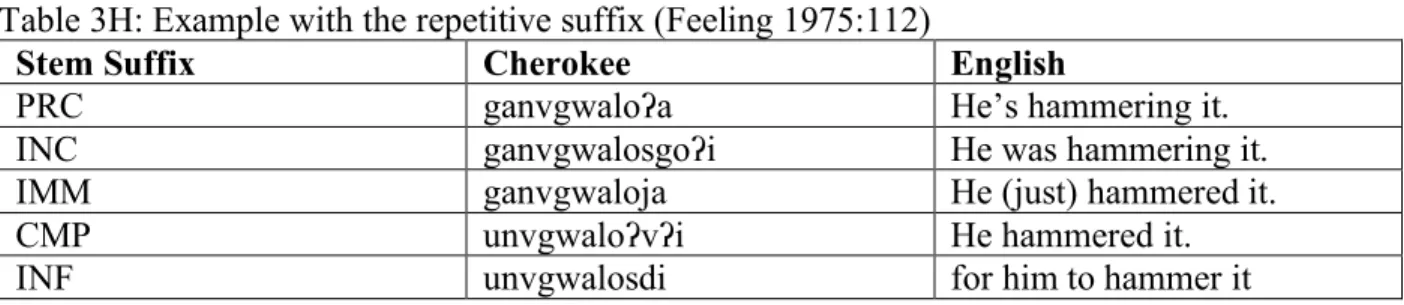
Table 3H: Example with the repetitive suffix (Feeling 1975:112)
Stem Suffix Cherokee English
PRC ganvgwaloʔa He’s hammering it.
INC ganvgwalosgoʔi He was hammering it.
IMM ganvgwaloja He (just) hammered it.
CMP unvgwaloʔvʔi He hammered it.
INF unvgwalosdi for him to hammer it
Table 3I: Terminative stem suffixes (Montgomery-Anderson 2015:387)
PRC INC IMM CMP INF
-sga -sg- -na -(h)n- -sdi
“The terminative indicates a definitive completion of the action” (Montgomery-Anderson 2015:387).
Table 3J: Example with the terminative suffix (Feeling 1975:57)
Stem Suffix Cherokee English
PRC asvhvsga He’s using it up.
INC asvhvsgoʔi He was using it up.
IMM asvhna He (just) used it up.
CMP usvhnvʔi He used it up.
INF usvhvsdi for him to use it up
Table 3K: Ambulative stem suffixes (Montgomery-Anderson 2015:388)
PRC INC IMM CMP INF
-ha -h- -a -l- -sdi
“The ambulative expresses the idea of repeated movement” (Montgomery-Anderson 2015:388). Table 3L: Example with the ambulative suffix (Feeling 1975:100)
Stem Suffix Cherokee English
PRC galidoha He’s climbing around.
INC galidohoʔi He was climbing around.
IMM galida He (just) climbed around.
CMP ulidolvʔi He climbed around.
INF ulidasdi for him to climb around
Table 3M: Movement stem suffixes (Montgomery-Anderson 2015:390)
PRC INC IMM CMP INF
-ga -g- -na/-ga -s- -sdi
Table 3N: Example with the movement suffix (Feeling 1975:111)
Stem Suffix Cherokee English
PRC gansinega He’s dragging it.
INC gansinegoʔi He was dragging it.
IMM gansinuga He (just) dragged it.
CMP unsinvsvʔi He dragged it.
INF unsinvsdi for him to drag it
Table 3O: Applicative stem suffixes (Montgomery-Anderson 2015:400)
PRC INC IMM CMP INF
-ha -h- -li/-si -l- -hdi
The applicative suffix is a valency-increasing suffix, so it is “attached to verbs to indicate the presence of an additional object affected by the verb” (Montgomery-Anderson 2015:400). Table 3P: Example with the applicative suffix (Feeling 1975:174)
Stem Suffix Cherokee English
PRC ulsdahneha It’s happening to him.
INC ulsdahnehoʔi It was happening to him.
IMM ulsdasi It (just) happened to him.
CMP ulsdahnelvʔi It happened to him.
INF ulsdahnehdi for it to happen to him
Table 3Q: Causative stem suffixes (Montgomery-Anderson 2015:405)
PRC INC IMM CMP INF
-ha -sg -a -an-/-n- -(h)di
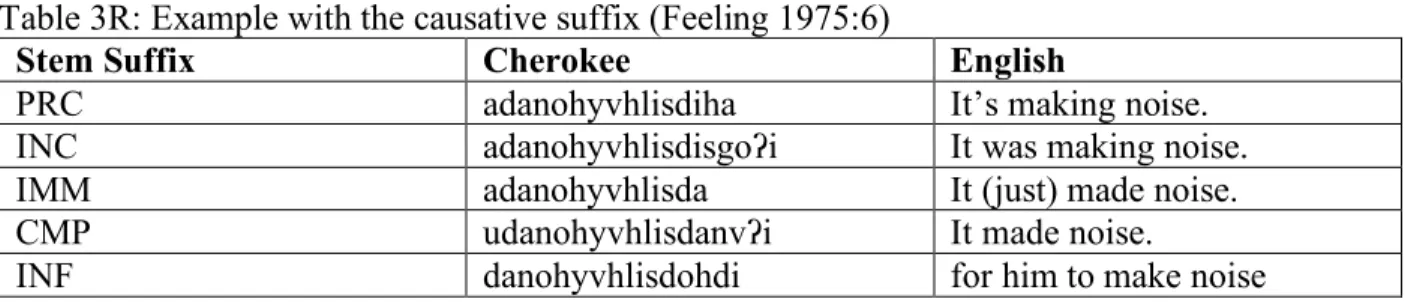
The causative suffix is a valency-increasing suffix just as the applicative suffix is. It “raises the valency of the verb by indicating a participant that causes the action” (Montgomery-Anderson 2015:405).
Table 3R: Example with the causative suffix (Feeling 1975:6)
Stem Suffix Cherokee English
PRC adanohyvhlisdiha It’s making noise.
INC adanohyvhlisdisgoʔi It was making noise.
IMM adanohyvhlisda It (just) made noise.
CMP udanohyvhlisdanvʔi It made noise.
The number of verbs in the dictionary that I did not record totaled 348 verbs. After recording the stem suffix forms of the remaining 357 verbs in the format discussed above, I began to group certain verbs together based on which stem suffix forms they took. A verb’s five stem suffix forms make up what I call a verb’s pattern. I put verbs into groups with other verbs that shared the same pattern; in other words, I grouped together verbs that had identical stem suffix forms in each of the five stem suffix categories. For example, the verbs meaning “to tell,” “to think,” and “to cheat,” each patterned with the following stem suffix forms:
Table 3S: The stem suffix pattern of the verbs meaning “to tell”, “to think”, and “to cheat”
PRC INC IMM CMP INF
-ha -sg- -vla -hl- -hdi
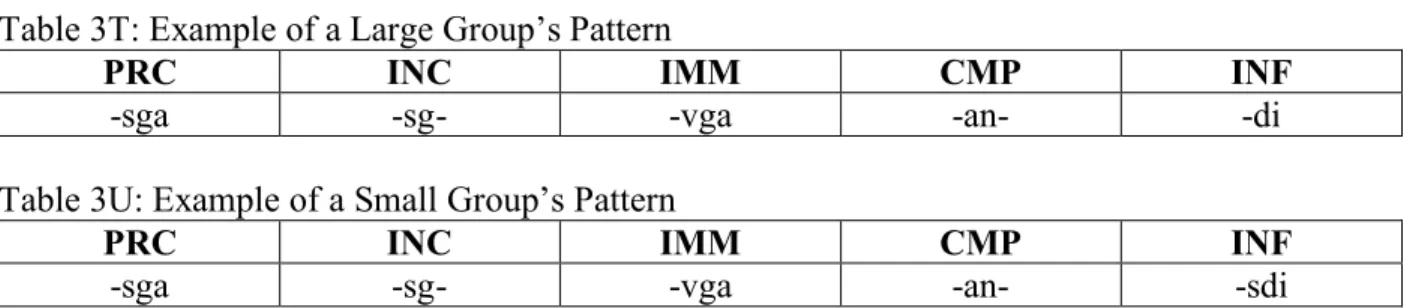
After doing this with all 357 verbs I had over 50 groups, meaning that I had over 50 patterns. Some groups had upwards of 30 verbs in them whereas others only had one or two verbs that belonged to that group’s pattern. Next, I identified the largest groups of verbs and their patterns. Then I looked for smaller groups whose patterns were similar to those of the largest groups. If a smaller group’s pattern matched three or four of the stem suffix forms of the largest group’s pattern, I then condensed the two groups into one. Below are some examples of large and small groups and their patterns.
Table 3T: Example of a Large Group’s Pattern
PRC INC IMM CMP INF
-sga -sg- -vga -an- -di
Table 3U: Example of a Small Group’s Pattern
PRC INC IMM CMP INF
-sga -sg- -vga -an- -sdi
SECTION 4: CHEROKEE VERB CLASSES
Below is a table presenting the eleven verb classes I propose for Cherokee. The columns labeled “Verb Class” and “Root-Final Syllables” give the number of the verb class and the root-final syllables that the verbs belonging to that class take. The five columns that follow are labeled according to the five stem suffix categories. The forms listed in these five columns make up the prototypical pattern of a verb class. The forms that a verb takes in each of the five stem suffix categories determines whether or not it can fit into this pattern. The column labeled “Accuracy” gives the number of verbs that fit into a class’s prototypical pattern out of the total number of verbs recorded for that class. The number is also given as a percentage. This number shows how accurate the prototypical pattern is for the verbs in that class. For example, 33 verbs were recorded for Class I, and 29 of them fit into Class I’s pattern. Class I’s pattern is accurate for 88% of the verbs in that class.
Table 4: Cherokee Verb Classes Verb
Class Root-Final Syllables
PRC INC IMM CMP INF Accuracy
I di, wi ʔa sg a/vga/aga ø/an/
vh/l sdi/odi/tdi/di/asdi 29/33 (88%)
II gi, ʔi ʔa sg ø/a s sdi 18/23 (78%)
III gv, yv ʔa sg na s sdi 8/12 (75%)
IV de, le, ne,
te, we ʔa sg agi/aga/i s/sg/aʔ sdi 23/39 (59%)
V hi, ni, yo ha/hiha h/hih ga/a/ø/ʔa (h)l/al sdi/di/asdi 25/37 (68%) VI ge, he,
ke, ye, ʔv
ha/ʔa sg vla/a h/ʔ hdi/di 15/18 (83%) VII li, ti, yi ha/ʔa sg a/vna vh/vhn (vh)di 20/39 (51%) VIII dv, hlu,
hv, lv, nv, tv, ʔv
sga sg ga/ʔvga/na an/n/hn di/hdi/sdi/ tdi/kdi/ ohdi/nhdi
63/75 (84%)
IX go sga sg la s sdi 6/9 (67%)
X l, t, w sga/isga sg sa/a/ø/i s sdi/isdi 10/18 (56%)
Each of the eleven verb classes are discussed below in greater detail. There are three tables given for each class. The first table shows the prototypical pattern of the class. It presents the stem suffix forms of the majority of the patterns taken by the verbs in the class. Each class has a unique prototypical pattern that sets it apart from every other class. The prototypical pattern is the most important pattern for second language learners of Cherokee to learn. Once having identified a verb as belonging to a certain class, a learner can apply the pattern to the verb and know which forms it takes in each of the five stem suffix categories. The second table shows every pattern that occurs for all of the verbs in a given class, and how many times it occurs. The purpose of this table is to show which pattern is the most frequent one and which patterns occur only infrequently. The third table shows how many of the class’s patterns have a certain number of stem suffix forms that are identical to those of the most frequent pattern. The purpose of this table is to show how accurately the class’s most frequent pattern represents the other patterns of the class. This is important information for second language learners of Cherokee who might make generalizations about how verbs that belong to that class pattern based on the most frequent pattern of that class. Following the three tables are several examples that are given for the verbs in each class. The Incompletive and Completive forms of the verbs are given in full; their final suffixes, [-oʔi] and [-vʔi], are attached to the verb stem.
4.1 Class I Verbs
Table 4.1 A: The Prototypical Pattern of Class I
PRC INC IMM CMP INF
-ʔa -sg- -a/-vga/-aga -ø-/-an-/-vh-/-l- -sdi/-odi/-tdi/ -di/-asdi
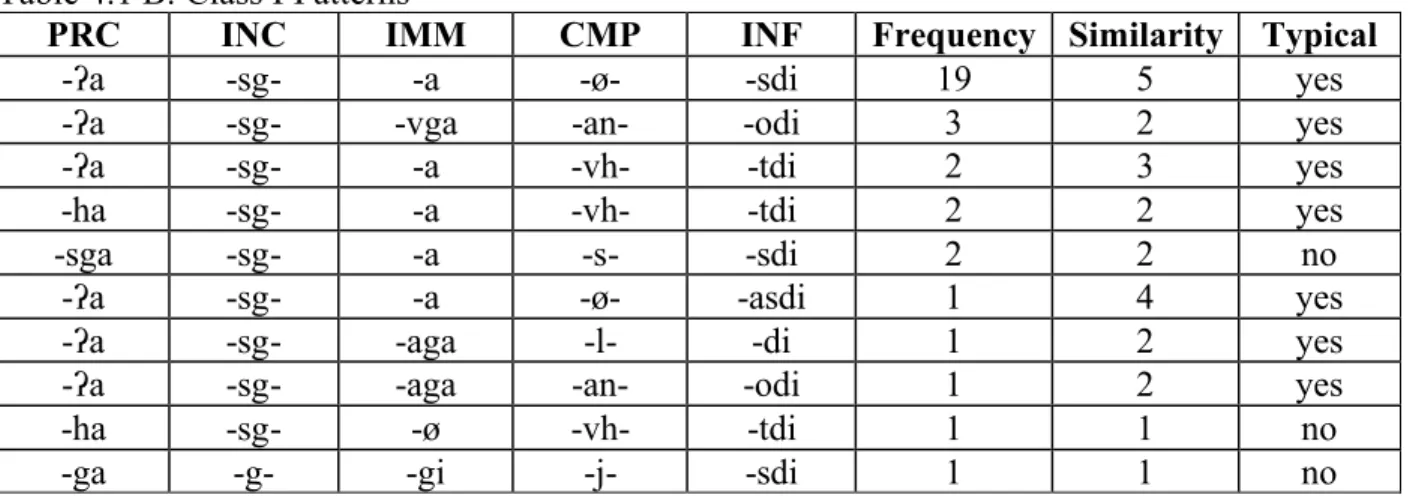
Class I verbs have root-final syllables that end in [di] and [wi]. I say that these root-final syllables end in [di] and [wi] instead of saying that they are [di] and [wi], because an additional phoneme will often precede them. If this is case, then the root-final syllable could be [hdi] instead of [di] or [hwi] instead of [wi]. There are 33 verbs from my data that belong to this class. The most frequent pattern occurs 19 times. Four of the patterns in this class are exceptions. Exceptional patterns are those that do not fit into the prototypical pattern of the class. A pattern fits into the prototypical pattern if all five of its stem suffix forms are ones that are listed as stem suffix forms of the prototypical pattern. The patterns in this class that are not exceptions have stem suffix forms that are identical to those of the most frequent pattern in the Present
Continuous and the Incompletive. They take forms that are phonologically similar to those of the most frequent pattern in the Immediate and the Infinitive. No patterns, save for one that is an exception, take the form [s] in the Completive; this sets this class apart from Class II.
of a pattern’s stem suffix forms are identical to those of the most frequent pattern does not guarantee it to be a typical pattern. Similarly, just because a given pattern only has two stem suffix forms that are identical to those of the most frequent pattern does not guarantee it to be an atypical pattern. What makes a pattern typical, and what allows it to be included in the class’s prototypical pattern, is which of its stem suffix forms match those of the most frequent pattern. Typical patterns almost always have forms identical to those of the most frequent pattern in the Present Continuous and the Incompletive. They rarely have identical forms to those of the most frequent pattern in the Immediate and the Completive, but their forms are phonologically similar. Therefore, a typical pattern’s forms could be identical to those of the most frequent pattern only in the Present Continuous and Incompletive forms but still be considered a typical pattern. Some atypical patterns also take forms that are identical to those of the most frequent pattern in the Present Continuous and Incompletive; however, their forms in the Immediate and Completive are not phonologically similar to those of the most frequent pattern.
Table 4.1 B: Class I Patterns
PRC INC IMM CMP INF Frequency Similarity Typical
-ʔa -sg- -a -ø- -sdi 19 5 yes
-ʔa -sg- -vga -an- -odi 3 2 yes
-ʔa -sg- -a -vh- -tdi 2 3 yes
-ha -sg- -a -vh- -tdi 2 2 yes
-sga -sg- -a -s- -sdi 2 2 no
-ʔa -sg- -a -ø- -asdi 1 4 yes
-ʔa -sg- -aga -l- -di 1 2 yes
-ʔa -sg- -aga -an- -odi 1 2 yes
-ha -sg- -ø -vh- -tdi 1 1 no
-ga -g- -gi -j- -sdi 1 1 no
by the total number of verbs in this class. This fraction is also given as a percentage. The column labeled “4+” gives the number of verbs in this class that have four or more stem suffix forms that are identical to those of the most frequent pattern divided by the total number of verbs in this class. Again, this fraction is also given as a percentage. The column labeled “3+” gives the number of verbs in this class that have three or more stem suffix forms that are identical to those of the most frequent pattern divided by the total number of verbs in the class. The columns labeled “2+” and “1+” give the same kind of information as the information in columns “4+” and “3+.” The last column, labeled “0,” gives the number of verbs in this class that have no stem suffix forms in common with those of the most frequent pattern divided by the total number of verbs in this class.
Fifty-eight percent of the verbs in this class pattern according to the stem suffix forms of the most frequent pattern. Sixty-one percent of the verbs in this class have at least four stem suffix forms in common with those of the most frequent pattern; 67 percent have at least three, and 94 percent have at least two. No pattern in this class has five stem suffix forms that are entirely different from those of the most frequent pattern.
Table 4.1 C: Comparison to the Most Frequent Pattern of Class I
5 4+ 3+ 2+ 1+ 0
19/33 20/33 22/33 31/33 33/33 0/33
58% 61% 67% 94% 100% 0%
Table 4.1 D: Example with [di] (Feeling 1975:51)
Stem Suffix Category Cherokee English
PRC asgolvdiʔa He’s erasing it.
INC asgolvdisgoʔi He was erasing it.
IMM asgolvda He (just) erased it.
CMP usgolvdvʔi He erased it.
INF usgolvdisdi for him to erase
Table 4.1 E: Example with [wi] (Feeling 1975:31)
Stem Suffix Category Cherokee English
PRC ajewiʔa He’s spilling it.
INC ajewisgoʔi He was spilling it.
IMM ajewa He (just) spilled it.
CMP ujewvʔi He spilled it.
INF ujewasdi for him to spill
4. 2 Class II Verbs
Table 4.2 A shows the prototypical pattern for verbs in Class II. Eighteen out of the 23 verbs in this class fit this pattern. Seventy-eight percent of the verbs in Class II have patterns that are represented by this one.
Table 4.2 A: The Prototypical Pattern of Class II
PRC INC IMM CMP INF
-ʔa -sg- -ø/-a -s- -sdi
Accuracy of the Most
Frequent Pattern (Class I)
Verbs with the most frequent pattern Verbs with other patterns
Accuracy of the Prototypical
Pattern (Class I)
Class II verbs have root-final syllables that end in [gi] and [ʔi]. There are 23 verbs from my data that belong to this class. The most frequent pattern occurs 17 times. The patterns whose stem suffix forms are not [s] in the Completive are exceptions. This class, like Class I, has root-final syllables that end in the vowel [i], but it is distinguished from Class I by its stem suffix form, [s], in the Completive.
Table 4.2 B: Class II Patterns
PRC INC IMM CMP INF Frequency Similarity Typical
-ʔa -sg- -ø -s- -sdi 17 5 yes
-ʔa -sg- -vga -an- -odi 4 2 no
-ʔa -sg- -a -s- -sdi 1 4 yes
-ʔa -sg- -a -ø- -sdi 1 3 no
Seventy-four percent of the verbs in this class pattern according to the stem suffix forms of the most frequent pattern. Seventy-eight percent of the verbs in this class have at least four stem suffix forms in common with those of the most frequent pattern, and 83 percent have at least three. One hundred percent of verbs in this class have at least two stem suffix forms in common with those of the most frequent pattern even though two out of four of this class’s patterns are exceptions. No pattern in this class has five stem suffix forms that are entirely different from those of the most frequent pattern.
Table 4.2 C: Comparison to the Most Frequent Pattern of Class II
5 4+ 3+ 2+ 1+ 0
17/23 18/23 19/23 23/23 23/23 0/23
Table 4.2 D: Example with [gi] (Feeling 1975:54)
Stem Suffix Category Cherokee English
PRC asolvdagiʔa He’s waving his hand.
INC asolvdagisgoʔi He was waving his hand.
IMM asolvdagi He (just) waved his hand.
CMP usolvdagisvʔi He waved his hand.
INF usolvdagisdi to wave his hand
Table 4.2 E: Example with [ʔi] (Feeling 1975:48)
Stem Suffix Category Cherokee English
PRC asduʔiʔa He’s opening it.
INC asduʔisgoʔi He was opening it.
IMM asduʔi He (just) opened it.
CMP usduʔisvʔi He opened it.
INF usduʔisdi for him to open it
4.3 Class III Verbs
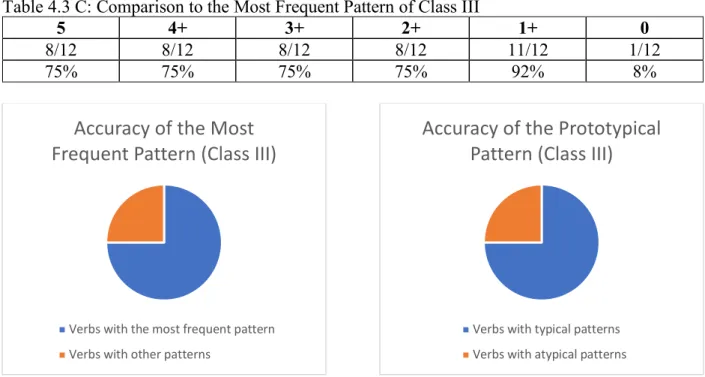
Table 4.3 A shows the prototypical pattern for verbs in Class III. Eight out of the 12 verbs in this class fit this pattern. Seventy-five percent of the verbs in Class III have patterns that are represented by this one.
Table 4.3 A: The Prototypical Pattern of Class III
PRC INC IMM CMP INF
-ʔa -sg- -na -s- -sdi
Accuracy of the Most
Frequent Pattern (Class II)
Verbs with the most frequent pattern Verbs with other patterns
Accuracy of the Prototypical
Pattern (Class II)
Class III verbs have verb roots that end in [gv] and [yv]. Class III is a small class, with only 12 verbs from my data that belong to this class. The most frequent pattern occurs eight times. Every other pattern is an exception. Other verbs with root-final syllables ending in the vowel [v] belong to Class VIII. Class III is distinguished from Class VIII by its stem suffix forms in the Present Continuous and the Completive.
Table 4.3 B: Class III Patterns
PRC INC IMM CMP INF Frequency Similarity Typical
-ʔa -sg- -na -s- -sdi 8 5 yes
-hiha -hih- -ha -hl- -sdi 1 1 no
-sga -sg- -ga -n- -di 1 1 no
-sga -sg- -hi -s- -hisdi 1 1 no
-ga -g- -gi -j- -ʔisdi 1 0 no
Seventy-five percent of the verbs in this class pattern according to the stem suffix forms of the most frequent pattern. Seventy-five percent of the verbs in this class have at least four stem suffix forms in common with those of the most frequent pattern; 75 percent have at least three, 75 percent have at least two, and 92 percent have at least one. This class has one pattern with five stem suffix forms that are entirely different from those of the most frequent pattern. Table 4.3 C: Comparison to the Most Frequent Pattern of Class III
5 4+ 3+ 2+ 1+ 0
8/12 8/12 8/12 8/12 11/12 1/12
75% 75% 75% 75% 92% 8%
Accuracy of the Most
Frequent Pattern (Class III)
Verbs with the most frequent pattern Verbs with other patterns
Accuracy of the Prototypical
Pattern (Class III)
Table 4.3 D: Example with [gv] (Feeling 1975:38)
Stem Suffix Category Cherokee English
PRC alasgvʔa He’s taking a step.
INC alasgvsgoʔi He was taking a step.
IMM alasgvna He (just) took a step.
CMP ulasgvsvʔi He took a step.
INF ulasgvsdi for him to take a step
Table 4.3 E: Example with [yv] (Feeling 1975:117)
Stem Suffix Category Cherokee English
PRC gawohiliyvʔa He’s replying.
INC gawonihiliyvsgoʔi He was replying.
IMM gawonihiliyvna He (just) replied.
CMP uwonihiliyvsvʔi He replied.
INF uwonihiliyvsdi for him to reply
4.4 Class IV Verbs
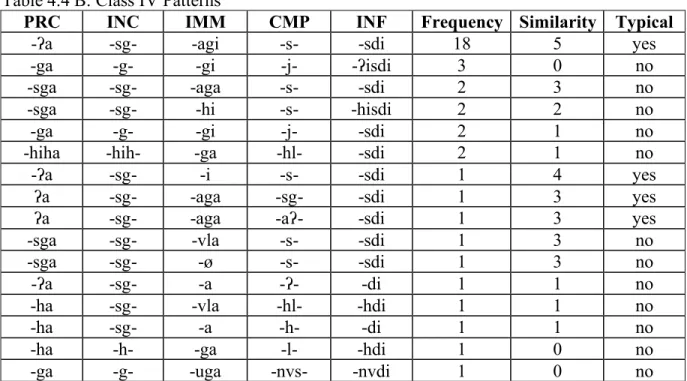
Table 4.4 A shows the prototypical pattern for verbs in Class IV. Twenty-three out of the 39 verbs in this class fit this pattern. Fifty-nine percent of the verbs in Class IV have patterns that are represented by this one. In the case of this class, the prototypical pattern is a much better representation of the stem suffix forms that the verbs in this class take than the most frequent pattern is.
Table 4.4 A: The Prototypical Pattern of Class IV
PRC INC IMM CMP INF
-ʔa -sg- -agi/-aga/-i -s-/-sg-/-aʔ- -sdi
Class IV verbs have root-final syllables that end in [de], [le], [ne], [te], and [we]. There are 39 verbs from my data that belong to this class. The most frequent pattern occurs 18 times. There are 12 patterns that are considered exceptional patterns because they do fit into the
Table 4.4 B: Class IV Patterns
PRC INC IMM CMP INF Frequency Similarity Typical
-ʔa -sg- -agi -s- -sdi 18 5 yes
-ga -g- -gi -j- -ʔisdi 3 0 no
-sga -sg- -aga -s- -sdi 2 3 no
-sga -sg- -hi -s- -hisdi 2 2 no
-ga -g- -gi -j- -sdi 2 1 no
-hiha -hih- -ga -hl- -sdi 2 1 no
-ʔa -sg- -i -s- -sdi 1 4 yes
ʔa -sg- -aga -sg- -sdi 1 3 yes
ʔa -sg- -aga -aʔ- -sdi 1 3 yes
-sga -sg- -vla -s- -sdi 1 3 no
-sga -sg- -ø -s- -sdi 1 3 no
-ʔa -sg- -a -ʔ- -di 1 1 no
-ha -sg- -vla -hl- -hdi 1 1 no
-ha -sg- -a -h- -di 1 1 no
-ha -h- -ga -l- -hdi 1 0 no
-ga -g- -uga -nvs- -nvdi 1 0 no
Only 46 percent of the verbs in this class pattern according to the stem suffix forms of the most frequent pattern. Forty-nine percent of the verbs in this class have at least four stem suffix forms in common with those of the most frequent pattern; 64 percent have at least three, 69 percent have at least two, and 87 percent have at least one. Thirteen percent of the verbs in this class have patterns with five stem suffix forms that are entirely different from those of the most frequent pattern.
Table 4.4 C: Comparison to the Most Frequent Pattern of Class IV
5 4+ 3+ 2+ 1+ 0
18/39 19/39 25/39 27/39 34/39 5/39
Table 4.4 D: Example with [de] (Feeling 1975:33)
Stem Suffix Category Cherokee English
PRC akodeʔa He’s shoveling.
INC akodesgoʔi He was shoveling.
IMM akodagi He (just) shoveled.
CMP ukodesvʔi He shoveled.
INF ukodesdi for him to shovel
Table 4.4 E: Example with [le] (Feeling 1975:41)
Stem Suffix Category Cherokee English
PRC alsduleʔa He’s taking off his cap.
INC alsdulesgoʔi He was taking off his cap.
IMM alsdulagi He (just) took off his cap.
CMP ulsdulesvʔi He took off his cap.
INF ulsdulesdi to take off one’s cap
Table 4.4 F: Example with [ne] (Feeling 1975:111)
Stem Suffix Category Cherokee English
PRC gansaneʔa He’s pulling.
INC gansanesgoʔi He was pulling.
IMM gansanagi He (just) pulled.
CMP unsanesvʔi He pulled.
INF unsanesdi for him to pull
Accuracy of the Most
Frequent Pattern (Class IV)
Verbs with the most frequent pattern Verbs with other patterns
Accuracy of the Prototypical
Pattern (Class IV)
Table 4.4 G: Example with [te] (Feeling 1975:29)
Stem Suffix Category Cherokee English
PRC ahyvteʔa He’s kicking.
INC ahyvhtesgoʔi He was kicking.
IMM ahyvhtagi He (just) kicked.
CMP uhyvhtesvʔi He kicked.
INF uhyvhtesdi to kick
Table 4.4 H: Example with [we] (Feeling 1975:69)
Stem Suffix Category Cherokee English
PRC dahnaweʔa He’s undressing.
INC dahnawesgoʔi He was undressing.
IMM dahnawagi He (just) undressed.
CMP duhnawesvʔi He undressed.
INF duhnawesdi for him to undress
4.5 Class V Verbs
Table 4.5 A shows the prototypical pattern for verbs in Class V. Twenty-five out of the 37 verbs in this class fit this pattern. Sixty-eight percent of the verbs in Class V have patterns that are represented by this one. Like in the case of Class IV, the prototypical pattern of this class is a much better representation of the stem suffix forms that the verbs in this class take than the most frequent pattern is.
Table 4.5 A: The Prototypical Pattern of Class V
PRC INC IMM CMP INF
-ha/-hiha -h-/-hih- -ga/-a/-ø/-ʔa -(h)l/-al -sdi/-di/-asdi
Table 4.5 B: Class V Patterns
PRC INC IMM CMP INF Frequency Similarity Typical
-ha -h- -ga -l- -sdi 12 5 yes
-hiha -hih- -ga -(h)l- -sdi 3 2 yes
-ha -sg- -a -vh- -hdi 3 1 no
-sga -sg- -hi -s- -hisdi 3 0 no
-ha -h- -ga -l- -di 2 4 yes
-ha -h- -ga -al- -sdi 2 4 yes
-hiha -hih- -ha -hl- -sdi 2 1 yes
-ga -g- -gi -j- -sdi 2 1 no
-ha -h- -ʔa -l- -sdi 1 4 yes
-ha -h- -ø -l- -sdi 1 4 yes
-ha -h- -aga -l- -di 1 3 yes
-ha -h- -aga -l- -asdi 1 3 yes
-ha -sg- -hi -s- -hisdi 1 1 no
-ʔa -sg- -ø -s- -sdi 1 1 no
-ʔa -sg- -a -vh- -hdi 1 0 no
-ga -g- -gi -j- -ysdi 1 0 no
Only 32 percent of the verbs in this class pattern according to the stem suffix forms of the most frequent pattern. Forty-nine percent of the verbs in this class have at least four stem suffix forms in common with those of the most frequent pattern; 54 percent have at least three, 62 percent have at least two, and 86 percent have at least one. Fourteen percent of the verbs in this class have patterns with five stem suffix forms that are entirely different from those of the most frequent pattern.
Table 4.5 C: Comparison to the Most Frequent Pattern of Class V
5 4+ 3+ 2+ 1+ 0
12/37 18/37 20/37 23/37 32/37 5/37
Table 4.5 D: Example with [hi] (Feeling 1975:62)
Stem Suffix Category Cherokee English
PRC ayatohiha He is distributing something.
INC ayatohihoʔi He was distributing something.
IMM ayatohi He (just) distributed something.
CMP uyatohlvʔi He distributed something.
INF uyatohisdi for him to distribute something Table 4.5 E: Example with [ni] (Feeling 1975:57)
Stem Suffix Category Cherokee English
PRC asvhniha He’s touching him.
INC asvhnihoʔi He was touching him.
IMM asvnhga He (just) touched him.
CMP usvhnilvʔi He touched him.
INF usvnsdi for him to touch him
Table 4.5 F: Example with [yo] (Feeling 1975:6)
Stem Suffix Category Cherokee English
PRC adanuteyoha He’s twisting.
INC adanuteyohoʔi He was twisting.
IMM adanuteyaga He (just) twisted.
CMP udanuteyolvʔi He twisted.
INF udanuteyodi for him to twist
Accuracy of the Most
Frequent Pattern (Class V)
Verbs with the most frequent pattern Verbs with other patterns
Accuracy of the Prototypical
Pattern (Class V)
4.6 Class VI Verbs
Table 4.6 A shows the prototypical pattern for verbs in Class VI. Fifteen out of 18 verbs in this class fit this pattern. Eighty-three percent of the verbs in Class VI have patterns that are represented by this one.
Table 4.6 A: The Prototypical Pattern of Class VI
PRC INC IMM CMP INF
-ha/-ʔa -sg- -vla/-a -h/-ʔ -hdi/-di
Class VI, like Class III, is a relatively small class. The verbs in this class have root-final syllables that end in [ge], [he], [ke], [ye], and [ʔe]. There are 18 verbs from my data that belong to this class. The most frequent pattern occurs ten times, and there are two patterns that are exceptions. Class IV verbs also have root-final syllables that end in [e]. Class VI is distinguished from Class IV by its stem suffix forms in the Immediate and the Completive.
Table 4.6 B: Class VI Patterns
PRC INC IMM CMP INF Frequency Similarity Typical
-ha -sg- -vla -h(l)- -hdi 10 5 yes
-ʔa -sg- -a -ʔ- -di 4 1 yes
-ha -sg- -a -h- -hdi 1 3 yes
-ʔa -sg- -agi -s- -sdi 1 1 no
-sga -sg- -hi -s- -hisdi 1 1 no
-ga -g- -gi -j- -ʔisdi 1 0 no
Table 4.6 C: Comparison to the Most Frequent Pattern of Class VI
5 4+ 3+ 2+ 1+ 0
10/18 10/18 11/18 11/18 17/18 1/18
56% 56% 61% 61% 94% 6%
Table 4.6 D: Example with [ge] (Feeling 1975:68)
Stem Suffix Category Cherokee English
PRC dahlihgeha He’s rocking.
INC dahlihgesgoʔi He was rocking.
IMM dahlihgvla He (just) rocked.
CMP dahlihgehvʔi He rocked.
INF dahlihgehdi for him to rock
Table 4.6 E: Example with [he] (Feeling 1975:141)
Stem Suffix Category Cherokee English
PRC anoheha He’s telling it.
INC anohesgoʔi He was telling it.
IMM anohvla He (just) told it.
CMP anohehlvʔi He told it.
INF anohehdi for him to tell it
Table 4.6 F: Example with [ke] (Feeling 1975:4)
Stem Suffix Category Cherokee English
PRC adakeha He’s looking at himself in a mirror. INC adakesgoʔi He was looking at himself in a mirror. IMM adakvla He (just) looked at himself in a mirror. CMP adakehvʔi He looked at himself in a mirror. INF adakehdi for him to look at himself in a mirror
Accuracy of the Most
Frequent Pattern (Class VI)
Verbs with the most frequent pattern Verbs with other patterns
Accuracy of the Prototypical
Pattern (Class VI)
Table 4.6 G: Example with [ye] (Feeling 1975:6)
Stem Suffix Category Cherokee English
PRC adahnoyeha He’s fanning himself.
INC adahnoyesgoʔi He was fanning himself.
IMM adahnoyvla He (just) fanned himself.
CMP udahnoyehvʔi He fanned himself.
INF udahnoyehdi to fan himself
Table 4.6 H: Example with [ʔe] (Feeling 1975:37)
Stem Suffix Category Cherokee English
PRC alasdaʔeha He’s speaking badly of it.
INC alasdaʔesgoʔi He was speaking badly of it. IMM alasdaʔvla He (just) spoke badly of it.
CMP alasdaʔehlvʔi He spoke badly of it.
INF alasdaʔehdi for him to speak badly of it
4.7 Class VII Verbs
Table 4.7 A shows the prototypical pattern for verbs in Class VII. Twenty out of the 39 verbs in this class fit this pattern. Fifty-one percent of the verbs in Class VII have patterns that are represented by this one. Like in the cases of Classes IV and VI, the prototypical pattern of Class VII is a much better representation of the stem suffix forms that the verbs in this class take than the most frequent pattern is.
Table 4.7 A: The Prototypical Pattern of Class VII
PRC INC IMM CMP INF
-ha/-ʔa -sg- -a/-vna -vh-/-vhn- -(vh)di
Table 4.7 B: Class VII Patterns
PRC INC IMM CMP INF Frequency Similarity Typical
-ha -sg- -a -vh- -(vh)di 12 5 yes
-ha -h- -ga -(h)l- -sdi 6 1 no
-ʔa -sg- -a -vh- -di 4 4 yes
-ʔa -sg- -vga -an- -odi 4 1 no
-ga -g- -gi -j- -sdi 4 0 no
-ha -sg- -vna -vhn- -vhdi 2 3 yes
-ʔa -sg- -a -s- -sdi 2 2 no
-sga -sg- -hi -s- -hisdi 2 1 no
-ʔa -sg- -a -vh- -di 1 4 yes
-ha -sg- -a -vhn- -di 1 3 yes
-ʔa -sg- -ø -s- -sdi 1 1 no
Only 31 percent of the verbs in this class pattern according to the stem suffix forms of the most frequent pattern. Fourty-four percent of the verbs in this class have at least four stem suffix forms in common with those of the most frequent pattern; 51 percent have at least three, 56 percent have at least two, and 90 percent have at least one. Ten percent of the verbs in this class have patterns with five stem suffix forms that are entirely different from those of the most frequent pattern.
Table 4.7 C: Comparison to the Most Frequent Pattern of Class VII
5 4+ 3+ 2+ 1+ 0
12/39 17/39 20/39 22/39 35/39 4/39
31% 44% 51% 56% 90% 10%
Accuracy of the Most
Frequent Pattern (Class VII)
Verbs with the most frequent pattern Verbs with other patterns
Accuracy of the Prototypical
Pattern (Class VII)
Table 4.7 D: Example with [li] (Feeling 1975:47)
Stem Suffix Category Cherokee English
PRC asdeliha He’s helping.
INC asdelisgoʔi He was helping.
IMM asdela He (just) helped.
CMP asdelvʔi He helped.
INF asdelisdi for him to help
Table 4.7 E: Example with [ti] (Feeling 1975:18)
Stem Suffix Category Cherokee English
PRC agowhtiha He sees it.
INC agowhtisgoʔi He was seeing it.
IMM agowhta He (just) say it.
CMP ugohvʔi He saw it.
INF ugowhtvhdi for him to see it
Table 4.7 F: Example with [yi] (Feeling 1975:13)
Stem Suffix Category Cherokee English
PRC adloyiha He’s crying.
INC adloyihoʔi He was crying.
IMM adloyiga He (just) cried.
CMP adloyilvʔi He cried.
INF adloyisdi for him to cry
4.8 Class VIII Verbs
Table 4.8 A shows the prototypical pattern for verbs in Class VIII. Sixty-three out of the 75 verbs in this class fit this pattern. Eighty-four percent of the verbs in Class VIII have patterns that are represented by this one.
Table 4.8 A: The Prototypical Pattern of Class VIII
PRC INC IMM CMP INF
suffix forms of the most frequent pattern in the Immediate and the Completive. The third and fourth most frequent patterns also differ only minimally from the most frequent one.
Table 4.8 B: Class VIII Patterns
PRC INC IMM CMP INF Frequency Similarity Typical
-sga -sg- -ga -an- -di 32 5 yes
-sga -sg- -ʔvga -n- -di 8 3 yes
-sga -sg- -na -(h)n- -(h)di 5 3 yes
-sga -sg- -ga -an- -sdi 4 4 yes
-sga -sg- -ga -n- -tdi 4 3 yes
-sga -sg- -hi -s- -hisdi 4 2 no
-sga -sg- -ga -n- -di 3 4 yes
-sga -sg- -ga -in- -di 2 4 yes
-sga -sg- -ga -n- -sdi 2 3 yes
-ga -g- -gi -j- -sdi 2 0 no
-ga -g- -gi -g- -ʔisdi 2 0 no
-ga -g- -gi -j- -ysdi 2 0 no
-sga -sg- -ga -n- -kdi 1 3 yes
-sga -sg- -ga -n- -ohdi 1 3 yes
-sga -sg- -na -hn- -nhdi 1 2 yes
-sga -sg- -la -s- -sdi 1 2 no
-ʔa -sg- -na -s- -sdi 1 1 no
Fourty-three percent of the verbs in this class pattern according to the stem suffix forms of the most frequent pattern. Fifty-five percent of the verbs in this class have at least four stem suffix forms in common with those of the most frequent pattern, whereas 83 percent have at least three, 91 percent have at least two, and 92 percent have at least one. Eight percent of the verbs in this class have patterns with five stem suffix forms that are entirely different from those of the most frequent pattern.
Table 4.8 C: Comparison to the Most Frequent Pattern of Class VIII
5 4+ 3+ 2+ 1+ 0
32/75 41/75 62/75 68/75 69/75 6/75
Table 4.8 D: Example with [dv] (Feeling 1975:29)
Stem Suffix Category Cherokee English
PRC ahyvhgwidvsga He is bending it.
INC ahyvhgwidvsgoʔi He was bending it.
IMM ahyvhgwidvʔvga He (just) bent it.
CMP ahyvhgwidvnvʔi He bent.
INF ahyvhgwidvdi for him to bend it
Table 4.8 E: Example with [hlu] (Feeling 1975:42)
Stem Suffix Category Cherokee English
PRC alsdvhlusga He is taking a seat.
INC alsdvhlusgoʔi He was taking a seat.
IMM alsdvhluga He (just) took a seat.
CMP alsdvhlunʔi He took a seat.
INF alsdvhlusdi for him to take a seat
Table 4.8 F: Example with [hv] (Feeling 1975:23)
Stem Suffix Category Cherokee English
PRC ahltelvhvsga He’s moving.
INC ahltelvhvsgoʔi He was moving.
IMM ahltelvhvga He (just) moved.
CMP uhltelvhnvʔi He moved.
INF uhltehldi for him to move
Accuracy of the Most
Frequent Pattern (Class VIII)
Verbs with the most frequent pattern Verbs with other patterns
Accuracy of the Prototypical
Pattern (Class VIII)
Table 4.8 G: Example with [lv] (Feeling 1975:72)
Stem Suffix Category Cherokee English
PRC alasuhlvsga He’s putting on shoes.
INC alasuhlvsgoʔi He was putting on shoes.
IMM alasuhlvga He (just) put on shoes.
CMP alasuhlanvʔi He put on shoes.
INF alasuhlvdi for him to put on shoes
Table 4.8 H: Example with [nv] (Feeling 1975:30)
Stem Suffix Category Cherokee English
PRC ajanvsga He’s dressing up.
INC ajanvsgoʔi He was dressing up.
IMM ajanvna He (just) dressed up.
CMP ajanvhnvʔi He dressed up.
INF ajanvhdi for him to dress up
Table 4.8 I: Example with [tv] (Feeling 1975:71)
Stem Suffix Category Cherokee English
PRC daktinvtvsga He is putting on glasses. INC daktinvtvsgoʔi He was putting on glasses.
IMM daktinvtvga He (just) put on glasses.
CMP daktinvtanvʔi He put on glasses.
INF daktinvtvdi for him to put on glasses
Table 4.8 J: Example with [ʔv] (Feeling 1975:61)
Stem Suffix Category Cherokee English
PRC atsgoʔvsga He is kissing it.
INC atsgoʔvsgoʔi He was kissing it.
IMM atsgoʔvga He (just) kissed it.
CMP atsgoʔvnvʔi He kissed it.
INF atsgoʔvdi for him to kiss it
4.9 Class IX Verbs
Table 4.9 A shows the prototypical pattern for verbs in Class IX. Six out of nine verbs in this class fit this pattern. Sixty-seven percent of the verbs in Class IX have patterns that are represented by this one.
Table 4.9 A: The Prototypical Pattern of Class IX
PRC INC IMM CMP INF
Class IX verbs have root-final syllables that end in [go]. There are nine verbs from my data that belong to this class. The most frequent pattern occurs six times, and the other two patterns are exceptions. This is a very small class, but it is unique in that it takes the form [la] in the Immediate stem suffix category. Class VII verbs have a similar Immediate form, [vla]; however they take [ha], not [sga], in the Present Continuous.
Table 4.9 B: Class IX Patterns
PRC INC IMM CMP INF Frequency Similarity Typical
-sga -sg- -la -s- -sdi 6 5 yes
-ga -g- -ʔi -j- -sdi 2 1 no
-sga -sg- -hi -s- -hisdi 1 3 no
Sixty-seven percent of the verbs in this class pattern according to the stem suffix forms of the most frequent pattern. Sixty-seven percent of the verbs in this class also have at least four stem suffix forms in common with those of the most frequent pattern; 78 percent have at least three, and 78 percent have at least two. No pattern in this class has five stem suffix forms that are entirely different from those of the most frequent pattern.
Table 4.9 C: Comparison to the Most Frequent Pattern of Class IX
5 4+ 3+ 2+ 1+ 0
6/9 6/9 7/9 7/9 9/9 0/9
67% 67% 78% 78% 100% 0%
Accuracy of the Most
Frequent Pattern (Class IX)
Verbs with the most frequent pattern Verbs with other patterns
Accuracy of the Prototypical
Pattern (Class IX)
Table 4.9 D: Example with [go] (Feeling:51)
Stem Suffix Category Cherokee English
PRC asgosga He’s digging.
INC asgosgoʔi He was digging.
IMM asgola He (just) dug.
CMP usgosvʔi He dug.
INF usgosdi for him to dig
4.10 Class X Verbs
Table 4.10 A shows the prototypical pattern for verbs in Class X. Ten out of 18 verbs in this class fit this pattern. Fifty-six percent of the verbs in Class X have patterns that are
represented by this one. Like in the cases of Classes IV, VI, and VII, the prototypical pattern of Class X is a much better representation of the stem suffix forms that the verbs in this class take, than the most frequent pattern is.
Table 4.10 A: The Prototypical Pattern of Class X
PRC INC IMM CMP INF
-sga/-isga -sg- -sa/-a/-ø/-i -s- -sdi/-isdi
Class X verbs have root-final syllables that end in the consonants [l], [t], and [w]. There are 18 verbs that belong to this class. The most frequent pattern occurs only five times, but many other patterns only have one stem suffix form that is differs from those of the most frequent pattern. This class has some exceptional patterns that are different from those of the other
Table 4.10 B: Class X Patterns
PRC INC IMM CMP INF Frequency Similarity Typical
-sga -sg- -(s)a -s- -sdi 5 5 yes
-sga -sg- -a -s- -isdi 2 4 yes
-a -ø- -esdi -ø- -di 2 1 no
-sga -sg- -ø -s- -sdi 1 4 yes
-sga -sg- -a -ø- -sdi 1 4 no
-isga -sg- -a -s- -sdi 1 4 yes
-sga -sg- -i -s- -isdi 1 3 yes
-ga -g- -gi -s- -sdi 1 2 no
-a -ø- -esdi -ø- -sdi 1 1 no
-ga -g- -la -j- -sdi 1 1 no
-ga -g- -gi -s- -isdi 1 1 no
-a -ø- -vga -ø- -di 1 0 no
Only 28 percent of the verbs in this class pattern according to the stem suffix forms of the most frequent pattern. Fifty-six percent of the verbs in this class have at least four stem suffix forms in common with those of the most frequent pattern; 61 percent have at least three, 67 percent have at least two and 94 percent have at least one. Six percent of the verbs in this class have patterns with five stem suffix forms that are entirely different from those of the most frequent pattern.
Table 4.10 C: Comparison to the Most Frequent Pattern of Class X
5 4+ 3+ 2+ 1+ 0
5/18 10/18 11/18 12/18 17/18 1/18
28% 56% 61% 67% 94% 6%
Accuracy of the Most
Frequent Pattern (Class X)
Verbs with the most frequent pattern Verbs with other patterns
Accuracy of the Prototypical
Pattern (Class X)
Table 4.10 D: Example with [l] (Feeling 1975:60)
Stem Suffix Category Cherokee English
PRC atolsga He’s borrowing it.
INC atolsgoʔi He was borrowing it.
IMM atola He (just) borrowed it.
CMP atolsvʔi He borrowed it.
INF atolisdi for him to borrow it
Table 4.10 E: Example with [t] (Feeling 1975:27)
Stem Suffix Category Cherokee English
PRC ahyahketsga He’s peeling it.
INC ahyahketsgoʔi He was peeling it.
IMM ahyahketsa He (just) peeled it.
CMP uhyahketsvʔi He peeled it.
INF uhyahketsdi for him to peel it
Table 4.10 F: Example with [w] (Feeling 1975:160)
Stem Suffix Category Cherokee English
PRC udiwsga He’s getting better.
INC udiwsgoʔi He was getting better.
IMM udiwi He (just) got better.
CMP udiwsvʔi He got better.
INF udiwisdi for him to get better
4.11 Class XI Verbs
Class XI is the smallest class, and it is a tentative class, because there are only four verbs from my data that belong to this class. These verbs are different from the other classes, because their final syllables end in [sa] and [ta]. There are no other classes whose verbs have root-final syllables that end in the vowel [a]. The combination of [sga] in the Present Continuous with a null form in the Immediate and [h] in the Completive is unique to this class.
Table 4.11 A: The Prototypical Pattern of Class XI
PRC INC IMM CMP INF
-sga -sg- -ø -h- -sdi
Table 4.11 B: Class XI Patterns
PRC INC IMM CMP INF Frequency Similarity Typical
There is no need to provide Table C for this class. One hundred percent of the verbs in this class take the stem suffix forms of the most frequent pattern, which is the only pattern given for this class.
Table 4.11 D: Example with [sa] (Feeling 1975:128)
Stem Suffix Category Cherokee English
PRC gvnosasga He’s sweeping.
INC gvnosasgoʔi He was sweeping.
IMM gvnosa He (just) swept.
CMP gvnosahvʔi He swept.
INF gvnosasdi for him to sweep
Table 4.11 E: Example with [ta] (Feeling 1975:11)
Stem Suffix Category Cherokee English
PRC aditasga He’s drinking.
INC aditasgoʔi He was drinking.
IMM adita He (just) drank.
CMP uditahvʔi He drank.
INF uditasdi for him to drink
4.12 Cook’s Verb Classes
![Table 4.1 E: Example with [wi] (Feeling 1975:31)](https://thumb-us.123doks.com/thumbv2/123dok_us/8335020.2212237/31.918.106.814.103.406/table-e-example-with-wi-feeling.webp)
![Table 4.2 D: Example with [gi] (Feeling 1975:54)](https://thumb-us.123doks.com/thumbv2/123dok_us/8335020.2212237/33.918.101.819.96.782/table-d-example-with-gi-feeling.webp)
![Table 4.3 D: Example with [gv] (Feeling 1975:38)](https://thumb-us.123doks.com/thumbv2/123dok_us/8335020.2212237/35.918.105.807.114.437/table-d-example-gv-feeling.webp)
![Table 4.4 D: Example with [de] (Feeling 1975:33)](https://thumb-us.123doks.com/thumbv2/123dok_us/8335020.2212237/37.918.106.811.103.427/table-d-example-with-de-feeling.webp)
