This study examines the relationship between school library media programs and special education programs in the context of meeting the unique needs of students with
disabilities. Library media specialists in a large public school system in North Carolina were surveyed on how they gather information about best practices in special education and students enrolled in special education programs, what services and instructional accommodations they provide, and how they collaborate with special education teachers. Participating library media specialists work at the elementary, middle, and high school levels.
The survey results indicate low confidence among library media specialists in their knowledge of special education practices; however, there is a strong preference to learn more from special education professionals in their schools through means like school-sponsored professional development. Results also show efforts being made to provide services and accommodations as well as to collaborate to improve student learning.
Headings:
School libraries/North Carolina
by Kendra L. Allen
A Master’s paper submitted to the faculty of the School of Information and Library Science of the University of North Carolina at Chapel Hill
in partial fulfillment of the requirements for the degree of Master of Science in
Library Science.
Chapel Hill, North Carolina November 2008
Approved by
TABLE OF CONTENTS
Introduction………..2
Literature Review………...3
Methodology and Analytic Techniques………...7
Data Analysis……….10
Gathering Information about School Library Media Best Practices Gathering Information about Special Education Programs Services, Accommodations, and Modifications for Students with Special Needs Collaboration Individualized Education Plans (IEPs) Services for Parents Conclusion……….35
Bibliography………..39
Introduction
According to the National Center for Education Statistics, the U.S. Department of Education reported that during the 2005-2006 school year students with disabilities were 13.8 percent of the total student enrollment in elementary and secondary public schools nationwide (2006). Given their central position in school environments as facilities for all students, school library media centers have to be equipped to meet students’ varying needs. Hopkins (2004) asserts that barrier-free information access facilitates student self-determination and helps students avoid becoming dependent on the assistance of others.
The Individuals with Disabilities Act (IDEA) 2004 specifies that not only are students with disabilities to be educated in the least restrictive environment but also that students should be provided with services that meet their unique needs so that they might be prepared for further education, employment, and independent living (IDEA 2004 Section 300). Given this federal mandate, all school personnel have a responsibility to ensure that the students in their school are educated appropriately. Since special
education teachers have specialized training and knowledge pertaining to working with individuals with disabilities, education experts suggest that others should look to these colleagues for advice, information, and assistance.
Experts in the field of school library media programs, such as Noonan and Harada (2007), advocate that library media specialists consult and collaborate with special
that can translate into a library media program that is better equipped to meet the needs of the school’s students who have disabilities. The purpose of this research study is to examine if and how school library media specialists gather information about the students with disabilities in their schools and if and how they meet students’ varying educational needs.
Literature Review
Since IDEA requires that students with disabilities be educated in the least restrictive environment, the intent is that “special education should be viewed as a set of services, not a place” (Noonan and Harada, 2007, p. 132). As a result, library media specialists have to be prepared to meet the service needs of students with disabilities who participate with their peers without disabilities in library media center activities. In addition, preparation for these students must acknowledge their range of disabilities and educational needs.
to develop services and collections that support school-wide inclusion. Not only that, but such collaborations can help classroom teachers by reducing their preparation demands as they try to meet the learning needs of all of their students. Noonan and Harada (2007) state that “to address the numerous student, curriculum, and instructional factors associated with planning and implementing inclusion, a collaborative team approach, involving the general education teacher, special education professionals, and the library media specialist, is vital” (p. 135).
Jouzaitis (2004) argues that library media specialists need to be briefed on the goals and educational strategies as outlined in students’ individualized education plans soon after they are written so that they might be able to anticipate how they can
accommodate students’ needs prior to actual visits to the media center. This exchange of information can only come with cooperation between the special education teachers who oversee the individualized education plans and the library media specialists.
With recognition that a growing number of students with disabilities are being educated in inclusive settings wherein they spend at least 80 percent of their day in regular classroom environments, Murray (2002) notes that the need for school library media specialists to be aware of the needs of these students also grew in an effort to provide them with adequate library services alongside their peers. She further advocates that to improve in service delivery, much could be achieved through enhanced
can discover the nature of their disabilities, thus allowing them to tailor their programs accordingly.
Hopkins (2003) asserts that “an inclusive library with a knowledgeable staff and a diverse selection of resources can be the key to developing enthusiasm for literature, research, and learning” (p. 46). In the effort to become knowledgeable, Hopkins believes that special education teachers can inform library media specialists about which students are not making use of the library and why . With regard to improving the academic achievement of at-risk students, as defined by Jones and Zambone (2008), “a media specialist analyzes, synthesizes, and applies research findings to building a library
program that meets the unique needs of students in the school and community” (p. 30) By looking to research, media specialists can pull instructional and behavioral strategies that will help students achieve their academic goals. To access such information, Wojahn (2006) suggests that school library media specialists attend any in-service training sessions about children with special needs that schools and school districts offer to teachers.
The inclusion of resources and technologies in the library media center for individuals with disabilities is both recommended and challenging. Current literature advocates for greater accessibility for this population of individuals both in their access to the facility and to the information, resources, and reading materials.
offerings from publishers is difficult and time consuming. As they evaluate possible additions to their collection, they have to conversely take into account that what may be on their shelves at present includes titles with outdated information and objectionable attitudes and depictions of individuals with disabilities. Hopkins (2003) advocates that the resource focus should not center solely on print books. Instead, an assortment of books on tape and CD, as well as e-text resources will provide more options for students who have print-related disabilities.
Akin and MacKinney (2004) note that to serve students with autism spectrum disorders, for example, librarians should have a collection development strategy that includes the purchase of literature in all formats. They also recommend the use of books that contain repetitive language for read-aloud story times. In addition, they suggest using stories that illustrate a social problem or situation, and then explicitly present the
appropriate behavior so children learn common social conventions. Specific information such as what Akin and MacKinney (2004) present is put to best use when school library media specialists have consulted with disability professionals to determine if these collection development and read-aloud strategies would be appropriate for the school’s population of students with disabilities.
a library media specialist has to purchase expensive, high-tech equipment to serve one child out of 500. Rather, there are low-cost options that can meet children’s needs and stay within a tight budget.
In conclusion, the literature demonstrates that a library media specialist must work on several tiers of involvement with special education programs within a school so as to best serve the population of students who have special needs. Communication and collaboration with the special education professionals must be coupled with provision of appropriate resources and technologies.
Methodology and Analytic Techniques
This study addresses the relationship between the school library media program and the special education programs in a shared school environment. The school library media program is defined as being staffed by at least one certified school library media specialist. Special education programs are defined as the academic programs designed to meet the needs of enrolled students with disabilities who have individualized education plans (IEPs).
To study the relationship between library media programs and the special education programs, an electronic survey that collected quantitative and qualitative data was distributed to 223 school library media specialists in a large public school system in central North Carolina. Publicly available staff email addresses were used for the
selecting the link, subjects were taken to an online survey that requested that subjects either accept or decline participation in the survey with its outlined conditions and parameters. With consent granted, subjects proceeded with the survey. Without consent, subjects were taken to the final screen of the survey, which thanked them for their participation.
Thus, in keeping with ethical standards, participation was voluntary. There was no penalty to any subject who declined participation in the study. By using Qualtrics™ survey software for the survey, subjects’ email addresses, IP addresses, and any other identifying information were not collected or recorded. Within the survey itself, questions were designed so as to gather information about the participating population without soliciting details about subjects that might directly or indirectly identify them.
Since gender, age, race, ethnicity, and education are not pertinent to this study, no demographic information of this nature was included in the survey. In lieu of
with disabilities; (5) confidence of the media specialists in their knowledge of special education best practices and the students with disabilities in their schools; and (6)
involvement with Individualized Education Plan meetings and goal-setting (see Appendix A). The questions were designed to elicit information about the relationship of the school library media programs and the special education programs in the context of
circumstances which library media specialists could easily identify and quantify. The intent was to focus on behavior rather than attitudes to maintain objectiveness in the responses.
For the purposes of this study, participants were given two weeks to complete the electronic survey. During this time, participants had the option to stop and start the survey, returning to the unfinished portion at a later time if so needed. While taking the survey, participants could choose to not answer a question without penalty. If a
Data Analysis
Of the 223 subjects to whom the electronic survey was distributed via email, 67 subjects accepted the terms of participation in the study and therefore were directed to the survey questions. Three subjects chose to formally decline participation in the study by not providing consent. The remaining subjects have no record as they opted to not select the link to the survey as included in the recruitment email or opted to not select either accept or decline with regard to the condition of consent, thereby not entering the survey. Throughout the survey, the number of participants who responded to individual questions varies. Discussion of responses will indicate the number of participants for each question so as to provide an accurate context for the responses and their corresponding
percentages. The variance is a condition of the allowance for participants to select the questions for which they provide responses with no risk of penalty for skipping one or multiple questions. This allowance was in accordance with the intent for participation to be purely voluntary. The only forced answer question was with regard to the letter of consent.
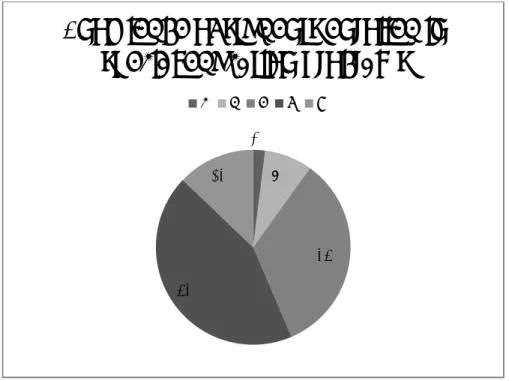
specialists, 27 percent are 0-5 years, 35 percent are 6-11 years, 17 percent are 12-17 years, and 22 percent are 18 or more years.
Gathering Information about School Library Media Best Practices
Before addressing the specific nature of the relationship between the library media program and special education programs, the goal was to establish a precedent of how library media specialists received information about best practices in the school library media field. To what and to whom do they target for information they perceive as relevant to their performance as professionals? If one were to want to disseminate
information to this group, what would be the best avenue? Respondents were permitted to indicate multiple resources, thereby acknowledging that often there may be no single source from which to seek information about best practices. Instead, what range of resources do library media specialists tap into?
For this query, there were a total of 65 respondents. The resources with the highest percentages of users were other library media specialists and professional literature; for both, 86 percent of respondents indicated these sources (Table 1). Following close behind, 83 percent of respondents noted that they receive information from the district’s school library media supervisor. Additionally, 53 percent of
Sources of best practices in school library media
Percent (%) of respondents
(n=65) District’s school library media supervisor 83 Other library media specialists 86
Professional literature 86
Professional conferences 53
Other 11 Table 1: Sources of information about best practices in school library media
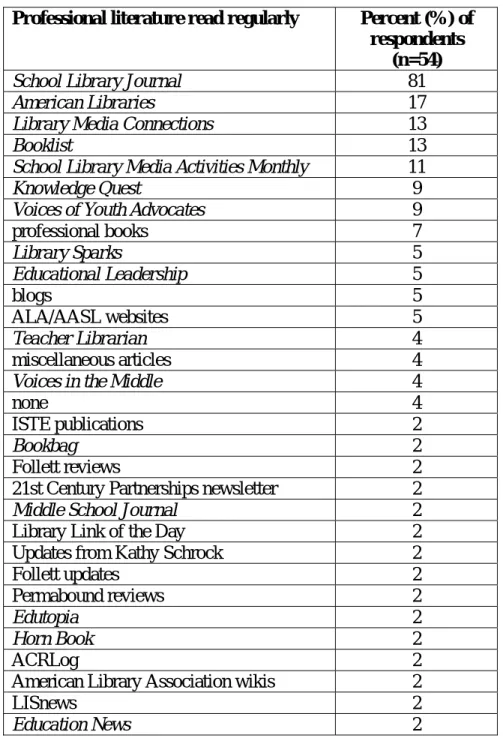
To further target the use of professional literature to acquire information about best practices in school library media, participants were asked to note what professional literature they read on a regular basis (Table 2). In response, 81percent, a clear majority of the 54 respondents indicated that they read School Library Journal. Other publications receiving five or more mentions include American Libraries, Knowledge Quest, Library Media Connections, Voices of Youth Advocates, School Library Media Activities
Professional literature read regularly Percent (%) of respondents
(n=54)
School Library Journal 81
American Libraries 17
Library Media Connections 13
Booklist 13
School Library Media Activities Monthly 11
Knowledge Quest 9
Voices of Youth Advocates 9
professional books 7
Library Sparks 5
Educational Leadership 5
blogs 5
ALA/AASL websites 5
Teacher Librarian 4
miscellaneous articles 4
Voices in the Middle 4
none 4
ISTE publications 2
Bookbag 2
Follett reviews 2
21st Century Partnerships newsletter 2
Middle School Journal 2
Library Link of the Day 2
Updates from Kathy Schrock 2
Follett updates 2
Permabound reviews 2
Edutopia 2
Horn Book 2
ACRLog 2 American Library Association wikis 2
LISnews 2
Education News 2
Table 2: Self-reported professional literature read on a regular basis
Gathering Information about Special Education Programs
to turn to if and how they receive information about best practices in special education programs. The juxtaposition of the questions was intended to show the potential duality of the task to acquire knowledge of best practices. The task put forth to library media specialists is to gather information about more than just their specific area of expertise and to recognize that in doing so a variety of means may be necessary.
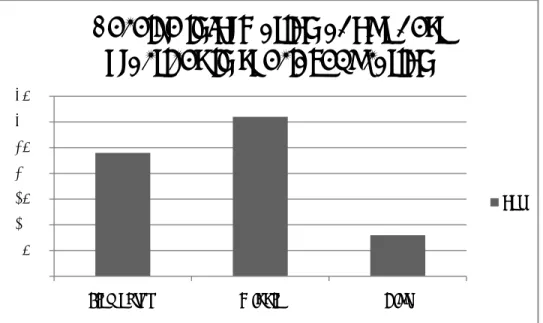
With this in mind, when asked if they receive information about best practices in special education programs, only 14 respondents out of 64 said yes. That means that 78 percent of the respondents to the question indicated that they do not receive information about best practices in special education. Of those 14 library media specialists who said yes, a majority (13 out of 14) said that they get their information from special education professionals. Among the other options, only one person indicated getting information from each of these categories: district’s school library media supervisor, school principal, and professional conferences. Three respondents marked general education teachers; the same was true for professional literature. Other sources of information contributed by respondents were: experience as a special education teacher, staff development, and materials sent to the respondent by mistake of the sender.
from general education teachers. Four respondents selected their district library media supervisor, six selected from professional literature, and three selected from professional conferences. The second-largest response, 18 respondents’ preference, was for school-sponsored professional development. The final respondent used the other category to frankly note, “Anywhere.”
Preference for source of information about best practices in special education
Percent (%) of respondents
(n=64) Special education professionals 50 School-sponsored professional development 28
Professional literature 9
School district’s library media supervisor 6
Professional conferences 5
Other 2
General education teachers 0
Principal 0 Table 3: Respondents’ preferences for sources of information about best practices in
special education
School level breakdown
0% 5% 10% 15% 20% 25% 30% 35%
Elementary Middle High
Receive
information
about
best
practices
in
special
education
Yes
Figure 1: Percent of school library media specialists who receive information about best practices in special education—school level subgroups (Elementary n=34, Middle n=13, High n=13)
In reflection on the responses indicating preference, there is an evident need to disseminate information about best practices in special education to library media professionals. In going about doing this, the largest reception, as indicated by the data, would be if the information came from special education professionals. Given the strong response for school-sponsored professional development, there is reason to discuss the possibility of organizing school-sponsored professional development opportunities led by familiar, knowledgeable special education personnel who are already within the school. If looking at numbers alone, this option might have been the preference of 68 percent of the respondents. To test this hypothesis, a follow-up question would be necessary.
correctly identify those needs and then make accommodations and modifications
accordingly. No two students are alike, even if they share a disability. Best practices are only as effective as how they are tailored to each student; therefore, it is not sufficient for library media specialists to have knowledge of just best practices in special education programs. It leaves them with only half of the equation. The same can be said for knowing about students in one’s school but not having tools to meet their needs.
So in looking at the other side of the equation, subjects were asked if they receive information about the students enrolled in special education programs in their schools (Table 4). Of the 64 respondents, 45, or 70 percent, said yes. Those 45 respondents were then asked to note how they receive information. All 45 potential respondents chose to answer the question, which allowed them to highlight all the means they use for information gathering. The most popular response was from special education
professionals (40 respondents = 89 percent). Comparatively, 18 selected from general education teachers, 13 selected during professional learning community (PLC) meetings, and 12 selected during Individualized Education Plan (IEP) meetings. Four respondents each marked from the principal and from parents. Finally, five people chose the other category. Their open-ended responses included while reading all of the IEPs for the school, from counselors, from SAM (School Assistant Module) and NCWise (North Carolina Window of Information on Student Education), and from the data manager and the teacher. Among the other group, one respondent noted from special education
Sources of information about students enrolled in special education programs in schools
Percent (%) of respondents
(n=45)
Special education professionals 89
General education teachers 40
Principal 9 Parents 9 Individualized Education Plan (IEP) meetings 27
Professional Learning Community (PLC) meetings 29
Other 11 Table 4: Sources of information about students enrolled in special education programs in
schools
Preferences for source of information about students enrolled in special education programs in schools
Percent (%) of respondents
(n=62)
Special education professionals 69
General education teachers 3
Principal 2 Parents 2 Individualized Education Plan (IEP) meetings 5
Professional Learning Community (PLC) meetings 13
Other 6 Table 5: Respondents’ preferences for sources of information about students enrolled in
special education programs in their schools
School level breakdown
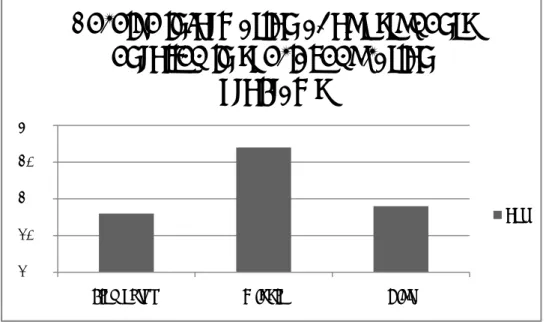
Compared to the percentages of school library media specialists who reported receiving information about best practices in special education, more respondents
60% 65% 70% 75% 80%
Elementary Middle High
Receive
information
about
students
enrolled
in
special
education
programs
Yes
Figure 3: Percent of school library media specialists who receive information about students enrolled in special education programs in their schools—school level subgroups
(Elementary n=34, Middle n=13, High n=13)
In considering the whole equation, it appears that school library media specialists participating in this study have a strong preference to work with special education professionals in respect to learning about best practices and learning about students enrolled in special education programs within their schools. This relationship between professionals in both programs is in line with best practices advocated by the literature. Library media specialists have thus identified special education professionals as valuable resources who can improve the accommodations and modifications made to the library media program so as to best service students with special needs.
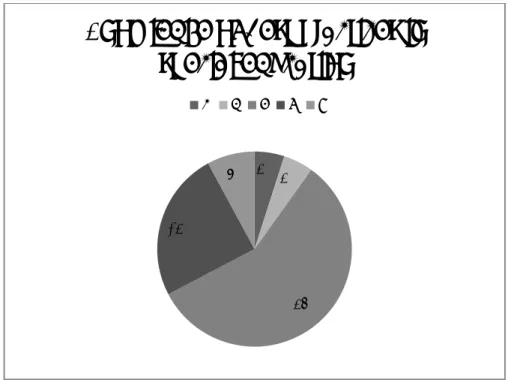
58 percent of the gave themselves Cs, 25 percent gave themselves Ds, and 8 percent gave themselves Fs (Figure 4). In keeping with the role of letter grades in the modern education system, a self-reported response of this nature shows a lack of mastery that necessitates close and thorough examination.
5% 5%
57% 25%
8%
Knowledge
of
best
practices
in
special
education
A B C D F
Figure 4: Respondents’ evaluation of their knowledge of best practices in special education (n=64)
The grade report on knowledge of students with special needs equally favored the lower end of the grading scale. Of the 64 respondents, only 2 percent (or one respondent) awarded an A, 5 percent gave themselves Bs, 34 percent gave themselves Cs, 44 percent gave themselves Ds, and 13 percent gave themselves Fs (Figure 5). Again, the
2%
8%
34%
43% 13%
Knowledge
of
students
enrolled
in
special
education
programs
A B C D F
Figure 5: Respondents’ evaluation of their knowledge of students enrolled in special education programs (n=64)
The responses to this section of the study prompt not only a call to action to improve self-reported levels of knowledge in the area of special education, but they also shed light on ways in which to provide information to which library media specialists will be receptive. Special education professionals are the key to the complete equation.
Respondents have distinctly put their trust in the information provided by these
Services, Accommodations, and Modifications for Students with Special Needs The next part of the study was designed to ascertain what services, accommodations, and modifications the library media specialists surveyed were providing in their schools for students with special needs. Given their backgrounds in knowledge of best practices in special education and knowledge of the students enrolled in special education programs in their schools, the intent was to examine the ways their knowledge was demonstrated in library media programs.
To begin this line of questioning, subjects were asked what services they provide to students with special needs. A list of services gleaned from the literature was provided, and subjects were asked to select all of the options that applied to their programs (Table 6). Of the 62 respondents, 58, or 94 percent, indicated that they provide books that are considered to be on a low reading level and are of high interest. Forty-two respondents, or 68 percent, said they provide books with accurate and non-stereotypical portrayals of children and youth with disabilities. Forty-four respondents, or 71 percent, offer guided or individualized instruction on how to use the library media center. Forty respondents, or 60 percent, provide wide aisles that allow for wheelchair navigation. Thirty-three
respondents, or 53 percent, have audio books in their collections. Thirty-two respondents, or 52 percent, have print materials suggested to them by special education teachers. Twenty-three respondents, or 37 percent, have commonly used materials on reachable shelves. Twenty-five respondents, or 40 percent, have computer workstations at
percent, indicated having computer monitors mounted on adjustable arms. The two respondents who chose the other category wrote in that they offer services for students with hearing impairments and provide storytime with songs and puppetry.
Services provided to students with special needs Percent (%) of respondents
(n=62)
Low reading level/high interest books 94
Audio books 53
Large-print books 13
Books with accurate and non-stereotypical portrayals of children and youth with disabilities
68 Print materials suggested by special education teachers 52
Access to assistive technology devices 31
Guided or individualized instruction on how to use the library media center
71
Wide aisles for wheelchair navigation 65
Computer workstations at wheelchair height 40
Commonly used materials on reachable shelves 37
Computer monitors mounted on adjustable arms 2
Other 3 Table 6: Services provided by the respondents for students with special needs
respondents, or 36 percent, use picture books with large, clear illustrations. Twenty respondents, or 33 percent, use visual cue cards or reminders. Nineteen respondents, or 31 percent, present a unit of stories that are related by a common theme or character. Seventeen respondents, or 28 percent, perform task analysis. Falling into the
accommodations with lesser prevalence, using big books and moving a chair from in front of a window to across from it both were selected by 10 respondents, or 16 percent. Two respondents chose the other category option, and one wrote in that he or she offers preferential seating.
Accommodations made in instruction for students with special needs
Percent (%) of respondents
(n=61)
Task analysis 28
Repetition of instruction 66
Adjust pacing for attention span 74
Adjust group size 49
Use visual cue cards or reminders 33
Move read-aloud chair from in front of a window to across from a window
16 Present a unit of stories that are related by a common theme or
character
31 Pair students without disabilities with students with special needs 46
Use big books 16
Use picture books that have large, clear illustrations 36
Other 3 Table 7: Accommodations respondents make in instruction for students with special needs
there is no specificity as to whether students are participating in inclusion classrooms or if they are being taught in self-contained classrooms. From an instructional standpoint, accommodations may manifest in different ways based on the setting in which the students learn and with whom they visit the library media center. Of strongest popularity among both questions, though, was the provision of low reading level/high interest books. Considering the rates of the occurrence of disabilities, it stands to reason that such a service would be applicable to the larger population of students with learning
disabilities. In addition, these texts often appeal to students without identified disabilities but who are reluctant readers. With multiple population appeal and the popularity of reading encouragement efforts in the face of standardized testing, these books become an important print resource in the collection.
Collaboration
The literature advocates for collaboration between library media specialists and special education professionals. As examined previously, library media specialists rely on special education professionals as resources for information about best practices in
special education programs as well as for information about students enrolled in special education programs in schools. However, the best practice approach is not to treat the relationship between education colleagues as a one-way street. Rather, the literature is in favor of taking the collaborative teaching model found in discussions of best practices with general education teachers and applying those principles to the instructional
collaboratively with special education teachers. Of the 61 respondents, 59 percent of them reported that they do work collaboratively.
School level breakdown
In examining the percentages of respondents who reported collaborating with special education teachers, it appears that the respondents at the elementary school level were less likely to work collaboratively with special education teachers (see Figure 6). The survey was not designed to discover the causes of collaboration, or lack thereof in the case of elementary schools. However, it did go on to explore how collaboration manifested at the three levels of school.
0% 10% 20% 30% 40% 50% 60% 70% 80% 90%
Elementary Middle High
Collaboration
between
library
media
specialists
and
special
education
teachers
Collaborate
Figure 6: Percent of library media specialists who report collaborating with special education teachers—school level subgroups (Elementary n=34, Middle n=13, High n=13)
is necessary but without ideas and direction as to implementation. With that in mind, respondents who answered affirmatively to the question regarding their practice of collaboration were directed to a question that asked them to provide one or two examples of collaborative projects. While not going into great detail about the projects, respondents offered a considerable response, which is documented in the bulleted list below. Of the 36 respondents who were directed to this question, 31 provided ideas and comments. Elementary School
• Working with the students on units that the teacher has introduced; mirroring
the same techniques as the teachers
• Offer support by providing appropriate nonfiction science related books for
units of study in the classroom; read science related nonfiction books at storytime in the media center
• Lesson using a read-aloud story relating to their curriculum, help students
select books on their level; reward special needs student with individual attention in the media center
• Choosing stories that have a theme they are studying or learning about in class • 1) Animal studies involving stories, finding information, sorting information,
creating ways to present information. 2) Country study (going with our magnet theme) including producing a power point presentation.
• I try to coordinate with the special education teachers on the topics they are
• Thematic units with self-contained classes
• Use of visual stimulation through pop-up books and the choosing of books
that enhance their units of study
• Creating web-based activities to provide curriculum instruction in different
modalities (visual, aural)
• Introducing the Hank Zipzer series to special education kids
• Collaborative planning as to themes of study, reading incentive program
Middle School
• Wrote a grant to purchase hi-low books and we are using them with students
in SSR. I purchased graphic novels and used them in literature circle reading for classes who were not ready to study Shakespeare.
• Research projects
• We worked on character traits using storybook characters; we worked on
various concepts (i.e., seasons, health, ordinal words) using storybooks • We work with the AU [autism] teacher to have students come into the Media
Center to help with the shelves - regularly. We do story time with the TMD [mental disability] class which is a special event for the class of middle schoolers.
• Understanding nonfiction (guide words, context clues, etc.)
• Collaboration with regular education teacher, special education teacher and
• Choice of materials from the collection geared to individual students, a
collection of materials specifically for special education students
• How to choose a book for you, Special leveling for integration in regular
classroom on research assignments
• Independent Reading, and using databases for research.
• Books, read-alouds, and flannel boards on folktales
High School
• Reading lesson and discussion of the book Night
• Career project is upcoming; utilization of interactive software in classroom
• Banned Book Week project; president research
• Booktalking level-appropriate books; Media Center orientation.
• Modifying 9th Grade Library-Media Orientation for students with limited
literacy proficiency to enable success for special education students; also, working individually with Down Syndrome student (we have one in our school) to teach her media skills, including use of digital camera (she actually "published" a scrapbook of digital photos of her 9th grade year with my help in the library.)
• Accommodations in Freshman Orientation, individual support for students in
Curriculum Assistance classes
• Hands-on lessons for using databases and catalog
• We collaborate with curriculum teams so we teach lessons to all levels
education teachers participate and we add to our instruction graphic organizers, notes in different forms, lower leveled texts, etc.
• Home hospital teaching where I work with special needs teachers to plan
lessons for students. Adjusting lessons to accommodate special needs students’ disabilities in our classroom.
• Reading aloud time and book talking high interest, low vocabulary books.
The responses appear to vary from addressing areas of academic instruction to reading-related activities. There is a common theme of read-aloud activities and booktalks that involve props and books tailored to the students reading levels. In doing these reading activities, library media specialists indicate consideration of what the students are studying in their classrooms so that the reading materials for storytime are appropriately reflective of those units. What seems to be less prevalent is the use of technology in these collaborative projects. Database instruction is mentioned more than once, but of
Individualized Education Plans (IEPs)
Continuing the discussion of addressing students with disabilities as having individual needs, the study asked subjects about their participation in the individualized education plan (IEP) process. These documents are contracts stipulating the needs of the student as well as goals for the student and how to provide accommodations and
modifications to acknowledge the needs and meet the goals in a manner that provides the least restrictive environment (LRE) for the student. Generally, participants in the IEP process include special education professionals, general education teachers who teach the student in question, and the student’s parents or legal guardians. If a student is old
School level breakdown
0% 5% 10% 15% 20% 25% 30%
Elementary Middle High
Attendance
at
Individualized
Education
Plan
(IEP)
meetings
Attend IEP meetings
Figure 7: Percentage of respondents who attend individualized education plan meetings—school level subgroups (Elementary n=34, Middle n=13, High n=13)
As shown in Figure 7, elementary and middle school library media specialists who reported their attendance at IEP meetings did so at a fairly similar rate. However, high school library media specialists fell short in this category, as only two of the 13 respondents reported attendance. While factors affecting these responses are not elicited from the respondents, there is room to question if there is a philosophical difference among the levels of school as to the definition of the involvement of the library media specialist in formal affairs related to students with disabilities, such as IEP meetings. Perhaps, though, there is also a matter of size of total student enrollment and
Services for Parents
In recognizing the critical role of parents in the success of students with
disabilities, subjects were questioned in regards to the services they offer parents of this population of students. The list of options from which the respondents were able to select services was adapted from literature discussing services generally provided to parents, regardless of the nature of the student (Table 8). Respondents were allowed to choose all of the services that apply to their library media programs. Of the 40 respondents, the largest majority, 84 percent, allow parents to check out materials from the library media center. Since a policy of this kind is applicable to all parents, this response is less surprising. The same goes for the response with the next highest response; 21
Services offered to parents of students with special needs Percent (%) of respondents
(n=44) Allowance for parents to check out materials from library media
center
8 Afterschool or evening family reading programs designed specifically
for families with students with special needs
0 Direction on library media center website to online resources for
parents of students with special needs
7 Resources (print, audio, electronic) that address parenting issues and
child development
48
Resources about disabilities 39
Other 5 Table 8: Services respondents provide for parents of students with special needs
Conclusion
Driving this study was the recognition that school library media programs have an academic and recreational responsibility to students with special needs in equal capacity to students without disabilities. To reiterate, the Individuals with Disabilities Act (IDEA) 2004 specifies that not only are students with disabilities to be educated in the least restrictive environment but also that students should be provided with services that meet their unique needs so that they might be prepared for further education, employment, and independent living (IDEA 2004 Section 300). A commitment to student learning does not exclude those students whose learning is structured around Individualized Education Plans and 504 plans.
their schools. A majority of library media specialists reported inadequacy in their
knowledge in the area of special education. They noted limited information retrieval from an assortment of sources. To accompany this void in information, their confidence in their own understanding of how to best serve students with special needs would barely earn a passing grade, at best.
Despite the indications of inadequacies, there is hope in respondents’ self-evaluation. Judging from their responses, there is a recognized area of need to know more. This realization sets the stage for implementation of programs designed with their preferential responses under consideration. Library media specialists showed a collective preference to have special education professionals serve as their main sources of
information about best practices in special education as well as about students enrolled in special education programs. They have pinpointed these education colleagues as to whom they will listen and perceive as experts and credible sources of information. Such
identification cannot go unnoticed as future efforts to educate library media specialists are discussed. Coinciding with these results are those that show strong preference for school-sponsored professional development. By combining the two, a foundation is laid for solutions to the problems associated with deficient knowledge of special education practices and student needs. An opportunity to improve student learning is fostered.
With the prospective possibilities in mind, the next consideration is what services and instructional accommodations and modifications are currently being implemented in library media programs, and, correspondingly, which ones are not. While most
the degree to which they are circulated among the student population. Is there a need even in this area of frequent implementation to improve the collection and/or the efforts to get the books into the appropriate students’ hands? Further investigation is warranted. With regard to some of the services provided to a lesser degree, there is a common relation to physical access, such as computer workstations at wheelchair height, materials on reachable shelves, and computer monitors on adjustable arms. Are students deterred because of their inability to access computers or materials? Being aware of the needs of the students in a school’s population helps to begin to assess services such as these, thus reinforcing how knowledge facilitates evaluation of the library media program’s services for students with special needs.
In the same manner, knowledge of the needs of students with special needs as well as best practices in instructional techniques for them establishes a course of action for accommodations and modifications to instruction. While most respondents noted that they alter pacing to accommodate varying attention spans, there is infrequency in the other tactics listed, such as something as simple as moving a chair for read-aloud activities so that students do not face a window. Communication between library media specialists and the special education teachers who have honed instructional methods for students with special needs becomes a critical component for success. Transferring what happens in classrooms to support successful learning and behavior into the library media center is both possible and imperative. The least restrictive environment (LRE) outlined in IDEA applies to all learning environments, the library media center included.
The relationship between library media specialists and special education
Self-reported collaborative projects provided by respondents offer one of the points of greatest need for additional research. The information gathered by the study only begins to shed light on what is taking place in schools. To build meaning, case studies would be useful to tease out ideas and details from which library media specialists could learn and use as starting points for their own collaborative projects with special education
professionals. Both parties are professionals who bring unique expertise to the discussion table, which has the potential to positively impact learning and reading experiences for students enrolled in special education programs.
Bibliography
Akin, Lynn and Donna MacKinney. “Autism, Literacy, and Libraries.” Children and Libraries: The Journal of the Association for Library Service to Children 2.2 (2004): 35-43.
Digest of Education Statistics: 2006 Tables and Figures. Sep. 2006. National Center for Education Statistics, Washington, DC. 27 May 2008
<http://nces.ed.gov/programs/digest/d06/tables/dt06_048.asp>.
Hopkins, Janet. “Assistive Technology for the School Library.” Library Media Connection 21.6 (2003): 46.
Hopkins, Janet. “Extending Inclusive Learning: Library and Special Education Collaboration.” Library Media Connection 23.6 (2005): 17-19.
Hopkins, Janet. “School Library Accessibility: The Role of Assistive Technology.” Teacher Librarian 31.3 (2004): 15-18.
Jones, Jami L., and Alana M. Zambone. "The Role of the Media Specialist to Improve Academic Achievement and Strengthen At-risk Youth." Library Media Connection 26.7 (2008): 30-32.
Jouzaitis, Vida. “Serving the needs of our students with LD in the school library.” School Libraries in Canada 23.3 (2004): 34-38.
Kaiser, Crystal E. “Is Your Early Childhood Literature Collection Disability-Inclusive and Current?” Children and Libraries: The Journal of the Association for Library Service to Children 5.3 (2007): 5-12.
Murray, Janet. “The Implications of Inclusive Schooling for School Librarians.”
International Journal of Disability, Development, and Education 49.3 (2002): 301-322. Noonan, Mary Jo, and Violet H. Harada. "Special Education and Inclusion: Opportunities for Collaboration." School Reform and the School Library Media Specialist. Eds. Sandra Hughes-Hassell and Violet H. Harada. Westport, Conn.: Libraries Unlimited, 2007. 131-143.
Peters, Tom and Lori Bell. “Assistive Devices and Options for Libraries.” Computers in Libraries 26.9 (2006): 38-40.
Appendix A Electronic Survey Questions
You are being asked to take part in a research study. To join the study is voluntary. You may refuse to join, or you may withdraw your consent to be in the study, for any reason, without penalty.
Research studies are designed to obtain new knowledge. This new information may help people in the future. You may not receive any direct benefit from being in the research study. There also may be risks to being in research studies.
Details about this study are discussed below. It is important that you understand this information so that you can make an informed choice about being in this research study. The following survey will ask you questions about your role as a school library media coordinator1 and how your role is connected to working with special education programs and the students, teachers, and parents involved with those programs. Your employer will never know whether or not you have participated. Your participation is confidential. No identifying information will be collected in order to protect your anonymity. All data obtained in this study will be reported as group data. The name of your school district will be disguised. No individual can be or will be identified. The only persons who will have access to the data are the Principal Investigator. There are neither anticipated risks should you participate, no anticipated benefits from being involved in the study.
However, there will be educational or professional benefit from this study. The information you provide will help identify current practices in school library media program--what is working as well as areas in need of improvement. There is no cost to you or financial benefit for your participation.
I am asking you to generously take 5-10 minutes of your time to complete this survey. You may opt to discontinue the survey at any time without risk of penalty. Also, you may skip any question for any reason.
All research on human volunteers is reviewed by a committee that works to protect your rights and welfare. If you have questions or concerns about your rights as a research subject, you may contact, anonymously if you wish, the Institutional Review Board at 919-966-3113 or by email to [email protected]. Please reference IRB study #08-1661.
If you have any questions about this research study, you may contact me at
[email protected] or my advisor, Dr. Sandra Hughes-Hassell at
[email protected] or 919-843-5276.
111 In the North Carolina public school system participating in the survey, library media specialists
By continuing to the next screen, you will indicate your consent to participate in this research.
__ Accept __ Decline
1. How do you receive your information about best practices in school library media? (Check all that apply.)
__ From the district’s school library media supervisor __ From other library media coordinators
__ From professional literature __ From professional conferences __ Other ________________________
2. What professional literature do you read on a regular basis?
__________________________________________________________________ __________________________________________________________________ ____________________________________________________________ 3. Do you receive information about best practices in special education programs?
Yes __ No __
4. {If yes} How do you receive information about best practices in special education programs? (Check all that apply.)
__ From the district’s school library media supervisor __ From your principal
__ From special education professionals __ From general education teachers __ From professional literature __ From professional conferences __ Other ________________________
5. How would you prefer to receive information about best practices in special education programs? (Check one.)
__ From special education professionals __ From general education teachers __ From your principal
__ From your district’s school library media supervisor __ From professional literature
__ At professional conferences
__ Other ________________________
6. Do you receive information about the students enrolled in special education programs in your school?
Yes __ No __
7. {If yes} How do you receive information about students enrolled in special education programs in your school? (Check all that apply.)
__ From special education professionals __ From general education teachers __ From your principal
__ From parents
__ During Individualized Education Plan (IEP) meetings __ During Professional Learning Community (PLC) meetings __ Other ________________________
8. How would you prefer to receive information about the students enrolled in special education programs in your school? (Check one.)
__ From special education professionals __ From general education teachers __ From your principal
__ From parents
__ During Individualized Education Plan (IEP) meetings __ During Professional Learning Community (PLC) meetings __ Other ________________________
9. What letter grade would you give yourself on your knowledge of best practices in special education programs?
[scale consisting of A, B, C, D, and F]
10.What letter grade would you give yourself on your knowledge of the students enrolled in special education programs at your school?
[scale consisting of A, B, C, D, and F]
11.What kinds of services do you offer for students with special needs? (Check all that apply.)
__ Low reading level/high interest books __ Audio books
__ Books with accurate and non-stereotypical portrayals of children and youth with disabilities
__ Print materials suggested by special programs teachers __ Access to assistive technology devices
__ Guided or individualized instruction on how to use the library media center __ Wide aisles for wheelchair navigation
__ Computer work stations at wheelchair height __ Commonly used materials on reachable shelves __ Computer monitors mounted on adjustable arms __ Other __________________________
12.What kinds of accommodations do you make in instruction? (Check all that apply.)
__ Task analysis
__ Repetition of instruction
__ Adjust pacing for attention span __ Adjust group size
__ Use visual cue cards or reminders
__ Move read-aloud chair from in front of a window to across from it __ Present a unit of stories that are related by a common theme or character __ Pairing students without disabilities with students with special needs __ Use big books
__ Use picture books that have large, clear illustrations __ Other ___________________________
13.Do you work collaboratively with special programs teachers? __ Yes __ No
14.{If yes} Please provide one or two examples of successful collaborative projects. __________________________________________________________________ __________________________________________________________________ __________________________________________________________________ __________________________________________________________________ ________________________________________________________
15.Do you attend Individualized Education Plan (IEP) meetings? __ Yes __ No
__ Yes __ No
17.What kinds of services do you offer for parents of students with special needs? (Check all that apply.)
__ Allowance for parents to check out materials from the library media center __ Afterschool or evening family reading programs designed specifically for families with students with special needs
__ Direction on the library media center website to online resources for parents of children with special needs
__ Resources (print, audio, electronic) that address parenting issues and child development
__ Resources about disabilities
__ Other _____________________________
18. At what level of school do you work? __ Elementary
__ Middle __ High
19. Do you have National Board Certification? __ Yes
__ No
20. How many years have you been a library media coordinator? __ 0-5