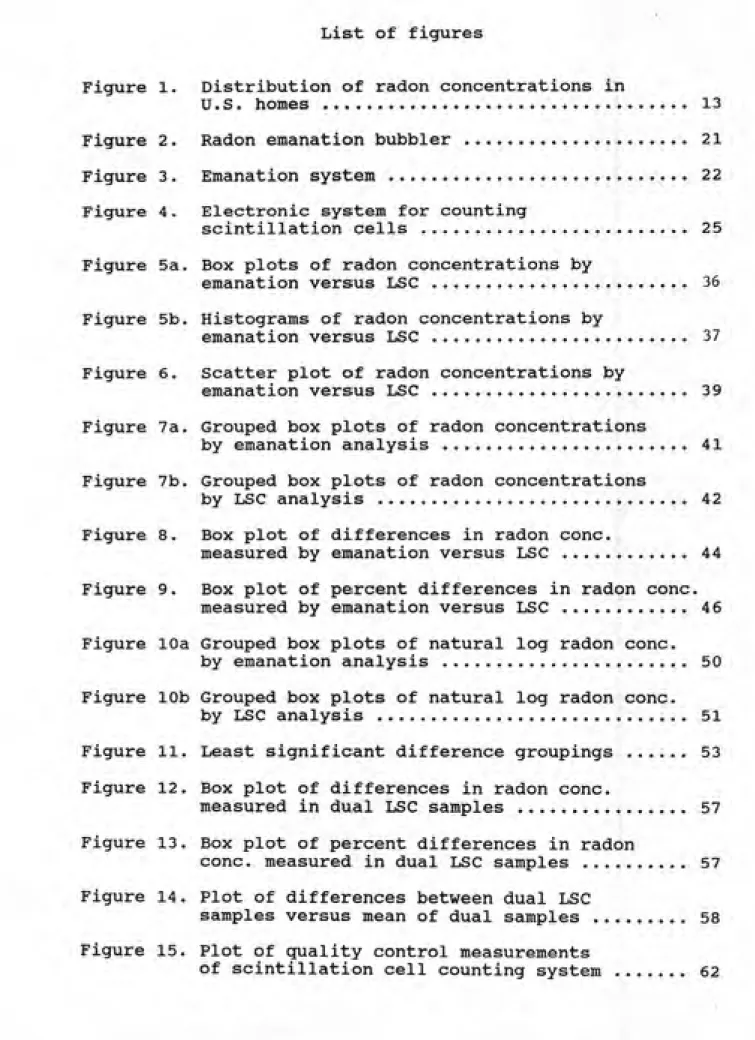
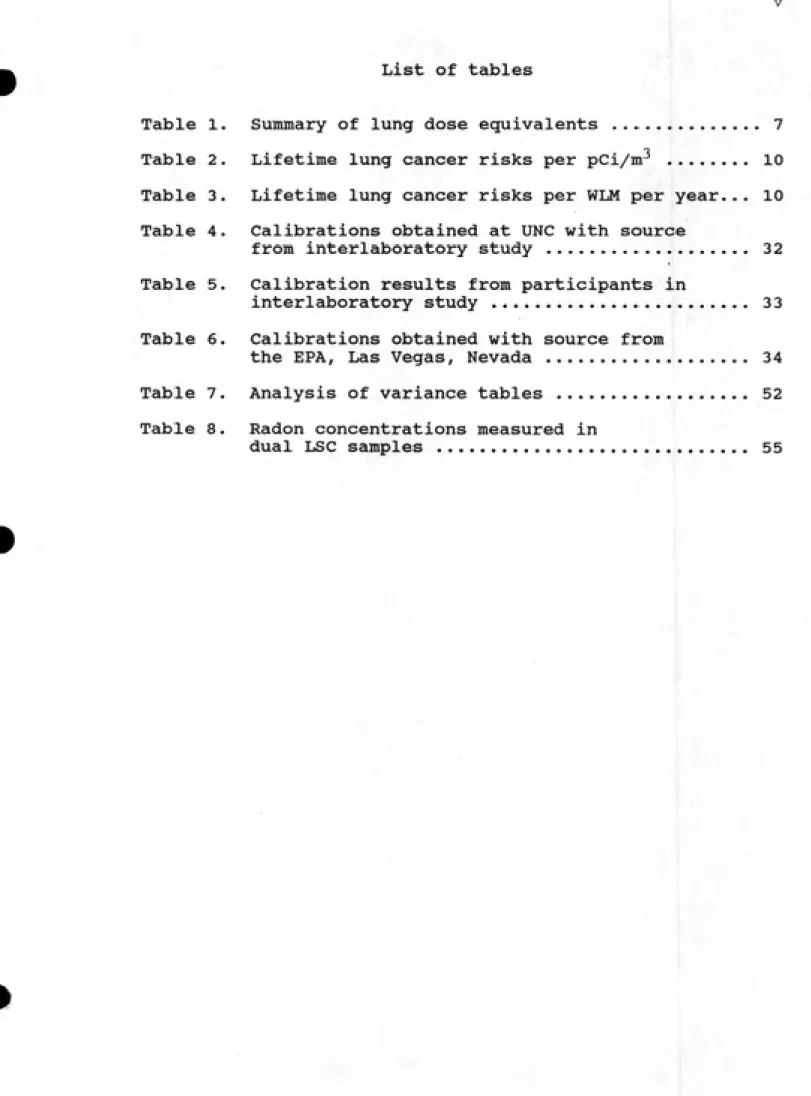
CONTENTS
Acknowledgements ... 11
Abstract ... ill List of figures ... iv
List of tables ...v
Introduction... 1
Literature review ... ... 4
Analytical techniques ... 4
Radon hazard ... 6
Radon in groundwater... 12
Geological influence ... 15
Materials and methods ... 18
Emanation... 19
Liquid scintillation ... 26
Calibrations ... 27
Data analysis ... 30
Calibration factors ... 30
Exploratory data analysis ... 35
Hypothesis testing ... 40
Liquid scintillation precision ... 54
Lower limit of detection ... 59
Quality control ... 60
Conclusions ... 63
Appendices I ... 66
II ... 67
III ... 70
IV... 72
References ... 75
Acknowledgements
I would like to express special thanks to my research advisor Dr. James Watson for his guidance and suggestions,
especially during the writing of this report. He has spent
many hours reviewing this document as it progressed through
several revisions. I would also like to thank Dr. Douglas
Crawford-Brown for his assistance with the scintillation cell counting system, the liquid scintillation counting
system and for serving as a committee member for my oral
presentation. Thanks also to Dr. Alvis Turner for serving
Abstract Kenneth Ladrach THE OCCDRRENCE OF RADON
IN SOME NORTH CAROLINA GROUNDWATER SUPPLIES (Under the direction of Dr. James E. Watson)
Approximately one hundred small public groundwater sup¬
plies in North Carolina were sampled. Analyses for
radon-222 were performed by two methods, emanation and a
newer liquid scintillation counting (LSC) method. Two
primary goals were involved in this work, (1) comparing the
two analysis methods listed above and (2) testing for an
association between radon concentration in groundwater and
the geology of the sampled site. The data show
statistically significant differences in radon
concentrations measured by the two methods. In 75 percent
of the cases the liquid scintillation result was lower,
indicating the possible need for refinement of this
technique. The precision of liquid scintillation results
was tested by comparing dual samples from each site. A
paired difference T-test on the dual LSC measurements
indicates that the mean difference between dual LSC
measurements is equal to zero. Forty three of fifty two
differences are less than 10 percent different. The radon
concentration data show in general, higher radon
concentrations associated with granite and gneiss/schist
rock formations over those in mafic and metavolcanic
formations. Samples from the coastal plain area had the
List of figures
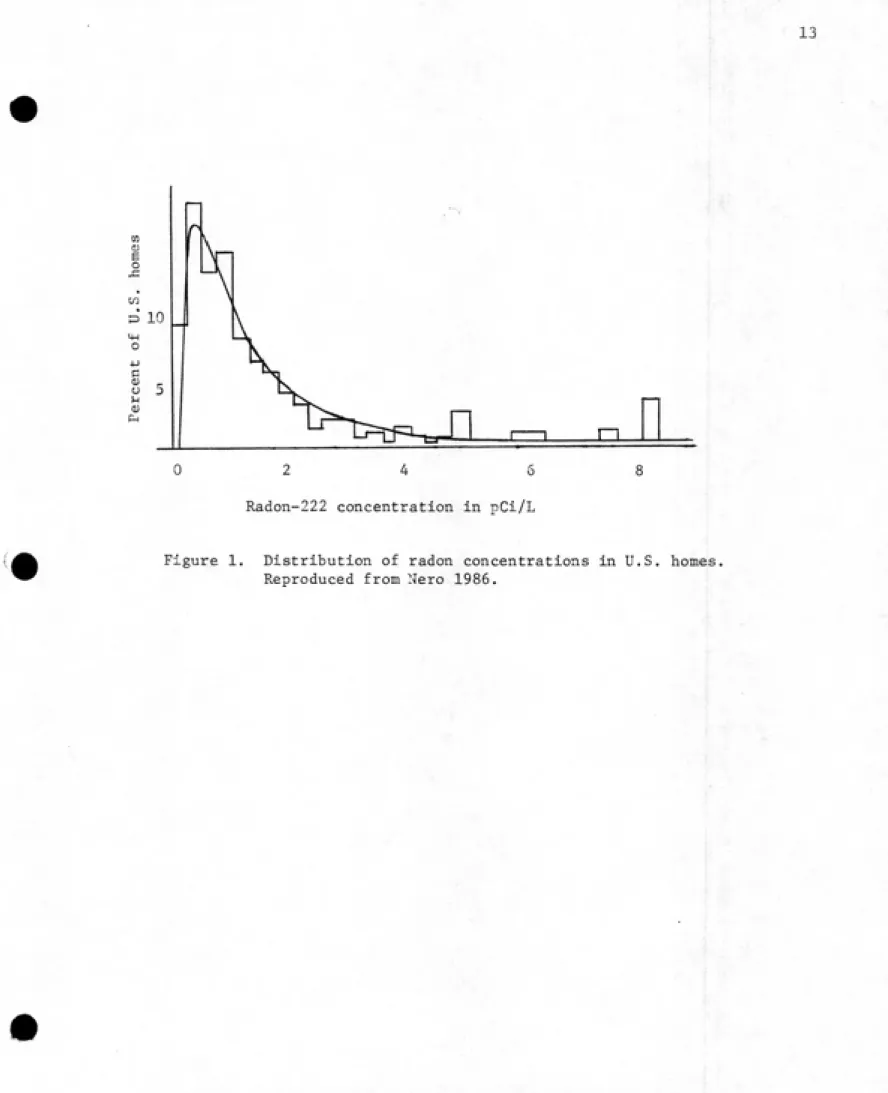
Figure 1. Distribution of radon concentrations in
U.S. homes ... 13
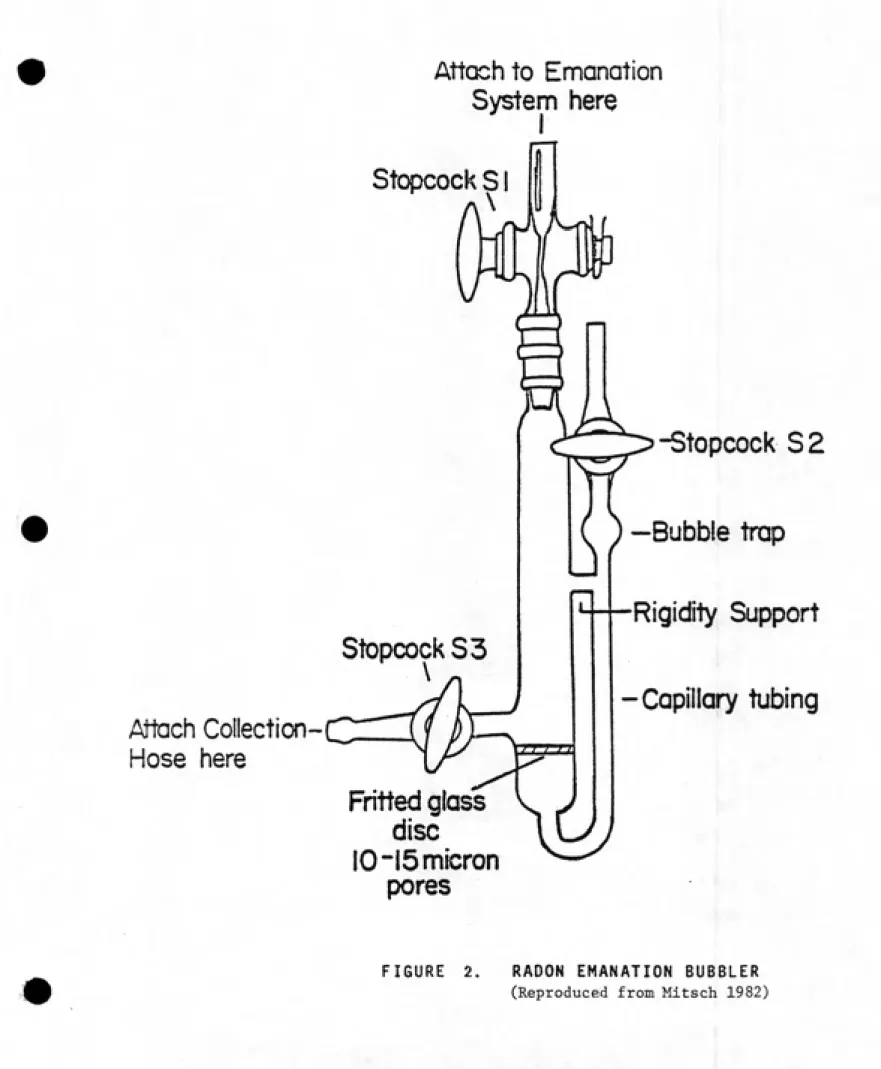
Figure 2. Radon emanation bubbler ... 21
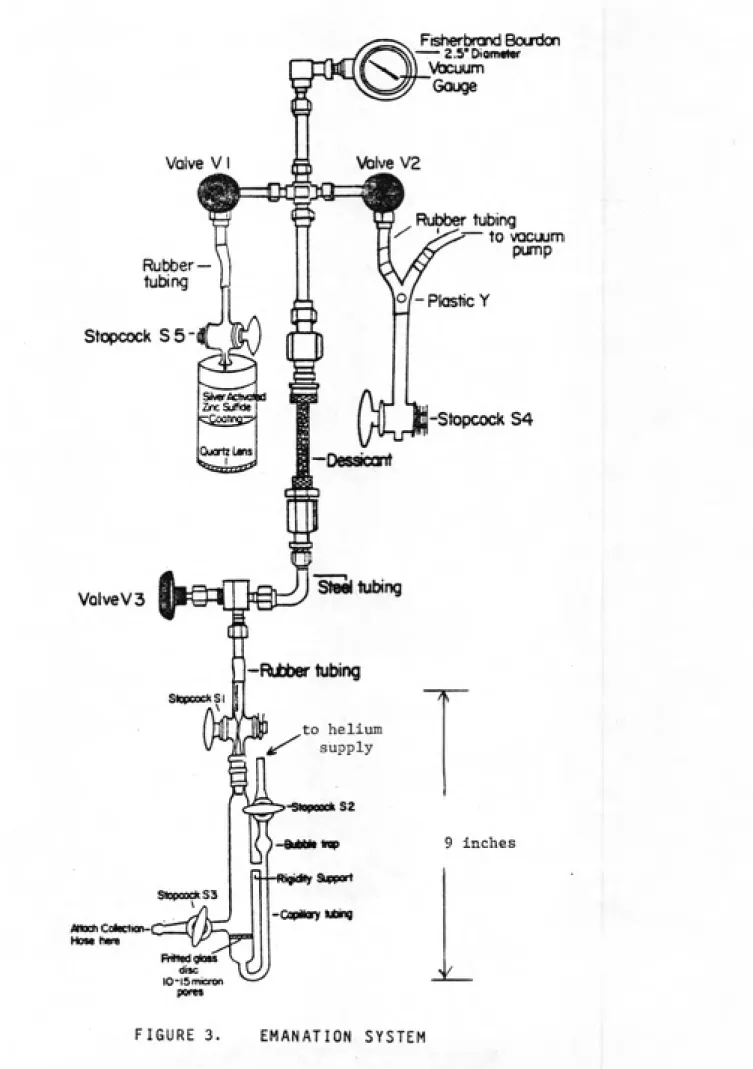
Figure 3. Emanation system ... 22
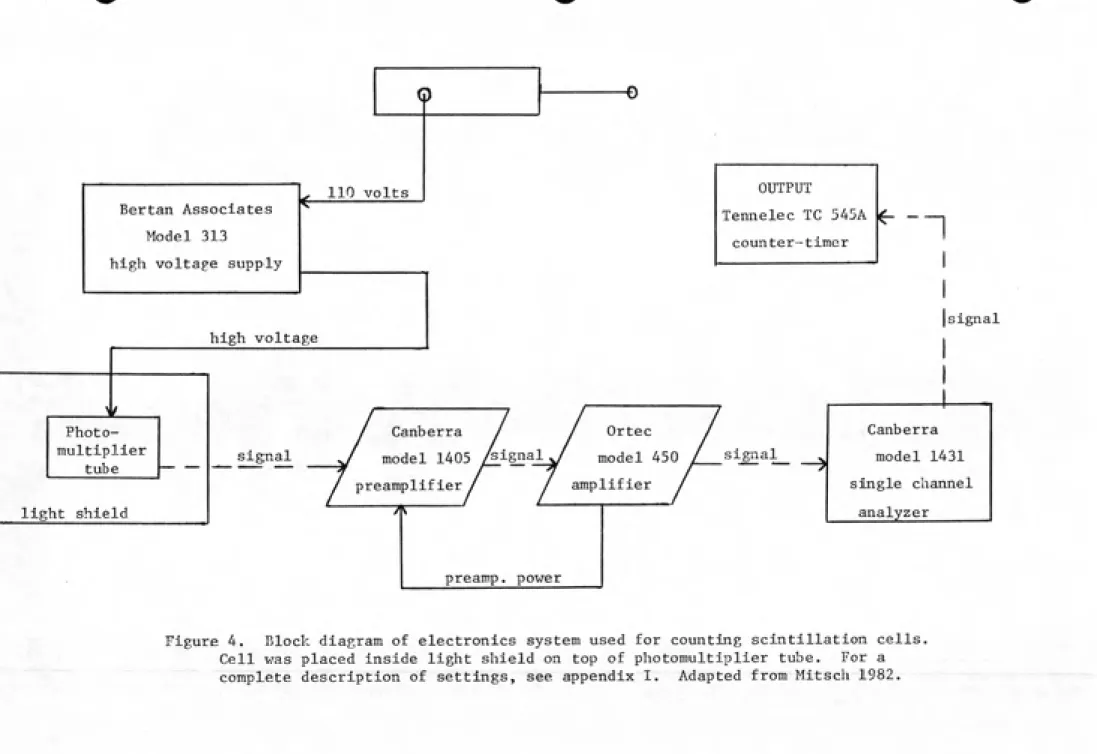
Figure 4. Electronic system for counting
scintillation cells ... 25
Figure 5a. Box plots of radon concentrations by
emanation versus LSC ... 36
Figure 5b. Histograms of radon concentrations by
emanation versus LSC ... 37 Figure 6. Scatter plot of radon concentrations by
emanation versus LSC ... 39
Figure 7a. Grouped box plots of radon concentrations
by emanation analysis ... 41
Figure 7b. Grouped box plots of radon concentrations
by LSC analysis ... 42
Figure 8. Box plot of differences in radon cone.
measured by emanation versus LSC ... 44
Figure 9. Box plot of percent differences in radon cone.
measured by emanation versus LSC ... 46
Figure 10a Grouped box plots of natural log radon cone. by emanation analysis ... 50
Figure 10b Grouped box plots of natural log radon cone.
by LSC analysis ... 51
Figure 11. Least significant difference groupings ... 53
Figure 12. Box plot of differences in radon cone.
measured in dual LSC samples ... 57
Figure 13. Box plot of percent differences in radon
cone, measured in dual LSC samples ... 57
Figure 14. Plot of differences between dual LSC
samples versus mean of dual samples ... 58
Figure 15. Plot of quality control measurements
Table 1. Summary of lung dose equivalents ... 7
Table 2. Lifetime lung cancer risks per pCi/m-' ... 10
Table 3. Lifetime lung cancer risks per WLM per year... 10
Table 4. Calibrations obtained at UNC with source
from interlaboratory study ... 32
Table 5. Calibration results from participants in
interlaboratory study ... 33
Table 6. Calibrations obtained with source from
the EPA, Las Vegas, Nevada ... 34
Table 7. Analysis of variance tables ... 52
Table 8. Radon concentrations measured in
sented in this technical report. The first question this
report addresses is whether two methods used in the
Radiological Hygiene Laboratory to measure radon
concentrations in water samples provide comparable results.
The standard procedure of emanating radon from a glass
sample collection bubbler into an alpha scintillation cell
for counting (Lucas 1957) has been used by a number of
researchers in the past (APHA 1976, Lee 1979, Michel 1980,
Mitsch 1982). Previous work by Radiological Hygiene
students (Strain 1978, Mitsch 1982 and Hayes 1984) utilized
this type of equipment and procedures for emanation analyses
of groundwater samples from wells in the phosphate mining
region of eastern North Carolina. For the current project
the emanation apparatus and procedures were used to measure
radon concentrations in well water samples collected
statewide. However we wanted to implement an alternative
analytical technique that would be reasonably accurate,
reliable and less time intensive. The liquid scintillation counting method described by Prichard and Gesell (Prichard
1977) and subsequently used in a nationwide study (Horton
1983) seemed a good candidate. Sample collection for liquid
scintillation counting analysis is easy to perform but
analysis requires a liquid scintillation counter plus blank
and standard activity vials. Since a programmable liquid
needed. A synopsis of the procedures used by the
Environmental Protection Agency in their nationwide study of
radon in drinking water (Horton 1983) was obtained from
Larry Kanipe (personal communication, current address:
Tennessee Valley Authority, Muscle Shoals, Alabama 35660).
A good liquid scintillation counting procedure would provide
an excellent alternative to emanation because more samples
could be analyzed in a shorter period of time without
requiring the presence of someone to operate the equipment. An important question is whether the liquid scintillation
counting procedure performs accurately and reliably in
comparison to the emanation procedure. This is the reason for comparison of emanation and liquid scintillation
counting results in this report.
The second question this report is concerned with is
the distribution of radon concentrations in groundwater as a
function of different geological regions of the state. This
technical report examines radon concentrations in water
samples from well sites classified in five major geological
groups across North Carolina. A statistical test for
significant differences in radon concentrations between
geological groups is performed. The longer range goal of
this type of work is to be able to predict with confidence
the concentration of radon to be expected in a given
groundwater sample based on site geological characteristics
Analytical techniques
For years the standard analytical technique for the
determination of radon concentration in water has been
emanation of radon from the water into an evacuated
scintillation cell for counting (APHA 1985). More recently,
liquid scintillation counting (LSC) techniques have been
used to measure radon concentrations. For example, the air
in a cave in Japan was analyzed for radon by counting
scintillation fluid after bubbling air through it in a
scrubbing bottle (Amano 1985). In another study, thoron and
radon gas bubbling from a hot spring was collected in a
syringe, liquid scintillator was added and the mixture
transferred to a vial for counting (Yoshikawa 1986). Two
researchers used LSC in conjunction with other methods of
analysis to study radon concentrations in groundwater (Ohnuma 1982, Oliveira de Sampa 1980). Radon concentrations
measured by LSC were compared with concentrations measured
using an ionization chamber (Ohnuma 1982). The coefficient
of variation in LSC measurements was given as 4.9 percent
and the correlation between the two methods was given as
0.966 (Ohnuma 1982). Oliveira de Sampa (1980) fabricated
scintillation cells by internally lining the walls of
Erlenmeyer flasks with silver activated zinc sulfide.
Samples were then analyzed by emanation and LSC. Both
sample was reported to be lost by retention in the emanation
system and 95 percent of the radon in the sample was
reported to remain dissolved in the liquid scintillation
cocktail (Oliveira de Sampa 1980).
In a review of methods for radiological analyses of
drinking water, Blanchard (1985) cites four investigators
who have used LSC to determine radon concentrations (Noguchi
1964, Homma 1977, Prichard 1977 and Horton 1983). High
volume extraction of radon from water followed by LSC was
performed by Noguchi (1964) and Homma (1977). This technique was used to indirectly measure radium-226 in
environmental samples. Simplified procedures have been used
to directly measure radon in water collected in low volume samples using commercially available liquid scintillation
counters (Prichard 1977 and Horton 1983). Broad spectrum
energy windows were used by both investigators; however,
different scintillation cocktails were employed. The
precision of paired LSC measurements in the study by Horton
(1983) was assessed by plotting the average range between
paired measurements against average concentration. A linear
fit to the data produced a slope of 0.054, indicating about
5 percent degree of precision over the range of
concentrations measured. The accuracy of the LSC technique
was checked through participation in an interlaboratory
study at the University of Texas in Houston and a comparison
well with the known values of controls. For the comparison
study with USC, a set of ten samples was analyzed by LSC
(EPA-EERF lab) and by emanation (USC Geology lab). The
correlation between the two sets of measurements was 0.998.
The use data were found to be about 10 percent lower than
the EPA data as observed in a scatter plot of the two datasets. The LSC method used by the EPA (Horton 1983) was
used in this study for comparison with the emanation method
because of the ease of sampling and analysis as well as the
previously demonstrated measurement capabilities of the
technique.
In the remainder of the literature review the hazard of
radon exposure is described in terms of increased risk of
lung cancer induction, and a relationship is presented
between the hazard of indoor radon and the potential
contribution of radon in groundwater to this hazard.
Finally, the question of the influence of geology on the
radon content of groundwater is explored. Radon hazard
Radon gas and associated daughter products have been a
concern for some time. On the average, radon daughters
contribute the largest fraction of annual lung dose from all
the sources of natural background radiation (NCRP #45 1975 &
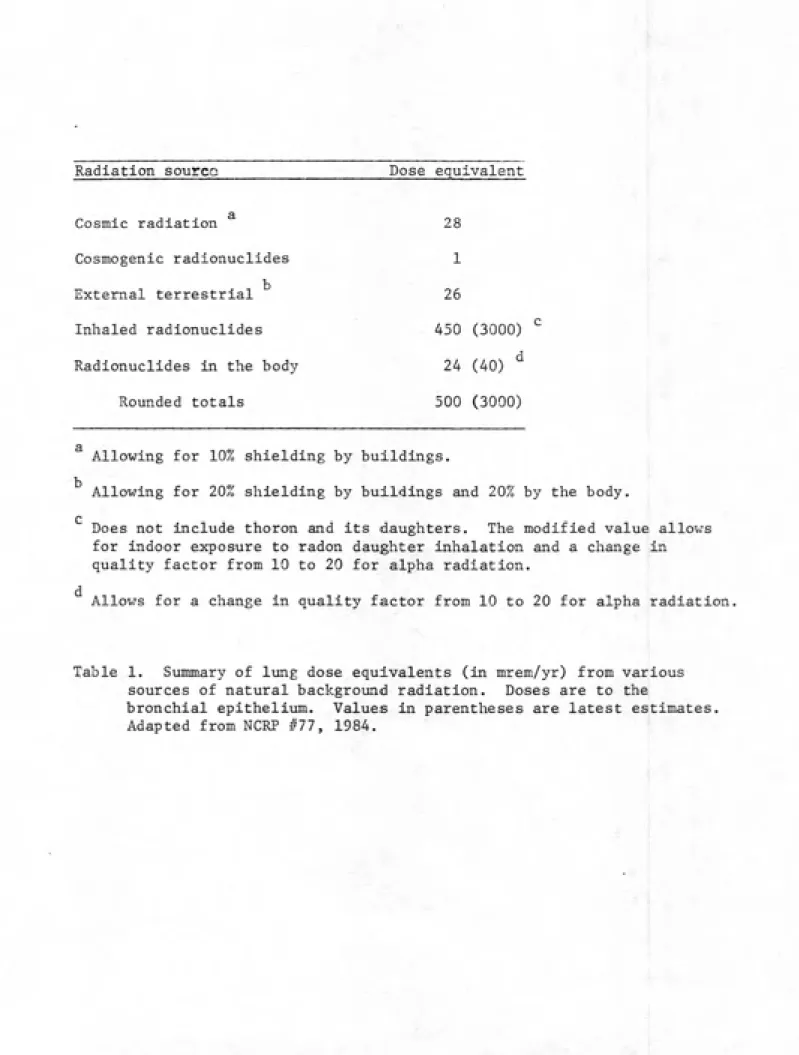
#77 1984), see table 1. In table 1 the category "inhaled
radionuclides" refers primarily to inhaled radon daughters.
inhala-Cosmic radiation
Cosmogenic radionuclides
External terrestrial Inhaled radionuclides
Radionuclides in the body
Rounded totals
28 1 26
450 (3000) 24
(40) •"
500 (3000)Allowing for 10% shielding by buildings.
Allowing for 20% shielding by buildings and 20% by the body.
Does not include thoron and its daughters. The modified value alloxv^s
for indoor exposure to radon daughter inhalation and a change in quality factor from 10 to 20 for alpha radiation.
Allows for a change in quality factor from 10 to 20 for alpha radiation.
Table 1. Summary of lung dose equivalents (in mrem/yr) from various
sources of natural background radiation. Doses are to the
Protection and Measurements studied the available data on
the effects of radon inhalation experiments involving
animals and data on the effects of radon inhalation among
underground uranium mine workers. Their examination of data
on effects of inhaling radon daughters found that animal
study results parallel epidemiological studies of mine workers inhaling radon daughters. Several important points
are made. First, very high cumulative exposures, over 1000 working level months (WLM), are less effective at lung
cancer induction per WLM than are more moderate cumulative
exposures. Secondly, the highest lung cancer risk
coefficients for humans (50 x lOE -6 lung cancers/yr/WLM)
were found among those exposed to radon daughters later in
their lives (NCRP #78 1984). Finally, the regions of the human lung receiving the greatest absorbed dose from radon
daughters are the basal cells of the epithelial tissue in
the upper airways of the tracheobronchial tree. In fact
human lung cancers do appear predominantly in the upper
airways of this region (NCRP #78 1984).
NCRP report #78 adopts an average lung cancer risk co¬
efficient of 10 X lOE -6 cancers/yr/person/WLM averaged over
all age and exposure groups. Through a time integrating
risk model NCRP converts this to a lifetime risk of about
1.5 X lOE -4 lung cancers per WLM averaged over all age and
exposure groups. This is comparable to a range given by the
cancers/yr/person/WLM as well as an exponential term to
account for the decrease in cancer appearance rate due to
cellular repair and cell death over time. NCRP #78 presents
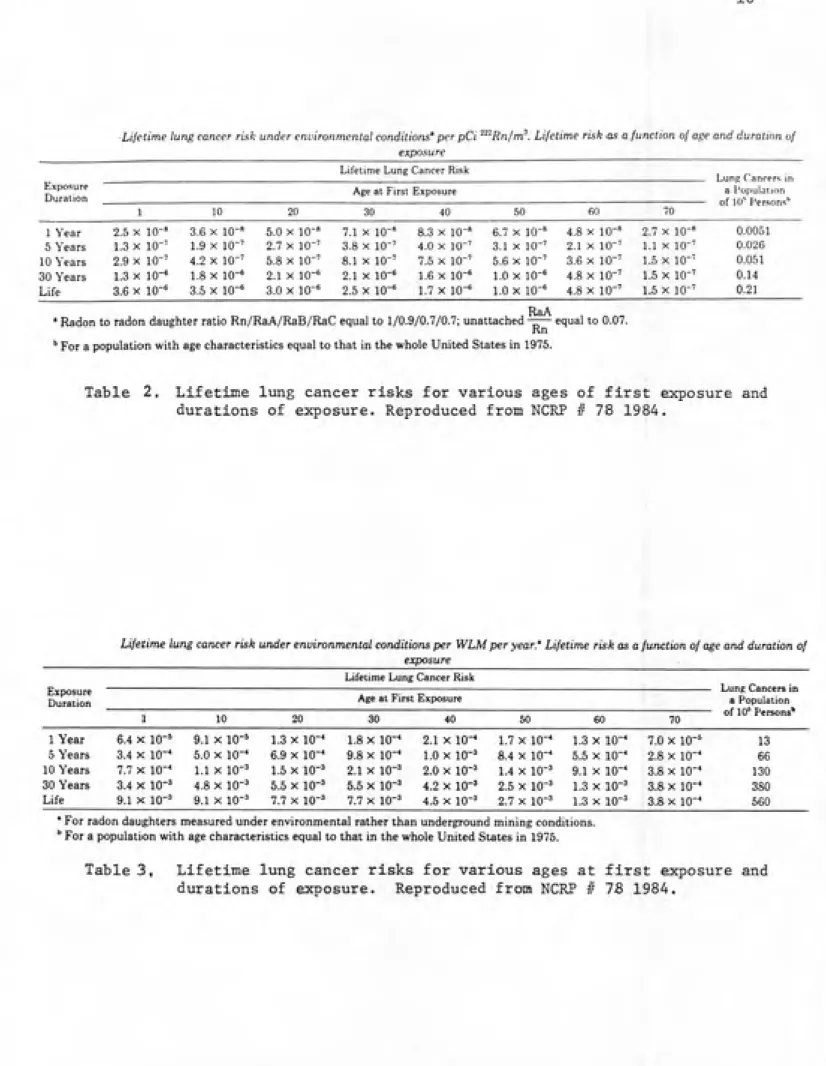
tabulated lifetime lung cancer risks for environmental
3
levels of radon daughter exposure per pCi/m or per WLM per
year for different ages of first exposure and different
durations of exposure, see tables 2 and 3. The risks at the v lower radon daughter levels found under environmental conditions have been extrapolated down from the risks obtained from the higher radon daughter levels of the uranium miner data. The NCRP justifies this extrapolation by taking the conservative position that lung cancer induction is a stochastic or non-threshold type of response and therefore there is some risk even at the lower doses delivered by environmental levels of radon daughters.
Lifetime lung cancer risk under environmental conditions' per pCi ""^Rn/m^. Lifetime risk as a function of age and duration of
exposure
Lifetime Lung Cancer Risk Exposure
Duration
Age at FirstExposure a Population of 10' I'ersons''
1 10 20 30 40 50 GO 70
1 Year 2.5 X 10-" 3.6 X 10-» 5.0 X 10-' 7.1 X 10-» 8.3 X 10-« 6.7 X 10-' 4.8 X 10-' 2.7 X 10-" 0.0051 5 Years 1.3 X 10- 1.9 X lO"' 2.7 X 10-' 3.8 X 10-' 4.0 X 10"' 3.1 X 10-' 2.1 X 10-' 1.1 X 10-' 0.026 10 Years 2.9 X lO"' 4.2 X IQ-' 5.8 X 10-' 8.1 X 10"' 7.5 X 10-' 5.6 X 10-' 3.6 X 10-' 1.5 X 10-'
0.051 30 Years 1.3 X 10-« 1.8 X 10-« 2.1 X 10-^ 2.1 X 10-' 1.6 X 10-' 1.0 X 10-' 4.8 X 10-' 1.5 X 10-'
0.14
Life 3.6 X 10"^ 3.5 X 10"' 3.0 X 10-' 2.5 X 10-' 1.7 X 10-' 1.0 X 10"' 4.8 X 10-' 1.5 X 10"' 0.21
RaA
• Radon to radon daughter ratio Rn/RaA/RaB/RaC equal to 1/0.9/0.7/0.7; unattached —— equal to 0.07.Kn
'' For a population with age characteristics equal to that in the whole United States in 1975.
Table 2. Lifetime lung cancer risks for various ages of first exposure and
durations of exposure. Reproduced from NCRP # 78 1984.Lifetime lung cancer risk under environmental conditions per WLM per year.' Lifetime risk as a function of age and duration of
exposure
Lifetime Lung Cancer Risk
Lung Cancers in a Population of 10* Persons' Exposure
Duration Age at First Exposure
1 10 20 30 40 50 60 70
1 Year 6.4 X 10-' 9.1 X 10-' 1.3 X 10-* 1.8 X 10-* 2.1 X lO-* 1.7 X 10-* 1.3 X 10-* 7.0 X 10-' 13 5 Years 3.4 X IQ-" 5.0 X 10-' 6.9 X 10-* 9.8 X 10-* 1.0 X 10-' 8.4 X 10"* 5.5 X 10-* 2.8 X 10-* 66
10 Years 7.7 X 10-* 1.1 X 10-' 1.5 X 10-' 2.1 X 10-' 2.0 X 10-' 1.4 X 10-' 9.1 X 10-* 3.8 X 10-* 130
30 Years 3.4 X 10-' 4.8 X 10-' 5.5 X 10-' 5.5 X 10-' 4.2 X 10-' 2.5 X 10-' 1.3 X 10-' 3.8 X 10-* 380 Life 9.1 X 10-' 9.1 X 10-' 7.7 X 10-' 7.7 X 10-' 4.5 X 10-' 2.7 X 10-' 1.3 X 10-' 3.8 X 10-* 560
* For radon daughters measured under environmental rather than underground mining conditions.
*ͣ For a population with age characteristics equal to that in the whole United States in 1975.
Table 3, Lifetime lung cancer risks for various ages at first exposure and
durations of exposure. Reproduced from NCRP # 75 1984.
wuyi/yr)(9.1 x lOE --3 per WLM per year) = 1.8 x lOE -3 lung
cancers. This risk multiplied by the size of the U.S.
population would yield the number of excess lung cancers to
be expected in a lifetime due to exposure to average
environmental levels of radon daughters. The 0.2 WLM/yr
exposure can be expressed as continuous exposure to a radon
concentration of 0.8 pCi/L by the conversion shovm below
(assuming 50 percent eguilibrium of radon daughters).
0.2 WLM Yr 200 pCi/L „ „ _. ,^
---^--- -30lM---~WL~~ = °-^ P"^^^"^
By the same conversion process an exposure level of 1.0
WLM/yr corresponds to a concentration of 4 pCi/L which is
the indoor radon concentration at which remedial action is
recommended by the E.P.A., assuming 50% equilibrium of radon
daughters (EPA 1986).
The source of airborne radon is radium-226 decay in the
earth's crust (NCRP #45 1975, NCR? #77 1984, NCRP #78 1984).
The chemically inert gas emanates from porous rocks and
soils into the air above ground. Homes which are located on
top of soils with high emanation rates are effective at
trapping significant amounts of the emanating radon if their
ventilation rates are low. Relatively high indoor radon
concentrations (4 pCi/L or more) can be reduced roughly to
the outdoor concentration by a ventilation rate of about
four air changes per hour (NCRP #78 1984) . The average
outdoor radon concentration is often given as 0.2 pCi/L
high ventilation rate necessary to ensure low indoor radon
concentrations. As a result, houses in many areas of the
United States have high radon concentrations indoors. It is
estimated that about two percent or 1.0 to 1.6 million of
the houses in the U.S. have indoor radon concentrations at
or above 8 pCi/L, see figure 1 (Nero 1986) . This is
equivalent to about 2.0 WLM/yr which is the exposure limit
recommended by the NCRP for an individual of the general
population (NCRP # 77 1984). The exposure limit for a
radiation worker is 4 WLM/yr (NCRP #77 1984).
Radon in groundwater
Although the greatest contribution to indoor radon is
from soil emanation, radon will also emanate from building
materials if significant amounts of uranium-238 decay
products are present and from the home's water supply if it
contains significant concentrations of radon. The latter
possibility is of concern in this groundwater sampling
project conducted in North Carolina.
A chemically unreactive gas is retained in water only
to the degree that it is soluble in water. Radon is
slightly soluble in water and can therefore be transported
by water. But it can also easily escape from the water into
the airspace above it if the water lies stagnant, or even
more so if the water is agitated or aerated. The water
supply to a house enters via a sealed system of plumbing
that prevents escape of radon, but at points of direct water
2 4 6 Radon-222 concentration in pCi/L
Figure 1. Distribution of radon concentrations in U.S. homes.
opportunity for the radon to be released into the home
environment. Bathroom, laundry and kitchen facilities are
major sites where radon from the water supply could enter
the home.
The questions of interest then become, how much radon
is present in a typical water supply and how much radon is
released indoors from a given level of radon in the water?
These are difficult questions to answer accurately and
require collecting a lot of data. It has been estimated
that a radon concentration of 10,000 pCi/L in a home's water
supply will contribute approximately 1 pCi/L radon indoors
(Duncan 1976). This relationship is an average and will
vary somewhat as characteristics vary from house to house in
terms of their ability to trap the emanating radon.
In addressing the question of radon concentrations in
water supplies the first consideration should be the source
of the water. Dwellings that draw on open bodies of water
such as lakes or rivers should not exhibit a high radon
concentration in their water because most of the gas will be
released through the large surface area available for
emanation before the water enters the home. Homes supplied
by large groundwater systems should also be less likely to
show high radon concentrations in the water entering them
because the size of the system usually results in long time
periods between extraction of the water from the ground, and
its use in individual homes. This time factor affords
daughters and emanation of radon from the water while stored
in tanks or towers. By contrast, in small groundwater
supplies water is used in homes much sooner after removal
from the ground. If the formations containing the
groundwater are rich in the parent nuclides of radon and if
the rock is porous enough radon can easily dissolve in the water and be transported to sites where the water is tapped
for human use.
Geological influence
The question regarding how much radon is in a
ground-water supply relates to the long range goal mentioned
earlier, the formulation of a predictive model of radon
concentration based on site characteristics and well parameters. In order to describe such a model different
factors that influence radon concentrations need to be identified.
One factor is the type of rock from which the
ground-water originates. Since radon is a link in the natural uranium decay series, water coming from rock formations rich
in uranium-238 or its decay products is likely to contain a
lot of radon. Previous studies have found significantly
elevated radon concentrations in North Carolina groundwater
supplies (Sasser and Watson 1978, Horton 1983) with one
third of the samples in the former study showing radon
concentations over 2000 pCi/L and several samples in the
range of tens of thousands of pCi/L. A review of radon
highest concentrations to be in the Appalachian-Piedmont
regions of the eastern states (Hess 1985) which includes a
large portion of North Carolina. The Appalachian-Piedmont
area is comprised of granite rock formations which are
characteristically high in uranium-2 38 from which radon is
formed.
Comparison of radon concentrations measured in North
Carolina (measured in previous studies) with site geology
showed radon concentration to be associated with rock type.
The highest concentrations were found in groundwater from
sites located in granite formations (geometric mean equals
5900 pCi/L, Loomis 1985). Gneiss, schist and metavolcanic
regions of North Carolina contained groundwater with lower
radon concentrations with a geometric mean of about 1200 to
1300 pCi/L and the rock types of the coastal plain area
showed the lowest radon concentrations in groundwater
sampled (Loomis 1985). The association between site geology
and radon concentration in groundwater is examined as one of
the two objectives of this report. A statistical test for
differences in measured radon concentrations between the
geological groups sampled in North Carolina is applied in
the data analysis section of this report.
Other factors besides geology could influence varia¬
tions in radon concentrations in groundwater. Among them
are the porosity of rock strata, the ratios of parent
nuclides of radon in the rock, the quantity of water present
ground and time or climatic variations. Some of these are
addressed in the report to the Water Resources Research
Institute (Loomis 1987) but are not given any more attention
here.
For this study it was decided that small public water
supplies would be used for sample collection. In North
Carolina these are systems serving 25 persons or more with
water from one to several wells located in the vicinity of
the user population. An advantage of sampling public water
supplies is that the state requires that public records be
kept for each well in such a supply. This meant that owner
contact information and information needed to locate
potential sampling sites was on file. These are important
items of information to have in conducting a statewide
sampling project of this size. Also available on file were
the driller's pumping tests. These were used to obtain
information about each well for calculation of hydrologic
parameters under consideration for the predictive model of
MATERIALS AND METHODS
Two hundred and nineteen wells were selected for poten¬
tial sampling. The goal was to actually sample 100 of them
for the final dataset (20 from 5 geological groups). All
sites were wells that serve as small public water supplies.
Although it was not a requirement that they were actually
being used at the time of sampling, this was usually the
case. Choosing from public well water supplies facilitated
gathering owner contact information, pumping capacity data
and geological information for each site from public
records.
Data on individual wells needed for contacting the
owner and locating the well were obtained by Dana Loomis
from the state's Division of Health Services Water Supply
Branch computer files. The owners were initially contacted
by mail describing the sampling project and soliciting
permission to collect a sample from their well. A copy of
the driller's well record was also obtained from the Ground
Water Section of the North Carolina Department of Natural
Resources and Community Development for each well selected.
These provided data on exact location, total depth, drilling
date and the driller's pumping test. Pump test data were
used to calculate values of hydrological parameters for each
well.
Each site was assigned to one of five generalized geo¬
logical categories or rock types. This was based on surface
Survey maps. The final dataset was comprised of wells
sampled from granite rocks, gneiss and schist rocks,
metavolcanic rocks, mafic rocks and the rocks of the coastal
plain region of North Carolina.
From the selected sites a sample of 100 was randomly
chosen (20 in each of the 5 rock groups) . Their locations
were marked on a state map to organize sampling trips that
would maximize collection efficiency. Owners of wells were
contacted by telephone to arrange specific meeting times for
sampling each well.
Two sample analysis techniques were used during this
work. The technique of radon emanation into a scintillation
cell was performed on all samples, and a liquid
scintillation counting procedure was performed concurrently
on about half of the sampled sites (Horton 1983). The
emanation process will be discussed first.
Emanation
Sample collection for analysis using the emanation
technique was made at a water faucet located as close to the
wellhead as possible. Every attempt was made to obtain
samples that were representative of fresh groundwater. This
meant avoiding water from pressure tanks, storage tanks,
water towers or outlets distant from the wellhead. In
addition the pump in the well was switched on and the
collection valve was opened to allow water to flow from the
well for several minutes before sample collection. To
rubber hose was fitted to the faucet. The other end of the
hose was attached at the collection stopcock S3 of the
emanation bubbler shown in figure 2. Water was allowed to
enter the bubbler displacing the air through the open
stopcock at the top of the bubbler (stopcock SI). Stopcock
32 remained closed. If turbulence was evident the water was
discarded and the flow rate reduced further until a sample
was obtained without aeration. Since radon is a chemically
unreactive gas it may be lost rather easily from the sample
if there is much aeration of the water during collection.
When the bubbler was approximately three quarters full
collection was stopped by rapidly closing stopcocks S3 and
SI in that order. The bubbler was then disconnected,
labelled and carefully stored for transportation. Time and
date of collection were noted for each sample. One sample
for emanation analysis was taken at each site. Samples were
transported back to the Radiological Hygiene Laboratory for
analysis as soon as possible. Samples were emanated within
one to two days of the time of collection.
The emanation apparatus used for analysis is shown in
figure 3. It consists of stainless steel seamless tubing
(I.D. of 0.25 inches), clear plastic tubing and hose clamps
of various sizes, glass stopcocks, silicone sealant, Whitey
valves, Swagelok fittings, calcium sulfate desiccating
material and a Fisher vacuum gauge. Prior to use each day
the system was evacuated in order to assess its ability to
Attach to Emanation
System here
I
Stopcock S!
Attach
Collection-Hose here
^
Stopcock S3
-Stopcock S2
—Bubble trap
Rigidity Support
-Capillary tubing
Fritted glass
disc
10-15 micron
pores
FIGURE 2. RADON EMANATION BUBBLER
Vaive VI
Ftsherbfond Bordon — Z.S'Diomfrter
Vbcuum Gauge
VQlve V2
Rubber —
tubing
Stopcock
S5-Rubber tubing
ͣ
to vcscuum pLtfnp
Silver tetiwol Id ZncSulWe
VolveV3
Ojortzlans
o/-Plastic Y
^/v-u-fl
'Dessicant
StopcockSl
Steel tubing
-Rubber tubing
to helium supply
Attach Coiection-Hose twr«
RigicMy Support StopoocfcS3
-CapMry Uxng
RiltGdQloss
disc 10-15 micron
pores
Stopcock S4
9 inches
inches mercury over thirty minutes was judged as acceptable.
The scintillation cell to be used for the emanation of a
given sample was flushed and filled several times with
helium gas and counted for background for thirty minutes
just prior to the emanation. Helium was used during
background counting because helium was also used during the
emanation. The emanation was performed following the
procedure outlined in the technical report of Barry Mitsch
(Mitsch 1982). The sample bubbler and scintillation cell
(with all stopcocks closed) were attached to the emanation
system as shown in figure 3. The helium supply was then
attached, valves VI through V3 were opened, stopcock S4 was
closed and the system was evacuated by switching on a vacuum
pump attached as indicated in the figure. Stopcock S5 on
the scintillation cell was then opened and the drop in
vacuum was noted to be certain the cell was evacuated.
After 1 to 2 minutes the system was sealed off from the pump
by closing valve V2. The vacuum pump was returned to
atmospheric pressure by opening stopcock S4. The emanation
was initiated by very slightly opening stopcock Si at the
top of the bubbler. The difference in pressure draws gases
out of the water and into the system. Once the pressure
equalized the stopcock was opened fully. The bubbling was
maintained by slightly opening stopcock S2 on the bubbler to
allow pressurized helium to continually flow through the
bubbler and the system. The rate of helium flow was used to
During the emanation, radon and helium gas pass through
filter paper barriers and desiccating material where water
vapor and radon progeny attached to particulates become
trapped. Care must be taken not to let water rise up into
the system during emanation or the desiccant and filters are
rendered useless. After a thirty minute bubbling time the
process was stopped by closing stopcock S5 on the
scintillation cell sealing in any radon that was transferred
from the sample. Next, stopcocks SI and S2 were closed to
seal the water in the bubbler. The rest of the system was
returned to room pressure and the cell was disconnected and
stored in a light tight box to allow equilibration between
radon and radon progeny. A minimum equilibration time of
four hours was always used.
The electronic counting system used is depicted in fig¬
ure 4. The components used are indicated. For a complete
description of equipment settings used see appendix I.
Prior to any background or sample counting for the day and
at the end of counting the consistency of the system was
tested. A standard activity scintillation cell was used for
this testing. Ten one minute counts were recorded and
averaged. For background and sample counting, scintillation
cells were counted for thirty minutes. Since emanation was
performed for thirty minutes, a series of several samples
could be efficiently analyzed by simultaneously emanating
one sample into a scintillation cell while counting the
Model 313
high voltage supply
Photo-multiplier
tube
light shield
high voltage
signal
counter-timer
Canberra
model 1405 /^iSB^l
preamplifier
----71^----Ortec model 450
amplifier
signal
preamp. power
n
signal
Canberra model 1431
single channel analyzer_____
Figure 4. Block diagram of electronics system used for counting scintillation cells.
Cell V7as placed inside light shield on top of photomultiplier tube. For a
was counted once after a minimum four hour ingrowth.
Liquid scintillation
Sample collection for liquid scintilltion analysis was
made immediately after and at the same outlet where samples
were taken for emanation analysis. To collect the sample
the water flow rate was reduced, clear plastic tubing was
fitted to the outlet and a four inch diameter funnel was
attached to the free end of the tube. Holding the funnel
upright the water was allowed to pool and slowly overflow
the edges until all air pockets had been purged from the tubing and no turbulence was evident in the water. A 20 cc
syringe with 18 gauge needle was inserted one to two inches below the water surface. As the water continued to flow the
syringe was flushed a few times discarding the water each
time. The final 10 ml sample was drawn into the syringe and
immediately expelled at the bottom of a 20 ml glass liquid
scintillation counting vial already containing 10 mis of a mineral oil based scintillation fluid. Care was taken to
draw the water into and expel it from the syringe slowly to
minimize aeration of the sample. The dense water layer
remains at the bottom of the vial and the organic layer on
top helps prevent the escape of radon as the water is introduced into the vial. Two vials were filled at each
site and the time and date of collection were noted. Once
transported to the Radiological Hygiene Laboratory the vials
were counted within one to two days of the time of
Counting was done using a Packard Tri-Carb 300 liquid scintillation counter preprogrammed to count each vial for
50 minutes or until the percent deviation was down to 2
percent. The energy windows were set to count from 0 to
2000 KeV. Two background vials were counted with each batch
of samples. One background vial contained only 10 ml of
scintillation fluid and the other contained scintillation fluid plus 10 ml of distilled water. No standard activity
vials were counted with samples because none were available
when sampling for liquid scintillation counting began. Just
prior to starting counting, each vial was shaken for about
15 seconds to mix the two fluid phases. According to the
EPA protocol (Horton 1983) the radon in the water sample
preferentially dissolves in the organic scintillator layer
and any radium present remains dissolved in the aqueous
layer. The batches of vials were counted after four hours
in order to allow for equilibration of radon daughters. See
appendix II for step by step details of the liquid
scintillation counting procedure used.
Calibrations
In order to calculate sample radon concentrations from
count rate data collected by either analysis technique a
calibration factor was needed relating count rate to
activity present in the sample. This was obtained by
analyzing a sample of known activity in exactly the same way
that unknown samples were analyzed. The net count rate
observed was then divided by the known activity contained in
the standard. This factor (counts per minute per unit
activity) was then divided into the count rate from an
unknown sample to convert to sample activity.
Separate standard activity sources were needed for the
two analysis procedures. Two standard bubblers made
previously by a Radiological Hygiene student were initially
used for the emanation system (Carver 1980). By allowing
the source to remain sealed for approximately thirty days
the activity of radon equilibrates with that of the radium.
The bubbler is then processed as if it were a sample of
unknown activity. Calibration factors obtained from
analyses on the two standard bubblers were inconsistent with
values obtained in previous work by Barry Mitsch (Mitsch
1982).
Since the completion of sampling, two other sources of
radium have been obtained. The first was through
participation in an interlaboratory quality control program
with Lockheed Engineering and Management Services, Las
Vegas, Nevada. The program was designed to assess the
reliability of environmental radon measurement efforts by
laboratories across the country and to test the performance
of a new radium-226 source package they had fabricated. We
were provided with a bottle containing a known amount of
radium-226 activity dried on a piece of filter paper which
was sealed between two pieces of clear plastic. The sealed
source packet was immersed in the bottle full of water.
seal into the water while the radium does not (as long as
the water tight plastic seal remains intact). By allowing
the bottle to remain sealed for thirty days the radon
activity equilibrates with the radium activity. The
standard activity water was analyzed by carefully
transferring aliquots to bubblers and counting vials. The
procedure can be repeated by simply refilling the source
bottle and allowing for ingrowth again.
The second new radium source was obtained from the
Environmental Protection Agency in Las Vegas, Nevada in the form of an aqueous solution. From this solution dilutions
were made in two bubblers and five sealed liquid
scintillation counting vials. See appendix III for a step
DATA ANALYSIS
One hundred sampled wells are included in the final dataset. All wells were sampled for emanation analysis. Only fifty two were sampled for liquid scintillation analysis because sampling began before the liquid scintillation counting procedure had been set up. Samples
were collected from May through November 1986. The radon
concentration data obtained for the 100 sites are shown in
appendix IV. The data are sorted by five geological classifications of sites sampled. Radon concentrations in pCi/L were calculated from net count rates obtained from sample analyses. The relationship used is shown below.
Rn-222 cone. (pCi/L) = --1---^°°° "'^/^ ^^ ^^t)
where;
X = net count rate (cpm)
Y = calibration factor (cpm/pCi) V = sample volume (ml)
> = radiological decay constant for radon
(1.8 X lOE-1 daysE-1)
t = elapsed time from sample collection to midpoint
of count (days).
Calibration factors
As stated in the methods section, samples of known ac¬ tivity were analyzed to obtain calibration factors in counts
per minute per picocurie (cpm/pCi). Calibrations for the
31
emanation standards were inconsistent. One value (4.73 cpm/pCi) agreed well with previous results while the other did not (3.27 cpm/pCi) . It was concluded that these old
emanation standards were no longer reliable, and that an
average calibration factor from previous work (4.61 cpm/pCi)
should be assumed (Mitsch 1982) until the old standards
could be replaced.
A new sealed radium-226 source from an interlaboratory
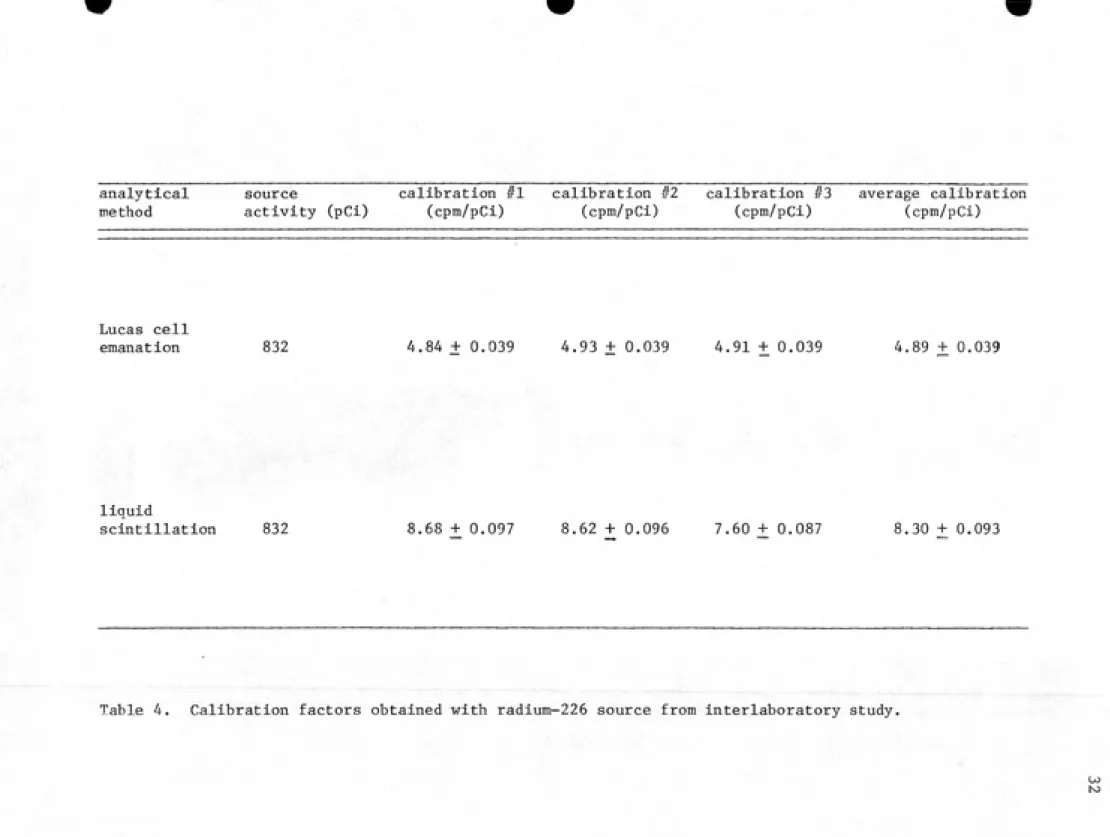
quality control study provided a convenient means of generating water containing a known radon activity. Aliquots of this water were dispensed into emanation bubblers and liquid scintillation counting vials and analyzed in the usual manner. Results of this work are shown in table 4. Results from other laboratories participating in the study are shown in table 5.
In addition, an aqueous radium-226 source obtained from
the Environmental Protection Agency in Las Vegas was diluted
into a stock solution which was used to make sealed standard
bubblers and vials. The procedure used for this is given in
detail in appendix III. Results from analyses of these new
standards are shown in table 6. The emanation calibration
Lucas cell
emanation 832 4.84 + 0.039 4.93 + 0.039 4.91 + 0.039 4.89 + 0.039
liquid
scintillation 832 8.68 + 0.097 8.62 + 0.096 7.60 + 0.087 8.30 + 0.093
Table 4. Calibration factors obtained with radium-226 source from interlaboratory study.
Emanation method
Laboratory Calibration factor
(cpm/pCi)
5 3.79 + 0.08
8 4.24 ± 0.04
14 2.50 ±. 0.04
16 4.78 + 0.13
*17 4.89 jL 0.04
19 4.67 Ji 0.21
21 4.66 + 0.15
24 4.57 ± 0.24
25 1.53 + 0.13
28 0.105
Liquid scintillation method
(cpm/pCi)
1 8.88 + 0.00
2 8.25 J^ 0.23
3 7.26 +. 0.19
4 8.45 Jl 0.05
6 8.13 J^ 0.34
7 7.50 +. 0.23
10 8.59 + 0.06
11 7.51 t 0.45
13 6.75 Ji 0.08
15 7.70 i 0.17
*17 8.30 Ji 0.49
18 8.40 +_ 0.08
18 8.12 ± 0.37
20 8.08 jL 0.10
21 8.19 i 0.05
21 9.12 jt 0.09
23 6.82 ± 0.003
26 9.00 ± 0.09
27 3.64
27 3.34 ± 0.47
* indicates Radiological Hygiene Lab
Table 5. Calibration factors obtained by participants in interlaboratory study. Adapted from personal communi¬ cation from E.L. Whittaker, Lockheed Engineering and Management Services Company, Environmental Programs Office, 1050 E. Flamingo Road, Suite 120, Las Vegas,
Lucas Cell Emanation
Activity (pCi) Calibration (cpm/pCi)
238 5.67 ± 0.032
476 5.38 ± 0.022
* 5.53 ± 0.027 (average)
Liquid Scintillation Counting
Activity (pCi) Calibration (cpm/pCi)
238 10.87 ± 0.11
476 10.96 JL 0.11
714 10.85 ± 0.11
952 10.78 ± 0.11
1190 10.84 ± 0.11
10.86 ± 0.11 (average)
Table 6. Calibration factors obtained with dilutions from
aqueous radium-226 source from the Environmental
Protection Agency in Las Vegas, Nevada.
* Analyses of the two standard activity emanation
bubblers has been repeated. The resulting calibrations were 5.61 cpm/pCi for the 238 pCi standard and 5.11 cpm/pCi for the 476 pCi standard. The overall average
for emanation and liquid scintillation counting were used
for final calculations of radon concentration. The
standards from which these data were obtained are sealed and
do not require handling of an aliquot prior to analysis.
The final average calibration factor used to calculate
the emanation radon concentrations (table 6) represents a
20% increase over the average value of 4.61 cpm/pCi
previously used (Mitsch 1982) . Although this is a
significant increase, it should be noted that quality
assurance emanation experiments performed at U.N.C. in
cooperation with the E.P.A. in Las Vegas produced
consistently high radon measurements (Mitsch 1982). It was
proposed that error in the calibration factor was the
greatest contributor to these high radon measurements (Hayes
1984). Consistently high radon measurements could be
explained by the calibration factor being too low (see
previous expression for calculating radon concentration).
The quality assurance radon measurements performed by Mitsch
were an average of 23 percent too high.
Exploratory data analysis
The data in appendix IV include radon concentrations
determined by both emanation and liquid scintillation
analysis for fifty two out of one hundred sites sampled. An
objective of this study was to determine whether the liquid
scintillation counting procedure produced results consistent
with those of the standard emanation method. An exploratory
12000
11000
10000
u p.
c
•H
g •H U
to
1-1
c
o
c
o CJ
c
o •o R)
Pi
9000
4000
3000
2000
1000
Emanation Liquid scintillation
Figure 5a. Box plots of radon concentrations as determined
cr
u
(U
Pi
itO.5 0.5 1.0 1.5 2.0 2.5 3.0 3.5 7.8 11.0 Radon-222 (10 pCi/L)
Emanation
a*
(-1
M-l
erf
I I [ IM .
«i::0.5 0.5 1.0 1.5 2.0 2.5 3.0 4.5 5.0 7.5
Radon-222 (10 pCi/L)
Liquid scintillation
indicate great differences in radon concentrations between
the two datasets. However, the histograms indicate that the
data for both analytical techniques are not normally
distributed. In addition, the box plots show that there are
outlying data points present. The box in the figure
represents the interquartile range (IQR) or the middle 50
percent of the data. The line across the box is the median
value (50th quartile) , the ends of the box represent the
25th and 75th quartiles. The length of each stem represents
up to 1.5 times the IQR, depending on where values fall in
this area. Shorter stems result when data points are
lacking in the stem region. Values extending beyond the
stems are called outlying data points. Outliers may be
present regardless of the length of the stem. The nonnormal
distribution of the data violates an assumption of the
classical statistical test employed in this section to
compare the two analysis techniques. This indicates that a
transformation of the data or other robust method of
statistical analysis will be needed. The hypothesis testing
section will describe this in greater detail.
Figure 6 shows a scatter plot of radon concentrations
measured in the groundwater of the fifty two sites analyzed
by both emanation and liquid scintillation counting methods.
If the two analysis procedures produce similar results for
the same sites sampled, then the slope of the best fit line
through the data in the scatter plot should be equal to one.
100000
y 10000
5
100 1000 10000 100000
Radon-222 concentration by emanation (pCi/L)
Figure 6. Radon concentrations as determined by emanation versus liquid scintillation analysis. Slope of the line
through the data is equal to one.
(dependent variable) on the emanation data (independent
variable) yields a slope of 0.94 indicating that on the
average the emanation results are slightly higher. A
Pearson correlation matrix for the two variables generated a
correlation coefficient of 0.98, which is highly
significant.
The other primary objective of this study was to de¬
termine whether there were significant differences in radon
concentrations in groundwater sampled from different
geological formations. Figures 7a and 7b show the radon
data grouped in five geological classifications for
emanation and liquid scintillation counting analysis
respectively. Examination of the grouped data shows
nonnormal distributions (note off center locations of
medians), outlying data and inequality of variance between
groups (note different length boxes). Again, because the
data do not satisfy test assumptions well, robust methods
will be used in the next section to test the influence of
geology on radon concentration.
Hypothesis testing 1
Hypothesis tests are used to answer experimental ques¬
tions on a statistical or probabilistic basis, and to make
inferences about a population based on a sample from the
population. Each question is expressed in the form of two
hypotheses concerning a population parameter selected to
represent the population. The hypothesis tests establish a
30000
20000
13000
o 6000
Cfl
C
Cfl
B
<U
^ 5000
c
o •H
4-1
^ 4000
o
n
o o
^ 3000
I
o Xi
cfl
2000
1000
X CP n=20
GN GR ͣMA
n=23 n=18
Rock types
n=17
MV n=22
Figure 7a. Box plots of radon concentrations, grouped by rock type,
as determined by emanation analysis. Rock types: CP=coastal
20000. 13000-a g
^
6000 •H c o CD T3 •H.1 5000
c•^ 4000
)-< 4-1 C (U o c o o CN CS CM I C o nJ Pi 3000-2000 1000 CP n=3 GN n=21 GR n=6 MA. n=14 MV n=i Rock typesFigure 7b. Box plots of radon concentrations, grouped by rock type, as determined by liquid scintillation analysis. Rock types: CP=coastal plain, GN=gneiss & schist, GR=granite, MA=mafic,
produce a test statistic calculated from parameters of the
sample. The test statistic is compared to a tabulated
critical test statistic of a specified confidence level,
which assumes the null hypothesis. The decision to accept
or reject the null hypothesis is made based on whether the
sample statistic exceeds the critical value. Before a test
can be performed, certain prior conditions must be satisfied
as nearly as possible. Checking to see if these conditions
were met was the purpose of the exploratory analysis, which
revealed that certain assumptions were not well satisfied.
The question which asks whether liquid scintillation
analysis produced results comparable to standard emanation
analysis is tested by looking at the differences between the
two measurements for each site sampled. A one sample paired
T-test is used because the samples were collected at each
site in pairs (Koopmans 1987). The null hypothesis states
that the mean difference (in the population) equals zero,
meaning the two techniques yield the same results. The
alternative states that the mean difference does not equal
zero. The test statistic is calculated using sample
estimators of the population parameters. Exploratory
analysis of the fifty two pairs of emanation and liquid
scintillation data in figures 5a and 5b indicated the need
for a modified hypothesis testing method. Figure 8 shows a
box plot of the differences in radon concentrations measured
by the two analytical techniques. The outlying data points
1600
1400
1200'^
1000'
800
u
600
p.
o •H
4J
CD 400 M
4->
200
g
u
0
CM
c
o
•d
ct) -200 C
•H
(0 -400
U
C!
<U Vj 0)
4-1 -600
«M
•rl
P
-800
-1000
-1200
-1400
-1600
Figure 8. Box plot of the differences in radon concentrations
measured by emanation versus liquid scintillation
analysis. Differences were calculated by subtracting the
of the differences and therefore can reduce the power of the
T-test. Trimming outliers from the dataset before
performing the test restores much of the power (Koopmans
1987). The outliers are trimmed so that the data better fit
the conditions of the hypothesis test used. The term
outlier is being used to describe data points which deviate
from the mean to a much greater degree than most of the
data. It is not implied that outliers are data which are
suspected of being the result of improper experimental
analyses. The T-statistic calculated from the trimmed data
is shown below.
T=
^T
T= 2.954
where: Xj= 10% trimmed mean difference =79.6 pCi/L
Sy= trimmed standard deviation = 170.5 pCi/L
Np= trimmed sample size =40
The critical value at the 95 percent confidence level for
this test is 2.042. Since the sample statistic exceeds
this, the null hypothesis is rejected with 95 percent
confidence. Therefore it is inferred, based on the sample,
that there is a significant difference in radon
concentrations measured by the two techniques.
Figure 9 shows a box plot of the differences expressed
0) o
c
Q)
Q)
14-1 14-1 4J
C
o
0)
P-i
100,
90
80
70
60
50
40
30
20
10
Figure 9. Box plot of percent differences in radon concentrations
measured bj' emanation versus liquid scintillation analysis.
examination of the percent differences in appendix IV and
their distribution in figure 9 shows that only five values
are greater than 45 percent difference. Alternatively,
forty five of fifty two values are below 35 percent difference and forty values are below 25 percent difference. Although there are statistically significant differences between emanation and liquid scintillation results, the
majority of them can be considered relatively small on a
practical basis.
With modification of sampling materials and procedures
used, these differences could be substantially reduced.
Noting the signs of percent difference values in appendix
IV, in 75 percent of the cases it is positive, indicating
that the emanation result is greater than the liquid scintillation result. The sample collection technique for
liquid scintillation analysis could provide insight as to
why these results were often lower. During collection a
water sample is drawn from a gently flowing, nonaerating
pool of water using a syringe. Careful attention must be paid to this procedure. The degree of success achieved in
executing this step with minimal radon loss may partially
account for the lower liquid scintillation results. By
comparison, samples for emanation analysis were collected
directly from a faucet, via rubber tubing, into the bubbler.
The potential for loss of radon during this collection
process is lower. The vials into which liquid scintillation
as well. Glass vials and plastic caps with paperbacked foil
liners were used in this study. Vial caps with better
sealing capabilities would reduce the likelihood of radon
loss due to leakage. It is also important to keep in mind
that the emanation result for each site is based on only one
sample while each liquid scintillation result is the average
of two measurements. Although it would require a
significant amount of extra time for analysis, it would be
best to obtain an average emanation result for each site.
By taking the following measures, substantial reductions in
the differences in radon concentrations measured may be
possible. Strict attention must continue to be given to
liquid scintillation sampling technique. To further reduce
the potential for radon loss after sampling, improved
collection vials should be used. Finally, an average result
for both analytical techniques should be obtained for each
site.
The other objective of the study, which asks whether
site geology has an influence on radon concentration, is
tested by looking at the variation in concentrations between
the five geological groups sampled. This is accomplished
using one way analysis of variance (Koopmans 1987). The
null hypothesis states that there is no difference in mean
radon concentration between any of the five groups. The
alternative is that there is a difference between at least
two of the groups. Exploratory analysis of the data in
the data prior to testing. In this case, the data are
transformed by taking their natural logarithms. Figures 10a
and 10b show the effect of the transformation on the data.
The data fit the test assumptions better, however outlying
data points persist in a number of the groups. Applying the
trimming technique to each group of the emanation data
improves the power of the test further. The analysis of
variance tables in table 7 show significant differences
between groups for both the emanation and liquid
scintillation counting data (the null hypothesis is rejected
in both cases). The liquid scintillation counting data were
not trimmed following the transformation because of the lack
of enough data in each group (see figure 7b for group sample
sizes) . The small sample sizes in some of the groups as
well as the variation in sample size between groups of the
liquid scintillation data has undoubtedly affected the power
of the analysis of variance test.
The analysis of variance indicates that for both eman¬
ation and liquid scintillation analysis at least two groups
have different mean radon concentrations. In order to tell
which groups are different, each mean is compared to the
other four individually by a least significant difference
method (Koopmans 1987). Results of these individual
comparisons are depicted in figure 11. The rock groups are
arranged in order of increasing mean radon concentration.
Groups that are inside sets of brackets were not
g ͣ H U CO e c O •H •U CO M 4-1 d u c o o c o 13 0) (-1 M-H o 00 o u 3 4J Cfl a 9 • 8 4 3 . 2 i
CP GN GR MA MV n=20 n=23 n=18 n=17 n=22
GN GR MA
n=23 n=18
Rock types
n=17
Figure 10a. Box plots of natural logarithms of radon concentrations, grouped by rock type, as determined by emanation analysis. Rock types: CP=coastal plain, GN=gneiss & schist, GR=granite,
u> Ui >^ H-CW C f-i (B 3
O pj 00 II o
fti 3 H M (jO <-a
II P) O O (W M c cr i-i ^ -a . P3 tn fO
3 H- Cl-H- CO bd
rt • o- o
(t) ^ M
^ 1^ H -a
ͨ
^ o
> n
O M O O
tt '^ !C rtCO 3II
B
P3 rt rt M
Hl^ͣv<! o M
H- ^ >xi t-u O (D (D
» CD - 3 pel
o
^ O S ?
R-II ^tJ »-<
S II n- p) rt
n> o n> H" Vl
n- o rt ͨo
P) pi n> M to
< en a o en
O rt a 0^
M P) p. pi
O M 3 i-i 3
PJ (D H- II o
3 13 a. rt a^ td
H- M O P) cr g
• t;-ͣ^ en
0
V
of r
liqu
II H- P3 OP p, p^
3 O ro cn 3
H- n 3
CD CD
^1
rt 3
II H 4>
g
(^ H- n
CD M 3
n B) rt
3* rt H H- H- P3
CD O rt
rt 3
H-B
en
3
II
sum of squares degrees freedom
between groups
within groups
64.1
70.2 71
16
0.99
16,211 0.001
(reject null hypothesis)
Dependent variable; In liquid scintillation result
sum of squares degrees freedom mean square
between groups
within groups
20.4
44.5 47
5.1
0.95
F-statistic p-value
5.385 0.001 (reject ntill hypothesis)
•
CP1
MA GR GN
Low radon-222 High radon-222
[
[
MV MA
GR GN
]
]
These two groups were not significantly different,
These two groups were not significantly different.
CP MV
Liquid scintillation
MA GR GN
Low radon-222
[
[
[
CP MV
MV MA
MA GR
]
]
High radon-222
These two groups were not significantly different.
These two groups were not significantly different.
GN These thr —' different
three groups were not significantly
Figure 11. Results of least significant difference groupings for emanation and liquid scintillation analysis. Rock groups are arranged by increasing mean radon concentration. Sets of brackets are intended only to depict which rock groups were not significantly different. Therefore, other combinations
significantly different.
Liquid scintillation precision
Two samples were collected at each site for liquid
scintillation analysis. This provides the opportunity for
testing the precision of liquid scintillation analysis by
applying a paired difference T-test to the data. The
results of the two measurements for each site are listed in
table 8. A one-sample paired T-test was performed on the differences between the two measurements obtained for each
site. The null hypothesis tested states that the mean
difference equals zero. The difference data are shown in
figure 12. The figure shows that the data contain outliers,
so it was first trimmed before applying the test. The
T-statistic calculated from the trimmed data is shown below.
^T
T = 0.914
where: X_= 5% trimmed mean difference =8.7 pCi/L S = trimmed standard deviation = 64.7 pCi/L
Nj= 46
The critical T-value at the 95 percent confidence level is
2.021. Since the sample statistic is less than 2.021, the
null hypothesis is accepted with 95 percent confidence.
Therefore it is inferred, based on the sample, that there is
no significant difference in radon concentrations measured
L.S. sample 1 L.S. sample 2 Pent diff (pCi/L) (pCi/L)
342 ± 17.7 370 + 17.7 7.7 675 + 19.5 651 + 19.4 3.6 292 i 16.5 331 ±. 16.7 12.5 254 ± 18.2 152 Jl 17.3 50.6 325 ± 18.2 539 Jl 19.7 49.4 691 i 18.5 709 Jl 18.8 2.6 2002 ± 27.7 1816 ± 26.0 9.8 1593 ± 25.1 1498 Jl 24.5 6.1 1958 + 27.5 2327 Jl 30.8 17.2 1113 ±. 23.0 1185 Jl 23.2 6.3 1297 ± 24.1 1241 _+ 23.8 4.5 2842 Jl 35.9 2832 i 35.8 0.4 1698 ± 26.2 1659 ±. 26.0 2.3 891 Jl. 22.1 926 JL 22.4 3.8 1362 ± 28.8 1397 J^ 29.0 2.6 288 ± 22.7 340 ^ 23.0 16.7 1215 Jl 21.8 1245 ± 22.0 2.5 7949 ±. 85.0 7644 Jl 82.0 3.9 2241 + 29.2 2121 ± 28.1 5.5
2065 ± 27.6 2086 Jl 27.8 1.0 1264 Jl 22.6 1170 + 22.1 7.7 484 i 18.3 516 +_ 18.6 6.4 3432 ± 40.8 3330 ± 39.8 3.0 284 + 17.2 311 + 17.4 9.0 1238 J: 22.9 1276 + 23.0 3.1 1114 Jl 22.3 1083 + 22.1 2.8 1018 Ji 21.9 1024 ± 21.9 0.6 1063 +. 22.2 1103 ± 22.5 3.7 359 i 19.4 323 Jl 19.2 10.4 175 J: 18.3 186 + 18.4 5.7 4949 ± 56.4 4834 d^ 55.3 2.4 3193 ± 39.4 3119 ± 38.7 2.3 1532 ± 22.4 1460 Jl 22.1 4.8 452 ± 16.7 497 Jl 17.1 9.6 9879 ±103.7 9942 J:104.4 0.6 2013 i 28.1 1975 + 27.8 1.9 1553 i 25.7 1439 + 25.0 7.7 238 ± 18.2 234 ± 18.2 1.7 2693 + 34.3 2762 + 35.1 2.5 4298 + 49.8 4524 ± 52.0 5.1 2648 Ji 34.1 2620 ± 33.7 1.1 285 ± 15.4 267 ± 15.3 6.7 49 Jl 23.6 52 Jl 23.6 5.5 62 J: 23.8 94 ± 24.0 40.6 842 ± 28.9 857 + 29.0 1.8 104 ± 15.1 91 ± 14.9 13.1 3165 + 49.9 3073 ± 49.4 3.0 1967 ± 44.4 1948 + 44.2 1.0 1125 + 26.3 1090 ± 26.0 3.2 417 + 19.2 484 i 19.7 14.9 722 + 20.5 690 ± 20.3 4.6 1419 + 24.8 1486 + 25.2 4.6
Table 8. Radon concentrations determined by liquid scin¬
tillation analyses of two sample vials collected at 52
Figure 13 shows a box plot of the differences expressed
as percents. It should be noted that only three of the
values are above 40 percent difference, while forty nine of
the fifty two values are below 20 percent difference and
forty three values are below 10 percent difference. These
results show good reproducibility in the paired liquid
scintillation measurements. This is valuable information to
have since it lends credibility to the measurement
technique. The relatively few cases of larger percent
differences may be partially attributable to leakage of
radon from one vial of some of the pairs. Looking at table
8, it seems that the greatest percent differences are
associated with lower radon concentrations, indicating that
the difference expressed as a percent is large because the
concentration is low. However, this is not strictly the
case. A number of sample pairs at low concentrations have
low percent differences between them. Figure 14 shows a
plot of the differences between radon concentrations
measured in dual LSC samples versus the mean of dual LSC
samples.
In general, the results of hypothesis tests should be
taken with some reservation. Factors which can affect test
validity and power should be considered. This is
particularly true when considering the effect of a variable,
such as geology, on measured radon concentrations. Since
inferences are made about the population based on small
(pCi/L)
-400 -300 -200
________k—
-100 100 200 300 400
Figure 12. Box plot of the differences between radon concentrations
measured in dual liquid scintillation samples.
Percent difference
0 10 20 30 40 50 60 70 80 90 100
p.
CO 0)
400 ,
300 ͣ
CO
G
•H
CM
CM
C-J
I
C
O
(0 u
200.
CO
(J
C
(U !-i 0)
•H
Q
100,
-..N'
mean radon-222 concentration (10 pCi/L)
10
Figure 14. Plot of differences in radon concentration measured in