Introduction
Heart failure is a nation-wide epidemic with 5 million Americans affected, and it is the leading cause of death in the world.1,2 Cardiac transplantation is the current gold-standard to treating end-stage heart failure.3 The one-year survival rate of cardiac transplantation is greater than 80% when patients are placed on an immunosuppressive regimen including medications such as corticosteroids, azathioprine, and cyclosporine
A.3,4 Prior to the 1980s, success with cardiac transplantation was very limited. The introduction of cyclosporine A in 1980, when used in combination with azathioprine and corticosteroids, was the reason for the increase in one-year graft and patient survival.4 The use of a three-drug regimen was became a main-stay in cardiac transplant
recipients in the prophylaxis of acute rejection.5
Shortly after 1980, tacrolimus was identified as a potential immunosuppressive agent that had comparable efficacy to cyclosporine A with significantly decreasing the
incidence and severity of acute rejection following cardiac transplantion.6 In vivo and in vitro studies both suggest that cyclosporine A and tacrolimus operate through slightly
different mechanisms. Tacrolimus is successful in providing ongoing prophylaxis of rejection due to the suppression of IL-10 and inhibition of IL-10-mediated cytotoxic cell infiltration into the transplant.7 There was no statistically significant difference in
freedom from ISHLT Grade 3A rejection when using tacrolimus compared to
A newer randomized controlled open-label trial investigated the use of tacrolimus
monotherapy to the use of tacrolimus in combination with mofetil mycophenolate (MMF) as prophylaxis of acute rejection in cardiac transplantation.7 The goal of this trial was to determine if outcomes were similar between monotherapy and combination groups. The
primary outcome was the 6-month mean International Society of Heart and Lung Transplant (ISHLT) biopsy score, and the secondary outcomes included all-cause
mortality, incidence of ISHLT grade 2R/3R rejection over 6- and 12-month time points, one-year mean cumulated ISHLT biopsy score, and incidence of allograft vasculopathy. The researchers found the incidence of 6-month freedom from rejection in the
monotherapy group was 85.9% and in the combination group was 94.4%, but the
findings were not statistically significant (p = 0.14). There was no significant reduction in
rejection, allograft vasculopathy, or 3-year survival.
The purpose of this project is to further establish the efficacy and safety of the use of
tacrolimus monotherapy for immunosuppression in cardiac transplant recipients at UNC medical center.
Methods
This was a single arm, retrospective patient chart analysis of patients that received a
cardiac transplant at UNC between 2006-2012. Patients were included if they were 18 years of age or older, received a heart transplant between 2006-2012, and received
transplanted. Data was collected from existing medical records in Transchart and
Webcis. The primary outcome of the research was the incidence of acute rejection at 6 and 12 months post-monotherapy initiation. The secondary outcomes included adverse effects, graft survival, patient survival, and incidence of CMV viremia. Approval to
conduct this research was obtained from UNC’s institutional research review board.
Results
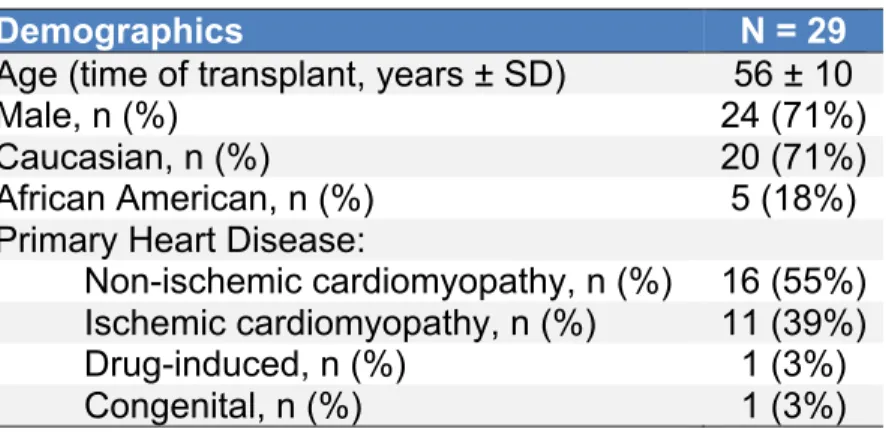
Of all cardiac transplant recipients at UNC medical center, 29 patients had received tacrolimus monotherapy for some duration post-transplant. The average patient was a
56 year-old Caucasian male who required a transplant due to non-ischemic cardiomyopathy (Table 1).
Table 1. Patient demographics.
Demographics N = 29
Age (time of transplant, years ± SD) 56 ± 10
Male, n (%) 24 (71%)
Caucasian, n (%) 20 (71%)
African American, n (%) 5 (18%)
Primary Heart Disease:
Non-ischemic cardiomyopathy, n (%) 16 (55%) Ischemic cardiomyopathy, n (%) 11 (39%) Drug-induced, n (%) 1 (3%) Congenital, n (%) 1 (3%)
Most patients were placed on tacrolimus monotherapy due to good graft function (97%), and one patient was transitioned to monotherapy due to experiencing neutropenia from
dual therapy with mycophenolate. The neutropenia did resolve after the removal of mycophenolate. The average time to initiating patients on monotherapy was 625 ±551 days (median time to initiate monotherapy was 318 days with a range 137-2014). The
range 55-2140). Biopsy rejection scores at baseline were 0R in 15 patients (52%) and
1R in 14 patients (48%). In patients with no evidence of rejection at baseline, 26.7% remained rejection-free at 6 months and 73% experienced some type of rejection (Figure 1). At 12 months a total of 27% were rejection-free, 20% had 1R rejection, 7%
had 2R rejection, and 46% did not have a 12-month biopsy obtained.
Figure 1. Rejection status progression from 0R at baseline to 12 months.
Patients who were 0R at initiation of tacrolimus monotherapy and experienced a
rejection episode were likely to experience their first rejection within the first 100 days (Figure 2). One patient continued to remain rejection-free at the end of 12 months.
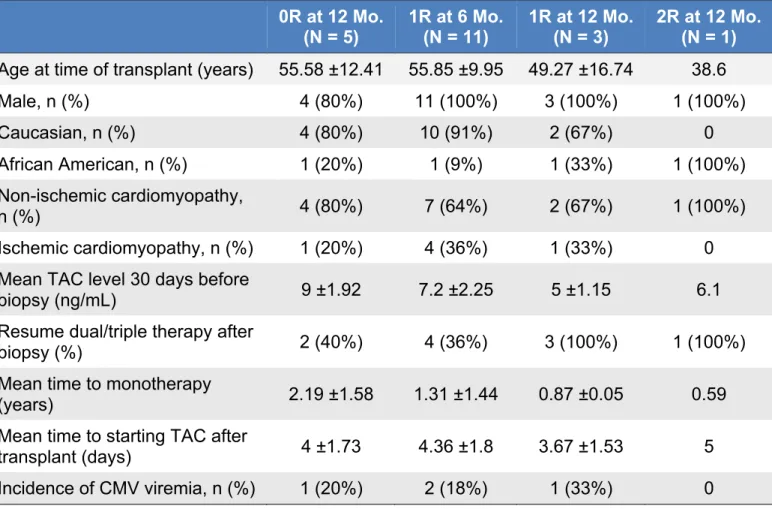
Patient characteristics of those who were rejection-free at 12 months were compared with those that experienced rejection at 6 and 12 months (Table 2.). There was no
difference in age, gender, race or type of heart disease leading to transplantation. Mean tacrolimus levels were higher in those who had no rejection, 9 ±1.92, and trended down
in those who experienced 1R rejection at 6 months, 7.2 ±2.25, and 12 months, 5 ±1.15,
and 2R rejection at 12 months, 6.1. Mean time to initiating monotherapy was also longer in those with no rejection at 12 months, 2.19 ±1.58 years, than those who experienced 1R rejection at 6 months, 1.31 ±1.44 years, and at 12 months, 0.87 ±0.05 years, and 2R
rejection at 12 months, 0.59 years.
Figure 2. Time to first rejection in patients with 0R rejection at initiation of tacrolimus monotherapy.
Table 2. Comparison of characteristics in patients with and without rejection.
Discussion
Tacrolimus is an immunosuppressive therapy that requires therapeutic drug monitoring to assess the level of immunosuppression a patient receives. The length of time after transplant typically determines the optimal goal trough for tacrolimus, with
recommended troughs to be 5-15 ng/mL in patients 4 months post-transplant.8 The higher the trough typically the greater level of immunosuppression a patient receives. The patients in this study who were rejection-free at 12 months had higher trough levels
than those experiencing some level of rejection, which indicate they were more
immunosuppressed. The higher level of immunosuppression contributes to the patient’s 0R at 12 Mo.
(N = 5) 1R at 6 Mo.(N = 11) 1R at 12 Mo.(N = 3) 2R at 12 Mo.(N = 1)
Age at time of transplant (years) 55.58 ±12.41 55.85 ±9.95 49.27 ±16.74 38.6
Male, n (%) 4 (80%) 11 (100%) 3 (100%) 1 (100%)
Caucasian, n (%) 4 (80%) 10 (91%) 2 (67%) 0
African American, n (%) 1 (20%) 1 (9%) 1 (33%) 1 (100%) Non-ischemic cardiomyopathy,
n (%) 4 (80%) 7 (64%) 2 (67%) 1 (100%)
Ischemic cardiomyopathy, n (%) 1 (20%) 4 (36%) 1 (33%) 0 Mean TAC level 30 days before
biopsy (ng/mL) 9 ±1.92 7.2 ±2.25 5 ±1.15 6.1
Resume dual/triple therapy after
biopsy (%) 2 (40%) 4 (36%) 3 (100%) 1 (100%)
Mean time to monotherapy
(years) 2.19 ±1.58 1.31 ±1.44 0.87 ±0.05 0.59
Mean time to starting TAC after
transplant (days) 4 ±1.73 4.36 ±1.8 3.67 ±1.53 5
transplant having a lesser chance for acute rejection, which was seen in the results of
this analysis.
Another factor that can contribute to the stability of a transplant is the length of time
post-transplant. Typically a transplant has a lower immunosuppression requirement the longer it is post-transplant. There was a clear trend in the data illustrating that more
patients who were rejection-free at 12 months were placed on monotherapy when they were more than two years from transplant. The one patient that experienced 2R
rejection at 12 months was initiated on monotherapy within the first year of receiving the
transplant. The patient’s transplant was likely at greater risk for acute rejection, and the removal of all but one immunosuppressive therapy further increased the risk of rejection
due to not receiving adequate immunosuppression.
This study has several limitations that we were aware of during data analysis. First the
sample size is very small, making it difficult to draw conclusive evidence and apply it to clinical practice. Secondly there was no protocol in place for initiating patients on
monotherapy, so the process for placing patients on monotherapy was not
standardized. This was an issue because biopsy results were not taken at regular intervals and data was missing at 6- and 12-month time points for some patients, and
this resulted in less data that could be analyzed. The study is also of a retrospective nature, so this made it impossible to assess patient adherence to tacrolimus since it
rejection seen in the trial were what should be expected, as there was a lack of a
comparator group.
Conclusion
From this study we conclude that tacrolimus monotherapy should be considered in patients who are healthy, adherent to their immunosuppressive therapies, and have a
low risk for rejection. These patients should be at least two years post-transplant and should have a reduced immunosuppressive requirement. There are limitations to this study that make it difficult to generalize this to the transplant population. Follow up
studies could include a prospectively designed trial with a study and control arm and a strict protocol for monitoring immunosuppression adherence and obtaining biopsies on
a scheduled basis.
References
1. CDC. 2014. Heart Disease Facts. Accessed September 6, 2014. http://www.cdc.gov/heartdisease/facts.htm.
2. WHO. 2013. Cardiovascular Disease Fact Sheet. Accessed September 6, 2014. http://www.who.int/mediacentre/factsheets/fs317/en/.
3. 2013 ACCF/AHA Guideline for the Management of Heart Failure: A Report of the
American College of Cardiology Foundation/American Heart Association Task Force on Practice Guidelines. Circulation. 2013;128:e240-e327; originally
4. Griffith BP, Hardestry RL, Deeb GM, Starzl TE, Bahnson HT. Cardiac
transplantation with cyclosporine a and prednisone. Ann Surg. 1982;196:324-329.
5. Baran DA, Zucker MJ, Arroyo LH, et al. A prospective, randomized trial of
single-drug versus dual-single-drug immunosuppression in heart transplantation: the
tacrolimus in combination, tacrolimus alone compared (TIC TAC) trail. Circ Heart
Fail. 2011;4:129-137.
6. Pirsch JD, Miller J, Deierhoi MH, Vincentie F, Filo RS. A comparison of tacrolimus (FK506) and cyclosporine for immunosuppression after cadaveric
renal transplantation. Transplantation. 1997;63:977-983.
7. Reichenspurner H. Overview of tacrolimus-based immunosuppression after heart