Erin E Baucom. Do Archival Finding Aids Describe LGBT Individuals the Same Way They Would Describe Themselves? A Master’s Paper for the M.S. in L.S degree. April, 2016. 42 pages. Advisor: Denise Anthony
This study compares the terms used by the LGBT community to describe themselves to those terms used in institutional archives’ finding aids. An archive and LGBT history project website from each region in the United States and one region of Canada was chosen in an effort to examine differences in language uses. The history project websites were examined to find a list of terms used by the LGBT community to describe core identities. These terms were then searched for in the archival finding aids. It was
determined that the archival descriptions were often only using general, politically correct terms to describe LGBT collections. There was also evidence that some archivists were describing materials incorrectly.
Headings:
Archives – Access control Archival processing
Archives collection management LGBT archives
DO ARCHIVAL FINDING AIDS USE DESCRIBE LGBT INDIVIDUALS THE SAME WAY THEY WOULD DESCRIBE THEMSELVES?
by Erin E Baucom
A Master’s paper submitted to the faculty of the School of Information and Library Science of the University of North Carolina at Chapel Hill
in partial fulfillment of the requirements for the degree of Master of Science in
Library Science.
Chapel Hill, North Carolina April 2016
Approved by
Table of Contents
Table of Contents ... 1
Introduction ... 2
Literature Review... 4
Research Question ... 13
Methodology ... 14
Limitations of this study ... 18
Results and Discussion ... 19
Conclusion ... 33
Introduction
Institutional archives, such as those housed at a university, often hold much more than records that describe and document the institution’s history. These repositories also contain materials that document the history of events, individuals, social movements and much more. There has recently been a surge in collecting records that comes from groups in society that were either deliberately ignored or benignly neglected.
Until recently, the archivists who were creating, preserving and describing and using archival materials were often from the middle- or upper-class, male, and white with a western education. Since the end of World War II, those groups that had been, and often still are, on the margins of society have been demanding that their voices be heard. In an effort to be inclusive of society as a whole instead of just its most prominent members, institutions began collecting in earnest.
Now that those collections are in the repositories another issue has arisen. How should these new materials be arranged and described? Should the practices currently in use continue or there instead be a cooperative effort between the institution and the community from which the materials originated? The archivists that arrange and describe these materials have an enormous amount of power over how these communities are portrayed.
More and more often these communities are creating their own archives so as to control how those materials are presented to the world. This is an effort by the
to adequately represent them. Institutional repositories are seen as an extension of the authority that has harmed community members in the past.
In order to regain the trust that was lost, institutional repositories need to be more accepting of how that community describes itself. If the archive works with the
community or at least does research into how the community portrays itself, the archive can arrange and describe the materials in a way that the members of the community would feel represents them. This would also create better access points for researchers looking for materials pertaining to particular marginalized groups.
In this paper I will be looking at how the descriptions used by institutional
repositories compare to the terms used by LGBT individuals to describe themselves. This comparison will show which archives, if any, actually studied the community the archive is trying to represent through the descriptions of archival materials. I will use LGBT history project websites from cities closest to the institutional archives chosen from four regions in America and one region in Canada, to find key terms that LGBT individuals use to describe themselves. It is important that these archives came from different parts of the country because terms and phrases vary by region.
Literature Review
When considering institutional archives, great strides have been made in including underrepresented voices. Some examples of these voices are women, ethnic minorities, sexual minorities and the illiterate. Often these groups will appear in archival records, even if only among the records of those groups most likely to appear in an archival institution: those about middle- and upper-class white, educated males.
However, according to Flinn “…the mainstream or formal archive sector does not contain and represent the voices of the non-elites, the grassroots, the marginalized. Or at least if it does, the archive rarely allows them to speak with their voice, through their own
records,” (2007, p. 152).
It has only been as recently as the 1970s that sexuality studies have become robust and accepted by the academic community as a legitimate area of research. These studies are like all other historical studies and social history studies; they require primary source evidence to prove or disprove historical theories. According to Maynard, the true problem for sexuality studies as opposed to the much more common minority and women’s studies that have recently been celebrated is the lack of archival materials or at
least the lack of access to archival materials (1991).
There is an ingrained lack of trust in authority that has developed in the Lesbian, Gay, Bisexual and Transgender (LGBT) community over the course of recent history. For example, during the McCarthy Era, LGBT individuals were considered a threat to
just because of the implication that they might be homosexual. In most of these cases, it was documents such as letters, magazine subscriptions, and police records that tipped off the authorities to a possibility that a person could be homosexual (Loftin, 2015). In an effort to maintain their jobs, professional reputations and continue with their lives without stigma, many LGBT individuals self-censored (Freedman, 2015).
Individuals self-censored during their lifetimes in many eras, not just during the Red Scare. In other cases, the families of LGBT individuals would eliminate any evidence of “non-normal” sexual practices in an effort to posthumously protect the
memory of their loved ones (Loftin, 2015). In some cases, there was also a monetary concern for a person to keep quiet about their sexual identity. According to Rob
Hernandez, “[s]uspect sexualities have profound effects on artists’ biographies, careers, and art-market valuations and inform the perception of the work” (2015). There is a clear argument that it is beneficial for artists to hide any evidence of “deviant” sexual practices
while they are alive, and for their families to continue this practice after the artists have died.
In an effort to control how their history is told, LGBT groups have decided to create their own archives. These are commonly referred to as independent archives, community archives or counter archives (Cantrell & Stone, 2015). Flinn provides the best description of the need for and use of community archives:
“In the case of the independent archival act, when informed by a radical public history agenda of not just the reclamation and celebration, but also of reflection and explanation, then the community archive can represent not only the
One of the most well-known community archives in the LGBT community is the Lesbian Herstory Archive, created by lesbians for lesbians. The materials are all in open stacks and volunteers in the lesbian community perform the appraisal and description of the materials. There are no restrictions concerning who is allowed to come to the archives, though previously it was women only. Also, the only rule is that those who use the resources leave them in a condition that will allow them to be available in the future (Beins, 2015). One of the founders of the archive, Joan Nestle, said “[w]e wanted our
story told by us, shared by us and preserved by us. We were tired of being the medical, legal, and religious other” (Enszer, 2015, p. 152).
Throughout their history, LGBT individuals have been silenced by authority. Their history has purposefully been erased. Thus, LGBT individuals are justifiably concerned about institutional power and authority. A traditional archive is the epitome of the authority and control governments and dominant social narratives have over how information is preserved and shared. In an effort to regain control over their own cultural narrative from these authorities, LGBT community groups have created and maintained their own archives. More importantly, they have created these private archives in an effort to make sure that their history does not disappear.
Research into social history that targets the LGBT community is now often referred to as queer studies (Howard, 2001). Queer is a very controversial word,
noun, it is most often used as a term used to describe the entire community of people that do not identify as strictly heterosexual or gender conforming (Cantrell & Stone, 2015). In my research, I found that Canadians are much more likely to use queer as a noun, as previously defined, but people in the United States are now slowly incorporating it into common discourse.
Often, the only records available for queer history studies, when a researcher wants to a look at time periods before the second world war, are almost always found in police and court reports. However, when looking at these reports a researcher must know the key phrasing used to find information relating to homosexual activity. A person was not arrested for being a homosexual. An individual could only be arrested for performing deviant sexual practices or trying to solicit deviant sexual practices. Another common accusation was distribution of pornographic sexual material. A researcher may also find personal papers and newspaper accounts, but for the most part the history of human sexuality is told in the records of arrests, trials and imprisonment of these LGBT
individuals. Additionally, imprisonment could have meant one of two things: a traditional jail or a mental hospital (Maynard 1991, 2009; Rawson, 2009).
After the explosion of LGBT activism in the 1970s, many more records were generated and saved by community archives and by institutions. Many LGBT activists specifically chose institutional archives for the authority those institutions transfer to the records. According to Hyry and Light “[i]n the very act of soliciting and preserving the
Those records that do exist in institutional repositories that relate to human
sexuality are often inaccessible because of government restrictions, archivist gatekeepers, uncomfortable reading room environments or even poor description. If a researcher cannot access the records, then the records might as well not exist. Archives exist to be used. As Devor and Wilson so eloquently put it, “[i]f patrons become frustrated when they do not find what they are seeking, or are disappointed if they do not see their own experience reflected in the material, they may turn away from the archives…” (2015, p.
261). There is little that activists can do about government restrictions to certain records, other than continued and forceful lobbying, but archivist can control how materials are described so as to make access much easier and much more likely (Maynard 1991, 2009; Beattie, 1997).
An improvement in archival description will lead to an improvement in access. Archival description updates could also lead to increasing trust between users of the materials, not to mention the community the materials come from, and archival
institutions. Archival institutions being aware and willing to use terms most familiar to the community show respect to that community (Rawson, 2009; DiVeglia, 2010).
The most detailed descriptions of archival materials are found in finding aids. A finding aid is “…a document that provides description and metadata crucial to
understanding the nature, contents, and contexts of a collection…” (Sedgwick, 2008, p.
archivists who knew their collections intimately to find the records related to the subjects of the researcher’s focus (Beattie, 1997).
Access to records has greatly increased with the advent of the internet. In fact, according to Helen Tibbo, historians and other researchers now automatically go to an archives website (2003). With access to online finding aids, researchers have become more adept at navigating the provenance based descriptions (Beattie, 1997). However, if descriptions of resources are not available or are poorly written, researchers are less likely to contact the repository for more information. These online researchers require detailed, easily readable information with little jargon; using a writing style that is more akin to the information provided by museums for exhibitions than what is in a traditional archival finding aid (Hill, 2004). Also, because, online researchers are more likely to do keyword searching, there must be access points that include all the keywords a researcher might use.
Most archives follow library cataloging tradition and use Library of Congress Subject Headings as these access points. However, Library of Congress Subject Headings are not updated often, and in the case of the LGBT community, there are outdated terms or at least outdated definitions for the terminology (Berman, 2015). Therefore, a
researcher into queer history, especially a novice researcher, might not use the same terms as the archivist who described the collections.
subject heading definition remained (Buckland, 2012). In a similar vein, the LC uses the subject heading transsexual” for all gender “nonconforming” individuals. Whereas trans*
is the common parlance in the LGBT community. Also, transsexual is most often defined by the medical establishment as “a male or female who “is deeply unhappy as a member of the sex (or gender) to which he or she was assigned,” and who has the desire to
physically alter their body through surgery and the use of hormones” (Lair, 2015, p. 242). Library of Congress Subject Headings change too slowly and are added to so infrequently that it is impossible for the terms and definitions to stay up to date with common parlance. Confounding this are the challenges involved in the classification of identities. Campbell paraphrases Sedgwick when saying “…people are different, categories shift, and labels are provisional. We are dealing with no monolithic identity, no stable categories, and no consensus…survival within a marginalized group depends on the regular and frequent subversion of traditional classification categories,” (2000, p.
127).
In the past, one or two archivists would create the description for each collection. That archivist would bring their own inherent biases and life perspectives to each description. These life experiences influence how the archivists describe the collections in their care. In an effort to combat this, Terry Cook has promoted a newer framework for archival description, one based on community archiving (2013). Cook claims that:
“…influences of race, ethnicity, class, gender, and sexual orientation make their varying impacts felt, related groups in society shape their identities anew, seeking in the memory of past triumphs or abuses, traumas or achievements, very
This new community involvement would “…achieve more democratic, inclusive, holistic
archives, collectively, listening much more to citizens than the state, as well as respecting indigenous ways of knowing, evidence, and memory…” (Cook, 2013, p. 116).
Archivists truly need to reevaluate how they describe collections, especially those that come from underrepresented communities. To maintain the institution’s integrity and
the community’s trust, archival descriptions must match those the community uses to describe themselves (Loewenthal, 2015). This increased awareness of the community’s own descriptions will also lead to increased accessibility of the materials.
Researchers into queer history will be able to use terms that the queer community uses to describe themselves and actually have search results returned. However, it is important that legacy materials retain the terminology of their time. This keeps the descriptions historically authentic, and when used in conjunction with the newer terms, descriptions will stay true to the materials themselves and still be findable (Beattie, 1997). This is especially true in the history of sexuality. The laws that govern and have governed sexuality get their text from material written before the American Revolution. Terms have evolved from abstract concepts that cover many aspects of sexuality to meaning only one sexual act. Case in point is the word sodomy; it was an
all-encompassing word that described any sexual act that the church did not agree with, then it evolved as a term only to be used as an identifier for a person, to what it is today: an identifier for a person as well as a term used for a specific sexual act (Campbell, 2000).
originally defined as an act but during the 1950s it became an identity. When that shift occurred, homosexuality was defined as sexual aggression toward a person of the same-sex and was thought to be a “curable social problem not unlike alcoholism” (Freedman,
2001, p. 57). Using this definition, many people of that time, who would acknowledge that they participated in romantic and physical same-sex relationships, would not identify themselves as homosexuals.
There is a further wrinkle in the descriptions of LGBT material. The community itself does not always agree on the terminology. In some cases, some words are
considered outdated or too broadly used. In other cases, terms are highly regionalized and only appear in small subsets of the community. This is why it is so important for
archivists to consult the community the archivist is trying to describe. Institutions need to focus on where the materials come from and where the materials now reside. In this way, the archivists can choose the most appropriate community specific and region specific terms (Campbell, 2000).
Research Question
As institutions change and evolve they consider what is missing in their collections. This has led to a surge in collecting records from previously hidden
communities. There has also been a reevaluation of existing collections to determine if extant material was suppressed due to prejudice against these groups. Now these hidden collections are being actively uncovered, processed and described. Similar to other suppressed and minority groups, the LGBT community has actively tried to collect and maintain their own records. Some of these independent archives have been able to process and provide access to these records. Smaller independent community archives have built up enough trust to turn their records over to an institutional repository so as to give a wider spectrum of the population access to these records.
These LBGT materials tell the story of the community. In order to maintain the existing trust and even grow that trust, institutional archives are going to have to describe the materials in a way that conforms to how LGBT community members see themselves. I focused on specific terms that describe core identities in order to determine if
Methodology
This study compares the terminology used by LGBT individuals to describe themselves with the terminology used by institutional repositories to describe their LGBT holdings. For the purpose of this research, an institutional repository is considered to be any archive or special collection that is affiliated with a university, established historical society or government organization. Conversely an independent archive is considered to be any archive, library or special collection that was created by the LGBT community.
I did a qualitative content analysis of websites created by LGBT history projects that are a part of LGBT independent archives: that were in the same region as the
institutional archives chosen for the study. These websites provide access to information acquired as part of collecting the archival objects. They also provide a point of access for donors and contributors to add to the knowledge and the archives themselves. I looked through the exhibit sections to determine the keywords that these individuals use to describe themselves. All the keywords came from photo captions, timelines and the contextual information provided in these exhibition portions of the websites.
LGBT archive website resources will be used as a proxy for current LGBT community language practices.
I chose an institutional archive with LGBT collections from four regions of the United States and one region in Canada. After the archives were chosen I looked in that region for an independent archive created by the LGBT community to document their own history. If there were multiple independent archives close to the institutional
repository, I chose the archive with the most comprehensive website. Conversely, if there was no regional archive, I chose the closest independent archive to the institutional repository.
The four regions of the United States were Northeast, South, Midwest and West grouped by state according to the U. S. Census Bureau. The archive chosen from Canada was randomly selected in the same way as those from the United States but the list
included all of Canada not just one region. Lavender Legacies is a guide developed by the Society of American Archivists Lesbian and Gay Archives Roundtable (LAGAR). This guide, while not comprehensive, lists LGBT collections in the United States and Canada. This guide is what was used to determine the sampling lists. Unfortunately, the guide has not been updated since 2012, but the list was able to give me a large, diverse population of institutional repositories from which to sample.
The sampling method I used to choose each regional archival institution was selective randomized sampling. For each region, all those archives that met my study criteria were placed in a list. I then generated a random number and chose the
archive have online finding aids or detailed catalog entries describing their contents. An LGBT collection was considered to be any collection that the institution included in an LGBT subject guide. In one case there was not a subject guide, so only those collections that contained the keywords, LGBT, gay, lesbian, homosexual, bisexual or transgender were examined.
Without a subject guide, I was unable to consider any collections that did not have these keywords but may have included archival materials created by LGBT individuals. Most often, these are older collections where the individuals would not have used more modern terminology to describe themselves or refused to describe themselves in terms of their sexuality.
I only looked for those terms that are used to describe core identities. For example, the term lesbian is one used to describe women who are sexually attracted to other women only and that is part of what makes that person who they are. I did not look for descriptors of sexual practices. These identity descriptions include slang terms as well as those considered to be “politically correct”.
The content analysis was a very subjective process. In an effort to balance the subjectivity, any keyword that could be used to describe a core identity was included in the study. After compiling a list of keywords from the LGBT center website, I used a control+ F command to search for these keywords in the institutional repositories’
keyword was found in any part of the finding aid it was counted. The keyword counts were put into a table to clearly show how many times a term was used in the finding aid.
There are some keywords that appear in the results section that may be considered offensive. Often these are older terms, mostly slang, that were initially used by the
Limitations of This Study
This study looked at a very small subset of LBGT history projects and
institutional special collections. My sample size is very small and is not a comprehensive example of all LGBT collections in the United States and Canada; therefore, results will not be statistically significant. Instead, the results will simply show if further research into the subject is needed and where that research should be focused.
Results and Discussion
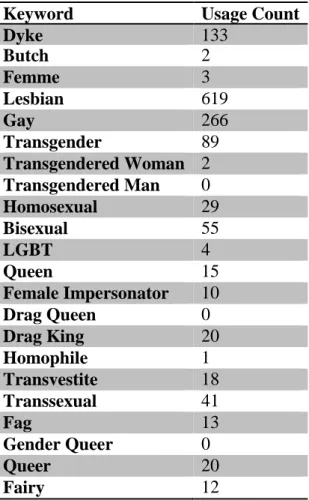
Across all of the different regions, the most commonly used term in the institutional archives was gay. In the United States, the word gay has three different contexts. The first is an all-encompassing term that is meant to describe any member of the LGBT community, and is an older usage. Recently, Canadians are beginning to use the word queer in this context. The second way the word gay is used is to describe any individual (regardless of gender) who identifies as a homosexual. In the third context the word gay is used to describe a homosexual male specifically. Besides the term gay, the most common terms found were those general and accepted descriptors like lesbian, homosexual, bisexual, and transgender. Transsexual appears often when describing transgender materials because that is the Library of Congress Subject Heading assigned to those materials.
There was some evidence to support my original supposition that terminology would differ in different regions of the country. Many of the same terms appear in
multiple regions but often, one region will be more likely to use a descriptor than another region. Another interesting difference across the many regions was the disparity in the number of LGBT collections housed by the institutional archives. In the Northeast region there were 66 collections while, in the South there were only 13. Canada cannot truly be included in this comparison, because while there were only 9 collections, these
In a majority of the collections across all regions, the slang terms and some of the more specialized terminology were not used at all by the archivist and library generated content. Specialized slang that did appear were part of the folder descriptions or title of publications held by the by the different archives. Often, there was not even a single instance of the slang terminology or evidence of more specialized or specific terminology for the trans* community. Additionally, I did not find any instance where the institutional repository used a word that was not in evidence on the independent archival website.
Northeast
In the Northeast region, I examined the The History Project – Documenting LGBTQ History in Boston MA website to find the terms used by the community to describe their core identities. The History Project maintains their archival holdings, independent of an institutional repository. The finding aids for these holdings were created by interns from Simmons College’s School of Library and Information
Science. I did not look into these finding aids for further terms because it is impossible to determine if the interns themselves were members of the Boston LGBTQ community. All information retrieval from the website was done on February 25, 2016. Since that time, The History Project has added more exhibits to their website. The reason LGBTQ is not in the keyword list is because when I originally examined The History Project website this term was not in evidence. Now it is featured prominently on the main page. This is one indications of how word usage changes over time.
These terms were compared to the descriptions provided online by the
part of the Radcliffe Institute for Advanced Study at Harvard University. The Schlesinger Library provides a guide to their LGBTQ archival collections. In this guide all of the collections the Schlesinger believes to be valuable to an LGBTQ researcher are listed with links out to either a full finding aid or a detailed catalog description for those materials that are not fully processed.
Keyword Usage Count
Dyke 133
Butch 2
Femme 3
Lesbian 619
Gay 266
Transgender 89
Transgendered Woman 2
Transgendered Man 0
Homosexual 29
Bisexual 55
LGBT 4
Queen 15
Female Impersonator 10
Drag Queen 0
Drag King 20
Homophile 1
Transvestite 18
Transsexual 41
Fag 13
Gender Queer 0
Queer 20
Fairy 12
Table 1: Total number of times keywords from The History Project were found in the 61 collections contained in the Schlesinger Library’s LGBTQ Research Guide.
II, before the upsurge in public discourse about homosexuality. These women would probably not have used any of these terms to describe themselves. Instead, the biographies included subtle hints. For example, the finding aid for the Mary Ellicott Arnold Papers (1908-1958), described a “life-long companion” who was a female but there was no other indication that this woman was a lesbian. If a researcher did not know about the subject guide and only did a keyword search, these types of collections would not be findable.
Those collections that contained the terms that could be considered offensive, like dyke, did not have the terms as part of the archivist provided information. Instead these more offensive terms, and some of the slang, all appeared in the inventory as a folder or contents label. In this way, the LGBT community is describing itself through the
materials that are donated. Dyke appears so often because it was a term used as part of a magazine title and the collection contained many of these magazines. If these detailed content lists had not been available, these terms would not have appeared. It is often very difficult for archivists to take the time to create these detailed lists, so in many cases they do not appear in the finding aids.
One collection was described incorrectly. The J. Ari. Kane-Demaios Papers has a biographical description that uses the wrong gender pronoun throughout description. Ariadne Kane was born Joseph DeMaios but has since transitioned. She should,
Midwest
In the Midwest region I looked at the Wisconsin LGBT History Project website. The website has general information about LGBT history but most of the specific content is focused on the Milwaukee area. The archival materials collected by the history project are housed at the University of Wisconsin. I did not examine any finding aids when looking for key descriptors of identity. The website did make a point to mention that they tried to use terms that matched the periods of time they were describing. Earlier materials would exclusively use terms like gay and lesbian. As I went further along in the timeline I encountered more diverse terminology including bisexual, transgender and many slang variants of the common terminology.
Keyword Usage Count
Gay 184
Lesbian 83
Bisexual 11
Transgender 6
LGBT 19
Queer 6
Homosexual 18
GLBT 2
Same-sex 10
Drag Queen 0
Female-to-Male 0
Cross Dresser 0
Dyke 1
King 0
Leatherman 0
Gay Clone 0
Butch 0
Bear 0
Table 2: Total number of times the keywords from Wisconsin LGBT History Project were found in the 22 collections with an LGBT connection in the Wisconsin Historical Society Finding Aids.
There was an interesting dichotomy when looking at the context surrounding these keywords. One finding aid that had a strong connection to LGBT community history only used dyke and queer one time in the entire finding aid. These words were an example of particularly emotionally harmful terms to members of the community. Another finding aid used queer liberally without any implication that the term might be hurtful. This in some ways shows a generational gap.
member who is offended by the term queer, this term should not be used in the description of the materials.
South
In the South I explored The Rainbow History project website. This project has a “…mission is to collect, preserve, and promote an active knowledge of the history, arts, and culture relevant to sexually diverse communities in metropolitan Washington DC”
(2015). This is another instance of an archive created by historians and scholars of the LGBT community who were unable to find the materials they needed to research their own history in traditional settings. The project started in 2000 and has since grown to include a diverse set of exhibitions and timelines chronicling the many different aspects of LGBT history.
The archival materials are housed at an institution but all the content on the website is curated by volunteers from the DC LGBT community. This particular website was clearly created and curated by academics. The tone of the information is educational and all exhibition entries were carefully chosen and curated to match this tone. While there are some instances of slang, most of what I found on the website was many different terms for the same concept. This shows the diversity of the volunteers: many probably moved to D. C. from another location and thus used the terms from their hometown location.
Keyword Usage Count
Homosexual 9
Gay 470
Lesbian 217
Same-sex 2
Drag Queen 3
Bisexual 13
LGBT 3
Queer 11
Faggot (Fag) 2
Transgendered 3
Two-Spirited 0
Queen 0
Transsexual 0
Cross Dresser 0
LGBTQ 7
Female-To-Male 0
Transman 0
Intersex 0
Transwoman 0
Transmasculine 0
Transgender Woman 0
Male-To-Female 0
Pansy 0
Female Impersonator 0
Homophile 0
GLBT 0
Dyke 3
Table 3: Total number of times the keywords from the Rainbow History Project were found in the 13 collections included in The George Washington University subject guide for LGBT collections.
The majority of the time The George Washington University finding aids used gay or lesbian. There are very few instances of more specific terminology. The Rainbow History Project had a timeline that focused solely on the history of the Trans*
focus of The George Washington University collections. In 13 collections, terms that are used to describe the Trans* community only appeared three times. In each of these cases, it was used in conjunction with the terms lesbian, gay, and bisexual when acronyms were being spelled out.
As with the Midwest institutional archival collections, there was a specific finding aid that used dyke and faggot only to make the point that these terms should never be used to describe an individual. It seemed that gay and lesbian were used as
all-encompassing terminology to describe this community. This descriptive method was used in the past by the LGBT community but now, in an effort to acknowledge the wide
spectrum of identities that make up the entire LGBT world, the materials are more often described either as specifically as possible, or at least as lesbian, gay, bisexual and transgender.
A unique aspect of The George Washington University finding aids was the use of very specific Library of Congress Subject Headings. These finding aids included more than the general subject headings of Lesbianism, Homosexual and similar commonly used access points. One in particular was Gay and Lesbian – Poets. By including these sub-subject headings, researchers will have an easier time finding the materials they need.
West
currently still under construction. Therefore, there were far fewer pages to examine in an effort to compile a keyword list. The list is smaller than it might be later when there is more information on the website. The available information shows that the focus of the history project will be on the Denver LGBT community and its influence on the Rocky Mountain region.
The institutional archive I looked at was the Stephen H. Hart Library, which provides access to History Colorado collections. There was a subject guide provided that included the archival collections of History Colorado. However, all that was available to search were the library catalog entries. None of the finding aids were available online: I would have had to request copies from the library to view them. This is a significant barrier to access. The library catalog entries are sparse and often do not provide enough information to give a researcher an idea of what is in a collection, especially if the collection has more than two or three boxes of archival materials. Due to a lack of information available online, these collections are probably underutilized as a resource when researching the history of the LGBT community in Colorado.
Keyword Usage Count
LGBT 0
Lesbian 33
Gay 66
Bisexual 0
Transgender 0
GLBT 2
LGBTQ 0
Same-sex 0
Cross Dressing 0
Homosexual 9
Drag Queen 0
Homophile 0
The information provided in the library catalog entries conform to an older standard of description where Gay and Lesbian were the terms used to describe the entire community. Gay is seen more often because it was used in the past as the all-inclusive term to describe all members of the LGBT group. Also, these descriptions most often use the term Homosexual not as part of the description but as a Library of Congress Subject Heading. Another indicator that these descriptions follow an older standard is the use of the acronym GLBT and the fact that the term Transgender is not used in any of the descriptions. For a significant portion of LGBT history, transgender issues were not allowed to be seen a distinct subgroup that needed its own terminology and its specific issues addressed separately from lesbian and gay activism.
Canada
The independent archive I considered for Canada was the Canadian Lesbian and Gay Archives (CLGA). This archive collects materials from the entirety of Canada, not just a specific region. CLGA is similarl to the ONE National Gay and Lesbian Archives at the University of Southern California, developed out of a magazine. In Canada, the magazine in question was The Body Politic. The creators of this magazine preemptively collected materials from its readers while it was still being published in an effort to create a community focused archive to provide references and resources for future members of the Canadian LGBT community.
independent of any institutional support. In an effort to compile the keyword list, I examined all of the descriptions for future, current and past exhibitions of LGBT materials. What was interesting about the descriptions on the CLGA website was that queer seems to be used as the all-encompassing term in Canada to describe the entire community.
Keyword Usage Count
Lesbian 2
Gay 4
Transgender 54
LGBTQ+ 0
Queer 0
Butch 0
Sissy 1
Fairy 0
Cross Dresser 16
Transsexual 26
LGBT 0
LGBTQ 1
Drag Queen 0
Genderqueer 0
Transmen 2
Female-To-Male 1
Drag King 0
Femme 0
Dyke 0
Same Sex 0
Table 5: Total number of times the keywords from the Canadian Lesbian and Gay Archives were found in the 9 collections currently listed as archival materials in the Transgender Archives at the University of Victory.
The Transgender Archive website provides small descriptions for each collection with only a few collections having a separate finding aid. Of those finding aids, only one finding aid is a full finding aid as prescribed by the Describing Archives: A Content Standard: the others only have a content list. Interestingly, the descriptions provided by the archive heavily favor the more traditional terms of transsexual and transgender with very little slang or specific terms that describe different members of the community. The most used slang term, which is an older descriptor, was Cross Dresser.
Aaron H. Devor and Lara Wilson described the mission, history and current projects of the Transgender archive in “Putting Trans* History on the Shelves: The
used in this essay to describe the trans* community are not in evidence anywhere on the website. The authors say that there is “…approximately 320 linear feet [of material]…the
collection includes materials from seventeen countries, with research materials going back more than one hundred years and activist records going back more than fifty years,” (Devor and Wilson, 2015, p. 257). There is also a mention of “…over 800 books,
including many rare, hard-to-find, and first editions; an extensive collection of
informational pamphlets and booklets, generally produced by advocacy organizations for educations purposes…” (Devor and Wilson, 2015, p. 259). I had examined the website
Conclusion
After exploring the different LGBT history project websites and corresponding institutional archives, I have reached several observations. There is a persistent lack of finding aids available online. One archive, History Colorado, had only short descriptions similar to what would be seen in a library catalog. All other archives had a mix between full finding aids, brief descriptions with box lists, and detailed descriptions. This lack of accessibility to the detailed finding aids online hinders researchers who are trying to determine what records are relevant to the subject there are trying to study. The History Colorado website did say that a researcher could request a finding aid from the archive if it was not available online, but that in itself is a barrier to access.
The second point to be made was the clear lack of research that went into the description of the archival records. One archival finding aid from the Schlesinger Library on the History of Women in America consistently used the wrong pronoun for a trans* individual throughout the entire document. Other finding aids only used the most general terminology to describe the collections. In the case of trans* materials, this general terminology like, transgender and transsexual, can often be incorrect because trans* is a spectrum of identities, not an absolute identity. Using only the terms transgender or transsexual implies that the person or people the records apply to conform to the strict definition of what a transgender person or transsexual is.
the folder level descriptions. Terms like dyke, queer, faggot, fairy and many more are used currently within the community quite liberally, but all of these term were originally meant to cause harm to the individuals the terms were applied to. It is important that these terms be included for accessibility reasons, and to correctly represent the records, but it is also important to protect the users of the materials by making it clear in advance why the words are present and how the words are used.
I propose the following to combat the current problems with archival descriptions of institutional LGBT collections. While I know resources for institutional archives are often scarce, it is important that steps be taken to provide better descriptions and thus better access for these materials. First, before the records are described, the archivist should thoroughly research the person, organization or event that created the records. This research should help determine how the creator or creators would have preferred to be described.
Second, there should be subject access points for all records. These subject access points should not be limited to the Library of Congress Subject Headings. A section titled “Related Topics” or “Keyword Access” should list all the possible terms that might be
Third, if it is possible, researchers and users should have some forum to provide additional descriptions, and if necessary, corrections to the finding aids. By making this option available, the burden, responsibility and authority of description is shared between the archivists and the users. I do not advocate that these corrections be unmoderated by the archivist. Ultimately, the archives are responsible for what users see, so all additional information provided by researchers, casual or professional, should be fact checked and approved before it appears publicly on an institution’s website.
Finally, there should be an increased use of topic subject guides, or bibliographies of materials. Researchers must know that the collections exist if the records are to be used. These subject guides are often the easiest way to provide brief descriptions of unprocessed collections that are not restricted to researchers. This will allow researcher to have a better idea of the scope of the collections that pertain to their research at the
Bibliography
Beattie, D. (1997). Retrieving the irretrievable. The Reference Librarian, 26(56), 83–94. Beins, A. (2015). Making a place for lesbian life at the lesbian herstory archives. Out of
the closet, into the archives: Researching sexual histories, Ed. Jaime Cantrell & Amy L. Stone. Albany: State University of New York Press.
Berman, S. (1971). Prejudices and antipathies: A tract on the LC Subject Heads concerning people, Scarecrow, Metuchen, NJ.
Black, A. (2001). Modern American queer history. Philadelphia: Temple University Press.
Buckland, Michael. (2012) Obsolescence in subject description. Journal of Documentation,68(2), 154-161.
Cantrell, J. & Stone, A. L. (2015). Out of the closet, into the archives: Researching sexual histories. Albany: State University of New York Press.
Cantrell, J. & Stone, A. L. (2015). Something queer at the archive. Out of the closet, into the archives: Researching sexual histories, Ed. Jaime Cantrell & Amy L. Stone. Albany: State University of New York Press.
Campbell, G. (2000). Queer theory and the creation of contextual subject access tools for gay and lesbian communities. Knowledge Organization, 27(3), 122-131.
Chenier, E. (2010). Hidden from historians: Preserving lesbian oral history in Canada.
Cook, T. (2001). Archival science and postmodernism: new formulations for old concepts. Archival Science, 1(1), 3–24.
Cook, T. (2011). “We are what we keep; we keep what we are”: Archival appraisal past, present and future. Journal of the Society of Archivists, 32(2), 173–189.
Cook, T. (2012). Evidence, memory, identity, and community: four shifting archival paradigms. Archival Science, 13(2-3), 95–120.
Craig, B. L. (1998). Old Myths in new clothes: Expectations of archives users.
Archivaria, 1(45).
Deodato, J. (2006). Becoming responsible mediators: The application of postmodern perspectives to archival arrangement & description. Progressive Librarian, (27), 52–63,75.
Devor, A. H. & Wilson, L. (2015). Putting trans* history on the shelves: the transgender archives at the University of Victoria, Canada. Out of the closet, into the archives: Researching sexual histories, Ed. Jaime Cantrell & Amy L. Stone. Albany: State University of New York Press.
DiVeglia, A. L. (2015). Activism, Accountability, Access: Archival Outreach and the LGBT Community. (Master’s Paper, University of North Carolina, 2010).
Duff, W. M., & Harris, V. (2002). Stories and names: Archival description as narrating records and constructing meanings. Archival Science, 2(3-4), 263–285.
Flinn, A. (2011). Archival activism: Independent and community-led archives, radical public history and the heritage professions. InterActions: UCLA Journal of Education and Information Studies, 7(2).
Flinn, A. (2007). Community histories, community archives: Some opportunities and challenges. Journal of the Society of Archivists, 28(2), 151–176.
Freedman, E. B. (2001). “The burning of letters continues”: Elusive identities and the
historical construction of sexuality. Modern American Queer History, Ed. Allida M. Black. Philadelphia: Temple University Press, 51-68.
Fullan, R. L. (2015). Victory celebration for Essex Charles Hemphill; Or, what Essex saved. Out of the closet, into the archives: Researching sexual histories, Ed. Jaime Cantrell & Amy L. Stone. Albany: State University of New York Press. Gentile, P. (2010). Resisted access? National security, the access to information act, and
queer(ing) archives. Archivaria, 68(68).
Hernandez, R. (2015). Straight talk, queer haunt: The paranormal activity of the Chicano art movement. Out of the closet, into the archives: Researching sexual histories,
Ed. Jaime Cantrell & Amy L. Stone. Albany: State University of New York Press. Hill, A. (2004). Serving the invisible researcher: Meeting the needs of online users.
Journal of the Society of Archivists, 25(2), 139–148.
Howard, J. (2001). Where are we to begin?. Modern American Queer History, ED. Allida M. Black. Philadelphia: Temple University Press, 51-68.
Light, M., & Hyry, T. (2002). Colophons and annotations: new directions for the finding aid. The American Archivist, 65(2), 216–230.
Loewenthal, A. B. (2015). Comparing representations of race in finding aids over time. (Master’s Paper, University of North Carolina, 2015).
Loftin, C. M. (2015). Secrets in boxes: The historians as archivist. Out of the closet, into the archives: Researching sexual histories, Ed. Jaime Cantrell & Amy L. Stone. Albany: State University of New York Press.
Maynard, S. (1991). “The burning, willful evidence”: Lesbian/gay history and archival research. Archivaria, 1(33), 195-202.
Maynard, S. (2009). Police/Archives. Archivaria, 68(68).
Morra, L. M. (2015). Autobiographical text, archives and activism: The Jane Rule fonds and her unpublished memoir, Taking My Life. Out of the closet, into the archives: Researching sexual histories, Ed. Jaime Cantrell & Amy L. Stone. Albany: State University of New York Press.
Rawson, K. J. (2010). Accessing transgender // Desiring queer(er?) archival logics.
Archivaria, 68(68).
Sedgwick, J. M. (2008). Let me tell you about my grandpa: A content analysis of user annotations to online archival collections. (Master’s Paper, University of North Carolina, 2008).