MORE UNKNOWNS THAN KNOWNS:
CHARTING A COURSE FROM OBSTETRIC MISTREATMENT TOWARDS ENSURING RESPECTFUL MATERNITY CARE FOR ALL
by .~
Caitlin Williams
Paper presented to the faculty of The University of North Carolina at Chapel Hill in partial fulfillment of the requirements for the
degree of Master of Science in Public Health in the Department of Maternal and Child Health.
Chapel Hill, N.C.
15 November 2017
2 Abstract
3 Overview
Currently there is no scientific consensus for how “obstetric mistreatment”1 should be defined
or measured, making an accurate estimation of prevalence difficult. However, an emerging body
of literature suggests that obstetric mistreatment is pervasive, both in the public and private
health sectors in many countries.
Members of the Department of Reproductive Health and Research at the World Health
Organization (WHO) have developed an instrument for measuring the prevalence of obstetric
mistreatment that is currently being pilot tested in Ghana, Guinea, Myanmar and Nigeria (1).
However, there is strong evidence to suggest that disrespectful and abusive treatment also
occurs in Latin America and the Caribbean, and that the form it takes may be different than in
other regions, suggesting a need for the WHO’s instrument to also be validated in this context.
Moreover, little is known about the effect that obstetric mistreatment has on health outcomes.
To-date the vast majority of the English-language research has focused on the effect of obstetric
mistreatment on rates of facility delivery, positing that experiencing disrespectful or abusive
care during childbirth could deter women from returning to health facilities during a subsequent
pregnancy. Yet this assumption ignores the possible existence of another mechanism – namely
that exposure to obstetric mistreatment might directly elevate the risk of adverse outcomes in
the current pregnancy. Observational and anthropological studies conducted in settings with
high rates of facility delivery, particularly Latin American and Caribbean countries, seem to
4 suggest the existence of such a direct causal pathway, yet conclusive evidence of this link is
lacking.
More research is needed to determine whether and how the prevalence of obstetric
mistreatment may vary in different regions of the world, and whether there is a direct
association between obstetric mistreatment and adverse health outcomes. In this paper, I
propose two studies: a prevalence study in Argentina using the WHO’s metric for disrespectful
and abusive treatment during childbirth and a globally-oriented systematic review to help
organize what is known with regards to the varied ways in which obstetric mistreatment impacts
health outcomes. Together, these studies will help contribute to the development and
evaluation of interventions to combat mistreatment during childbirth.
Historical Context: Global
Each year, approximately 303,000 women die from complications of pregnancy and childbirth
(2). Though expert consensus is that maternal deaths may never be completely eliminated, the
vast majority are believed to be preventable (3). Given their preventable nature, and the
profound effect maternal deaths have on impacted families and communities, reducing
maternal mortality has long been a primary concern of public health programs. Millennium
Development Goal 5a (MDG5) challenged the global maternal health community to reduce the
global maternal mortality ratio (MMR) by 75% from 1990 levels by the year 2015 (4). While
many countries struggled to meet the ambitious target, nine countries achieved it (2). Globally,
the number of maternal deaths was nearly halved, in spite of population growth (2). For the
2016-2030 period, Sustainable Development Goal 3.1 has set an even bolder goal: bring the
global MMR down to no higher than 70 maternal deaths per 100,000 live births, from an
5 launch into this new SDG era, a critical assessment of the lessons learned over the last few
decades can help identify what has worked and where course-correction might be needed.
In an effort to reduce maternal mortality, global campaigns have primarily focused on ensuring
women have access to timely, quality emergency obstetric care. Through the Safe Motherhood
Initiative, launched in 1987, this often took the form of training traditional birth attendants
(TBAs) to recognize signs and symptoms of complications and refer women with high-risk
obstetric cases to health facilities. However, by the early 2000s, evidence had begun to
accumulate that training of TBAs to assess obstetric risk and conduct referrals had limited
effectiveness, in part because potentially life-threatening complications can arise suddenly and
with little warning (6–9). Further, when such complications occur, they can be addressed
successfully only with access to Emergency Obstetric Care (6,9). Consequently, in the MDG era,
leading experts in the field called for public health campaigns to trained skilled birth attendants
(SBAs) and to urge women to give birth in health facilities under the care of such attendants
(8,9).
Through the first decade of the new millennium, this new strategy worked wonders,
contributing to the largest decline in maternal mortality known to humankind. Yet as public
health professionals around the world raced to meet the audacious target set by MDG5 in the
final years of the global Goals, it became apparent that many programs had not laid the
groundwork to ensure that health facilities were prepared to handle the influx of new patients.
Facilities were understaffed and lacked key equipment and supplies. Those that had undertaken
health worker training and capacitation were often staffed with newly minted health care
6 enough to manage births with minor complications. Clinical quality of care was uneven and
inconsistent (10–12).
Simultaneously, anecdotes began to surface about women refusing to give birth within a health
facility due to poor treatment that they received from health providers, ranging from
disrespectful interactions to allegations of abuse and corruption (13). In March 2010, the USAID
Translating Research into Action (TRAction) project convened a group of key government and
NGO stakeholders to discuss the issue, eventually commissioning a landscaping report to better
understand disrespectful and abusive treatment, as well as its converse, respectful maternity
care (14). The global maternal health community began to develop a consensus that providing
quality care also meant ensuring the human rights of childbearing women, and might require
the involvement of a broader set of global health actors (15,16).
Historical Context: Latin America and the Caribbean
With the dawn of the new millennium, many Latin American countries began developing an
awareness of what in that context was named “obstetric violence,” or mistreatment of women
during childbirth. Definitions varied from context to context, but tended to include elements like
unconsented care, denial of treatment, physical and verbal abuse, and use of non-medically
indicated and/or outdated practices. What started as a series of small country-level activist
networks blossomed into a region-wide movement on November 5, 2000 when feminist
activists and concerned public health professionals converged in Fortaleza, Brazil for the first
International Conference on the Humanization of Labor and Birth. Out of this meeting, the Latin
American and Caribbean Network for the Humanization of Labor and Birth (dubbed
7 After the Conference, participants returned to their home countries to pursue a political and
public health agenda around humanizing birthing experiences for women across the region.
Simultaneously, Latin American academics began studying obstetric mistreatment, working to
better characterize its antecedents and the forms it took. In 2003, Chilean anthropologist
Michelle Sadler published a scathing doctoral dissertation entitled “How They Birthed My
Daughter” (“Así Me Nacieron a Mi Hija”), where she analyzed the ways in which poor quality
clinical care and disrespectful and abusive treatment of women were intertwined and
normalized within Chilean medical practice (18). This piece, and similar work across the region,
began to inform RELACAHUAPAN’s emerging political demands.
In 2007, Venezuela became the first country in the world to adopt a law banning obstetric
violence (19). Argentina and Mexico were the next to follow suit. In all three countries, the law
posits obstetric mistreatment as a form of both clinical malpractice and gender-based violence,
with critical feminist analysis underlying major pieces of the legislation (19,20). While these laws
signaled major progress for public health and human rights, enforcement and accountability has
been problematic since the beginning.
None of the three countries with a legal framework on obstetric violence has a national
governmental body charged with surveillance of cases. Rather, civil society organizations have
stepped in to fill this role (e.g., Mexico’s Grupo de Información en Reproducción Elegida
(Information Group on Reproductive Choice) and Argentina Cuenta la Violencia Machista
(Argentina Counts Sexist Violence)). These organizations record the number of cases reported to
them, but do not have a consistent surveillance protocol in place (either active or passive) that
would ensure that all cases are captured. To further complicate matters, in some jurisdictions
8 and responsibilities may not be clear. For example, a woman who experiences obstetric
mistreatment in Buenos Aires, Argentina has the option to file a report with the hospital
administration, the afore-mentioned Argentina Cuenta la Violencia Machista, an Obstetric
Violence Observatory run by another feminist advocacy organization, and the Gender-Based
Violence Observatory administered by the provincial government (21–24). The methodology for
collecting information differs among organizations, resulting in widely variable estimates of
prevalence. A survey conducted by Argentina Cuenta la Violencia Machista found that 71% of
women surveyed in the city of Buenos Aires reported ever experiencing obstetric mistreatment
(22). In contrast, over a two-year period covering 2014 and 2015, the Gender-Based Violence
Observatory for the Province of Buenos Aires received information about 45 cases out of
579,906 live births (24,25). Such disparate figures suggest a need for standardized metrics and
surveillance systems so that the prevalence of obstetric mistreatment can be well-documented.
Towards a single consensus metric
The Department of Reproductive Health and Research at WHO has taken the lead in recognizing
the need for a consensus definition and a consistent prevalence metric that could be used to
determine the extent of the problem. Bohren et al.’s 2015 article, “The mistreatment of women
during childbirth in health facilities globally: A mixed-methods systematic review” proposed a
working definition (26) and that same year, Vogel et al. published a study protocol for
developing a tool to measure the prevalence of this type of treatment in health facilities
worldwide (1). The study protocol called for the tool to be piloted in Ghana, Guinea, Nigeria and
Myanmar. Missing from this group of countries is a representative of Latin America and the
Caribbean, despite 15 years of studies documenting the existence of obstetric mistreatment in
9 More importantly, the existing qualitative studies suggest that the way that disrespectful and
abusive treatment presents in the Americas may be different than in other regions. Reports of
physical abuse seem to be more frequent in the literature from sub-Saharan Africa, whereas
studies from the Americas seem to report more verbal and psychological abuse, including what
women perceive to be punitive use of unconsented surgical procedures such as cesarean section
and episiotomy, and punitive withholding of evidence-based practices such as pain relief or a
birth companion (18,21,27–30). However, without comparative studies using the same
instrument across contexts, it is impossible to know whether this perceived difference truly
exists.
In addition, some studies from sub-Saharan African countries have suggested that health system
resource constraints may underpin some cases of obstetric mistreatment (31,32). Women in
Guinea noted that some types of obstetric mistreatment (e.g., a provider slapping a patient)
might arise because providers are under extreme duress given the workforce shortages, product
and equipment stock-outs, and other resource constraints that define their work environment
(31). The implicit observation here is that a higher-resourced health system might result in
fewer instances of obstetric mistreatment. Yet without comparable data from more
highly-resourced health systems, it is unclear how differential resource constraints (i.e., between a
lower middle-income country and an upper middle-income country) might influence providers’
treatment of the women under their care. A prevalence study conducted in an upper-middle
income country in Latin America might start to provide evidence to either support or reject this
10 Determining public health impact
In 2010, Bowser and Hill published a proposed typology of the dimensions of obstetric
mistreatment (14), which was later augmented by Bohren et al. in their 2015 systematic review
(26). According to Bohren and colleagues, there are seven overarching dimensions of
disrespectful and abusive treatment: physical abuse, verbal abuse, sexual abuse, stigma and
discrimination, failure to adhere to professional standards, poor patient-provider
communication, and health system limitations and constraints (see Appendix for additional
detail) (26).
Currently, obstetric mistreatment is described in the English-language literature primarily as a
factor that may deter women from seeking facility-based labor and delivery care, rather than a
negative exposure that may directly contribute to adverse maternal, perinatal, or infant health
outcomes. Yet authors like Mirjam Lukasse, Arachu Castro, and Rakime Elmir have
demonstrated that this type of treatment also occurs in settings with high rates of facility
delivery, including contexts as varied as Australia, Belgium, Brazil, Bolivia, Costa Rice, Cuba,
Iceland, Mexico, Sweden, and the United States (30,33,34). In Latin America and the Caribbean,
97.2% of all births occur in a health facility and 96.0% are attended by a skilled birthing
professional (35). Yet care is not necessarily more respectful than in other low- and
middle-income countries outside of the region, nor is it necessarily of higher clinical quality. In Brazil,
Nascimento Andrade et al. found that a startling 86.6% of women surveyed reported
experiencing some form of obstetric mistreatment and/or outdated or harmful clinical practice
during their last birth (36). Similarly, Karolinski et al. found limited use of evidence-based
obstetric practices in public hospitals in Argentina (37), even as human rights organizations and
11 unclear at this juncture the degree to which mistreatment and poor quality clinical care are
linked, and what the resultant consequences might be for maternal and infant health outcomes.
Though definitive evidence does not yet exist linking disrespectful and abusive treatment
directly to adverse health outcomes, some preliminary studies seem to suggest a causal
pathway. In their 2015 review, Castro et al. found that in Latin America and the Caribbean,
obstetric mistreatment sometimes took the form of intentional neglect of certain women during
labor and delivery and even deliberate refusal of emergency obstetric care (30). These types of
mistreatment have clear potential implications for these women’s health outcomes as well as
the health outcomes of their infants. More recently, Raj et al. showed that pregnant women
delivering in public hospitals in Uttar Pradesh, India who endured obstetric mistreatment had
1.32 times the odds of developing delivery complications (95% CI: 1.05-1.67) and 2.12 times the
odds of developing postpartum complications (95% CI: 1.67-2.68) as women who did not
experience such treatment (38). These disturbing findings suggest that more research is urgently
needed to understand obstetric mistreatment in order to develop evidence-based interventions
to protect the human rights of childbearing women and their infants, including potentially to
help safeguard their health.
Advancing the field: Proposals for moving forward
As with any emerging topic in public health, the growing field of research around obstetric
mistreatment still presents more unknowns than knowns. However, two key studies can help to
build on existing knowledge and ensure that interventions to prevent disrespectful and abusive
treatment are context-specific and culturally-appropriate. The first of these is a prevalence
study in Latin America, to help elucidate how obstetric mistreatment presents in the region, and
12 to organize what information is already known about how obstetric mistreatment may affect
maternal and infant health outcomes, in order to inform future efforts to understand and
prevent it. In this section, I present both proposed studies in additional detail, and discuss the
context and new knowledge that they would provide to help advance the field.
Prevalence study in Argentina
As previously mentioned, Argentina is one of three countries in the world that has an existing
legal framework regarding obstetric mistreatment. Argentine law locates obstetric mistreatment
at the intersection of medical malpractice and gender-based violence, and particularly highlights
the overmedicalization of childbirth (i.e., non-medically indicated cesarean sections, routine
episiotomy in primigravidas) as a critical element. Against this backdrop, the Dr. Ramón Sardá
Maternal-Infant Hospital in Buenos Aires developed clinical practice guidelines explicitly around
providing respectful maternity care, and in 2008 they published an article describing their
experiences and lessons learned with representatives from the Pan American Health
Organization (39). In spite of this, there is currently no estimate of the prevalence of obstetric
mistreatment in the country. While anecdotal reports of mistreatment surface periodically, it is
unclear whether they represent extreme cases or the proverbial tip of the iceberg.
Given this clinical and legal context, the former may seem more likely. However, during a site
visit to a maternity hospital in Tucumán, Argentina in July 2017 to conduct direct observations of
provider-patient interactions during childbirth, I witnessed treatment that would meet the
WHO’s definition of disrespectful and abusive care in all four births observed. That this occurred
despite the presence of an outside observer (who was introduced as a doctoral student from the
United States who focuses on quality of care) suggests that such treatment may be common, at
13 These preliminary observations, combined with grey literature publications from both feminist
and provider organizations in Argentina, argue for a more systematic accounting of the
prevalence of obstetric mistreatment in the country. Moreover, as an upper-middle income
country where disrespectful and abusive treatment has received a fair amount of media
coverage, Argentina would function as an interesting contrast to the four countries where the
Department of Reproductive Health and Research at the WHO is currently conducting its
prevalence studies. If the prevalence of obstetric mistreatment is found to be high in Argentina,
additional studies would be warranted to understand why, and to explore what types of
interventions might be used to reduce the prevalence. If, in contrast, the prevalence of obstetric
mistreatment is found to be lower in Argentina than in other countries, future studies could be
undertaken to better understand the Argentine experience, and use those learnings to inform
interventions in other settings.
In addition, the few published studies with quantitative data on obstetric mistreatment suggest
that it may be more commonly experienced by women with low socioeconomic status and/or
high parity, women from marginalized or stigmatized populations, and adolescents
(27,28,30,40). Despite its status as an upper-middle income country, Argentina has a poverty
rate of 30.3% (41), and approximately 15% of all births in the country are to adolescent mothers
(42). Thus, a prevalence study conducted in Argentina could be designed to target these groups
and allow for subgroup analyses of prevalence in these two vulnerable populations.
An initial study might measure prevalence of obstetric mistreatment in several hospitals
14 mistreatment in different regions of the country (e.g., in Buenos Aires and in more rural
provinces) or between the public and private sectors2.
The three objectives that such a study might seek to address are:
1. Measure the prevalence of obstetric mistreatment (both generally and across the seven
dimensions identified by Bohren et al.) in Argentina.
2. Compare the overall prevalence of obstetric mistreatment between hospitals, as well as
the prevalence of the seven dimensions of mistreatment, to determine whether they
differ (after adjusting for patient demographics and hospital infrastructure/resources).
3. Explore providers’ perceptions around the causes or factors that may contribute to
obstetric mistreatment, to help identify potential areas to target with future
interventions.
A study that addresses these three objectives, particularly across multiple settings in Argentina,
could provide key insights into the ways in which population- and institution-level factors may
influence the prevalence of obstetric mistreatment, as well as the form in which it presents. Set
within the broader context of prevalence studies coming out of sub-Saharan Africa and
South/Southeast Asia, such information could prove critical for better understanding this
complex issue. In addition, the final objective around exploring provider perceptions (which
could be conducted through a mix of focus group discussions and in-depth interviews with key
informants), would generate ideas for potential interventions, as well as offering important
context for the complex milieu in which disrespectful and abusive treatment occurs.
2 Interestingly, in the Province of Buenos Aires, 40% of the reports of obstetric mistreatment filed with the Gender-Based Violence Observatory have been from women who gave birth in private hospitals,
15
Systematic Review
Bohren et al.’s systematic review examined the various forms that obstetric mistreatment might
take in order to provide a working definition to organize future work in the field (26). Castro et
al.’s literature review focused on identifying potential upstream factors that influence the
likelihood that a provider might direct disrespectful or abusive treatment at a pregnant woman
(30). Yet there currently exists no comparable review exploring the existence of a causal
mechanism that links obstetric mistreatment and poor health outcomes.
Thus, I propose a systematic review to begin addressing two important gaps in the literature: 1)
determining whether obstetric mistreatment increases the risk of specific maternal, perinatal,
and infant health outcomes related to the same pregnancy; and 2) identifying pathways through
which this might occur, in order to guide further empirical research. Although obstetric
mistreatment is a relatively new topic in public health, other disciplines including anthropology,
sociology, and feminist critique have reported on it for decades, meaning that a review of all
relevant literature could reap benefits for public health researchers looking to better
understand the phenomenon. Similarly, human rights organizations including Amnesty
International and the Center for Reproductive Rights have published case reports and even
prosecuted legal cases around obstetric mistreatment, all of which could provide valuable
insight towards developing targeted interventions. Thus, the proposed review would be
designed to be interdisciplinary from the start, and to include not only peer-reviewed
publications but also grey literature, in order to build synergistically off of this existing body of
knowledge.
There are several dates that could provide reasonable starting points for this review, including
16 occur within a health facility, influencing practice trends around the globe. However, the
significant cultural and social shifts since the 1970s might make results difficult to compare
meaningfully. Perhaps then a more useful start date for the review would be January 1, 2000,
officially the start of the MDG era, since MDG 5 (Reduce maternal mortality by 75%) contributed
to a dramatic increase in the focus placed on ensuring that women gave birth in health facilities
with the aid of a skilled birth attendant. As this is an emerging area in the public health
literature with studies being published with increasing frequency, the search would need to be
conducted both at the start of the study and once the analysis was conducted and initial draft of
the manuscript prepared, in order to ensure that newly published articles were included. The
review could be divided into two components, to address each of the two objectives identified
above.
In order to respond to the first gap (Is there a causal relationship between obstetric
mistreatment and adverse health outcomes?), quantitative data like that collected by Raj et al.
(38)could be used to calculate the odds of experiencing an adverse outcome between women
who suffered mistreatment and those who did not (experience of mistreatment measured
either by self-report or by direct observation). In order to address the second gap (How might
obstetric mistreatment contribute to adverse outcomes?), qualitative data could be used to
complement the quantitative data and identify potential pathways linking mistreatment to
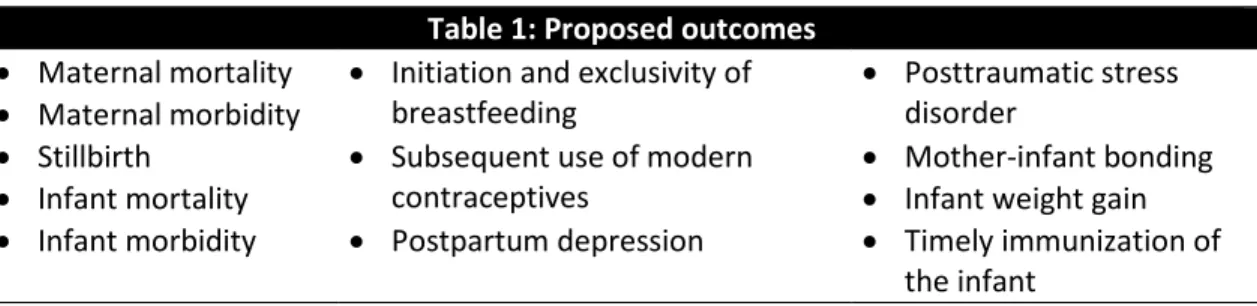
adverse maternal and infant health outcomes, such as those listed in Table 1 below:
Table 1: Proposed outcomes • Maternal mortality
• Maternal morbidity
• Initiation and exclusivity of
breastfeeding • Posttraumatic stress disorder
• Stillbirth
• Infant mortality • Subsequent use of modern contraceptives •• Mother-infant bonding Infant weight gain
17 The overall search strategy would consist of a comprehensive initial search of bibliographic
databases, a review of the reference lists of the primary studies identified in the initial search,
and then hand-searching of the archives of relevant government bodies and NGOs in order to
identify relevant grey literature. In order to ensure that insights from the full range of disciplines
working on obstetric mistreatment are taken into account, this review would intentionally
search not only the key medical/public health databases (MEDLINE (using PubMed), CINAHL,
Embase, and the Cochrane Library), but also databases they may be more commonly used by
researchers working in Latin America and the Caribbean, such as LILACS, and those in pertinent
disciplines beyond public health, such as PyschInfo and SocINDEX. The search would also be
conducted in electronic repositories of grey literature such as the WHO Global Health Library,
Popline, and Google Scholar.
The analysis of the literature reviewed would rely on the WHO definition of obstetric
mistreatment. Given that this is a newer definition, not all published studies include all elements
of the WHO definition in their definition of mistreatment as an exposure. For this reason, the
review would include studies that analyze sub-sets of the WHO definition, while still considering
them to be measuring the effect of obstetric mistreatment as an exposure. In this way, the
association between obstetric mistreatment and health outcomes of interest could be
conducted via a meta-analysis of crude and adjusted odds ratios with 95 % confidence intervals.
A sub-group analysis might then be conducted by each type of mistreatment to account for the
above-mentioned variability in sub-sets of mistreatment in different studies, assuming adequate
statistical power. That said, it is possible that sufficient quantitative data to warrant conducting
a meta-analysis do not yet exist. In this case, a narrative description that summarizes findings
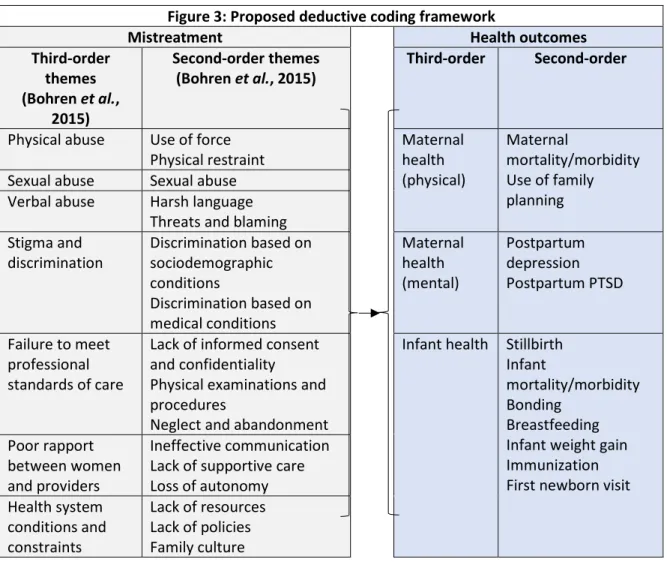
18 Meanwhile, qualitative data could also be explored to help define potential pathways linking
disrespectful and abusive treatment to the aforementioned adverse health outcomes. Relevant
content could be extracted from publications and then coded both according to the type of
mistreatment described and the type of adverse health outcome to which it points. Then, the
data could be mapped to show the potential pathways, which might then inform future research
efforts to determine whether there is indeed a quantifiable association. Figure 3 below provides
a conceptual map for this analytic process.
Figure 3: Proposed deductive coding framework
Mistreatment Health outcomes
Third-order themes
(Bohren et al.,
2015)
Second-order themes
(Bohren et al., 2015) Third-order Second-order
Physical abuse Use of force
Physical restraint Maternal health (physical)
Maternal
mortality/morbidity Use of family planning Sexual abuse Sexual abuse
Verbal abuse Harsh language Threats and blaming Stigma and
discrimination Discrimination based on sociodemographic conditions
Discrimination based on medical conditions Maternal health (mental) Postpartum depression Postpartum PTSD
Failure to meet professional standards of care
Lack of informed consent and confidentiality
Physical examinations and procedures
Neglect and abandonment
Infant health Stillbirth Infant
mortality/morbidity Bonding
Breastfeeding Infant weight gain Immunization First newborn visit Poor rapport
between women and providers
Ineffective communication Lack of supportive care Loss of autonomy Health system
conditions and constraints
19 While this review might well raise more questions than it answers, it would be an important
contribution to the literature by organizing existing knowledge and providing guidance for
future research.
Conclusion
Despite increased attention to obstetric mistreatment in recent years, far more remains
unknown than known about the phenomenon. The lack of a scientific consensus around how
the phenomenon should be defined or measured has led to conflicting approaches and wide
variance in estimations of prevalence. Even less is known about the severity of obstetric
mistreatment across different settings, and the short- and long-term effects it might have on
maternal and child health. The two proposed studies – a rigorous prevalence study in a
middle-income country with high rates of facility delivery and a systematic review exploring evidence
for how obstetric mistreatment may increase risk of adverse maternal and infant health
outcomes – would contribute to the field. Ultimately, these two investigations would provide
critical evidence needed to better understand obstetric mistreatment and design interventions
20
References
1. Vogel JP, Bohren MA, Tunçalp Ö, Oladapo OT, Adanu RM, Baldé MD, et al. How women are treated during facility-based childbirth: development and validation of measurement tools in four countries - phase 1 formative research study protocol. Reprod Health [Internet]. 2015;12:60. Available from:
http://www.pubmedcentral.nih.gov/articlerender.fcgi?artid=4510886&tool=pmcentrez&renderty pe=abstract
2. WHO, UNICEF, UNFPA, World Bank Group, United Nations Population Division. Trends in maternal mortality 1990 to 2015 [Internet]. Geneva; 2015. Available from:
http://datatopics.worldbank.org/hnp/files/Trends in Maternal Mortality 1990 to 2015 full report.PDF
3. Souza J, Tunçalp Ö, Vogel J, Bohren M, Widmer M, Oladapo O, et al. Obstetric transition: the pathway towards ending preventable maternal deaths. BJOG An Int J Obstet Gynaecol [Internet]. 2014;121:1–4. Available from: http://doi.wiley.com/10.1111/1471-0528.12735
4. United Nations (UN). Millennium development goal 5: Improve maternal health [Internet]. 2017 [cited 2017 Nov 10]. Available from: http://www.un.org/millenniumgoals/maternal.shtml
5. United Nations (UN). Sustainable development goal 3: Ensure health lives and promote well-being for all at all ages [Internet]. 2017 [cited 2017 Nov 10]. Available from:
http://www.un.org/sustainabledevelopment/health/
6. Thaddeus S, Maine D. Too far to walk: Maternal mortality in context. Sm Sci Med [Internet]. 1994;38(8):1091–110. Available from: http://ac.els-cdn.com/0277953694902267/1-s2.0-
0277953694902267-main.pdf?_tid=7ba7955a-9d70-11e7-9e96-00000aab0f02&acdnat=1505849389_8ccdf6e1b984efe2b736242a37b209ce
7. Sibley L, Sipe TA, Koblinsky M. Does traditional birth attendant training improve referral of women with obstetric complications: A review of the evidence. Soc Sci Med. 2004;59(8):1757–68.
8. Paxton A, Maine D, Freedman L, Fry D, Lobis S. The evidence for emergency obstetric care. Int J Gynecol Obstet. 2005;88(2):181–93.
9. Campbell OM, Graham WJ. Strategies for reducing maternal mortality: Getting on with what works. Lancet. 2006;368(9543):1284–99.
10. Bohren MA, Hunter EC, Munthe-Kaas HM, Souza JP, Vogel JP, Gülmezoglu AM. Facilitators and barriers to facility-based delivery in low- and middle-income countries: A qualitative evidence synthesis. Reprod Health [Internet]. 2014;11(1):71. Available from:
http://dx.doi.org/10.1186/1742-4755-11-71
11. Chou D, Daelmans B, Jolivet RR, Kinney M, Say L. Ending preventable maternal and newborn mortality and stillbirths. Bmj [Internet]. 2015;h4255. Available from:
http://www.bmj.com/lookup/doi/10.1136/bmj.h4255
21 13. Ogangah C, Slattery E, Mehta A. Failure to deliver: Violations of women’s human rights in Kenyan
health facilities [Internet]. 2014. Available from:
http://www.reproductiverights.org/document/failure-to-deliver-violations-of-womens-human-rights-in-kenyan-health-facilities%5Cninternal-pdf://0.0.2.176/2014 - Failure to Deliver Violations of Women’s Human Ri.html
14. Bowser D, Hill K. Exploring evidence for disrespect and abuse in facility-based childbirth: Report of a landscape analysis [Internet]. 2010. Available from:
http://www.urc-chs.com/uploads/resourceFiles/Live/RespectfulCareatBirth9-20-101Final.pdf
15. Freedman LP, Kruk ME. Disrespect and abuse of women in childbirth: Challenging the global quality and accountability agendas. Lancet [Internet]. 2014;384(9948):e42–4. Available from: http://dx.doi.org/10.1016/S0140-6736(14)60859-X
16. Miller S, Abalos E, Chamillard M, Ciapponi A, Colaci D, Comandé D, et al. Beyond too little, too late and too much, too soon: A pathway towards evidence-based, respectful maternity care
worldwide. Vol. 388, The Lancet. 2016.
17. Relacahupan [Internet]. 2017 [cited 2017 Nov 10]. Available from: http://www.soniacavia.com.ar/relacahupan.com.ar/lared.html
18. Sadler M. “Así me nacieron a mi hija”: Aportes antropológicos para el análisis de la atención biomédica del parto hospitalario [Internet]. 2003. Available from: http://www.pasa.cl/wp-content/uploads/2011/08/Asi_me_Nacieron_a_mi_Hija._Aportes_antropologicos_para_el_analisi s_de_.pdf
19. Belli LF. La violencia obstétrica: Otra forma de violación a los derechos humanos. Red Bioet UNESCO. 2013;1(7):25–34.
20. Estados Unidos Mexicanos: Cámara de Diputados del H Congreso de la Unión. Ley general de accesso de las mujeres a una vida libre de violencia y de igualdad entre hombres y mujeres. 2011.
21. Chiarotti S, García Jurado M, Aucía A, Armichiardi S. Con todo al aire: Reporte de derechos humanos sobre atención en salud reproductiva en hospitales públicos [Internet]. 2003. 1-121 p. Available from: https://insgenar.files.wordpress.com/2012/04/con-todo-al-aire.pdf
22. Beck I, Romeo M. Primer Índice Nacional de Violencia Machista. Buenos Aires; 2016.
23. Las Casildas. Observatorio de Violencia Obstétrica [Internet]. 2017 [cited 2017 Nov 9]. Available from: http://www.lascasildas.com.ar/observatorio.html
24. Observatorio de Violencia de Género de la Defensoría del Pueblo de la Provincia de Buenos Aires. Monitoreo de políticas públicas y violencia de género: Informe 2014/2015. Buenos Aires; 2016. 207 p.
25. Ministerio de Salud - Provincia de Buenos Aires. Estadísticas: Estado de Salud [Internet]. 2017 [cited 2017 Nov 9]. Available from: http://www.ms.gba.gov.ar/estadisticas/
22 27. Sando D, Ratcliffe H, McDonald K, Spiegelman D, Lyatuu G, Mwanyika-Sando M, et al. The
prevalence of disrespect and abuse during facility-based childbirth in urban Tanzania. BMC Pregnancy Childbirth. 2016;
28. Abuya T, Warren CE, Miller N, Njuki R, Ndwiga C, Maranga A, et al. Exploring the prevalence of disrespect and abuse during childbirth in Kenya. Dowdy DW, editor. PLoS One [Internet]. 2015 Apr 17;10(4):e0123606. Available from: http://dx.plos.org/10.1371/journal.pone.0123606
29. Okafor II, Ugwu EO, Obi SN. Disrespect and abuse during facility-based childbirth in a low-income country. In: International Journal of Gynecology and Obstetrics. 2014.
30. Castro A, Savage V, Kaufman H. Assessing equitable care for indigenous and afrodescendant women in Latin America. Rev Panam Salud Pública [Internet]. 2015;38(2):96–109. Available from:
http://www.scielosp.org/scielo.php?script=sci%7B_%7Darttext%7B&%7Dpid=S1020-49892015000700002%7B&%7Dlang=pt
31. Balde MD, Bangoura A, Diallo BA, Sall O, Balde H, Niakate AS, et al. A qualitative study of women’s and health providers’ attitudes and acceptability of mistreatment during childbirth in health facilities in Guinea. Reprod Heal 2017 141 [Internet]. 2017;14(1):1045–9. Available from: http://doi.wiley.com/10.1111/1471-0528.13451%0Ahttps://reproductive-health-journal.biomedcentral.com/articles/10.1186/s12978-016-0262-5
32. Bohren MA, Vogel JP, Tunçalp Ö, Fawole B, Titiloye MA, Olutayo AO, et al. Mistreatment of women during childbirth in Abuja, Nigeria: A qualitative study on perceptions and experiences of women and healthcare providers. Reprod Heal 2017 141 [Internet]. 2017;14(1):239–44. Available from: http://link.springer.com/10.1007/s10995-005-0037-z%0Ahttps://reproductive-health-journal.biomedcentral.com/articles/10.1186/s12978-016-0265-2
33. Lukasse M, Schroll AM, Karro H, Schei B, Steingrimsdottir T, Van Parys AS, et al. Prevalence of experienced abuse in healthcare and associated obstetric characteristics in six European countries. Acta Obstet Gynecol Scand. 2015;94(5):508–17.
34. Elmir R, Schmied V, Wilkes L, Jackson D. Women’s perceptions and experiences of a traumatic birth: A meta-ethnography. J Adv Nurs. 2010;66(10):2142–53.
35. Belizán JM, Pingray V. Stillbirth rates in Latin America: An ecological study [unpublished data].
36. Nascimento Andrade P de O, Pereira da Silva JQ, Menino Diniz CM, Costa Caminha M de F. Fatores associados à violência obstétrica na assistência ao parto vaginal em uma maternidade de alta complexidade em Recife, Pernambuco. Rev Bras Saúde Matern Infant [Internet]. 2016;16(1):29– 37. Available from:
http://www.scielo.br/scielo.php?script=sci_arttext&pid=S1519-38292016000100029&lng=en&nrm=iso&tlng=pt
37. Karolinski A, Micone P, Mercer R, Gibbons L, Althabe F, Belizán JM, et al. Evidence-based maternal and perinatal healthcare practices in public hospitals in Argentina. Int J Gynecol Obstet [Internet]. 2009;105(2):118–22. Available from: http://dx.doi.org/10.1016/j.ijgo.2009.01.003
23 39. Uriburu G, Mercer R, Romero M, Zamberlin N, Herrero B. El modelo de Maternidad Centrada en la
Familia. Experiencia del Hospital Materno Infantil Ramón Sardá. Estudio de buenas prácticas. [Internet]. 1st ed. Organización Panamericana de la Salud; 2008. 58 p. Available from: http://www.who.int/dietphysicalactivity/strategy/eb11344/strategy_spanish_web.pdf?ua=1
40. Kruk ME, Kujawski S, Mbaruku G, Ramsey K, Moyo W, Freedman LP. Disrespectful and abusive treatment during facility delivery in Tanzania: A facility and community survey. Health Policy Plan [Internet]. 2014;1–8. Available from:
https://academic.oup.com/heapol/article-lookup/doi/10.1093/heapol/czu079
41. Instituto Nacional de Estadísticas y Censos (INDEC). Incidencia de la pobreza y la indigencia en 31 aglomerados urbanos. Segundo semestre de 2016. Vol. 1, No. 53. Buenos Aires; 2016.
42. Unicef, Sociedad Argentina de Pediatría. Salud materno-infanto-juvenil en cifras [Internet]. Salud materno-infanto-juvenil en cifras. 2013. Available from: