INTERFACE USED FOR KNOWN-ITEM AND EXPLORATORY SEARCH
TASKS.
By Jack W. Ward III
A Master's paper submitted to the faculty of the School of Information and Library Science of the University of North Carolina at Chapel Hill
in partial fulfillment of the requirements for the degree of Master of Science in
Information Science.
Chapel Hill, North Carolina April, 2006
Approved by:
Exploratory Search Tasks. A Master’s paper for the M.S. in I.S. degree. April, 2006. 50 pages. Advisor: Barbara Wildemuth
This paper reports on a study in which 40 participants completed a known-item music
search task and an exploratory search task using an e-commerce style interface that
accessed the Amazon.com music catalog. Depth of description and the level of
contextual information were manipulated in a 2x2 factorial design in which high depth of
description included a review of the release, cover art, and release date in addition to
basic metadata. Perceived ease of use, perceived usefulness, flow (enjoyment) and flow
(engagement) were collected following each task. The high context condition added
hyperlinks to artist, genre, and record label, where the low context condition did not.
Findings suggest that high depth of description has both positive and negative effects on
users’ perceptions of the interface, although context does not appear to have significant
effects. The task completed also appears to affect sensitivity to depth of description and
level of context manipulations.
Headings:
Music/Databases
Introduction
Since the CD made its consumer debut in the 1980s music recording, playback, and storage have transitioned from an analog environment to a digital one. More recently, physical media has begun to give way to audio files that are distributed via the World Wide Web and peer-to-peer file sharing networks and played on a myriad of devices including PCs, portable MP3 players, cellular phones, and PDAs. These new
technologies have made huge amounts of music available to consumers, whose music collections have grown as a result of easier access and reduced storage needs. As the amount of music information available through computer interfaces grows, so does the risk of music information overload and the need to organize, catalogue, and retrieve music information. Music Information Retrieval (MIR) has emerged to respond to these challenges by creating tools and interfaces in the forms of stores and digital libraries that facilitate common music information tasks like locating metadata for a work, keeping up with new music, acquiring music, and conducting research.
MIR is an international and interdisciplinary field comprised of researchers in computer science, signal processing, information retrieval, ethnomusicology, audio engineering, and music as well as system designers, librarians, and information architects (Downie & Cunningham, 2002; Downie, 2005). Topics of study, like the backgrounds of MIR researchers, are various and include representations of music and indexing
libraries, music stores, and peer-to-peer clients (Chen & Chen, 2001; Feng et al., 2003; Uitdenbogerd & Yap, 2003; Baumann & Kluter, 2002; Mandl & Womser-Hacker, 2002). Despite the variety of topics studied by MIR researchers, the literature is
disproportionately focused on the development of algorithms and interfaces based on unsupported assumptions about music information seeking behaviors and information needs. Though novel interfaces and new methods of representing and indexing music are essential to progress in MIR, they should be informed by an understanding of users’ music information needs and their searching and browsing behaviors.
information seekers had some bibliographic metadata with which to start their search (Downie & Cunningham, 2002; Cunningham et al., 2003; Downie, 2004).
Query By Humming interfaces are not the only approaches to creating MIR systems, nor are they devoid of value, but they illustrate a number of weaknesses in MIR work. The success of new MIR systems is contingent on the degree to which they support users’ needs and behaviors. The usability of interfaces like QBH must be determined by
evaluating how successfully users are able to interact with them to find the music they are looking for. Equally important is the need for interfaces to accommodate strategies that music information seekers already employ in their searches. The literature on MIR behavior is sparse at best, but exploratory studies have already revealed characteristics of information needs and behaviors that contradict many of the assumptions that MIR interface designers have taken for granted.
The degree to which users engage in browsing and exploratory search when filling their music information needs is one of the most commonly overlooked aspects of music information seeking behaviors. The exploratory research in MIR behaviors suggests that browsing is not only common in music information seeking behavior, it makes up a large portion of music information seeking activity and is interleaved with searching
(Cunningham et al., 2003). QBH search interfaces provide little, if any support for browsing beyond scanning the search results.
Unlike known-item searching, which presupposes an identifiable target that is known to exist, browsing and exploratory search are characterized by a wide range of
Directed browsing occurs when the information seeker has a target item for which they are looking in a highly directed task; scanning is an example of directed browsing. Semi-directed browsing result from less clearly defined goals. An example of semi-Semi-directed browsing is monitoring new releases at a music store or browsing a genre to get a feel for the information space. Undirected browsing is described as an entirely goal-less activity in which the browsing itself appears to be an end as opposed to a means (Marchionini, 1995). All three types of browsing described by Marchionini are common to music shopping. Cunningham et al. (2003) observe that music shoppers scan for known items, monitor new music, browse to gain an understanding of a domain, and browse simply for entertainment. Because music shopping behaviors conform so well to descriptions of browsing behaviors it is important to consider browsing tasks when investigating variables that may affect music information seeking behavior.
Problem Statement
Literature Review
In this section I will present a survey of the literature on Music Information Retrieval. I will first provide a brief overview of music information and research on its
representations to establish a setting for research on MIR behavior. I will then review the literature on the usability of MIR interfaces and MIR behavior.
Music information and its representation
Representations of music information are central to the advancement of MIR systems and approaches. According to Downie (2005), music information is both multifaceted and plastic. Facets of music information include pitch, temporal, harmonic, textual, timbral, editorial, and metadata elements. The plasticity of music information means that it can vary within a piece of music. In a given piece of music the tempo, instrumentation of the melody, harmonies, and key may change many times. Additionally, songs may be reinterpreted by many artists and still remain the same song (Downie, 2005). For
example, many artists including Louis Armstrong, Ella Fitzgerald, Miles Davis, and Janis Joplin have reinterpreted “Summertime” by Gershwin; each version of the song is still recognizable as George Gershwin’s “Summertime” despite differences of style, instrumentation, and genre between the artists.
Blandford (2002) adds to the discussion of representing music information by
(acoustic-concrete-dynamic). Printed lyrics of a song would be visual-lexical-continuous and metadata such as title, artist, or genre would be visual-lexical-discrete (Blandford, 2002). Whereas Downie's facets of music information address how we break down the components of music information so that we can represent them, Blandford's application of modality to music information provides a way to describe and categorize representations of music information.
Representations of music information include audio recordings, melody contours, audio files, acoustic fingerprints, traditional scores, MIDI, tablature, printed lyrics, metadata records, and extra-musical information such as reviews, or associative
metadata. Audio recordings, MIDI, tablature, traditional scores, transcriptions of lyrics, and reviews are familiar to most people, and representations such as metadata records and relational metadata are familiar to the greater information and library science community. Other representations such as acoustic fingerprinting, also known as audio fingerprinting, and melody contours are basically unknown outside of MIR.
Acoustic fingerprinting is like a short summary of an audio file, similar to a hash encryption function (Haitsma & Kalker, 2002). Unlike a hash function, however, an audio fingerprint should be similar for any audio file with similar acoustic properties (Haitsma & Kalker, 2002). For example two mp3 files of the same song should have similar acoustic fingerprints even if one of those files is missing the last 10 seconds of the tune. A comparison of audio fingerprints for Janis Joplin’s version of ‘Summertime’ should be similar to the audio fingerprint of Miles Davis’ version.
Whereas audio fingerprints are primarily for machines to perform comparisons
to allow users to express musical queries. A melody contour represents the shape of melody in terms of pitch and direction (Uitdenbogerd & Yap, 2003). Starting from the second note in a melody, pitch changes are represented by ‘U’ for up, ‘D’ for down, and ‘S’ for same. There is also an extended contour that uses ‘u’, and ‘d’ in addition to ‘U’, ‘D’, and ‘S’ to denote small and large changes in pitch. A third type of contour-based representation of melody, the numeric scale, describes melody curve by specifying a pitch’s deviation from a ‘key note,’ set to 1, using numbers (Uitdenbogerd & Yap, 2003). The melody contour is the foundation of popular query-by-humming retrieval techniques and has been implemented in some digital libraries like Indiana University’s Digital Music Library (Blandford & Stelmaszewska, 2002).
Other researchers are attempting to represent more amorphous aspects of music information. Feng et al. attempted to create a metric for a musical pieces mood based on a ratio of tempo and articulation, and the degree to which notes are connected (2001). These sorts of metrics, although rough, attempt to address user descriptions of music, as described below, that are amorphous and imprecise.
Usability, User needs and Usage Scenarios
Though techniques of MIR representation and interfaces to those representations multiply, the needs and behaviors of users in MIR contexts are still largely unknown (Cunningham et al., 2003; Downie & Cunningham, 2002; Downie, 2005; Lee & Downie, 2004). Many approaches to MIR system interfaces are based a priori assumptions,
Users’ information needs and seeking behaviors are explored in two ways in the MIR literature. Usability studies look at task performance in and affective response to specific MIR systems to determine their effectiveness (Blandford & Stelmaszewska, 2002,
Uitdenbogerd & Yap, 2003). While this course of research hopes to evaluate existing approaches to make sure they meet user needs, other researchers are working to describe MIR behaviors exhibited by people in naturalistic settings to inform interface designers (Cunningham et al., 2003, Downie & Cunningham, 2002, Lee & Downie, 2004,
Uitdenbogerd, 2002).
Evaluations of the Usability of Particular Systems
Usability studies evaluate the effectiveness of existing systems by exposing users to multiple interfaces and comparing user responses to the system and users’ task
performance. These studies are essential to the production of usable systems that
accommodate user workflow. As noted above, many MIR systems implement interfaces based on assumptions about user behaviors and attitudes. One of the more prominent assumptions is that users of MIR systems will want to query for known music items using a representation of melody. Indeed, a large portion of MIR literature is devoted to the creation of these types of interfaces (Cunningham et al., 2003).
asked to compose a query for “Twinkle-Twinkle Little Star” and enter it into the search engine for each of the three query types. A query was considered a success if “Twinkle-Twinkle Little Star” appeared in the ranked list of retrieved documents. Participants were allowed to perform a second query if the first failed. Affective measures of satisfaction and frustration were taken by observation and the researchers asked the participants questions about their perceptions of the system, including overall satisfaction (Uitdenbogerd & Yap, 2003).
Results from this study suggest that melody-based queries are not effective for users who do not have professional level music skill. Participants with medium skill were more successful at creating queries using the numeric scale method than the other two methods, while participants with professional skill had equal success with the extended contour and numeric scale methods. Users with no self-reported musical skill failed to create any successful queries (Uitdenbogerd & Yap, 2003).
The majority of users in the no-skill and medium-skill groups reported medium levels of satisfaction with the system despite relatively low performance, while professionally skilled participants reported much higher satisfaction with the system. Similarly, while professionally skilled participants found the system to be “user friendly” and learnable, medium-skill and no-skill participants rated the systems lower on both of these measures (Uitdenbogerd & Yap, 2003).
professional musicians, the interface for querying using a textual representation of melody should allow the finest distinctions possible because the extended contour and numeric scale systems, which allow for finer distinctions in the query, provide better results than the less sensitive contour approach. Although this study suggests that querying a music collection using a textual representation of melody is not usable for most users, the researchers note that a query-by-humming or query-by-singing approach may still prove usable (Uitdenbogerd & Yap, 2003).
In an earlier study, Blandford and Stelmaszewska (2002) find that query-by-singing also has usability problems. They employed the Evaluating Multimodal Usability (EMU) evaluation technique to four music digital libraries selected to provide a broad
representation of the capabilities of existing music digital libraries. The four digital libraries investigated in this study supported retrieval through several methods including browsing, text-based retrieval, contour representation queries, and querying by
submitting a sound file representing the target melody. The modality of the retrieved tune varies between the four music digital libraries as well, ranging from musical scores to audio files and video files (Blandford & Stelmaszewska, 2002). Using the EMU technique, the researchers explored each site and defined user goals and tasks. They then “stepped through” each task, identifying the modality of input and output at each step in a task and identifying clashes and mismatches. Beyond the EMU analysis the researchers also noted other usability problems as they encountered them (Blandford &
Stelmaszewska, 2002).
techniques presented significant usability difficulties for many of the users that would make up the target population of the digital libraries. Both textual representations of melodies and sung queries were problematic because of differences between user’s mental representations of melodies and the representation stored in the database. In some cases, where users perceived one note in the melody, the stored representation of the melody had two or more notes. One reason for the difference in representations is that stored melody representations can be too precise for users of the system that are untrained. Another reason for the mismatch is the melody contour’s inability to
distinguish between flat and natural notes. In the case of the Beatles’ ‘Yesterday’, where users heard a rise in pitch between a D-flat and D-natural, the system stores the two notes only as D (Blandford & Stelmaszewska, 2002).
This study provides more specific findings on the usability of melody-based querying than Uitdenbogerd and Yap (2003), but the strength of these findings is mitigated by the methods used. Blandford and Stelmaszewska performed the usability analysis that amounted to a cognitive walkthrough of the system and did not employ participants for a usability study. The question of how a diverse group of users with varying levels of musical skill would respond to the query-by-singing interface still remains. More user-based usability studies should be done to evaluate approaches to MIR interfaces. In particular, experimental research may provide answers to questions regarding the effectiveness of different music querying strategies.
User Behavior in MIR
behavior to the set of options the system makes available (Downie & Cunningham, 2002). Usability studies fail to provide researchers with insight into users’ motivations, and they do not yield suggestions for new features that may be desirable in MIR systems (Cunningham et al., 2003). Because of the limitations of usability studies, a few
researchers are working to describe users’ music information needs and searching behaviors in an attempt to develop an empirically derived framework of music information behavior including known item and exploratory search (Downie & Cunningham, 2002, Lee & Downie, 2004).
In a content analysis of 161 music information queries on the rec.music.country.old-time Usenet newsgroup, Downie and Cunningham made a number of empirical findings about MIR behavior in a real setting, where queries were not restricted by an existing MIR system’s features (2002), though queries were restricted by the medium of a text-based news group. The analysis found that users primarily described the information they were looking for by providing bibliographic descriptions. Bibliographic information was used to describe the information need in 75% of the queries submitted to the newsgroup. Lyrics trailed far behind, appearing in only 14% of requests (Downie & Cunningham, 2002). This suggests that for the majority of music information needs presented as queries, users already know some of the bibliographic information for the item of interest.
Bainbridge et al. (2003) made similar findings in their study of music queries to Google Answers. This study found that more than 80% of queries provided some form of bibliographic data when describing their information need. Bainbridge suggests that bibliographic metadata is crucial for searching. While the findings of studies described above suggest that music information seekers have bibliographic data when they carry out known item searches, these findings may result from the environment in which users are making queries. The evidence that most music information queries rely on some amount of bibliographic data may be a result of the types of services that have been studied.
In his analysis of queries to Google Answers, Bainbridge et al. (2003) also found that users had experienced difficulty giving “crisp” descriptions for categories of music. If Bainbridge is right, and bibliographic metadata is crucial for searching, then an absence of bibliographic data coupled with the rough descriptions typical of music information queries could leave users stranded.
Kim and Belkin’s research on music description by non-experts also suggests that systems need to support rough descriptions of music (2002). The study exposed
participants to musical works. The researchers then prompted them to describe the pieces and compose a query for the “ideal” MIR system. The findings suggest that most non-expert users do not use music terminology to describe music, and none of the participants wanted to find the pieces by specific melodies (Kim & Belkin, 2002).
requested recordings, and notation and background information were sought 13% of the time (Downie & Cunningham, 2002). The high percentage of posts using bibliographic information to describe the desired information suggests that bibliographic information is easy to come by and would be less often the subject of the search. Lee and Downie, however, find that respondents to their 2004 survey often search for bibliographic data. 90.1% of survey respondents reported that they were likely to seek the title of a work and 74% were likely to seek artist information (Lee & Downie, 2004). Lee and Downie’s findings do not tell us whether these respondents already had some bibliographic data when they began their search. More research is needed to determine which of these studies better represents users’ music information needs.
It is surprising that only 17% of queries to the newsgroup were for recordings. In a different population, the UIUC campus community, Lee and Downie found that 87% of respondents sought music recordings (CD, vinyl, etc) at least once a month and 74% sought electronic music files at least once a month (Lee & Downie, 2004). Additionally 77.9% of respondents purchased music on-line at least once a month and 74.9%
findings that “Users seek music as an auditory experience,” and “users seek information to assist in the building of collections of music” (Lee & Downie, 2004pg. 547).
The distinction between seeking information about a piece of music and seeking the music itself is pertinent to the MIR system designer. The breadth of information needs identified by Lee and Downie suggests that music information systems like digital music libraries and music stores may want to provide as much information on a release as possible. Not only are libraries and stores places to acquire music but they also serve as a clearing-house for information about the songs in their catalog.
Cunningham et al. (2003) also found that browsing was a significant task in music information-seeking, and that searching for known-items and browsing were interleaved, with shoppers quickly shifting from one to the other. The lack of observations of
browsing in Downie and Cunningham is probably due to characteristics of the information space. Whereas the CD Shop in Cunningham et al. (2003) intentionally facilitates browsing, the format of the Usenet newsgroup precludes it. A comparison of the findings from these two studies suggests that the information space in which a researcher studies users has an impact on the type of information-seeking behavior in which the user engages.
The Importance of Contextual Information
into motivations and instigations behind the music queries. Environmental or associative contextual information such as where they heard a song appeared in 18% of queries.
Kim and Belkin (2002) also found a strong connection between social events and emotions in their study. Of the words given to describe the stimulus music those that fell into the emotions (happy, sad, threat, cheerful) category were given most often. This number was almost identical to the number of words in the occasions and events category (song for exploring a forest, for celebration, grand arrival) in the searching task. These results lend further support to the significance of social and emotional contextual information in music information seeking.
Conclusion
The Music Information Retrieval literature addresses many facets of the field including music information, representations of music information, approaches to interfacing with collections of music information, and the behaviors, needs and usage scenarios of users. Studies on MIR behavior have identified the social nature of music information-seeking, characterized information needs and queries, and not the importance of contextual information and associative metadata to the expression of the information need.
Nearly all of the research described addresses known-item retrieval. Because of the prevalence of browsing found in Cunningham et al.’s ethnographic study, future research should focus on the nature of exploratory search behaviors in MIR and the mechanisms underlying the social nature of information-seeking behavior. The research here considers task as well as description and context to examine both known-item and exploratory search tasks.
Research Question and Importance of This Research
Based on the exploratory research mentioned above and the importance of context and description to information seekers’ behavior, I pose the following research question: What is the relationship between task, depth of description and level of contextual information available in the interface AND task performance and attitudes towards the interface?
attributes of a system affect behavior, MIR system designers will be hard pressed to create usable interfaces with features that complement users’ search strategies.
Method
To facilitate a comparison of information-seeking behaviors between known-item searching and exploratory searching, participants completed both types of tasks, in a 2 (depth of description) x 2 (level of contextual information) between-subjects design. Each participant was randomly assigned to one of the four interface conditions and completed a known-item and exploratory search task. Both tasks were designed to simulate typical music information retrieval tasks as identified by research described above. The four interface conditions were compared in terms of user performance on the known-item task and user attitudes on both tasks and overall. The study methods are described in more detail below.
Subjects
40 subjects participated in the experiment voluntarily and received compensation in the form of 10 songs (a $10 value) from the iTunes Music Store. Subjects were recruited from the UNC and Chapel Hill/Carrboro communities to diversify the demographics of the population. All participants were over the age of 18 and had basic computer skills.
Search Tasks
decision to add the artist metadata for two of the three songs was based on pretest results that suggested that most subjects would fail to identify the jazz and classical songs without such information. Instructions for the music identification task are included in Appendix A.
In the shopping task participants were asked to use the interface to select 10 songs from the catalog, which were then purchased and given to the participant as
compensation for their involvement. This form of compensation was critical to the design of the study to ensure that participants had motivation for engaging in a genuine exploratory search. Because browsing and exploratory search are characterized by ill-defined information needs it was essential to provide such a motivation to ensure a realistic scenario.
Stimulus & Manipulations
The interface used in the study was designed to provide a typical, though simplified, e-commerce experience. Keyword searching was supported across conditions, as were entry points for browsing in the form of links to releases by genre. Asynchronous Javascript and XML (AJAX) were used to make some data requests such as adding and removing items from the cart, and making behavior log entries. The system tracked participant behaviors including task initiation, searches performed, links followed, items purchased, items removed, and task completion.
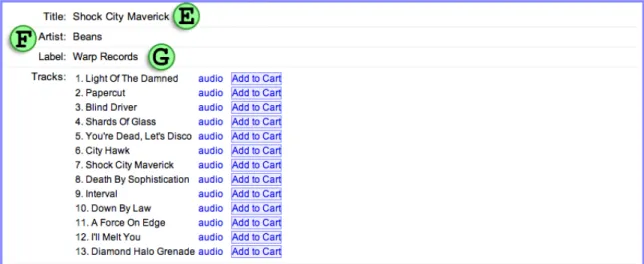
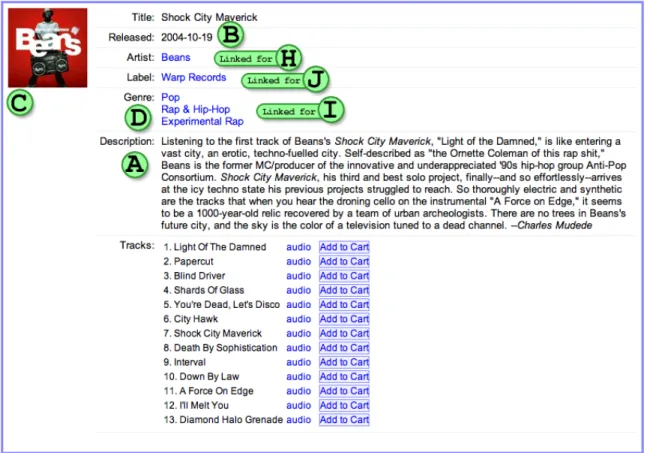
Figure 1, which included title (E), artist (F), and record label (G) metadata. The low context condition did not feature any contextual information for a record, whereas the high context condition included links to other releases by the same artist (H), in the same genre (I), and on the same record label (J).
Figure 2. High context/High description condition
A subset of the Amazon.com catalog, including more than 22,000 music releases, was used for the study. Amazon.com provides a web services application program interface (API) that allows programmers to query the Amazon catalog by making queries using
Representational State Transfer (REST) or Simple Object Access Protocol (SOAP).
Results to queries were cached on the server running the experimental interface to ensure quick download speeds for frequently viewed pages. Limitations of this catalogue were significant because the REST API offered only limited search options and restricted searching to one field at a time.
Procedure
consent form, the researcher provided instructions for the session orally and participants were instructed to begin.
Participants first completed a demographic questionnaire designed to collect information on level of education, experience with web based shopping interfaces. Knowledge about and attitudes towards music were also collected, including the frequency and extent to which the participant interacted with music, the genres they frequently listen to, and how important music is to them.
Following the demographic questionnaire, participants completed the first of the two tasks (task order was counter-balanced to eliminate order effects). Following the
submission of their cart, which marked completion of the task, participants filled out a questionnaire related to the task. Completion of the first task specific questionnaire led subjects to the second task. Completion of the second task was followed by a task specific questionnaire and, finally, the final questionnaire relating to the interface in general. Participants were then given their compensation, were debriefed and thanked for their participation in the study.
Both of the task specific questionnaires were identical and collected measures of perceived ease of use of the interface, perceived usefulness of the system (Davis, 1989), and flow (Ghani, Supnick, & Rooney, 1991). The final questionnaire was identical to the task specific questionnaires with the addition of two short answer questions that
prompted participants to describe the best and worst parts of the interface. The questionnaires are included in Appendix B.
Dependent variables included perceived ease of use of the interface, perceived
Supnick, & Rooney, 1991) for all tasks. Perceived ease of use and perceived usefulness were measured by five five-point Likert-type questions. Both enjoyment and engagement were measured using a 7-point semantic differential scale. Perceived ease of use and perceived usefulness have been established as good indicators of the likelihood that users will adopt a new technology and provides a good metric by which to evaluate users perceptions of a system (Davis, 1989). Flow has only recently been used to evaluate perceptions of systems and system adoption, but has been found to correlate with perceived control (Ghani, Supnick, & Roooney, 1991) and has been recommended as a goal for interface design (Hearst et al., 2004). Task duration and the number of correct identifications were an additional dependent variables use to determine task performance on the music identification task.
Data Analysis
Data from each task questionnaire and the general system questionnaire were kept in separate datasheets. In all three cases individual questions were grouped into one of four categories: ease of use, usefulness, flow (enjoyment), and flow (engagement). A score for each participant was calculated for each index. In addition, the number of correct answers and duration were recorded for each participant.
An analysis of variance was used to evaluate the main effects and interaction effects of the four experimental conditions on each of the measures.
Results
Participant Demographics
Twenty-two women and 18 men participated in the study with ages ranging from 18 to 39 and a mean age of 27. Education levels ranged from those who had not completed college to advanced-degree holding researchers. Twenty-one participants had bachelor’s degrees, or were graduate students or post-grads, eight were undergraduates or had no degree, and two was a researcher with an advanced degree. Participants came from a variety of departments including Information-Library Science (17), Linguistics (3), Philosophy (1), Physics (1), Art (2), Orthopedics (1), Political Science (3), American Studies (1), and Music (1). Three participants were from non-academic departments. All of the participants reported using a computer daily. Participants had a mean of 9.15 years (s.d. 2.962) doing online searches with 92.5% engaging in online searches daily, and 7.5% searching online weekly. Participants had a lot of experience with searching library catalogs and the World Wide Web and less experience searching other systems including CD ROMs and commercial databases. While participants did not have as much experience with shopping for music online as they did using web-based search engines, the mean experience was still 3.75 where 5 was the highest level of experience. Participants varied in their frequency of shopping online: 37.5% shopped online
never shopped for music online, 35% shop for music occasionally, 22.5% have shopped for music monthly, and 15% weekly.
Participants reported being fairly knowledgeable about music with a mean of 3.725 (s.d.=.845) where 5 is the most knowledgeable. About half (52.5%) of the participants reported playing music (e.g., playing an instrument, djing, composing, arranging, or remixing). The majority of participants (57.5%) spent 0-1 hours per week reading or learning about music, 27.5% spent 1-3 hours learning or reading about music, 5% read or learned about music between 4-6 hours a week, and 10% spent 7 or more hours a week learning about music. The majority of participants (62.5%) spend between 1-3 hours listening to music each week, 20% listened from 1 hour or less per week, 7.5% listened to 7 or more hours a week, 7.5% listened 4-6 hours per week, and 2.5% did not listen to music at all. Eighty percent of the participants searched for music using online music stores, 27.5% used peer-to-peer networks, 57.5% used the conventional or internet radio, 5% reported going to friends, and 2.5% went to musicians’ web sites.
Task Performance
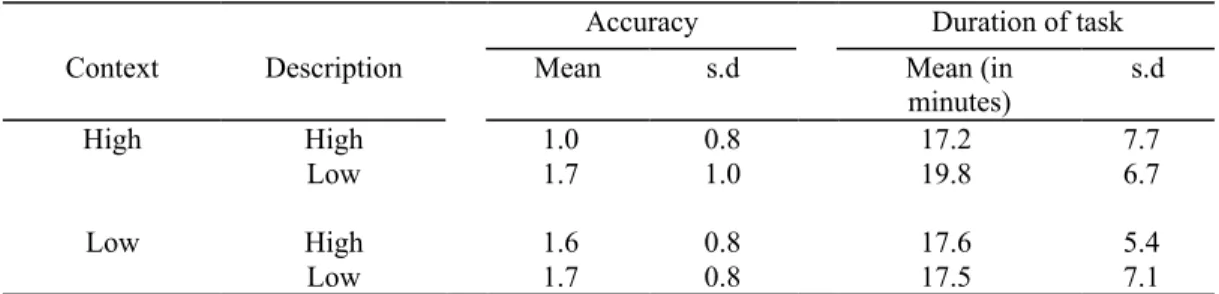
Table 1. Summary of performance on music identification task
Accuracy Duration of task
Context Description Mean s.d Mean (in
minutes)
s.d
High High 1.0 0.8 17.2 7.7
Low 1.7 1.0 19.8 6.7
Low High 1.6 0.8 17.6 5.4
Low 1.7 0.8 17.5 7.1
The differences between conditions in accuracy for the music identification task were not statistically significant. An analysis of variance failed to reveal main effects for accuracy across context (F=0.904, p=0.348) or depth of description (F=1.771, p=0.192) and there was no interaction effect (F=1.771, p=0.192). Differences in task duration also failed to show statistical significance across context (F=.196, p=.660), depth of
description (F=0.340, p=0.563) or in the interaction between context and description (F=0.397, p=0.533).
Perceptions of and attitudes towards the interface
Perceived ease of use and perceived usefulness were measured using 5-point Likert-type scales in which 1 was the best and 5 the worst. Both ease of use and usefulness measures were calculated for each participant by finding the mean score across six questions for each scale. Flow (enjoyment) and flow (engagement) were measured using 7-point semantic differential scales in which 1 was the best and 7 was the worst. Each participant’s score for each type of flow was the mean of responses to four questions.
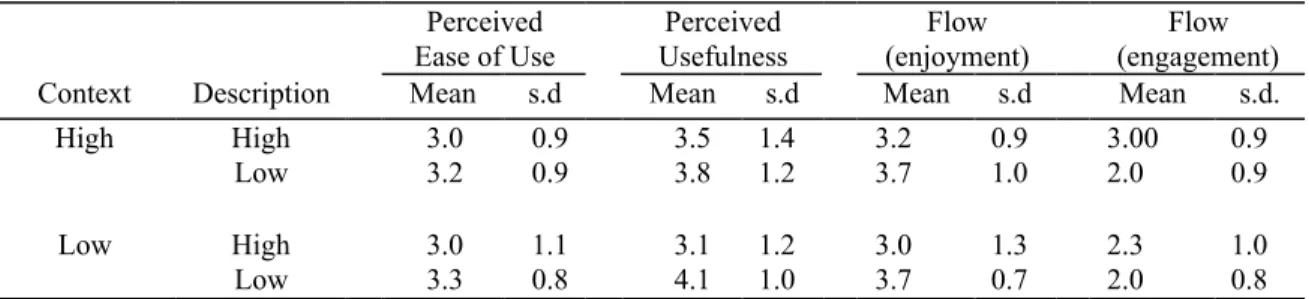
Table 2 Summary of user perceptions for Music identification task. Perceived
Ease of Use
Perceived Usefulness
Flow (enjoyment)
Flow (engagement) Context Description Mean s.d Mean s.d Mean s.d Mean s.d.
High High 3.0 0.9 3.5 1.4 3.2 0.9 3.00 0.9
Low 3.2 0.9 3.8 1.2 3.7 1.0 2.0 0.9
Low High 3.0 1.1 3.1 1.2 3.0 1.3 2.3 1.0
Low 3.3 0.8 4.1 1.0 3.7 0.7 2.0 0.8
No main or interaction effects were found on perceived ease of use (see Appendix C for a summary of findings). Marginal significance (F=3.147, p=0.085) was found for the effect of depth of description on perceived usefulness. Comparing the means for
description (3.3 with high description versus 4.0 with low description) the marginal effect suggests that high depth of description increases perceptions of usefulness. No other main or interaction effects were found on perceived usefulness. Marginal significance was found for the main effect of depth of description on flow (enjoyment) (F=3.346, p=0.076). A comparison of flow (enjoyment) means across description conditions (3.1 with high description versus 3.7 with low description) suggests that high depth of description may increase flow (enjoyment). A main effect for depth of description on flow (engagement) emerged (F=4.448, p=0.025) and less depth of description was associated with better flow (engagement) (2.7 with high description versus 2.0 with low description) in the music id task. No other main or interaction effects were found on flow (engagement).
Subjects’ perceptions of the interface were also collected following the shopping task. Table 3 summarizes the means for all participants across conditions. Marginal
interactions effects were found on perceived ease of use, perceived usefulness, flow (enjoyment) or flow (engagement) following the shopping task (see Appendix C for a summary of findings).
Table 3. Summary of user perceptions for shopping task. Perceived
Ease of Use
Perceived Usefulness
Flow (enjoyment)
Flow (engagement) Context Description Mean s.d Mean s.d Mean s.d Mean s.d.
High High 3.2 1.5 3.1 1.5 3.0 1.3 2.9 0.9
Low 2.6 1.4 3.1 1.5 2.8 1.4 1.9 0.8
Low High 2.4 1.3 2.9 1.3 2.8 1.2 2.3 1.2
Low 2.5 0.9 3.2 1.2 3.5 0.8 2.4 0.9
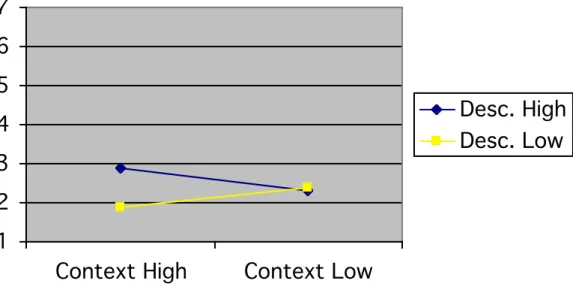
Figure 3. The interaction effect on flow (engagement) following the shopping task.
1
2
3
4
5
6
7
Context High
Context Low
Desc. High
Desc. Low
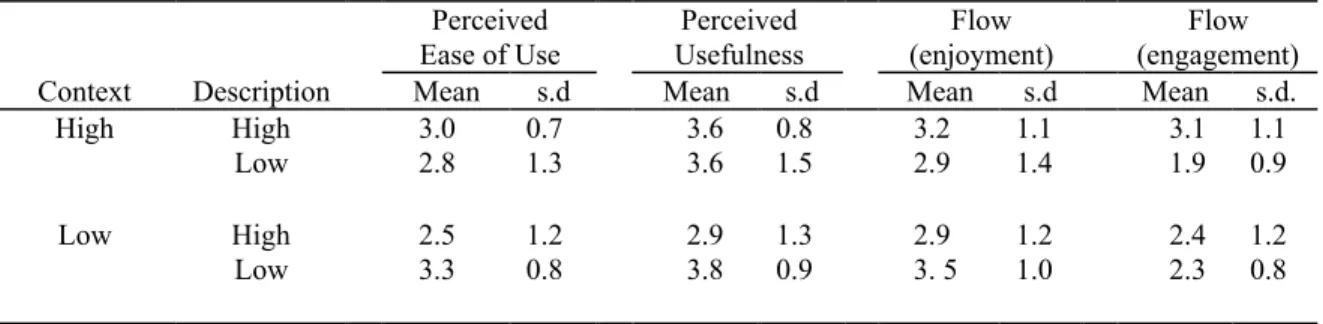
Following the completion of both tasks, participants’ perceptions were collected for the interface overall. Table 4 summarizes means for overall perceptions of the interface. No main or interaction effects were found on perceived ease of use, perceived usefulness, or flow (enjoyment) (See Appendix C for a summary of findings). Depth of description did affect flow (engagement) (F=4.054, p=0.052) indicating that less depth of description leads to better flow (engagement) (2.8 with high description versus 2.1 with low
Table 4. Summary of user perceptions after both tasks. Perceived Ease of Use
Perceived Usefulness
Flow (enjoyment)
Flow (engagement) Context Description Mean s.d Mean s.d Mean s.d Mean s.d.
High High 3.0 0.7 3.6 0.8 3.2 1.1 3.1 1.1
Low 2.8 1.3 3.6 1.5 2.9 1.4 1.9 0.9
Low High 2.5 1.2 2.9 1.3 2.9 1.2 2.4 1.2
Low 3.3 0.8 3.8 0.9 3. 5 1.0 2.3 0.8
Discussion
The purpose of this study was to examine observations about music information seeking behavior made by previous exploratory research. Forty participants completed a known-item search task (music identification ) and an exploratory search task (shopping) using an e-commerce style interface that was manipulated on level of context and depth of description vectors. High context was operationalized as hot-linking artist, label, and genre information to other items with matching metadata. The high description condition included album artwork, a description, and a release date in addition to the basic metadata such as title, artist, record label and track information present in the low depth of
description condition.
Despite the small size of the sample (N=40) statistically significant main effects were found for description on flow (engagement) following the music identification task and overall. Additionally, marginal significance was found for the differences in flow (enjoyment) and perceived usefulness across description conditions in the music
Depth of description appears to have a negative effect on engagement for the known-item search task. Participants were more likely to report being fully engaged when only the base descriptive metadata was present. A similar effect was found for engagement and description on overall perceptions of the interface. The negative effect of description on flow (engagement) during the music identification task and on overall perceptions of the interface suggests that greater description distracts users from known-item retrieval tasks. In a known item retrieval task greater description may lower the ratio of pertinent data, such as title, artist, or record label, to impertinent data. In this scenario greater depth of description increases the amount of text the user must scan, making it more difficult to identify the information sought. Deeper description may also reduce engagement by simply pulling attention away from the task and into the descriptive content.
That the negative effect of high depth of description does not appear in the shopping task suggests that shoppers or browsers are less distracted by descriptive information like reviews and album artwork than information seekers looking for a particular work. Because browsers rely on serendipity (Marchionini, 1995) and information scent (Pirolli, & Card, 1995) to fulfill vaguely defined information needs, greater depth of description is less likely to distract users engaged in a browsing task than those in a known-item
searching task, and may even prove useful for clarifying an information need. While main effects did not emerge for description on flow (engagement) in the
shopping task, marginal significance was found for the interaction effects on engagement. The marginal significance found for the interaction effect on flow (engagement) during the shopping task suggests that the task did not entirely mitigate users’ perceptions of the interface. When context was low there was almost no differences in flow (engagement) did not appear across depth of description conditions. In the high context condition however, differences in flow (engagement) were found across depth of description. Participants reported much lower levels of engagement when both context and depth of description were high than they did when context was low.
Though high description appears to reduce engagement in the known-item task (music identification), it may also improve perceptions of the interface and the task. Marginal significance was found for the effects of description on both perceived usefulness and flow (enjoyment) in the music identification task. While it may distract users from a known item task, high depth of description may encourage repeated use of an interface. Given a larger sample, statistical significance may be found for these effects and provide stronger support for the value of high depth of description.
Even if statistical significance is found for the effects of depth of description on usefulness and flow (enjoyment) in the music identification task, there is no indication that these effects will emerge for the shopping task. Like the negative effects of high depth of description, the positive effects of more descriptive information appear to be mitigated by the nature of the task. During the exploratory search task participants were less sensitive to depth of description conditions, suggesting that the type of task affects users’ perceptions of an interface.
disconnect between user expectations and system performance likely predisposed participants to have poor perceptions of the interface that may have overwhelmed the effects of the manipulations.
The conceptualization of context used in this study may have contributed to the lack of results. It was assumed that the kinds of personal context described by Lee and Downie (2003) and Cunningham et al. (2004) would be difficult to include in an MIR system. As a result context was conceptualized as providing access to the associative connections between works. Based on the results of this study it appears that this type of context does not affect task performance or perceptions of the interface. Personal
contexts described in the exploratory research above may still have a significant effect on perceptions of the interface and task performance. Further research should compare these two conceptualizations to determine which, if either, affects MIR experiences.
Conclusion
The findings of this study suggest that depth of description has divergent effects on users’ perceptions of music information retrieval interfaces, but more research is needed to examine the effects of description and context on users’ perceptions of interfaces. Future work will attempt to re-conceptualize context to better conform to the social and circumstantial context that Downie and Cunningham (2002) and Lee and Downie describe in their survey of MIR behaviors.
following the exploratory search task. Perceptions of the task may have influenced perceptions of the interface and should be measured in future studies.
The findings of this study also have ramifications for the design of music information systems. The presence of some effects in one task and not the other suggests that there are differences in the way information presented on a page affects user perceptions of the site based on the task. While a store may want to provide high depth description to engage customers in the activity, a music digital library that caters to researchers
References
Bainbridge, D., Cunningham, S., & Downie, S. (2005). How people describe their music information needs: a grounded theory analysis of music queries. Proceedings of the International Symposium on Music Information Retrieval, USA, 4. 61-71.
Bauman, S., & Kluter, A. Super-Convenience for Non-musicians:
Querying MP3 and the Semantic Web. Proceedings of the International Conference on Music Information Retrieval, France, 3.
Blandford, A., & Stelmaszewska, H. (2002). Usability of musical digital libraries: a multimodal analysis. Proceedings of the International Conference on Music Information Retrieval, France, 3, 231-237.
Chen, H., & Chen, L.P.. (2001). A music recommendation system based on music
data grouping and user interests. Conference on Information and Knowledge
Management (CIKM), USA, 5-10.
Cunningham, S., Reeves, N, & Britland, M. (2003). Proceedings of the 3rd ACM/IEEE-CS joint conference on digital libraries, USA, 3, 5-16.
Davis, F.D. (1989). Perceived usefulness, perceived ease of use, and user acceptance of information technology. MIS Quarterly, 13(3), 319-340.
Downie, S. (2004). A sample of music information retrieval approaches. Journal of the american society for information science and technology, 55 (12), 1033-1036.
queries: system design implications. Proceedings of the International Conference on Music Information Retrieval, France, 3, 299-300.
Eveland, William. & Dunwoody, Sharon. (2001). User control and structural isomorphism or disorientation and cognitive load? Learning from the web versus print.
Communications Research 28(1): 48-78.
Feng, Y., Xhuang, Y., & Pan, Y. (2003) Popular music retrieval by detecting mood.
Proceedings of the 26th Annual International ACM SIGIR conference on Research and
Development in Information retrieval, Canada, 26, 375-276.
Ghani, J.A., Supnick, R., & Rooney, P. (1991). The Experience of flow in compuyter-mediated and in face-to-face groups. Proceedings of the Twelfth
International Conference On Information Systems (New York, December 16-18, 1991),
228-237.
Ghias, A., Logan, J., Chamberlin, D., & Smith, B. (1995). Query by humming --musical information retrieval in a audio database. Proceedings of the ACM International Multimedia Conference.
Hearst, M., Elliott, A., English, J., Sinha, R., Swearingen, K. –P. (2004). Finding the flow in Web site search. Communications of the ACM, 45(9), 42-49.
Jungmin Song , S. & Yoon, K. (2002). Query by humming: Matching humming query to polyphonic audio. Proceedings of the IEEE International Conference on Multimedia and Expo, 329-332.
Lee, J., & Downie, S. (2004). Survey of music information needs, uses, and, seeking behaviours: preliminary findings. Proceedings of the 5th international conference on music information retrieval, USA, 5, 441-446.
Mandl, T., & Womser-Hacker, C. Learning to Cope with Diversity in Music
Retrieval. Proceedings of the International Conference on Music Information Retrieval,
France, 3.
Marchionini, Gary M. 1995. Information Seeking in Electronic Environments. Cambridge, UK: Cambridge University Press.
McNab, R., Smith, L., Witten, I., Henderson, C., & Cunningham, S. (1996). Towards the digital music library: Tune retrieval from acoustic input. Proceedings of the ACM Digital Libaries.
Pirolli, P. and S.K. Card, Information foraging. Psychological Review, 1999. USA, 106, 643-675.
Uitdenborgerd, A., & Yap, Y. (2003). Was Parsons right? An experiment in
Appendix A
Music Id Task Instructions
During this task you will identify three songs. First, listen to each song then use the information provided to locate the song in the catalog. Once you have located the song add it to your cart as if you were going to buy it.
Music Id Task Details
Please identify the songs listed below by adding them to your cart. Once you have identified all three songs submit your cart to complete the task.
Title: Summertime Artist: Marcus Roberts
Scenario: You recently heard this song at a wedding reception. When you asked the DJ what the song was he told you the title and the artist. Use the music store interface to find this particular recording of the song. When you've found it add it to your cart. link to audio
Title: Stairway To Heaven.
Scenario: Listening to a radio station in the car, you hear the song below and want to know who sings this version of it. Use the music store interface to find a recording of this song by this artist. When you've found it add it to your cart.
link to audio
Conductor: Bernstein
Scenario: Your friend is having a birthday next week and you'd like to get her a gift. You know that she likes classical music. For many listeners of classical music the record label that releases a recording is just as, if not more, important than the conductor or musicians performing the piece. Find a recording on the same label as the recording below. When you've found it add it to your cart.
link to audio
When you have identified all three songs submit your cart and fill out the questionnaire for the Music identification task.
Shopping Task Instructions
During this task you will spend some time shopping for music. Navigate the catalog using the interface and select ten songs that you would like to buy.
Appendix B
Pre-Session Questionnaire
Participant ID: _______
General Information
1. What is your age? 2. What is your sex?
3. What is your educational level/status?
Undergraduate student / no degree
Graduate student / you have a primary degree
Researcher / you have an advanced degree
Faculty or research staff
Non-research staff
Other
4. With what department are you affiliated?
5. What is your relationship to the Open Video project team?
I have no connection with the Open Video research team.
I am not part of the research group but I am within the same department.
I am not directly involved in the development of the Open Video TREC VID system but am part of the research group.
I am directly involved in the development of the Open Video TREC VID system.
Experience with computers and searching
6. Overall, for how many years have you been doing online searching? 7. How often do you use a computer?
Never
Occasionally
Monthly
Weekly
8. How often do you conduct a search on the web or any kind of system? Never Occasionally Monthly Weekly Daily
How much experience have you had…
No Some A great deal
experience experience
using a point-and-click interface (e.g., Macintosh, Windows)
1 2 3 4 5
. searching on computerized library catalogs either
locally (e.g., your library) or remotely (e.g., Library of Congress)
1 2 3 4 5
. searching on CD ROM systems (e.g., Encarta,
Grolier, Infotrac)
1 2 3 4 5
. searching on commercial online systems (e.g.,
BRS Afterdark, Dialog, Lexis-Nexis)
1 2 3 4 5
. searching on world wide web search services
(e.g., Alta Vista, Excite, Yahoo, HotBot, WebCrawler)
1 2 3 4 5
. shopping for music on an online record store 1 2 3 4 5
. searching on other systems, please specify the
system: ________________________
1 2 3 4 5
Music use
16. What genre of music do you usually listen to? 17. How knowledgeable are you about music?
Not at all
How much time do you spend listening to music each day?
None
0-1 hours
1-3 hours
4-6 hours
7 or more hours
18. How often do you search/browse/shop for music?
Never
Occasionally
Monthly
Weekly
Daily
19. When you search for music, where do you go?
Library
Music Store
Online music store
Peer-2-peer networks
Radio
Other:
20. How do you usually search for music?
By song title
By album title
By artist
By record label
Other:
21. How much time do you spend reading/learning about music each week?
Online Shopping
22. How often do you shop online?
Never
Occasionally
Monthly
Weekly
Daily
23. How often do you shop for music online?
Never
Occasionally
Monthly
Weekly
Questionnaire to be Administered after Completing the Music Identification Task
Please indicate your level of agreement with each of the following statements as they relate to the music identification task:
Strongly Strongly agree disagree Using this system enables me to find
music more quickly.
1 2 3 4 5
Learning to operate this system was easy for me.
1 2 3 4 5
Using this system improves my performance in finding music.
1 2 3 4 5
I found this system to be flexible to interact with.
1 2 3 4 5
This system makes it easier to find music.
1 2 3 4 5
It would be easy for me to become skillful at using this system.
1 2 3 4 5
Using this system enhances my effectiveness in finding music.
1 2 3 4 5
I found this system easy to use. 1 2 3 4 5
I find this system useful for finding music.
1 2 3 4 5
My interaction with this system was clear and understandable.
1 2 3 4 5
Using this system increases my
productivity in finding music. 1 2 3 4 5
I found it easy to get this system to do what I wanted it to do.
1 2 3 4 5
Please check the space that best describes:
USING THE ONLINE MUSIC STORE
interesting :____:____:____:____:____:____:____: uninteresting
enjoyable :____:____:____:____:____:____:____: not enjoyable
exciting :____:____:____:____:____:____:____: dull
fun :____:____:____:____:____:____:____: not fun
HOW YOU FELT WHILE USING THE ONLINE MUSIC STORE
concentrated fully :____:____:____:____:____:____:____: did not fully concentrate deeply engrossed :____:____:____:____:____:____:____: not deeply engrossed
Questionnaire to be Administered after Completing the Music Shopping Task
Please indicate your level of agreement with each of the following statements as they relate to the shopping for music:
Strongly Strongly
agree disagree
Using this system enables me to find music more quickly.
1 2 3 4 5
Learning to operate this system was easy for me.
1 2 3 4 5
Using this system improves my performance in finding music.
1 2 3 4 5
I found this system to be flexible to interact with.
1 2 3 4 5
This system makes it easier to find music.
1 2 3 4 5
It would be easy for me to become skillful at using this system.
1 2 3 4 5
Using this system enhances my effectiveness in finding music.
1 2 3 4 5
I found this system easy to use. 1 2 3 4 5
I find this system useful for finding music.
1 2 3 4 5
My interaction with this system was clear and understandable.
1 2 3 4 5
Using this system increases my productivity in finding music.
1 2 3 4 5
I found it easy to get this system
to do what I wanted it to do. 1 2 3 4 5
Please check the space that best describes:
USING THE ONLINE MUSIC STORE
interesting :____:____ :____:____:____:____:____: uninteresting
enjoyable :____:____:____ :____:____:____:____: not enjoyable
exciting :____:____:____:____ :____:____:____: dull
fun :____:____:____:____:____ :____:____: not fun
HOW YOU FELT WHILE USING THE ONLINE MUSIC STORE
attention was focused :____:____:____:____:____:____:____: attention was not focused concentrated fully :____:____:____:____:____:____:____: did not fully concentrate
deeply engrossed :____:____:____:____:____:____:____: not deeply engrossed
Questionnaire to be Administered after Completing Both Tasks
Please indicate your level of agreement with each of the following statements for the online music store overall:
Strongly Strongly
agree disagree
Using this system enables me to find music more quickly.
1 2 3 4 5
Learning to operate this system was easy for me.
1 2 3 4 5
Using this system improves my performance in finding music.
1 2 3 4 5
I found this system to be flexible to interact with.
1 2 3 4 5
This system makes it easier to find music.
1 2 3 4 5
It would be easy for me to become skillful at using this system.
1 2 3 4 5
Using this system enhances my effectiveness in finding music.
1 2 3 4 5
I found this system easy to use. 1 2 3 4 5
I find this system useful for finding music.
1 2 3 4 5
My interaction with this system was clear and understandable.
1 2 3 4 5
Using this system increases my productivity in finding music.
1 2 3 4 5
I found it easy to get this system to do what I wanted it to do.
1 2 3 4 5
Please check the space that best describes:
USING THE ONLINE MUSIC STORE
interesting :____:____:____:____:____:____:____: uninteresting
enjoyable :____:____:____:____:____:____:____: not enjoyable
exciting :____:____:____:____:____:____:____: dull
fun :____:____:____:____:____:____:____: not fun
absorbed intensely :____:____:____:____:____:____:____: not absorbed intensely attention was focused :____:____:____:____:____:____:____: attention was not focused
concentrated fully :____:____:____:____:____:____:____: did not fully concentrate deeply engrossed :____:____:____:____:____:____:____: not deeply engrossed
Interview questions:
In just a few words, please tell us what you found to be BEST about the online music store you just used?
Appendix C
Summary of findings for the Music Identification Task
* indicates statistical significance - indicates marginal significance
Dependent variable F P
Perceived ease of use
Context 0.038 0.860
Depth of description 1.182 0.284
Context X Depth of description 0.019 0.890 Perceived usefulness
Context 0.002 0.965
Depth of description 3.417 0.085
-Context X Depth of description 0.710 0.405 Flow (enjoyment)
Context 0.057 0.813
Depth of description 3.336 0.076
-Context X Depth of description 0.057 0.813 Flow (engagement)
Context 1.515 0.226
Depth of description 5.448 0.025 *
Summary of findings for the Shopping Task
Dependent variable F P
Perceived ease of use
Context 1.208 0.279
Depth of description 0.468 0.498
Context X Depth of description 0.723 0.401 Perceived usefulness
Context 0.000 0.985
Depth of description 0.104 0.749
Context X Depth of description 0.130 0.721 Flow (enjoyment)
Context 0.405 0.529
Depth of description 0.328 0.570
Context X Depth of description 1.171 0.287 Flow (engagement)
Context 0.020 0.889
Depth of description 1.661 0.206
Context X Depth of description 3.470 0.071
-Summary of findings following both tasks.
Dependent variable F P
Perceived ease of use
Context 0.003 0.959
Depth of description 0.875 0.356
Context X Depth of description 2.117 0.154 Perceived usefulness
Context 0.521 0.475
Depth of description 1.271 0.267
Context X Depth of description 1.482 0.231 Flow (enjoyment)
Context 0.140 0.710
Depth of description 0.175 0.678
Context X Depth of description 1.214 0.278 Flow (engagement)
Context 0.229 0.636
Depth of description 4.054 0.052 *