*Corresponding author: E-mail: [email protected]
Department of Chemistry, Payame Noor University, PO Box 19395‑4697, Tehran, Iran, Tel: +98918 7434889 Chemical Methodologies 3(2019) 251-260
Chemical Methodologies
Journalhomepage: http://chemmethod.com
Original Research article
Synthesis of 2-Amino-4
H-
chromene Derivatives under
Solvent-Free Condition Using MOF-5
Zeinab Arzehgar*a, Vahid Azizkhania, Sami Sajjadifara, Mohammad Hossein Fekrib
aDepartment of Chemistry, Payame NoorUniversity, PO Box 19395‑4697,Tehran, Iran
bDepartment of Chemistry, Ayatollah Alozma Borujerdi University, Borujerd, Iran
A R T I C L E I NF O R MA T I O N A B S T R A C T
Received: 17 September 2018
Received in revised:20 October 2018
Accepted: 12 November 2018
Available online: 14 November 2018
DOI: 10.22034/chemm.2018.149048.1089
MOF-5 has been employed as a powerful catalyst for the preparation of
2-amino-4H-chromene. A wide variety of aromatic aldehydes was condensed
with malononitrile and 2-naphthol under mild and solvent-free conditions in the presence of the trace amount of catalyst. A variety of 2-amino-4H -chromene can be obtained in good to excellent yield up to 95% in relatively short time reaction and easy workup.
KEYWORDS
MOF-5
Metal organic framework Solvent-Free
2-Amino-4H-chromenes
Introduction
Chromene analogues derivatives are an important class of heterocyclic compounds. 2-Amino-4H -chromene are an important class ofheterocyclic compounds having important biological activities such as antiviral [1], antimicrobial [2], antiproliferative [3], mutagenic [4], antitumor [5], pheromonal [6], and central nervous system activity [7]. Several protocols have been reported for thesynthesis of 2-amino-4H-chromenes and their derivatives usingmalononitrile, 2-naphtholand aldehyde.Various catalysts such astetramethylguanidine [8], Fe3O4 nanoparticles [9], TiCl4 [10],
InCl3 [11],Mg/Al-HT [12], potassium phthalimide-N-oxyl [13], bifunctional nanostructured molten
salt [4,4-bipyridine]-1,1-diium tricyanomethanide[14], methane sulfonic acid [15], and etc., have been used for these reactions. Most of these reported protocols require a long reaction time, high temperature, and use of organic solvents, and have problems associated with the reusability of catalysts. In order to make the reaction simple and green, it is important to use environmentally friendly medium for the organic reactions, and combination of heterogeneous catalysts and water is the most demanding combination for catalytic reactions.
of aldehyde, alkyne, and amine, the Biginelli reaction, Knoevenagel condensation, cycloaddition of CO2 with epoxides, alkene epoxidation, oxidation of homocoupling of phenylboronic acid, trans
esterification reaction, hydrolysis of ammonia borane, aza Michael condensation and 1,3-dipolar cycloaddition reactions [31].
Herein, in an extension of our previous studies on the catalyst reactions via MOF [32-35], we wish to present a versatile and new method for the synthesis of 2-amino-4H-chromene.
Experimental
General procedure for the synthesis of MOF-5
Li et al. [36] have synthesized MOF-5 bythree approaches: direct mixing of the reactants with Et3N,
slow addition of Et3N and solvothermal synthesis. we synthesized MOF-5 nanoporous with
solvothermal method. Zn(NO3)2.6H2O and H2BDC were dissolved in DMF. Then, thesolution was
transferred into a teflon-lined autoclave, whichwas then heated at 373 °K for 24 h. The reaction products werecooled to room temperature, and the solids were collected by centrifugation, washed with ethanol, and dried at roomtemperature.
General procedure for the preparation of 2-amino-4H-chromene
In the 50 mL flask mixture of malononitrile(1.0 mmol), aldehyde (1 mmol), and 2-naphthol (1.0 mmol) in the presence of a catalytic added and the mixture was stirred at 80 °C. After completion of the reaction as indicated by TLC, (n-hexane/ethyl acetate, 2:1), ethylacetate (10 mL) was added and the reaction mixture was stirredand heated to reflux for 10 min. The resulting mixture was then filteredto separate catalystfrom the other materials. The resulting mixture was thenwashed with water (10 mL) and decanted.Then organic layer was dried, filtered, the solvent wasremoved, and the crude product was purified by recrystallizationfrom ethanol (95%) to give the pure product with high toexcellent yields.
Results and Discussion
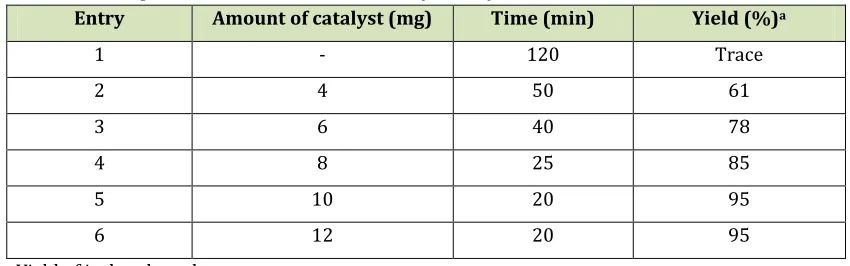
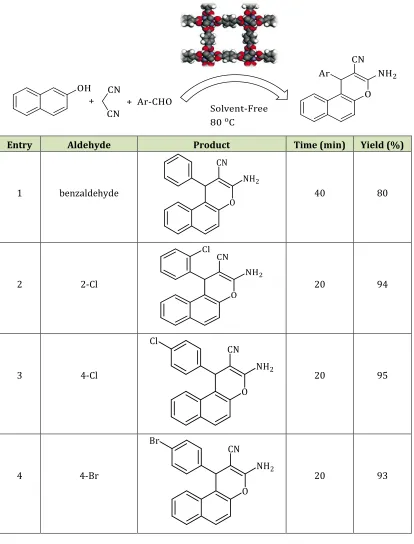
In a pilot experiment and to achieve suitable conditions for the synthesis of 2-amino-4H-chromene, various reaction conditions have been investigated in the reaction of malononitrile, 4-chlorobenzaldehyde and 2-naphtol in the presence of a catalytic amount of MOF-5 as a model reaction.After that, in order to explore the scope and limitations of the reaction, various aryl aldehydes were used.
nanostructured under solvent-free conditionsat 80 °C (entry 3). No improvement inyield was observed on increasing either the amount of catalyst. The reaction did not proceed in the absenceof nanocatalyst.
Table 1. optimization of amount of catalyst in synthesis of 2-amino-4H-chromene
Entry Amount of catalyst (mg) Time (min) Yield (%)a
1 - 120 Trace
2 4 50 61
3 6 40 78
4 8 25 85
5 10 20 95
6 12 20 95
a Yield of isolated products
We examined the effect of various solvents on a model reaction (Table 2). We did this experiment at ethanol, H2O and CH3CN but the reaction did not take place even after prolonged reaction time
(Table 1, entries 1-3). As could be seen in Table 2, in solvent-free conditionthe yield of the reaction was found to be very good (95 %).
Table 2. optimization of solvent in synthesis of 2-amino-4H-chromene
Entry Solvent Time (min) Yield (%)a
1 - 20 95
2 EtOH 60 79
3 H2O 60 67
4 CH3CN 60 Trace
5 CH2Cl2 55 Trace
6 CHCl3 50 84
7 n-hexane 70 trace
a Yield of isolated products
Table 3. synthesis of 2-amino-4H-chromene using MOF-5 as catalyst
Entry Aldehyde Product Time (min) Yield (%)
1 benzaldehyde 40 80
2 2-Cl 20 94
3 4-Cl 20 95
5 4-OMe 45 80
6 4-Me 42 78
7 3-NO2 25 90
8 4-NO2 24 91
9
3-OH
45 78
The purposed mechanism for the synthesis of 2-amino-4H-chromene in the presence of MOF-5 is shown in Scheme 1. Firstly, MOF-5 binds with the oxygen of the carbonyl group makes the alpha hydrogen very acidic, thereby involving the Knoevenagel condensation reaction between aromatic aldehyde and malononitrile. In the second step, Knoevenagel product was reacted in a Michael addition with 2-naphtol to produce desired product after rearomatization and intramolecular cyclization with the help of MOF-5 as a catalyst.
Scheme 1. Proposed mechanism pathway for the synthesis of 2-amino-4H-chromene derivatives using MOF-5
as a catalyst
The reusability of the MOF-5 as heterogeneous catalyst was tested as shown in (Figure 1) using the model reaction under the optimized reaction conditions. After completion of the reaction, the catalyst was easily removed from the reaction medium using centrifugation. Then, it was washed several times with ethanol, water and dried under vacuum and reused again. MOF-5 can be reused more than five times without any significant decrease about catalytic function. It looks like highly stable and reusable catalyst.
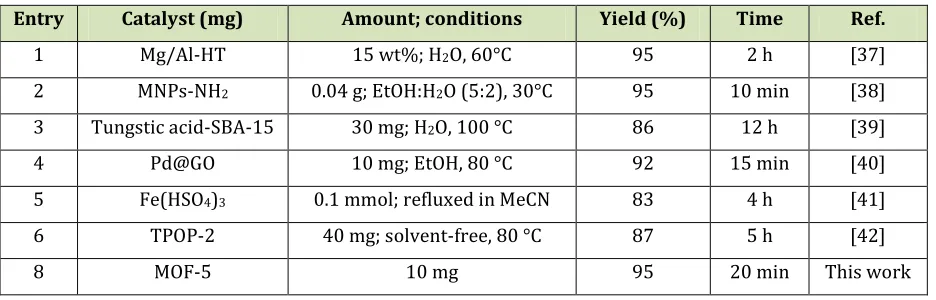
A comparison of the catalytic activities of the different heterogeneous catalysts which was reported in the literature with that of prepared MOF-5 to synthesize the compound of the model reaction is indicated in Table 4. The MOF-5 catalyst method offers several advantageous over most of the literature methods such as, a short reaction time, simple work-up procedure, high reusability of catalyst, high yields [37-43].
Table 4. Comparison of MOF-5 with other catalysts
Entry Catalyst (mg) Amount; conditions Yield (%) Time Ref.
1 Mg/Al-HT 15 wt%; H2O, 60°C 95 2 h [37]
2 MNPs-NH2 0.04 g; EtOH:H2O (5:2), 30°C 95 10 min [38]
3 Tungstic acid-SBA-15 30 mg; H2O, 100 °C 86 12 h [39]
4 Pd@GO 10 mg; EtOH, 80 °C 92 15 min [40]
5 Fe(HSO4)3 0.1 mmol; refluxed in MeCN 83 4 h [41]
6 TPOP-2 40 mg; solvent-free, 80 °C 87 5 h [42]
8 MOF-5 10 mg 95 20 min This work
Conclusion
In summary, 2-amino-4H-chromenes has been synthesized through addition–cyclization process catalysed by MOF-5 under sonication at 80 °C. The corresponding products can be obtained in moderate to good yields. MOF-5 has been employed as a highly efficient and powerful nanocatalyst for the preparation of 2-amino-4H-chromenes.
References
[1] Martínez-Grau A., Marco J. Bioorg. Med. Chem. Lett., 1997, 7:3165
[2] Khafagy M.M., El-Wahas A.H.F.A., Eid F.A., El-Agrody A.M. IL Farma., 2002, 57:715 [3] Dell C.P., Smith C.W. European Patent Appl. EP 537949, Chem. Abstr., 1993, 119139102d
[4] Hiramoto K., Nasuhara A., Michiloshi K., Kato T., Kikugawa K. Mutat. Res., Genet. Toxicol. Environ. Mutagen., 1997, 395:47
[5] Mohr S.J., Chirigos M.A., Fuhrman F.S., Pryor J.W. Cancer Res., 1975, 35:3750 [6] Bianchi G., Tavaz A. Agric. Biol. Chem., 1987, 51:2001
[7] Anderson D.R., Hegde S., Reinhard E., Gomez L., Vernier W.F., Lee L., Liu S., Sambandam A., Snider P.A., Masih L. Bioorg. Med. Chem. Lett., 2005, 15:1587
[10] Kumar B.S., Srinivasulu N., Udupi R.H., Rajitha B., Reddy Y.T., Reddy P.N., Kumar P.S. J. Heterocyclic Chem., 2006, 43:1691
[11] Lakshmi N.V., Kiruthika S.E., Perumal P.T. Synlett, 2011, 2011:1389
[12] Kale S.R., Kahandal S.S., Burange A.S., Gawandeb M.B., Jayaram R.V. Catal. Sci. Technol., 2013,
3:2050
[13] Dekamin M.G., Eslami M., Maleki A. Tetrahedron, 2013, 69:1074 [14] Zolfigol M.A., Yarie M., Baghery S. Synlett, 2016, 27:1418
[15] Heravi M.M., Baghernejad B., Oskooie H.A. J. Chin. Chem. Soc., 2008, 55:659 [16] Vangala V.B., Pati H. Chem. Method., 2018, 2:333
[17] Behbahani F.K., Shahbazi R. Chem. Method., 2018, 2:270
[18] Momeni A.R., Samimi H., Vaezzadeh H. Chem. Method., 2018, 2:260 [19] Samadi S., Behbahani F.K. Chem. Method., 2018, 2:181
[20] Shaikh U.U., Tamboli Q.Y, Pathange S.M., Dahan Z.A., Pudukulathan Z. Chem. Method., 2018, 2:73 [21] Salavati H., Teimouri A., Kazemi S. Chem. Method., 2017, 1:145
[22] Sajjadifar S. Chem. Method., 2017, 1:1
[23] Salavati H., Teimouri A., Kazemi S. Chem. Method., 2017, 1:12
[24] Chughtai A.H., Ahmad N., Younus H.A., Laypkov A., Verpoort F. Chem. Soc. Rev., 2015, 44:6804 [25] Soleiman-Beigi M., Arzehgar Z. J. Sulfur Chem., 2015, 36:395
[26] Soleiman-Beigi M., Arzehgar Z., Movassagh B. Synthesis, 2010, 2010:392 [27] Soleiman‑Beigi M., Arzehgar Z. Heteroatom Chem., 26:355
[28] Soleiman-Beigi M., Arzehgar Z. Monatsh Chem., 2016, 147:1759
[29] Sajjadifar S., Rezayati S., Arzehgar Z., Abbaspour S., Torabi Jafroud M. J. Chin. Chem. Soc., 2018,
65:960
[30] Dhakshinamoorthy A., Asiric A.M., Garcia H. Chem. Soc. Rev., 2015, 44:1922 [31] Soleiman-Beigi M., Yavari I., Sadeghizadeh F. RSC. Adv., 2015, 5:87564 [32] Sajjadifar S., Arzehgar Z., Ghayuri A. J. Chin. Chem. Soc., 65:205
[33] Soleiman-Beigi M., Arzehga Z. Synlett, 2018, 29:986
[34] Sajjadifar S., Arzehgar Z., Khoshpoori S. J. Inorg. Organomet. Polym. Mater., 2018, 28:837 [35] Arzehgar Z., Sajjadifar S., Arandiyan H. Asian J. Green Chem., 2019, 3:43
[36] Li J., Cheng S., Zhao Q., Long P., Dong J. Int. J. Hydrogen. Energy, 2009, 34:1377
[37] Kumar D., Reddy V.B., Mishra B.G., Rana R.K., Nadagouda M.N., Varma R.S. Tetrahedron, 2007,
63:3093
[39] Kundu S.K., Mondal J., Bhaumi A. Dalton Trans., 2013, 42:10515
[40] Akocak S., Şen B., Lolak N., Şavk A., Koca M., Kuzu S., Şen F. Nano-Struct. Nano-Object., 2017,
11:25
[41] Eshghi H., Damavandi S., Zohuri G.H. Synth. React. Inorg. Met., 2011, 41:1067 [42] Kundu S.K., Bhaumik A. Rsc. Adv., 2015, 5:32730