Racial Discrimination, Social Support, and Mental Health Katherine Reiter-Lavery
The University of North Carolina at Chapel Hill Spring 2017
A thesis presented to the faculty of the University of North Carolina at Chapel Hill in partial fulfillment of the requirements for the Bachelor of Arts degree with Honors in Psychology.
Abstract
Introduction
Despite talk of a post-racial society, racial discrimination remains a common experience for African American young adults (Banks, 2010; Banks & Kohn-Wood, 2007). In both cross-sectional and prospective studies, racial discrimination has been shown to be associated with a broad range of psychological adjustment outcomes such as well-being, psychiatric symptoms and psychological distress (Paradies, 2006; Pascoe & Smart Richman, 2009; Schmitt, Branscombe, Postmes, & Garcia, 2014).
Fortunately, not all African Americans who experience racial discrimination evidence negative psychological adjustment. One potential variable that may account for individual differences in responses to racial discrimination is social support, which can be defined as the presence and perceived availability of social resources that assist a person in times of stress, or a general sense that an individual is cared for by others. The social support buffering model posits that social support serves as a moderator and mitigates the detrimental impact of stressful life experiences, such as racial discrimination, while the social support deterioration model suggests that social support mediates the association between racial discrimination and declines in mental health. In an attempt to elucidate the role of social support in the link between racial
discrimination and psychological adjustment, this study examines social support as a mediator and a moderator in the relationship between racial discrimination and psychological distress. Discrimination and Mental Health
Racial discrimination can be defined as “differential treatment of members of [racial] groups by both individuals and social institutions,” and “can persist in institutional structures and policies even in the context of marked declines in individual level racial prejudice and
been linked to a number of negative physical and mental health outcomes. For example, discrimination has been shown to be associated with a physiological stress response, such as increased blood pressure or hypertension (Smart Richman, Pek, & Pascoe, 2008, as cited by Pascoe & Smart Richman, 2009). Further, discrimination is connected to decreases in positive aspects of mental health, such as quality of life (Utsey, Lanier, Williams III, Bolden & Lee, 2006), general well-being (Wong, Schrager, Holloway, Meyer & Kipke, 2014), and
psychological adjustment (Prelow, Mosher, & Bowman, 2006), as well as increases in negative aspects of mental health, such as depressive symptoms (e.g. Seawell, Cutrona, & Russell, 2012; Nadimpalli, James, Yu, Cothran, & Barnes, 2015; Lewin, Mitchell, Rasmussen, Sanders-Phillips, & Joseph, 2011), anxiety symptoms (Graham & Roemer, 2012), and a general decline in mental health (Williams & Mohammad, 2009).
Social Support
Although racial discrimination increases the likelihood of negative mental health outcomes, there is considerable variation in psychological outcomes among those who experience racial discrimination. Social support has been generally connected to better
adjustment and psychological health in African Americans (Mosher, Prelow, Chen, & Yackel, 2006), lending support to the idea that it may positively impact the relationship between racial discrimination and mental health.
discrimination. Greater instrumental support and greater social network connection have been found to help buffer the impacts of minority stress (collectively defined as abuse, violence, homophobia, and discrimination) in gay African American men (Wong et al., 2014). In a sample of international adoptees, higher levels of social support, measured by having a sense that more individuals could be counted on to provide support in specific situations, was found to be
connected to fewer depressive symptoms and generally better mental health outcomes (Koskinen et al., 2015).
The buffering effect of social support is also supported for race-related stressors. In a large sample of 526 heterosexual adult men ages 18-45, the presence of high social support buffered the effects of frequent experiences of racial discrimination on sexual and HIV risk (Bowleg et al., 2012). When measured together, a combination of high social support and high cognitive ability buffered against a decreased quality of life in a sample of 323 African American adults as a result of individual and cultural racism (Utsey et al., 2006). Sociofamilial resources, or the presence of support from and connection to immediate, extended, and kinship family networks, has been shown to buffer against psychological distress as an outcome of experiencing race-related stress in African American college students (Utsey, Giesbrecht, Hook, & Stanard, 2008). Together, these studies suggest that social support might buffer against the negative mental health outcomes associated with experiences of discrimination.
discrimination that leads to a decrease in mental health, but instead the decrease in social support that impacts mental health (Barrera, 1988, as cited by Prelow et al. 2006). This hypothesis has been less examined than the social support buffering hypothesis, but there is some empirical support.
For example, in a population of 405 Asian American adults (mean age = 30.3), social support mediated the relationship between racial discrimination and depressive symptoms. Participants completed a survey answering questions about depressive symptoms, critical ethnic awareness, experiences of racial discrimination, and social support. Results were consistent with the social support deterioration model and indicated that social support helped explain the relationship between experiences of racial discrimination and depressive symptoms (Kim, 2014). Prelow et al. (2006) examined both models in the context of racial discrimination and mental health outcomes. A sample of 135 African American college students completed a questionnaire at one time point measuring racial discrimination, social support, depression, and life satisfaction. They found support for social support deterioration model, but not the social support buffering
hypothesis.
Limitations of Previous Research
view is available to them. Because researchers have measured different aspects of social support, it is possible that different aspects have different relationships with mental health outcomes. Further, previous research has shown that different types of relationships provide different forms of support (Wellman & Worthley, 1990); thus, different measurements of support may be
account for different relations between discrimination and outcomes.
Further, some researchers examine an aggregate measure of social support (e.g. Koskinen et al., 2015), while others compare multiple aspects of support (Graham & Roemer, 2012;
Marshall-Fabien & Miller, 2016; Seawell et al., 2012). Marshall-Fabien and Miller (2016) found, for example, that when social support and social connectedness were compared, only social connectedness buffered depressive outcomes. Seawell et al. (2012) found that when general social support was compared with social support tailored to discriminatory experiences, only the tailored form of social support moderated depressive symptoms and optimism. Additionally, specific measures of social support such as church-based social support serve as moderators between discrimination and mental health outcomes (Graham & Roemer, 2012). These comparisons suggest that different types of social support relate to adjustment outcomes in different ways. Thus, social support must be operationalized precisely.
Different conceptualizations of social support, based on number of connections, perception of social support, or even other definitions, may lead to social support playing a different role in the relationship between race-related stressors and mental health because they represent different aspects and experiences of social support.
difficult to fully determine mediation of a specific variable if the design does not examine change over time in all variables examined. Second, it is not possible to truly determine the impact of racial discrimination if the long-term impacts are not examined; thus, it is crucial that more studies use longitudinal methods to examine the impact of social support on racial
discrimination over time. The Present Study
In light of the shortcomings of previous research, this study uses longitudinal data to examine the role of social support in the relationship between racial discrimination and mental health. I examine two measures of social support: amount of social support, or the number of people an individual can count on for support, and social support satisfaction, or the level of satisfaction with the support an individual receives. Consistent with previous findings, I expect racial discrimination to be related to decreased mental health outcomes. Consistent with the social support buffering model, I expect that the social support buffering model will hold true when social support is measured based on the number of people that offer support, or amount of social support. On the basis of prior research, I also expect that the social support deterioration model will hold true when utilizing a measure of satisfaction with social support, such that racial discrimination will lead to decreased satisfaction with social support, and decreased satisfaction will, in turn, lead to decreased mental health outcomes.
Method
Data were collected as part of a longitudinal research project on African American health and life experiences. Three waves of data were used, with an interval of one semester
Participants
Participants were African American first-year students at a mid-size, public, southeastern, predominantly-White university in the United States, and were recruited from a list of incoming first-year students provided by the university registrar. To be eligible to participate, students had to be a college student at the university where the study was conducted, be at least 18, and self-identify as African American. The sample consisted of 155 students: 105 females (67.7 %) and 50 males (32.3 %). Two groups were represented: Cohort 1 (N = 82; 52.9 %) with an average age of 18.52 years (SD = 0.53), and Cohort 2 (N = 73; 47.1 %), with an average age of 18.07 (SD = 0.25) at Wave 1. Cohort 1 consisted of 55 females (67.1%) and 27 males (32.9%), whereas Cohort 2 consisted of 50 females (68.5%) and 23 males (31.5 %). Sample attrition was 29.6 % (10.97 % from wave 1 to wave 2 and 18.71 % from wave 2 to wave 3) across all waves. Students who participated in all three waves did not differ in gender composition, age, racial discrimination experiences from those who dropped out after wave 1.
The median highest maternal educational attainment was ‘Bachelors or 4-year college degree’ and representation of self-reported family SES included: 7.0% poor, 19.3% working class, 50.9% middle class, 22.2% Upper Middle, and 0.6% Wealthy. About 80.7% of students were in state, 91.8% were born in the United States, 28.7% were first generation college
Measures
Demographic Information. Participants reported demographic data, some of which were used as covariates in the analysis. This information consisted of gender, age, race/ethnicity, socioeconomic status, and mothers’ highest level of educational attainment (1 = Elementary School to 7 = Graduate or professional degree). Empirical work suggests that parental
educational attainment may be a more accurate measure of SES (Almeida, Neupert, Banks, & Serido, 2005; Grzywacz, Almeida, Neupert, & Ettner, 2004). As such, parental educational attainment was utilized as a proxy for SES.
Racial Discrimination. College students’ racial discrimination experiences during the past year (and between waves of data collection at Time 2 and 3) were assessed at Time 1, 2, and 3 utilizing the Daily Life Experiences Scale (DLE; Harrell, 1994). Initial responses at Time 1 were used as a baseline measure of experiences of racial discrimination. The DLE is a subscale of Harrell’s (1994) Racism and Life Experience Scale. As a whole, this self-report scale is used to assess past experiences with racial discrimination. The DLE subscale (Time 1 α = 0.92; Time 2 α = 0.93; Time 3 α = 0.94) assesses the frequency and extent to which individuals have
experienced 18 independent microaggressions as a result of their race in the past year (or since the prior study time point). Responses on the DLE are rated from 0 = never to 5 = once a week or more, with higher scores corresponding to higher levels of experiences with racial
Mental Health. To assess participants’ mental health, the Symptom Checklist-90-Revised was utilized (SCL-90-R; Derogatis, 1994). Responses to the SCL-90-R measure 9 dimensions of psychiatric symptoms (somatization, obsessive-compulsive, interpersonal sensitivity, depression, anxiety, hostility, phobic anxiety, paranoid ideation, and psychoticism) and as well as three global indices of psychological distress. Initial responses at Time 1 were utilized as a baseline measure in order to assess changes in psychiatric symptoms over time in response to racial discrimination. This study utilized one global index, the Global Severity Index, which accounts for the number of symptoms present as well as the severity of symptoms
reported. Previous studies have demonstrated the reliability and validity of the SCL-90-R (e.g., Derogatis & Unger, 2010).
the reliability of this index as well as its correlations with other measures (e.g. Heitzmann & Kaplan, 1988).
Procedure
Following university Institutional Review Board approval, students were contacted via email and asked to participate in a longitudinal study examining the impact of stressful life experiences on mental and physical health in African American college students. Participants completed a battery of questionnaires in survey administrations lasting approximately one hour. Participants were asked to return twice more, for a second and third wave of data collection in which the same battery of questionnaires was completed. Research assistants administered the questionnaires via Qualtrics Online Survey Software in a university classroom at each time point. Participants received payment of $15 at each wave of data collection.
Statistical Analysis
and psychological distress (at mean and +1 SD amount of social support and social support satisfaction) and test the simple slopes of the regression lines.
To determine whether social support mediated the effect of racial discrimination on later psychological distress, I tested a longitudinal mediation model for each measure of social
support. This model examined whether (a) racial discrimination predicted subsequent amounts of social support, controlling for prior amount of social support; whether (b) amount of social support predicted later psychological distress, controlling for prior levels of each variable; and whether (c) the indirect effect of racial discrimination on subsequent psychological distress, controlling for previous levels of distress, was significant. The same model was used to determine if social support satisfaction mediated the effect of racial discrimination on later psychological distress. Model fit indices examined were the Root Mean Square Error of Approximation (RMSEA; Steiger & Lind, 1980), Comparative Fit Index (CFI; Bentler, 1990), and Tucker-Lewis Index (TLI; Tucker & Lewis, 1973)
Results Preliminary Analyses
negatively related to psychological distress at Wave 1. Psychological distress at Wave 1 was positively related to psychological distress at Wave 3. Finally, correlational analyses indicated that racial discrimination at time 1 was positively related to psychological distress at Time 2 and Time 3, such that higher levels of discrimination were related to higher subsequent levels of distress.
Social Support Buffering Hypothesis: Moderation Model
The first aim of the study was to examine whether amount of social support and satisfaction with social support each independently moderated the relationship between racial discrimination and psychological distress.
Social Support Amount as a Moderator. Racial discrimination at Time 1 was positively linked to psychological distress at Time 3, controlling for Time 1 psychological distress (β = 0.14, p = .01), but amount of social support at Time 1 was not significantly related to psychological distress at Time 3 (p = .36). There was not a significant interaction between racial discrimination (Time 1) and amount of social support (Time 1) in predicting psychological distress at Time 3 (p = .40) after controlling for demographic variables and Time 1 distress. Thus, there was no moderation by amount of social support on the relationship between racial discrimination and psychological distress.
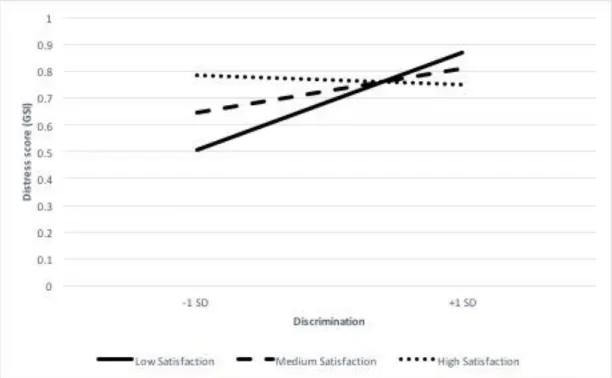
significant, whereas the slope of the line one standard deviation above the mean (β = -.02,p = .69) was nonsignificant. As shown by Figure 1, racial discrimination scores positively predicted psychological distress at low and medium levels of social support satisfaction, but not at high levels of social support satisfaction. This finding is consistent with social support satisfaction acting as a buffer of the relationship between racial discrimination and psychological distress. Social Support Deterioration Model: Longitudinal Mediation Model
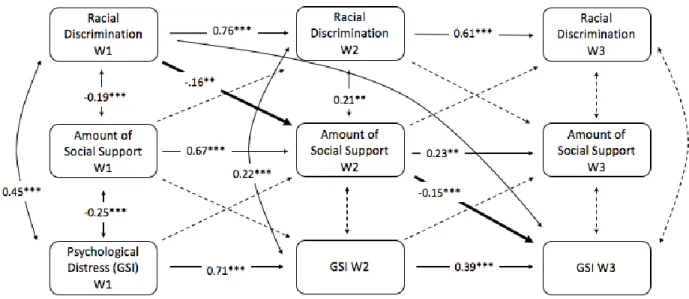
The second aim of the study was to examine whether amount of social support and social support satisfaction independently mediated the longitudinal relationship between discrimination and distress. The cross-lagged mediational model for social support amount (Figure 2), RMSEA = 0.06, CFI = 0.98, TLI = 0.94 and the model for social support satisfaction, RMSEA = 0.05, CFI = 0.98, TLI = 0.95 fit the data well.
Social Support Amount. As shown in Figure 2, racial discrimination at time 1 was negatively related to social support amount at time 2 (β = -0.16, p = .03), such that as racial discrimination increased, the amount of social support decreased (or vice versa, as racial
discrimination decreased, amount of social support increased). In contrast, racial discrimination at time 2 was not significantly related to social support amount at time 3 (p = .37). Social support amount at time 1 was unrelated to GSI (psychological distress) at Time 2 (p = .44). However, social support amount at time 2 was negatively related to GSI at time 3 (Β = -.15, p = .003). This is consistent with a mediational pathway, whereby racial discrimination at time 1 leads to
decreased social support amount at time 2, and social support amount at time 2, in turn, leads to increased psychological distress at time 3, even when taking into account prior levels of social support and psychological distress. The confidence interval for the indirect effect of racial
2) was significant 95% CI [0.002, 0.060]. Of note, psychological distress (Time 1) was unrelated to subsequent social support and social support was unrelated to subsequent racial
discrimination, which rules out the reverse mediation pathway. In sum, the perceived amount of social support mediated the relationship between racial discrimination and subsequent
psychological distress.
Social Support Satisfaction. In the satisfaction model (not depicted), racial
discrimination at time 1 was not significantly related to social support satisfaction at time 2 (p = .08), and discrimination at time 2 was not significantly related to social support satisfaction at time 3 (p = .51). Social support satisfaction at time 1 was unrelated to GSI at time 2 (p = .30), and social support satisfaction at time 2 was not significantly related to GSI at time 3 (p = .40). The indirect effect of racial discrimination at time 1 on psychological distress at time 3 through social support satisfaction was not significant (p = .44).
Discussion
The first aim of the study was to examine social support as a buffer against the
detrimental impacts of racial discrimination on mental health, specifically psychological distress. To do so, I compared two measures of social support: amount of social support, and satisfaction with social support. Based on previous literature, much of which has measured social networks (e.g. Marshall-Fabien & Miller, 2016), I expected amount of social support to serve as a
moderator, but not social support satisfaction. Counter to my predictions, however, I found that social support satisfaction acted as a buffer and not amount of social support. As shown in Figure 1, higher levels of social support satisfaction attenuated the relation between racial
discrimination and subsequent distress, even after controlling for initial distress. While
somewhat surprising, these results are consistent with results of other studies that have utilized similar measures of social support (e.g. satisfaction or perception; Seawell, et al., 2012; Burns et al. 2012). The direct comparison of different measurements of social support highlights the need to be conscientious in comparing measurements of social support, particularly when examining its role as a moderator of racial stress.
The second study objective was to examine social support as a mediator between
discrimination and distress. Here, I expected social support satisfaction, but not amount of social support, to act as a mediator. The results were, again, counter to my prediction, such that amount of social support, but not satisfaction, acted as a mediator of the link between racial
discrimination and subsequent distress. Results showed that racial discrimination was negatively related to amount of social support, which in turn was negatively related to psychological
of it focuses on moderators (Schmitt et al., 2014); however, perceptions of social support have been shown to mediate the relationship between discrimination in sexual minority populations and negative mental health problems (Schwartz, Stratton & Harat, 2016). Additionally, social isolation has been shown to be connected with worse health outcomes, supporting my finding that lower amounts of social support would be connected to more distress (House, Landis, & Umberson, 1988). The lack of research on social support as a mediator of the impacts of race-related stress indicates the need for additional research in this area.
As a whole, the study findings indicate that different aspects of social support (i.e., amount versus satisfaction) may have differential impacts on the relationship between
of the social support provided (e.g., tailored discrimination support versus general support), as well as the race of those providing support.
Limitations and Future Directions
Despite the strengths of this study (e.g., longitudinal design and comparison of different measures of social support), there are still a number of limitations. First of all, the population is limited to that of an undergraduate population at a predominately white institution. As a result, this study examines racial discrimination in a specific population, limited by education
attainment, age, and similar environment. Future research should make a goal to gain a deeper understanding of the impacts of discrimination in non-undergraduate populations. Additionally, it is difficult to accurately measure discrimination experiences. This study uses a measure of self-reported frequency of discrimination in everyday life, which does not easily lend itself to
experimental manipulation and which also may be subject to recall biases.
This research makes a valuable contribution to the literature on the impacts of racial discrimination. First of all, it is one of the few longitudinal studies examining the impact of racial discrimination, social support and mental health. More longitudinal research in this area needs to be done, particularly over longer periods of time. Second, it examines two different
Conclusion
This study examined social support as a moderator and a mediator in the relationship between racial discrimination and mental health outcomes as measured by psychological distress. I showed that different measurements of social support have different impacts on this
relationship, such that social support satisfaction buffers the impacts of racial discrimination while amount of social support mediates the association between discrimination and distress. Thus, the social support buffering hypothesis and the social support deterioration model were supported, although not with the measurements of social support I expected. Overall, this research provides important longitudinal data examining the impact of discrimination over time. Additionally, this research shows how different aspects of social support (e.g. amount versus satisfaction) may play different roles, particularly as a moderator or a mediator, depending on how social support is measured. Because of the detrimental outcomes of experiencing
References
Almeida, D. M., Neupert, S. D., Banks, S. R., & Serido, J. (2005). Do daily stress processes account for socioeconomic health disparities?. The Journals of Gerontology Series B: Psychological Sciences and Social Sciences, 60(Special Issue 2), S34-S39.
Banks, K.H. (2010). African American college students’ experience of racial discrimination and the role of college hassles. Journal of College Students Development, 51, 23-34. Doi: 10.1353/csd.0.0115
Banks, K.H., & Kohn-Wood, L.P. (2007). The influence of racial identity profiles on the relationship between racial discrimination and depressive symptoms. Journal of Black Psychology, 33, 331-354. doi: 10.1177/0095798407302540
Bentler, P. M. (1990). Comparative fit indexes in structural models. Psychological Bulletin, 107(2), 238-246. doi:10.1037/0033-2909.107.2.238
Bowleg, L., Burkholder, G. J., Massie, J. S., Wahome, R., Teti, M., Malebranche, D. J., & Tschann, J. M. (2012). Racial discrimination, social support, and sexual HIV risk among Black heterosexual men. AIDS and Behavior, 17(1), 407-418.
Burns, M. N., Kamen, C., Lehman, K. A., & Beach, S. R. (2012). Attributions for discriminatory events and satisfaction with social support in gay men. Archives of sexual
behavior, 41(3), 659-671.
Cohen, S., & Wills, T. A. (1985). Stress, social support, and the buffering hypothesis. Psychological bulletin, 98(2), 310.
Derogatis, L. R., & Unger, R. (2010). Symptom checklist‐90‐revised. Corsini encyclopedia of
psychology.
Graham, J. R., & Roemer, L. (2012). A preliminary study of the moderating role of church-based social support in the relationship between racist experiences and general anxiety
symptoms. Cultural Diversity and Ethnic Minority Psychology, 18(3), 268.
Grzywacz, J. G., Almeida, D. M., Neupert, S. D., & Ettner, S. L. (2004). Socioeconomic status and health: A micro-level analysis o exposure and vulnerability to daily stressors. Journal of Health and Social Behavior, 45(1), 1-16.
Harrell, S. P. (1994). The racism and life experience scales. Unpublished manuscript. Heitzmann, C. A., & Kaplan, R. M. (1988). Assessment of methods for measuring social
support. Health Psychology, 7(1), 75.
House, J. S., Landis, K. R., & Umberson, D. (1988). Social relationships and health. Science, 241, 540-545.
Kim, I. (2014). The role of critical ethnic awareness and social support in the discrimination– depression relationship among Asian Americans: Path analysis. Cultural Diversity and Ethnic Minority Psychology, 20(1), 52.
Koskinen, M., Elovainio, M., Raaska, H., Sinkkonen, J., Matomäki, J., & Lapinleimu, H. (2015). Perceived racial/ethnic discrimination and psychological outcomes among adult
international adoptees in Finland: Moderating effects of social support and sense of coherence. American Journal of Orthopsychiatry, 85(6), 550.
Lee, D. B., Neblett Jr, E. W., & Jackson, V. (2015). The role of optimism and religious involvement in the association between race-related stress and anxiety
Lewin, A., Mitchell, S. J., Rasmussen, A., Sanders-Phillips, K., & Joseph, J. G. (2011). Do human and social capital protect young African American mothers from depression associated with ethnic discrimination and violence exposure?. Journal of Black Psychology, 37(3), 286-310.
Marshall-Fabien, G. L., & Miller, D. B. (2016). Exploring ethnic variation in the relationship between stress, social networks, and depressive symptoms among older Black
Americans. Journal of Black Psychology, 42(1), 54-72.
Mosher, C. E., Prelow, H. M., Chen, W. W., & Yackel, M. E. (2006). Coping and social support as mediators of the relation of optimism to depressive symptoms among black college students. Journal of Black Psychology, 32(1), 72-86.
Nadimpalli, S. B., James, B. D., Yu, L., Cothran, F., & Barnes, L. L. (2015). The Association Between Discrimination and Depressive Symptoms Among Older African Americans: The Role of Psychological and Social Factors. Experimental aging research, 41(1), 1-24. Neblett, E. W., Bernard, D. L., & Banks, K. H. (2016). The moderating roles of gender and
socioeconomic status in the association between racial discrimination and psychological adjustment. Cognitive and Behavioral Practice, 23(3), 385-397.
Paradies, Y. (2006). A systematic review of empirical research on self-reported racism and health. International Journal of Epidemiology, 35(4), 888-901.
Pascoe, E. A., & Smart Richman, L. (2009). Perceived discrimination and health: a meta-analytic review. Psychological bulletin, 135(4), 531.
Prelow, H. M., Mosher, C. E., & Bowman, M. A. (2006). Perceived racial discrimination, social support, and psychological adjustment among African American college
students. Journal of Black Psychology, 32(4), 442-454.
Sarason, I. G., Levine, H. M., Basham, R. B., & Sarason, B. R. (1983). Assessing social support: The Social Support Questionnaire. Journal of Personality And Social Psychology, 44(1), 127-139. doi:10.1037/0022-3514.44.1.127
Schmitt, M. T., Branscombe, N. R., Postmes, T., & Garcia, A. (2014). The consequences of perceived discrimination for psychological well-being: A meta-analytic
review. Psychological Bulletin, 140(4), 921.
Schwartz, D. R., Stratton, N., & Hart, T. A. (2016). Minority stress and mental and sexual health: Examining the psychological mediation framework among gay and bisexual men.
Seawell, A. H., Cutrona, C. E., & Russell, D. W. (2012). The effects of general social support and social support for racial discrimination on African American Women’s well-being. Journal of Black Psychology, 0095798412469227.
Sellers, R. M., Copeland‐Linder, N., Martin, P. P., & Lewis, R. H. (2006). Racial identity
matters: The relationship between racial discrimination and psychological functioning in African American adolescents. Journal of Research on Adolescence, 16(2), 187-216. Steiger, J. H., & Lind, J. C. (1980, May). Statistically-based tests for the number of common
factors. Paper presented at the annual Spring meeting of the Psychometric Society, Iowa City, IA.
Utsey, S. O., Giesbrecht, N., Hook, J., & Stanard, P. M. (2008). Cultural, sociofamilial, and psychological resources that inhibit psychological distress in African Americans exposed to stressful life events and race-related stress. Journal of Counseling Psychology, 55(1), 49.
Utsey, S. O., Lanier, Y., Williams III, O., Bolden, M., & Lee, A. (2006). Moderator effects of cognitive ability and social support on the relation between race-related stress and quality of life in a community sample of black Americans. Cultural Diversity and Ethnic
Minority Psychology, 12(2), 334.
Wellman, B., & Wortley, S. (1990). Different strokes from different folks: Community ties and social support. American Journal of Sociology, 96(3), 558-588.
Williams, D. R., & Mohammed, S. A. (2009). Discrimination and racial disparities in health: evidence and needed research. Journal of behavioral medicine, 32(1), 20-47.
Wong, C. F., Schrager, S. M., Holloway, I. W., Meyer, I. H., & Kipke, M. D. (2014). Minority stress experiences and psychological well-being: The impact of support from and connection to social networks within the Los Angeles house and ball
Table 1
Zero-Order Correlations Among Demographic, Racial Discrimination, Social Support, and Distress (N=171)
Note. *** p < .001; **p < .01; *p < .05; + p <.10
1 2 3 4 5 6 7 8 9 10 11 12 13 14 15 16
1. Cohort —
2. Gender -0.01 —
3. Age 0.43 *** 0.02 —
4. Maternal Education 0.11 0.15 0.00 —
5. Racial Discrimination W1 -0.06 0.16 -0.10 0.03 —
6. Racial Discrimination W2 -0.03 0.19 ** -0.10 0.06 0.77 ***—
7. Racial Discrimination W3 0.34 *** 0.06 0.04 0.10 0.52 *** 0.67 ***—
8. Amount of Social Support W1 -0.10 -0.01 -0.13 0.12 -0.21 ** -0.21 * -0.20 * —
9. Amount of Social Support W2 -0.03 -0.01 -0.11 0.19 ** -0.28 ** -0.12 -0.15 0.71 ***—
10. Amount of Social Support W3 -0.50 *** -0.09 -0.31 ** 0.10 -0.02 -0.03 -0.23 * 0.43 *** 0.41 *** —
11. Social Support Satisfaction W1 -0.03 0.08 -0.02 0.00 -0.25 ** -0.15 -0.21 * 0.40 *** 0.27 ** 0.18 —
12. Social Support Satisfaction W2 0.04 0.07 -0.11 0.06 -0.27 ** -0.16 -0.11 0.33 *** 0.45 *** 0.24 * 0.57 ***—
13. Social Support Satisfaction W3 0.00 -0.04 -0.01 -0.06 -0.30 ** -0.23 * -0.22 * 0.40 *** 0.33 ** 0.38 ** 0.68 *** 0.57 ***—
14. Wave 1 GSI 0.10 -0.07 0.06 -0.10 0.48 *** 0.45 *** 0.34 *** 0.28 ** -0.19 * -0.17 -0.41 *** -0.22 * -0.43 ***—
15. Wave 2 GSI -0.02 0.02 -0.03 -0.01 0.39 *** 0.47 *** 0.29 ** 0.23 ** -0.15 -0.10 -0.22 * -0.15 -0.34 ** 0.73 *** —
16. Wave 3 GSI -0.09 -0.16 -0.15 0.02 0.45 *** 0.34 *** 0.35 *** -0.22 * -0.25 * -0.04 0.31 ** -0.15 -0.41 *** 0.64 *** 0.66 *** —
M — — 18.30 — 1.34 1.22 1.54 3.92 3.93 4.39 5.10 5.02 5.26 0.62 0.57 0.48
Figure 2. Mediation of satisfaction with social support on the relationship between racial discrimination and mental health over time. Bold lines show longitudinal mediation pathway; solid lines indicate significant associations; dotted lines indicate non-significant associations. Indirect effect of racial discrimination W1 on GSI W3 95% CI [0.002, 0.060].