(Under the direction of Dr. R.A. Pegram and Dr. A. Gold)
ABSTRACT
BDCM, a water disinfection byproduct, was administered by gavage
at 0, 200, and 400 mg/kg in either corn oil or 10% Emulphor to
90-day- old F-344 male rats. Urine was collected from 0-6, 6-12,
12-24, 24-36, and 36-48 hours. Animals were killed at 24 or 48 hr,
and serum collected. In the high dose groups for both vehicles
after 48 hours, significant increases were observed in serum
aspartate aminotransferase (AST), lactate dehydrogenase (LDH),
blood urea nitrogen (BUN), cholesterol and bile acids. At the
apparent time of peak hepatotoxicity (48 hours), 400 mg BDCM/kg
caused significantly greater elevations in AST, creatinine, and
bile acids when administered in corn oil than in 10% Emulphor.
Significant interactions between dose and vehicle of administration
were noted for serum enzymes AST, ALK, and LDH, indicating that
vehicle differences observed in BDCM hepatotoxicity may be
dose-dependent. At 200 mg/kg, the only significant response of a serum
enzyme was a slight increase in LDH following aqueous
administration of BDCM. In contrast to the virtual lack of effects
on liver function enzymes at 200 mg/kg, urinary enzymes were
dramatically elevated at the low dose in both vehicles. At 24
hours, BDCM increased urine ALT (33%), AST (390%), LDH (300%), and
alkaline phosphatase (ALK) (230%) in the low dose corn oil group
with respective increases of 75%, 590%, 540%, and 380% in the 10%
Emulphor group. Significant vehicle differences were noted for
urinary AST and total protein at the 200 mg/kg dose after 36 hours
and glucose at the high dose level at 48 hours. Significant
interactions between BDCM dose and dosing vehicle were observed for
urinary AST, LDH, and total protein at 36 hours post-gavage and
total protein at 24 hours, suggesting again that vehicle effects
noted in BDCM nephrotoxicity may be dependent on dose. At 400
mg/kg, the time to peak nephrotoxicity appeared greater with corn
oil than with the aqueous vehicle. These data suggest that BDCM is
more acutely hepatotoxic when administered in corn oil than in an
aqueous vehicle and further suggest that the kidney may be a more
sensitive indicator of BDCM toxicity than the liver.
List of Figures...ii
I. Literature Review...2
A.Trihalomethanes (THMs)...2
1. Formation and Chemical Properties...2
2 . Prevelance and Occurrence...2
3 . Human Exposure and Risk...3
B. Bromodichloromethane (BDCM)...5
1. Systemic Toxicity...5
a. Acute and Short Term Exposure...5
b. Subchronic Toxicity...7
c. Carcinogenicity and Chronic Toxicity...8
2 . Toxicokinetics and Metabolism...10
C, Effects of Different Dosing Vehicles...12
1. Effects on Acute and Subacute Toxicity...12
2 . Effects on Subchronic Toxicity...14
3 . Effects on Pharmacokinetics...15
II. Introduction...17
III. Materials and Methods...19
a. Animals and Husbandry...19
b. Chemicals...19
c. Study Design...20
d. Safety Precautions...20
e. Clinical Chemistry...20
f. Necropsy and Histopathology...21
g. Preliminary Pharmacokinetics Study...22
h. Statistical Analysis...23
IV. Results...23
a. Effects of Dosing Vehicle on Acute Nephrotoxicity... 23
b. Effects of Dosing Vehicle on Acute Hepatotoxicity... 28
V. Discussion...31
VI. Conclusions...40
1. Trihalomethane risk estimates...42
2. Effect of BDCM on terminal kidney and relative kidney
weights of male F-344 rats...43
3. Urine pH and osmolarity over time following administration
of BDCM in different dosing vehicles...44
4. Urinary activities of renl damage indicators over time
following administration of BDCM in different dosing
vehicles...45
5. Urinary concentrations of glucose and total protein over
time following administration of BDCM in different
dosing vehicles...46
6. Levels of serum indicators of renal damage 24 and 48 hours
after oral administration of bromodichloromethane (BDCM)
in different dosing vehicles...47
7. Kidney histopathology 24 and 48 hours following exposure
to BDCM in corn oil or an aqueous vehicle...48
8. Body and liver weights of male F-344 rats 24 and 48 hours
following administration of BDCM in corn oil or aqueous
(10% Emulphor) dosing solution...49
9. Serum enzyme levels 24 hours after oral administration of
bromodichloromethane (BDCM) in different dosing
vehicles...50
10. Levels of serum hepatic damage indicators 24 hours after
oral administration of bromodichloromethane (BDCM) in
different dosing vehicles...51
11. Levels of serum hepatic damage indicators 48 hours after
oral administration of bromodichloromethane (BDCM) in
different dosing vehicles...52
12. Levels of serum hepatic damage indicators 48 hours after
oral administration of bromodichloromethane (BDCM) in
different dosing vehicles...53
13. Liver histopathology 24 and 48 hours following
1. Structures of the four most widely studied trihalomethanes
(THMs)...55
2 . Oxidative metabolism of BDCM...56
3 . Reductive metabolism of BDCM...57
4. Time course of nephrotoxicity following oral
administration of 200 mg BDCM/kg in corn oil or aqueous
vehicle...58
5. Time course of nephrotoxicity following oral
administration of 400 mg BDCM/kg in different vehicles..59
6. Response of renal indicators of BDCM nephrotoxicity
36 hours post-exposure...60
7. Response of renal indicators of BDCM nephrotoxicity
48 hours post-exposure...61
8. Concentration-time profile following administration of
400 mg BDCM/kg in corn oil or 10% Emulphor...62
9. Increases in hepatic toxicity indicators compared to
increases in renal toxicity indicators at apparent times
of peak toxicity following challenge with
200 mg BDCM/kg...63
10. Increases in hepatic toxicity indicators compared to
increases in renal toxicity indicators at apparent times
of peak toxicity following challenge with
A. Formation and Chemical Properties
Trihalomethanes (THMs) are formed when surface waters
containing organic substances are disinfected via chlorination.
Hypochlorous acid (HOCl) reacts with endogenous organic
molecules, such as humic and fulvic acids, to form chloroform and
many other halogenated by-products. HOCl can also oxidize
bromide ion to form hypobromous acid (HOBr) which reacts with
organic acids to form reactive brominated compounds (Jolley et
al., 1978). Some of these reactions are shown below:
(1) Fulvic acid + HOCl —> CHCI3 + acid residual
(2a) Br~ + HOCl —> HOBr + Cl~
(2b) Fulvic acid + HOBr —> CHBr3 + acid residual
The four most commonly studied trihalomethanes are chloroform
(CHCI3), bromodichloromethane (BDCM), chlorodibromomethane
(CHBr2Cl) and bromoform (CHBr3). The structures of these
compounds are illustrated in Figure 1. THMs are lipophilic,
volatile compounds which are colorless and have a slight sweet
non-irritating odor associated with them.
B. Prevalence and Occurrence
A number of surveys of THM prevalence in the U.S. have been
conducted in the past decade. These studies have found that, in
finished drinking water, chloroform levels range from 0.7 to 540
have been reported in drinking waters which have surface waters
as a primary source rather than groundwater. This may be due to
lower concentrations of organic precursors and smaller
disinfection requirements in groundwater compared to surface
waters (Jolley et al., 1978). Increased use of ozonation by
municipalities as an alternative to chlorination may result in
formation of higher concentrations of brominated THMs (Jacangelo
et al., 1989).
In addition to being found in chlorinated drinking water,
THMs are extensively used in industry and are commonly found in
consumer products. Chloroform is used as a solvent and in the
production of plastics, refrigerants and other solvents (U.S.
EPA, 1980) . Chloroform was widely used as an anesthetic but is
no longer utilized in this capacity. Brominated THMs have been
widely used in chemical and pharmaceutical manufacturing and as
solvents (U.S. EPA, 1975).
C. Human Exp>osure and Risk
Recently, chlorination by-products have been implicated in
increased risks of bladder and rectal cancer in humans (Morris et
exposure. Human exposure can also occur in swimming pools (Beech
et al., 1980) and showers (Jo et al., 1990) via dermal absorption
and inhalation of vapors. However, it is generally accepted
that consumption of drinking water is the primary route of human
exposure to THMs, although the study conducted by Jo et al.
(1990) introduces inhalation and dermal absorption as significant
exposure mechanisms.
Due to the presence of these compounds in most drinking water
supplies and discovery of their carcinogenic and toxic potential,
regulation of THMs has become neccessary. Acceptable human
exposure levels and health advisories have been determined for
the four THMs with the highest mean concentrations in municipal
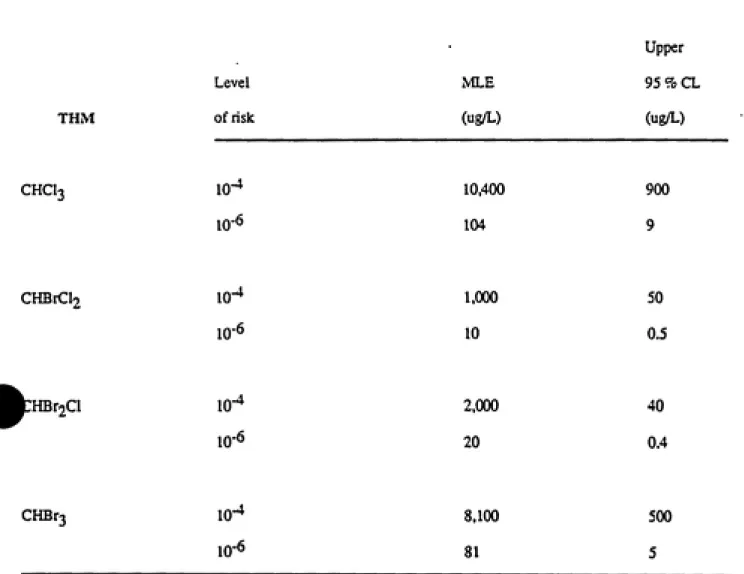
water supplies. Levels of risk, maximum likelihood estimates
(MLE's) and upper 95% confidence limits for the four primary
THM's are compiled in Table 1. Levels were determined from data
from animal studies and human epidemiological studies. Both
carcinogenic and noncarcinogenic endpoints were used in these
determinations. BDCM has been assigned the lowest MLE of the
four primary THMs suggesting that BDCM poses the greatest risk of
1. Systemic Toxicity
a. Acute and shoirt term exposure
The most extensive study of acute BDCM toxicity was performed
by the National Toxicology Program (NTP, 1987) at the National
Institute of Environmental Health Sciences (NIEHS). Male and
female F-344 rats and male and female B6C3F1 mice were exposed to
single doses of 150, 300, 600, 1,250 or 2500 mg BDCM/kg via corn
oil gavage. All animals dosed with 2,500 or 1,250 mg BDCM/kg
died while 2 of 5 male rats, 1 of 5 female rats, and 2 of 5
female mice survived gavage with 600 mg BDCM/kg. All animals
receiving lower doses of BDCM survived. The LD50 values (with
95% confidence interval in parentheses) were calculated to be 651
mg/kg (462-917 mg/kg) and 751 mg/kg (568-993 mg/kg) in male and
female F-344 rats, respectively. For female B6C3F2 mice, an
LD50 value of 651 mg/kg was reported with a 95% confidence
interval of 462-917 mg/kg. Values for male mice were not
reported. In a fourteen-day study conducted as part of the NTP
evaluation of BDCM, male and female F-344 rats were administered
BDCM in corn oil at 0, 38, 75, 150, 300, and 600 mg/kg. Male and
female B6C3F2 mice received the same dosages with the exception
of the 600 mg/kg dosage. All male rats survived at all dosage
levels while one female rat died at 38 mg/kg and one at the
with BDCM was also noted in both sexes. Following administration
of 150 and 300 mg/kg, no male mice survived while only one female
died at the highest dosage. At 150 mg BDCM/kg, renal medullae
appeared reddened in 90% of the male mice and 1 of 5 of the
female mice with 100% of the males exhibiting the same effect at
the 300 mg BDCM/kg dose.
Chu et al. (1980,1982a) reported lethality when dosages of
BDCM ranging from 54 6 mg/kg to 1500 mg/kg were administered in
corn oil to both male and female Sprague-Dawley rats with the
latter dose killing 100% of the male rats and 90% of the female
rats. Values for the LD50 were reported to be 916 mg/kg with a
95% confidence interval of 779-1083 mg/kg in male rats and 969
mg/kg with a 95% confidence interval of 764-1198 mg/kg in female
rats. The values determined in this study were somewhat higher
than those reported in the NTP study, perhaps due to different
dosing volumes (5 ml/kg in NTP study versus 2 ml/kg in Chu et al.
study) or strain differences. In a subacute {28-day) study, male
and female Sprague-Dawley rats received 0.14, 1.4 or 11
mg/rat/day of BDCM in drinking water (Chu et al. , 1982). No
pathological or biochemical changes were noted following
administration of the compound. However, slight increases in
relative kidney weights were observed in the 1.4 mg/rat/day group
aminohippurate (PAH) into renal cortical slices at the two
highest dose levels (Condie et__al., 1983), suggesting damage to
the organic anion uptake function of the proximal tubule. A
dosage of 148 mg BDCM/kg caused significant increases in serum
ALT (alanine aminotransferase) levels as well as increasing
histopathological lesions in both the kidney and liver
implicating these organs as primary targets of BDCM. Munson et
al. (1982) gavaged male and female CD-I mice with 0, 50, 125 and
250 mg BDCM/kg in 10% Emulphor solution and noted signifcant
increases in serum ALT, AST (aspartate aminotransferase) and BUN
(blood urea nitrogen) while blood glucose levels and body weights
decreased significantly. This study is consistent with the
previous reports noting the liver and kidney to be target sites
of BDCM toxicity.
b. Subchronic toxicity
A 13-week NTP study resulted in death of 5/10 male and 2/10
female rats following administration of 300 mg BDCM/kg. Both
male and female rats survived delivery of 0, 19, 38, 75, and 150
mg/kg doses while both sexes of mice survived doses ranging from
6.25 to 400 mg BDCM/kg. Histopathological findings revealed
increases in necrosis of proximal tubule epithelium cells in the
kidney and enlarged, vacuolated hepatocytes in the centrilobular
After administration of 2500 mg BDCM/liter of drinking water
to male and female Sprague-Dawley rats for 90 days and allowing a
90-day recovery period, Chu et al. (1982b) noted no significant
effects of BDCM on serum biochemical indicators. However,
decreases in water and feed consumption were noted after dosing
with BDCM for 90 days while thyroid and liver lesions
(vacuolation, increased cytoplasmic volume, homogeneity and
density of hepatocytes with vesiculation of biliary epithelial
cells and increase in thyroid epithelial height with reduction of
follicular size and colloid density) were observed after the
90-day recovery period. Histopathological changes in the thyroid
suggest a delayed effect of BDCM, indicating a longer latency
period may be required for development of thyroid pathology.
2. Carcinogenicity and chronic toxicity.
Administration of 0, 50, and 100 mg BDCM/kg five days a week
in corn oil to male and female F-344 rats for 104 weeks resulted
in increased incidences of neoplastic changes compared to
controls (NTP, 1987; Dunnick et al., 1987) Large increases (90%
and 26% in male and female rats, respectively) in incidences of
adenomatous polyps or adenocarcinomas in the large intestine were
noted in both sexes at the 100 mg BDCM/kg dosage. Overall rates
of tubular cell adenomas or adenocarcinomas in the kidney
gland. Fifty mg BDCM/kg dosages increased overall incidences of
renal tubular cell adenoma or adenocarcinomas in male mice by 18%
with increases of 58% in hepatocellular tumors in female mice
following chronic challenge with 150 mg BDCM/kg (NTP, 1987;
Dunnick et al., 1987). Additional pathological changes were also
noted in mouse thyroid and anterior pituitary glands, as well as
lesions in the testis and ovaries.
Tumasonis et al. (1985) administered BDCM to male and female
Wistar rats at 2.4 grams of BDCM per liter of drinking water for
the lifetime of the animal (approximately 180 weeks). Incidence
rates of hepatic adenofibrosis, lymphosarcomas, and pituitary
gland tumors increased 2%, 19% and 21%, respectively, in male
rats while female rats exhibited increases of 23%, 17% and 9%,
respectively, with a 6% increase in tumor incidence in the
mammary gland. In contrast to the NTP study, no renal lesions or
large intestinal tumors were noted suggesting the dosing vehicle
may influence the site of tumor formation. However, animals in
the Tumasonis et al. study limited their water intake due to
palatability problems and therefore, were likely diet-restricted
as well, which could have resulted in significantly lessened
expression of neoplasms (Pollard et al., 1985).
Chronic administration of microencapsulated BDCM in feed for
two years to male and female Wistar rats resulted in increases in
increases in biochemical indices of toxicity (ALT and AST) after
12 months in groups administered 138 mg/kg/day (Aida et al.,
1992). One hundred percent of female rats examined at 24 months
exhibited histopathological changes in the liver (fatty
degeneration, granulomas, altered cell foci, bile duct
proliferation or cholangiofibrosis) after ingesting high dosages
of BDCM. Although nonneoplastic responses were noted in other
organs in both sexes, the authors concluded that these
alterations could not be attributed to BDCM exposure.
3. Toxicokinetics and Metabolism.
The proposed metabolic pathways of BDCM are illustrated in
Figures 2 and 3. The first step in the oxidative metabolism is
mediated by NADPH-dependent cytochrome P-450, converting BDCM
into the unstable intermediate alcohol, bromodichloromethanol.
This alcohol rapidly decomposes to form phosgene (Pohl et al.,
1978), which may undergo further reactions with water to form CO2
and HCl, glutathione to form CO and corresponding conjugates
(Anders et al. , 1978), cysteine to form cysteine conjugates
(Stevens and Anders, 1979), or may bind directly to
macromolecules (DNA, RNA, proteins, etc.). Gao and Pegram (1992)
reported BDCM bound more extensively to protein and lipid than
CHCI3, and CHCI3 has also been demonstrated to bind to DNA
(Colacci et al., 1991). Therefore, due to the higher reactivity
in BDCM toxicity and carcinogenicity and BDCM may be a more
important compound for study.
Reductive metabolism of BDCM begins with addition of an
electron via the cytochrome P-450 mixed function oxidase system
and formation of the unstable bromodichloromethane radical anion
(Testai and Vittozzi, 1986). This intermediate spontaneously
decomposes to form the dichloromethyl free-radical (Tomasi et
al., 1985) which may covalently bind to tissue or initiate lipid
peroxidation.
The distribution of a single administration of
ͣ
'-^C-labeled
bromodichloromethane (BDCM) to male F-344 rats at 0, 10, 32 or
100 mg/kg for one day and 10 or 100 mg/kg/day for 10 days in corn
oil was investigated by Mathews et al. (1990) . The highest dose
level of BDCM appeared to be extensively metabolized to -'-^C02
(71% of dose) and partially metabolized to
ͣ
'
ͣ
^CO (5% of dose)
after 24 hours. Small amounts of radioactivity were found in the
urine or feces, suggesting little conjugation of intermediates
or, perhaps, excretion of negligible amounts of parent compound.
Although total tissue amounts of radiolabeled BDCM never exceeded
4.4% of the total dose, greatest levels of radioactivity were
reported in the liver (up to 3.06%) and kidney (up to 0.15%) with
liver tissue to blood ratios (TBR) decreasing and kidney TBRs
increasing with dose. TBRs in the liver and kidney were greater
and tissue levels of -^^C-labeled BDCM were less in the liver and
kidney after administration of BDCM for 10 days. Consequently,
Mink et_al. (1986) reported 81.2% of a 150 mg/kg dose of
^^C-labeled BDCM was expired as CO2 when administered in corn oil toB6C3Fi mice, with 7% being exhaled unmetabolized, 2% found in the
urine, and 3% remaining in the tissue eight hours post-gavage.
Sprague-Dawley rats receiving 100 mg/kg of radiolabeled compound
expired 41.7% of the total dose as parent compound, 14.2% as
ͣ
'
ͣ
^C02, 1.4% in the urine, and 3.3% remained in the tissue.
Absorption from the gastrointestinal tract appeared to be
relatively rapid with 92.7% and 62.7% of the total dose being
eliminated from mice and rats, respectively, after 8 hours.
Notable dissimilarities of amounts of the total dose expired as
parent and as
ͣ
'
ͣ
^002 between mice and rats may indicate species
differences in rates of metabolism of BDCM. The differences
between this study and the investigation by Mathews et_al. also
suggests possible strain differences in the Sprague-Dawley and
F-344 rats and their strain-specific ability to metabolize BDCM.
III. Effects of different dosing vehicles.
A. Effects on acute and subacute toxicity.
A number of studies have been performed to determine the
effect of vehicle of administration on the toxicity of VOCs.
1,1-dichloroethylene (1,1-DCE) toxicity was reported to change
markedly with dosing vehicle 6 hours after male Sprague-Dawley
rats were given 200 mg/kg dosages (Chieco et_al., 1981). Levels
of serum AST and ALT increased 100-fold after administration of
solution) delivery of the compound resulted in only a 15-fold
increase. Histological findings included massive centrilobular
and mid-zonal necrosis in the liver following a 1,1-DCE dose in
the oil vehicle while 0.5% Tween-80 administration caused only
slight necrotic responses. The results of this study suggest
that corn oil administration can greatly increase the
hepatotoxicity of 1,1-DCE. <
Acute CHCI3 administration in corn oil resulted in greater
hepatic and renal toxicity in male F-344 rats compared to
delivery in 10% Emulphor (M. Lilly, 1992; personal
communication). Increases in serum and urinary enzyme activities
were greater following delivery of CHCI3 in corn oil, suggesting
vehicle of administration can influence the acute toxicity of
CHCI3.
The subacute toxicity of trichloroethylene (TCE) in different
dosing vehicles has also been examined. Merrick et__al. (1989)
noted greater elevations in serum enzymes ALT, AST, and LDH in
male B6C3F]^ mice following administration of TCE for four weeks
in corn oil than the aqueous vehicle (20% Emulphor) . A similar
trend was observed in liver histopathology with higher incidences
of necrosis in mice receiving 600 or 1200 mg TCE/kg in corn oil
compared to an aqueous solution. These data are consistent with
results reported by Chieco et al., suggesting corn oil can influence the toxicological responses of VOCs in experimental
Kim et al. (1990a) investigated the effect of dosing vehicle
on the acute hepatotoxicity of carbon tetrachloride (CCI4) in
male Sprague-Dawley rats. In contrast to the previously
described studies, aqueous (0.25% Emulphor) delivery of dosages
of CCI4 ranging from 10-1000 mg/kg caused significantly greater
elevations in serum SDH (sorbital dehydrogenase), ALT and AST
than corn oil adminstration. Histological examination of the
liver lobule revealed significantly greater hepatocellular injury
in the centrilobular region following administration of CCI4 in
the aqueous vehicle compared to corn oil. CCl4-induced
hepatotoxicity appears to be attenuated by corn oil while aqueous
delivery increases CCI4 toxicity. This phenomenon may be due to
more rapid uptake rates of CCI4 from the GI tract when it is
administered in an aqueous vehicle while corn oil may be acting
as a reservoir for the compound, thus slowing absorption.
A. Effects on siibchronic toxicity.
In contrast to the results from the acute study conducted by
Kim et al. (1990), subchronic studies of effects of dosing
vehicles on VOC toxicity suggest corn oil administration enhances
toxicity. Ninety-day administration of relatively low doses (12
and 120 mg/kg/day) of CCI4 in corn oil to male and female CD-I
mice resulted in markedly greater increases in serum ALT, AST,
and LDH compared to delivery in 1% Tween-60 solution (Condie et
corn oil to both sexes, a higher incidence of hepatocellular
necrosis was noted than in the aqueous vehicle.
Bull et al ͣ (1986) reported greater hepatotoxicity resulting
from 90-day CHCI3 administration in corn oil than in an aqueous vehicle. Male and female B6C3F;2^ mice given 270 mg/kg/day in corn
oil exhibited significantly higher levels of serum AST and
triglycerides. At the same dose level in corn oil,
histopathological examination revealed enlarged, vacuolated
hepatocytes and altered hepatic structure in 50% of the males and
70% of the females. However, only minimal necrosis was noted in
two of ten females and one of ten males following administration
of an equal dose in 2% Emulphor. These studies suggest that
results from subchronic administration of VOC's in corn oil can
be substantially different from aqueous delivery of the
compounds.
C. Influence on pharmacokinetics.
In addition to influencing the acute, subacute and subchronic
toxicity of VOC's, vehicle of chemical administration can
markedly affect the pharmacokinetics of compounds. Withey et al.
(1983) reported greater areas under the blood-concentration
curves (AUC) when four halogenated hydrocarbons (methylene
chloride, dichloroethane, TCE, and CHCI3) were administered to
male Wistar rats in an aqueous dosing vehicle compared to corn
oil. Peak blood concentrations (Cjjj^j^) were markedly greater when
time required to reach maximum concentratons in the blood (Tjjia^)
compared to corn oil. The authors also reported corn oil
delivery of VOCs resulted in complex or "pulsed" uptake of the
compounds in the GI tract.
Consistent with the results previously described, CCI4
pharmacokinetics were markedly influenced by dosing vehicle. Kim
et al. (1990b) noted a ten-fold increase in Cmax when 25 mg
CCl4/kg was administered to male Sprague-Dawley rats in water or
aqueous emulsion (0.25% Emulphor) compared to corn oil. Although
AUCs were not significantly different between dosing vehicles,
''^max values were 30 times greater following corn oil delivery of
CCI4 compared to water or aqueous emulsion administration. These
data and results from the investigation by Withey et al. (1983)
suggest that the rates of VOC uptake from the GI tract are
markedly affected by dosing vehicle and differences in toxicity
Introduction
Bromodichloromethane (BDCM) is a common contaminant of
finished drinking water produced when surface waters containing
organic substances are disinfected via chlorination. Found in
many municipal drinking water supplies in the U.S. (U.S. EPA,
1990), trihalomethanes (THMs) have been measured in
concentrations ranging from 0.1 to 540 ug/1 (U.S. EPA, 1990).
THMs have been linked by epidemiological data with human bladder
and rectal cancer (Morris et al., 1992; Cantor et al., 1978). In
chronic studies with experimental animals, BDCM caused increased
incidences of neoplasms in the kidney and large intestine of male
and female rats, in the liver of female mice, and in the kidney
of male mice (Dunnick, 1987; NTP, 1987). In comparison with
chloroform (CHCI3), the most prevalent and widely studied THM,
BDCM appears to be more carcinogenic (Dunnick et al., 1987) and
more acutely toxic (Chu et al., 1982), further indicating the
importance of studying this brominated THM. The bromine moiety
of BDCM may cause these differences by increasing the reactivity
of the compound compared to chloroform.
Due to the volatile and lipophilic nature of VOCs (volatile
organic compounds) , many investigators have administered these
compounds in a corn oil vehicle. However, corn oil can influence
the biological activity of chemicals. Chronic administration of
BDCM to male and female rats in drinking water increased hepatic
neoplastic nodules (Tumasonis et al. , 1985); in contrast, only
was delivered in corn oil (NTP, 1987) . CHCI3 hepatotoxicity in
mice was enhanced following administration in corn oil for 90
days when compared to dosing in an aqueous vehicle (Bull et al. ,
1986) . Condie et al. (1986) noted the same trend when carbon
tetrachloride (CCI4) was delivered subchronically by corn oil
gavage compared to an aqueous vehicle in CD-I mice. However,when vehicle effects on the acute toxicity of CCI4 were studied,
aqueous administration led to greater hepatotoxicity than dosing
in corn oil (Kim et al., 1990a) . Several investigators have
noted that the pharmacokinetics of certain VOCs are markedly
changed when different dosing vehicles are used. Withey et al.
(1983) noted greater peak blood concentrations (Cjy^^) and total
area under blood concentration-time curves (AUC) and shorter
times to peak blood concentration (Tjyj;^) for four halogenated
hydrocarbons when administered in an aqueous solution compared to
a corn oil vehicle. CCI4 delivery in an aqueous solution
resulted in a greater Cj.^^^ and AUC and shorter Tjyjj^ than in corn
oil (Kim et al., 1990b).
Because of the variability in responses with different dosing
vehicles and the scarcity of data concerning BDCM administration
in water, comparisons of BDCM toxicity in different dosing
vehicles are needed. Results from such comparisons should be
useful in the interpretation of corn oil studies for drinking
Materials and Methods
Animals and husbandry. Male Fischer-344 rats were obtained
from Charles River Breeding Laboratories (Raleigh, N.C.)/ at 90
days of age, housed 2 per cage and were acclimated for 3 days to
a 12-hr light/dark cycle with light from 0600 to 1800, The animal
room was maintained at 20-22°C with 40 to 60% relative humidity.
Rats were provided Purina Rodent Chow 5001 (Ralston Purina Co.,
St. Louis, MO) and tap water water ad libitum during the
acclimation period. Animals were then assigned to groups based on body weight and housed individually in Nalgene plastic metabolism cages (Nalgene Corp., Rochester, NY). Additional dose
groups were placed individually in polyethylene shoebox cages
with heat-treated pine-shavings as bedding. Rats were acclimated
to the metabolism cages for 3 days prior to dosing and were
provided with Bio-Serv 45 mg pelleted Rodent Chow (Bio-Serv,
Frenchtown, N.) and tap water ad libitum. Animals were not
fasted prior to dosing.
Chemicals. BDCM (Lot no. 04117DX; purity=98.09%) was obtained
from Aldrich Chemical Co. (Milwaukee, WI) and was dissolved in
either 10% Emulphor EL-620 solution (GAF Chemical Corp., Wayne,
NJ) or corn oil (Sigma Chemical Co.). BDCM dosages were
administered in a constant volume of 5 ml/kg by oral intubation with 20-gauge, 2.5 inch ball-tipped gavage needles attached to a 3.0 ml disposable syringe. Control animals received vehicles at
Study Design. The rats in metabolism cages were assigned to
six treatment groups consisting of 6 animals each. The doses
were 0, 200, and 400 mg BDCM/kg body weight for each vehicle, and
the rats were killed 48 hours post-dosing. Additional groups (6
rats per group) were given 0 or 400 mg BDCM/kg body weight and
were killed at 24 hours. The rats were dosed between 0900 and
1100. Body weights were measured daily.
Safety precautions. Personnel were required to wear
respirators with cartridges for removing organic vapors and
protective lab coats and gloves. Dosing was performed in an
animal room under negative pressure ventilation and restricted
for VOC study.
Clinical chemistry. Urine samples were collected for 12
hours prior to dosing, then from 0 to 6 hours, 6 to 12 hours, 12
to 24 hours, 24 to 36 hours, and 36 to 48 hours. Urine was
cooled by Uotek refrigerant packs (Polyform Packer Corp.,
Wheeler, IL) . Urine samples were centrifuged at 800Xg for 10
minutes, and volume, pH and osmolality were measured. After 24
or 48 hours, rats were anesthetized with carbon dioxide, and
blood was drawn for clinical chemistry measurements from the
dorsal aorta with a 21-gauge, 1.5-inch sterile syringe and a
Vacutainer serum-separation tube (Becton Dickinson Vacutainer
Systems, Rutherford, NY). Blood samples were held on ice for 30
minutes and allowed to clot. Samples were then centrifuged at
for 12 to 24 hours. Various analyses were conducted on sera and
urine, which included alanine aminotransferase (ALT), aspartate
aminotransferase (AST), alkaline phosphatase (ALK), blood urea
nitrogen (BUN), creatinine (CRE) , gamma glutamyl transferase
(GGT), glucose (GLU), lactate dehydrogenase (LDH), and total
protein (TPR). Additional analyses were carried out on sera to
determine levels of sorbitol dehydrogenase (SDH), cholesterol
(CHOL), total bilirubin (TOT BIL), triglycerides (TRIG), albumin
(ALB), 5' nucleotidase, and bile acids. Urine and sera analyses
were conducted with a CentrifiChem-500 centrifugal analyzer
(Baker Instruments Co., Allentown, PA) and appropriate reagent
kits.
Necropsy and histopathology. After blood collection, the
livers were excised, weighed, and sections taken for
histopathology. Slices of the left lobe were triimned to 2 to 3
mm in thickness, placed in tissue cassettes, and fixed in 10%
phosphate-buffered Formalin solution. Kidneys were also removed
and sliced, either laterally (right kidney) or longitudinally
(left kidney), and placed in 10% phosphate-buffered Formalin
solution. Liver and kidney slices were subsequently prepared for
histological evaluation using hematoxylin and eosin (H&E)
staining. Prepared liver and kidney sections were evaluated by a
certified veterinary pathologist from Pathco, Inc. (Research
Triangle Park, NO) . Hepatocellular vacuolar degeneration and
necrosis were graded separately for location in the liver lobule
described previously (Simmons et__al., 1988). Lesions were evaluated according to the following criteria: none, minimal (one
to several hepatocytes affected) ; mild (no more than 25% of the
hepatocytes in the affected zone involved); moderate (up to 50%
of hepatotcytes in affected zone appeared damaged); marked (over
50% of cells in affected zone damaged). Histopathological
evaluations of kidney slices were graded on a scale of increasing severity as none, minimal (up to 25% of cells in affected area damaged); mild (25-50% of cells in damaged area affected);
moderate (51-75% of cells affected); and marked (greater than 75%
of the area damaged and may contribute to death).
Preliminary pharmacokinetic study. Three rats per vehicle
per time point were dosed with 400 mg BDCM/kg in corn oil or 10%
Emulphor in a constant dosing volume of 5 ml/kg. Animals were
killed 4, 16 or 64 minutes post-exposure. Blood was collected
via the dorsal aorta with a 20-gauge heparin-coated syringe and
EDTA-treated Vacutainer tube to prevent clotting. Blood (0.5 ml)
was analyzed with a headspace method on a Hewlett-Packard 5890A
gas chromatograph (GC) and headspace sampler with a 6 meter,
1/8-inch diameter SP-1000 stainless steel column (Supelco,
Bellafonte, PA). GC parameters for the method were as follows:
initial oven temperature of 100°C for 2.00 minutes increasing to
140°C at a rate of 15.0°C/minute and maintaining that temperature
for 5.0 minutes. Flame Ionization Detector (FID) temperature was
250°C and injection port temperature was 225°C. Total carrier
headspace and 12 ml/minute from GC) . Standards were made from
heparinized blood samples of control animals.
Statistical analysis. Data were subjected to Bartlett's test
for homogeneity of variances (Sokal and Rohlf, 1981) with p<0.001
as the level of significance. Upon failure of the homogeneity
test, data were transformed to corresponding logarithms.
Analyses of sera and urine data were performed at individual time
points. Due to variability in urine volume, values obtained for
urinary indicators of toxicity were normalized to creatinine
prior to analysis. A two-way analysis of variance (ANOVA) was
performed to determine effects of BDCM concentration, dosing
vehicle, and to test for significant interactions between vehicle
and BDCM dose (PROC GLM, SAS, 1989). Differences were
determined to be significant at the p<0.05 level. When
appropriate, a student Newman-Keul's range test was used to
determine if differences either between doses or between vehicles
were significant. Analysis of data from a preliminary
pharmacokinetic study was performed with a one-way ANOVA to
determine if significant vehicle differences were present at
individual time points.
Results
Effects of dosing vehicle on acute nephrotoxicity. Kidneys
appeared lighter in color following administration of BDCM in
kidney weight {% body weight) are compiled in Table 2. Kidney
and relative kidney weights were increased significantly by 400
mg BDCM/kg in both dosing vehicles. Corn oil delivery of 400 mg
BDCM/kg significantly changed kidney (18% greater than aqueous
dose) and relative kidney weights (12% greater than aqueous dose)
compared to dosing with the aqueous vehicle.
Mean urine volumes were approximately 80% greater in groups
administered BDCM, but these increases were not statistically
significant (data not shown). No vehicle differences were noted
in urine volume. Urine osmolality and pH decreased significantly
following administration of BDCM in both vehicles (Table 3) .
Forty-eight hours after administration of low doses of BDCM,
urine pH and osmolality appeared to begin to return to normal
levels. Urine pH was decreased to a significantly greater extent
following delivery of 200 mg BDCM/kg in corn oil than in a
aqueous vehicle 24 hours post-exposure. Corn oil administration
of 400 mg/kg of BDCM resulted in a significantly greater
reduction of osmolality 48 hours post-gavage when compared to the
aqueous vehicle.
Urinary levels of renal damage indicators AST, ALT, LDH, ALK,
glucose and total protein are compiled in Tables 4 and 5.
Significant interactions between BDCM dose and vehicle of
administration were noted for the nephrotoxicity indicators, LDH,
AST and total protein at 36 hours and in total protein at 12 and
24 hours, respectively, suggesting that the effect of vehicle on
Examination of the time course of nephrotoxicity of BDCM
reveals that the time to apparent peak toxicity was both dose and
vehicle dependent. Highest mean levels of the renal damage
indicators LDH and AST (Figure 4) were noted 24 hours following
administration of 200 mg BDCM/kg in both vehicles. ALT activity
was greatest at 24 and 36 hours after delivery of 200 mg BDCM/kg
in both vehicles. In contrast, 400 mg BDCM/kg dosages in corn oil
caused highest levels of ALT and AST 48 hours post-exposure while
aqueous delivery of the compound produced greatest activity after
24 and 36 hours, respectively (Figure 5) . LDH levels peaked 36
hours after administration of 400 mg BDCM/kg in either dosing
vehicle. Delivery of 200 and 400 mg BDCM/kg in both dosing
vehicles resulted in peak ALK activities at 24 hours. In
addition, urinary ALK levels in control animals for both dosing
vehicles shifted temporally in a cyclical fashion. Total protein
levels were greatest 36 hours post-gavage with 200 mg BDCM/kg in
both vehicles while peak levels following delivery of 400 mg
BDCM/kg were noted at 36 hours in corn oil and 48 hours in the
aqueous vehicle. Glucose levels were highest 48 hours after
administration of 400 mg BDCM/kg in either dosing vehicle.
Exposure of groups to 400 mg BDCM/kg in corn oil caused
significantly greater increases in BUN 48 hours post-gavage
compared to the same aqueous dosage (Table 6) with corresponding
decreases (50% in corn oil and 40% in the aqueous vehicle) in
urine urea nitrogen at the same time point (data not shown) .
•
challenge with 400 mg BDCM/kg in both dosing vehicles with the
same dosage in corn oil resulting in significantly greater
increases in creatinine at 48 hours compared to the aqueous
vehicle (Table 6).
Changes in urinary indicators of nephrotoxicity were noted as
early as 12 hours post administration of BDCM. Significant
increases in LDH activity followed administration of 200 and 400
mg/kg in corn oil while significant increases were noted strictly
in the high dose group when BDCM was delivered in 10% Emulphor.
Glucose levels were increased only following exposure to 400 mg
BDCM/kg in corn oil 12 hours post-gavage.
Activities of renal indicators AST and ALK markedly increased
24 hours post-exposure with significant differences noted when
control groups at 24 hours were compared to low and high dose
groups in both vehicles. Groups given 400 mg BDCM/kg in either
dosing vehicle exhibited significant increases in LDH 24 hour
post-gavage when compared to the low dose and control groups. The
same trend was noted in total protein levels after administration
of 400 mg/kg in an aqueous vehicle.
Delivery of 200 and 400 mg BDCM/kg in both dosing vehicles
caused significant dose-dependent increases in AST and total
protein levels 36 hours post-dosing while aqueous administration
of the low dose of BDCM caused significantly greater increases in
AST and total protein than corn oil (Figure 6) . The activity of
urinary LDH following exposure to 400 mg BDCM/kg in both vehicles
Groups given 200 or 400 mg BDCM/kg in corn oil exhibited
significantly greater levels of urinary ALT when compared to corn
oil controls.
Forty-eight hours following administration of 400 mg BDCM/kg
in both dosing vehicles, serum BUN and urinary LDH, glucose, and
total protein levels were significantly different than control
and low dose groups, and delivery of 400 mg BDCM/kg in corn oil
resulted in significantly greater increases in glucose than the
aqueous vehicle (Tables 4,5,6; Figure 7). The activity of AST
increased in a significant dose-dependent manner in both dosing
vehicles. Elevations of ALT persisted at 48 hours after delivery
of 400 mg/kg of BDCM in corn oil, but not 10% Emulphor, while ALK
activity was increased significantly at 48 hours post-exposure to
200 and 400 mg BDCM/kg in corn oil, but not the aqueous vehicle.
Therefore, at specific time points, the nephrotoxicity of low
doses of BDCM was greater when the compound was administered in
an aqueous vehicle while 400 mg BDCM/kg doses appeared more
acutely toxic when delivered in corn oil.
Results of histopathological examination of kidney slices of
dosing groups killed 24 and 48 hours post exposure are shown in
Table 7. BDCM caused a dose-dependent increase in the incidence
of renal tubule necrosis 48 hours post-exposure. Corn oil
delivery of 400 mg BDCM/kg caused greater damage to the kidney
with a higher number of moderate necrotic events than the aqueous
vehicle. Renal tubular degeneration increased in a
vehicles. Groups administered 400 mg BDCM/kg in corn oil exhibited a higher incidence of marked degeneration of the renal
tubule when compared to the aqueous vehicle.
Effect of dosing vehicle on acute hepatotoxicity. Effects of acute BDCM exposure on body weight, liver weight and relative liver weight (% body weight) are presented in Table 8. BDCM
caused a significant loss of body weight at 400 mg/kg in the
aqueous vehicle at 48 hours. No significant vehicle differences
were noted. BDCM administered in an aqueous vehicle
significantly decreased liver weights at 48 hours post-dosing but
not at 24 hours. Relative liver weights (% body weight) were
generally lowered slightly by BDCM administration, but were only
significantly decreased by an aqueous dose of 400 mg/kg at 24
hours.
Serum levels of hepatic damage indicators 24 hours post-dosing are shown in Tables 9 and 10. Activities of serum
enzymes, ALT, AST, LDH and SDH were significantly increased
following administration in both vehicles, with higher levels in
rats administered 400 mg BDCM/kg dosage in corn oil than the
aqueous vehicle. ALK activity was significantly increased only following delivery of the high dose of BDCM in corn oil.
Although no statistically significant vehicle differences were
noted, aqueous administration of 400 mg BDCM/kg resulted in
relative increases in serum enzymes AST, ALT, ALK, SDH and LDH of
350%, 630%, 6%, 620%, and 140%, respectively, while corn oil
Groups exposed to 400 mg/kg of BDCM in both dosing solutions
exhibited significant decreases (p<0.05) in triglycerides (TRIG),
glucose, and cholesterol and significantly increased bile acid
levels. Total bilirubin levels did not change. The activity of
5' nucleotidase was significantly greater 24 hours following
administration of 400 mg BDCM/kg in corn oil compared with corn
oil controls and the aqueous 400 mg/kg dose group.
Activities of the serum enzymatic hepatotoxicity indicators,
AST, ALT, LDH, SDH, and ALK 48 hours after dosing, are compiled
in Table 11. Significant interactions between dose and vehicle
were noted for the hepatic damage indicators, LDH, ALK and AST
(p<0.05). While significant differences were noted only in the
aqueous vehicle at the 200 mg/kg dosage, four serum enzymes were
significantly increased at 400 mg BDCM/kg in both vehicles.
Administration of 400 mg/kg of BDCM in corn oil resulted in
significantly greater AST and ALK activities than in the aqueous
vehicle (p<0.05). In addition to the statistically significant
difference between dosing vehicles noted with AST and ALK, BDCM
administration in corn oil caused greater relative elevations in
mean enzyme activity than in the aqueous vehicle. Percent
increases in serum activities of ALT, AST, LDH and SDH were
approximately 390%, 650%, 390%, and 510%, respectively, in corn
oil, and 240%, 300%, 300%, and 470% in 10% Emulphor.
Levels of hepatic damage indicators triglycerides, total
bilirubin, bile acids, cholesterol, glucose, and 5' nucleotidase
•
(TRIG) were noted following dosing with 200 and 400 mg BDCM/kg in
both the aqueous and corn oil vehicles; glucose was decreased
only by corn oil BDCM administration; and decreases in total
bilirubin were noted only in rats dosed with the aqueous vehicle.
Administration of 400 mg BDCM/kg in corn oil, but not 10%
Emulphor, caused significant increases in bile acids.
Administration of BDCM in corn oil caused significantly greater
increases in bile acid levels at the high dose level than in the
aqueous vehicle. There were no significant changes in
5'nucleotidase 48 hours post-administration in either dosing
vehicle.
Histopathological examination of liver slices sampled at 24
hours post-dosing with 400 mg BDCM/kg revealed centrilobular
vacuolar degeneration and hepatocellular necrosis in 100% of the
rats in both vehicle groups (Table 13) . At 48 hours,
centrilobular cellular necrosis was still present in the 400
mg/kg dose groups but at lower frequency in the aqueous vehicle,
while mid-zonal vacuolar degeneration was noted in both 400 mg/kg
dose groups. Necrosis was evident in 83% of the rats
administered the high dose of BDCM in corn oil but only in 33% of
the aqueous group. The only histopathological observation at
200 mg/kg was a finding of midzonal vacuolar degeneration in one
rat in the corn oil group. On a five-level severity scale (none,
minimal, mild, moderate and marked), hepatocellular necrosis was
the exception of 2 rats in the 400 mg/kg aqueous vehicle group
which exhibited minimal vacuolar degeneration.
Results of a preliminary pharmacokinetics study of the
effects of dosing vehicle on blood concentrations of BDCM
absorbed from the GI tract following oral gavage are presented in
Figure 8. This study revealed significantly greater levels (92%
and 100%) of BDCM in the blood 4 and 16 minutes after
administration of 400 mg BDCM/kg in an aqueous vehicle compared
to corn oil delivery.
Discussion
Although the effects of oil and aqueous dosing vehicles on
CHCl3-induced chronic and subchronic hepatotoxicity have been
studied, vehicle differences in the acute toxicity of BDCM had
not been determined previously. The characterization of the
acute toxicity of BDCM in aqueous media is vital for assessing
risks associated with drinking water exposures to trihalomethanes
since BDCM produces a wider spectrum of carcinogenic responses
(Dunnick et al., 1987; NTP, 1987) and is more acutely toxic (Chu
et al., 1980) than CHCI3 in experimental animals. Unfortunately,
nearly all of the acute and chronic studies conducted to examine
the toxicity or carcinogenic potential of BDCM have employed
administration of the compound to experimental animals in corn
oil (Chu et al., 1982; Condie, et al., 1983; NTP, 1987) which may
confound interpretation of results for drinking water risk
administration of BDCM results in different hepato- and
nephrotoxic responses than corn oil delivery of the compound.
An attempt to identify the best clinical indicators of renal
and hepatic damage caused by administration of BDCM in different
dosing vehicles is constructive for further discussion and to
provide focus for future studies of BDCM toxicity. A range of
characteristics were used to evaluate serum and urinary
indicators of toxicity: response to low dose, exhibition of
dose-response, correlation with histopathological results, rapid
change following initial renal or hepatic insult, statistical
significance, and support from related literature. Based on
these relatively qualitative criteria, the serum indicators of
hepatotoxicity, AST, ALT, ALK, SDH, and LDH, and urinary indices
of nephrotoxicity AST, ALK, LDH, glucose, and total protein,
appear to be the most useful measurements for assessing the acute
toxicity of BDCM among the parameters included in the present
study.
Serum AST has been noted to increase after exposure of the
liver to known centrilobular toxicants (Plaa and Hewitt, 1982).
In the present study, necrosis of the centrilobular region of the
liver lobule (observed in 33% and 83% of the animals given 400 mg
BDCM/kg in the aqueous or corn oil vehicles, respectively) and statistically significant increases in AST levels following
administration of high doses of test compound suggest that AST is
a reliable indicator of BDCM-induced hepatotoxicity. Reported as
Hewitt (1982) and Zimmerman (1982), significant increases in SDH
and ALT indicate that these enzymes are also useful in assessing
BDCM hepatotoxicity. With significant increases in serum LDH
following delivery of 400 mg BDCM/kg dosages in both dosing
vehicles, LDH appeared to be a consistent parameter in reflecting
the response of the liver to acute exposure to BDCM, even though
it is nonspecific for the liver and may increase following
extrahepatic damage (Plaa and Hewitt, 1982). Zimmerman (1982)
reported increases in ALK to be an index for biliary obstruction
rather than a measurement of parenchymal cell damage. However,
in the present study, ALK appeared to be a sensitive indicator of
significant vehicle differences at high doses of BDCM.
While no indicators of hepatotoxicity or vehicle differences
were noted at 200 mg/kg, acute delivery of 400 mg BDCM/kg in corn
oil caused significantly greater increases in serum AST, ALK
(Table 11) and creatinine levels (Table 6) than aqueous delivery
of the compound. Although the increases were not statistically
significant, activities of serum ALT, LDH, and SDH were 90-170%
greater compared to corresponding controls when 400 mg BDCM/kg
was given to animals in corn oil rather than 10% Emulphor,
suggesting a trend of greater hepatotoxicity when higher doses of
BDCM are administered in corn oil. Two-way ANOVAs comparing dose
and vehicle revealed significant interactions between BDCM
concentration and vehicle for serum AST, LDH and ALK, supporting
the concept that vehicle effects noted with BDCM hepatotoxicity
trichloroethylene (TCE) in corn oil for 90 days to mice caused
greater hepatotoxicity than delivery of the compounds in an
aqueous vehicle (Condie et__al.,1986; Bull et al., 1986; Merrick
et al., 1989, respectively). 1,1-Dichloroethlyene (1,1-DCE)
administered in corn oil caused greater activities of AST and ALT
6 hours post-exposure when compared to levels in animals given
the compound in 0.5% Tween-80 solution (Chieco et al., 1981). M.
Lilly et al. (1992, personal communication) reported that CHCI3
was more acutely hepato- and nephrotoxic when administered to
rats in corn oil compared to aqueous delivery. The results of the
current study and the investigations described above suggest that
corn oil delivery of BDCM and other VOC s to experimental animals
may enhance the hepatotoxicity of these compounds. In contrast,
Kim et al. (1990) reported significantly greater increases in
hepatic damage indicators SDH and ALT when CCI4 was administered
to male Sprague-Dawley rats in 0.25% Emulphor compared to corn
oil.
Corn oil delivery of BDCM to experimental animals may also
alter important biological characteristics of the liver. Plaa
and Hewitt (1982) reported ALK and 5'nucleotidase to be
indicators of obstructed biliary function. The significant
vehicle effects noted for 5' nucleotidase at 24 hours and ALK at
48 hours following administration of 400 mg BDCM/kg in corn oil
suggests possible effects of corn oil administration of high
doses of BDCM on biliary function. However, biliary pathology
hours post-exposure to the high dose of BDCM in both vehicles, centrilobular necrosis and degeneration were noted in 100% of the
animals. However, at 48 hours, high dosages of BDCM caused
increases in midzonal vacuolization in conjunction with a lower
percentage (83% in the corn oil group and 33% in the aqueous
vehicle) of centrilobular necrosis than at 24 hours. This trend
suggests a possible shift in the site of metabolism, possibly due to acute P-450 loss in the centrilobular region between 24 and 48
hours and/or possible regeneration and recovery of the
centrilobular region by 48 hours. Testai et__al. (1990) noted loss
of P-450 in hepatic microsomes following exposure to CHCI3.
Kidney enzymuria and urinary indicators of renal damage
(total protein and glucose) have long been used to evaluate the
nephrotoxic potential of xenobiotics (Bomhard et al., 1990; Ohata
et al., 1987; Stonard et al., 1987; Price, 1982; Kluwe, 1981;
Berndt, 1976). Using the criteria described above, urinary
enzymes AST, ALK, and LDH and urinary glucose and total protein
appeared to be the most useful parameters reflecting BDCM
nephrotoxicity. Significant increases in urine AST, ALK and LDH
were noted after administration of both doses of BDCM as well as
substantial necrosis and degeneration of the renal tubule. A
review of enzyme distribution in the nephron by Guder and Ross
(1984) ascribes high relative activities of these enzymes to the
proximal tubule. Sensitivity to low doses of BDCM and
qualitative correlation with histopathological results
indicators of acute BDCM nephrotoxicity. Increases in urinary
glucose and total protein may indicate impaired selective
resorption exhibited when the proximal tubule and other segments
of the nephron are damaged or loss of glomerular function. Due
to early responses in urinary glucose and increases in total
protein at low doses, both indicators roughly paralleled
histopathological findings and responded differently to the two
vehicles, leading to their classification as good indices for
assessing the acute nephrotoxicity of BDCM.
Significant vehicle differences were noted in urinary
indicators of nephrotoxicity following challenge with BDCM.
Administration of 400 mg BDCM/kg in corn oil caused significantly
higher levels of urinary glucose after 48 hours with greater (but
not significantly different) mean levels of LDH, AST and total
protein at 36 hours when compared to aqueous administration of
the compound. These results indicate that corn oil may enhance
the renal as well as the hepatic toxicity of high dosages of
BDCM. In contrast, groups given low dosages of BDCM (200 mg/kg)
in an aqueous solution exhibited significantly greater AST and
total protein levels 36 hours post-exposure than the groups
receiving the same dosage in corn oil. Moreover, significant
interactions between dose and vehicle of administration were
noted for LDH, AST and total protein 36 hours post-gavage. These
interactions in conjunction with the pattern of increases in the
urinary indicators of nephrotoxicity again suggest that the
dosage of BDCM in a aqueous vehicle resulting in greater kidney
damage and the 400 mg BDCM/kg dosage causing greater
nephrotoxicity when administered in corn oil.
Percent increases of urinary and serum enzymes AST, ALT, LDH
and ALK following administration of 200 mg BDCM/kg in both
vehicles are presented in Figures 9 and 10. Comparison of the
relative increases of serum and urinary indicators reveals that
the kidney appears to be more sensitive to BDCM insult than the
liver. Significant differences in levels of urinary indicators
between control and the low dose of BDCM in both vehicles (Table
4 and 5) , large dissimilarities between relative increases in
urine and serum indicators of damage, as well as little or no
effect of 200 mg BDCM/kg in corn oil or aqueous vehicle on
hepatotoxicity indicators at 48 hours (including histopathology)
with concurrent large increases in urinary enzymes suggests that
there was no apparent "spillover" of hepatic damage indicators
from blood into the urine. Increases of urinary LDH, AST and
ALK, enzymes which are normally located in the renal tubule cells
of the nephron (Price, 1982; Guder and Ross, 1984; Bomhard et
al.,1990), following administration of low doses of BDCM in
either vehicle corresponds with renal tubule degeneration and
necrosis noted upon histopathological examination of kidney
slices, providing further support to the contention that
"spillover" was insignificant. Although increases in total
protein were noted, no histopathological evidence of glomerular
Concentration-dependent vehicle differences were also
apparent in time to peak nephrotoxic responses to BDCM. At 200
mg BDCM/kg in corn oil or 10% Emulphor, activities of urinary LDH
and AST were greatest 24 hours post-exposure (Figure 4).
Alternatively, 400 mg BDCM/kg administered in corn oil caused
highest levels of AST at 48 hours, while aqueous delivery of the
same dosage resulted in peak response at 36 hours. A similiar
trend was noted in urinary ALT with the high dosage of BDCM in
corn oil resulting in peak nephrotoxicity at a later time than
aqueous administration (Figure 5) . Differences in the time to
peak levels of nephrotoxicity with BDCM dosage and vehicle may be
due to dose-dependent uptake rates from the gastrointestinal (GI)
tract with lower dosages in both vehicles being absorbed more
rapidly while high dosages in corn oil are taken up slower than
the aqueous vehicle. Kim et__al. (1990) reported rapid uptake
(Cjnax after 3-6 min) of a relatively low dose (25 mg/kg) of CCI4
from the GI tract in both water and 0.25% Emulphor while corn oil
greatly delayed absorption. Perhaps a similar, yet more
pronounced, effect occurs when high dosages of BDCM are
administered in corn oil or an aqueous vehicle. This effect
could be even more pronounced for BDCM compared to CHCI3, given
the greater octanol:water coefficient of BDCM.
Delayed uptake of high doses of BDCM in corn oil from the GI
tract provides a basis for a possible mechanism to explain the
oil was absorbed slowly from the GI tract in a complex or
"pulsed" manner. When high dosages of BDCM are administered in
corn oil, gradual uptake of the compound from the GI tract in
small "pulses" may allow more complete conversion of the compound
to its toxic metabolites, thus resulting in a greater toxic
insult per unit of dosed BDCM. Rapid absorption of BDCM from an
aqueous solution may result in metabolic saturation, less total
conversion of BDCM to toxic intermediates, and a greater
percentage of the total dose being eliminated via pulmonary
exhalation or in the urine. One would also expect that this
effect would be less significant at the lower doses, which
saturate metabolism to a lesser degree. In a preliminary
pharmacokinetic study conducted in our laboratory, higher
concentrations of BDCM were present in the blood in the first 64
minutes after administration of a 400 mg/kg aqueous dosage
compared to corn oil delivery (Figure 8), thus adding support to
this hypothesis.
In summary, these results indicate that the kidney is a more
sensitive target organ to BDCM, which is consistent with human
epidemiological studies linking THM' s in drinking water to urinary tract cancer (Cantor et al., 1978). Dose-dependent vehicle differences in toxicity are consistent with a
pharmacokinetic explanation based on differential rates of
Conclusions
Corn oil administration of THM's can confound results and
enhance the toxicity of certain compounds. In the present study,
delivery of 400 mg BDCM/kg in corn oil resulted in significantly
greater hepatotoxicity than aqueous administration of the
compound. Significant interactions were noted between vehicle
and BDCM indicating that the observed vehicle effects are
dose-dependent. Aqueous administration of 200 mg BDCM/kg resulted in
significantly greater increases in indicators of nephrotoxicity
than corn oil delivery of an equivalent dose. In contrast, high
doses of BDCM in corn oil caused greater nephrotoxicity than the
same dose in an aqueous vehicle. In addition to the above data,
significant interactions between dose and vehicle of
administration were noted in indicators of kidney damage,
suggesting that vehicle differences influencing BDCM
nephrotoxicity may be also dose-dependent. Corn oil delivery of
400 mg BDCM/kg affected the time of peak nephrotoxicity by
perhaps slowing absorption of BDCM from the GI tract, resulting
in greater elevations of urinary toxicity indicators later in the
time course than the aqueous vehicle. No apparent "spillover"
of hepatic damage indicators from the blood into the urine
occurred following administration of low dosages of BDCM in
either dosing vehicle as evidenced by large differences between
dosages of BDCM than the liver. Upon qualitative evaluation of
serum and urinary indicators, AST, ALT, ALK, SDH and serum LDH
appear to be the most useful measures of BDCM-induced
hepatotoxicity while "key" indicators of renal toxicity appear to
be increases in urinary AST, LDH, glucose and total protein
levels. The results presented here suggest that gavage vehicle
can greatly influence the acute hepato- and nephrotoxicity of
BDCM. Dissimilarities in pharmacokinetic properties between
corn oil and aqueous gavage solutions may provide a foundation
for elucidating the mechanism of vehicle-influenced differences
Table 1. Trihalomethanc cancer risk estimates.
THM
CHCh
Level of risk
10 10"
-4
MLE
(ug/L)
10,400
104
Upper
95%CL
(ugA-)
900
9
CHBrCl2
#
HBr2Cl10 10"
10-,-4
10-6
1,000
10
2,000
20
50
0.5
40
0.4
CHBr3
10-8,100
81
500
5
Parameter
Vehicle BDCM (mg/kg) Left
RightKidney wI. (g)
% Kidney wt. (g)
Oil
Aqueous
Oil
Aqueous
0 200 400 0 200 400
0
200 400
0
200 400
0.912+0.045''>*
0.950+0.094^
1.295+0.118^ 0.946+0.048^ 0.936+0.029^
1.099+0.167^'**
0.362+0.020^ 0.387+0.032^
0.531+0.048*' 0.374+0.022'* 0.388+0.009'*
0.477+0.072'^-**
0.896+0.036^ 0.957+0.093^
1.302+0.081'^
0.938+0.033^* 0.916+0.023^*
1.079+0.167'^>**
0.354+0.021^ 0.389+0.032^
0.541+0.028*^
0.369+0.016'*
0.379+0.013'* 0.467+0.074'^'**
Means+s.d.
Indicates significant differences between dosing vehicles at the san.c dose level (p<0.05).
^•" Means for oil vehicle in same column with different leuer superscripts differ significantly (p<0.05).
BDCM (mg/kg) 12 24 36 48 pH Oil Aqueous 0 200 400 0 200 400 8.54+0.26 8.48+0.18 8.60+0.01 8.53+0.26 8.67+0.15 8.62+0.11 8.28+0.16^ 6.97+0.36*' 7.74+0.61'*'^ 8.16+0.44'! 7.14+0.87^ 7.10+0.91^ 7.26+0.66^ 7.19+0.33^ 6.73+0.47*' 7.57+0.19'* 7.04+0. lO'l 6.62+0.26*= 8.58+0.18^ 7.04+0.35*' 6.76+0.46*' 8.61+0.21'* 7.80+0.43'=-' 6.39+0.22f 7.37+0.29^ 6.53+0.19*' 6.37+0.18*' 7.65+0.51'* 6.88+0.20^ 6.60+0.43^ 8.72+0.21" 7.72+0.37*' 6.92+0.71'^ 8.57+0.18'* 8.19+0.36'= 6.68+0.44f Osmolality Oil Aqueous 0 200 400 0 200 400 965+144 1022+102 959+139 842+166 974+123 1042+159 615+198 470+64 462+173 672+130'* 434+101** 448+49^ 939+119" 596+109*' 526+230*' 974+99** 551+310'= 631+153*= 931+168" 614+406"-*' 401+209*' 1055+104'* 429+169*= 760+286'*-^ 990+231" 608+187*' 565+150*' 1105+175'* 606+223^ 750+248*= 990+205" 954+149" 225+65*' 1027+170'* 767+164'* 479+31^.** Means+s.d.