2Faculty of Engineering, Hokkaido University, Sapporo 060-8628, Japan 3
Joining and Welding Research Institute, Osaka University, Ibaraki 567-0047, Japan
In order to improve the oxidation resistance of WSi2at 873–1473 K, B added WSi2was fabricated by a spark plasma sintering method and
oxidation tests were carried out in air. The fabricated B added WSi2consists of WSi2, Si and W2B5. The addition of B into WSi2leads to the
formation of a protective borosilicate scale, resulting in improvement of the oxidation resistance. Requisite concentration of B for the formation of a protective borosilicate scale decreases as the temperature is raised. Consequently, the addition of 2 or 3 mass% B is the most effective for improvement of the oxidation resistance of WSi2in the temperature range of 873–1473 K. Such effect of B on high-temperature oxidation of
WSi2is also discussed. [doi:10.2320/matertrans.MRA2008002]
(Received December 29, 2007; Accepted June 5, 2008; Published July 16, 2008)
Keywords: high temperature oxidation, tungsten disilicide, boron addition, borosilicate scale
1. Introduction
From the viewpoint of energy resource saving and
reduction in CO2emissions, we have to attain high efficiency
for energy conversion systems such as gas turbine and jet engine systems. However, at present this depends much on the high-temperature performance of Ni-base superalloys. Future high-temperature structural applications will require materials with increasing performances. This is the reason
why intermetallics,1–4)ceramics,5)carbon composites,6–8)and
refractory metals9,10)are candidates for replacing the current
Ni-base superalloys. Silicide becomes one of the above candidates, because it has high strength and can form a
protective SiO2 scale at very high temperature.
When metal disilicides form a protective SiO2 scale, they
show excellent oxidation resistance. The structures of oxide scales formed on metal disilicides are classified into three groups: (1) silica scale, (2) mixed oxide (silica + metal oxide) scale, and (3) double layered (silica(outer side)/metal
oxide) scale.13)
On WSi2, it has been reported that its oxidation behavior
is complicated, and the structures of their scales show the 3
types,13–16)depending on temperature ranges. At temperatures
below 1073 K, the scales consist of mixed oxides of WO3and
SiO2, indicating a low oxidation rate. In an intermediate
tem-perature range (1073–1473 K), scales having double-layer structure are formed. The outer and inner layers are consisting
of SiO2and mixed oxides of WO3and SiO2, respectively. The
outer porous SiO2 layer must be formed by evaporation of
WO3. Consequently, at these temperatures, WSi2 forms the
thick and porous oxide scales and thus shows an extremely poor oxidation resistance. On the other hands, at temperatures
above 1573 K, WSi2shows excellent oxidation resistance
be-cause of the formation of a thin and dense SiO2 scale on it.
Therefore, understanding the classification of oxidation be-havior in silicides is essential for investigating the oxidation resistance of next generation’s ultra high temperature material.
A few papers demonstrated the improvement of oxidation
resistance by the addition of B to metal silicide. Meyeret al.
reported that Mo5Si3 formed a protective borosilicate scale
by the addition of B and thus showed a good oxidation
resistance.17) According to Kurokawa et al., the oxidation
resistance of NbSi2is dramatically improved by the addition
of B with concentrations of 2 mass% or higher at
temper-atures ranging from 1073 to 1673 K in air.4) Consequently,
their results suggested that the formation of a borosilicate scale having high plasticity suppressed the high porosity of
the scale, making the scale much more protective.4,17,18)
The purpose of this work is to clarify the effect of B addition on the improvement of oxidation resistance for
WSi2 compacts, especially at intermediate temperatures
(1073–1473 K).
2. Experimental Procedures
The starting materials were WSi2 powder (purity:
99.5 mass%, average grain size: 2.5mm, Japan New Metals
Co., LTD) and B powder (purity: 99 mass%, average grain
size: 40mm, Kojundo Chemical Laboratory Co., LTD).
Percent in this paper means mass percent, unless otherwise
stated. B and WSi2 mixed powders consisting of WSi2-0.5,
1.0, 2.0 and 3.0%B were ball-milled for 1.8 ks at a rate of 150 rpm. These powder mixtures were sintered by using a spark plasma sintering (SPS) method. The sintering conditions are shown in Table 1.
The specimens for oxidation tests were cut into 10
3:51 in mm pieces from the compacts. Their surfaces
were polished with SiC paper of up to #1500, and then
polished with a 1mmdiamond abrasive for mirror finishing.
[image:1.595.305.550.720.788.2]Prior to oxidation tests, the specimens were ultrasonically
Table 1 Sintering conditions of B added WSi2powders.
1. RT-873 K : 2 K/s Sintering process 2. hold for 3 min at 873 K
3. 873–1473 K : 0.167 K/s
Compressive stress 40 MPa
Atmosphere high vacuum (510Pa)
*1This Paper was Originally Published in Japanese in J. Japan Inst. Metals 71(2006) 9–15
cleaned in ethanol, and the mass and the surface area were measured.
Isothermal oxidation tests were performed at temperatures ranging from 873 to 1473 K for up to 360 ks in the laboratory air. The oxidation kinetics was obtained by measuring the difference in masses before and after the oxidation. The oxidized specimens were characterized by using X-ray diffractometer (XRD), field-emission scanning electron
microscope (FE-SEM) and electron probe microanalyzer (EPMA).
3. Results and Discussion
3.1 Microstructure of B added WSi2 compact
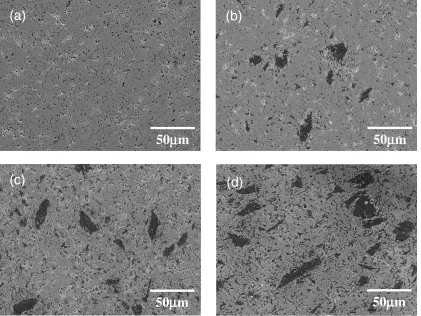
Figure 1 shows the microstructures of B added WSi2
compacts (B-WSi2) fabricated by SPS. The analysis by XRD
(a)
(c)
(b)
(d)
50 m
µ
50 m
µ
50 m
µ
50 m
µ
Fig. 1 Microstructures of sintered B added WSi2. (a) 0.5 mass%B, (b) 1.0 mass%B, (c) 2.0 mass%B, and (d) 3.0 mass%B.
20
Intensity (a.u.)
Diffraction angle, 2θ
WSi2 W2B5 Si
0.5mass% B 1.0mass% B 2.0mass% B 3.0mass% B
64.66
B
35.34
W
mol%
1.25
B
66.29
Si
32.46
W
mol%
99.84
Si
0.16
W
mol%
(a)
(b)
80 60
40
10 m
µ
[image:2.595.89.510.74.390.2] [image:2.595.78.525.432.651.2]and EPMA (Fig. 2) showed that the matrix of the compact
is WSi2, the dark-colored second phase is Si, and the
third phase around Si is W2B5. The amount of the second
phase increases with an increase in the B concentration.
The reaction between B and WSi2 at their interface can be
expressed as
5Bþ2WSi2 !4SiþW2B5:
3.2 Oxidation behavior
Figure 3 shows the temperature dependence of mass
changes of WSi2 and B-WSi2 oxidized for 180 and 360 ks
in the temperature range. In the oxidation of WSi2, W and Si
are simultaneously oxidized to form WO3 and SiO2 in the
temperature range of 873 K to 1473 K.13,14) As the
temper-ature increases, the mass gain increases and then reaches a maximum value at about 1300 K. Above 1300 K, a remark-able decrease in mass change occurs. At 1473 K a
pro--0.8 -0.4 0
900
Mass Change,
Temprature, T / K
36 ks WSi2
1B 2B 3B 0.5B
-0.8 -0.4 0
Mass Change,
Temprature, T / K
36 ks WSi2
1B 2B 3B 0.5B
1500 1400 1300 1200 1100 1000
900 1000 1100 1200 1300 1400 1500
Fig. 3 Mass change of WSi2and B added WSi2as a function of temperature for oxidation in air for (a) 180 ks and (b) 360 ks.
Cu plated
scale
substrate
Cu plated
scale
substrate
resin
substrate
scale
substrate
scale
(a)
(b)
(c)
(d)
50 m
µ
50 m
µ
1 m
µ
1 m
µ
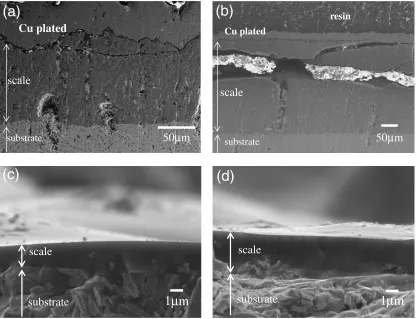
Fig. 4 Cross-sectional micrographs of oxide scales formed on B added WSi2, after oxidation at 1073 K for 180 ks in air. (a) 0.5 mass%B
[image:3.595.76.524.73.258.2] [image:3.595.91.508.307.626.2]nounced mass loss of WSi2 is confirmed for the oxidation
time of 36 ks. This mass loss is attributable to the evaporation
of WO3.13,14)
On the other hand, the addition of B leads to outstanding
suppression of the severe mass loss of WSi2. At 1073 K, 0.5
and 1.0% of B-WSi2show the almost same mass change for
the 180 ks oxidation as WSi2. Their mass changes for the
360 ks oxidation are larger than those of WSi2 for the same
oxidation time. In comparison, the mass changes of 2.0 and
3.0% of B-WSi2are negligible even for the 360 ks oxidation,
showing an excellent oxidation resistance. As the temper-ature is increased, the effect of B concentration on the mass change of the compacts diminishes. In other words, the B concentration necessary to improve the oxidation resistance decreases as the temperature increases.
3.3 Structure and composition of oxide scale
Figure 4 shows the cross-sectional SEM micrographs of
WSi2 containing various B concentrations which were
oxidized at 1073 K for 180 ks. As shown in Figs. 4(a) and (b), many pores are formed in the scales for 0.5 and 1.0% of
B-WSi2. The thickness of their scales consisting of yellow
oxide is 100mmor larger. On the contrary, the scales formed
on 2.0 and 3.0% of B-WSi2 are about 2mm in thickness
and dense.
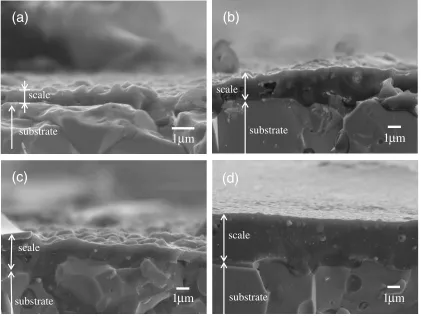
The scales formed at higher temperatures were similarly observed. The cross-sectional SEM micrographs of the
various B-WSi2 oxidized at 1473 K for 180 ks are shown in
Fig. 5. For all the specimens the scales are about 1–2mmin
thickness and dense. Thus, the influence of B concentration on the growth rate of scales decreases as the oxidation temperature increases. This is attributable to the fact that the
viscosity of the SiO2 scale with B (probably borosilicate)
decreases with increasing the B concentration and
temper-ature,19,20) and the SiO2 scale is easily formed due to the
evaporation of WO3in the initial oxidation stage.13)
Since the evaporation of WO3 affects the oxidation
kinetics of WSi2,13,14)there is a possibility that the
temper-ature dependence of mass change by the oxidation (Fig. 3)
substrate
scale
substrate
scale
substrate
scale
substrate
scale
(a)
(b)
(c)
(d)
1 m
µ
1 m
µ
1 m
µ
1 m
µ
Fig. 5 Fractured oxide scales formed on B added WSi2, after oxidation for 180 ks at 1473 K in air. (a) 0.5 mass%B, (b) 1.0 mass%B,
(c) 2.0 mass%B, and (d) 3.0 mass%B.
0 50 100 150 200
900
Thickness of oxide scale,
δ
/
µ
m
Temperature, T / K 0
2 4 6 8
1100
0.5B 1B 2B 3B
1500 1400 1300 1200 1100 1000
1500 1400 1300 1200
Fig. 6 Change of the thickness of scales formed on B added WSi2 with
[image:4.595.88.509.74.391.2] [image:4.595.312.540.443.612.2]will be inconsistent with that of the scale thickness. There-fore, the thicknesses of scales formed at various tempera-tures were measured on the SEM photographs. Figure 6 indicates the temperature dependence of the scale thick-ness formed by the 180 ks oxidation. The temperature dependence in Fig. 6 is in good agreement with that in Fig. 3. Furthermore, it was found that the negligible mass change in the high temperature range is due to the formation
of SiO2 scale, not owing to the evaporation of WO3 but
owing to the effect of the B addition.
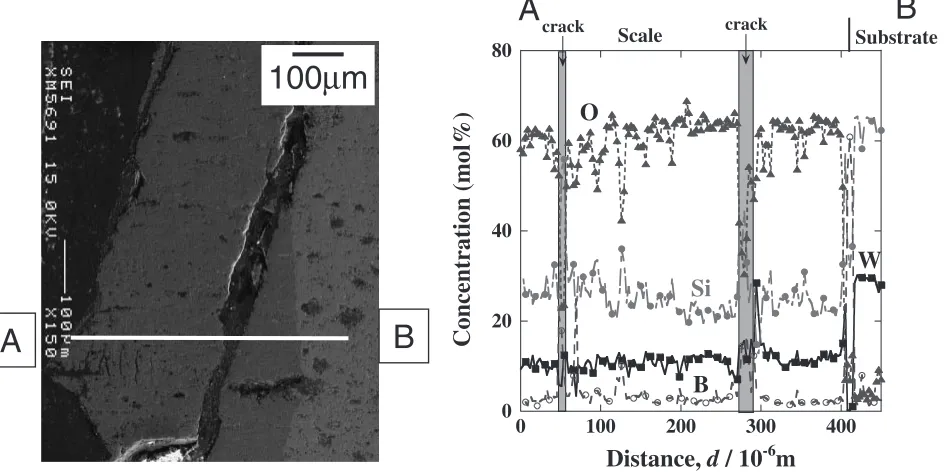
Next, the B concentration in the scale was examined. Figure 7 shows the cross-sectional SEM micrograph and concentration profiles of W, Si, B and O in the scale formed
on 1.0% of B-WSi2oxidized at 1073 K for 360 ks. WO3and
SiO2 are uniformly distributed throughout the scale. In
addition, the atomic ratio of Si to W in the scale is close to 2. Regarding B, the whole scale has the uniform B concen-tration of about 1.1%. These results mean that the effect of
the B addition on the oxidation of WSi2 containing low B
concentration at 1073 K is very little. It is concluded that
W and Si must be simultaneously oxidized to form WO3and
SiO2, and a thick scale is formed similarly with WSi2.
At this temperature, WO3evaporated hardly.
Moreover, the changes of composition of the scales formed
on B-WSi2with high B concentration and oxidation
temper-ature were investigated. Table 2 summarizes the results of
EPMA for the scales formed on 1.0 and 3.0% of B-WSi2
oxidized for 360 ks in the temperature range of 1073–1473 K. Though these concentrations are mean values analyzed by EPMA, the distributions of each element are almost uniform throughout the scale regardless of its thickness. These results demonstrate that the B concentration in the scale tends to decrease as the oxidation temperature increases. In addition,
these results indicate that the content of WO3 in the scale
formed at the intermediate temperatures decreases outstand-ingly with an increase in the B concentration. Consequently
it can be concluded that increasing B concentration leads to the formation of a protective oxide scale having little
content of WO3.
3.4 Formation of SiO2scale containing B2O3
B-WSi2 showed excellent oxidation resistance except
for the compacts having 0.5 and 1.0% B oxidized at 1073 K. It must be emphasized that the scales formed on
B-WSi2 showing excellent oxidation resistance consist of
SiO2 with B and their thicknesses are about 1–2mm. In
order to clarify the growth mechanism of the SiO2 scale
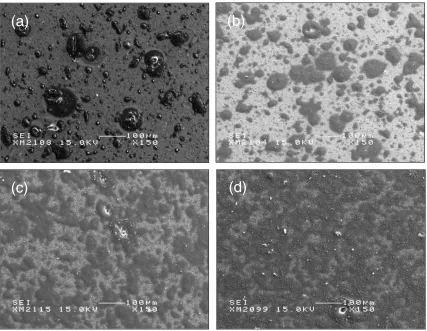
with B, the morphologies of protective scales formed at high temperatures during the short time were examined. Figure 8 shows the surface features of the scales formed
on WSi2 containing the various B concentrations in the
oxidation at 1473 K for 180 ks. The observation revealed that the ratio of surface area covered with the circular black oxide increases with the B concentration for the same oxidation time. The EPMA analysis indicated that this
black-colored oxide consists of SiO2 with B. Figure 9
shows the cross section of the SiO2 scale with B formed on
B-WSi2. The relatively thick SiO2 scale with B is locally
formed on the region where Si and W2B5 phases coexist.
It was observed that this oxide widens with oxidation time
[image:5.595.67.539.79.316.2]because of its low viscosity.19,20) In the case of high B
Table 2 Compositions of scales formed on B added WSi2by oxidation for
360 ks at 1073, 1273 and 1473 K. (mass%)
1 mass%B-WSi2 3 mass%B-WSi2
Si W B O Si W B O
1073 K 20.73 52.43 1.11 25.72 39.59 7.43 1.75 51.23 1273 K 35.35 19.79 0.6 44.26 39.92 3.33 1.38 55.38
1473 K 41.19 9.44 0.83 48.54 40.07 5.73 0.83 53.38
A
B
0 20 40
0
Concentration (mol%)
Distance,
d
/ 10
-6m
Si
W
B
400 300
200 100
[image:5.595.305.549.385.456.2]compacts, dense SiO2 scales with B were readily formed
throughout the surface during the initial stage of oxidation,
because of the homogeneous distribution of W2B5 over
the whole specimen surface.
3.5 Effect of B on improvement of oxidation resistance of WSi2
The effect of B on the high temperature oxidation
resistance of WSi2 has been considered on the basis of the
results, in which high temperature oxidation behavior of
WSi2 was classified according to the temperature range as
follows.
(1) T 51273K: Formation of the scales consisting of
mixed oxides of WO3 and SiO2 results in a large mass
gain.
(2) 1473K5T <1673K: In the initial stage of oxidation,
scales consisting of WO3and SiO2are formed, and then
SiO2 only is left in the scales owing to the evaporation
of WO3. However, these scales are porous.
(3) T =1673K: Protective scales consisting of only SiO2
are formed at 1673 K and above, from the initial stage because of their low viscosity.
At temperatures below 1573 K, WSi2 shows a poor
oxidation resistance because of the formation of either
porous scale or mixed oxides scale consisting of WO3 and
SiO2. Therefore, it is needed to form a protective oxide scale
below this temperature for the suppression of inward oxygen diffusion by densifying the oxide scale by B addition.
The effect of B addition on the improvement of oxidation
resistance of metal silicides such as Mo5Si3,17)NbSi24)and
ReSi1:7521)has been confirmed. Such an effect results from
densifying the scale due to the formation of borosilicate phase having low viscosity. Though the equilibrium disso-ciation oxygen pressure of borosilicate is not identified, that
of WO3is eight orders of magnitude higher than that of SiO2
over the whole temperature range.22)That of borosilicate was
estimated to be the almost same as that of SiO2. Therefore,
when the surface of B-WSi2 was entirely covered with a
(a)
(b)
(c)
(d)
Fig. 8 Surface features of B added WSi2oxidized for 90 ks at 1473 K in air. (a) 0.5 mass%B, (b) 1.0 mass%B, (c) 2.0 mass%B, and
(d) 3.0 mass%B.
1mass%B, 1273 K, 50hr
borosilicate
Si
W
2B
510 m
µ
[image:6.595.85.512.71.402.2] [image:6.595.61.278.454.618.2]was amorphous. However, the EPMA analysis confirmed that the presence of B in the scale (see Table 2). The formation of a borosilicate scale having low viscosity would lead to sealing pores in the scale and consequently improves the
oxidation resistance of WSi2. The high concentration of B is
required for showing this effect at low temperatures. In other words, at higher temperatures the addition of smaller
amounts of B is sufficient to give WSi2 excellent oxidation
resistance. Thus, this result implies that the increasing
temperature could cause SiO2 with B to soften easily.
Moreover, it is well-known that B2O3 evaporates heavily
above 1273 K.23)Consequently this causes a decrease in the
concentration of B in the oxide scale formed at higher temperatures.
4. Conclusions
In the present study, the oxidation behavior of B-WSi2
(WSi2-0.5, 1.0, 2.0, 3.0%B) was investigated in a
temper-ature range of 873 to 1473 K. The following results were obtained.
(1) The oxidation resistances of WSi2 containing B
concentrations above 2.0% are remarkably improved
owing to the formation of the dense SiO2scale with B
in a temperature range of 1073 to 1473 K.
(2) The B concentration of WSi2 to form the dense SiO2
scale with B decreases with an increase in the oxidation temperature. The structural features of the scales
formed on B-WSi2 at 1273 K and above are almost
the same irrespective of B concentration.
(3) The formation of a SiO2scale with B progresses around
the Si and W2B5 phases. The covering rate of the
surface with the oxide scale increases with temperature and B concentration.
4) K. Kurokawa, A. Yamauchi and S. Matsushita: Mater. Sci. Forum502 (2005) 243–248.
5) T. Fukudome, S. Tsuruzono, T. Tatsumi, Y. Ichikawa, T. Hisamitsu and I. Yuri: Key Eng. Mater.287(2005) 10–15.
6) J. D. Buckley: Am. Ceram. Soc. Bull.67(1988) 364–368.
7) C. A. A. Cairo, M. Florian, M. L. A. Graca and J. C. Bressiani: Mater. Sci. Eng. A358(2003) 298–303.
8) N. S. Jacobson and D. M. Curry: Carbon44(2006) 1142–1150. 9) Y. Yamabe-Mitarai, Y. Ro, S. Nakazawa and H. Harada: J. Japan Inst.
Metals64(2000) 1068–1075.
10) Y. Matsumura, M. Fukumoto, S. Hayashi, A. Kasama, I. Iwanaga, R. Tanaka and T. Narita: Oxid. Met.61(2004) 105–124.
11) J. K. Tien, G. E. Vignoul and M. W. Kopp: Mater. Sci. Eng. A143 (1991) 43–49.
12) A. K. Vasudevan and J. J. Petrovic: Mater. Sci. Eng. A155(1992) 1–17.
13) K. Kurokawa and A. Yamauchi: Solid State Phenomena127(2007) 227–232.
14) L. N. Yefimenko, Y. P. Nechiporenko and V. N. Pavlov: Fiz. Mtal. Metalloved.16(1963) 931–933.
15) Y. P. Nechiporenko, L. N. Yefimenko, N. N. Matyushenko and L. F. Verkhorobin: Fiz. Mtal. Metalloved.20(1965) 531–534.
16) K. Kurokawa, H. Matsuoka and H. Takahashi: Mater. Sci. Forum 251–254(1997) 885–892.
17) M. K. Meyer and M. Akinc: J. Am. Ceram. Soc.79(1996) 938–944. 18) T. A. Parthasarathy, M. G. Mendiratta and D. M. Dimiduk: Acta Mater.
50(2002) 1857–1868.
19) M. F. Yan, J. B. Macchesney, S. R. Nagel and W. W. Rhodes: J. Mater. Sci.15(1980) 1371–1378.
20) K. Yoshimi, S. Nakatani, T. Suda, S. Hanada and H. Habazaki: Intermetallics10(2002) 407–414.
21) K. Kurokawa, H. Hara, A. Shibayama and H. Takahashi: High
Temperature Materials, A Symposium in Honor of the 65th Birthday
of Professor Wayne L. Worrell ed. by S. C. Singhal, (ECS 2002) pp. 240–246.
22) K. Kurokawa: Journal of High Temperature Society 32 (2006) 85–91.