Applying Quality Improvement methodologies to reduce neonatal
and perinatal deaths in developing countries
Katlyn L. Donohue
Department of Maternal and Child Health Gillings School of Global Public Health University of North Carolina at Chapel Hill
Date submitted: April 5, 2013
Approved and Date:
TABLE of CONTENTS
ABSTRACT ... 3
INTRODUCTION ... 4
Problem Statement ... 4
Implementation of Clinical Interventions ... 4
Quality Improvement ... 6
FIGURE 1: TYPICAL STEPS FOR A QUALITY IMPROVEMENT PROGRAM ... 7
METHODS ... 8
TABLE 1: DATABASE SEARCH TERMS ... 9
TABLE 2: INITIAL SEARCH CRITERIA ... 12
TABLE 3: SECONDARY SEARCH CRITERIA: ARTICLE FILTER DISCRIPTIONS ... 14
RESULTS ... 15
DISCUSSION ... 21
PRACTICAL APPLICATION OF THIS KNOWLEDGE ... 24
Proposal for Saving Lives at Birth: A Grand Challenge for Development 2013 ... 25
ACKNOWLEDGEMENTS ... 33
ABSTRACT
Objectives: To understand the status of scientifically rigorous quality improvement published research literature for neonatal and perinatal interventions in low and middle-‐income countries (LMIC) and apply this knowledge to a grant proposal. Methods: Multiple searches were conducted in PubMed from September-‐October 2012. Abstracts and titles were reviewed and evaluated based upon 4 criteria to determine if the literature was relevant and rigorous. They were then re-‐reviewed and organized based upon where along the different steps of a quality improvement (QI) initiative the research contributed, ranging from identification of neonatal mortality as a public health issue to full design, implementation, and evaluation of interventions.
Results: While there are examples of individual QI projects, there are no exemplars of systemic QI implementation to reduce neonatal and perinatal mortality in LMICs in the published literature, and very little published on specific projects that use a systematic QI methodology. There is no data on the effectiveness of a
comprehensive systemic QI strategy to improve neonatal health outcomes in developing countries.
INTRODUCTION
Problem Statement
Childbirth associated morbidity and mortality disproportionately affects women and their babies in low and middle-‐income countries, and 99 percent of maternal deaths occur in developing countries.1 Additionally, neonatal deaths, which occur during the first 28 days after birth, account for 41 percent of child deaths and are the highest contributor to all child mortality. 2 However, two-‐thirds of neonatal deaths could be prevented if care is provided at birth and during the first week of life. 3 Ninety percent of neonatal deaths are caused by infections, birth
asphyxia/birth trauma, prematurity and low birth weight.4 Infections and birth asphyxia/birth trauma are clinically treatable by a skilled provider. Currently, only 63 percent of women in developing countries deliver with a skilled attendant present.5 These disparities demonstrate the need for systematic and high quality care, both for mothers at birth and within the first week of life for newborns, in order to reduce neonatal mortality.5
Implementation of Clinical Interventions
detailed descriptions of what should be available to women and their babies within routine care, additional care, and specialized or emergency care from pregnancy through the postpartum period.8 Some examples of newborn care include monitoring of breathing, promoting exclusive breastfeeding, eye care,
immunizations, and infection prevention and control.7 The WHO also developed the Essential Newborn Care Course in 2010, which is available in print and online and provides accurate and up-‐to-‐date materials about skills and information health workers should have to effectively care for newborns. 9 These are just a few of the many resources and standards that are widely promoted and available to health clinics around the world.
The WHO recognizes that it will be impossible to achieve the Millennium Development Goals, e.g. MDG 4: reduce child mortality (including neonatal mortality) without improved and strengthened health systems. 10 11
In September 2012, Dr. Herbert Peterson published Preventing Maternal and Newborn Deaths Globally: Using Innovation and Science to Address Challenges in
Implementing Life-‐Saving Interventions.12 This article acknowledges the gap between
available clinical knowledge and the implementation of life-‐saving interventions. Peterson states, “We know why maternal and newborn deaths occur, where they occur, and how they occur, and we have highly effective interventions for
effective interventions, but also strategies and plans for implementing these interventions.”12 Simply writing, distributing, or posting on the internet sharing
knowledge like the WHO’s IMPAC manual is not reducing the amount of neonatal deaths in developing countries. There is a need to address weak health systems and context-‐specific service delivery in addition to publication of evidence-‐based
practices. 12 Instead of focusing on “what” to teach health workers, it is increasingly
important to understand how to implement life saving measures. One means of achieving this is through the use of quality improvement (QI) methodologies.
Quality Improvement
Increasingly, QI is recognized as a means to provide better health care for patients in the most limited of resource settings.13 For the purpose of this paper, quality improvement is defined as the structured, team-‐based processes and
methods for implementing, managing and continually enhancing the performance of maternal and neonatal health care delivery and programs in a facility or community. There are a variety of models for framing quality improvement; the most well-‐
Six Sigma has been used in business and health care and focuses on reducing variation in processes to provide consistent high quality products.17
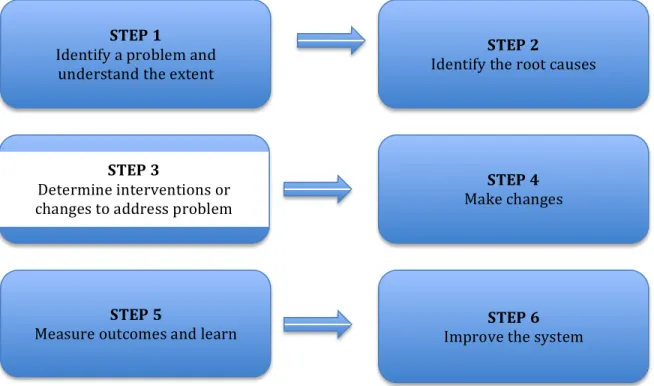
There are six steps along a continuum to implement a QI program. These steps include: 1) identify or define an explicit problem and the extent of the problem; 2) identify its root causes 3) determine productive interventions or changes to address the problem; 4) implement those changes; 5) measure the outcomes and
continuously learn from the outcomes; and, 6) improve the system. Quality
improvement can enhance implementation through the standardization of clinical processes within the health facilities while simultaneously developing locally identified solutions.
FIGURE 1: TYPICAL STEPS FOR A QUALITY IMPROVEMENT PROGRAM
STEP 1
Identify a problem and understand the extent
STEP 2
Identify the root causes
STEP 3
Determine interventions or changes to address problem
STEP 4 Make changes
STEP 5
The goal of this paper is to present the results of a systematic review of published literature related to quality improvement methodologies applied in low and middle-‐income countries at both the health facility and community level to reduce perinatal and neonatal mortality. This will be accomplished within the context of the aforementioned QI steps. This is important to the maternal and child health field as it assess the extent to which well-‐established QI methods are being used in developing country contexts, the extent to which successful use of these methods is being reported through peer reviewed literature, and the effect use of these QI methods are having on reported neonatal outcomes. No evidence could be found by this author of a study of this kind, which focuses specifically on QI to reduce neonatal mortality. Quality improvement methodologies could not only lead to improvements in patient care and systems level operations, but could also allow for capacity building and, ultimately, sustainability.
METHODS
incorporating various PubMed Medical Subject Headings (MeSH) terms. Quality improvement and quality assurance are linked as MeSH terms and therefore were both included, allowing for optimal search returns. Table 1 includes the database of all of the search terms used.
TABLE 1: DATABASE SEARCH TERMS Search
Number Search Terms Number of articles
found Search 1 (Quality improvement OR quality assurance or
implementation improvement) AND (neonatal death OR perinatal death) AND (developing countries OR middle income countries OR low income countries)
35
Search 2 (Quality improvement OR quality assurance) AND (neonatal death OR perinatal death) AND (developing countries OR middle income countries OR low income countries)
34
Search 3 (Quality improvement OR quality assurance) AND (neonatal outcomes OR perinatal outcomes) AND
(developing countries OR middle income countries OR low income countries) AND Study
22
Search 4 (neonatal mortality OR perinatal mortality OR infant mortality) AND (quality improvement OR implementation science) AND (low resource OR low income OR middle income OR developing OR less developed country) AND (community level) AND ( facility level) AND (systems strengthening) AND (Africa OR Latin America OR Asia OR Middle East)
0
Search 5 (neonatal mortality OR perinatal mortality OR infant mortality) AND (quality improvement) AND (low resource OR low income OR middle income OR developing OR less developed country)
122
Search 6 (Quality improvement OR quality assurance or implementation improvement OR implementation science) AND (neonatal death OR perinatal death) AND (developing countries OR middle income countries OR low income countries)
249 articles were identified from the search criteria and after review of the articles, a total of 160 unique articles (some articles populated searches multiple times) were identified for analysis. One article from Indian Pediatrics was not available from the University of North Carolina’s online research database or on Indian Pediatrics’ website and was, therefore, not included in the analysis. The articles were organized in an Excel database with different sheets for each search criteria and were given identification numbers based upon their search criteria number and when they appeared.
To initially analyze the data, the author looked to the 2001 Institute of Medicine (IOM) issued report Crossing the Quality Chasm.12 Within this report, the IOM outlined six specific quality aims for improvement in health care. The aims suggest that health care should be:
• “Safe: avoiding injuries to patients from the care that is intended to help them
• Effective: providing services based on scientific knowledge to all who could benefit, and refraining from providing services to those likely not to benefit • Patient-‐centered: providing care that is respectful of and responsible to
individual patient preferences, needs, values, and ensuring the patient values guide all clinical decisions
• Efficient: avoiding waste, including waste of equipment, supplies, ideas, and energy
• Equitable: providing care that does not vary in quality because of personal characteristics such as gender, ethnicity, geographic location, and
socioeconomic status.” 18
This report was a follow-‐on to the 1999 publication To Err is Human: Building a Safer Health System, which recognizes the human, institutional and societal costs associated with medical errors.19 Both reports recommend and encourage focusing on safety and quality at the systematic and service delivery level. With the six aims of health care quality in mind, the following analytical questions were identified to see if there were existing peer-‐reviewed studies that address those IOM dimensions of quality specifically in the neonatal and perinatal context within developing countries. In summary, the author wanted to see if (1) was the term Quality
Improvement or QI (or variations) being used within the published literature; (2) if it was being used, was it applied appropriately, in reference to Lean, Six Sigma or PSDA cycles, which were the standard for this paper and (3) if so, were the studies conducted with adequate levels of scientific rigor, ideally utilizing recognized scientific study designs for public health research.
TABLE 2: INITIAL SEARCH CRITERIA
Analytical Questions Yes or No
Does the study mention Quality Improvement (QI) in the
abstract?
Does it describe an intervention related to improving safety, effectiveness, patient-‐centeredness, timeliness, efficiency, and equity of care ? Which?
Does it evaluate the results of the intervention using a scientific,
data driven approach
Does it pertain to a Low or Middle Income Country (LMIC)? Does it meet all criteria? (Yes, or No) If the answer was yes, then it was included as QI research; if no, then it was discarded.
Four articles20 21 22 23 met all of the initial search criteria, but the majority of the articles did not address the previously mentioned quality improvement continuum: 1) identify or define an explicit problem and the extent of the problem, 2) identify its root causes, 3) determine productive interventions or changes to address the
problem, 4) implement those changes, 5) measure the outcomes and continuously learn from the outcomes, and 6) improve the system. Common reasons for exclusion from meeting the search criteria of a rigorous QI study with interventions to reduce neonatal or perinatal mortality include the following.
• The article was not a research study (for example, a call to action paper). • The article was not a Quality Improvement study. The study may have had
strong evaluation, but did not use quality improvement methodologies like Lean, Six Sigma, or PDSA in the design.
• They were unrelated to low and middle-‐income countries.
• The content of the article was related to child health but not specifically neonatal or perinatal health.
One of the best examples according to both the IOM quality aims and the QI continuum was written by Srofenyoh, et al. because of the clear description of QI methodology used, the PDSA cycle.21 A QI system was put in place within one hospital in Ghana and the study reported reductions in maternal and infant
mortality. However this was limited to one hospital, there was no control group, and it is difficult to attribute the mortality reductions to the QI processes with only one sample.
In conclusion, the first set of criteria was too broad as quality improvement was interpreted in a variety of ways in the literature and did not clearly address the IOM quality aims. This finding lead to a re-‐evaluation of the criteria of a high quality QI program or study to reduce neonatal mortality in developing countries used for this study. The focus of research for this paper then became the process of quality improvement along the quality continuum, with the goal of understanding how many studies fell along various points in the process of quality improvement.
The abstracts of the 160 articles were then read again, re-‐analyzed, evaluated and organized by the following filters in table 3, which narrow down the articles by grouping them by where they fall in the QI continuum.
TABLE 3: SECONDARY SEARCH CRITERIA: ARTICLE FILTER DISCRIPTIONS Filter
Number Description Number of articles
1 All papers that are not related to reducing neonatal mortality
in low or middle-‐income countries. 105 2 Descriptive Neonatal Health Paper: All papers that are not
about facility or community based maternal or neonatal health programs or interventions (position papers,
viewpoints, come under this category, papers that provide estimates of maternal or neonatal outcomes at a country, or multi-‐country level, general description of interventions without the context of a region or program)
19
3a Estimate of the extent of poor maternal or neonatal health in a geographic area around which a program can be designed
6 3b Identification of causes of poor outcomes (through audits) in
a specific program or geographic area
14 3c Description of evidence based interventions to improve the
quality of care as determined by the Institute of Medicine (IOM) characteristics in the context of a particular region or program
12
3d Description of implementation of evidence-‐based
interventions and evaluation of process or outcomes (within this section, give higher priority to more scientifically
rigorous evaluations with a control and robust evaluation of processes and outcomes)
3
4 GOLD STANDARD: Description of a quality improvement program within which evidence-‐based interventions are embedded, evaluated through the process and outcomes and with a view towards building sustainable Continuous Quality Improvement capability in the organization
0
RESULTS
The majority (105) of the papers in the second search were a Category 1 and not specifically related to quality improvement for neonatal mortality or to low or middle-‐income countries. Some of the resulting themes include:
• Call to action, referencing or discussing the importance of incorporating quality improvement in health systems overall, mentioning focusing on quality as a next step, promoting evidence-‐based research, or using quality indicators to improve child health 24 25 26 27 28 29
• Review of demographic information, descriptive statistics, or clinic data audits to understand or give insight into changes in child, neonatal, or perinatal mortality rates 30 31 32 33 34
• Published conclusions of conferences on child health35 36 37
• Pregnancy nutrition or infant feeding studies in developing countries38 39 40 41 42
• Healthcare behavior in relation to delivery decisions, birth experience, and newborn care.43 44
• Studies or commentary addressing sanitation issues related to child mortality 45 46
• Articles related to maternal but not neonatal health 49 50
• Literature reviews on Prevention of Mother to Child Transmission of HIV (PMTCT) programs, in-‐service trainings for providers of perinatal care, caesarean rates, causes of child mortality, infant sepsis, and/or traditional birth attendants 51 52 53 54 55 56 57
• Position pieces on Integrated Management of Child Illnesses (IMCI) 58 • Articles not related to developing countries59 60 61 62 63
There were also some articles that were highly unrelated to the topic,
demonstrating how widely quality is interpreted, including: “Time trends in cervical cancer epidemiology in the Slovak Republic: reflection on the non-‐implementation of screening with international comparisons64,” “Quality indicators for testicular cancer: a population-‐based study,” and “Burden of disease in Thailand: changes in health gap between 1999 and 2004.”65 66
Categories 2-‐4 were developed in reference to the quality improvement continuum: 1) identify or define an explicit problem and the extent of the problem, 2) identify its root causes, 3) determine productive interventions or changes to address the problem, 4) implement those changes, 5) measure the outcomes and continuously learn from the outcomes, and 6) improve the system.
Category 2 papers (19 articles) fall within Step 1 of the QI continuum and
identify or define neonatal mortality as a pressing global health issue. These papers do not address specific programmatic interventions, but rather review data
• Call to action papers related to neonatal health, focused on increasing high quality care for mothers and newborns, improving child survival in
developing countries, and pushing the research agenda forward to reduce newborn infections and death. 67 68 69 Other call to action papers addressed the need to reduce stillbirths globally, and promote safe motherhood and newborn health.70 71 72
• Systematic reviews, for example, Delivering interventions to reduce the global burden of stillbirths: improving service supply and community demand73 This article uses the term quality improvement and references audits as a QI tool to reduce stillbirths, however due to the systematic nature it examined various interventions, and did not contain a study or implementation of interventions. Category 2 also contained systematic reviews on antenatal care and clinical signs to identify illness in infants, and 74 75
• Finally, perinatal-‐specific descriptive population statistics papers. 76 77 78
Category 3A (6 articles) are in line with step 2 on the quality continuum, identify the root causes of a problem, and estimate the extent of poor maternal or neonatal health within a specific geographic area around which a program can be designed. The geographic component is important for understanding context-‐specific
contributions to neonatal mortality and potential interventions to work in those settings. Some examples of these types of papers and their subject matter include:
• Describing study design for studies on child mortality in Nairobi, Kenya and 81 82
• Pregnancy outcomes in rural Nigeria. 83
Category 3B (13 papers) is characterized by articles that identify causes of poor neonatal or perinatal outcomes through the use of death audits within a specific program or geographic area and fall along step 2 and 3, identify root causes of a problem and determine productive interventions. Death audits can help to identify the root causes of neonatal mortality and be used as a tool to understand where improvements could be made in the service delivery process. 84 Through the
identification of these causes, such as asphyxia, congenital abnormalities or fetal growth restriction, interventions and improvement plans can be designed and implemented in the cases that medicine can improve outcomes. 84 Congenital
abnormalities may not be preventable. This category does not include papers that describe interventions and their outcomes. Studies around the use of neonatal death audits and hospital records of neonatal death occurred in South Africa, Afghanistan, United Arab Emirates, Maputo, Mozambique, Zimbabwe, and Sudan. 85 86 87 88 89 90
There was also a systematic review of facility-‐based perinatal mortality audit in low and middle-‐income countries. 91 If audits are used as a means to understand why
perinatal deaths are occurring then health facilities can create change within the hospital environment and can lead to reductions in maternal and neonatal mortality.92
Medicine (IOM) characteristics (safe, effective, patient-‐centered, timely, efficient, and/or equitable) or medical best practices, and are implemented in the context of a particular region or program. This is the next step along the quality continuum: step 3, determine productive interventions or changes to address the problem, and 4, implement those changes Some major themes of these papers include
• Improving service delivery at the health facility: One program accomplished this in India through the design and implementation of a full package of reproductive health care services.93 Within Kosovo a paper was published about improving the primary healthcare system antenatal care, which used chart reviews and direct observation.94
• Research, which focused on testing interventions and understanding if they are effective. These articles ranged from addressing the development of research capacity for maternal and perinatal health practices in South East Asia, 95 studying the abilities of skilled birth attendants and understanding the effectiveness of the intervention and, using partograms, which track labor against time, as a means to delivery better delivery care. 96 97
• Finally, papers on Leadership for QI also contributed to Category 3C such as the Global Sepsis initiative to reduce sepsis in infants99 as well as a
systematic review of QI tools for maternal and infant care.100 Three articles fell into the category of 3D, which describes the
implementation of evidence-‐based interventions and attempts to assess the outcomes or impact of quality improvement methods combined with clinical interventions. The important differentiation between 3C and 3D is that 3D specifically uses a recognized QI method and evaluates the intervention
The highest standard for implementation evaluation and outcomes focused research is a Randomized Control Trials (RCT). There was one RCT that met this research criteria and was a study utilizing quality improvement methodologies as well as community mobilization and facility-‐based training as part of the Global Network EmONC trial in Argentina, Guatemala, India, Kenya, Pakistan and
Zambia.101 The primary outcome is the reduction of neonatal mortality. Results are currently unavailable at this time, but the reported design is strong from a design and evaluation standpoint.
accomplishing 10-‐29 of the steps to 28 of the 29 steps that occurred in 795 deliveries.
None of the articles from this review met the Gold Standard, Category 4, which utilizes the entire QI continuum and describes a complete quality
improvement program, which includes each of the elements of problem
identification, interventions, strong evaluation, and sustainable continuous quality improvement within a system or an organization within an LMIC. Notably, none of the studies mentioned the use of Lean or Six Sigma methodologies applied to neonatal health care in developing countries.
DISCUSSION
This research has demonstrated that there are a variety of ways quality in health care is interpreted, how to improve that quality, and specifically, how to reduce neonatal mortality rates through the use of QI. The findings suggest that there are no published articles identified from the searches that reach the gold standard of category 4 and which presents thoughtful, researched programs with evidence-‐based interventions, continuous quality improvement, and a robust evaluation strategy to determine if the interventions are improving processes in addition to saving neonatal lives. While this literature was not found in this review, it is possible that it QI and evaluations are documented outside of the scope of this research.
strategies to reduce neonatal and perinatal mortality. Simply distributing best practices or discussing the means of mortality are not enough.12 For example, through this research, perinatal death audits have been identified as a useful tool to track causes of death and discuss as a team what to do differently in the case of future complications, but if the discussion ends without concrete planning and testing of new ideas to prevent death in the future, then audits cannot be considered an end point for quality improvement. Quality needs to be part of the organizational culture. 16 Part of developing this culture is giving front line health workers the ability to identify areas of improvement and try new locally appropriate ideas to address the needs as part of the PDSA process.
Moving forward, the following steps should be considered: programs and researchers should try to understand the mother’s experience at the community and the facility while pregnant, delivering, and new mothers. There should be an
increased focus on the previously referenced Institute of Medicine’s call to improve safety and patient satisfaction at the health facility. Improved processes and health facility experiences could encourage more mothers to deliver at the facilities if possible, where they could be referred to a hospital in the event of a complication, thereby reducing neonatal mortality. Improved health facility conditions and satisfaction in the ability to provide quality care will also keep health workers from early burn out and disenchantment. Integration of QI into health worker’s
management of tasks will empower them to examine their systems, make
In order to address the dearth of peer-‐reviewed QI published literature on this topic, a few steps need to be taken. More QI projects focused on neonatal health and using recognized methodologies such as the Plan-‐Do-‐Study-‐Act (PDSA) cycle or Six-‐Sigma need to be designed and implemented with a rigorous evaluation. In-‐ country staff of every level should receive continuous quality improvement training in order to undergo their own projects and identify opportunities for change. The changes and processes should be tracked in order to understand what is working within the clinics. These lessons learned should be scaled-‐up across the country and the information disseminated to other clinics. Finally, criteria should be discussed outside of quality-‐based journals and within neonatal health specific journals as to what is considered rigorous quality research. As previously mentioned, often QI research features pre-‐and post-‐test intervention study designs as opposed to a randomized control trial design. While there is a place for pre-‐ and post-‐test designs in evaluation and when developing a new line of study, support for the more
rigorous research designs (and subsequent publication of findings) in communities where this research is feasible, could provide important information to the field.
The literature reviewed in this study is limited to what was identified in PubMed and the combination of the search terms. This study is specifically focused on QI for neonatal health, which is a narrow topic. Other global health topics such as emergency obstetric care, HIV, and tuberculosis treatment may have a greater breadth and depth of studies. Due to the fact that the review was limited to published, peer-‐reviewed quality improvement articles, it therefore excluded
For instance, the Institute for Healthcare Improvement’s Fives Alive program in Ghana has been working to improve child health through the use of continuous quality improvement since 2008, but103 has not published results and was therefore not included in this review. As many NGOs working to improve healthcare have their own variations of quality improvement, there are a variety of resources
available online but there is no central repository. It is important to encourage NGOs and government implementing partners to publish their results in scientific journals to add to QI literature and broader understanding gained from their lessons learned, as well as to continue to define a standard for evaluating QI and implementation science programs.
PRACTICAL APPLICATION OF THIS KNOWLEDGE
The analysis of the published literature demonstrates that there is a dearth of knowledge surrounding practical design and implementation of quality
mechanism. The following proposal was submitted to the Gates Foundation on March 28, 2013 requesting $250,000 in funding over two years to work with Jacaranda Health in Nairobi, Kenya.
Proposal for Saving Lives at Birth: A Grand Challenge for Development 2013
Part A:
Section 1: Basic Information
• Name and address of applicant: contact at Jacaranda, Kenya • Type of organization: Jacaranda Health: Non-‐profit
• Point of contact (lead contact name; relevant telephone, fax, and email information):
• Name and email of the Project Manager. Jacaranda Health: _________________, Nairobi, Kenya
• Concise title and objective of proposed activity: Mother Centered Quality Management System: Improving quality of implementation to ensure effective and efficient low risk deliveries on a global scale.
• Application category (seed grant or transition to scale grant) Seed grant • Domain of application: Technology: virtual learning network, service
delivery: Process design and management
• Focus of application: maternal health and neonatal health
• (If applicable) Cause(s) of mortality for maternal health –other indirect causes
• (If applicable) Cause(s) of mortality for neonatal health–other causes • Technical focus of application – one or more of the following: supervision,
data collection and entry, affordability, client satisfaction, • Tracer indicators of maternal and neonatal health– N/A
• Country(s) where the proposed activities will be implemented; countries where proposed activities’ direct beneficiaries reside: Kenya
• Pending applications for funding from any of the Saving Lives at Birth partners No
• A short, concise statement describing what the Savings Lives at Birth funding will achieve within the context of the overall activity. This statement should be specific to achievements with the Saving Lives at birth funding and time period of award only and not reflective of longer-‐term goals if the project includes multiple donors and/or several stages:
safe antenatal care, labor and delivery and post natal care at the Jacaranda Health maternity clinics in Kenya and (ii) to test global applicability through a virtual learning network that will make the system available for testing and feedback by other maternity clinics around the world through social media.
Section II: Summary Paragraph (abstract) (250 words)
Applicants are asked to provide a brief summary of their project innovation in response to the following two questions:
1. What is the essence of your idea and how will it significantly improve the outcomes of the problem you have identified?
Consider including the following information in your response: • Rationale: What problem will the project address?
• Approach: What approach(es) does this project take to address the problem (science and technology, service delivery, and/or demand creation)?
• Objective and Impact: What is the primary objective and expected impact of the project if successful?
2. What makes this project innovative and a significant improvement upon standard practice?
There has been an emphasis on innovative techniques for emergency obstetrics to save the lives of mothers and neonates. However, the need for emergency procedures arises partly because of inconsistent and ineffective implementation of basic labor and delivery practices and lack of access to clinics that provide high quality, low cost services. The WHO’s IMPAC guidelines stress routine maternal health care as a means to reduce infant mortality. Jacaranda Health targets mothers in poor communities and provides midwife services in Kenya. Our project is to build a replicable routine obstetric quality management system for Jacaranda through engagement of health workers and mothers.
modify the processes. Through global crowd sourcing, we will develop optimal processes for diverse contexts.
The impact will be a set of field-‐tested global best practices that will provide the capability for consistent, high quality performance of non-‐emergency obstetric care in resource-‐constrained settings around the world.
There is no “standard practice” that defines replicable and sustainable processes to provide low cost, high quality care to mothers in low-‐income areas. This project will create the standard processes and the system for monitoring and continuous improvement, and will use crowd sourcing to refine, test and modify these processes for many diverse conditions. It addresses the problem of global capacity building to improve obstetric services for routine births which has not been systematically addressed to date.
Part B:
Section 1: What is your idea:
Jacaranda Health has a dual mission of providing affordable, high quality maternity services to low-‐income women whilst being a laboratory for integrating innovations for maternal health. It is a chain of maternity clinics in Kenya that provide deliveries, antenatal and postnatal care, and family planning.
following: (1) understanding quality from the mother’s viewpoint; (2) designing, simplifying and standardizing work so that it delivers quality consistently and reliably; (3) identification of critical metrics that are leading indicators of defects and other poor health outcomes and poor quality; (4) engaging leaders and staff to take ownership for monitoring these metrics and continually improving
performance.
The second component of this project will make the system available to obstetric (OB) clinics around the world on a virtual learning network. Any clinic in the world with English speaking staff will able to test any metrics and monitoring plans of the Jacaranda Health clinics. The goal is to start with clinics in East Africa. The learning network, supported by University of North Carolina’s Center for Global Learning, will provide the capability to post modifications and recommendations and to participate in online discussion forums and blogs. This learning network will be synced to Facebook and Twitter, two social media tools that are regularly
posted on this quality improvement management system.
Section II. How will you execute and test your plan?
Use this section to briefly describe your idea and the project design. Make sure that your idea directly fits the topic; otherwise your proposal may be disqualified.
• Indicate in one or two sentences in bold the essence of your idea – the specific problem you are addressing, your proposed solution, how it will be delivered, and who are the primary beneficiaries.
The problem that is being addressed is the lack of documented and managed processes to efficiently and effectively provide women and their babies the routine care interventions proposed by WHO’s Integrated Management of Pregnancy and Childbirth (IMPAC) program reliably and at a low cost, with high patient satisfaction and to refer them to additional and specialized care when needed. Our solution is to develop a quality management system with a value stream map, process
documentation, metrics, risk management, and monitoring plan for implementation at Jacaranda maternity clinics in Kenya and then disseminated worldwide for testing and replication so that the lessons learned will benefit mothers undergoing routine deliveries around the world.
• Explain why your idea is an unconventional or creative approach to the stated problem and how it improves upon the best existing alternatives.
Successful and sustainable outcomes depend upon creating a system
infrastructure for effective and efficient delivery of services. While best practices for successful maternal and neonatal care are well known, their successful
implementation, and organizations often adopt an ad-‐hoc approach to service delivery, fixing problems as they occur. This approach is neither scalable nor sustainable. For consistent performance delivery systems, there needs to be a template for systematic implementation and on-‐going quality management through the use of PDSAs (Plan-‐Do-‐Study-‐Act cycles) that can be tested and adopted to local conditions, resulting in a global knowledge base about the implementation of best practices. The goal of this project is to create this template for Jacaranda Health and to facilitate its global use.
• Describe the scientific and/or technical basis for your idea and why you expect it to succeed. For transition to scale applicants, identify and fully explain the proof of concept supporting the proposal.
The technical basis for this idea is grounded in the principles of Business Process Management (BPM), Process Improvement and Quality Management Systems, which have been used by organizations for over 75 years. BPM has been shown to increase organizational effectiveness in stable environment and is therefore a good approach for replication. Industries (such as General Electric, Toyota, Coca-‐Cola) and
practice in a variety of industries all over the world, and we are adapting for maternal clinics in low resource settings.
UNC Chapel Hill’s Center for Global Learning (www.sph.unc.edu/glp) is experienced in developing global learning networks for knowledge sharing and will bring this experience to the creation of a global learning network for maternal health.
• Describe the context and/or cultural relevance of your idea – explain how your idea is culturally informed and is designed to address the user’s needs.
Jacaranda is already providing service in Nairobi and its clinic is designed to address the needs of the local communities. Our pilot design simply systematizes the processes for care delivery and support in that context by engaging health workers and mothers, with collaboration between UNC and the local Jacaranda staff. The pilot will be embedded in the cultural context of the patients of Jacaranda
health. The idea of crowd sourcing is to give other clinics the opportunity to modify the pilot system to their own contexts – therefore the design is flexible to easily accommodate a variety of diverse user needs while maintaining system integrity.
• Describe the potential scale at which the idea can be implemented and how many people you expect will be impacted.
healthcare delivery. The Global Learning Management System has infinite scale-‐up possibilities as it will be available online to anyone with an Internet connection.
• Identify the level of funding requested and the specific project goals to be achieved with this level of funding within the two-‐year time frame for seed funds and up to four-‐year time frame for transition grants.
$250,000 is requested for a two-‐year seed grant. The goals of the project to be achieved during this time are:
Deliverable Timeline
Process Management System Design 6months
Process Management System Implementation and Testing 6 months
Operation of Virtual Learning Network 6 months
Best Practice Implementation Toolkit website 6 months
Section III. How does your solution demonstrate its potential to sustain health and development impacts?
Jacaranda Health is positioned to grow to 25 clinics by 2015, which will each be financially self-‐sustained via fee-‐for-‐service medical care. A process management system early in the development of Jacaranda Health with input from clinics around the world will create an efficient model for Jacaranda Health clinic scale-‐up as well as application for other health centers in low resource communities around the world. Hopefully more private clinics in the future will come to fruition and use a similar self-‐sustaining model as well as the tools and processes available on the Learning Management System online. This will contribute to a reduction of obstetric deaths among poor women in low-‐income countries.
ACKNOWLEDGEMENTS
Many thanks to Rohit Ramaswamy, PhD, Gillings School of Global Public Health and Tom Ivester, MD, UNC School of Medicine for giving me the opportunity to work on this project. I have learned so much and really appreciate your many hours of brainstorming and guidance. Your sense of humor and passion for saving maternal and newborn lives always invigorates me and keeps me pushing forward. Sherri Green, PhD, thank you for keeping me on schedule and serving as my first reader. You have been so flexible and supportive over my two years in the MPH program. To the department of Maternal and Child Health, know I will miss this place after graduation and also wish I could be taking more classes. I hope to remain a lifelong learner.
REFERENCES
1 World Health Organization. Maternal Mortality (internet). Geneva: WHO; 2012 May. (2012 May: 2013 Apr) Available from:
http://www.who.int/mediacentre/factsheets/fs348/en/index.html
2 World Health Organization. Newborn deaths decrease but account for higher share of global child deaths (Internet). Geneva: WHO; August 2011. (2011 Aug: 2013 Jan) Available from:
http://www.who.int/mediacentre/news/releases/2011/newborn_deaths_20110830/en/i ndex.html
3 World Health Organization. Newborns: reducing mortality (Internet). Geneva: WHO; 2012 May. (2012 May: 2013 Mar) Available from:
http://www.who.int/mediacentre/factsheets/fs333/en/index.html
4 MCHIP. Interventions for impact in essential obstetric and newborn care (Internet). Unknown: MCHIP; 2011 Feb. (2011 Feb: 2013 Mar) Available from:
http://www.mchip.net/sites/default/files/mchipfiles/FINAL%20AddisMeetingReport_062 7.pdf
5 Women Deliver. Maternal health (Internet). Unknown: Women Deliver; 2013 Apr. (2013 Apr: 2013 Apr) Available from: http://www.womendeliver.org/knowledge-‐center/facts-‐ figures/maternal-‐health/
7 World Health Organization. Integrated management of pregnancy and childbirth
(internet). Geneva: WHO; (2013: 2013 Mar) Available from:
http://www.who.int/maternal_child_adolescent/topics/maternal/impac/en/index.html 8 World Health Organization. Integrated Management of Pregnancy and Childbirth: WHO recommended interventions for improving maternal and newborn health (report). Geneva: WHO; 2009. (2009: 2009 Mar)
9 World Health Organization. Essential newborn care course (internet). Geneva: WHO; 2010. (2010: 2013 Mar) Available from:
http://www.who.int/maternal_child_adolescent/documents/newborncare_course/en/inde x.html
10 World Health Organization. Everybody’s business: Strengthening Health Systems to Improve Health Outcomes: WHO’s framework for action (Internet). Geneva: WHO; 2007. (2007: 2013 Mar) Available from:
http://www.who.int.libproxy.lib.unc.edu/healthsystems/strategy/everybodys_business.pdf 11 United Nations. Millennium Development Goals: Goal 4: Reduce Child Mortality (Internet). Unknown: United Nations; Unknown. (Unknown: 2013 Feb) Available from:
http://www.un.org/millenniumgoals/childhealth.shtml
12 Peterson HB, Haidar J, Merialdi M, Say, L, Gülmezoglu AM, Fajans PJ, Mbizvo MT, Ghaffar A, Tran NT, de Bernis L, Laski L, Freedman, Lynn P, Chopra M. Preventing maternal and newborn deaths globally: using innovation and science to address challenges in
implementing life-‐saving interventions. Obstet Gynecol. 2012: 120 (3): 636-‐642.
13 Smits HL, Leatherman S, Berwick D. Quality Improvement in the Developing World. Int J Qual Health Care. 2002: 14 (6): 439-‐440. Available from:
http://intqhc.oxfordjournals.org.libproxy.lib.unc.edu/content/14/6/439.full?ijkey=c88883 386528c9fd2b0f12a74a19a9c1f5da8d5c&keytype2=tf_ipsecsha
14HRSA. What is Quality Improvement? (Internet). Washington DC: HRSA; Unknown. (Unknown: 2013 Mar) Available from:
http://www.hrsa.gov/healthit/toolbox/HealthITAdoptiontoolbox/QualityImprovement/w hatisqi.html
15 Miller D. Going Lean in Health Care (white paper). Institute for Healthcare Improvement. 2005.
16 Institute for Healthcare Improvement. Science of improvement: how to improve (Internet). Cambridge: IHI; 2013. (2013: 2013 Mar) Available from:
http://www.ihi.org/knowledge/Pages/HowtoImprove/ScienceofImprovementHowtoImpr ove.aspx
17Schriefer J, Leonard MS. Patient Safety and Quality Improvement: An Overview of QI. Peds in Review. 2012: 33 (8): 353-‐360. Available from:
http://pedsinreview.aappublications.org.libproxy.lib.unc.edu/content/33/8/353.full 18Institute of Medicine. Crossing the Quality Chasm. IOM report. 2001. (2001: 2013 Mar) Available from: http://www.iom.edu/~/media/Files/Report%20Files/2001/Crossing-‐the-‐ Quality-‐Chasm/Quality%20Chasm%202001%20%20report%20brief.pdf
19 Institute of Medicine. To Err is Human. IOM report. 1999. (1999: 2013 Mar) Available from: http://www.iom.edu/~/media/Files/Report%20Files/1999/To-‐Err-‐is-‐
Human/To%20Err%20is%20Human%201999%20%20report%20brief.pdf