Samuel S. Robinson. Hiding in Plain Sight: An Exploration of the Classification of LGBT Materials in Libraries and Bookstores. A Master’s Paper for the M.S. in L.S. degree. April, 2018. 38 pages. Advisor: Melanie Feinberg
The goal of this study has been to analyze the classification of prominent, award winning books on LGBT topics, to see how these topics are being treated in libraries and
bookstores today. These materials have, in the past, been placed in a variety of locations throughout the library, sometimes with unsavory connotations. This study, however, does more to show the limited reach of even the most acclaimed fiction and nonfiction LGBT titles in today’s libraries and bookstores, with eleven books from the sample appearing in three or fewer institutions. Those books that were frequently held across all institutions visited were frequently organized alphabetically by author or topic, and very few of them were discoverable or browsable based upon their LGBT content.
Headings:
Classification of books
Dewey decimal classification
Library of Congress classification
LGBT library materials
LGBT literature
HIDINGINPLAINSIGHT:ANEXPLORATIONOFTHECLASSIFICATIONOF LGBTMATERIALSINLIBRARIES ANDBOOKSTORES
by
Samuel S. Robinson
A Master’s paper submitted to the faculty of the School of Information and Library Science of the University of North Carolina at Chapel Hill
in partial fulfillment of the requirements for the degree of Master of Science in
Library Science.
Chapel Hill, North Carolina
April 2018
Approved by
_______________________________________
Table of Contents
Introduction ... 2
Literature Review ... 5
Methods ... 10
Booklist Selection ... 11
Site Selection ... 13
Results ... 16
Discussion ... 19
Conclusion ... 32
Introduction
Libraries are often portrayed as paragons of freedom and the sharing of
public knowledge, with their spaces acting as vital community centers and places
for learning. This belief often is tied to an image of the library as a neutral space,
a shining, unbiased authority in the realm of information dissemination. This
idea, while noble and aspirational, ignores the very real biases and skewed
perspectives inscribed in any organization built and operated by human
beings. This study explores the classification and placement of books with LGBT
themes in order to explore some of these biases, not to correct them, but to
better understand how they are woven into the structure of our library systems.
Much research has been done over the past fifty years into how systems
of organization in libraries represent diverse perspectives, and how those
systems may alienate or diminish those perspectives. Starting with Sanford
Berman’s Prejudices and Antipathies (Berman 1971), which focused on an item
by item description of all of the Library of Congress Subject Headings which he
felt were exclusionary or offensive, along with his suggestions for their change or
removal, several other researchers have given attention to the issue of biases
inherent in library cataloging and classification systems (Olson and Schlegl
2001). The goal of much of this research has been either to identify and name
explicit cases of bias, and campaign for their removal, or to evaluate the
how easily they could be found through the existing organizational structure,
such as through the application of subject access terms.
While the focus on analyzing and correcting elements of our current library
organizational systems has led to a great number of outdated and offensive
terms being replaced or removed, some feel that this focus on ‘fixing’ the catalog
is insufficient. In her paper “Queering the Catalog” (Drabinski 2013), Emily
Drabinski discussed how these corrective methods fall short of their own goals.
By her estimation, the creation of an unbiased, objective catalog is not possible,
as any organizational structure will inherently reflect the beliefs of those in power
who created it, and that the act of creating a codified, organized structure
inherently creates outsiders and fringe elements out of anything that is not
defined within the structure. Her conclusion is that a library catalog or
classification system cannot be fully rid of biases, and that the act of trying to
correct individual cases of bias actually makes it harder to expose and discuss
those biases in other settings.
If we are not studying bias within organizational systems for the purposes
of correcting it, in order to provide better, more accurate information search and
retrieval, then why study them at all? Melanie Feinberg answers this in part with
her discussion of exploring databases for reasons other than information
retrieval, a process she calls database reading (Feinberg 2017). The goal here
is not to find information within an organizing system, but to read the structure of
a system itself, in order to better understand how it is built, and what it says
the biases inherent in organizational systems as systems of power; by reading
the structure of these systems, we can better understand what biases and
opinions went into creating them, and what they say about their material and the
world.
In relation to this, there is a relative lack of research on how library
classification systems exhibit and perpetuate biases. Both have been studied
since the 1970s, but greater emphasis has often been given to biased
terminology within subject access systems, most commonly the Library of
Congress Subject Headings. Studies have been done on how subject access
terms perpetuate bias, as well as how subject terms are applied to materials
dealing with perspectives outside of the dominant perspective and inherent bias
of the library, and how those subject terms aid or obfuscate search and
retrieval. This study, in contrast, examines library classification schemes, which
determine how books and other materials are categorized and physically placed,
as well as the implementation of these classification schemes within individual
public and academic libraries. In addition, this study analyzes the structure of
several bookstores, in order to compare how materials with diverse perspectives
are organized and physically placed outside of traditional library structures. The
goal for this study has been to observe how libraries and bookstores implement
organizational systems with regards to materials about marginalized groups, in
order to better understand if and how they display biases inherent in their
Literature Review
In some respects, much of modern critique of the Library of Congress
Classification and Subject Headings began in the 1970s, spurred on by the
writings of Sanford Berman, Joan Marshall, Steve Wolf, and many others
(Berman 1971; Wolf 1972; Marshall, 1977). After learning how certain terms in
the Library of Congress Subject Headings were perceived as offensive and
demeaning by cultures outside of the US, Berman performed an extensive review
of the LCSH, culminating in his book Prejudices and Antipathies (Berman
1971). In his book, Berman laid out a comprehensive list of subject terms which
he believed were biased or offensive towards marginalized groups, along with
suggestions for their alteration or removal. He continued to campaign for these
changes and others throughout his career.
The goal of this type of work may seem self-evident, but is perhaps worth
explaining. Libraries, especially public libraries, quite famously love to advertise
themselves as being open for everyone. Their mission is to serve all members of
their community. These libraries also use organizational systems to sort their
materials, and the overwhelming majority use either the Library of Congress or
Dewey Decimal Classification systems. However, problems can arise when
those systems are designed and implemented by people with biases against
particular groups or populations. Those biases can lead to materials about
described with unhelpful or outright derogatory terminology. This can lead to
people from these affected populations feeling frustrated when they cannot find
materials about themselves, or even unwanted in a library space, because the
books they do find are cataloged using offensive, derogatory terminology, or
have been organized alongside other works with negative implications. This is
no small problem within our current systems of library organization. As Berman
wrote in the introduction to his book, “the LC list can only ‘satisfy’ parochial,
jingoistic Europeans and North Americans, white-hued, at least nominally
Christian (and preferably Protestant) in faith, comfortably situated in the middle
and higher-income brackets, largely domiciled in suburbia, fundamentally loyal to
the Established Order, and heavily imbued with the transcendent incomparable
glory of Western civilization” (Berman 1971).
Since the first major wave of LC criticism in the 1970s, many other writers
have observed and explored examples of bias in library organization. Hope
Olson and Rose Schlegl summarized many of these studies at the turn of the
century (Olson and Schlegl, 2001), and found that most examples of bias in
library organization systems fell into five main categories. They are: treatment of
a topic as an exception, ‘ghettoization’ of a topic, omission of a topic, biased
structuring of a classification, and biased terminology. Some of these forms
appear more often in subject access, such as the LCSH, while others are more
relevant to classification systems. Treatment as an exception occurs when a
subject heading implies that members of one group are out of the ordinary in a
headings refers to terminology that may once have been deemed appropriate,
but which is now considered offensive or derogatory. Omission of a topic can
either occur at the collection development level, where books on a topic are not
collected by a library, or at the subject heading level, where a topic is not
included as a subject for a book, thus making it difficult to search for by that topic.
Ghettoization of a topic and biased structuring both primarily involve classification
systems; the former refers to a topic becoming ostracized from other, related
topics within a classification scheme, and biased structuring occurs when one
topic receives far more room within a scheme than other versions of a topic, such
as the different spaces given to American history and to all other world history.
There have also been a number of more specific studies since, focusing
on subject headings in both public and school libraries (McClary and Howard
2007; Hughes-Hassell, Overberg, and Harris 2013; Williams 2017). These
studies have looked at materials pertaining to particular groups in particular
contexts. They have studied whether or not libraries have collected certain
books, what subject headings have been applied to these books, and whether or
not those books included subject headings that reflected their traditionally
underserved topics and populations. While their results are not all directly
comparable, they do show some evidence that libraries are doing a better job of
representing these topics than in the past. This plays out as well in a study from
2005, where Steven Knowlton reviewed Berman’s recommended changes from
the 1970s to the current LCSH, and found that a significant portion of the
While this progress is generally commendable, some have argued that the
theoretical basis for this sort of work is unsound. In her article “Queering the
Catalog” (Drabinski 2013), Emily Drabinski argued that the majority of
scholarship surrounding biased cataloging over the past few decades has
focused on a philosophy of correction. If we just take the time to consider all
perspectives, we can create a perfect, unbiased catalog, which reflects our
unbiased neutrality as librarians. Drabinski argues that this goal is unattainable,
for any organizing system we create will inherently reflect the biases of its
creators. Instead of focusing on biases as a cataloging problem, she argues for
viewing them as a reference education problem. By using ruptures in the
otherwise seeming neutrality of the library catalog as teaching moments,
librarians can work to teach patrons about how to understand and better navigate
the inevitable biases of the library.
While not discussing cataloging biases and corrections directly, Melanie
Feinberg touches on some related points in her discussion of reading databases
(Feinberg 2017). In this paper, she argues that information science has long
been preoccupied with information search and retrieval, and has focused on the
optimization of these processes to the detriment of other potential forms of
information study. Her discussion of database reading as a process of exploring
and interpreting the structure of a database could be likened to Drabinski’s
approach to teaching catalogs to library patrons. Rather than focusing on
‘correcting’ subject headings and classification, both useful for information
points of the catalog as teaching moments, which is only possible if the teacher
has themselves taken time to read and understand the structure and failings of
the catalog.
Finally, while specific studies have been conducted on how subject
headings are applied to materials pertaining to marginalized groups, much of the
recent discussion of related issues in classification has been historical or
conceptual in nature. Tennis (2012) put forward a discussion of how topics
within a classification system such as the Library of Congress Classification can
change over time, as our understanding and cultural perception of that topic
changes. He discusses the ontogeny of a topic as the collection of meanings
and interpretations that a topic has had over time, and argues that a greater
understanding of topics with varied ontogenies could help libraries to connect
otherwise disparate topics. For his examples, he uses the topic of eugenics, but
the study of ontogeny could just as easily be applied to the representations of
marginalized groups. Melissa Adler did just this in her recent book, Cruising the
Library, which discusses a variety of issues pertaining to LGBT representation
within the Library of Congress across history (Adler 2017). This includes a
discussion of the history of ‘sexual perversion’ within the LCC, an exploration of
the many places works on homosexuality have been shelved, and the other
topics it has been shelved alongside.
Adler’s work leads on directly to the focus of this study. As mentioned in
her book, materials about LGBT topics have had a varied and interesting
representation within library catalogs have focused on subject headings, as
opposed to classification. This study, therefore, focuses on observing and
describing the recent organization of LGBT materials within a variety of
book-holding institutions, including public libraries, academic libraries, and
bookstores. The goal is to see how said materials have been classified and
physically placed in relation to each other, and in relation to other books and
materials. This will lead to a greater understanding of how libraries and other
institutions perceive these books and their topics.
Methods
The goal of this project was to observe and analyze the classification and
physical placement of fiction and nonfiction LGBT books in a variety of libraries
and bookstores. This was accomplished by developing a list of books to search
for and a list of institutions to visit, visiting said institutions to observe where each
book in the sample had been placed and what it had been placed next to, and
then analyzing what topics or subjects each book had been classified under, to
search for any underlying meanings and better understand each institution’s
interpretation of their collections. The locations and neighbors of each instance
of each book were recorded, primarily by recording the title and call number of
the ten books situated to the left and to the right of each sample book in
Booklist Selection
The first step in this process was to develop two samples; a sample of
representative LGBT books to search for, and a set of libraries and bookstores to
search in. In previous studies of this type, researchers have developed lists of
books from relevant award winner lists, suggested reading lists, and other
previous studies. For this project, three such sources were consulted: the
American Library Association’s Stonewall Book Awards, the ALA Gay, Lesbian,
Bisexual, and Transgender Roundtable’s “Over the Rainbow” booklist, and the
Lambda Literary Foundation’s Lambda Literary Awards. As this project intended
to examine both libraries and bookstores, the initial sample frame focused on
relatively recent books; the idea here being that, unlike libraries, bookstores
cannot be as reliably checked ahead of time online to see which books they hold,
and that bookstores are more likely to have recent publications on their shelves.
So, the initial sample frame consisted of all books nominated for either the
Stonewall Book Award or Lambda Literary Award from 2013-2017, as well as the
complete Over the Rainbow booklists from each of those years.
From this sample frame, ten fiction books and ten nonfiction books were
randomly selected. After this initial selection, the next step was to make sure
that these books were actually available in nearby libraries. If not for this rule
that each book on the list must be actually held in at least one local library, this
study would have likely been dead before it got off the ground. This check was
accomplished using OCLC’s WorldCat; each book on the list was searched for,
University of North Carolina, they were removed from the list and a new book
was randomly selected. The goal here was to develop a list of books which were
all held in at least one library locally, to ensure that data could be collected for
each of them.
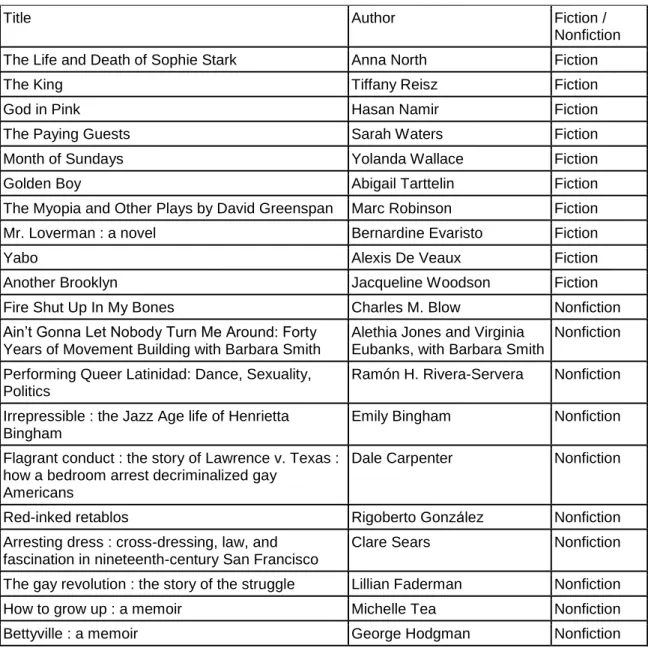
Table 1: Selected Books
Title Author Fiction /
Nonfiction
The Life and Death of Sophie Stark Anna North Fiction
The King Tiffany Reisz Fiction
God in Pink Hasan Namir Fiction
The Paying Guests Sarah Waters Fiction
Month of Sundays Yolanda Wallace Fiction
Golden Boy Abigail Tarttelin Fiction
The Myopia and Other Plays by David Greenspan Marc Robinson Fiction
Mr. Loverman : a novel Bernardine Evaristo Fiction
Yabo Alexis De Veaux Fiction
Another Brooklyn Jacqueline Woodson Fiction
Fire Shut Up In My Bones Charles M. Blow Nonfiction
Ain’t Gonna Let Nobody Turn Me Around: Forty Years of Movement Building with Barbara Smith
Alethia Jones and Virginia Eubanks, with Barbara Smith
Nonfiction
Performing Queer Latinidad: Dance, Sexuality, Politics
Ramón H. Rivera-Servera Nonfiction
Irrepressible : the Jazz Age life of Henrietta Bingham
Emily Bingham Nonfiction
Flagrant conduct : the story of Lawrence v. Texas : how a bedroom arrest decriminalized gay
Americans
Dale Carpenter Nonfiction
Red-inked retablos Rigoberto González Nonfiction
Arresting dress : cross-dressing, law, and fascination in nineteenth-century San Francisco
Clare Sears Nonfiction
The gay revolution : the story of the struggle Lillian Faderman Nonfiction
How to grow up : a memoir Michelle Tea Nonfiction
However, even after this initial sample list was completed, there were very
few libraries nearby which held even a couple of the books. Since a second aim
of the study was to only visit libraries which held a significant portion of the
sample, a new, narrower sample frame was devised, using only books which had
won either the Stonewall Book Award or Lambda Literary Award between
2013-2017, or which had been placed in the Over the Rainbow booklist’s “Top 10”
section in that time period. From this, a booklist was created which was held
more frequently across several nearby library systems. This list can be seen in
Table 1.
Site Selection
The intent of this study was to explore the placement of the books in the
sample in a wide range of institutions. Due to the need to travel to each
institution and conduct observations on site, a convenience sample of institutions
was developed, primarily based on their proximity to the University of North
Carolina at Chapel Hill. To meet the goal of observing a variety of different types
of institutions, five different categories were envisioned; “small” public libraries,
“large” public libraries, academic libraries, “independent” bookstores, and large,
“chain” bookstores. The goal was to develop a list which included three of each
of these categories of institution. As is implied by the heavy use of quotation
marks, these categories may have been envisioned as separate, easily definable
entities during the planning process, but were less easily defined during the
sample range, with most public libraries nearby belonging to a county-wide
system. In these cases, a central library within the system was identified, if
possible. As for bookstores, it turned out that there was not much variety with
regards to “large, chain” bookstores in the area, so the one chain available was
visited three times, at different physical locations.
An initial list of libraries to be considered was created alongside the
booklist. As each book was checked in WorldCat, to see if it was held at any
local libraries, a list was also made of which libraries consistently came up. This
list was used as a starting point for testing to find libraries which held a significant
portion of the books on the booklist. For this study, a library was considered to
hold a significant number of books from the list if it held at least 25% of the
booklist. This method produced a good selection of possible academic libraries,
including the three used for this study (NC State University, Duke University, and
Elon University), but not as many public libraries (only Wake County Public
Libraries appeared frequently in WorldCat). Additional possible public libraries
were added based on their proximity to the study area, which led to the selection
of the Orange, Chatham, Durham, and Alamance county public library systems,
and the Chapel Hill Public Library.
Libraries identified as possible candidates were vetted through their online
public access catalogs. Each book on the finalized booklist was searched for
within a library’s catalog, with the goal of ensuring that the institution held a
minimum of 25% of the sample books. Also, where possible, the central library
within a county system, and so a regional branch with the greatest number of
books from the sample was selected as the system’s representative. In two
other cases, a library system held different parts of the sample in different
locations, and so two libraries in the system were visited, to create a more
comprehensive dataset.
Bookstores were also selected based on proximity. Since they could not
be easily surveyed and selected through a system like WorldCat, a simple
Google Maps search for “bookstores” close to the Raleigh/Durham/Chapel Hill
area was conducted. From there, an attempt was made to check the websites of
each store, to search for the availability of the books on the booklist, and in one
instance, this led to a store being passed over for the study; despite its close
proximity to Chapel Hill, its online catalog indicated that it had only one book from
the list, while a more distant store in Raleigh, Quail Ridge Books, indicated that it
had four. The other two independent bookstores selected, The Regulator
Bookshop and Letters Bookshop, did not have useful online catalogs of their
in-store books, and so were visited conditionally. As it so happened, they did have
some books on the list (two each), and so were used as sites. For larger chain
bookstores, only Barnes and Noble was identified within the study area, and their
online catalog indicated that all of the nearby stores held the same three books
Results
Of the twenty books selected for this study, nineteen were found across
fifteen institutions, and seventeen different physical locations. Two outlier
situations should be mentioned here. One of the books selected for the list,
which was originally confirmed to be held by one university library, turned out to
be held in a closed stacks library, and therefore was inaccessible. This was
discovered after data had been collected at several other institutions, and so it
was decided that it was too late to replace it with a new 20th book and return to
the other institutions. Also, when selecting libraries, a mistake was made while
counting the number of books held by one of the university libraries, and some of
their electronically held books were included in the count. When that library was
physically, or less than 25% of the list. Their data was included anyway, instead
of searching for a new third university library to include. The overall spread of
books held at each institution, and the number of places each book was
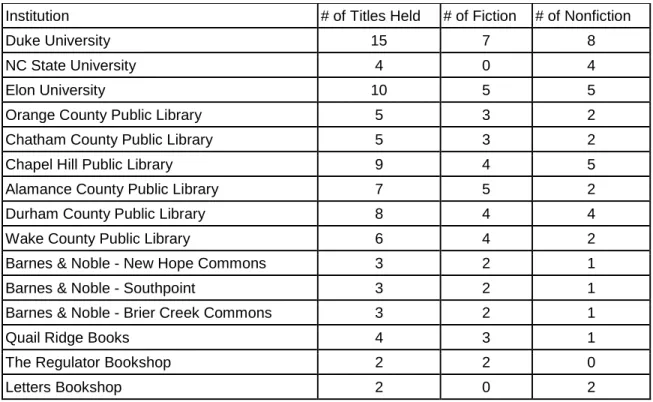
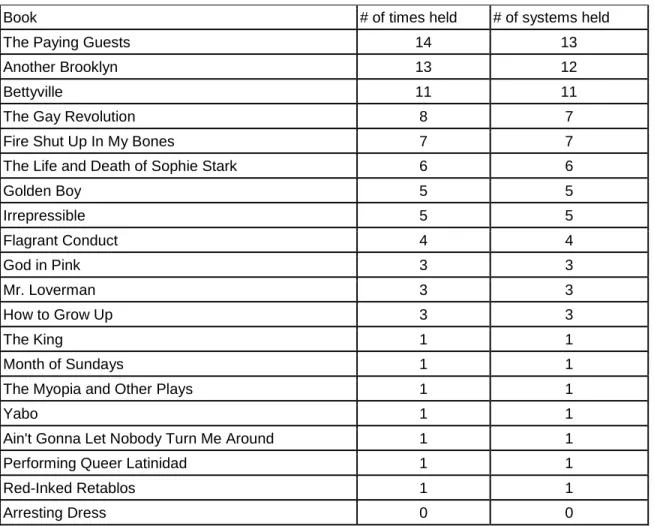
observed, can be seen in Tables 2-3 and Figures 1-2.
Table 2: Books held by each Institution
Institution # of Titles Held # of Fiction # of Nonfiction
Duke University 15 7 8
NC State University 4 0 4
Elon University 10 5 5
Orange County Public Library 5 3 2
Chatham County Public Library 5 3 2
Chapel Hill Public Library 9 4 5
Alamance County Public Library 7 5 2
Durham County Public Library 8 4 4
Wake County Public Library 6 4 2
Barnes & Noble - New Hope Commons 3 2 1
Barnes & Noble - Southpoint 3 2 1
Barnes & Noble - Brier Creek Commons 3 2 1
Quail Ridge Books 4 3 1
The Regulator Bookshop 2 2 0
Letters Bookshop 2 0 2
Even for a relatively narrow list of award winning and “top 10” books, only a few
titles in the sample were widely held. Less than half of the books on the list were
found in even a third of the visited institutions, and a third of them were found in
only one institution. The three most commonly found, “The Paying Guests”,
“Another Brooklyn”, and “Bettyville”, all had their numbers slightly boosted by
they were also held by almost all of the libraries as well. None of them are
particularly recent books either; the most recently published of the three being
“Almost Brooklyn” in 2016. On the other end of the scale, seven of the books
were only held in one location, which in each case was one of two of the
university libraries. As for the breakdown between fiction and nonfiction, fiction
appeared slightly more often; fiction titles were held 48 times, while nonfiction
titles were held 41 times. The three university libraries had roughly even or
larger nonfiction holdings than fiction, while most of the public libraries and
bookstores had larger fiction holdings than nonfiction, with a couple of
Table 3: Number of Locations each Book was Held
Book # of times held # of systems held
The Paying Guests 14 13
Another Brooklyn 13 12
Bettyville 11 11
The Gay Revolution 8 7
Fire Shut Up In My Bones 7 7
The Life and Death of Sophie Stark 6 6
Golden Boy 5 5
Irrepressible 5 5
Flagrant Conduct 4 4
God in Pink 3 3
Mr. Loverman 3 3
How to Grow Up 3 3
The King 1 1
Month of Sundays 1 1
The Myopia and Other Plays 1 1
Yabo 1 1
Ain't Gonna Let Nobody Turn Me Around 1 1
Performing Queer Latinidad 1 1
Red-Inked Retablos 1 1
Arresting Dress 0 0
Discussion
Originally, this study intended to analyze the subject headings or other
terms associated with the ten books located to either side of each book in the
study sample. However, the majority of the instances observed in this study
were shelved by genre or form, alphabetical by author. Specifically, there were
89 different instances of sample books observed on shelves recorded for this
study. Of those, 50 were placed in some form of general fiction or literature
biographies, sorted
alphabetically by the
subject of the biography.
This left only 26 instances,
or 29%, which were placed
on shelves based on their
topic, not their genre. For
this reason, it was decided
that analyzing books by
their subject headings may
be misleading, since for the
majority of the instances
observed, books had not
been organized with
regards to their subjects. Any associations made between the subjects of these
books would be purely due to the circumstances of which authors last names
were close to each other. To illustrate this, consider the book “Bettyville: a
memoir”, the third most frequently held book in the sample. This book, written by
George Hodgman, was placed alongside other biographies seven times,
alphabetically by the name of the subject of the biography. In five of those
instances, this placement put Hodgman within ten books distance of one or more
biographies about Adolf Hitler (For example, see Figure 3). However, it would
which had done so felt that Hodgman’s memoir was topically related to Hitler.
For another example, data from three observations of the book “Another
Brooklyn” are included in Table 4. As can be seen in this example, Jacqueline
Woodson’s book frequently ended up next to popular and well known authors
Cindy Woodsmall, Stephen Woods, Virginia Woolf, and Herman
Wouk. However, it would be incorrect to try to draw conclusions between these
associations, beyond the fact that both public libraries and bookstores prefer to
organize their fiction collections by author’s names, and not by their subjects.
For this reason, a more surface level analysis of call number topics was
conducted.
In order to conduct this call number topic analysis, the call numbers of the
books placed alongside the book being observed were coded for the general
topic or area they were meant to designate. For each book, the ten books placed
to either side were recorded, and the topics represented by their call numbers
were counted. If a topic was found in the range around a book more than once, it
was counted only once. This was done to counteract the large number of fiction
titles at public libraries, which were exclusively placed with other fiction titles. It
was felt that counting “Fiction” 20 times for each of these titles would
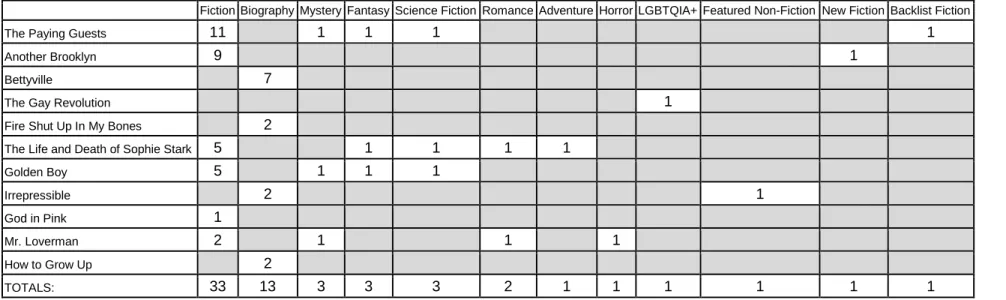
unnecessarily skew the data. Even so, as can be seen in Tables 5a-d, in each
Table 4 - Neighboring Books Sample for “Another Brooklyn”
Ten Books to the Left Ten Books to the Right
Orange County Main Library
“The scent of cherry blossoms” - Cindy Woodsmall
“A love undone” - Cindy Woodsmall “The christmas singing” - Cindy Woodsmall
“The angel of forest hill” - Cindy Woodsmall
“When the soul mends” - Cindy Woodsmall
“When the morning comes” - Cindy Woodsmall
“When the heart cries” - Cindy Woodsmall
“Seasons of tomorrow” - Cindy Woodsmall
“For every season” - Cindy Woodsmall “The winnowing season” - Cindy Woodsmall
“August” - Gerard Woodward “A curious earth” - Gerard Woodward “Raiding with morgan” - Jim R. Woolard “Mrs. dalloway” - Virginia Woolf “Orlando” - Virginia Woolf
“The caine mutiny” - Herman Wouk “The glory” - Herman Wouk “A hole in texas” - Herman Wouk “The hope” - Herman Wouk “The lawgiver” - Herman Wouk
Chapel Hill Public Library
“D.C. dead” - Stuart Woods “Heat” - Stuart Woods
“Unnatural acts” - Stuart Woods “Iron orchid” - Stuart Woods “Collateral damage” - Stuart Woods “Scandalous behavior” - Stuart Woods “Naked greed” - Stuart Woods “Family jewels” - Stuart Woods “Fresh disasters” - Stuart Woods “Indecent exposure” - Stuart Woods
“The voyage out” - Virginia Woolf “Between the acts” - Virginia Woolf “The complete shorter fiction of virginia woolf” - Virginia Woolf
“Jacob's room” - Virginia Woolf “The waves” - Virginia Woolf
“The world of the short story” - Clifton Fadiman
“Any approaching enemy” - Jay Worrall “Sails on the horizon” - Jay Worrall “A hole in texas” - Herman Wouk “She rises” - Kate Worsley
Barnes & Noble - Southpoint
"The wrong sister" - T. E. Woods "Unnatural acts" - Stuart Woods "Naked greed" - Stuart Woods "Orchid beach" - Stuart Woods "Chiefs" - Stuart Woods
"Imperfect strangers" - Stuart Woods "Choke" - Stuart Woods
"Santa fe edge" - Stuart Woods "Standup guy" - Stuart Woods "Scandalous behavior" - Stuart Woods
"Dear carolina" - Kristy Woodson Harvey "John dies at the end" - David Wong "Orlando" - Virginia Woolf
"Mrs. dalloway" - Virginia Woolf "The waves" - Virginia Woolf
"The complete shorter fiction of virginia woolf" - Virginia Woolf
"Night and day" - Virginia Woolf "The lawgiver" - Herman Wouk
"War and remembrance" - Herman Wouk "The winds of war" - Herman Wouk
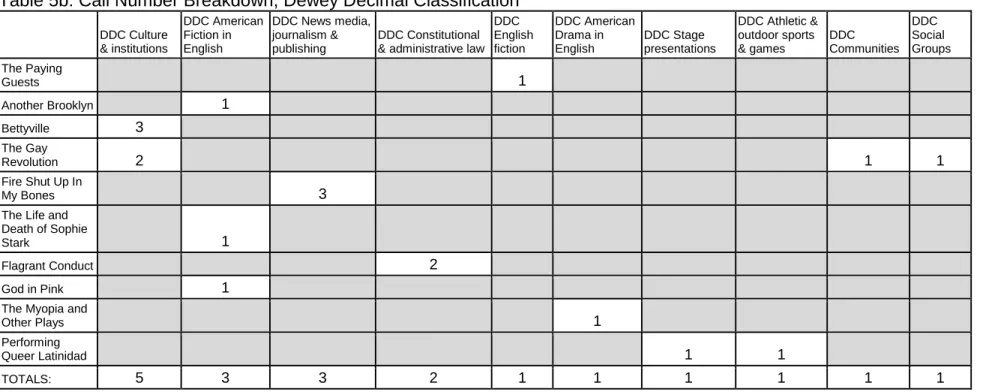
To better display the call number categories that were found, three
general categories were devised. First of all, most of the public libraries used
their own call numbers for fiction and biography books, based on the last name of
so the shelf labels for each book’s section were used instead. These two
situations are collected together in Table 5a, and are referred to as
‘institution-supplied’ call number topics. The public libraries visited generally used Dewey
Decimal call numbers for nonfiction books other than biographies, while the
university libraries visited used Library of Congress call numbers for all of the
books in their collection. One of the three university libraries made an exception
to this rule, however, and used Dewey Decimal numbers for its entire
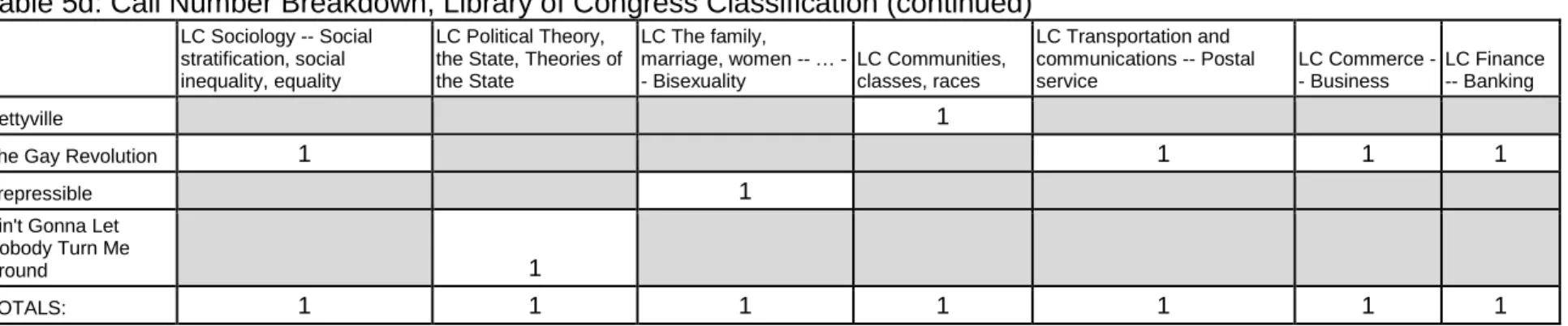
collection. The Dewey call number topics are collected in Table 5b, while the
Library of Congress call number topics are spread across Tables 5c and 5d.
A few outliers can be seen in this data. For one, there are a sprinkling of
genre-specific call number topics in the institution-supplied list; these cases
entirely originate from the Durham County Southwest Regional Library
branch. This library branch had separate call number indicators for a variety of
genres, such as F for fiction, FAN for fantasy, and MYS for mystery. However,
unlike some other libraries which made physical distinctions for genres of fiction,
these were all shelved together by author’s last name, rather than shelved by
genre. There are a couple possible explanations for this. The library could have
previously separated fiction genres and recently made the decision to shelve
them all together in one general fiction collection, but not had the time to relabel
everything. They also may have made a decision to use their call numbers to
highlight various genres of fiction, but not felt that these subgenres warranted
Table 5a: Call Number Breakdown, Institution-Supplied
FictionBiographyMysteryFantasy Science FictionRomance AdventureHorrorLGBTQIA+ Featured Non-Fiction New FictionBacklist Fiction
The Paying Guests 11 1 1 1 1
Another Brooklyn 9 1
Bettyville 7
The Gay Revolution 1
Fire Shut Up In My Bones 2
The Life and Death of Sophie Stark 5 1 1 1 1
Golden Boy 5 1 1 1
Irrepressible 2 1
God in Pink 1
Mr. Loverman 2 1 1 1
How to Grow Up 2
TOTALS: 33 13 3 3 3 2 1 1 1 1 1 1
Table 5b: Call Number Breakdown, Dewey Decimal Classification DDC Culture & institutions DDC American Fiction in English
DDC News media, journalism & publishing
DDC Constitutional & administrative law
DDC English fiction DDC American Drama in English DDC Stage presentations
DDC Athletic & outdoor sports & games DDC Communities DDC Social Groups The Paying Guests 1
Another Brooklyn 1
Bettyville 3
The Gay
Revolution 2 1 1
Fire Shut Up In
My Bones 3
The Life and Death of Sophie
Stark 1
Flagrant Conduct 2
God in Pink 1
The Myopia and
Other Plays 1
Performing
Queer Latinidad 1 1
TOTALS: 5 3 3 2 1 1 1 1 1 1
Table 5c: Call Number Breakdown, Library of Congress Classification
LC American Literature
LC The family, marriage, women -- … -- Homosexuality, lesbianism
LC English Literature
LC Law of the United States -- Criminal trials LC Social history and conditions, social problems, social reform
LC The family, marriage, women -- … -- Transsexualism, transgenderism
LC The family, marriage, women -- The family, marriage, home LC The family, marriage, women -- Women, feminism LC Journalism LC Social pathology, social and public welfare, criminology LC Sociology -- Social change The Paying Guests 1 Another Brooklyn 2
Bettyville 1 1 1 1 1 1 1
The Gay
Revolution 3 1 1 1 1 1 1
Fire Shut Up
In My Bones 2
Irrepressible 1
Flagrant
Conduct 2
God in Pink 1
Mr.
Loverman 1
How to Grow
Up 1
The King 1
Month of
Sundays 1
Yabo 1
Red-Inked
Retablos 1
TOTALS: 7 5 3 2 2 2 2 2 2 2 2
Table 5d: Call Number Breakdown, Library of Congress Classification (continued)
LC Sociology -- Social stratification, social inequality, equality
LC Political Theory, the State, Theories of the State
LC The family, marriage, women … -- Bisexuality
LC Communities, classes, races
LC Transportation and communications -- Postal service
LC Commerce -- Business
LC Finance -- Banking
Bettyville 1
The Gay Revolution 1 1 1 1
Irrepressible 1
Ain't Gonna Let Nobody Turn Me
Around 1
TOTALS: 1 1 1 1 1 1 1
Another outlier case was the use of Dewey Decimal classification at Elon
University. Because of their use of Dewey over LC, there are several more
books represented on the Dewey chart than might otherwise be there. This is
due to their use of Dewey for everything in their collection, including their fiction
titles, and their inclusion of several nonfiction books not held in any of the public
libraries visited. Lastly, the extensive range of LC call number topics observed
can mostly be attributed to two books, “The Gay Revolution” and “Bettyville”, both
of which were held in a “Current Lit” section at Duke University's Lily Library,
meant to provide easier access to popular, current titles. This section covered a
much wider range of nonfiction topics within the span of 10 books than any other
library observed, leading to “The Gay Revolution” in particular being placed
alongside books about the postal service, business, and banking.
So, what does this survey of call number topics tell us? The clearest
takeaway from this study is that the majority of the books in this sample have not,
in fact, been cataloged or shelved based on their LGBT content. The most
common topic used is some variation on ‘Fiction’ or ‘Literature’. In the
institution-supplied and Library of Congress sections, these are the most common topics,
while in the Dewey table, literature comes second, likely due to Dewey’s more
prevalent use for nonfiction than for fiction. Indeed, all of the Dewey topics which
could be considered fiction or literature, were found at the one library using
Dewey for its fiction collection, Elon University. Interestingly, even two of the
fiction by one of the other university libraries, Duke, as they were
autobiographies written by fiction authors.
After fiction and literature, the next most common designation is the
‘Biography’ label, used frequently in public libraries and bookstores. After that,
the topic occurrences begin to trail off. Of the 20 books in the sample, only three
were placed in sections with other ‘LGBT’ topics, and only one was placed there
consistently. One bookstore held one book in an ‘LGBTQIA+’ section, a handful
of public libraries held one or two books in the Dewey “Culture & Institutions”
section alongside similar LGBT content, and the academic libraries using Library
of Congress shelved three of the sample books alongside books with
classification topics such as ‘Homosexuality, lesbianism’, ‘Transsexualism,
transgenderism’, and 'Bisexuality’.
This overwhelming tendency towards organizing books alphabetically by
author clearly shows how public libraries, academic libraries, and bookstores all
make an effort to show themselves as neutral, welcoming places, where people
can come to borrow, or purchase, books of all kinds. The use of authors’ names
to organize fiction, and subjects’ names to organize biographies, both show that
libraries and bookstores expect their patrons to arrive already knowing who or
what they are generally looking for. This system works great if a person knows
they want a fiction book by Herman Wouk, or a biography of Charlton Heston. It
is not as helpful if a person wants to find a book about a seaside town, or a Civil
War general, or, as was explored here, a book with LGBT characters or dealing
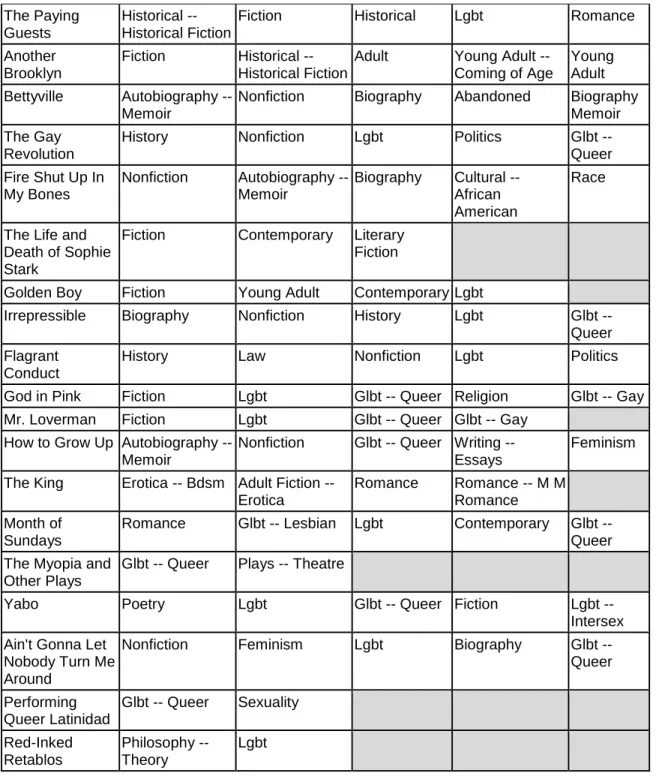
Table 6: Goodreads Genres
The Paying Guests
Historical -- Historical Fiction
Fiction Historical Lgbt Romance
Another Brooklyn
Fiction Historical --
Historical Fiction
Adult Young Adult --
Coming of Age
Young Adult
Bettyville Autobiography --
Memoir
Nonfiction Biography Abandoned Biography
Memoir The Gay
Revolution
History Nonfiction Lgbt Politics Glbt --
Queer Fire Shut Up In
My Bones
Nonfiction Autobiography --
Memoir
Biography Cultural --
African American
Race
The Life and Death of Sophie Stark
Fiction Contemporary Literary
Fiction
Golden Boy Fiction Young Adult ContemporaryLgbt
Irrepressible Biography Nonfiction History Lgbt Glbt --
Queer Flagrant
Conduct
History Law Nonfiction Lgbt Politics
God in Pink Fiction Lgbt Glbt -- Queer Religion Glbt -- Gay
Mr. Loverman Fiction Lgbt Glbt -- Queer Glbt -- Gay
How to Grow Up Autobiography -- Memoir
Nonfiction Glbt -- Queer Writing --
Essays
Feminism
The King Erotica -- Bdsm Adult Fiction --
Erotica
Romance Romance -- M M
Romance Month of
Sundays
Romance Glbt -- Lesbian Lgbt Contemporary Glbt --
Queer The Myopia and
Other Plays
Glbt -- Queer Plays -- Theatre
Yabo Poetry Lgbt Glbt -- Queer Fiction Lgbt --
Intersex Ain't Gonna Let
Nobody Turn Me Around
Nonfiction Feminism Lgbt Biography Glbt --
Queer
Performing Queer Latinidad
Glbt -- Queer Sexuality
Red-Inked Retablos
Philosophy -- Theory
Lgbt
The question then is, if these books are not being classified and shelved
it is better for these books to be treated the same as other books on non-LGBT
topics; not only is this an equal and supposedly neutral treatment, but it stops
books on sensitive or marginalized topics from being singled out. In theory, part
of the purpose of subject access is to help users search for materials based on
topics other than the main topic or genre used for their classification, and
collecting all fiction together alphabetically, for example, should allow patrons to
search for and find books on particular or sensitive topics in privacy, as opposed
to forcing them to go to a section of the collection clearly and overtly labeled
“LGBT” to find what they need. Herein lies the problem with any supposedly
neutral system of organization; we could assume that one way of displaying
things is better for the greatest number of patrons, and that we are catering to the
needs of the 'average user'. However, for each patron who may know exactly
which author they are looking for, and who appreciates the anonymity of
searching for an LGBT author amidst a sea of alphabetized fiction, there is
another patron who has not arrived at the library with a clear book in mind, and
would prefer a "genrefied" or topic-oriented system which helps them find LGBT
content expressly and explicitly.
The biggest issue with deciding how to classify and shelve a book is the
fact that, unless an institution is willing to invest in having several copies of each
book placed in different sections, a book can really only be placed it in one spot.
Even if a library were to try to support multiple organizational systems at once,
such as a general alphabetized fiction section, and a rotating collection of genre
every patron's particular organizational whims. One way in which this may be
supplemented, at least in part, is through increasing reliance on digital shelves
and interfaces. An ebook file can, in theory, be shelved alongside any multitude
of other titles in different ways, to help highlight its various genres, topics,
subjects, and other relevant associations. For example, on the website
goodreads.com, users can place books on their own shelves, based on what
they think is most relevant about the book. These are aggregated, and through a
quick search of the platform, the top five genre shelves for each of the books in
this study were gathered, as shown in Table 6. While only one of them has ‘Lgbt’
or a related term as its top genre, all but four of them include some variation in
their top five. By adapting this sort of system, institutions could potentially
involve patrons in digitally classifying and arranging their own sub-collections for
topics they are passionate about, and feature some of these alternate
classifications in the physical library, thereby allowing others to explore alternate
methods of access within the collection as a whole.
Conclusion
The goal of this study was to analyze the classification of prominent,
award winning books on LGBT topics, to see how these topics are being treated
in libraries and bookstores today. These materials have, in the past, been placed
in a variety of locations throughout the library, sometimes with unsavory
connotations. This study, however, does more to show the limited reach of even
bookstores, with eleven books from the sample appearing in three or fewer
institutions. An interesting follow-up to this study could involve a comparison of
highly rated or award winning titles, and an investigation into how likely it is that a
title will be added to a collection based on which awards it has won. Is it normal
for award winners to be collected at a relatively low rate, or are books which win
“minority representation” awards collected differently? Of the books that were
available for observation, all of the fiction titles were shelved with other fiction
alphabetically by author, and most of the nonfiction titles were either shelved as
biographies, or under topics not pertaining to their LGBT content. This shows
how, with what few LGBT titles libraries do collect, they have done their best to
cast them amidst the rest of their collection, aiming to show off the fairness and
neutrality of their organization, for the benefit of the known item searcher, but to
Bibliography
Adler, M. (2017). Cruising the library : perversities in the organization of knowledge (First edition.). New York: Fordham University Press.
Alexander, L. B., and Miselis, S. D. (2007). Barriers to GLBTQ Collection Development and Strategies for Overcoming Them. Young Adult Library Services 5(3): 43–49.
Berman, Sanford. (1971). Prejudices and Antipathies: A Tract on the LC Subject Heads Concerning People. Metuchen, N.J.: Scarecrow Press.
Boon, M. H., and Howard, V. (2004). Recent Lesbian/Gay/Bisexual/Transgender Fiction for Teens: Are Canadian Public Libraries Providing Adequate Collections. Collection Building 23 (3): 133–38.
Buckland, Michael. (2012) Obsolescence in subject description. Journal of Documentation 68(2): 154-161.
Clyde, L. A., and Lobban, M. (2001). A Door Half Open: Young People’s Access to Fiction Related to Homosexuality. School Libraries Worldwide 7 (2): 17– 30.
Drabinski, E. (2013). Queering the Catalog: Queer Theory and the Politics of Correction. The Library Quarterly: Information, Community, Policy, 83(2), 94–111.
Feinberg, M. m. (2017). Reading databases: slow information interactions
beyond the retrieval paradigm. Journal Of Documentation, 73(2), 336-356.
Hoffman, Gretchen L. (2009). Meeting Users’ Needs in Cataloging: What is the Right Thing to Do?. Cataloging & Classification Quarterly, 47:7, 631-641
Johnson, Matthew. (2007) GLBT Controlled Vocabularies and Classification Schemes. American Library Association GLBT Roundtable,
http://www.ala.org/glbtrt/popularresources/vocab.
Johnson, Matt. (2010). Transgender Subject Access: History and Current Practice. Cataloging and Classification Quarterly. 48(8). 665.
Knowlton, Steven A. (2005). Three Decades Since Prejudices and Antipathies: A Study of Changes in the Library of Congress Subject Headings,
Cataloging & Classification Quarterly, 40:2, 123-145
Kublik, Angela, Clevette, Virginia, Ward, Dennis, and Olson, Hope A. (2003). Adapting Dominant Classifications to Particular Contexts. Cataloging & Classification Quarterly, 37:1-2, 13-31
Marshall, J. (1977). On Equal Terms: A Thesaurus for Nonsexist Indexing and Cataloging. New York: Neal-Schuman.
McClary C., Howard V. (2007). From "Homosexuality" to "Transvestites": An Analysis of Subject Headings Assigned to Works of GLBT Fiction in Canadian Public Libraries, Canadian Journal Of Information & Library Sciences. 31(2): 149-162.
Olson, Hope A. (1998). Mapping beyond Dewey's Boundaries: Constructing Classificatory Space for Marginalized Knowledge Domains. How
Classifications Work: Problems and Challenges in an Electronic Age, ed. Geoffrey C. Bowker and Susan Leigh Star, special issue of Library Trends 47(2): 233-254.
Olson, Hope A. (2000). Difference, Culture and Change: The Untapped Potential of LCSH. Cataloging & Classification Quarterly, 29:1-2, 53-71
Olson, Hope A. (2001). The Power to Name: Representation in Library Catalogs. Journal of Women in Culture and Society. Vol. 26, No. 3, pp. 639-668.
Olson, Hope A., and Schlegl, Rose. (2001). Standardization, Objectivity, and User Focus: A Meta-Analysis of Subject Access Critiques. Cataloging & Classification Quarterly, 32:2, 61-80
Olson, Hope A., Ward, Dennis B. (1997). Feminist Locales in Dewey's Landscape: Mapping a Marginalized Knowledge Domain. Knowledge Organization for Information Retrieval: Proceedings of the Sixth
Rauch, E. W. (2010). GLBTQ Collections Are for Every Library Serving Teens! Voice of Youth Advocates 33 (3): 216–18.
Schrader, A. M. (2007). ‘I thought I’d find myself at the library’: LGBTQ Services & Collections in Public and School Libraries. PNLA Quarterly 72 (1): 4–9.
Schrader, A. M. (2009). “Challenging Silence, Challenging Censorship, Building Resilience: LBGTQ Services and Collections in Public, School, and Post-Secondary Libraries.” Feliciter 55 (3): 107–109.
Smiraglia, Richard P. (2009) Bibliocentrism, Cultural Warrant, and the Ethics of Resource Description: A Case Study, Cataloging & Classification
Quarterly, 47:7, 671-686
Tennis, Joseph T. (2012) The strange case of eugenics: a subject’s ontogeny in a long-lived classification scheme and the question of collocative integrity. Journal of the American Society for Information Science and Technology 63(7): 1350-1359.
Wakimoto, D. K., Hansen, D. L., & Bruce, C. (2013). The case of LLACE: Challenges, triumphs, and lessons of a community archives. American Archivist, 76(2), 438-457.
Ward, Dennis B., Olson, Hope A. (1998). A Shelf Browsing Search System for Marginalized User Groups. Information Access in the Global Information Economy: Proceedings of the 61st Annual Meeting of the American Society for Information Science, October 25-29, 1998, Pittsburgh, Pennsylvania, 342-47. Medford, N.J.: Information Today, Inc.
Williams, S. (2017). Subject headings friend or foe?: Cataloging diverse YA books in public libraries. Unpublished master’s paper, The University of North Carolina at Chapel Hill, Chapel Hill, North Carolina.