Elizabeth A. Dunn. Talking Animals: A Literature Review of Anthropomorphism in Children's Books. A Master‟s Paper for the M.S. in L.S. degree. May, 2011. 61 pages. Advisor: Rebecca Vargha
In children's literature, talking animals run rampant. These characters exhibit various levels of anthropomorphism, from talking or thinking like a human, to wearing clothes and riding bicycles. Through the examination of ten of the most commonly seen animals in children's books and a selection of 120 titles, the role and importance of
anthropomorphic animals in children's literature is assessed.
Headings:
Animals in literature
Anthropomorphism in literature Children's literature -- Bibliography
TALKING ANIMALS: A LITERATURE REVIEW OF ANTHROPOMORPHISM IN CHILDREN'S BOOKS
by
Elizabeth A. Dunn
A Master‟s paper submitted to the faculty of the School of Information and Library Science of the University of North Carolina at Chapel Hill
in partial fulfillment of the requirements for the degree of Master of Science in
Library Science.
Chapel Hill, North Carolina May 2011
Approved by
Table of Contents
Introduction... 2
A Brief History... 3
Methodology... 7
Types of Animals Dogs... 9
Cats... 13
Pigs... 17
Chickens... 19
Ducks... 23
Rabbits... 26
Mice... 30
Wolves and Foxes... 34
Bears... 37
Conclusion... 40
Bibliography... 43
Appendix A: Children's Books Cited... 46
Introduction
Talking animals have become commonplace in the realm of children's literature, and are perhaps even expected.Animals of every variety populate picture books and even chapter books, and display varying degrees of human-like characteristics. This
anthropomorphism is not limited to talking, but also includes wearing clothing, walking upright, cooking, playing instruments, and living in houses. Behaviorally, those animals who are fully anthropomorphic are almost indistinguishable from humans; they go to school, drive cars, and deal with the same daily issues and concerns that humans have.
Talking animals generally fall into the category of "animal fantasy," referring to a genre where animals are given human characteristics (Galda et al. 213, Lynch-Brown et al. 136). As previously mentioned, animals can be fully anthropomorphic or simply have the ability to talk or reason like a human. Animals can inhabit their own humanless worlds, or they can coexist with humans, occasionally even speaking to them directly.
A Brief History
Some of the most well-known animal stories are Aesop's fables (dating from the sixth century BCE), which use animals to show humans how they should behave.
According to Margaret Blount, Aesop "used the attractive power of animals and narrative to get at his audience in a peculiar way, and the method has been seized on, enlarged, used and copied until…the animal moral tale becomes almost wearisome" (34). Aesop's stories have been written and rewritten thousands of times, yet still manage to attract readers with their timeless lessons about socially acceptable behavior.
Talking animals have become commonplace in the realm of children's literature, and are perhaps even expected.Animals of every variety populate picture books and even chapter books, and display varying degrees of human-like characteristics. This
anthropomorphism is not limited to talking, but also includes wearing clothing, walking upright, cooking, playing instruments, and living in houses. Behaviorally, those animals who are fully anthropomorphic are almost indistinguishable from humans; they go to school, drive cars, and deal with the same daily issues and concerns that humans have.
Talking animals generally fall into the category of "animal fantasy," referring to a genre where animals are given human characteristics (Galda et al. 213, Lynch-Brown et al. 136). As previously mentioned, animals can be fully anthropomorphic or simply have the ability to talk or reason like a human. Animals can inhabit their own humanless worlds, or they can coexist with humans, occasionally even speaking to them directly.
going past their "intuitive inclusion in a replication of reality and have put them to use in a purposeful distortion of reality" (Burke and Copenhaver 206). But why are talking animals so prevalent in children's literature? What is their function, and why are they so popular?
Similarly, traditional oral stories and folktales from around the world feature talking animals, which "is so universal a convention that we hardly notice it" (Le Guin 22). One of the most popular types of folktales is the trickster tale, in which a character attempts to trick others in order to get what he or she wants. In tales from several different cultures, rabbits are featured heavily as tricksters (a tradition that will be discussed in more depth later on).
Prior to the eighteenth century, children were regarded as miniature versions of adults, and were expected work hard and to act responsibly. With the advent of the middle class, a new idea emerged that children needed time to develop before they could be expected to behave as adults; thus many children were able to spend more time playing and reading (Burke and Copenhaver 208). Around this time, an interest in nature was growing rapidly, and a majority of animal books available to children were realistic natural histories, as well as the continued popularity of Aesop's fables (Cosslett 10-11, Ritvo 72).
abuse, Black Beauty suffers through and witnesses nearly "every event that can happen to a horse" (Blount 251). And as the story is presented from Beauty's perspective,
sympathetic readers were able to better imagine themselves in the horse's position. The story is moralistic, and also shows typical Victorian concern with human vices (Hogan 3).
The stories of Beatrix Potter, on the other hand, also portray realistic versions of animals' lives, but were specifically intended for children and are far less emotionally intense. The Tale of Peter Rabbit, Potter's first book to be published (1902), is notable for the use of clothing for animals. In the very beginning of the book, the rabbits are shown as normal, realistic animals in the woods; the next scene is of them being dressed by their mother. Not all of Potter's animals wear clothing, which often has an effect on the story. In Peter Rabbit, Peter's jacket causes him to be trapped in a net, and his shoes slow down his running (Cosslett 156-157). Part of the attraction that Potter's stories hold for readers is their naturalism and charming English countryside setting: "That this beautiful, idealised place…could and possibly did have these small dramas in lake, burrow and hedgerow made the fantasy more real and the pleasure more possible, the animals' humanity…more natural" (Blount 137).
Published in 1908, Kenneth Grahame's The Wind in the Willows is another anthropomorphic animal story which remains popular today. Similar to some of Potter's characters, Grahame's animals are fully anthropomorphic, yet they have moments where they inexplicably change size, and are at times a bit too human. Beatrix Potter, not pleased with Grahame's style of anthropomorphism, said:
not describe "Toad" as combing his hair? A mistake to fly in the face of nature – A frog may wear goloshes; but I don't hold with toads having beards or wigs! (quoted in Cosslett 172)
Methodology
In the process of selecting titles for this paper, a number of different sources were consulted, and limitations were set. Specifically, the books analyzed were written for children no older than age twelve, and had to include talking animal characters, or animals who exhibited noticeable anthropomorphic behaviors. These behaviors can include wearing clothes, walking upright, or even thinking in a human-like manner. The latter quality can be difficult to judge, however, as authors tend to project their own thoughts and emotions onto their animal characters. Board books and simple books which teach counting, shapes, colors, or the alphabet were not considered. Fantastic and
mythological creatures were also excluded, as were stories where the animal characters are actually toys that have somehow come to life.
most often, and would therefore be the focus of this paper: dogs, cats, pigs, chickens, ducks, rabbits, mice, wolves and foxes (eventually grouped together because of substantial similarities), and bears.
In total, 120 titles – including picture books, easy readers, chapter books, and graphic novels – were selected. Each book was assessed equally, using the following evaluative questions:
What kinds of animals play a major role in the story? What anthropomorphic qualities do they exhibit? Do they retain any animal behaviors or characteristics?
Are there any humans in the story? If so, what is their relationship to the animals? What personality traits are shown by each type of animal in the story?
What lesson or value (if any) is taught by the animal characters?
From the answers to these questions, it was easier to make direct comparisons between books from the same animal category, as well as to note similarities with other groups.
Types of Animals
Dogs
The image of a dog brings to mind the phrase “man‟s best friend,” that faithful and devoted companion who, under a layer of hair and occasional drool, does not judge or question, and only wishes to please. An estimated 75 percent of U.S. households with children own a pet, and this number is steadily increasing (Hogan 131). Dogs are
probably the animal that children come into contact with the most on a regular basis, and are therefore one of the animals that children feel most comfortable with.
Over the past few years, special literacy programs at both libraries and schools have used this bond to help children become more confident in their reading ability, by giving them a chance to read aloud to certified therapy dogs. These programs “provide a safe and nurturing environment for beginning and struggling readers” (Hartman 13), as dogs act as a noncritical audience.
In children‟s literature, dogs are far outnumbered by other types of animals, especially when it comes to dogs with anthropomorphic qualities. There are plenty of “realistic” dog stories, such as Phyllis Reynolds Naylor‟s Shiloh, Gene Zion‟s Harry the Dirty Dog, Alexandra Day‟s Carl books, and Kate DiCamillo‟s Because of Winn-Dixie. And in general, stories about dogs tend to be rather “straightforward” (Rahn 152), as they almost always revert to their timeless role as a loyal companion.
rather dark story about an unlikely friendship between a partially blind dog and a magpie who can no longer fly. The magpie has no will to live, but the dog convinces her that together they can be whole; riding on the dog‟s back, the magpie acts as the eyes for both of them, and the dog replaces the magpie‟s wings. When the titular fox comes along, the magpie takes an instant dislike to it, while the dog decides to give it a chance. Eventually, the fox tricks the magpie into leaving the dog, who devotedly waits for his friend‟s return.
Friendship is a recurring theme in several dog stories. In Meow Ruff, by Joyce Sidman and Michelle Berg, the story of a reluctant friendship between a cat and dog is told (and shown) through the creative use of concrete poetry. When the dog, who has escaped from its home, encounters the abandoned cat (cruelly thrown from a car), the two are not at all on friendly terms. A sudden thunderstorm, however, forces them to take shelter together under a bench. When the dog‟s owner eventually finds his lost pet, he also takes the cat home, as the two have become good friends.
Similarly, City Dog, Country Frog, written by Mo Willems and gorgeously illustrated by Jon J. Muth, is centered around another unlikely friendship – this time between a dog and a frog. The book, which progresses through the seasons of the year and stages of the friendship, also teaches children about the sadness of death and of losing a friend. The story ends on a happy note, however, for as the dog waits in vain for his frog companion to return, he finds a new friend in an amiable chipmunk.
Interestingly, City Dog, Country Frog appears to be one of the few books for children that addresses death without involving any human characters at all. The only
facial expressions) is that they can speak; otherwise they are shown to be normal animals. Perhaps children will find more of a connection with the friendly, fun-loving dog, rather than with humans, when it comes to such a serious subject.
That New Animal, by Emily Jenkins, is another book which teaches a life lesson to children. Two dogs, FudgeFudge and Marshmallow, are absolutely devastated when their owners bring home a baby. They feel betrayed and neglected, much as older siblings will feel when confronted with a new addition to the family. The dogs crave attention, and begin to behave quite badly, which only gets them into trouble. When Grandpa comes to visit, FudgeFudge and Marshmallow feel a sudden protectiveness toward the “new animal,” and refuse to let him near the baby.
John Brown, the sheepdog hero of Jenny Wagner‟s John Brown, Rose and the Midnight Cat, is also adverse to change. He is stubbornly set in his ways, and believes that his life with Rose, his elderly owner, is perfect with just the two of them. John Brown continuously tells Rose how content he is, and is horribly dismayed when she wishes to bring a stray cat into their household. He confronts the cat, warning it to leave them alone. When Rose becomes ill, nothing makes her feel better until John Brown agrees to let the cat inside. His loyalty to Rose‟s happiness is so strong that he would do anything to help her.
triumphs. The two are rescued from the side of a busy highway by a young couple who have no idea how to take care of dogs, let alone two strays who have had almost no interaction with people. The puppies are soon abandoned at a shopping mall, where a passerby picks up Bone, but decides to leave Squirrel behind. Sadly, Squirrel spends the rest of her life looking for her brother, but never finds him. Eventually, Squirrel befriends another dog (who is later hit by a car), and then is adopted by a kindly old lady, whose neighbors continually tell her that she is unable to care for a dog. This depressing story is highly reminiscent of Black Beauty, in that it is told from the suffering animal‟s point of view. In A Dog’s Life, however, there is no actual dialogue other than Squirrel‟s
narration.
On a brighter note, there are several children‟s books that offer entertaining stories about anthropomorphic dogs. Susan Meddaugh‟s Martha Speaks, the first book in a best-selling series and the inspiration for a television show, is about a dog who develops the ability to speak after eating alphabet soup. The problem is, Martha does not know when to stop talking. After she is scolded by the family who owns her, she stops talking all together, until an encounter with a burglar requires her to call for help. Martha is praised as a hero, and has also learned a valuable lesson about the power of words and knowing when to say the right thing.
advantage of his owners‟ evenings out, by sitting on the couch, watching TV, and eating their food. Once he realizes that he can get away with this, he decides to host a party for the rest of the dogs in the neighborhood. Of course, his family returns early on the night of the party, and Stanley gets caught. His punishment, however, is that his owners now take him out with them, which Stanley does not seem to mind.
The Blues of Flats Brown, by Walter Dean Myers, shows children that they should always follow their dreams. Flats Brown and Caleb are two junkyard dogs who belong to mean A. J. Grubbs, who does not treat them well. The two dogs manage to escape, and Flats begins a new life as a prominent blues musician. Grubbs catches up to him, but the beauty of Flats‟ music prompts a change of heart in the junkyard owner.
The Blues of Flats Brown is the most anthropomorphic dog book included here; not only does Flats Brown talk, but he also plays music, and even wears clothing. In several of the other books, dogs can communicate with humans (if humans are present), but most of them only speak with other animals. Flats Brown is also a book that could be retold with human characters, and the story would largely remain unchanged. Almost all of the other dogs retain some of their original canine behavior, which creates a unique story that can only be told with dogs as the main characters.
Cats
however, the number of cat stories has grown as cats have become established as a favorite household pet.
Compared to the typical fun-loving and friendly companion role that dogs usually fall into, cat characters can exhibit a variety of different personality traits and functions (Rahn 152). One of the most well-known cat stories is Charles Perrault‟s Puss in Boots, which stems from a classic story that has been told in multiple cultures around the world with slight variations (Nikolajeva 252). Here the cat fulfills both the traditional trickster and animal helper roles, as he uses his cunning and manipulative nature to ensure his master‟s success. A “human in cat‟s skin” (Blount 25), Puss walks upright and talks (which no one seems particularly bothered by), and is able to convince his rather simple master into buying him a pair of boots. Puss also tricks a shapeshifting ogre into
becoming a mouse, whereupon Puss‟ feline nature takes over, and the ogre is eaten. In the end, his master becomes a wealthy man and marries a princess, all because of his talking cat‟s deceptions.
The titular figure of Nero Corleone: A Cat’s Story, originally written in German by Elke Heidenreich, is also a manipulative and self-important cat. Unlike Puss, Nero is depicted as a realistic cat, except that readers are privy to his thoughts and conversations with other animals. Nero finds humans to be simple-minded, and is always able to charm them into doing whatever he wishes – most notably a kind German couple who take Nero and his sister away from the boring farm in Italy where they were raised. Nero‟s behavior toward other animals is rather harsh and threatening, although he does show a softer side toward several close friends, including his slow-witted sister.
Gary Soto. Chato and Novio Boy invite a family of mice over for dinner, with the intention of eating them. His plans are thwarted, however, when the mice bring along a dachshund friend – aptly named Chorizo, which is Spanish for “sausage” – who terrifies the cats. Interestingly, this fear brings out the animal side of the two felines, who had previously acted very much like humans in cat form. When they see the dog, they fluff out their fur, hiss, and climb the curtains. Also noted is the depiction of the size
differences between the various types of animals, which is often ignored in fully anthropomorphic stories like Chato’s Kitchen.
Cats versus mice is, of course, a recurring theme in books about either type of animal. In Martin’s Mice, a novel by Dick King-Smith, Martin the cat refuses to hunt for mice like his mother and siblings do, and instead decides to keep one as a pet. That mouse, Drusilla, soon has a litter of babies; and after they are old enough to go off on their own, Drusilla asks Martin to bring her a husband so that she can have a new family. Throughout this humorous story, Martin is very kind toward his captives, and feels that he is doing them a favor by keeping them away from the other cats on the farm. He fails to understand why his pets wish for freedom, until he is taken into someone‟s home and forced (briefly) to live a pampered and smothered life.
proves himself a worthy member. He also solves the somewhat disturbing mystery of the evil man who has taken over his home, and realizes that his family‟s superb bloodline is not really that important.
While Varjak Paw inadvertently discovers the worth of self-identity, Wabi Sabi (the heroine of Ed Young‟s book of the same name), purposefully undertakes a journey to find out who she is. True to a cat‟s nature, Wabi Sabi is very curious. When she
overhears someone ask her owner what “Wabi Sabi” means, she is disappointed when her owner says that is too difficult to explain. She asks several other animals, but none of them will take the time to tell her. Finally, Wabi Sabi‟s quest leads her to an all-knowing monkey, who explains that the philosophy behind her name has to do with seeing the beauty in simple things, and also finding peace with nature. After realizing just how important her name is, Wabi Sabi is honored that it was bestowed upon such an ordinary cat.
In all of the titles mentioned above, the cat characters retain some, if not most, of their natural feline behavior. Each of the main characters does have a human side, even if it is only evident through talking or the way they think. In books like Ginger (by
Pigs
To many people, the word “pig” has a negative connotation. In his article “The Pig – Pet, Pork, or Sacrifice?” Arthur Arnold begins by saying:
No domestic animal has been more widely used as a metaphor expressing opprobrium than the pig. In common parlance it stands for greed, gluttony, dirt, squalor, and selfishness, but any observant pig farmer will testify that this is a gross misrepresentation, and children‟s writers, to their credit, have avoided the stereotype. (80)
Indeed, pigs are actually very clean animals, and quite intelligent. They have also been a long-time favorite in children‟s literature, thanks in part to classic characters like Beatrix Potter‟s Little Pig Robinson and Pigling Bland, Babe from Dick King-Smith‟s Babe: The Gallant Pig, Wilbur from E. B. White‟s Charlotte’s Web, and more recently, Olivia from Ian Falconer‟s series of the same name.
While most of these porcine characters do avoid stereotypes, occasionally pigs will be used to teach children about vices. For example, Lady Muck (by William Mayne) is a story about greed. Boark and Sowk are two pigs who find truffles while foraging in the woods, and decide to sell them with the intention of using their earnings to buy a carriage so that they may be “rich folk.” The story and dialogue are written in a
nonsensical manner, which makes the pigs‟ idea seem even more ridiculous. By the time they make it to the market, Sowk has secretly eaten most of the truffles, and they only earn enough money to buy a wheelbarrow. Boark laboriously pushes Sowk back home (amid mocking cries of “Lady Muck” from people watching), only to have the
wheelbarrow break. Sowk lands in a puddle of mud, and decides that she prefers the mud to any finery, thus remaining true to her pig nature.
attempting to enter the first pig‟s house, and then huffing and puffing to blow it down. Here, however, the three pigs somehow manage to leave their story, travel through other fairy tales (making some new friends in the process), and are able to rewrite their own ending. In The True Story of the 3 Little Pigs, by Jon Scieszka, the wolf attempts to explain what really happened, and why he should not be blamed for the demise of the unkind pigs. Another variation of the story is Eugene Trivizas‟ The Three Little Wolves and the Big Bad Pig, which reverses the roles of the characters, with the three wolves being terrorized by a villainous pig.
Pig books which feature a wolf as the villain are rather numerous. Colin
McNaughton‟s Oops! is a retelling of “Little Red Riding Hood.” Preston Pig is clumsy and easily distracted, and when he goes to visit his grandmother, the two are attacked by the sneaky Mr. Wolf. Luckily for the pigs, Preston‟s father shows up just in time to save them at the end. Other pig versus wolf stories include Hog-Eye by Susan Meddaugh, Nice Work, Little Wolf! by Hilda Offen, and Garth Pig and the Icecream Lady by Mary
Rayner. In both Hog-Eye and Garth Pig, the courageous young pig protagonists manage to outsmart the wolf who is attempting to harm them. Nice Work, Little Wolf! on the other hand, is a story about a wolf being mistreated by the slothful and domineering Porker family.
There are also books which send a positive message to readers through
Babe, however, is very kind toward the other animals, and is able to become a successful “sheep pig” by talking to the sheep and earning their respect. Dumpy La Rue (written by Elizabeth Winthrop) is another book that features a pig who goes against the norm to follow his dream – this time, to become a dancer.
Except for some of the fairy tale variations, most of the books discussed here have been about younger pigs, which helps to create a stronger bond with young readers. The epitome of pig child characters, however, is Olivia. In Olivia, the first book in the series by Ian Falconer, readers are introduced to a fully anthropomorphic cast of characters where pigs function just as humans do (they even keep cats and dogs as pets). Olivia is a typical little girl – creative, adventurous, and always busy. Her extensive imagination really shines through in Olivia Saves the Circus, where she shares with her class a slightly-exaggerated story of her trip to the circus.
Beryl: A Pig’s Tale, by Jane Simmons, is another story about a young pig,
although Beryl and her companions are a bit more realistic. Beryl, who has been raised as an orphan, manages to escape from a transport truck en route to the slaughterhouse. Her bravery leads her to join a pack of wild boars, where she learns much about herself. The Great Pig Escape, by Eileen Christelow, is yet another story in which pigs are able to use their courage and cleverness to escape their fate as dinner.
Chickens
other than for a few minor changes. When it comes to chickens, however, there is a marked difference between the functions and personalities and hens and roosters. In Barbara Cooney‟s Chanticleer and the Fox – based on Geoffrey Chaucer‟s version of the fable as included in The Canterbury Tales – the rooster Chanticleer is captured by a fox after falling prey to his flattery. Chanticleer, in return, is able to outwit the fox (also by means of flattery). The rooster, with his proud sense of “heraldic beauty” (Blount 33), allows his vanity to get the better of him.
Similarly, in The Rooster’s Gift, by Pam Conrad, Rooster forms a very high opinion of himself after hearing the farmer‟s wife say that he has “the Gift” as a young chick. Rooster believes that his crowing has the power to make the sun rise, and is quite egotistical as a result, which nearly ruins his friendship with his biggest admirer, Smallest Hen: “In the beginning he‟d grin and hop down from his perch to be by her. And they‟d talk about his Gift. But eventually, after smiling slightly, he would be on his way. Soon he would only nod. Then barely nod. And finally he didn‟t even hear her. Rooster was growing very proud of his Gift. Very, very proud” (n. pag.).
The majority of hens tend to have far less of a self-important air. In the classic story of The Little Red Hen (Jerry Pinkney‟s version has been used here), the hen works diligently to prepare her bread, without assistance from any of the other animals, who had all replied “Not I” when asked for help. Of course, when the bread is finally finished, everyone is willing to help eat it, but the hen refuses them, as they had refused her. In Rosie’s Walk, by Pat Hutchins, the title chicken character is neither hard-working nor vain; Rosie is simply oblivious to the world around her. As she walks around the neighborhood, she fails to notice that a fox is following her. Fortunately, the fox never manages to catch her.
allows them to live happier, healthier lives.
In Daisy Comes Home, Daisy is bullied by the five other hens where she lives because she is smaller than they are. After being pushed out of the chicken coop one night, Daisy finds a nice basket to sleep in by the river. The basket is swept away down the river, where Daisy is forced to confront water buffalo, a troupe of monkeys, and a dog, before being picked up by a passing fisherman who plans to sell her in the market. Fortunately, Daisy‟s distressed owner is able to find the missing chicken and takes her home, where she has learned a great deal about courage from her journey, and is able to stand up to the other chickens.
In Tippy-Toe Chick, Go! a hen and her three chicks are on their way to the garden when their path is blocked by a menacing dog. The mother chicken decides that there is no way for them to go any further, but the two biggest chicks try anyway, unsuccessfully. Little Chick, the smallest of the three siblings, also wants to try, and is able to use her speed and “tippy-toe” skills to trick the dog into wrapping its chain around a tree, thereby allowing the family to go past the dog without harm.
Hopefully, when Charlie grows up, he won‟t fall into the arrogant and “cocky” rooster role addressed earlier.
Ducks
In comparison to their chicken cousins, ducks tend to serve in the capacity of more light-hearted characters. Perhaps because of their amusing waddle, laugh-like quack, or maybe because of associations with comedic and well-loved characters like Daffy Duck and Donald Duck, ducks usually serve as sources of entertainment in children‟s literature, rather than as moralistic role models.
As indicated with some of the other animal groups, books about friendship are apt to be rather numerous. This is also true with ducks, particularly inter-species friendships. In Helen Cooper‟s Pumpkin Soup, for instance, Duck lives in a cozy, pumpkin-shaped cottage with his two good friends, Cat and Squirrel. The trio love to make pumpkin soup, and each has his own job to do during preparation. When Duck decides that he wants to do a different job, everyone gets upset and Duck ends up leaving. Apart, they are all quite despondent, and the pumpkin soup just doesn‟t taste the same. Duck eventually comes back home, and the friendship is renewed.
and Duck and Goose, who are now friends, agree that it‟s a very nice ball to share. In Don’t Fidget a Feather! Duck and Gander love to challenge each other in friendly competitions, like seeing who can swim the fastest or fly the highest. Duck decides that they should have a contest to see who can remain still for the longest amount of time. In their frozen positions, the two are steadfastly resistant to a number of
interruptions, including inquisitive animals a very strong wind. When Fox comes along, he is able to carry Gander (who still refuses to move) away without any struggle. Duck is reluctant to forfeit the competition, but once she realizes that her friend is about to be eaten, she hurries to the rescue, showing readers that winning isn‟t everything.
In books that are purely intended for entertainment, ducks are very successful as humorous characters. In Duck on a Bike, by David Shannon, adventurous Duck sees a bicycle and decides that he wants to ride it. The other barnyard animals are scornful at first, but by the end of the book, they all love riding bikes just as much as Duck does (and look quite funny doing so). Another humorous story is The Web Files, by Margie
Palatini, which is a parody of detective stories and crime dramas like Dragnet, starring Ducktective Web and his partner Bill.
Duck stories can also pass along inspiring or instructional messages, such as the benevolent ducks who help chickens escape a fox in Across the Stream, by Mirra
Ginsburg. Or in Lisa Westberg Peter‟s Cold Little Duck, Duck, Duck, where a little duck learns about patience and the power of imagination while waiting for spring to arrive. Martin Waddell‟s Farmer Duck will teach readers about the unfairness of taking
becomes too exhausted to move, the other farm animals step in to help their friend and perform a coup against the torpid farmer.
An ambitious and not-so-humble farm duck decides that he should be in charge in Duck for President, by Doreen Cronin. Duck does not like having to do chores on the farm, so he holds an election to replace the farmer. After he wins, he moves on to
governor, and then becomes President of the United States. The responsibility of running a country becomes too much for Duck, however, and he returns to the farm, where he eagerly begins work on his autobiography.
Young children will surely find a connection with some of the younger ducklings. In Have You Seen My Duckling? by Nancy Tafuri, a mother duck searches around the pond for her missing duckling, who can be seen adventurously exploring in the
Rabbits
As one of the most prominent groups of animals in children‟s books, rabbits certainly have a long history in both literature and oral stories. Rabbits can be found in fables and traditional tales from many cultures around the world, usually in the role of a trickster archetype, representing the “power of anarchic impulse” (Nodelman and Reimer 229). One of the best-known rabbit stories is that of Aesop‟s “The Tortoise and the Hare.” In Helen Ward‟s version of the fable, entitled The Hare and the Tortoise, the vainglorious hare trips over the tortoise and falls into a thorny bush: “The hare shouted at the tortoise. The noise attracted a crowd. The hare called the tortoise slow-witted and stupid. The tortoise did not say what he thought of the hare. Instead, he challenged the hare to a race. The hare laughed so much that he hurt even more” (n. pag.). Of course, during the race, the hare‟s self-confidence gets the better of him, and the tortoise is able to win.
Another definitive trickster rabbit is Brer Rabbit, the hero of a series of stories popular in America, with roots in African folklore. Bruh Rabbit and the Tar Baby Girl, written in a Gullah dialect by Virginia Hamilton, with illustrations by James E. Ransome, is a retelling of one of the most well-known Brer Rabbit episodes. Bruh Wolf, who is tired of Bruh Rabbit stealing from his garden, sets a trap. When the thieving rabbit becomes stuck to the tar baby, he tricks Bruh Wolf into letting him go by begging that he do anything but throw him into the briar patch (where Bruh Rabbit is able to easily escape). It is Brer Rabbit‟s cunning acts of deception which have appealed to generations of readers; in discussing the original Uncle Remus stories, Margaret Blount writes:
and cunning, and the reversal of nature and the likely gives great delight. Everyone wants the weak and innocent to win and the tyrant to be
defeated, and enjoyment is increased by Brer Rabbit‟s sly confidence, his deceits and trickeries that are full of outrageous resource and happy zest. (27)
In the “About this Story” section of Bruh Rabbit and the Tar Baby Girl, illustrator James E. Ransome also points out that this celebration of an often helpless animal is what added to the appeal of rabbit trickster stories among African slaves (n. pag.).
As the Brer Rabbit stories were influenced by traditional African tales, it is not surprising that there still exist a number of African stories about trickster rabbits. Some modern versions of these stories include Zomo the Rabbit: A Trickster Tale from West Africa by Gerald McDermott, The Magic Gourd by Baba Wagué Diakité, Rabbit Makes a Monkey of Lion by Verna Aardema, and To Dinner, for Dinner by Tololwa M. Mollel. In the first title, Zomo asks the Sky God for wisdom, but is sent on an impossible quest before his wish will be granted. About Zomo, author McDermott says that “he outwits his large foes with guile and trickery,” and also that he “uses his wit to gain wisdom,” much like Brer Rabbit, who was probably based on a Zomo-like character (Author‟s Note, n. pag.). The characters from the other books mentioned here also use their cunning insight to escape from danger or to defeat their adversaries.
sort out the cause of Rabbit‟s distress. In The Rabbit’s Escape, a traditional Korean tale by Suzanne Crowder Han, the Dragon King has fallen ill and calls for the faithful turtle to bring a rabbit‟s liver to cure him. When the turtle brings the rabbit back to the underwater kingdom, the rabbit is able to escape by convincing the king that he has left his liver back on land. In a note from the author, Han says, “The rabbit is one of the most prevalent characters in Korean tales. Always clever and witty, it can also be frivolous and vain” (n. pag.). This certainly holds true in the tales from other cultures as well.
In more modern children‟s stories, rabbit characters are used to teach children a number of different things, including the value of friendship and family. Sam McBratney, in his well-loved book Guess How Much I Love You, explores the extent of a family‟s love as Little Nutbrown Hare and Big Nutbrown Hare take turns telling how much they love one another. In Catherine Rayner‟s Harris Finds His Feet, Harris is a young rabbit who has yet to grow into his giant feet. As Harris‟ grandfather teaches him what his feet can do, readers will also learn about the strong bond between grandparents and their grandchildren.
not happy. But when he sees how lonely and scared the baby rabbit is, the two form an unusual friendship. Another pet white rabbit is the star of While We Were Out, by Ho Baek Lee. When the family goes out for the day, their pet rabbit makes her way inside, where she has fun putting on makeup, playing dress-up, eating at the table, and watching movies.
In comparison to some of the other animal groups, rabbits appear more often as human children in animal form – meaning that the characters are fully anthropomorphic in the way they speak, dress, and act, and the stories could easily just as well feature human characters. A number of books by beloved children‟s author Rosemary Wells are about “rabbit children.” Her books about brother and sister rabbits Max and Ruby teach children about sibling relationships, sharing, and kindness. Recycle Every Day! by Nancy Elizabeth Wallace is another fully anthropomorphic rabbit book, which uses the main character‟s school project to show readers the importance of recycling. There are also instances like Mr. Rabbit and the Lovely Present, written by Charlotte Zolotow and illustrated by Maurice Sendak, where a fully anthropomorphic animal exists alongside humans, which certainly creates an interesting story. Perhaps a more acceptable and potentially plausible friendship exists between Mouse and the unintentionally troublesome Rabbit in My Friend Rabbit, by Eric Rohmann.
As indicated already, many of these rabbit roles could be filled by humans without significantly changing the story, although the books would likely be less appealing to many children. Those stories which feature fully anthropomorphic rabbits tend to carry a positive message, and children will often form a connection with the juvenile rabbits without feeling overburdened by heavy moral lessons. Even the
traditional trickster tales should attract young children, who find humor in the trickster‟s devious nature, as well as in their success at always getting what they want (Galda et al. 186).
Mice
The most successful and celebrated animal in children‟s literature is also one of the smallest. Some of the earliest recorded mouse stories were part of Aesop‟s fables, with such well-known titles as “The Lion and the Mouse” and “The Town Mouse and the Country Mouse” (Blount 153, Trim 96). For centuries, mice have appeared in fables, fairy tales, and nursery rhymes, and are still very common in modern children‟s books. Mice are appealing to readers for a number of reasons, the most notable of which is that children can easily see themselves reflected in mouse characters, who are small, often overlooked or totally ignored, and have very lively personalities (Anderson 85, Hunt 116, Trim 95). In her book Animal Land: The Creatures of Children’s Fiction, Margaret Blount discusses why mice are so popular as anthropomorphic characters:
think that when out of sight they might be a part of a miniature mirror world. Their fur and appearance helps them to win our love, their apparently timorous and desperate courage, our sympathy; and they are easy to „dress‟. […] Mice have an almost unfair advantage. (152) There are several excellent examples of the aforementioned “miniature mirror world” of mice, including those found in William Steig‟s classic adventure, Abel’s Island, and also in Anatole by Eve Titus. In the latter book, the mice live in their own miniature city outside of Paris, where they live very much as humans do, even riding tiny bicycles. In Abel’s Island, the mice also live in a very civilized manner, and are
concerned with matters like money, fashion, and luxury living. Abel is a very cultured mouse, and this is quite evident in the scene where he builds a boat after being marooned. After finding a piece of wood that had been chewed on by “lower forms of life” (22), Abel washes his paws, and then gets to work:
It was slow work with the small penknife. Not thinking, he fell to using his teeth. What? He drew back for a moment, in revulsion. Then he continued to gnaw away. He had never before gnawed on anything but food. But the grooves were done in no time, and he didn‟t honestly mind the taste of somewhat decayed wood. (22)
His surprise at his animal instinct is rather humorous, but also somewhat pitiable. Prior to this, Abel had never had to work in his life, and even occasionally expresses disdain at his wife‟s work as an artist, before his loneliness and boredom lead to his making sculptures of his family members.
makes a living by stealing from humans who live nearby. When he overhears them discussing how mice are “a disgrace to all of France” (13), he feels very ashamed and decides to begin living honorably (which he does quite successfully).
A number of books present mouse societies that are not exactly mirrors of a human world, but there is a social hierarchy with specific regulations. In Belling the Tiger by Mary Stolz, Poppy by Avi, and The Tale of Despereaux by Kate DiCamillo, there are organized meetings held to discuss important matters that affect the entire community, and the outcomes of which also serve as a critical turning point in the story. In The Mouse and the Motorcycle by Beverly Cleary, and The Subway Mouse by Barbara Reid, it is evident that family groups play an important role in the decisions of the main characters. Similarly, in Denise Doyen‟s whimsical cautionary tale, Once Upon a Twice, the mouse elders have a tremendous influence over the lives of the younger generations.
Anthropomorphic mice stories tend to have a greater human-animal interaction rate than with other types of animals, at least in the number of relationships where humans come into direct contact with and interact with the talking animal characters. Ralph S. Mouse, the adventurous hero of The Mouse and the Motorcycle, befriends a young boy staying at the hotel where he lives, and is allowed to ride the boy‟s toy motorcycle. In The Mouse of Amherst, by Elizabeth Spires, a timid mouse named Emmaline moves into a vacant mouse hole in Emily Dickinson‟s home, where she and the poet develop an unspoken respect for one another and exchange snippets of poetry. In The Tale of Despereaux, tiny Despereaux falls in love with a human princess, and risks his life against evil rats and mice-hating humans in order to rescue her.
presented as self-serving and uncaring. Their experiments on captured rats and mice create rodents that are literate and highly intelligent. Unlike the rats that Despereaux must face, the rats that Mrs. Frisby encounters are generally kind and helpful.
As seen in books like Poppy, The Tale of Despereaux, and Abel’s Island, bravery is a commonly found trait in mouse characters. That a tiny animal should be associated with extraordinary courage is inspiring, especially to those young children who see themselves reflected in the mice. In Jerry Pinkney‟s The Lion & the Mouse (a nearly wordless version of the Aesop fable), the miniscule mouse bravely steps forward to pull a thorn from the mighty lion‟s foot. The lion, who could easily eat the mouse as a snack, spares its life as an act of gratitude. Later, when the lion becomes caught in a poacher‟s trap, the mouse comes to the rescue again, freeing the lion by chewing through the net which entangles him. A courageous set of twin mice are the heroes of Belling the Tiger. Bob and Ozzie, two of the youngest and smallest mice in their community, are chosen by their domineering leader to put a bell around a cat‟s neck. The two manage to find a belled collar, but are chased onto a ship before they have a chance to complete their task. The ship carries them to an island where they encounter a real tiger, who turns out to be actually quite friendly and helpful. Then there are books like Emily Gravett‟s Little Mouse’s Big Book of Fears, which teaches readers about the importance of overcoming personal phobias.
As with rabbits, there are quite a few mouse books where the characters are fully anthropomorphic, and are essentially human-like in everything they do. Kevin Henkes, well known for books such as Lilly’s Purple Plastic Purse, Owen, and Wemberly
day of school or having a new baby in the family. Similarly, Babymouse: Queen of the World!, a graphic novel by siblings Jennifer and Matthew Holm, is the story of a young mouse who deals with issues at school and with friends that will be familiar to many children. Unlike Henkes' books, however, Babymouse's world includes animals of other species as well, rather than just mouse characters.
Mice are possibly the easiest animal to imagine as being human. Another graphic novel, Little Mouse Gets Ready, by Jeff Smith, stars a mouse who seems to be confused about his own place in the world. Most of the book consists of Little Mouse showing readers how to get dressed for the day, which could certainly be beneficial for children who are learning how to dress themselves. But when the time comes to leave, his mother reminds him that mice don't wear clothes, and Little Mouse humorously flings off his clothes and runs away, an ordinary mouse once more.
Wolves and Foxes
When it comes to animal portrayals and stereotypes in children's literature, wolves and foxes are distinctly different from their domestic canid cousin. Dogs, who have lived with humans for thousands of years, are generally valued for their
Two of the most well-known wolf stories are "Little Red Riding Hood" and "The Three Little Pigs." Lon Po Po: A Red-Riding Hood Story from China, by Ed Young, bears this dedication: "To all the wolves of the world for lending their good name as a tangible symbol for our darkness" (n. pag.). Indeed, his version of the devious wolf presents a convincing villain, who is ultimately defeated by the three sisters he was trying to trick.
As already discussed in the pig section, retellings of "The Three Little Pigs" are rather numerous. David Wiesner's The Three Pigs and Jon Scieszka's The True Story of the 3 Pigs are creative versions of the traditional story. In The Three Little Wolves and the Big Bad Pig, by Eugene Trivizas, the story is switched, as the title suggests, with the three little wolves being tormented by the brutish pig. A family of lazy pigs is the villainous force in Hilda Offen's Nice Work, Little Wolf!, as they unfairly force Little Wolf to act as a servant for them. There are also plenty of books which center around a pig versus wolf conflict – Mary Rayner's Garth Pig and the Icecream Lady, Susan Meddaugh's Hog-Eye, and Colin McNaughton's Oops!
become to him once the latter leaves.
Children's books about foxes also tend to portray them in an ignoble light. Like the wolf, foxes are traditionally shown as evil-doers. In aforementioned titles like Chaucer's Chanticleer and the Fox, Silverman's Don't Fidget a Feather!, Hutchins' Rosie's Walk, and Ginsburg's Across the Stream (where the fox is referred to as the "bad dream"), the fox character is determined to eat the chickens and other fowl characters, but is always deterred in the end. In Doctor De Soto, by William Steig, a fox manages to convince a mouse dentist and his wife to help him when he is in pain. He promises that no harm will come to them, but quickly decides that it would be okay to eat them after his tooth is fixed. The mice, however, are able to outsmart the sly fox with a trick of their own.
In Fox, by Margaret Wild, the titular fox attempts to destroy the friendship between a dog and a magpie, as the angry fox cruelly (and somewhat pitiably) wishes for them to experience the same loneliness that he feels. A lonely fox is also featured in Tejima's Fox's Dream, although this wistful story has a happy ending, as the fox finds a companion and will no longer be alone. Another aspect of the fox's personality is vanity and greed, as exemplified by the fox in Nonny Hogrogian's One Fine Day, a retelling of an Armenian folktale. As punishment for his act of greed, the fox's tale is cut off by an old woman, who promises to sew it back on once the fox completes a task. This task leads to a series of events and bargaining with humans, during which the fox continues to worry about his appearance and fears being ridiculed by his friends.
Of course, as with the other animals, there are instances where foxes are
be able to relate to. In Zelda and Ivy, the first book in a series by Laura McGee Kvasnosky, the interactions between two young fox sisters illustrate the rivalries and strong bond between siblings, while teaching readers the importance of sharing and being kind to others.
Unfairly cast as literary villains for centuries, fox and wolf characters have long served as a "metaphor for dangerous human behavior" (Mitts-Smith 19). While neither canid typically means well, they both go about their evildoings in different ways: "Where the wolf's large size supports cruel and brutal intentions, the fox relies on wit to
overcome physical stature" (21). However, it is evident that children's authors and
illustrators have begun to explore other facets of these animals' personalities, which alters the way that readers perceive them.
Bears
In the wild, bears have the potential to be just as intimidating as wolves (and possibly foxes), although neither should be actively feared. Bears in literature, however, have an entirely different reputation from the wild canids, who are customarily cast as villainous characters. It is not surprising that children whose teddy bears number among their most cherished toys also develop a loving bond with the bears they read about (Schoenfeld 40). Traditionally, books about the adventures of toy bears (like Winnie-the-Pooh and Corduroy) have remained very popular, and many of the "real" bears in
One of the best known bear stories is that of "Goldilocks and the Three Bears," in which a presumptuous young girl takes advantage of the hospitality of a bear family while they are away. That the bears have porridge, chairs, and beds in their human-like home creates a welcoming atmosphere for readers and listeners, and the bears are very affable until they realize that someone has broken into their home, eaten their food, and even dared to sleep in their beds.
The hospitality element of this story is still evident in many books about bears today. Bears are also generally kind characters, even if they act gruffly at first. For instance, in A Visitor for Bear, by Bonny Becker, Bear has a large, comfortable-looking home, but he is rather aloof – there is even a "No visitors allowed" sign on the front door. When a persistently friendly mouse refuses to leave, Bear realizes that having a friend around isn't so bad after all. Similarly, in Bearsie Bear and the Surprise Sleepover Party, by Bernard Waber, Bearsie Bear kindly lets Moosie Moose spend the night one cold evening. However, Moosie Moose is quickly followed by a plethora of other animals, who all want to sleep in Bearsie Bear's bed. Throughout the entire ordeal, Bearsie Bear hardly gets a moment of sleep in his own bed, but he remains welcoming and courteous toward his friends.
problem. Can't You Sleep, Little Bear?, by Martin Waddell, is another book in which bears live very comfortably in a cozy-looking cave, this time complete with furniture, books, and lighting.
Conclusion
In "Picture Book Animals: How Natural a History?" Leonard S. Marcus asks the question, "Does it matter much what kinds of animals occur in the stories?" (127). Yes, for many of the stories it does indeed matter. For some authors, it is important that the animals retain at least some of their natural behavior, thereby creating a story that is unique to that particular animal (Lynch-Brown et al. 136). Others are portrayed as stereotypes that are specific to their species (i.e. the loyal dog, the sly fox, etc.), and so cannot be replaced by a different type of animal. Consider the book Rosie's Walk, the story of a hen who is oblivious to the fox that is following her. If these two characters were replaced by humans, the story would be radically different and also mildly
disturbing. Additionally, the fox needs no character development or explanation; he is a fox, and so is automatically perceived as sneaky and a threat to Rosie.
There are a number of stories, however, which are essentially about humans in animal form, where the kind of animal has no major impact on the story. These fully anthropomorphic animals show children situations that are likely familiar to them,
thereby creating a comfortable bond with the story and characters. The Little Bear books, for instance, center around a kind and welcoming family, the members of which could very easily be replaced by humans without significantly altering the story. These types of books tend to center around families, friends, and generosity.
children's literature, there are several possible reasons, but no definite answer. Ursula K. Le Guin attempted to answer a similar question a few years ago, but could not find a satisfactory explanation: "I did find some themes, some threads of guidance, but I can say now, I came out of the jungle of Critter Lit with a peacock's feather and a tiger's whisker and a white rabbit's top hat, but with no answers at all" (22).
There is no doubt that many children prefer stories with animals, quite possibly because they are just more interesting than humans. Children may find it easier to relate to animal characters, many of which are small, courageous, and serve as good role models. Inspirational animals abound in children's literature, where it is often the weakest, most ridiculed individual who triumphs. The title characters of The Tale of Despereaux and Beryl: A Pig's Tale, for instance, are both the smallest of their kind, and yet are able to successfully overcome the challenges and enemies which they encounter.
Carolyn L. Burke and Joby G. Copenhaver also point out that animals add an emotional distance that makes them ideal characters for addressing difficult subjects, like death, bullying, race and social class, respecting differences, and making the right
decision (211-213). Elaborating on this point, Jennifer Armstrong says:
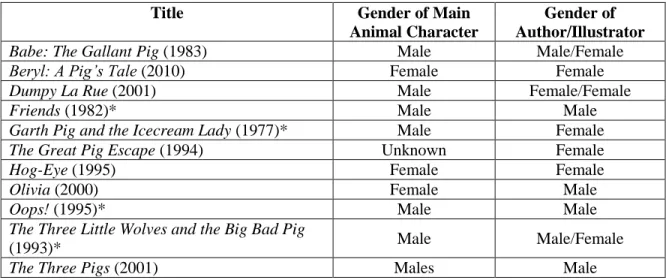
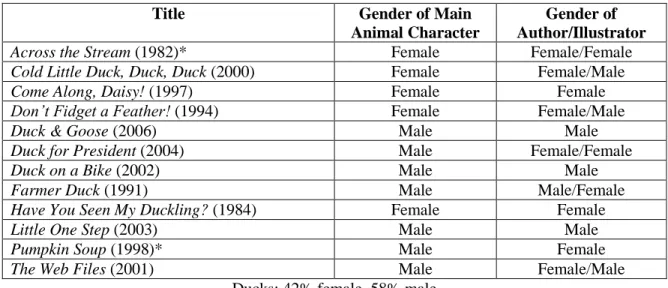
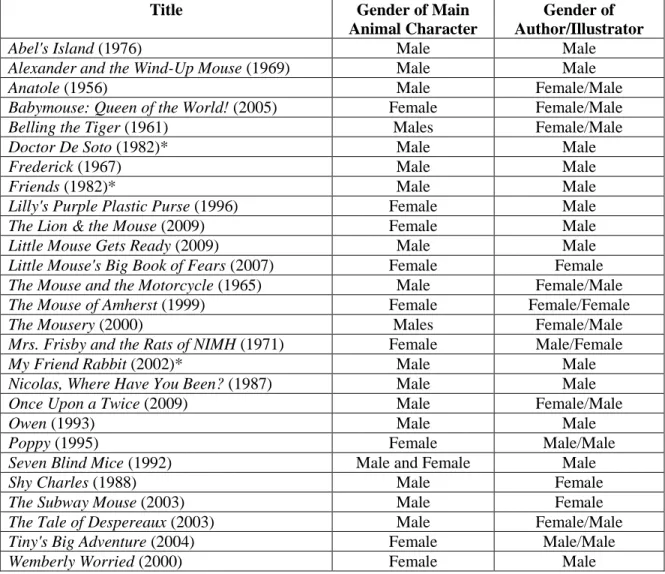
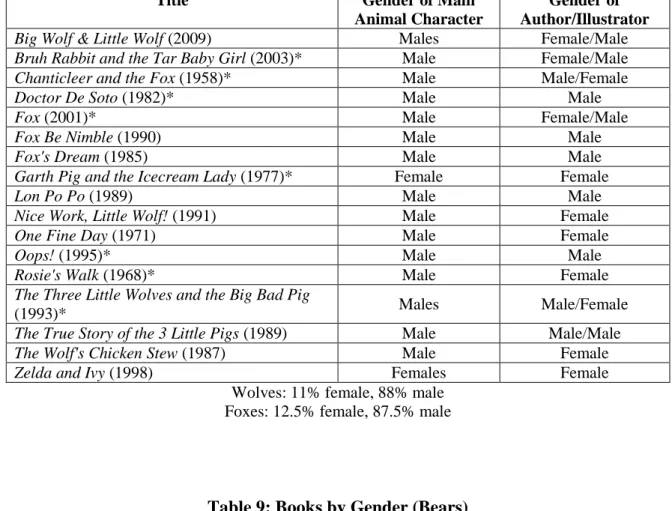
In this paper, a variety of different animal types have been included. Given the extent of anthropomorphic animals in children's literature, it would certainly be very easy to focus on only one kind of animal, providing a more specific literature analysis. Also, while a few tables addressing gender of these animal characters have been included as Appendix B, gender has not been thoroughly considered for this study. If an accurate gender study of animals were to be conducted, however, the number of books would have to be expanded, and perhaps more attention given to publication dates.
Bibliography
Anderson, Susan M. “„Regard[ing] a Mouse‟ in Dickinson‟s Poems and Letters.” The Emily Dickinson Journal 2.1 (1993): 84-102. Project Muse. Web. 5 Mar. 2011. Armstrong, Jennifer. "Eating Reading Animals." The Horn Book Magazine 86.3 (2010):
34-40. Academic Search Premier. Web. 18 Nov. 2010.
Arnold, Arthur. “The Pig – Pet, Pork or Sacrifice?” Children’s Literature in Education. 19.2 (1988): 80-85. SpringerLink. Web. 5 Mar. 2011.
Blount, Margaret. Animal Land: The Creatures of Children’s Fiction. New York: William Morrow, 1975. Print.
Bolle, Sonja. “Cluck, cluck buh-cawk!” Los Angeles Times 11 Jan. 2009. Web. 3 Mar. 2011.
<http://www.latimes.com/entertainment/la-caw-wordplay11-2009jan11,0,561227.story>
Burke, Carolyn L., and Joby G. Copenhaver. "Animals as People in Children's Literature." Language Arts 81.3 (2004): 205-213. Web. 18 Nov. 2010.
<https://secure.ncte.org/library/NCTEFiles/Store/SampleFiles/Journals/la/LA0813 Animals.pdf>
Cosslett, Tess. Talking Animals in British Children’s Fiction, 1786-1914. Burlington, VT: Ashgate, 2006. Print.
Galda, Lee, Bernice E. Cullinan, and Lawrence R. Sipe. Literature and the Child. 7th ed. Belmont, CA: Wadsworth/Cengage Learning, 2010. Print.
Grauerholz, Elizabeth, and Bernice A. Pescosolido. "Gender Representation in Children's Literature: 1900-1984." Gender & Society 3 (1989): 113-125. Sage Journals
Online. Web. 9 Mar. 2011.
Hartman, Anna. “Good Dog. Sit. Listen.” American Libraries 41.8 (2010): 13. Library Literature & Information Full Text. Web. 7 Mar. 2011.
Hogan, Walter. Animals in Young Adult Fiction. Lanham, Md.: Scarecrow Press, 2009. Print.
Hunt, Caroline C. “Dwarf, Small World, Shrinking Child: Three Versions of Miniature.” Children’s Literature 23 (1995): 115-136. Project Muse. Web. 5 Mar. 2011. Johnson, Katherine R. Understanding Children’s Animal Stories. Lewiston, NY: Edward
Mellen Press, 2000. Print.
Kortenhaus, Carole M., and Jack Demarest. "Gender Role Stereotyping in Children's Literature: An Update." Sex Roles 28.3/4 (1993): 219-232. SpringerLink. Web. 9 Mar. 2011.
Le Guin, Ursula K. "Cheek by Jowl: Animals in Children's Literature." Children and Libraries 2.2 (2004): 20-30. Education Full Text. Web. 18 Nov. 2010.
Lynch-Brown, Carol, Carl M. Tomlinson, and Kathy G. Short. Essentials of Children’s Literature. 7th ed. Boston: Pearson, 2011. Print.
Marcus, Leonard S. "Picture Book Animals: How Natural a History?" The Lion and the Unicorn 7/8 (1983-1984): 127-139. Project Muse. Web. 24 Feb. 2011.
2010. Print.
Newman, Anne Royall. “Images of the Bear in Children‟s Literature.” Children’s Literature in Education 18.3 (1987): 131-138. SpringerLink. Web. 5 Mar. 2011. Nikolajeva, Maria. “Devils, Demons, Familiars, Friends: Toward a Semiotics of Literary
Cats.” Marvels & Tales 23.2 (2009): 248-267. Project Muse. Web. 5 Mar. 2011. Nodelman, Perry, and Mavis Reimer. The Pleasures of Children’s Literature. 3rd ed.
Boston: Allyn and Bacon, 2003. Print.
Rahn, Suzanne. “Cat-Quest: A Symbolic Animal in Margaret Wise Brown.” Children’s Literature 22 (1994): 149-161. Project Muse. Web. 5 Mar. 2011.
Ritvo, Harriet. “Learning from Animals: Natural History for Children in the Eighteenth and Nineteenth Centuries.” Children’s Literature 13 (1985): 72-93. Project Muse. Web. 5 Mar. 2011.
Schoenfeld, Madalynne. "Stuffed Bears." Early Childhood Education Journal 12.3 (1985): 40-41. SpringerLink. Web. 5 Mar. 2011.
Trim, Mary. “Viva Hunca Munca: What Every Children‟s Librarian Should Know About Mice in Children‟s Literature.” New Review of Children’s Literature and
Appendix A: Children’s Books Cited
Aardema, Verna. Rabbit Makes a Monkey of Lion. Illus. Jerry Pinkney. New York: Dial, 1989. Print.
Avi. Poppy. Illus. Brian Floca. New York: Orchard Books, 1995. Print.
Bailey, Linda. Stanley’s Party. Illus. Bill Slavin. Toronto: Kids Can Press, 2003. Print. Becker, Bonnie. A Visitor for Bear. Illus. Kady MacDonald Denton. Cambridge, MA:
Candlewick Press, 2008. Print.
Bloom, Suzanne. A Splendid Friend, Indeed. Honesdale, PA: Boyds Mill Press, 2005. Print.
Brett, Jan. Daisy Comes Home. New York: G. P. Putnam‟s Sons, 2002. Print. Brown, Peter. Children Make Terrible Pets. New York: Little, Brown, 2010. Print. Brun-Cosme, Nadine. Big Wolf & Little Wolf. Illus. Olivier Tallec. New York: Enchanted
Lion, 2009. Print.
Chaucer, Geoffrey. Chanticleer and the Fox. Illus. Barbara Cooney. New York: Thomas Y. Crowell Company, [1958]. Print.
Christelow, Eileen. The Great Pig Escape. New York: Clarion, 1994. Print. Cleary, Beverly. The Mouse and the Motorcycle. Illus. Louis Darling. New York:
Morrow, 1965. Print.
Cooper, Helen. Pumpkin Soup. New York: Farrar Straus Giroux, 1998. Print.
Cronin, Doreen. Duck for President. Illus. Betsy Lewin. New York: Atheneum, 2004. Print.
Diakité, Baba Wagué. The Magic Gourd. New York: Scholastic, 2003. Print.
DiCamillo, Kate. The Tale of Despereaux: Being the Story of a Mouse, a Princess, Some Soup, and a Spool of Thread. Illus. Timothy Basil Ering. Cambridge, MA:
Candlewick Press, 2003. Print.
Doyen, Denise. Once Upon a Twice. Illus. Barry Moser. New York: Random House, 2009. Print.
Falconer, Ian. Olivia. New York: Atheneum, 2000. Print.
Falconer, Ian. Olivia Saves the Circus. New York: Atheneum, 2001. Print.
Feiffer, Kate. Henry the Dog with No Tail. Illus. Jules Feiffer. New York: Simon & Schuster, 2007. Print.
Foley, Greg. Thank You Bear. New York: Viking, 2007. Print.
Ginsburg, Mirra. Across the Stream. Illus. Nancy Tafuri. New York: Greenwillow, 1982. Print.
Gravett, Emily. Little Mouse’s Big Book of Fears. New York: Simon & Schuster, 2007. Print.
Gravett, Emily. Wolves. New York: Simon & Schuster, 2005. Print.
Hamilton, Virginia. Bruh Rabbit and the Tar Baby Girl. Illus. James E. Ransome. New York: Blue Sky Press, 2003. Print.
Heidenreich, Elke. Nero Corleone: A Cat’s Story. Illus. Quint Buchholz. New York: Viking, 1995. Print.
Heine, Helme. Friends. New York: Margaret K. McElderry, 1982. Print.
Henkes, Kevin. Julius, the Baby of the World. New York: Greenwillow, 1990. Print. Henkes, Kevin. Kitten’s First Full Moon. New York: Greenwillow, 2004. Print. Henkes, Kevin. Lilly’s Big Day. New York: Greenwillow, 2006. Print.
Henkes, Kevin. Lilly’s Purple Plastic Purse. New York: Greenwillow, 1996. Print. Henkes, Kevin. Old Bear. New York: Greenwillow, 2008. Print.
Henkes, Kevin. Owen. New York: Greenwillow, 1993. Print.
Henkes, Kevin. Wemberly Worried. New York: Greenwillow, 2000. Print. Hills, Tad. Duck & Goose. New York: Schwartz & Wade, 2006. Print. Hogrogian, Nonny. One Fine Day. New York: Macmillan, 1971. Print.
Holm, Jennifer L., and Matthew Holm. Babymouse: Queen of the World! New York: Random House, 2005. Print.
Hutchins, Pat. Rosie’s Walk. New York: Macmillan, 1968. Print.
James, Simon. Little One Step. Cambridge, MA: Candlewick Press, 2003. Print. Jenkins, Emily. That New Animal. Illus. Pierre Pratt. New York: Farrar, Straus, and
Giroux, 2005. Print.
Johansen, Hanna. Henrietta and the Golden Eggs. Illus. Käthi Bhend. Boston: David R. Godine, 1998. Print.
Kasza, Keiko. The Wolf’s Chicken Stew. New York: G. P. Putnam‟s Sons, 1987. Print. King-Smith, Dick. Babe: The Gallant Pig. Illus. Mary Rayner. New York: Crown
King-Smith, Dick: Martin’s Mice. Illus. Jez Alborough. New York: Crown Publishers, 1989, Print.
Kvasnosky, Laura McGee. Zelda and Ivy. Cambridge, MA: Candlewick Press, 1998. Print.
Lawson, Robert. Rabbit Hill. New York: Puffin, [1944]. Print.
Lee, Ho Baek. While We Were Out. La Jolla, CA: Kane/Miller, 2003. Print.
Lionni, Leo. Alexander and the Wind-Up Mouse. New York: Alfred A. Knopf, [1969]. Print.
Lionni, Leo. Frederick. New York: Alfred A. Knopf, [1967]. Print.
Lionni, Leo. Nicolas, Where Have You Been? New York: Alfred A. Knopf, 1987. Print. Marshall, James. Fox Be Nimble. New York: Dial, 1990. Print.
Martin, Ann M. A Dog’s Life: The Autobiography of a Stray. New York: Scholastic, 2005. Print.
McBratney, Sam. Guess How Much I Love You. Illus. Anita Jeram. Cambridge, MA: Candlewick Press, 1994. Print.
McCarty, Peter. Henry in Love. New York: Balzar + Bray, 2010. Print.
McDermott, Gerald. Zomo the Rabbit: A Trickster Tale from West Africa. Orlando: Voyager, 1992. Print.
McNaughton, Colin. Oops! New York: Harcourt Brace, 1995. Print. Meddaugh, Susan. Hog-Eye. Boston: Houghton Mifflin, 1995. Print. Meddaugh, Susan. Martha Speaks. Boston: Houghton Mifflin, 1992. Print.
Minarik, Else Holmelund. Father Bear Comes Home. Illus. Maurice Sendak. New York: HarperCollins, [1959]. Print.
Minarik, Else Holmelund. Little Bear’s Visit. Illus. Maurice Sendak. New York: HarperCollins, [1961]. Print.
Mollel, Tololwa M. To Dinner, for Dinner. Illus. Synthia Saint James. New York: Holiday House, 2000. Print.
Myers, Walter Dean. The Blues of Flats Brown. Illus. Nina Laden. New York: Holiday House, 2000. Print.
Newberry, Clare Turlay. Marshmallow. New York: HarperCollins, [1942]. Print. O‟Brien, Robert C. Mrs. Frisby and the Rats of NIMH. Illus. by Zena Bernstein. New
York: Atheneum, 1971. Print.
Offen, Hilda. Nice Work, Little Wolf! New York: Dutton, 1991. Print. Oldland, Nicholas. Big Bear Hug. Toronto: Kids Can Press, 2009. Print.
Palatini, Margie. The Web Files. Illus. Richard Egielski. New York: Hyperion, 2001. Print.
Paye, Won-Ldy, and Margaret H. Lippert. Mrs. Chicken and the Hungry Crocodile. Illus. Julie Paschkis. New York: Henry Holt, 2003. Print.
Perrault, Charles. Puss in Boots. Illus. Fred Marcellino. New York: Farrar Straus Giroux, 1990. Print.
Peters, Lisa Westberg. Cold Little Duck, Duck, Duck. Illus. Sam Williams. New York: Greenwillow, 2000. Print.
Pomerantz, Charlotte. The Mousery. Illus. Kurt Cyrus. New York: Gulliver, 2000. Print. Portis, Antoinette. Not a Box. New York: HarperCollins, 2006. Print.
Rayner, Catherine. Harris Finds His Feet. Intercourse, PA: Good Books, 2008. Print. Rayner, Mary. Garth Pig and the Icecream Lady. New York: Atheneum, 1977. Print. Reibstein, Mark. Wabi Sabi. Illus. Ed Young. New York: Little, Brown, 2008. Print. Reid, Barbara. The Subway Mouse. New York: Scholastic, 2003. Print.
Rohmann, Eric. My Friend Rabbit. Brookfield, CT: Roaring Brook, 2002. Print. Said, S. F. Varjak Paw. Illus. Dave McKean. New York: David Fickling, 2003. Print. Scieszka, John. The True Story of the 3 Little Pigs. Illus. Lane Smith. New York: Viking,
1989. Print.
Shannon, David. Duck on a Bike. New York: Blue Sky Press, 2002. Print.
Shannon, George. Tippy-Toe Chick, Go! Illus. Laura Dronzek. New York: Greenwillow, 2003. Print.
Sidman, Joyce. Meow Ruff. Illus. Michelle Berg. Boston: Houghton Mifflin, 2006. Print. Silverman, Erica. Don’t Fidget a Feather! Illus. S. D. Schindler. New York: Macmillan,
1994. Print.
Simmons, Jane. Beryl: A Pig’s Tale. New York: Little, Brown, 2010. Print. Simmons, Jane. Come Along, Daisy! New York: Little, Brown, 1997. Print. Smith, Jeff. Little Mouse Gets Ready. New York: Toon Books, 2009. Print.
Soto, Gary. Chato’s Kitchen. Illus. Susan Guevara. New York: G. P. Putnam‟s Sons, 1995. Print.
Steig, William. Abel’s Island. New York: Farrar, Straus and Giroux, [1976]. Print. Steig, William. Doctor De Soto. New York: Farrar, Straus and Giroux, 1982. Print. Stolz, Mary. Belling the Tiger. Illus. Beni Montresor. New York: Harper & Row, 1961.
Print.
Tafuri, Nancy. Have You Seen My Duckling? New York: Greenwillow, 1984. Print. Tejima, Keizaburō. Fox’s Dream. New York: Philomel, 1985. Print.
Thompson, Lauren. Polar Bear Night. Illus. Stephen Savage. New York: Scholastic, 2004. Print.
Titus, Eve. Anatole. Illus. Paul Galdone. New York: Alfred A. Knopf, [1956]. Print. Titus, Eve. Anatole and the Cat. Illus. Paul Galdone. New York: Alfred A. Knopf,
[1957]. Print.
Trivizas, Eugene. The Three Little Wolves and the Big Bad Pig. Illus. Helen Oxenbury. New York: Margaret K. McElderry, 1993. Print.
Voake, Charlotte. Ginger. Cambridge, MA: Candlewick Press, 1997. Print.
Waber, Bernard. Bearsie Bear and the Surprise Sleepover Party. New York: Houghton Mifflin, 1997. Print.
Waddell, Martin. Can’t You Sleep, Little Bear? Illus. Barbara Firth. Cambridge, MA: Candlewick Press, 1988. Print.
Waddell, Martin. Farmer Duck. Illus. Helen Oxenbury. Cambridge, MA: Candlewick Press, 1991. Print.
Waddell, Martin. Tiny’s Big Adventure. Illus. John Lawrence. Cambridge, MA: Candlewick Press, 2004. Print.