Utilizing Object Compression for
Better J2ME Remote Method
Invocation in 2.5G Networks
Jalal Kawash, Ahmad El-Halabi and Ghassan Samara
Department of Computer Science, American University of Sharjah, UAEThis paper introduces two new Java 2 Platform Mi-cro Edition(J2ME)Remote Method Invocation(RMI)
packages. These packages make use of serialized object compression and encryption in order to respectively minimize the transmission time and to establish secure channels. The currently used J2ME RMI package does not provide either of these features. Our packages substantially outperform the existing Java package in the total time needed to compress, transmit, and decompress the object for General Packet Radio Service (GPRS)
networks, often called 2.5G networks, even under ad-verse conditions. The results show that the extra time incurred to compress and decompress serialized objects is small compared to the time required to transmit the object without compression in GPRS networks. Existing RMI code for J2ME can be obliviously used with our new packages.
Keywords: RMI, compression, encryption, J2ME, wire-less, GPRS.
1. Introduction
There is a constant increase in the proliferation of wireless handheld devices and in their com-puting capabilities. Wireless devices have lim-itations with processor power, memory space, and bandwidth. In order to cope with some of these limitations and to address the needs of a rapidly growing wireless technology mar-ket, Sun Microsystems introduced Java 2 Micro Edition(J2ME)platform. About half a billion users currently carry handheld phones that can run J2ME and there are 150 mobile operators supporting Java1]. Except for mobile gaming, this huge device population is not being taken advantage of.
Java Remote Method Invocation(RMI)allows programmers to rapidly create Java-to-Java dis-tributed applications, without the need to
rea-son about the complex message passing details. J2ME supports an RMI Optional Package(RMI OP) on some device families, and Java RMI on wireless devices offers a promising mecha-nism to address the need to build successful mo-bile and Peer-to-peer(P2P)applications. Many reasons lead us for this conjecture. These in-clude Java’s wide adoption, development con-venience, crossplatform compatibility on a wide range of supporting devices, and an appealing security model.
Java objects are passed by value to remote meth-ods throughserialization, which is a mechanism of converting a set of objects into a linear stream of bytes. Because objects may contain refer-ences to other objects, serializing Java objects converts them into linked structures and it also inflates their original size. Transmitting such large object graphs can consume a large chunk of network bandwidth and CPU time. In spite of low bandwidth and large transmission error rates in wireless networks, RMI OP does not try to compress serialized objects before trans-mitting them. Furthermore, RMI OP does not encrypt these objects before transmission. The programmers are left with the job of ensuring both efficient and secure transmission of Java serialized objects.
to compress data objects and RMI EOP-PPM makes use of prediction by partial matching. Our experimental results show that, in spite of the extra time incurred by compressing and de-compressing objects, RMI EOP-GZip transmits objects faster than RMI OP by a factor of 60% to 74% in GPRS networks. Similarly, RMI EOP-PPM is 27% to 54% faster than RMI OP also using GPRS.
Sun’s original Java RMI implementation was slow and many enhancements and drop-in re-placements have been suggested. Krishnaswamy et al. 2] proposed a better implementation of RMI that uses UPD instead of TCP and re-lies on caching. Thiruvathual et al. 3] and Philipsen et al.4] suggested alternative object serialization mechanisms. Since serialization is the major performance inhibitor in RMI, Berg and Ploychronopoulos5]implemented part of Java’s serialization protocol in native code to make it faster. Other similar studies to improve RMI efficiency include Nester et al.’s 6] and Massen et al.’s7]. The latter discussed a new implementation of RMI which uses static in-stead of just-in-time compiling. This allows the utilization of compile-time information to get better object sterilizations. The implemen-tation also utilizes faster protocol and commu-nication. Their experimental results were ob-tained on multiprocessor machines with 16 or 32 processors. However, Nester et al.6] pro-vide RMI protocols that are faster than the stan-dard Sun implementation, even without resort-ing to native code. Kurzyniec et al. 8] tested different RMI protocol implementations. All of these studies are concerned with “full-size” Java Virtual Machines(JVMs)and do not apply to J2ME environments.
However, there is some(although very limited) related work in J2ME environments. P. C. Wei et al.9]reported on RMI support and optimiza-tion for Bluetooth environments. They devel-oped a cost model for access patterns in RMI communication. This study is limited to Blue-tooth. Other related studies include memory management10], garbage collection 11], and energy savings 12] for limited-memory envi-ronments. Optimizing Java-based cryptogra-phy applications to Kilobyte Virtual Machines is discussed by Matsuoka et al.13].
To the best of our knowledge, this is the first study that is concerned with developing a more efficient replacement of J2ME OP using seri-alized object compression. Our work also
in-cludes encryption for secure channel mecha-nisms.
Paper roadmap: Section 2 provides back-ground information. Section 3 contains a de-tailed description of both versions of RMI EOP and Section 4 presents the experimental eval-uations and results. Section 5 concludes the paper.
2. Background
2.1. J2ME
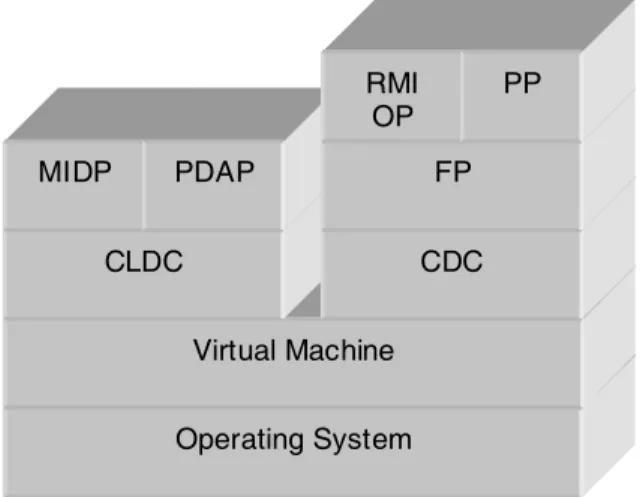
The J2ME14]architecture(Figure 1)involves
configurations,profiles, andoptional packages, which can be used by developers to construct a complete Java runtime environment that closely fits the requirements of a particular range of de-vices. Each combination is optimized for the memory, processing power, and I/O capabili-ties of a class of mobile devices. The config-urations and profiles are used to customize the J2ME runtime environment.
The basic runtime environment is defined as a configuration, combining a virtual machine and a collection of core classes. These core classes can run on a target family of devices, sharing similar characteristics. A configuration defines minimum requirements for such a fam-ily of devices. These requirements are: mem-ory size, virtual machine, language support, and core runtime libraries.
J2ME supports two configurations: the Con-nected Device Configuration (CDC), version 1.0 known as JSR36 (and recently version 1.1
Operating System Virtual Machine
CLDC CDC
MIDP PDAP FP
RMI
OP PP
known as JSR 218), and the Connection Lim-ited Devices Configuration (CLDC), version 1.0 known as JSR30(and recently version 1.1 known as JSR 139). CLDC is targeted to re-source constrained mobile devices. The vir-tual machines Kuaui Virvir-tual Machine (KVM) and (recently) HotSpot are respectively used in CLDC 1.0 and 1.1. RMI is not supported in CLDC. CDC is targeted to higher-end de-vices with more capabilities. Compact Virtual Machine(CVM)is used in CLDC 1.0 and the recent CLDC 1.1 uses the HotSpot implemen-tation. In J2ME, RMI is only14]supported in CDC.
Configurations are complemented by profiles in order to provide support for application devel-opment and execution. Profiles provide Ap-plication Programmer Interfaces (APIs), for devices that share some capabilities. CDC has many profiles and packages, including the JSR46 Foundation Profile (FP), JSR129 Ba-sis Profile(PBP), JSR62 Personal Profile(PP) and RMI OP. The RMI OP reference imple-mentation can be built with impleimple-mentations of CDC/FP-based profiles and PBP. RMI OP re-quires a minimum RAM of 512 KB.
2.2. Data Compression
Data compression is the process of encoding data so that its storage space or transmission time is minimized. There are two types of data compression algorithms, depending on how they preserve data. Lossy data compressiondoes not require the compressed data to be exactly the same as the decompressed data, but should be close enough in order to be useful in some way
15]. Obviously, lossy compression algorithms are not suitable for compressing the programs including Java objects, which require lossless data compression. This category prohibits any difference between decompressed and com-pressed data15].
Our RMI enhancement makes use of two loss-less tools, which are Prediction by Partial Match-ing(PPM)16, 17]and GNU Zip(GZip)18].
PPM is an adaptive statistical data compres-sion technique based on context modeling and prediction. PPM was originally proposed by Cleary and Witten 16]. In its finite context form, PPM(k)predicts thek+1
stsymbol in an
input stream, based on the precedingksymbols in the stream. k is called the model order and
PPM makes use of PPM(k) for values from 0 up to a predefined maximum value, typically 16. For each model (for each k), PPM keeps track of the characters that have occurred after every subsequence of lengthk, as well as the fre-quencies of these occurrences. PPM generates prediction probabilities for the next characters based on these measures. The probability dis-tributions are different for different model or-ders and PPM combines these distributions into one distribution. That is, PPM-level n makes use of PPM(k), for 0 k n, to generate what is called escape probabilities. It first uses PPM(n) to calculate the prediction probabili-ties. If a new character is encountered when us-ing PPM(k), for which model orderkcannot be used to encode it, PPM switches to PPM(k;1). This process is repeated until the character is not new in that model order. In the worst case, this can be repeated until model order 0 is reached. There has been many improvements to PPM19, 20]; in particular PPM 19]uses similar ideas, but with unbounded contexts.
GZip is an open-source replacement for the
UNIX compress program and was created by Jeanloup Gailly and Mark Adler. GZip gives a better compression rate, the algorithms it uses are non-patented. GZip is based on the deflate algorithm 18]. The deflate algorithm consid-ers the input stream to be a sequence blocks of arbitrary sizes. This algorithm compresses each block separately, using a combination of LZ77 and Huffman coding. Huffman coding creates trees that allow us to encode data based on its frequency in the input stream. The more frequently a data item occurs, the smaller its encoding should be. The deflate algorithm cre-ates a Huffman tree for each block, indepen-dently from the trees corresponding to other blocks. However, LZ77 may use references to an input string duplicated in a previous block. Hence, each block with the deflate algorithm consists of Huffman code trees representing the compressed data and the compressed data itself. The compressed data consists of literal( undu-plicated)data and references to duplicated data in previous blocks.
3. RMI Enhanced Optional Packages
oper-ation from the stream. This requires the agree-ment between the remote object’s skeleton and the client’s stub on a new header format, im-plemented by ourcreate headeroperation. We present two versions of the protocol, the first re-lies on PPM for compression and is called EOP-PPM and the second uses GZip and is called EOP-GZip.
3.1. Reading and Writing
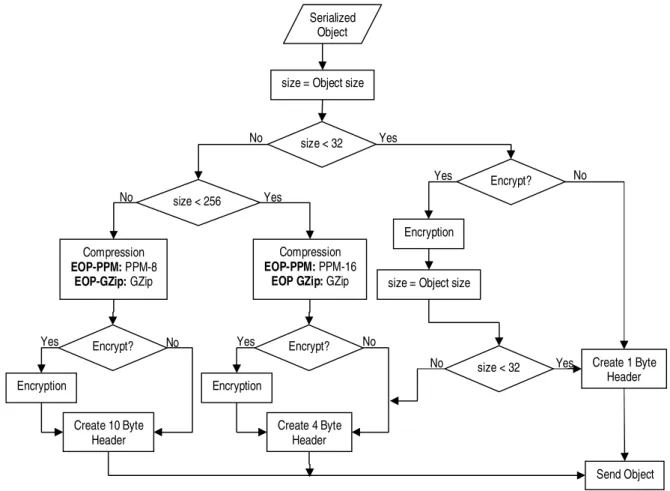
The writing operation is outlined in Figure 2, for both versions. For small size(less than 32 bytes)serialized objects, compression is omit-ted, unless encryption inflates the object serial-ization to a size larger than 32 bytes. For larger objects, EOP-PPM makes use of PPM-level 8 and PPM-level 16, depending on the size of the object and EOP-GZip always uses GZip for any object of size more than 32 bytes. Regardless of the compression tool used, an appropriate packet header is generated. The read opera-tion is merely a reversed process for the write operation.
3.2. Operation Modes
In each package there are 4 operation modes re-flecting the use of compression or encryption, both, one without the other, or neither. In the case where neither is used, RMI EOP simply operates as RMI OP.
3.3. Packet Header
The Create Header procedure is responsible for generating compatible packet headers between the remote object’s skeleton and the client’s stub. The header size varies with the object size. RMI EOP uses 3 header sizes, which can be determined by reading the first byte(called theindicator). For example, if the indicator in-cludes a value less than 40Hex, the header is a 1-byte header. The headers are as follows:
1-byte header: four bits indicate the size of the object and an additional bit indicates if the object is encrypted or not.
Serialized Object
size = Object size
size < 32
Encrypt?
Compression EOP-PPM: PPM-16
EOP GZip: GZip Compression
EOP-PPM: PPM-8 EOP-GZip: GZip
Yes No
Yes No size < 256
No
Create 1 Byte Header Encryption
No Encrypt? Yes
Create 4 Byte Header
Send Object Encryption
No Encrypt? Yes
Create 10 Byte Header
Yes
Encryption
size < 32 Yes No
size = Object size
4-byte header: The first byte is the indicator byte; the second byte is the operation mode; the third is the original object size(prior to com-pression and decryption); and the last is for the size after compression and encryption.
10-byte header: This header adds (to the 4-byte header)3 bytes for the original size of the object and 3 bytes for the resulting size.
3.4. Encryption
Secure RMI is established by using symmetric key cryptography. The symmetric key is valid for one RMI session and public key cryptog-raphy is used in order to exchange the session key.
Secure channels in RMI EOP are implemented using the Bouncy Castle Crypto package 1.3
21]. This package is organized so that it con-tains a light-weight API suitable for use in any environment including the newly released J2ME and doesn’t require a high computation power. The Bouncy Castle Crypto package supports a handful of encryption algorithms. It includes symmetric and asymmetric cryptosystems, in addition to message digest algorithms. RMI EOP makes use of the Data Encryption Standard
(DES)22]to establish a secure channel and the Rivest-Shamir-Adleman(RSA) algorithm 23] to communicate the shared key.
3.5. Memory Requirements
On limited memory devices, PPM can be pro-hibitively expensive in terms of RAM usage. RMI EOP requires a minimum of 1MB of RAM for fast mode and 30MB for medium mode. Typical CDC devices are equipped with 32 to 128MB of RAM. For storing objects, RMI EOP can optionally make use of chunking. This is ac-complished through the use of a 100KB buffer to store the compressed and encrypted object. When the buffer is filled, its contents are trans-mitted and a new chunk can be prepared in the buffer.
3.6. Using RMI EOP
The changes to existing Java RMI OP code are minimal. In both implementations ( EOP-GZip and EOP-PPM) the programmer is re-quired to make remote object types subclasses
of comUnicastRemoteObject, instead of Uni-castRemoteObject. A new overloaded
con-structor is provided in comUnicastRemoteOb-ject, super(port, mode), which allows the programmer to choose from the four opera-tion modes. All remaining code is oblivious
to changes.
4. Experimental Evaluation
4.1. Java Object Benchmark
The benchmark introduced by Nester et al. 6] is not suitable for our purpose, since we are not testing different RMI protocols, and we are not aware of any other RMI benchmarks. In fact, both RMI OP and RMI EOP work us-ing the same underlyus-ing RMI protocol and will both generate exactly the same communication patterns and number of messages. Since RMI EOP uses compression and encryption, we are obliged to verify how RMI EOP performs rel-ative to RMI OP on different Java objects. So, our benchmarking is primarily concerned with using different object contents and sizes.
Test Cases
Array type /
Class 1 2 3 4
boolean X X X
byte X X
char X X X
short X X X
int X X X
long X X X
float X X X
double X X X X
String X X X
Vector X X
HashTable X X X
Table 1.Examples of the contents of test cases.
4.2. Parameters and Assumptions
RMI EOP incurs an additional cost for com-pressing the object by the sender and then de-compressing it by the receiver. The time re-quired to both compress and decompress an object is called processing time. So the total time required to send and receive an object be-tween the calling object and the remote object in RMI EOP consists of processing time in ad-dition to the transmission time. We assume that both ends in RMI communication(sender and receiver) are CDC devices (P2P environ-ment). That is, the time taken to compress and
decompress an object is substantially larger than the case when one of the parties is a full-size server machine. Even with this assumption, we demonstrate that RMI EOP is appealing. In RMI OP, only the transmission time needs to be measured. The set up time is similar for both packages and is ignored. When secure channels are used, the processing time for both packages includes the time required for encryption and decryption. Our experiments were conducted based on GPRS wireless network technologies. The practical peak performance of GPRS is 53.6 Kilobit/second22].
4.3. Development and Testing Environment
RMI EOP was developed using Nokia’s Series 80 Developer Platform 2.0 SDK for Symbian OS – For Personal Profile, Version 1.0 25]. The running time measurements reported in the next subsection are valid for devices with clock speed of 400 MHz and 128MB RAM26].
4.4. Experimental Results
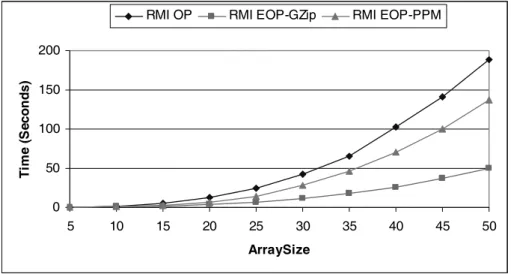
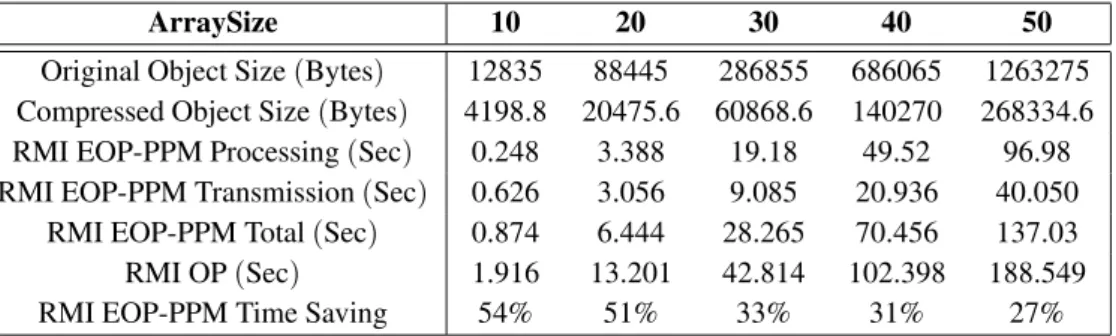
Even if GPRS operates at its peak, RMI EOP
(both versions)show a total time savings over RMI OP. EOP-GZip outperforms both RMI OP and RMI EOP-PPM. Figure 3 depicts a sum-mary of the results, ignoring re-transmissions, and without encryption. In Figure 3, thex-axis represents ArraySize and the y-axis represents the total time (processing and transmission).
0 50 100 150 200
5 10 15 20 25 30 35 40 45 50
ArraySize
Ti
m
e (
S
ec
on
ds)
RMI OP RMI EOP-GZip RMI EOP-PPM
ArraySize 10 20 30 40 50
Original Object Size(Bytes) 12835 88445 286855 686065 1263275
Compressed Object Size(Bytes) 4665.99 24498.7 743391 171733 328958
RMI EOP-GZip Processing(Sec) 0.0067 0.043 0.132 0.314 0.570
RMI EOP-GZip Transmission(Sec) 0.696 3.656 11.095 25.631 49.098
RMI EOP-GZip Total(Sec) 0.703 3.699 11.227 25.945 49.619
RMI OP(Sec) 1.916 13.201 42.814 102.398 188.549
RMI EOP-GZip Time Saving 63% 71% 73% 74% 73%
Table 2.RMI EOP-GZip detailed results for selected values of ArraySize.
ArraySize 10 20 30 40 50
Original Object Size(Bytes) 12835 88445 286855 686065 1263275
Compressed Object Size(Bytes) 4198.8 20475.6 60868.6 140270 268334.6
RMI EOP-PPM Processing(Sec) 0.248 3.388 19.18 49.52 96.98
RMI EOP-PPM Transmission(Sec) 0.626 3.056 9.085 20.936 40.050
RMI EOP-PPM Total(Sec) 0.874 6.444 28.265 70.456 137.03
RMI OP(Sec) 1.916 13.201 42.814 102.398 188.549
RMI EOP-PPM Time Saving 54% 51% 33% 31% 27%
Table 3.RMI EOP-PPM detailed results for selected values of ArraySize.
0 20 40 60 80 100 120
0% 10% 20% 30% 40% 50% 60% 70% 80%
Probability of Transmission Fault
Ti
m
e (
se
con
d
s)
RMI OP RMI EOP-GZip RMI EOP-PPM
Fig. 4.Effect of unreliable channels, sampled over all test cases.
The figure shows that the total time in EOP-GZip is between 25% and 54% of the RMI OP time. EOP-GZip total time is between 34% and 80% of EOP-PPM GZip. Tables 2 and 3 give more detailed results.
These numbers are even better for RMI EOP in the cases of faulty channels and secure channels. We only show the results for the base test class, which contains all of the Java types mentioned earlier.
Faulty Channels Effect
When channels are faulty(and this is typical in wireless networks), a retransmission of the se-rialized object will be required. Figure 4 shows the effect of faulty transmissions on RMI EOP and RMI OP. The figure is a projection of Fig-ure 3, averaging all cases of ArraySize. The
0 50 100 150 200 250
0% 10% 20% 30% 40% 50% 60% 70% 80%
Bandwidth Loss
Ti
m
e (
se
con
d
s)
RMI OP RMI EOP-GZip RMI EOP-PPM
Fig. 5. Effect of throughput loss, sampled over all test cases.
is minimal. However, the high impact on RMI OP is clear. There is also a moderate impact on RMI EOP-PPM.
Bandwidth Loss Effect
When GPRS does not operate at its peak through-put, both versions of RMI EOP become even more attractive to use, as is illustrated in Fig-ure 5. This figFig-ure is a projection of the mea-surements given in Figure 3. The x-axis rep-resents the loss in network throughput, up to a maximum throughput of 25% of the peak per-formance.
Secure Channels Effect
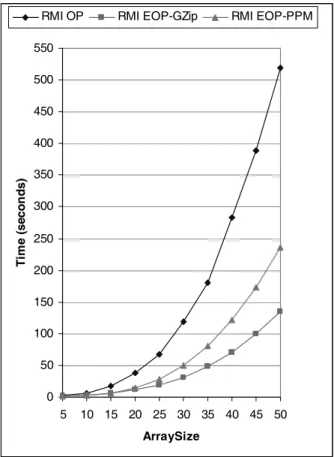
Encrypting serialized objects inflates their size and, therefore, makes their transmission time higher. Hence, the use of compression is even more urging when using secure channels. Fig-ure 6 summarizes experiments with RMI EOP using secure channels. It shows that the benefits of using RMI EOP over RMI OP are magnified when objects of the base class are encrypted.
5. Conclusions
We have introduced a new J2ME RMI pack-age, which makes use of object compression in order to minimize the transmission time. The package, called RMI EOP, also supports secure channels. The currently existing RMI package
(RMI OP)for wireless devices does not provide either of these crucial features.
0 50 100 150 200 250 300 350 400 450 500 550
5 10 15 20 25 30 35 40 45 50
ArraySize
Ti
m
e (
se
con
ds)
RMI OP RMI EOP-GZip RMI EOP-PPM
Fig. 6.Effect of secure channels for different values of ArraySize, using selected test cases.
0 5 10
0 10 20 30 40 50
ArraySize
Ti
m
e (
se
con
ds
)
RMI OP RMI EOP-GZip RMI EOP-PPM
Fig. 7. Projection to 3G technologies with 1.5 Mb/s transmission rate.
(2)non-faulty channels,(3)insecure channels, and(4)both RMI communication ends are CDC devices. When these conditions are relaxed, the results are even more appealing.
RMI EOP makes use of GZip and PPM for ob-ject compression. PPM is time and memory intensive. RMI EOP supports three operation modes, one of which (slow) is only suitable for full-size server machines. In the other two modes(fast and medium), RMI EOP requires between 1MB and 30MB of RAM, respectively. This makes RMI EOP in its medium mode un-suitable for memory-constrained devices(Many handheld devices have a maximum of 32MB RAM). Some of our preliminary results on the use of LZMA show that it always outperforms PPM, in time and space.
Our Java object benchmark does not include ob-jects that contain multimedia members, such as images. In such a case, we conjecture that PPM will outperform GZip. Therefore, finding ways to improve the running time of RMI EOP-PPM is crucial.
While this paper showed that RMI EOP outper-forms RMI OP in GPRS networks, these conclu-sions may no longer be valid for 3G networks. For instance, the Universal Mobile Telecom-munications System (UMTS) 27] may allow transfer rates close to 2 Mb/s. A projection of the results given in Section 4 to this new rate shows that, contrary to GPRS, RMI OP will outperform RMI EOP in 3G networks. Fig-ure 7 projects the expectations for transmission
rates of 1.5 Mb/s., and maintains the compres-sion/decompression figures of Section 4. How-ever, we believe that with 3G technologies, also faster processors and better compression tech-niques would be developed.
6. Acknowledgments
We are grateful for the anonymous referees( es-pecially, referee #2)for their thorough and care-ful reading of the manuscript. Their sugges-tions were very valuable in preparing the final manuscript.
Preliminary results pertaining to the package RMI EOP-PPM were reported in “J. Kawash, G. Samara and A. El-Halabi. More Efficient Java RMI for GPRS Devices. InNew Trends in Com-puter Networks (T. Tugcu, M.U. ¸Ca˘ glayan, F.˘ Alag¨oz, and E. Gelenbe, Ed.) (2005)pp. 144– 153. Imperial College Press, London, UK”.
References
1] Mobile Monday Web Site, April 2005. http://www.mobilemonday.com.
2] V. KRISHNASWAMY, D. WALTHER, S. BOHLA, E.
BOMMAIAH, G. RILEY, B. TOPOL ANDM. AHAMAD, Efficient Implementation of Java RMI. Proc. Of the 24 USENIX Conference on Object-Oriented Technologies and Systems, 1998.
3] G. K. THIRUVATHUKAL, L. S. THOMAS, AND A. T.
KORCZYNSKI, Reflective remote method invocation.
Concurrency: Practice and Experience, 10(11–
4] M. PHILIPPSEN, B. HAUMACHER AND C. NESTER,
More Efficient Serialization and RMI for Java. Con-currency: Practice and Experience,(12)7:495–518,
2000.
5] F. BERG ANDC. D. PLOYCHRONOPOULOS, Java
Vir-tual Machine Support for Object Serialization.Proc. of the ACM 2001 Java Grande Conference, pp. 173– 180.
6] C. NESTER, M. PHILIPPSEN ANDB. HAUMACHER, A
More Efficient RMI for Java. Proc. Of the ACM 1999 Java Grande Conference, pp. 153–159.
7] J. MAASSEN, R. V. NIEWPOORT, R. VEILDEMA, H.
BAL, T. KIELMANN, C. JACOBS ANDR. HOFMAN, Efficient Java RMI for Parallel Programming. ACM
Transactions on Programming Languages Systems, 23(6):747–775, 2001.
8] D. KURZYNIEC, T. WRZOSEK, V. SUNDERAM AND
A. SLOMINISKI, Experiments with Multi-Protocol RMI in Java.Proc. of the ACM 2002 Java Grande Conference, pp. 233.
9] P. C. WEI, C. H. CHEN, C. W. CHEN ANDJ. K. LEE,
Java RMI over Bluetooth.Proc. of the ACM 2002 Java Grande Conference, pp. 237.
10] G. CHEN, M. KANDEMIR, N. VIJAYKRISHNAN, M. J.
IRWIN AND B. MATHISKE, Heap Compression for Memory-Constrained Java Environments.Proc. of the 18th Annual ACM Conference on Object-Oriented Programming, Systems, Languages, and Applications, pp. 282–301, 2003.
11] G. CHEN, R. SHETTY, M. KANDEMIR ANDN.
VI-JAYKRISHNAN, M. J. IRWIN ANDM. WOLCZKO, Tun-ing Garbage Collection in an Embedded Envi-ronment. Proc. of the 18th Int’l Symposium on High-Performance Computer Architecture, 2002.
12] G. CHEN, M. KANDEMIR AND N. VIJAYKRISHNAN
AND W. WOLF, Energy Savings through Com-pression in Embedded Java Environments. Proc. of the 10th International Symposium on Hard-ware/Software Codesign, 2002.
13] Y. MATSUOKA ANDP. SCHAUMONT, K. TIRI ANDI.
VERBAUWHEDE, Java Cryptography on KVM and its Performance and Security Optimization Using HW/SW Co-design Techniques, Proc. of Inter-national Conference on Compliers, Architecture, and Synthesis for Embedded Systems, pp. 303–311, 2004.
14] Java 2 Platform Micro Edition.
http://java.sun.com/j2me/index.jsp.
15] Data Compression, Retrieved October 1, 2004 from: http://www.bambooweb.com/articles/ l/o/Lossless data compression.html.
16] J. G. CLEARY AND I. H. WITTEN, Data
Compres-sion Using Adaptive Coding and Partial String Matching.IEEE Transactions on Communications, 32(4):396–402, 1984.
17] http://www.colloquial.com/ ArithmeticCoding/
18] J. GAILLY, The gzip homepage. Retreived October
1, 2004 from:http://www.gzip.org.
19] J. G. CLEARY, W. J. TEAHNAN AND I. H. WITTEN,
Unbounded Length Contexts for PPM. Computer Journal, 40(2/3):67–75, 1997.
20] D. SHAKRIN, PPM: One Step to Practicality.Proc. of the IEEE Data Compression Conference, pp. 2020211, 2002.
21] Bouncy Castle Crypto Package. http://www.bouncycastle.org.
22] N. M. DESHPANDE ANDJ. GILBERT, GPRS – How
Does it Work and How Good Is It?Intel Developer UPDATE Magazine, October 2002. Available at
http://www.colloquial.com/ ArithmeticCoding/
23] R. M. DAVIS, The Data Encryption Standard in
Perspective. Computer Security and the Data En-cryption Standard, National Bureau of Standards Special publication 500–27, 1978.
24] R. RIVEST, A. SHAMIR ANDL. ADLEMAN, A Method
for Obtaining Digital Signatures and Public-key Cryptosystems. Communications of the ACM, 21(2):120–126, 1978.
25] Forum Nokia, Series 80 Developer Platform 2.0
SDK for Symbian OS – For Personal Profile User’s Guide, July 6, 2004.
26] i-mate Pocket PC.http://www.carrierdevices .com.au/products.php?id=3.
27] G. ELLIOTT AND N. PHILIPS, Mobile Commerce and Wireless Computing Systems, Addison Wesley, 2004.
Received:June, 2005
Revised:January, 2006
Accepted:February 2006
Contact address:
Jalal Kawash Department of Computer Science American University of Sharjah P.O.Box 26666 Sharjah, UAE e-mail:[email protected]
JALAL KAWASHreceived his Ph.D. from The University of Calgary, Canada in 2000. He is currently an assistant professor of Computer Science at the American University of Sharjah, UAE and an adjunct assistant professor at The University of Calgary, Canada. His research interests are in distributed systems and algorithms, mobile collabora-tion, and computing education.
AHMADEL-HALABIis currently an application support executive at Da-tel Systems and Software in Dubai Internet City. He graduated from the American University of Sharjah in 2004. His interests are in database design, mobile applications, and performance analysis.