Lucrări ştiinţifice Zootehnie şi Biotehnologii, vol. 42(1) (2009), Timişoara.
ANALYSIS OF MILK QUALITY AND ITS IMPORTANCE
FOR MILK PROCESSORS
ANALIZA CALITATII LAPTELUI SI IMPORTANTA SA
PENTRU PROCESATORI
AGATHA POPESCU 1, ELENA ANGEL 2 1
University of Agricultural Sciences and Veterinary Medicine Bucharest, Romania , E-mail : [email protected]
2
Flav O’ Rich Dairy Inc , London , Kentucky, United States of America , E-mail : [email protected]
The paper aimed to present some aspects regarding milk quality and its importance for milk processors , taking into account a study case at FLAV O’RICH DAIRY INC,USA. The study analyses how milk quality is checked from the bulk milk to final product according to the Milk Quality Program in force. The main aspects concerning raw milk selection criteria such as : antibiotic test, temperature, bacteria, organoleptic properties , acidity, somatic cell count , but also main milk components such as water, butterfat , total solids, protein, lactose , solids non fats , minerals, acids have been approached . Also a comparison for 7 butterfat producers for East Fluid Group has been done . Milk processing assures the destruction of human pathogens , the maintenance of product quality without significant loss of flavor, appearance, physical and nutritive properties and the selection of
organisms which may produce unsatisfactory products.
Keywords: milk quality , importance , milk procesors , Flav O’Rich Dairy Inc
Introduction
being considered a complete food. The nutritive and energetic value of one milk kilogram corresponds to the ones of 0.5 Kg beef or 8-9 eggs. One kilogram of milk contains : water 84-90 %, fat 2-6 %, protein 3-4 %, lactose 4-5 %, minerals < 1 % and supplies about 668 Kcal. Therefore , milk is a very important raw material for food industry. There are estimated to be some 8 to 10,000 different types of milk products produced in the world . Dairy industry is considered a large and dynamic economic branch of many nations and consumption of dairy products continues to increase throughout the world. A new definition of “high-quality” milk has been imposed and Quality Management System has appeared as a compulsory tool for assuring milk quality from cow udder to consumer’s cup . In this context, the present paper approaches milk quality aspects in the USA according the standards in force giving an example how milk quality is checked by milk processors in close relationship to the quality of milk products at FLAV O’RICH DAIRY INC, London, Kentucky.
Materials and Methods
The paper was carried out at FLAV O’RICH DAIRY INC, in order to present how milk quality is checked from the bulk milk to final product according to the Milk Quality Program in force in the USA. Important aspects concerning raw milk selection criteria such as : antibiotic test, temperature, bacteria, organoleptic properties , acidity, somatic cell count , but also main milk components such as water, butterfat , total solids, protein, lactose , solids non fats , minerals, acids have been approached . Also a comparison for 7 butterfat producers ( F 1, F2, F3, F4, F5, F6, F7 ) belonging to East Fluid Group has been done.
Results and Discussion
Production of quality milk is the concern of dairymen, veterinarians, state regulatory departments, milk and milk product processors, retail distributors (super markets) and consumers of dairy products . In order to assure the delivery of safe quality products to consumers , the regulatory control of milk and milk products is run under the milk sanitation program of the United States Public Health Service/Food and Drug Administration, divisions of the Department of Health and Human Services which have developed a statement of policy and regulations with regard to milk quality. This model regulation is known as the "Pasteurized Milk Ordinance of 1978" (PMO), which also contains the milk quality standards recommended to states, counties and municipalities. The main milk quality problems at herd level are : the increased number of clinical mastitis , high somatic cell counts , high bacteria counts and antibiotic residues in the bulk milk .
respectively, 3) no drug residues, 4) SCC <690,000, 5) temperature < 7.20 and 10 degrees C for Grade A and Grade B milk respectively, and 6) no pesticide residues. While US standards for SPC are comparable to peer countries, the current US SCC limit is conspicuously higher than Canadian and European standards (500,000 cells/ml for Canada and 400,000 cells/ml for most of the E.U.).
The company applies Total Quality Management System whose slogan is “ To deliver safe milk to consumers “. High quality milk should be white in appearance, have no objectionable odors and be free of abnormal substances such as pesticides, added water or antibiotic and antiseptic residues. The company pays a special attention to the quality of raw milk because this is conditioning the quality of its dairy products and profit level.
Table 1. Raw Milk rejection Criteria at FLAV O’RICH DAIRY Inc, London , Kentucky Specification Rejection milk criteria
Antibiotics Test any positive or indeterminable results
Temperature greater than 42 degrees F
Bacteria anything greater than 90,000/slide sample Added Water 1% or greater than (Cryoscope reading lower
than 0.530 )
Organoleptic properties any odor or appearance deemed unacceptable by Flav-O’Rich personnel
Acidity greater than 0.14
Direct Microscopic Somatic Cell Count
greater than 690,000
Note : Not meeting any of the above criteria will not be considered a guarantee of acceptance.
For this reason, every tank truck of milk is carefully checked concerning the presence of antibiotics prior to the tank being unloaded. If the truck is confirmed positive for the presence of antibiotics, another test is run in order to identify which farm contaminated the milk. The entire tanker load of contaminated milk must be dumped and the offending farmer is fined. A farm that repeatedly violates antibiotic residue standards will be prohibited from selling milk. Antibiotic residues are undesirable for public health reasons and because of their potential impact on the manufacturing process .
If raw milk passes the antibiotics test , milk samples are collected from the bulk milk in order to determine temperature, bacteria content , acidity and somatic cell count .A high quality milk has to have less than 42 degrees F , less bacteria than 90,000/slide sample, no or less than 1 % added water and less than 0.14 acidity. Also the organoleptic properties are checked such as appearance and odor . Somatic cell count ( DMSCC) must be less than 690,000 cells/ml.
offering financial incentives to farmers for high quality milk. High SCC milk is not desirable because it reduces the shelf life of dairy products and diminishes the quality and quantity of milk protein; thereby reducing cheese yields. For instance , for a milk counting 240,000 somatic cells/ml an amount of 9.748 lbs cheese should be produced from 100 lbs milk, while in a milk counting 640,000 cells/ml just 9.430 lbs cheese is achieved .
Milk is an excellent growth media for bacteria , originating from either mastitis or from contamination of the milk with environmental pathogens during the milking or milk handling process. High quality milk originates from healthy cows that are free of mastitis . The company experts pay a special attention to the standard plate count ( SPC), in pre-pasteurized bulk tank milk too . Less bacteria than 90,000/slide sample have to be found as milk bulk to be accepted for processing .
Because the bacterial quality and somatic cell content of raw milk are important to product shelf-life, flavor and yields (particularly cheese), the company strives to obtain the highest quality raw product possible from its suppliers . Grade A milk quality standards allow a maximum of 90,000 bacteria/ml. in raw bulk milk. The raw milk samples are then used for determining milk components : water, butterfat, total solids, protein, lactose, solids-non-fat, minerals, acids, enzymes , gases and vitamins as shown in Table 2.
Table 2 . Analysis of Raw Milk Composition at FLAV-O-RICH, INC.London , Kentucky,
USA Farmer’s
name
% Water
% Butterfat
% Total Solids
% Protein
% Lactose
% Solids
Non Fat
% Minerals
% Acids
John Smith
86.4 3.88 11.07 2.73 4.78 8.86 0.64 0.17
Admitted limits of variation
85.5 –88.7
2.2 – 5.5 10- 12.63
3.25 4.60 7.9 –
10.0
0.65 0.18
Note: Date : 2/01/2009, FT-120 FOSS results
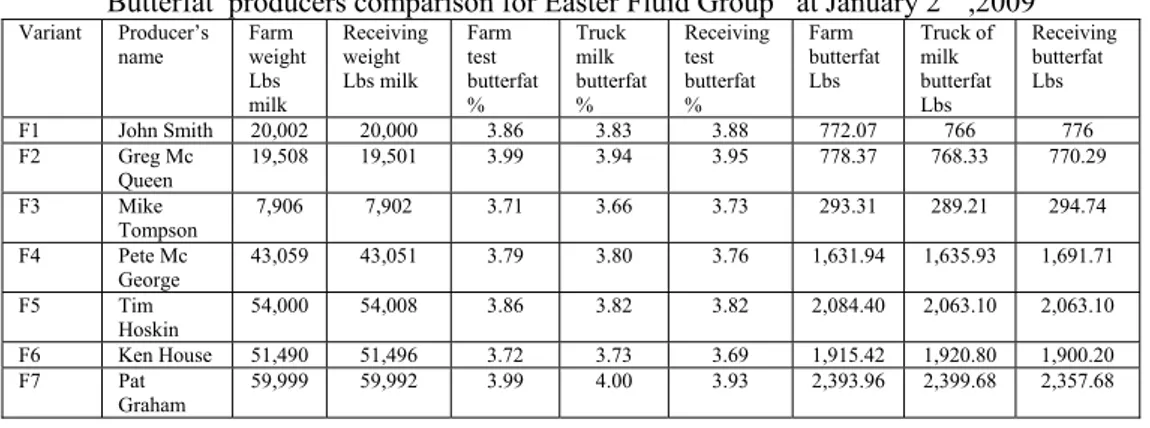
Butterfat percentage is determined by means of butterfat test both at farm place, in the truck milk and finally the receiving butterfat is established. The amount of milk in pound is weighted both at farm level and also at the Dairy Plant reception department . Then the amount of butterfat is calculated taking into account the butterfat percentage and the amount of milk delivered at the farm place and in the truck.
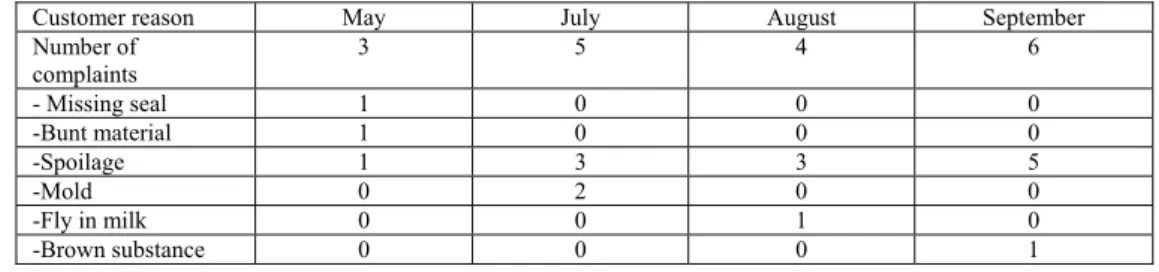
shown in Table 4. The company pays a special attention to Total Quality, as a component of its culture, attitude and organization . Customers’ needs must be satisfied. Quality is approached in all aspects of the company's operations, with processes being done right the first time and defects and waste eradicated from operations. The whole company is focused to Total Quality Management, involving the integration of all the organizational functions such as marketing, finance, design, engineering and production, customer service, etc.). A convincing example is the shelf life for Half and Whole Gallons of White Milk in the Summer months of the year 2008. In the month of May the shelf life was 93.4, in July 80.6 , in August 85.5 and in September 86.1 , which are considered acceptable values . Also in the same months of the year 2008 , from the total number of milk tanks received only a very few have been rejected as shown in Table 5.
Table 3. Butterfat producers comparison for Easter Fluid Group at January 2nd ,2009
Variant Producer’s name Farm weight
Lbs milk Receiving weight Lbs milk Farm test butterfat % Truck milk butterfat % Receiving test butterfat % Farm butterfat Lbs Truck of milk butterfat Lbs Receiving butterfat Lbs
F1 John Smith 20,002 20,000 3.86 3.83 3.88 772.07 766 776 F2 Greg Mc
Queen 19,508 19,501 3.99 3.94 3.95 778.37 768.33 770.29 F3 Mike
Tompson 7,906 7,902 3.71 3.66 3.73 293.31 289.21 294.74 F4 Pete Mc
George 43,059 43,051 3.79 3.80 3.76 1,631.94 1,635.93 1,691.71 F5 Tim
Hoskin 54,000 54,008 3.86 3.82 3.82 2,084.40 2,063.10 2,063.10 F6 Ken House 51,490 51,496 3.72 3.73 3.69 1,915.42 1,920.80 1,900.20 F7 Pat
Graham 59,999 59,992 3.99 4.00 3.93 2,393.96 2,399.68 2,357.68
Table 4 . Specifications concerning Butterfat ,Total Solids and Acids for various dairy products
Product % Butterfat % Total solids Acidity
Skim milk 0.01-0.20 9.00-10.00 0.12-0.13
1% Milk 0.80-1.20 11.00-12.50 0.12-0.13
2% Milk 1.60-2.40 11.50-12.50 0.12-0.13
Whole Milk 3.25-3.35 12.00-13.00 0.12-0.13
Table 5. Tankers of Milk received at FLAV O’RICH DAIRY in Summer 2008
Specification May July August September
Milk Tankers , of which 511 569 629 608
Rejected tankers 3 3 2 1
Share of rejected tankers 0.19 0.52 0.31 0.16
key actions, known as CCP's can be taken to reduce or eliminate the risk of the hazards being realized. The system is used at all stages of milk processing (raw milk quality, pasteurization , packaging, distribution etc ).
Table 6.
The number of complaints and customers’ reasons
Customer reason May July August September
Number of complaints
3 5 4 6
- Missing seal 1 0 0 0
-Bunt material 1 0 0 0
-Spoilage 1 3 3 5
-Mold 0 2 0 0
-Fly in milk 0 0 1 0
-Brown substance 0 0 0 1
Conclusions
Milk processing is destined to provide the consumer with a wholesome, nutritious and safe product. The production of quality milk and milk products begins on the farm and continues through further handling, processing and distribution. Milk processing assures the destruction of human pathogens , the maintenance of product quality without significant loss of flavor, appearance, physical and nutritive properties and the selection of organisms which may produce unsatisfactory products .Total Quality Management is successfully applied as a combination of quality and management tools destined to increase the company business and reduce losses .The company has no problems with bacteria and incidents with positive tests. It is facing customers complaints very rarely , meaning that milk quality is assured along the milk chain from farm gate to final dairy products.Production of quality milk is the concern of dairy farmers , veterinarians, state regulatory departments, milk and milk product processors, retail distributors (super markets) and consumers of dairy products.
References
1.Shearer J.K., Bachman K.C., Boosinger J, 2003, The production of Quality Milk , University of Florida , IFAS Extension, Gainesville.
2.Ruegg Pamela , ABVP Dairy , 2001, Milk secretion and quality standards