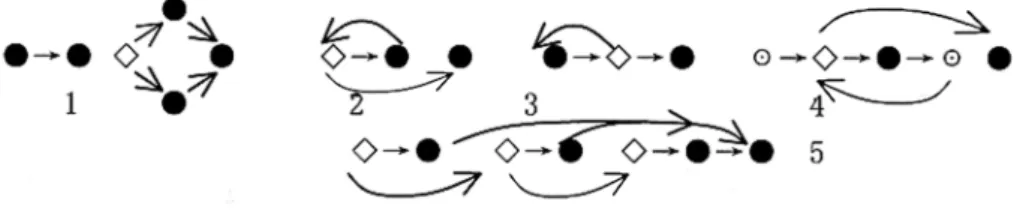
A System on Visualization
of Program Executive Path
and Extraction of Path Sets
Cai Zhimin, Rong Guoping, Zhou Peng and Pan Jingui
State Key Laboratory for Novel Software Technology, Computer Science and Technology Dept., Nanjing University, China
This article goes into the analysis of program executive path at length, performs a system of program executive path visualization, compares several aspects of different path coverage criteria and discusses the implementation of two specific, yet important, path combinations. In the end, it discusses briefly about the significance based on this system and further study.
Keywords: program executive path, route-covering com-bination, divergence-covering comcom-bination, directional graph, independent statement block, program semantics
1. Introduction
Program executive path is an important aspect of describing the syntax and semantics of a pro-gram. It not only reflects a program’s static semantics, its whole status space and problem solving space determined by the set of program executive paths, but also reflects a program’s dy-namic semantics, its transforming flow of status space through the executing flow. Obviously, program executive path also has an essential role in the proof of program validation and pro-gram equivalence. At the same time, it is the basis of software testing, especially white box testing.
Therefore, analysis of program executive path is of special importance. Unfortunately, analyz-ing all the paths in a program is often impossi-ble, since programs with loops may contain an infinite number of paths. Therefore, main en-ergy should be spent on how to extract the best, if possible, subset of program paths, of which
the features will be studied, as the substitute of whole path set. So that, how to select a con-siderate subset from whole path set, or in other words, how to decide a consideratepath selec-tion criteria, to achieve a high coverage and low cost, becomes a key point of the question.
Much work has been done in this field, and a number of criteria have been proposed during the years 5-8], including statement coverage,
branch coverage, loop coverage and so on. And, they were compared in 3]. Also, Sipser pointed
out that most of exhausting search belongs to NP problem in 12]. Specially, Chu raised several
visual model of program executive path 10].
This paper is trying to introduce a system based on program directional graph(called directional
graph or graph in the following, if no conflicts).
In this system, program executive path can be visualized in a clear way, and so path subsets, featuring different properties and fulfilling dif-ferent demands, can be generated easily. The advantage of this system includes: its clear vi-sualization of program executive path, robust-ness of its algorithm and high independency of platform. Anyway, the implementing system is working on k&r C language.
2. Construction of Directional Graph
Obviously, construction of directional graph is the basis of the system. Thus, we will go into it a little further. A directional graph is the visu-alization of a program. So, it must remain con-sistent in syntax and semantics of a program, or in clearer word, render original program’s syn-tax and semantics without any distortion. For this system, the consistency can be described as following. If constructing process is seen as a mapping:
f : program!directional graph
f must be reversible, that is, we can construct an equivalent program from the directional graph, although program literal may be a little differ-ent due to the implemdiffer-enting method. This is the fundamental rule of constructing directional graph and the premises of the algorithm’s va-lidity. Secondly, the graph itself should be in-tuitively easy to be understood, able to reveal the program meanings hidden in program text. This will promote the algorithm efficiency. First, let’s investigate a little energy in the obser-vation of relations between neighboring state-ments. Wong divided a program into the se-quence of basic blocks in 1]; Weyuker imported
the term of disjoint block in 4]. Similarly, we
first introduce the term of Independent State-ment Block, ISB for short, and then try to ex-plain how to construct a directional graph from a program, based on ISBs.
Independent statement blockmeans that: 1. a statement or declaration or condition is a
minor independent block; and
2. if the executing order of two minor indepen-dent blocks is of strict consequence, these
two minor independent blocks can be com-bined into one minor independent block, where strict consequence means that in a pro-gram executive path, for neighboring minor independent blocks A and B, the status of A appearing before B and that of B appearing before A cannot be found at the same time; and,
3. if none of such minor independent blocks can be combined, each of them is called an
independent statement block.
According to the above, we can easily divide a program into the sequence of ISBs. Let’s go a little further into the executing order among ISBs. We may find that there are altogether four types of executing order, respectively sequen-tial, selective, iterative and transferring order, corresponding to sequential structure, selective structure(includingif structureandcase
struc-ture), iterative structure (including while, do
whileandfor structure)and transferring
struc-ture(includinggoto, breakandcontinue
struc-ture).
The above structures’ representation in direc-tional graph is shown separately in Figure 1. Now, let’s move to the description of directional graph. To simplify the discussion, we here as-sume that a program is either a main program or a single module and has only one entry and one exit point. The directional graph of a program
PisG(P) = (N E ns nf), where N is a finite
set of nodes, E N N, is the set of
direc-tional edges, ns 2 N is called the start node,
andnf 2 N is called the end node. Each node
in the graph, except the start node and the end node, represents an ISB inP; for distinct nodes
mandn2N,(m n)2Ecalled an edge, is legal
if there is a possible executing transfer from the ISB represented bym, to the ISB represented by
n, also we call nodemapredecessorofn, andn
Fig. 1.The representation of different structures in a directional graph; respectively is sequential structure if structure, while structure, do while structure, for structure and case structure. Transferring structure is neglected here
since its representation is similar to sequential structure. In the figure, represents a statement,, a condition,, a
is asuccessorofm. If node has no successors, it is called adead node. Dead nodes often mean an abnormal or bad program. We assume that there is no (n n) 2 E. Specially, there exist
edges (ns i) and (o nf), where node i and o
called entry node and exit node, separately. The graph defines the paths in a program. In
G(P), a subpath is a sequence of nodes p =
(n1 n2 n3 ::: np)such that for alli, 1i p, (ni ni
+1
) 2 E. Aprogram executive path or a
pathis a subpath whose first node isstart node
and last node is end node. A circle or a loop
is a subpath whose first node is same as last node, representing to an iterative or transferring structure in the program.
As mentioned above, graph must represent the original program consistently and efficiently. So, in the implementing system, we assume: compound conditions not decomposed,
decla-rations and statements not distinguished, func-tion call seen as normal statement or expres-sion, function definitions analyzed respectively in a file if it contains more than one function definitions, and included head files not parsed. Also, some blank nodes may be included dur-ing construction; yet, they have no impact on the control flow of a program. Two properties of a directional graph are stated below:
1. each node, except the dead node, in the graph normally has 1 or 2 successor nodes, each node has at least one predecessor node, but no maximal value; and
2. iterative and transferring structures cause the loops in the graph, which often mean back-tracking in the search. Therefore the solving of loops is of great importance in the algo-rithm.
step0 initialize including adding a START node; generate it into a sub graph, goto step4; ELSE IF it is a step1 split the program of current layer through compound structure, enter inner layer, goto step1;
statement/declaration/condition; step4 IF current layer ends, check whether there is outer
step2 identify the type of current statement; layer to it; IF true, goto outer layer, goto step2; ELSE step3 IF it can be combined in a single node, combine goto step5;
it, goto step4; ELSE IF it is a simple statement, step5 add END node, END.
Fig. 2. The constructing algorithm of directional graph.
1 int total, valid nim, max; g
2 int i, sum, average; 10 else continue; 3 int value100]; 11 i
++;
4 total=0; valid=0; i=1; sum=0; min=MIN; max=MAX; g
5 while(valuei]<>;999 and total<100)f 12 if(total>0)
6 total++
; 13 average=sum/total;
7 if((valuei]>=min)&&(valuei]))f 14 else average=;999;
8 total++
; Mapping: 1-4:A, 5:B, 6:C, 7:D, 8-9:E, 10:F, 11:G, 12: 9 sum=sum+valuei]; H, 13:I, 14:J.
Fig. 3.An example to demonstrate the algorithm.
Before we move to discussing the details of the algorithm, one thing must be pointed out. One must confess thatgotostatement is not al-ways a trouble causer in software, especially for programming of embedded systems. Some-times, it is an efficient tool in programming. So, we deal with simple and easily understoodgoto
statements, otherwise, we will give a warning message that it is difficult to construct such a directional graph.
Now, it is time to focus on the algorithm itself. The basic idea is: seeking from the beginning of a program, judge the relations of neighboring statements. If they can be combined, combine them, otherwise, create a new node and set its links to other nodes, constructing correspond-ing subgraph. Seek and add nodes repeatedly, until it reaches the end of the program. Because programs are normally nested, graph generation is not done step by step along the program, but partitioned, needing backtracking. Or, in other words, because the syntax of a program is re-cursive, the algorithm is recursive. In Figure 2 the algorithm is shown in detail.
The example given in Figure 3 demonstrates the algorithm, which is also frequently used in the following discussion. This program fragment is originally used to compute the average value of an array of numbers. The corresponding map-ping between nodes and statements is shown in the figure. The graph derived from Figure 3 is shown in Figure 4.
3. Discussion of Three Selection Criteria
3.1. Comparison of Three Criteria
Definition: Independent Path is a path that contains at least one uncovered ISB, compared to the paths that have existed or have been de-rived. Independent path criterionrequires that each path extracted is an independent path dur-ing extractdur-ing procedure. In nature, it is equi-valent to statement coverage criteria. It needs that every statement of a program be executed at once in the test. It is well accepted that one may not feel confident about the program’s be-havior if there are some statements that are still not executed any time. After all, one should not be so glad because it is clear that even if all the statements are executed in the test, a program is
very likely to contain errors. So, this criterion is regarded as the weakest one. It is mostly used for comparison purpose, and so is in this paper. In fact, the path set derived from this criterion can only reveal some literal errors and simple logical errors in a program; it does not reflect real transforming flow of program status space, especially the transforming procedure of pro-gram dynamic semantics, due to iterative and transferring structures. So, the defect of the in-dependent path criterion (called criterion 1 in
the following, if no conflicts)is apparently
dis-tinct. For the example in section 2, a possible path set isf(A, B, H, I),(A, B, H, J),(A, B, C,
D, F, M, B, H, I),(A, B, C, D, F, M, B, H, J),
(A, B, C, D, E, G, M, B, H, I),(A, B, C, D, E,
G, M, B, H, J)g, whose path number is 6.
Loop coverage criterionis such a criterion that the path set must cover all the possible loops combinations at least once. In formal words, if a program hasn loops, a path setP satisfies loop coverage criterion, if paths withtloops are executed at least once, where 1 t n. This
criterion subsumes branch coverage criterion, which requires that each branch be covered in the set (if there is no loops/iterating or
trans-ferring structure, they are identical). Under this
criterion, path p (A, B, C, D, E, G, M, B, C,
D, F, M, B, H, I)needs to be tested, while path
q (A, B, C, D, F, M, B, C, D, E, G, M, B, H,
I) can be excluded if path p has been tested.
Consider path pandq, they both have loops m
(D, F, M) and n (D, E, G, M); the difference
is the executing order of two loops. Such that, this criterion(called criterion 2 in the following,
if no conflicts)regards that they reflect similar
program dynamic semantics, it is unnecessary to test them repeatedly(Strictly, the
transform-ing of program status space is wholly different through different paths). Criterion 2 can cover
all the statements and all branches, and also cover all iterative and transferring structures. It reflects more effectively the influence on pro-gram semantics, due to the variation of different number of executing loops. A significant num-ber of errors will be revealed by such a test. Of course, the path number increases rapidly, compared with criterion 1. And backtracking is inevitable in extracting paths. For the example in section 2, a possible path number is 8.
possible loop permutations should be addition-ally executed at least once. Under this crite-rion (called criterion 3 in the following, if no
conflict), path pand pathqare different. It
ar-gues that although loopmand loopnappear in both paths, the executing order is not the same; the transforming of program status space along each path is not same. They should be regarded as paths with different program semantics, and thus should both be tested. Criterion 3 takes into account the executing order of different loop, and considers of its influencing on program dy-namic semantics, then reflects more details of a program’s semantics transforming along differ-ent paths. After all, one obvious disadvantage is that the path number increases prominently, compared with criterion 2, even causing com-bination exploding(In fact, it partly indicates a
real state that analyzing all paths in a program belongs to NP problems). And, backtracking
is an important part of the extracting algorithm. For the example in section 2, a possible path number is 10.
One thing must be mentioned in above discus-sion, a single loop is assumed to execute once or none, which seems weak to reflect the real state of program executing. After all, on one hand, such a test concerning the executing times of a loop can be found in Woodard’s LCSAJ test in 9], which is beyond this paper, also we
know that the variation in executing a single loop with different times is only the value of variables, which probably has less influence on program test; on the other hand, one should bal-ance between coverage and cost, since too many
infeasible pathswill be extracted if too much attention is paid to counting the executing times 2]. So, we are only interested in whether a loop
is executed or not and in the order in which certain loops are executed, while the executing times is not taken into account.
Now, let’s estimate path numbers and comput-ing complexity of three criteria. Since most of the time is spent on visiting nodes, only such time is concerned in the algorithm. Supposed that there are n nodes in a program P0
s direc-tional graph, and the time of visiting each node is constant. Because at mostnnodes are visited in a single path, time of visiting a single path is assumedO(n).
Under criterion 1, McCabe pointed out that the path number equals to the cyclomatic complex-ity of a program in 7], which is, of course,
less than n, assumed O(n). So the whole
time consumption isO(n
n). Under criterion
2, path number has nothing to do with n, but with number of loops. Assumed there are t
loops in program P, the number of paths that have t loops is Ct
t, that have t ; 1 loops is
Ct;1
t , :::, that have one loop is C
1
t, that have no loop is C0
t. Altogether, path number is
Ctt+C
t;1
t +:::+C
1
t +C
0
t = 2
t. The whole time consumption isO(n
2t). Sincetis usually
less than 20, and is also far less thann, such a scale is compatible. Similarly, under criterion 3, path number is Ptt+P
t;1
t +:::+P
1
t +P
0
t. Obviously ift is moderately large, it is beyond a computer’s ability.
In the end, summary of the comparison is shown in Table 1.
3.2. Selection of Our Implementing System
The users of this system are designers of embed-ded systems, who hold a high view of program correctness, thus expecting to make the most of different test paths from different angles. So, we introduce strong loop coverage criterion, whose merits can be clearly seen from the compari-son. Another reason is that, several estimable path sets can be extracted, based on strong loop
Criterion Statementcoverage coverageBranch coverageLoop Reflectingsemantics numberPath Backtrackingin parsing complexityAlgorithm
Cri. 1 able disable disable bad Small None Low
Cri. 2 able able able good Large A little High
Cri. 3 able able able better Larger Much being NP
coverage path set. With regard to combina-tion exploding, the following should be done: for programs whose cyclomatic complexity is too high, for example, more than 20, a warning message will be given that it is possible to cause combination exploding; else if there are still too many potential paths, the user may specify a maximal path number or other limits to reduce the path number.
4. Implementation of the System
For comparison purpose, we implemented two path sets, based on two selection criteria. One set is Route Covering Combination, short for RCC, which is a path set, based on strong loop coverage criterion; the other one isDivergence Covering Combination, short for DCC, which is the smallest path set that covers all branches in a program. In fact, it is based on branch cov-erage criterion. In the system, we obtain paths of RCC first, and then select certain paths from RCC to build DRC.
4.1. Extraction of RCC
Brief of the algorithm is: from start node, search through the graph, using DFS (Depth
First Search), storing unvisited links of nodes
tonode stack, until reachingend node (thus a
path is obtained)or adead node, pop an
unvis-ited node fromnode stack, and go on searching untilnode stackis empty, which means RCC is complete, or path number reaches certain max-imal number, which means the program has to end abnormally.
Data structures related to algorithm is explained below:
Node: containing program text corresponding to a node. Each node has two links. If it has two successors, the left link points to the suc-cessor of true branch, the right one to that of false branch. Else, if it has only one successor, the left link works, by default. Otherwise, both links are set null.
Stack: Path stack stores current searching path. Node stack stores unvisited nodes dur-ing the search. Temp stack stores temporary subpath.
Path liststores extracted paths and finally writes them to a file. Loop listcontrols loops, recog-nizing, recording and comparing loops in cur-rent searching path, also in charge of finding and delete duplicated circles.
Backtracking of seeking is necessary due to the requirement of searching different branches, avoiding duplicated loops and returning from
dead nodes.
A complete extracting algorithm is shown be-low:
Initialize the surroundings of seeking include ad|ding a nul node to node stack initialize the graph
WHILE node stack not empty do WHILE current node is not END do
IF right link is not empty, push it to node stack temp node := left link
IF temp node is null //back tracking repeatedly pop nodes from node stack and
modify path stack and c|heck path until there are no same circles in path stack store the last popped node to temp node
current node=temp node IF current node is END, BREAK ELSE
Push temp node to path stack
Like above, do popping, modifying and c|hecking and storing
current node=temp node IF current node is END, BREAK ENDIF
ENDWHILE // find a single path IF node stack is empty, BREAK
Like above, do popping, modifying and c|hecking and storing
print the path from path stack path number plus 1 /*start another route seeking */
IF path number larger than MAX, BREAK ENDWHILE // find all pos|sible routes
4.2. Extraction of DCC
There is some practical difficulty in implement-ing DCC strictly. It is not so easy to find such a minimal set that has least paths, because such a set is possibly multiple, and in case of com-bination exploding, it is impossible to find a minimal set because RCC is not even obtained correctly. Also, in practical test, minimal path number usually does not mean the best test ef-fect. In fact, users expect from DCC to get a good test quality with relatively small path set. Then, in the system, we just try to find first satisfying path set as DCC.
Thus, the algorithm of DCC is described as fol-lowing: we first count the number of the condi-tions in the program, supposed isn, and add a coverage array to each path to record covering results of different branches. Also, we initialize a balance array to record covering status in cur-rent DCC. Of course, the size of coverage array and balance array is both 2
has a true branch and a false branch, altogether. Initially the value of item in both arrays is 0. At certain time, if certain branch of a condi-tion is covered, the corresponding item will be set 1. In the beginning, the coverage array of each path in RCC is assigned according to its coverage of all the branches. Pick a path from RCC one by one, compare it to balance array by "eXclusive OR" operation to get its current covering quality, which is represented as cover-ing degree, number of array items, whose XOR result is 1) and redundant degree, number of
array items, whose XOR result is 0), select the
path that has the highest covering degree and the lowest redundant degree and add to DCC, then modify the balance array according to current status of DCC. Repeat these operations until all the items of balance array are 1, thus DCC is generated.
The details of the algorithm are as following.
initialize the seeking END := false WHILE not END
WHILE path list not empty
get a path from path list compare with Balance Array to calculate the current value of this path ENDWHILE
rest the path list Best Path := null WHILE path list not empty
get a path from path list
IF this path is better than Best Path, replace it ENDWHILE
ad|d this Best Path to teh Set and modify the Balance Array
c|heck whether Balance Array is FULL, if so, END := true
reset the value of eac|h path ENDWHILE
5. Conclusion and Further Research
5.1. Conclusion Drew from the Experiment
We implemented our system withC++
Builder 3.0 on PC P100/40M and tested 80 programs,
trying to find the relations among path number, nest number, and cyclomatic complexity. As regards RCC, 12 cases exceed the upper limit
(10000 paths), 8 cases have paths more than
1000, 38 cases have paths more than 10, the others have less than 10. But as regards DCC, all the cases have paths less than 10. We sup-pose that RCC may have a good test quality in most cases, and that DCC can be used to test branches and loops in a program in quick time. The relations among path number, nest num-ber and cyclomatic complexity is not so simple.
For programs that do not contain loops, path number increases with nest number and cyclo-matic complexity. But for programs that contain loops, the relationship is not an increasing func-tion. Path number is more related to the nature of loops. This will be the subject of our further research.
5.2. Further Research
As is known from the above study, RCC is based on loop coverage, with an aim to study the trans-forming procedure of program dynamic seman-tics through checking whether a certain loop is executed or not and through relative execut-ing order of loops in an executive path. DCC is based on branch coverage, with an aim to study the transforming procedure of program dynamic semantic through checking whether a certain branch is executed or not and relative ex-ecuting order of branches in an executive path. This system can help us do some research on special-aimed path extracting techniques. Now we are considering the techniques including fol-lowing aspects: path set in which specified statements or branches are covered, and path set in which definitions or references of speci-fied variables are covered. In addition, we are also focusing on the following areas.
Analyzing the characteristics of program syntax and semantics embodied in a program executive path, which is one of our primary research in-terests.
Studying relations between program complex-ity and path number, to find the delicate deter-minism of a program’s complexity on the path set.
And, a useful research is to get practicing data of relations between path number and latent bugs number of programs. PG-Relief system, de-veloped in cooperation with Fujitsu Company, can find latent bugs in a program. Based on these data, we hope to find statistical relations between them through testing large numbers of programs, thus using it as a useful guide in pro-gramming.
References
1] W. ERIC WONG, JOSEPH R. HORGAN, SAUL LON
-DON,ANDADITYAP. MATHUR, “Effect of Test
Mi-nimization on Fault Detection Effectiveness” ,Proc.
17thInternational Conf. On Software Engineering,
April 23–30, 1995, Seattle, Washington, USA
2] D. HEDLEY ANDM. A. HENNELL, “The Cause and
Effects of Infeasible Paths in Computer Programs”,
Proc.8thInternational Conf. On Software Eng., Aug
28–30, 1985, London, UK
3] LORI A. CLARKE, ANDY PODGURSKI, DEBRA J.
RICHARDSON,ANDSTEVENJ. ZEIL, “A Formal Eval-uation of Data Flow Path Selection Criteria”,IEEE Trans. On Software, Eng., Vol. 15, No. 11, Nov. 1988
4] ELAINEJ. WEYUKER, “Evaluating Software
Com-plexity Measures”,IEEE Trans. On Software Eng., Vol. 14, No. 9 Sept. 1988
5] SANDRARAPPS, ELAINEJ. WEYUKER, “Selecting
Software Test Data Using Data Flow Information”,
IEEE Trans. On Software Eng., Vol. Se–11, No. 4, April, 1985
6] PHYLLISG. TRANKL ANDELAINEJ. WEYUKER, “An
Applicable Family of Data Flow Testing Criteria”,
IEEE Trans. On Software Eng, Vol. 14, No. 10, Oct. 1988
7] THOMAS J. MCCABE, “A Complexity Measure”,
IEEE Trans. On Software Eng., Vol. Se–2, No. 4, Dec. 1976
8] S. C. NTAFOS, “On Required Element Testing”,
IEEE Trans. On Software Eng., Vol. Se–10, No. 6, Nov. 1984
9] M. R. WOODARD, DAVID HEDLEY, ANDMICHAEL
A. HENNELL, “Experience with Path Analysis and
Testing of Programs”, IEEE Trans. On Software Eng., Vol. Se–6, No. 3, May, 1980
10] CHU JUNJIE, “Developing higher level views of
exe-cution paths”,Chinese J. Computers, Vol. 21, No. 3, Mar. 1998
11] ROGER S. PRESSMAN, Software Engineering, A
practitioner’s Approach, Fourth Edition 1997, McGraw–Hill
12] MICHAEL SIPSER, Introduction to the Theory of
Computation, 1997, PWS
13] KENNETH C. LOUDEN, Compiler Construction,
Principles and Practice, 1997, PWS
14] ZHENG RENJIE,Computer software test techniques,
1992, Tsinghua University Press
15] XU JIAFU, Corpus of Xu jiafu, 228–248, 1992,
Nanjing University Press
Received:June, 2001
Accepted:September, 2001
Contact address:
Cai Zhimin State Key Laboratory for Novel Software Technology Computer Science and Technology Dept. Nanjing University, 210093, China e-mail:[email protected] zhimin;[email protected]
Rong Guoping State Key Laboratory for Novel Software Technology, Computer Science and Technology Dept. Nanjing University, 210093, China e-mail:[email protected]
Zhou Peng State Key Laboratory for Novel Software Technology
Computer Science and Technology Dept. Nanjing University, 210093, China e-mail:[email protected]
Pan Jingui State Key Laboratory for Novel Software Technology Computer Science and Technology Dept. Nanjing University, 210093, China Phone: 86-25-3260023 Fax: 86-25-3317685 e-mail:[email protected] [email protected]
CAIZHIMINborn in 1977, obtained his B.Sc. degree from Nanjing Uni-versity, China, in 1999, and now is a graduate student of the graduate school, Nanjing University. He is doing research in the field of soft-ware testing and is also involved in a joint research project of Nanjing University and Fujitsu Company. He focused on information retrieving and analyzing before he moved to software engineering two years ago. His research interest is broad and mainly restricted in software engi-neering, including software testing and maintenance, software metrics and software quality.
RONGGUOPINGborn in 1977, obtained his B.Sc. degree from Nanjing University, China, in 2000, and now is a graduate student of the graduate school, Nanjing University. His research interest includes XML based systems and formal language analysis.
ZHOUPENGborn in 1978, obtained his B.Sc. degree from Nanjing Uni-versity, China, in 1999. After one year’s teaching career, he is now a graduate student of Nanjing University. His research interest is mainly focused on parallel and distributed system and system visualization.