Automated Learning Applied to
Functional Argument Identi
fi
cation
Vasile Rus
Department of Computer Science, The University of Memphis, USA Institute for Intelligent Systems, Fedex Institute of Technology, USA
This paper reports experiments on applying machine learning for identifying functional arguments of verbs such as logical subjects. In particular, it is shown that us-ing decision trees for functional arguments identification is beneficial. The paper also argues that linguistically-motivated features gathered from a large corpus can capture functional information.
Keywords: logic form, machine learning, decision trees, knowledge representation.
1. Introduction
Syntactic functional information is vital for ad-vanced text understanding technologies such as information extraction, machine translation, question answering and others.
Treebank II 18]includes functional tags as part
of its annotation tags. In spite of this, mod-ern parsing technologies generated from Tree-bank only offer surface syntactic information in the form of a bracketed representation in which main constituents and major structural phrases
of sentences are identified. Null elements and markers to co-indexed elements are not han-dled at all, thereby leading to major gaps in the relational information available to possible users. Moreover, from the bracketed represen-tation produced by parsers one can easily iden-tify the surface syntactic subject. Nevertheless, the logical subject requires further processing, as illustrated in Table 1: the bracketed form for the two examples is the same(it was generated
with a state-of-the-art statistical parser)and thus
a surface level pattern that identifies as subject the first NP in a(S(NP VP))
1phrasal structure
would wrongly label something as the subject oftell2.
Moreover, for verbs in coordinations the parsers are not able to correctly distinguish among which arguments are shared and which are not. This latter issue is illustrated by argumentsballand
newspaperin Table 2: ballis shared by throw
andcatchas opposed to what the bracketed form encodes.
Sentence Bracketed Form Grammatical Function
Something told John. (S(NP(NN something))(VP(VBD told))(NP(NNP John))) l-sbj=John
d-obj=something
John told something (S(NP(NNP John))(VP(VBD told))(NP(NN something))) l-sbj=John
d-obj=something
Table 1.Examples of similarly bracketed sentences by state of the art parsers but with different underlying logical structure.
1NP stands for noun phrase, VP for verb phrase and S for sentence.
Sentence Bracketed Form Shared
Grammatical Function ? John throws and (S(NP(NNP John))(VP(VP(VBZ throws))(CC and))) d-obj=ball
catches the ball . (VP(VBZ catches)(NP(DT the)(NN ball)(. .))) shared=yes
John eats and (S(NP(NNP John))(VP(VP(VBZ eats))(CC and))) d-obj=newspaper
reads the newspaper . (VP(VBZ reads)(NP(DT the)(NN newspaper)(. .))) shared=no
Table 2.Examples of shared and non-shared direct objects for verb in coordination for which the sharing problem cannot be solved only looking at the output of state-of-the-art parsers.
To overcome those drawbacks of modern pars-ing technology, novel methods are necessary in order to offer accurate, robust and scalable solutions to the problem of finding syntactic functional information.
In this work a model is introduced and further used to induce automated tools able to detect functional information(logical)in English
sen-tences. The tools are obtained using the C4.5 package for decision tree induction.
In addition, this paper argues that linguistically motivated features gathered from a large corpus can capture functional information.
The paper is organized as follows. The next section presents related work. In Section 3 we describe our approach and Section 4 details ex-periments and results. The following section compares our approach with similar approaches and Section 6 describes the impact of our solu-tion on the task of logic form identificasolu-tion. We then conclude the paper.
2. Related Work
Usually, when syntactic information is used to study a certain linguistic problem, people either use the bracketed form and are happy with surface level syntactic information or have their own pattern-based methods, which lack generality and scalability: in 25] a general
method for word sense disambiguation is pre-sented which yields high performance by taking advantage of full sentential context including raw surface syntactic information provided by a parser. Lapata in 15] proposed a technique
which acquires alternating verbs from large bal-anced corpora by using partial-parsing meth-ods. As part of the process, syntactic patterns to guess, i.e. heuristics, the double object frame, are applied on top of a parser’s output: if the syntactic pattern contains at least two proper names adjacent to each other(e.g. killed John
Kennedy), then reject. Similarly, in 26], a set
of heuristics are used to find counts of transitive frames for verbs: a number, a pronoun, a deter-miner, an adjective, or a noun were considered to be indication of a potential object of the verb. We already mentioned that Treebank II includes functional tags in its annotation guidelines(about
20 of them that can be appended to constituent labels, e.g. NP-LGS to denote a noun phrase, which is also a logical subject). Those tags were
manually inserted in Treebank.
Attempts to enrich the output of parsers with in-formation available in treebanks were described by Johnson 12]and Collins 6]. They develop
methods for recovering non-local dependen-cies in phrase trees. Jijkoun 11] uses
pattern-matching methods to solve non-local dependen-cies in parse trees.
An attempt to address the issue of assigning functional tags was made in 2]. They use a
sta-tistical algorithm for assigning the 20 function tags in Treebank(classified in four categories).
The reported precision over all four categories is 87.17% on text already parsed. In our work, we limit ourselves to assigning only grammatical labels(one of the four categories in 2]).
The present work is similar to the approaches to the problem of shallow semantic parsing pre-sented in 21] 27] 9] 4]. Shallow semantic
semantic roles specified, either using predicate specific labels 3] or predicate independent
la-bels 13]. They address the problem of
shal-low semantic parsing as a classification problem and use different machine learning methods to induce a classifier (Support Vector Machines,
Decision Trees). Our work is similar to those
approaches in several ways: (1)we address the
task of detecting logic roles(as opposed to
se-mantic roles)as a classification problem(2)we
use a set of features similar, to some extent, to those used by the mentioned studies and(3)the
induced classifier plays an important role in a natural language-based knowledge representa-tion: the Logic Form 20] and Propbank 13]
respectively.
The PropBank project adds a layer of seman-tic annotation to the Penn English TreeBank. It provides a consistent argument labeling of pred-icates, particularly verbs, participial modifiers and nominalizations. In the sentenceJohn broke the window, thebreakingevent is described by the following argument structure break(John,
window). In PropBank, the arguments of the
verb are labeled sequentially from ARG0 to ARG5, where ARG0 is usually the subject of a transitive verb; ARG1, its direct object, etc. Adjunct arguments are also marked for tempo-rals and locatives.
In 20]a natural language-based knowledge
re-presentation is presented, namely Logic Form, which requires logic functional arguments for its predicates. In 22] the logic functional
ar-guments were detected using a set of structural patterns that were well suited for small English sentences(definitions of concepts in electronic
dictionaries), but for open text that approach
lacks scalability.
LF is first order, syntactically simple, logic and was used in many language processing appli-cations. Davidson 8] proposed the predicate
treatment of verbs and then Hobbs 10]applied
this concept to automated text processing, par-ticularly interpretation of texts. Rus 22]
em-ployed LF to Question Answering, to search answers that were not explicitly stated in sup-porting documents.
In LF, a predicate is generated for every noun, verb, adjective or adverb. The name of the pred-icate is a concatenation of the word’s base form and its part-of-speech.
An example on how this is done is illustrated for the following sentence:
The Earth provides the food we eat every day.
Its corresponding logic form(LF)is:
Earth:n (x1) & provide:v (e1, x1, x2) & food:n (x2) & we:n (x3) & eat:v (e2, x3, x2;
x4) & every:a (x4) & day:n (x4)
In the example given above, the verbprovides
is mapped onto the predicateprovide:v, where
provide is the base form for provides and v
stands for verb(the part of speech ofprovide).
Arguments for predicates are of two types: e
- for events specified by verbs, x- for entities. The LF of the entire sentence is the conjunction of individual predicates.
The argument’s position is also important as it encodes syntactic information: the second ar-gument for a verb is syntactic subject, the third is direct object and the fourth is indirect object. For instance, the second argument of the pred-icate provide:v (e1, x1, x2) is x1 (Earth), the
subject of theprovidingevent. Arguments after ; (semicolon) are adjuncts (arguments which
are not mandatory to convey the message of the sentence — such as time or place) and were
introduced in 23].
The Role Assignment (RA) Problem
We look at a few examples that will show the complexity of the task of identifying functional arguments of verbs, also called the role assign-ment problem. Role assignassign-ment is an important step for Logic Form Identification (LFI), the
task of mapping English sentences onto LF. In the following sentence:
The judges hear or try a court case.
there are two verbshearandtryin a coordina-tion(indicated by prepositionor)and one direct
I1: The judges (hear or try) a court case.
LF1: judge:n (x1)& hear:v (e1, x1, x2)& or
(e3, e1, e2)& try:v (e2, x1, x2)& nn(x2, x3,
x4)& court:n (x3)& case:n (x4)
I2: The judges hear or (try a court case).
LF2: judge:n (x1)& hear:v (e1, x1)& or
(e3, e1, e2)& try:v (e2, x1, x2)& nn(x2, x3,
x4)& court:n (x3)& case:n (x4)
In I1, the compound nouncourt caseis shared since hear and try are bracketed together. In I2, the direct object is bracketed with the sec-ond verb(the verbhearbeing in an intransitive
subcategorization frame). For this particular
instance the correct interpretation is I1.
An example in which the direct object should not be shared is:
They steal or commit a violent act.
It is very unlikely to statesteal a violent actand thus, the correct interpretation is:
I:They steal or (commit a violent act).
LF: they(x1)& steal:v (e1, x1, x2)& or(e2,
e1, e3)& commit:v (e3, x1, x2)& violent:a
(x2)
Here is an example of two verbs that do not share the subject, a situation which might be interpreted otherwise at first sight.
An aircraft that has afixed wing and is powered by propellers or jets.
The reason why the nounaircraftdoes not play the role of subject for both verbshasandpower
is the changing of voice in coordination. The second verb has its subject introduced by prepo-sitionby.
This paper addresses the RA problem and demon-strates how a machine learning method can offer a robust solution.
3. Approach
Our approach is to address the RA problem as a classification task: given a verb in a sentence
and a candidate phrasal head, find the most ap-propriate syntactic role that the head plays. The set of possible roles contains: subject, direct object, indirect object, prepositional object or norole(a value which indicates that the
candi-date head does not play any role for the given verb). To preview our results, we demonstrate
that combining a set of indicators automatically extracted from large text corpora provides good performance.
The key to any automatic classification task is to determine a set of useful features for discrimi-nating the items to be classified. The features of our model are presented below. Each feature is accompanied by a small description explaining the rationale of picking it.
HeadThe candidate head could indicate whether it is an appropriate filler for a specific syntac-tic role of a verb. From the previous examples, we know thatactcannot stand as an object for
steal. Similarly, the verbwritetakes as subject only a person, or a referent to a person, such as a personal pronoun(persons are able to write).
Lexical Category of Head A noun is most
likely to be direct object of, say, the verbgive, and a pronoun the subject or indirect object of the verbwrite.
VoiceAs we saw in the last example of the
pre-vious section, the voice of a verb can play an important role in deciding what head word is the subject. In case the verb is in passive voice, the subject is most likely the prepositional ob-ject of the followingby, if any such preposition is present in the sentence. We have a dozen patterns to detect the voice of the verb.
Type of ClauseWe refer here to the type of
sen-tence (S, SINV) that includes the target verb.
An example is the main clause inI do not be-lieve it, said Peter DaPuzzo, head of retail equity trading stock prices during program-dominated trading. where said John is an inverted sen-tence in which the subject follows the verb, as opposed to the most common case John said. The type is read from the parse tree by follow-ing links from verb to parent up the parse tree until a S(S, SINV, SBAR)node is found.
Position of HeadIf the head is after or before
the verb and at what distance, in terms of words
(punctuation is ignored when the position is
Those features could be automatically extracted from a large corpus, either manually annotated, or automatically generated.
The basic steps of the feature extraction method are outlined below:
procedureExtractFeatures(Sentence)
– Generate a full syntactic parse tree for the Sentence
– Stem the words in the sentence forverb in Sentencedo
– Extract the set of features for each node in the tree relative to the verb
– Classify each node as norole or as
logical subject end for
4. Experimental Setup and Results
There are three major issues that we need to address before doing any kind of experiments: what verbs to focus on, where should we gather training data from, and what machine learning algorithm to use. In the next few paragraphs we provide our answers for each of those issues. Previous work on verb meaning research, such as 14]and 28], reported experiments on a set
of 14 target verbs that exhibit multiple argument patterns: ask, begin, believe cause, expect,find, give, help, like, move, produce, provide, seem, swing. We adopted those 14 verbs since we be-lieved it would be a good starting point to have a small set of verbs with many argument am-biguities, thus balancing manageability of the experiments against a set of challenging verbs. Next, we looked for a corpus as a source of training data. Treebank 18]is a good candidate,
because it contains role annotations. We started by developing patterns for tgrep, a tree retrieval pattern-based tool, to identify sentences con-taining target verbs from Wall Street Journal
(WSJ) corpus and used the online form to
re-trieve the data (http://www.ldc.upenn.edu/
ldc/online/treebank/). The set of sentences
previously obtained is further processed: a stem-mer is applied to obtain the stem of individual words3and then the target verb is identified and
features extracted. One or more training exam-ples(positive and negative)are generated from
a sentence(see the next section).
As learning paradigm, we opted for decision trees. Decision Trees are a popular method to approach classification problems. The attrac-tiveness of decision trees is due to the fact that, in contrast to neural networks, decision trees represent rules. Rules can readily be expressed so that humans can understand them.
The C4.5, an algorithm for decision tree genera-tion and an extension of ID3, is used to generate a classifier for the RA problem. The algorithm ID3 uses top-down induction of decision trees. Given a set of classified examples, a decision tree is induced, biased by the information gain measure, which heuristically leads to small trees. The examples are given in attribute-value rep-resentation. The set of possible classes is finite. Only tests that split the set of instances of the un-derlying example languages, depending on the value of a single attribute, are supported. De-pending on whether the attributes are nominal or numerical, the tests either have a successor for each possible attribute value, or split ac-cording to a comparison of an attribute value to a constant, or depending on if an attribute value belongs to a certain interval or not.
The algorithm starts with the complete set of examples, a set of possible tests and the root node as the actual node. As long as the ex-amples propagated to a node do not all belong to the same class and there are tests left, a test with highest information gain is chosen, the cor-responding set of successors is created for the actual node and each example is propagated to the successor given by the chosen test. ID3 is called recursively for all successors.
Some of the additional features of C4.5 over ID3 are: incorporation of numerical (
contin-uous) attributes, nominal (discrete) values of
a single attribute may be grouped together to support more complex tests, post-pruning after induction of trees, e.g. based on test sets. In order to increase accuracy, C4.5 can deal with incomplete information(missing attribute
val-ues).
One problem with decision trees is their ten-dency to overfit the training data, i.e. if tested on training cases from which it was constructed, it may give a poor estimate of its accuracy on new cases. The true predictive accuracy of the classifier can be estimated by sampling, or by using a separate test file. Either way, the classi-fier is evaluated on cases different from the ones used to build it. However, this estimate can be unreliable, unless the numbers of cases used to build and evaluate the classifier are both large. One way to get more reliable estimate of pre-dictive accuracy is by k-fold cross validation. The cases are divided into kblocks of roughly the same size and class distribution. For each block, a classifier is constructed from the cases in the remaining blocks and tested on the cases in the hold-out block. The error rate of a classi-fier produced from all of the cases is estimated as the ratio of the total number of errors on the hold-out cases and the total number of cases. Here, we predict the accuracy of our induced classifiers usingk=10 or 10-fold cross valida-tion.
In the following sections, we present two ma-jor experiments: (1) using the set of features
presented before and(2)adding the verb as an
extra feature. Each experiment has two sub-experiments:(i)traces in parse trees from
Tree-bank II are not solved and thus the training and test data sets do not include examples for those traces and(ii) traces are solved and the
corre-sponding examples are added to the training and test data sets.4
Experiment 1
In this experiment we focus on identifying a specific syntactic role for a specific verb: the role values can be eithersubjectornone. In Figure 1 a parse tree is provided for the sen-tence: Chris knew yesterday that Terry would catch the ball. The numbers below individual words is the index of that word in the sentence, starting with 0. We will use this example to illustrate our solution.
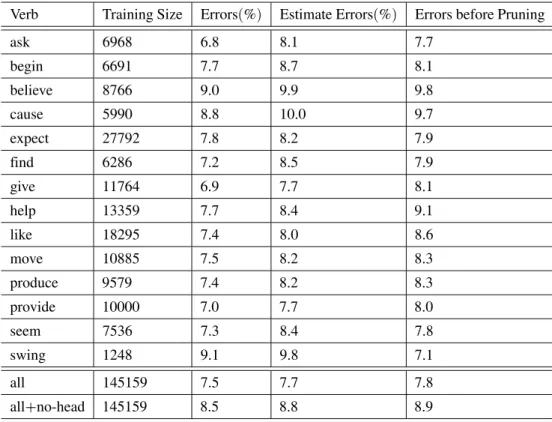
We pick a verb, say know, and then from an-notated corpora, training data is generated. For each word in the sentence a positive example is obtained if the word is the subject of the verb. Examples from different verbs are not mixed. Table 3 contains results for the first trial in which traces are not resolved (examples with traces
are eliminated from training data). We pay
spe-cial attention to punctuation(time stamps such
Chris/NNP knew/VBD yesterday/NN that/IN Terry/NNP would/MD catch/VB the/DT ball/NN NP
VP VP
S VP
S
NP−SBJ
NP−TMP NP−SBJ SBAR−1
SBAR
*ICH*−1
0 1 2 3 4 5 6 7 8 Sentence:
Word Index:
Fig. 1.An example of parsed sentence in Treebank II.
4 Traces are artificial links introduced in Treebank to accomodate the bracketed representation to remote dependencies. An
example is the remote relation between the verbknowand its direct object, introduced later in the sentence, as a relative clause
Verb Training Size Errors(%) Estimate Errors(%) Errors before Pruning
ask 6968 6.8 8.1 7.7
begin 6691 7.7 8.7 8.1
believe 8766 9.0 9.9 9.8
cause 5990 8.8 10.0 9.7
expect 27792 7.8 8.2 7.9
find 6286 7.2 8.5 7.9
give 11764 6.9 7.7 8.1
help 13359 7.7 8.4 9.1
like 18295 7.4 8.0 8.6
move 10885 7.5 8.2 8.3
produce 9579 7.4 8.2 8.3
provide 10000 7.0 7.7 8.0
seem 7536 7.3 8.4 7.8
swing 1248 9.1 9.8 7.1
all 145159 7.5 7.7 7.8
all+no-head 145159 8.5 8.8 8.9
Table 3.Errors reported by the induced decision trees with 10-fold cross validation.
as 10:40 are changed to 1040) and numbers
(350,000 is changed to 350000)to comply with
the input requirements for the C4.5. learner. In 19], commas, dots and columns are assigned a
special notation(CO and DO respectively)but
that was necessary because commas, dots and columns are features in their learning model
(they used Timbl 7] which accepts C4.5-like
input). For some sentences there is no logical
subject identified, because the logical subject is unspecified.
Examples of training data for the sentence in Figure 1 are given below as one training in-stance per line:
know, Chris, NN, active, S, -1, subject know, that, SBAR, active, S, 1, none know, yesterday, NN, active, S, 2, none know, that, IN, active, S, 3, none know, Terry, NN, active, S, 4, none know, catch, VB, active, S, 6, none know, ball, NN, active, S, 8, none catch, Chris, NN, active, S, -7, none catch, know, VB, active, S, -6, none catch, that, IN, active, S, -5, none catch, yesterday, NN, active, S, -4, none
catch, that, IN, active, S, -3, none catch, Terry, NN, active, S, -2, subject catch, ball, NN, active, S, 2, none
Entries for traces, when considered, have the corresponding lexical head and lexical category features borrowed from the constituent where a trace is resolved. In our example, the training entry for ICH hasthat as its lexical entry and
SBARas its category.
In Table 3 the line havingallin the verb column contains results when training examples of all target verbs were considered together in a sin-gle experiment, sayall-verb. The training time becomes larger, with larger training sets, while the error and estimated error are similar (7.5
– 7.7%). The all-verb case illustrates a more
general approach in which for all target verbs we generate a single decision tree, as opposed to having a single decision tree for each verb. The last line in the table shows results when the head feature is ignored. There is a small increase in the error rate (1%), but a simpler,
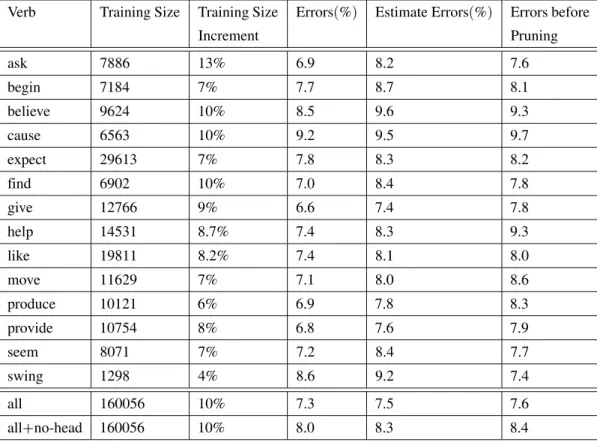
Verb Training Size Training Size Errors(%) Estimate Errors(%) Errors before
Increment Pruning
ask 7886 13% 6.9 8.2 7.6
begin 7184 7% 7.7 8.7 8.1
believe 9624 10% 8.5 9.6 9.3
cause 6563 10% 9.2 9.5 9.7
expect 29613 7% 7.8 8.3 8.2
find 6902 10% 7.0 8.4 7.8
give 12766 9% 6.6 7.4 7.8
help 14531 8.7% 7.4 8.3 9.3
like 19811 8.2% 7.4 8.1 8.0
move 11629 7% 7.1 8.0 8.6
produce 10121 6% 6.9 7.8 8.3
provide 10754 8% 6.8 7.6 7.9
seem 8071 7% 7.2 8.4 7.7
swing 1298 4% 8.6 9.2 7.4
all 160056 10% 7.3 7.5 7.6
all+no-head 160056 10% 8.0 8.3 8.4
Table 4.Errors when traces are solved.
Table 4 contains error rates for a trial in which traces in the corpus are resolved. The feature extraction method includes the new step ofSolve traces:
procedureExtractFeatures(Sentence)
- Generate a full syntactic parse tree for the Sentence
- Stem the words in the sentence -Solve traces
- Identify the targetverbor allverbs forverb in Sentencedo
- Extract the set of features for each node in the tree relative to the verb
- Classify each node asnoroleor as log-ical subject
end for
Double link traces, such as the links between indexes 3-2-1 in the following example, are ignored: (SBARQ (WHNP-1 Who) (SQ was
(NP-SBJ-2 *T*-1)(VP believed(S(NP-SBJ-3
*-2)(VP to(VP have(VP been(VP shot(
NP*-3))))))))). The number of training examples
generated for each verb is larger (on average
there are 10% more examples) and resulting
error rates are mixed: it drops for believe, it increases for ask, and it remains the same for
begin. Overall, there is a0.1%decrement in the error rate(see lineall). The last line in the
ta-ble shows results when the lexical information about the word that plays the role is ignored. As we notice, there is only a marginal increase in the error rate. It seems that in the absence of deeper semantic information about the word it-self(for example the semantic class for objects
used to specify selectional restrictions)there is
not much impact on the original model by the lexical feature.
Experiment 2
Verb Training Size Errors(%) Estimate Errors(%) Errors before Pruning
all+verb 145159 7.5 7.7 7.8
all+verb+no-head 145159 8.3 8.6 8.7
Table 5.Error rates with the verb as a feature and no traces.
Verb Training Size Training Size Errors(%) Estimate Errors before
Increase Errors(%) Pruning
all+verb 160056 10% 7.3 7.5 7.7
all+verb+no-head 160056 10% 7.8 8.2 8.5
Table 6.Error rates with the verb as a feature and no traces.
error rate when the head of the candidate word is eliminated(see lineall+verb+no-head). The
same trends can be seen when the training set is expanded with examples containing solved traces, as illustrated in Table 6.
Class-based Generalization
An improvement in performance was obtained by generalizing examples with named entities as head feature. For instance, theIMAand the De-partment of Trade and Industry were changed to group,Angelo andKeneth Romanto person andArizonato location. A NE component was used to recognize person names (PER),
orga-nizations/groups (ORG) and places/locations
(LOC). We applied this technique on training
data for the verbaskand obtained an improve-ment in performance of about 2.19%. As an al-ternative, the person category could be mapped into a personal pronoun. This would help es-pecially when new names(unseen data)are
en-countered. For common nouns, a related so-lution could be implemented using a general English taxonomy, such as WordNet, similar to what Li and Abe 16]did for generalizing case
frames. Each common noun would be replaced with more general concepts, carefully chosen from the hierarchy. An important issue for such an approach is the set of classes/general
con-cepts to be used.
The class-based generalization method leads to a smaller training set and, consequently, to a smaller training time and a smaller decision tree.
5. Comparing Performance with Other Systems
Although we are not aware of any systems that address the task of logic roles identification, we have mentioned systems that address the related task of shallow semantic parsing. Table 7 of-fers a comparative view at the precision of our model(the first model with traces resolved for
all-verb experiment) and the ones in 9](G&P
in the table) and 21](SVM in the table), for
which we report the best overall precision on arguments 0–5 for thegold experiments. The gold experiments use gold standard parses.
System Precision Logic 92.5
SVM 89
G&P 85
Table 7.Comparing logic role identification with shallow semantic parsing.
The results reported here are considerably bet-ter, probably due to the relatively simpler task of identifying logical roles, as compared to the shallow semantic parsing problem (which
of the best mentioned systems in each individ-ual subtask is in the upper 80s or lower 90s, thus comparable to the performance on the func-tional arguments identification task.
6. Impact on the Logic Form Task
In this section, we study the impact our machine learning solution on the bigger task of mapping English sentences onto logic form(LF).
Let us start by providing several metrics to quan-tify the quality of LF produced by some auto-mated system. There are two metrics we are going to use: precision and recall.
Argument Level
At argument level we define Precision as the number of correctly identified arguments di-vided by the number of all identified arguments. Recall at argument level is the number of cor-rectly identified arguments divided by the num-ber of arguments that were supposed to be iden-tified.
Predicate Level
Precision at predicate level is the number of correctly and fully identified predicates (with
ALL arguments correctly identified)divided by
the number of all attempted predicates. Recall at predicate level is the number of correctly and fully identified predicates(with ALL arguments
correctly identified)divided by the number of
all predicates that were supposed to be identi-fied.
Let us suppose that a system generates the fol-lowing logic form for the above example:
Sample Output: Earth:n (x1)provide:v (e1,
x1, x2)food:n (x2)we(x3)eat:v (e2, x3, x4)
every:a (x4)day:n (x4)
Correct Output: Earth:n (x1)provide:v (e1,
x1, x2)food:n (x2)we(x3)eat:v (e2, x3, x2,
x4)every:a (x4)day:n (x4)
where x4 is incorrectly identified as the direct object of theeatingevent. In the correct output there are 12 slots to be filled and predicateeat
should have 4 arguments. The previously de-fined measures for the sample output are given in Table 8.
Metric Argument Predicate
– Level Level Level
Precision 10/11 6/7
Recall 10/12 6/7
Table 8.
In addition to precision and recall, a more global measure is reported, namely exact sentence, which is defined as the number of sentences whose logic form was fully identified(all
pred-icates and arguments correctly found) divided
by the number of sentences attempted.
In order to see the impact of our model on the performance of a LFI task, we collected from the web 200 sentences containing our tar-get verbs in a coordination. Further, we have manually annotated the logical subject for them, thus obtaining a gold standard. At the same time, we generated logic forms using the ap-proach presented in 24]. From the generated
logic forms the subject information is retrieved and compared with the gold standard. We re-peated this process by applying our best model to the 200 sentences and compared the results with the gold standard. An increase in preci-sion of about 13% was observed at sentence level, 1.5% at argument level and 3.2% at pred-icate level. The big impact at sentence level can be explained by the fact that the method in 24]
generates many sentences which have only few arguments wrongly assigned and, thus, correct-ing them will make the whole sentence a cor-rect case when computing the precision. The recall for the learning method presented here is 100% due to the generality of the model, thus not suffering from the coverage problem(cases
not handled by the system) in 24]. The 200
sentences were less than 40 words(to ease the
task of syntactic parsing) and exhibited a
7. Conclusions
In this paper we presented a method on how to apply decision trees to induce classifiers for the problem of functional roles detection. The method relied on several models which were built using a set of linguistic features gathered from large corpora.
The reported results for the induced decision trees are an upper bound of the performance of the models on the given set of verbs, since the tagging and parsing of sentences from which we derived the training data are accurate (tag
or parse errors(noise)are present, though at a
very low rate, in Treebank).
We plan to introduce tagging and parsing errors in the training data to see how the models behave in the presence of noise. Using noisy state-of-the-art parsers for that purpose will not help, as they do not provide information regarding syntactic functional arguments at logic level. The relatively small number of verbs in the test set can constitute a drawback of our experi-ments. Nevertheless, the reader should keep in mind that those verbs are highly ambiguous. We plan to extend our experiments to a set of verbs that better resembles the natural distribu-tion of argument ambiguity of English verbs. Such a distribution will have an average am-biguity level lower than that of the set of verbs considered so far and thus, we expect our results to improve.
The classifiers were induced from data extracted from a large corpus, namely Treebank, and the good performance obtained proves that gather-ing lgather-inguistically-motivated features from such a corpus can capture functional argument infor-mation.
References
1] MARCUS, M. AND SANTORINI, B. AND MARCIN -KIEWICZ, Building a Large Annotated Corpus of
English: the Penn Treebank, Computational Lin-guistic, volume 19, number 2, pp. 313–330.
2] BLAHETA, DON ANDCHARNIAK, EUGENE,
Assign-ing function tags to parsed text,Proceedings of the 1st Meeting of NAACL,(2000), pp. 234–240.
3] COLLINF. BAKER, CHARLESJ. FILLMORE ANDJOHN
B. LOWE, The Berkeley FrameNet Project,
Proceed-ings of the Thirty-Sixth Annual Meeting of the As-sociation for Computational Linguistics and Seven-teenth International Conference on Computational Linguistics,(1998), Morgan Kaufmann Publishers,
San Francisco, California, editors Christian Boitet and Pete Whitelock, pp. 86–90.
4] CHEN, J.ANDRAMBOW, O., Use of Deep
Linguis-tic Features for the Recognition and Labeling of Semantic Arguments, Proceedings of the Confer-ence on Empirical Methods in Natural Language Processing,(2003), Sapporo, Japan.
5] MICHAELJOHNCOLLINS, A New Statistical Parser
Based on Bigram Lexical Dependencies, Proceed-ings of the Thirty-Fourth Annual Meeting of the Association for Computational Linguistics,(1996),
Morgan Kaufmann Publishers, San Francisco, edi-tors Arivind Joshi and Martha Palmer, pp. 184–191.
6] MICHAEL COLLINS, Three generative, lexicalised
models for statistical parsing, Proceedings of the 35th Annual Meeting of the Association for Compu-tational Linguistics,(1997), San Francisco, Morgan
Kaufmann.
7] WALTERDAELEMANS, JAKUBZAVREL, KO VAN DER
SLOOT ANDANTAL VAN DENBOSCH,TiMBL: Tilburg Memory-Based Learner – version 5.0 Reference Guide, ILK Technical Report 03–10.
8] DAVIDDAVIDSON, The logical form of action
sen-tences,The Logic of Decision and Action,pp. 81–95, University of Pittsburgh Press, editor Rescher, N.
9] GILDEA, D.ANDHOCKENMAIER, J., Identifying
Se-mantic Roles Using Combinatory Categorial Gram-mar, Proceedings of 2003 Conference on Em-pirical Methods in Natural Language Processing
(EMNLP), Sapporo, Japan.
10] HOBBS, J. R., Ontological Promiscuity,
Proceed-ings of the 23rd Annual Meeting of the Association for Computational Linguistics,(1983), pp. 57–63,
Cambridge, MA.
11] JIJKOUN, VALENTIN, Finding non-local
dependen-cies: Beyond pattern matching,Proceedings of the ACL-2003 Student Research Workshop,(2003), pp.
37–43.
12] JOHNSON, MARK, A simple pattern-matching
al-gorithm for recovering empty nodes and their an-tecedents,Proceedings of the 40th Meeting of ACL,
(2002), pp. 136–143.
13] KINGSBURY, P.ANDPALMER, M.ANDMARCUS, M.,
Adding Semantic Annotation to the Penn TreeBank,
Proceedings of the Human Language Technology Conference, San Diego, California.
14] A. KORHONEN AND G. GORRELL AND D. MC
-CARTHY, Statistical filtering and subcategorization
15] MARIALAPATA, Acquiring Lexical Generalizations
from Corpora: A Case Study for Diathesis Al-ternations,Proceedings of the 37th Meeting of the North American Chapter of the Association,(1999),
College Park, MD, pp. 397–404.
16] HANG LI AND NAOKI ABE, Generalizing Case
Frames Using a Thesaurus and the MDL Princi-ple,Computational Linguistics, volume 24, number 2, pp. 217–244.
17] MAGERMAN, D., Statistical Decision-Tree Models
for Parsing,Proceedings of the Association of Com-putational Linguistics Conference, June(1995).
18] MARCUS, M., SANTORINI, B.ANDMARCINKIEWICZ,
Building a Large Annotated Coprus of English: the Penn Treebank,Computational Linguistic, volume 19, number 2, pp. 313–330.
19] RADAMIHALCEA ANDVIVIANANASTASE,
Diacrit-ics Restoration: Learning from Letters versus Learning from Words,CICLing, pp. 339–348.
20] MOLDOVAN, DANI.ANDRUS, VASILE, Logic Form
Transformation of WordNet and its Applicability to Question Answering,Proceedings of ACL 2001, Toulouse, France, 6–11 July, Association for Com-putational Linguistics.
21] PRADHAN, S., HACIOGLU, K., WARD, W., MARTIN, J. ANDJURAFSKY, D., Semantic Role Parsing: Adding Semantic Structure to Unstructured Text, Proceed-ings of the International Conference on Data Mining
(ICDM-2003), November, Melbourne, FL.
22] RUS, VASILE,Logic Form for WordNet Glosses and
Applications, Southern Methodist University, PhD Thesis, May(2002).
23] RUS, VASILE, A Semantically Enhanced Logic
Form: Introducing Adjuncts, Southern Methodist University, Unpublished Manuscript.
24] RUS, VASILE, High Precision Logic Form
Transfor-mation, Proceedings of the International Confer-ence with Tools in Artificial Intellingence,(2001),
Dallas, TX, November, IEEE Computer Society, IEEE Press.
25] JIRI STETINA, SADAO KUROHASHI AND MAKOTO
NAGAO, General Word Sense Disambiguation Method Based on A Full Sentential Context, in
Use of WordNet in Natural Language Processing Systems: Proceedings of the Workshop, Association for Computational Linguistics, Somerset, (1998),
New Jersey, pp. 1–8.
26] S. STEVENSON ANDP. MERLO, Automatic verb
clas-sification using distributions of grammatical fea-tures, Proceedings of the 9th Conference of the European Chapter of the ACL, (1999), Bergen,
Norway, pp. 45–52.
27] SURDEANU, M., HARABAGIU, S., AARSETH, P.AND
WILLIAMS, J., Using Predicate-Argument
Struc-tures for Information Extraction,Proceedings of the Association of Computational Linguistic Meeting, Sapporo, Japan, July(2003), pp. 7–12.
28] BRISCOETED ANDJ. CARROLL, Automatic
Extrac-tion of SubcategorizaExtrac-tion from Corpora, Automatic Extraction of Subcategorization from Corpora, Pro-ceedings of the 5th Conference on Applied Natu-ral Language Processing(ANLP-97), Washington,
DC, USA.
Received:March, 2004
Revised:July, 2004
Accepted:July, 2004
Contact address:
Vasile Rus Department of Computer Science The University of Memphis 373 Dunn Hall Memphis, TN 38152 USA e-mail:[email protected]