Who are at risk?
Life-threatening allergic reactions in children may be divided into 9 major categories:
1. Children allergic to foods, e.g. peanuts, who could be inadvertently exposed (e.g. at children’s parties, fêtes, outside the home environment). This is a particular problem in very young children.
2. Reactions occurring in children known to be allergic to specific allergens (Table I) who may react to ‘cross reacting allergens’ (Table II).
3. Children who are exposed to allergens as part of an essential procedure, e.g. latex, radio-contrast media or antibiotics for the treatment of an infection.
4. Children known to be allergic to bees and who have had previous reactions, have not been carefully assessed or graded, or are entering a high-risk area for bee exposure (especially in spring and summer).
5. Children who have documented multiple-drug allergy. 6. Children suffering from diseases requiring the repeated
use of antibiotics (e.g. cystic fibrosis, AIDS, selective immunodeficiencies).
7. Children with spina bifida, or orthopaedic or urological abnormalities requiring repeated surgical procedures. 8. Life-threatening reactions also occur in children who do not
fall into any of the above-mentioned high-risk categories.
P C Potter, MD, FCP (SA), DCH (SA), FAAAAI, FACAAI, BSc (Hons) Immunology
Allergy Diagnostic and Clinical Research Unit, University of Cape Town Lung Institute and Department of Medicine, Groote Schuur Hospital, Cape Town
Investigation and diagnosis of
life-threatening allergies in childhood
S
A
Jo
ea
lth
S
A
Jo
ur
nal
of Child
H
ea
lth
S
A
Jo
ur
nal
of Child
H
ea
lth
Life-threatening allergies often present difficult diagnostic challenges to health practitioners managing children. They are a source of great anxiety to parents and children and require accurate assessment and careful management.
In recent decades there has been a real increase in true food and drug allergies affecting children across the age spectrum, from well-nourished ones to those infected with HIV.
Although the most severe life-threatening allergies in children most often result from food and drug hypersensitivities, severe allergic reactions with life-threatening consequences are also encountered after exposure to latex, insect venoms, vaccines, immunotherapy, certain aero-allergens and certain food and drug preservatives. In high-risk children life-threatening reactions may also follow exercise or exposure to cross-reacting allergens.
The principle of taking a careful history, details of the events and exposure before the reaction and before embarking on blood tests or other investigations, applies to all life-threatening allergies. There are a number of useful new diagnostic tests for evaluating life-threatening reactions. These include nonspecific tests, such as the mast cell tryptase test, and specific tests, including the Immunocap radio-allergosorbent test (RAST), cellular activated sulphido-leukotriene release test (CAST), titrated specific skin-prick testing and controlled challenge tests.
Assessment of risk, level of exposure, inadvertent exposure and prevention of subsequent reactions are important components of the comprehensive management of these children.
TABLE I. Common LIfE-ThrEATEnIng ALLErgEns
Foods Fish, crustaceans, molluscs, egg, milk, peanuts
Drugs Penicillins, cephalosporins,
sulphonamides, antiretrovirals, radio-contrast media
Additives Sulphites, benzoates
Occupational Latex
Venoms Bee, wasp
Vaccines influenza
Hormones Insulin
TABLE II. Cross-rEACTIng ALLErgEns And ALLErgEns CommonLy shoWIng
ConCordAnT sEnsITIvITy
Peanuts Soya and other legumes
Tree nuts Brazil nuts, cashew nuts, hazel nuts, almonds
Latex Avocado, banana, kiwi, mango,
peach, chestnuts, tomato, raw potato
Seafood All crustaceans cross react
Most fish cross react
Most molluscs cross react Concordant sensitivity between crustaceans and molluscs is common
Penicillins Cephalosporins, especially first and
second generation
Such reactions may occur seasonally in children who are atopic or known to be allergic to other usually relative ‘innocuous’ allergens, e.g. pollen, fungal spores or house dust mites. This applies to asthmatics who have multiple inhalant allergies, particularly if known to be allergic to fungal spores, and asthmatics who are also allergic to peanuts.
9. Life-threatening allergic reactions may occur in non-atopic children without a family history of allergies upon exposure to high concentrations of certain preservatives in foods (e.g. sulphur dioxide in sodium metabisulphites).
Principles of investigation
A detailed history is the cornerstone of the assessment of the above-described patients. The history should include consideration of all the risk factors listed above, as identifying certain clinical exposures and risk factors assists the clinician in establishing more precisely the allergen responsible for the reaction and the subsequent implementation of appropriate avoidance measures and standby medication.
The history should elicit the following:
• The nature of the reaction, e.g. wheezing, angioedema, hypotension, presence of urticarial rashes and swelling of the tongue or throat.
• The interval between ‘exposure’ and the reaction, and the duration of the reaction.
• A record of the therapeutic intervention and its effectiveness or ineffectiveness in reversing the reaction.
• The observations of a person (other than the child) who witnessed the reaction.
• Details of the drugs ingested, packaging, excipients, and expiry date. Details of the parents’ drug therapy and drugs kept in the child’s home may also be relevant.
• Details of concomitant medication (e.g. ACE inhibitors) and OTC medicines (e.g. cough syrups).
• Details of previous allergic reactions, even if regarded as ‘minor’ by the child or the parent.
• Details of the local environment where the reaction occurred, e.g. school, restaurant, party, outdoor, farm, and exposure to pets, glues and ‘health’ foods.
• Whether or not the patient already uses an adrenaline preparation (e.g. Epipen).
• Whether or not the child wears a Medic Alert bracelet or has previously had (or lost) one.
• Details of previous surgery or emergency room visits or exposure to latex products before the reaction.
Examination
In addition to a full general examination, the child should be specifically examined for signs of atopy (e.g. Dennie’s lines, allergic shiners, atopic eczema), wheezing, asthma, evidence of allergic rhinitis and urticaria.
In the acute situation the blood pressure, pulse, urticaria, extent of angioedema (especially the tongue and throat) and respiratory system should be carefully examined and,
if indicated and the child is old enough (over 6 years), a Vitallograph is essential to assess FEV1 and indices of small
airway function.
Investigations
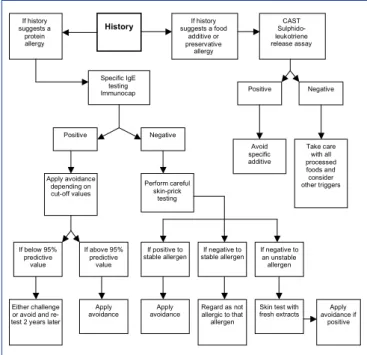
A diagnostic algorithm is given in Fig. 1.
Blood tests
Blood tests are preferred over skin-prick testing when the child has had a severe allergic reaction, as highly sensitive children may develop a systemic reaction or a severe local reaction to certain allergens applied to the skin, if not carefully titrated, e.g. peanuts, latex, penicillins, cephalosporins.
mast cell tryptase
Tryptase levels are low in normal or allergic/atopic individuals who have not had a recent allergic reaction. After a drug allergy, particularly if the drug has been administered during anaesthesia or intravenously (e.g. antibiotics, muscle relaxants), mast cells release tryptase into the bloodstream within 30 minutes and levels usually peak at 2 hours, remain elevated for 6 - 8 hours and fall back to normal levels within 24 hours.
The determination of serial tryptase levels at 2, 6 and 24 hours, if elevated after a severe adverse reaction during anaesthesia, confirms that the adverse reaction was indeed allergic. Tryptase levels are also above the normal ranges in children who have anaphylactic sensitivity to bees. An elevated baseline tryptase level in such children indicates a high risk for another severe reaction if they are exposed to bees. During bee venom immunotherapy, high tryptase levels indicate a greater risk of systemic reactions to the vaccine and extra precautions should be taken in such children (careful and more prolonged observation periods after their vaccines have been administered).
11 Fig. 1. Diagnostic algorithm.
Specific IgE testing Immunocap
Positive Negative
Perform careful skin-prick
testing
If below 95% predictive
value
If above 95% predictive
value
Either challenge or avoid and re-test 2 years later
Apply avoidance
If positive to stable allergen
If negative to stable allergen
Apply avoidance
Regard as not allergic to that allergen
If negative to an unstable allergen
Skin test with fresh extracts
Apply avoidance if
positive If history
suggests a protein allergy
History suggests a foodIf history
additive or preservative
allergy
CAST Sulphido-leukotriene release assay
Positive Negative
Avoid specific additive
Take care with all processed foods and consider other triggers Apply avoidance
depending on cut-off values
Fig. 1. Diagnostic algorithm.
Specific IgE tests
Over 400 Immunocap RASTs are available and should be carefully selected based on the history.1 Usually only a few Immunocap
tests are necessary if the history is carefully taken, but cross-reacting allergens should also be considered. Specific IgE Immunocaps are particularly reliable, sensitive and specific for stable ingested allergens, such as peanuts, milk, egg, other nuts (e.g. sesame, cashew, brazil nuts), crustaceans, molluscs and fish.
They are also very sensitive and specific for inhalants, e.g. grass pollen, cats, dogs, tree pollens, weeds, fungal spores, mites and latex. They have a low sensitivity for antibiotics (about 40%), but are more sensitive for muscle relaxants (e.g. succinyl choline). Cut-off values are available, indicating the positive 95% predictive
value for a reaction to subsequent exposure for several foods in children over 2 years of age (e.g. peanuts > 15 kU/l, fish > 20 kU/l, egg > 6 kU/l, milk > 31 kU/l);2 lower values should be
considered significant in children under 2 years (Table III).
Some children with levels below these 95 - 100% predictive cut-off values may still react to the allergen to which they are exposed. The only way to predict a subsequent reaction is to conduct a formal double-blinded placebo-controlled food challenge in a controlled environment if avoidance is likely to be difficult. Children allergic to eggs may safely receive measles and MMR vaccines.3
sulphido-leukotriene release test (CAsT)
The CAST has been found to be useful in identifying sensitivity to certain food additives and preservatives (e.g. sulphites, benzoates).4 It is important to note that there are different
cut-off values for the positive results of these tests recommended by the manufacturer, and that these have not been established for children.
Therefore careful interpretation of the results taken in the clinical context is important. A fresh sample of 2 ml EDTA blood is required and the test should preferably be performed within 3 hours of taking the blood, in a centre with experience in using CAST and its interpretation.
Eosinophil counts
A transient eosinophilia may follow an adverse allergic reaction to a drug, but many of these children already have moderate eosinophilia associated with the underlying atopic diseases (asthma, atopic eczema). The test results therefore
tend to be very nonspecific and not very informative unless results of previous recent eosinophil levels are known.
skin-prick tests
Skin-prick tests should be conducted by a specialist in allergology for the evaluation of life-threatening allergies in children when the results of blood tests are either non-informative or borderline and in certain situations when the results are negative. This applies to suspected antibiotic sensitivity, latex sensitivity, bee venom hypersensitivity, suspected sensitivity to unstable foods (e.g. banana, kiwi, apple, melon), indigenous allergens for which commercial blood tests are available, and where fresh extracts are known to provide greater sensitivity (e.g. apple, peach, melon).
Skin testing should be conducted with appropriate histamine and saline controls, and in duplicate for fresh extracts and drug-titrated testing. This should be done after systemic antihistamines have been withheld at least 72 hours before skin-prick testing, with full facilities on hand for resuscitation (including adrenaline, intravenous fluids, antihistamines, oxygen, equipment for intubation and ventilation).
The risks of skin testing should be carefully explained to parents and written consent should be obtained in every case. It is not necessary to conduct skin tests if it is quite clear from the history what the causative allergen was. Skin testing can also be postponed if more information is required for possible selection of the tests.
The technique must be impeccable and the lancet should penetrate no deeper than 1 mm into the skin. Intradermal skin testing is generally not recommended, but may be necessary only after a series of graded skin-prick testing has been found to be negative, confirming that the child is indeed non-reactive to the suspected agent (e.g. penicillin).
Challenge testing
food allergies
For food allergies, double-blind placebo-controlled challenge testing must be conducted in a specialised centre where levels are below the 95 - 100% positive predictive cut-off values in certain situations, with full facilities for resuscitation by experienced clinicians on standby.
Since the natural history for milk and egg allergies should subside by school entry age and a significant percentage of peanut allergies should subside between infancy and school entrance, challenge testing is sometimes indicated if the Immunocap IgE levels have fallen, especially when risks of exposure are high and children cannot be near their parents all day (e.g. crèche, pre-school).
In such situations caregivers and teachers should be fully educated regarding the risks and emergency measures to be applied. All schools should have adrenaline, antihistamines and a metered-dose bronchodilator with spacers in their sick rooms.
Parties are a
particular risk
situation for children
with certain life-
threatening allergies.
S
A
Jo
ur
H
ea
lth
S
A
Jo
ur
nal
of Child
H
ea
lth
S
A
Jo
ur
nal
of Child
H
ea
lth
TABLE III. CuT-off IgE vALuEs for > 90% PrEdICTABILITy for A suBsEquEnT
rEACTIon To foods
> 2 years Egg 6 kU/l
Milk 31 kU/l
Peanut 15 kU/l
Fish 20 kU/l
drug allergies
Challenge testing is not very well established for drug allergy evaluation in children. It may need to be conducted with small doses in an ICU setting in very ill children with life-threatening infection where antibiotic resistance has been confirmed. Such challenges follow a negative skin-prick test at full non-irritating concentrations (up to 3 mg/ml for penicillin), which have a 95% negative predictive value. This may be done especially for ‘potentially’ cross-reacting allergens (e.g. cephalosporins in penicillin-allergic subjects) where a newer-generation cephalosporin with a different side-chain is contemplated.5 It should only follow negative titrated skin
testing with the cephalosporins concerned (usually up to 25 mg/ml).
There is a 10% risk of specific re-sensitisation of the children during the titrated skin-prick testing procedure, so the first dose should always be given carefully in a high-care setting. Where allergic sensitisation has been confirmed by skin testing and no other therapeutic option is available for an infective agent, the antibiotic should only be given using an established desensitisation procedure (either orally or by injection) in an ICU. This rarely needs to be done, but can be life saving (e.g. in AIDS, subacute bacterial endocarditis and cystic fibrosis patients).
There is no place for challenging with non-steroidal anti-inflammatory drugs (NSAIDs). These are generally highly cross-reactive and there are no reliable in vitro tests established in children as yet. However, studies of the usefulness of the CAST for adults with NSAID sensitivity are in progress and positive results are found in a percentage of these patients.
‘sensitised’ or ‘allergic’?
An important current debate in allergy circles revolves around the significance of a particular value when assessing the results of a specific IgE test. It is well known that up to 40% of the general population may have ‘positive’ skin-prick tests or RASTs. In some of these the IgE confirms sensitisation, but many children are not ‘clinically allergic’ to that allergen. This applies to low levels of specific IgE to many food allergens in young children, particularly in those with atopic eczema. Therefore, in such children who are not obviously ‘allergic’ an ‘open challenge’ with the food could be contemplated in the doctor’s rooms to confirm clinically non-significant sensitisation. This also assists with planning the future dietary intake of these children in whom incorrect interpretation of laboratory results could lead to an unbalanced or nutritionally depleted diet.
In such cases follow-up of IgE values a year or two later may confirm a fall in IgE, or IgE values may even become negative after a period of avoidance, but may persist as ‘positive’ in the face of being clinically not significant.
In contrast, there are some children who are clinically highly sensitive to bee venom. In these cases both blood RASTs and skin tests are negative, but the children are still at great risk. In such cases the history is the clinician’s most important guide to further management and the patient should have emergency measures at hand at all times, and strictly avoid bee venom.
special situations
Bee venom hypersensitivity
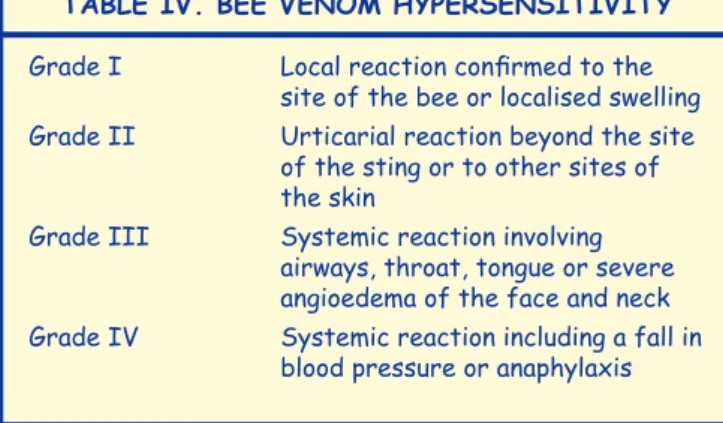
Children allergic to bees should be graded as shown in Table IV.
Specific IgE testing by Immunocap is performed to confirm sensitivity to hymenoptera (and not e.g. wasp) in order that the correct desensitising vaccine may be used. The level of IgE is not important, but should be positive. A tryptase level will indicate a further level of risk in these children.
Skin-prick testing may be used as an alternative to confirm bee sensitivity, but has potential for a serious adverse reaction and is not recommended unless the RAST is negative. It should be done at 4 - 6 weeks after having last been stung.
Latex allergy
Children with spina bifida, urogenital abnormalities, atrioventricular shunts and repeated orthopaedic or dental procedures are at risk of being sensitised to latex. These children may react to latex products in the home environment, e.g. rubberised toys, balloons, snorkels, sporting equipment, bathing caps, erasers and rubber balls.6
Immunocap RASTs will confirm sensitivity in about 85% of cases, particularly if the reaction has been severe. If negative, latex skin-prick testing will confirm sensitivity in more than 95% of sensitive individuals. Immunocap RASTs are more likely to be negative in those who have only oral or cutaneous involvement. It is important to confirm the diagnosis in all cases to prevent further exposure during dental procedures and to plan further surgery in a latex-free environment.7
Antibiotic and drug sensitivity
Anaphylactic reactions in children most commonly occur with the penicillins and cephalosporins.
Cross reactivity and concomitant sensitivity is more common between penicillins and first- and second-generation cephalosporins where the sensitivity is often to the beta-lactam core.5 For third- and fourth-generation cephalosporins allergic
reactions are often to the cephalosporin side-chain and not to the beta-lactam. Specific skin testing with such cephalosporins may enable the child to receive the cephalosporin safely. Specific testing should be carried out in specialised centres using specialised testing and desensitising protocols. There are no reliable sensitivity tests for sulphonamides or
TABLE Iv. BEE vEnom hyPErsEnsITIvITy
Grade I Local reaction confirmed to the
site of the bee or localised swelling Grade II Urticarial reaction beyond the site
of the sting or to other sites of the skin
Grade III Systemic reaction involving airways, throat, tongue or severe angioedema of the face and neck Grade IV Systemic reaction including a fall in
blood pressure or anaphylaxis
NSAIDs. Desensitisation protocols are available for penicillin, cephalosporins, vancomycin, sulphamethoxazole, aspirin and trimethoprin.
Children’s parties and airline travel
Parties are a particular risk situation for children with certain life-threatening allergies, especially for children under the age of 5 years. They often forget that they have allergies and allergens are hidden in cookies, biscuits, ice cream and drinks. Balloons represent a risk in the latex-sensitive group. Parties present high-risk exposure areas for nuts (including peanuts), egg and milk products and food additives (e.g. sulphites and sodium benzoates and colourants). A Medic Alert bracelet must be worn and other parents should be informed about the child’s sensitivity to avoid inadvertent and unintended exposure to a particular allergen.
A similar risk area is on airlines where children should take alternative ‘safe’ snacks on board.
visits to the doctor or health services
During such visits certain children are at risk. Allergens likely to be encountered include latex tubing or gloves, antibiotics, vaccines (e.g. influenza vaccine prepared in egg embryos), rubber blood-pressure cuffs and Elastoplast. Parents should inform their doctors about the child’s allergy, particularly when visiting a doctor or clinic for the first time or if the child requires transport in an ambulance.
A comprehensive booklet, listing non-latex alternatives for the medical environment in South Africa, is available from the Allergy Diagnostic and Clinical Research Unit at the University of Cape Town Lung Institute, tel (021) 406-6889.7
Provision of an emergency plan
It is essential that adequate time is spent educating the parents, child, caregiver, teacher, family members and friends about the child’s life-threatening allergies.
Information brochures are available from the Allergy Society of South Africa on the most important and common allergic emergencies. Parents should be given a written action plan on what should be done should the child be re-exposed. They need to be educated about the signs and about an ‘early reaction’ for which they should look out. Early signs, such
as tingling of hands or fingers, an itchy throat, coughing or dizziness, may proceed more obvious signs such as wheezing, angioedema, swelling of face and tongue, and hypotension. All children with life-threatening allergies should wear a Medic Alert bracelet. Adrenaline should be available, preferably in a syringe (e.g. Epipen), or an adrenaline vial and a tuberculin syringe with appropriate doses for weight in children under 3 years. Adrenaline should always be given intramuscularly in the upper thigh (not subcutaneously), and repeated after 20 minute if no response is obtained.
An antihistamine should be given orally or by injection and hydrocortisone (Solu-Cortef) should also be given, but this is a second-line drug and not life saving. Children should immediately be taken to an emergency room for at least 8 hours’ further observation, as some children will have a second late-phase delayed reaction 4 - 6 hours after the initial anaphylaxis.
In some situations where a known allergen has been inadvertently ingested the child may be given ipecacuanha syrup to induce vomiting to remove the ingested allergen before absorption takes place. Although this is not recommended by all allergists, it may be life saving when no other resuscitative treatments are available and the child is far away from medical facilities.
Although desensitisation has been performed in children with food allergies as part of research studies in the USA, this is currently not yet available for general use.
references
1. Potter PC. Food allergies: what every healthcare practitioner should know. South African Pharmaceutical Journal 2005; 72(3): 10-13.
2. Sampson HA, Ho DG. Relationship between food specific IgE concentrations and the risk of positive food challenges in children and adolescents. J Allergy Clin Immunol 1997; 100(4): 444-451.
3. Du Toit G, Weinberg E. Egg allergy and MMR vaccination. S Afr Med J 2003; 93(2): 113-114.
4. Potter PC. Clinical indications and interpretation of the CAST. Current Allergy and Clinical Immunology 2006; 19(1): 14-17.
5. Blanca M, Vega JM, Garcia J, et al. Unique aspects of allergic reactions to betalactams: cross reactions and unique specifications. Clin Exp Allergy
1994; 21: 407-415.
6. Potter PC. Latex allergy on the increase. Diseases of the Skin 1996; 10: 19-23.