Introduction
Evaluative Conditioning (EC) consists of a change in the valence of conditioned stimuli (CS) following their pair-ing with valent stimuli (unconditioned stimuli, or USs). The EC procedure has been regularly used for testing the automaticity of attitude formation (for a recent review, see Corneille & Stahl, 2019). Automaticity refers to four operating conditions: (1) unawareness of the CS-US pair-ings, (2) efficiency, (3) goal-independence, and (4) uncon-trollability (Bargh, 1994). In this research, we focus on the second one: efficiency (i.e., the possibility for the process to operate with minimal attentional resources) (Bargh, 1994). If EC relies on an efficient learning process, then it should be observed even when cognitive resources are depleted at encoding.
Against the efficiency view, previous research indicates the EC effect as well as memory of CS-US pairings are dras-tically reduced, often to non-significance, under cognitive load conditions (Dedonder et al., 2010; Mierop, Hütter & Corneille, 2017; Pleyers et al., 2009). As cognitive load was implemented during participants’ exposure to the CS-US pairs in these experiments, the availability of cognitive resources appears necessary for the successful encod-ing of CS-US pairencod-ings and, presumably as a result, for the establishment of an EC effect. CS-US relations encoding would thus be a critical, yet non-efficient, process in the establishment of EC effects.
Importantly, this account assumes load hampers the encoding of the CS-US relation while it preserves the
encoding of the individual CS and US stimuli that com-pose CS-US pairs. This assumption has not been tested yet, despite its importance. That is, should load impact the very encoding of individual stimuli, then the effect of load on EC would not conclusively speak to the efficiency of attitude acquisition. Rather, it would speak to the effi-ciency of the encoding of individual CS and US stimuli.
Blask, Walther, Halbeisen, and Weil (2012) correctly pointed out that a secondary task may prevent the encoding of the individual stimuli. Consistent with this, Halbeisen and Walther (2015) observed EC but not CS-US pairing memory resists a load manipulation when the load materials rely on a different modality than CS-US materials. These authors concluded EC can be established through an efficient encoding of the individual stimuli entering CS-US pairs, despite the unsuccessful encoding of the CS-US relation. Results from that experiment, how-ever, are at odds with many other experiments that failed to find efficient EC effect without CS-US memory when
also relying on dissimilarity conditions (e.g., Dedonder, 2010; Mierop et al., 2017).
Also consistent with the importance of encoding CS-US relations in EC effects is an experiment by Kattner (2012). This author observed no EC when participants’ atten-tion was directed to individual CS and US stimuli but was diverted from their pairings. Importantly, however, this research manipulated the focus of attention by using a processing goals modification. As was also the case in other experiments manipulating processing goals (e.g., Gast & Rothermund, 2011), participants were instructed to pay attention to irrelevant pairings (i.e., links of each CS and US with a random digit). Hence, this research speaks to goal-dependency (see also Corneille et al., 2009;
Université catholique de Louvain, BE
Corresponding author: Adrien Mierop ([email protected]) RESEARCH ARTICLE
Cognitive Load Impairs Evaluative Conditioning, Even When
Individual CS and US Stimuli are Successfully Encoded
Adrien Mierop, Pierre Maurage and Olivier Corneille
Cognitive load has been shown to reduce both Evaluative Conditioning (EC) effects and CS-US pairing memory. This suggests the successful encoding of CS-US pairings is required for eliciting EC effects. However, an alternative account may be that cognitive load impairs the encoding of individual CS or US stimuli in the first place. We examined this possibility by manipulating the presence or absence of an auditory two-back task at learning, and by measuring the memory for both individual CS and US stimuli and for their pairings. Cognitive load reduced memory for CSs, USs, and CS-US pairings. Of importance, however, it disrupted EC even when the encoding of individual CSs and USs composing a pair was pre-served. A mediation analysis also supported the assumption cognitive load reduces EC effects because it hampers the encoding of CS-US relations. This confirms the encoding of CS-US relation is a critical, yet non-efficient, contributor to EC.
Mierop et al: Evaluative Conditioning Under Load 2
Gast & Rothermund, 2011; Stahl, Haaf & Corneille, 2016; Verwijmeren et al., 2012), not to efficiency. Because auto-maticity features do not perfectly overlap with each other (Melnikoff & Bargh, 2018; Moors & De Houwer, 2006), the goal-dependency of EC does not imply EC is non-efficient.
To advance our understanding of the efficiency of atti-tude learning, we examined whether attiatti-tude formation is observed in an evaluative conditioning procedure when the encoding of individual CS and US stimuli is success-fully achieved but the encoding of their pairing is not. This was investigated by manipulating the presence or absence of an auditory two-back task at encoding and by measur-ing the memory of individual CS and US stimuli, as well as of their pairing. Based on growing evidence question-ing automatic attitude learnquestion-ing (Corneille & Stahl, 2019), we predicted we would replicate the findings that cogni-tive load (1) reduces EC and (2) weakens CS-US pairings memory. In addition, we (3) tested whether cognitive load preserves the memory of individual CS and US stimuli entering CS-US pairings and (4) examined whether EC effects are reduced in the load condition when memory for individual CS and US memory is preserved. Mediational analyses were additionally conducted to determine if the load effect on EC was mediated by participants’ memory for individual CSs and USs and CS-US relations.
Method
We report how we determined our sample size, all data exclusions, all manipulations, and all measures. The pre-registration, program script, raw data, and analytic script are publicly available on Open Science Framework (osf.io/g9wds).
Participants
Eighty-one undergraduate students participated in the experiment (58 women, 23 men, Mage = 20.49, SDage = 1.91). They were randomly assigned to a control (N = 41) or load (N = 40) condition. The ‘pwr.f2.test’ function of the ‘pwr’ package (Champely et al., 2013) in R (R Development Core Team, 2017) determined this sample size allows for detecting with a statistical power of (1–β) = 0.8 and a Type I error probability of α = 0.05 effect sizes as low as η2
p = 0.09, which is an intermediate effect size according to Cohen’s (1988) norm. In an Integrative Data Analysis con-ducted on data from three experiments, Mierop and col-leagues (2017) observed the overall effect of load on EC is of intermediate size (η2
p = 0.08).
Procedure and Material
The experiment was programmed with EPrime 2.0. Partici-pants went through three phases. In the first—condition-ing—phase, eight CS-US pairs were presented seven times, each for 1000 ms, in a random order. The CSs represented neutral consumption products (e.g., chewing-gums); whereas, the USs were pictures taken from the Interna-tional Affective Picture System (IAPS, Lang, Bradley & Cuthbert, 1997). Four CSs were paired with negative USs (IAPS references 2715, 2750, 6360, 6561, 2550, 4603, 4641, 8120) and four CSs were paired with positive USs (IAPS references 4608, 4700, 8200, 8460, 2141, 2900.1,
6315, 6510; CS-US pairings were counterbalanced across participants). At the trial level, a CS was presented at the bottom center of the screen; whereas, the US was simul-taneously presented in the background. During this con-ditioning phase, half of the participants had to perform an auditory two-back task involving numeric information communicated via headphones and responses produced on a keyboard (for a description of the procedure, see Pleyers et al., 2009).
In a second—evaluation—step, participants were invited to rate the CSs. In addition to the eight CSs that were pre-sented during the conditioning phase, eight additional CSs were included in this evaluation phase (previously and newly presented CSs were counterbalanced across partici-pants). In this evaluation phase, participants had to rate each of the 16 CSs on a scale ranging from 1 (very nega-tive) to 9 (very posinega-tive).
In a third—memory probe—step, we added 8 filler USs in addition to the 8 filler CSs that were not presented in the conditioning phase (old vs new USs were also counterbal-anced across participants), resulting in 16 CSs and 16 USs in the 2 subsequent memory tasks. Participants were first asked for each of the 16 CSs and 16 USs to report if (1) it was presented during the conditioning phase, (2) it was not presented during the conditioning phase, or (3) they do not remember.
Finally, for each of the 16 CSs, participants were asked to identify which of the 16 USs was paired with the CS. On each trial, participants had the opportunity to answer that they did not remember. Memory for individual CSs and USs was probed before CS-US pairing memory to avoid confusions (e.g., participants reporting they saw a given CS that was not presented during the conditioning phase because it was presented in the pairing memory phase).
Results
Analytical strategy
Data were analyzed using the ezANOVA, anovaBF, and lmBF functions (from the ‘ez’ and the ‘BayesFactor’ pack-ages, (Lawrence, 2016; Morey, Rouder & Jamil, 2015) in R (R Development Core Team, 2017). We report the Bayes factors associated with the model comparison made in the frequentist analyses.1 An augmented model containing the tested factor was compared to a constrained model not containing this factor. The Bayes factors in favor of the alternative hypothesis (or BF10) are presented when the conventional p-value of 0.05 is encountered. The Bayes factors in favor of the null hypothesis (or BF01) are reported when the p-value is above this threshold.
Evaluative ratings
The evaluative ratings of the CSs were averaged by partic-ipants and by US valence. These ratings were submitted to a 3 (US valence: positive, negative, none) × 2 (Depletion condition: Load, Control) repeated measures ANOVA, with the first factor manipulated within-participants and the second between-participants (see Figure 1A). This analysis revealed a main effect of US valence, F(2,158) = 10.51, p < 0.001, Generalized partial Eta-Squared (η2
positive CSs (M = 5.60, SD = 1.45) were preferred to neu-tral CSs (M = 5.10, SD = 0.99, t(80) = 2.89, p = 0.005), which tended to be preferred to negative CSs (M = 4.71, SD = 1.49, t(80) = 1.87, p = 0.06). A main effect of Deple-tion was also observed, F(1,79) = 4.30, p = 0.04, η2
g = 0.02, BF10 = 0.88 ± 4.52%. Although inconclusive in the Bayesian framework, CSs were less positively evalu-ated in the load (M = 4.96, SD = 1.25) than in the control (M = 5.31, SD = 1.48) condition.
More importantly, the analysis yielded a US valence × Depletion interaction, F(2,158) = 14.78, p < 0.001, η2
g = 0.11, BF10 > 1000. The simple effect of US valence was observed in the control condition, F(2,80) = 23.24,
p < 0.001, η2
g = 0.28, BF10 > 1000, but not in the deple-tion condideple-tion, F(2,78) = 0.58, p = 0.56, η2
g = 0.01, BF01 = 7.75 ± 1.17%. Consistent with previous research, the EC effect was reduced to non-significance when cognitive load was implemented at learning.
Load effect on CS-US pairing memory
We computed an accuracy score for the memory of the CS-US pairings. Correct responses were coded ‘1’; whereas, incorrect responses and ‘don’t know’ responses were coded ‘0’ at the item-level. We computed the pro-portion of correct responses for each participant. These proportion scores were submitted to a t-test as a func-tion of the Deplefunc-tion condifunc-tion (see Figure 1B). Con-tingency memory was higher in the control (M = 0.75, SD = 0.27) than in the depletion (M = 0.1, SD = 0.16,
t(79) = 13.14, p < 0.001, η2
g = 0.69, BF10 > 1000) condition. Hence, again consistent with previous research, cognitive load strongly reduced CS-US pairing memory.
Load effect on the memory of individual CSs and USs
To probe the memory of the individual stimuli, we com-puted an accuracy score for the memory of the individual CSs and USs after coding them into one of four possible categories: true positive (an old stimulus reported as old), false positive (a new stimulus reported as old), true nega-tive (a new stimulus reported as new), and false neganega-tive (an old stimulus reported as new). We computed an accu-racy score for each participant with the following formula:
( )
) (
True positives True negatives
True positives True negatives False positives False negatives
Memory accuracy was submitted to a t-test as a function of the load condition (see Figure 1D). It was higher for participants in the control condition (M = 0.95, SD = 0.08) than in the depletion condition (M = 0.58, SD = 0.17, t(79) = 12.29, p < 0.001, η2
g = 0.66, BF10 > 1000). Cognitive load thus substantially reduced memory accuracy for indi-vidual CS and US stimuli composing a pair.
Evaluative effects of load on correctly retrieved individual CSs and USs
We examined the role of US valence and Depletion condi-tion on the evaluacondi-tion of the subset of correctly retrieved2 individual CS and US stimuli. We observed a US valence × Depletion interaction, F(1,73.22) = 5.96, p = 0.02, η2
g = 0.06, BF10 = 6.01 ± 7.45%. EC was observed in the control condition, F(1,38.27) = 31.81, p < 0.001, η2
g = 0.44, BF10 > 1000, but not in the depletion condition, F(1,30.57) = 0.63, p = 0.43, η2
g = 0.00, BF01 = 3.29 ± 0.02% (see
Figure 1C). Hence, and critical to the present research endeavor, cognitive load impaired EC even when the
Mierop et al: Evaluative Conditioning Under Load 4
encoding of individual CS and US stimuli composing a CS-US pair was preserved.
This reduction of EC to non-significance in the deple-tion condideple-tion could be due to a weak statistical power. Indeed, only 30 CS-US pairs in the depletion condition for which both the CS and US stimuli were correctly retrieved were available. The number of available data points, however, allows the detection of an effect size as small as η2
g = 0.05 with a statistical power of (1–β) = 0.80 given the one-sided test (i.e., positive CSs are preferred to negative CSs) and a type I error probability of α = 0.05. As a matter of fact, the present study had 99% power for detecting an EC effect size of a magnitude similar to the one observed in the control condition (i.e., η2
g = 0.44). Furthermore, the Bayesian analysis suggests ‘substan-tial evidence in favor of the null-hypothesis’, which adds to the proposal that the non-significant EC under the depletion condition is not due to data insensitivity (Wagenmakers et al., 2011).
Memory and EC
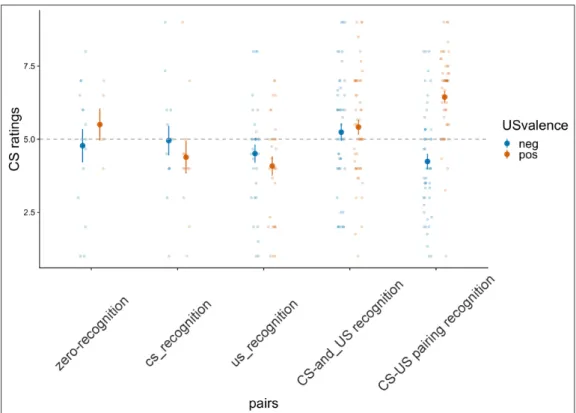
In a further—exploratory and non-preregistered—analy-sis, we examined CS evaluative ratings as a function of US valence and Pair types. Thus, we were able to test what type of memory (i.e., memory of individual CS, of individual US, and of their pairing) is necessary for EC. We first categorized each CS-US pair along five catego-ries: zero-memory (neither the CS nor the US was cor-rectly retrieved), CS-only memory pairs (the CS but not the US was retrieved), US-only memory (the US but not the CS was retrieved), CS-and-US memory (both CS and US were retrieved, but their pairing was not), and CS-US pairing memory (the CS, the US, and their pairing were correctly retrieved).
CSs evaluative ratings were then submitted to a 2 (US valence: positive, negative) × 5 (Pair: zero-memory, CS-memory, US-memory, CS-and-US memory, CS-US pairing memory) full repeated measures ANOVA (see
Figure 2). A US valence × Pair interaction was observed,
F(4,240.54) = 7.30, p < 0.001, η2
g = 0.09, BF10 > 1000. Looking at the simple effects of US valence by Pair types, a US valence effect (i.e., an EC effect) was observed for the CS-US pairing memory pairs, t(92.99) = 6.58,
p < 0.001, BF10 > 1000, but not for the CS-and-US mem-ory pairs, t(93.55) = 0.45, p = 0.66, BF01 = 4.31 ± 0.03%, the US-memory pairs, t(61.73) = 0.94, p = 0.34, BF01 = 2.69 ± 0.01%, the CS-memory pairs, t(24.56) = 0.75,
p = 0.46, BF01 = 2.26 ± 0.01%, and the zero-memory pairs, t(12.86) = 0.91, p = 0.38, BF01 = 1.95 ± 0.01%. In sum, EC was observed only when both individual stimuli and their pairing were correctly retrieved.
The mediating role of pairing memory between load and EC
In a final—exploratory and non-preregistered—analysis, we examined memory for CS-US pairings and for individ-ual CSs and USs as potential mediators of the causal Load-to-EC relation. We first computed a baseline-corrected EC score by participant [(CSpositive – CSneutral) – (CSnega-tive – CSneutral)], with higher score indicating higher EC. We then regressed this score in three steps (see Table 1). In the first step, we observed EC was predicted by the load manipulation (coded ‘control’ = 0.5, ‘depletion’ = –0.5; b
= 2.02, 95% CI [1.15, 2.88], t(79) = 4.63, p < 0.001, BF10 > 1000). In the second step, we added individual stimuli memory performance to the model. This factor did not predict EC (b = 0.14, 95% CI [–3.15, 3.43], t(78) = 0.09,
p = 0.93, BF01 = 2.59 ± 0.76%), nor did it reduce the
impact of the load on EC (see Table 1). In the third step, we added CS-US pairing memory in the model. Whereas CS-US pairing memory strongly predicted EC (b = 3.08, 95% CI [1.12, 5.05], t(77) = 3.12, p = 0.003, BF10 = 23.39 ± 1.11%), the load factor was no more related to EC (b = 0.51, 95% CI [–1.18, 2.20], t(77) = 0.60, p = 0.60, BF01 = 1.50 ± 0.81%, for the full reporting, see Table 1). We con-clude that cognitive load reduces EC to non-significance because it hampers the encoding of CS-US pairings.
Discussion
Previous studies suggest load disrupts EC by hampering the encoding of CS-US pairing, making it a non-efficient attitude formation effect (Dedonder et al., 2010; Mierop et al., 2017; Pleyers et al., 2009). It was correctly pointed out, however, the inability to encode individual compo-nents of CS-US pairings under load, rather than the inabil-ity to encode their pairing, may have been responsible for the effect of load on the EC effect and CS-US pairing mem-ory. Here, we observed the auditory two-back task reduced memory for individual CS and US stimuli, as well as for their pairing. However, we also found load reduces EC to non-significance even when individual stimuli enter-ing a pairenter-ing are successfully retrieved. We more gener-ally found EC is observed only when there is a successful retrieval of CS-US pairings. This finding, along with the mediation results obtained here, is fully consistent with previous research supporting the critical role of attention paid to CS-US pairings at encoding for establishing EC effects (e.g., Kattner, 2012; Stahl et al., 2016). In contrast, the present findings go against previous research
conclud-ing the correct encodconclud-ing of individual stimuli may be suf-ficient for EC to occur (Halbeisen & Walther, 2015).
By relating EC effects to a Load manipulation and to memory measures for both CS-US pairings and individual CSs and USs, the present research constitutes the first empirical indication EC is non-efficient because it relies on a non-efficient encoding of CS-US relations. This, in turn, is consistent with a broader range of findings that question the automaticity of attitude formation (see Corneille & Stahl, 2019). Because dual-learning of atti-tude theories explicitly state the efficiency of associative attitude learning (e.g., Gawronski & Bodenhausen, 2014), the present findings challenge this theorization. Recently, however, attitude learning researchers have noted oper-ating conditions may be agnostic to whether learning effects are driven by propositional or associative processes (De Houwer, 2018; Gawronski & Bodenhausen, 2018).
An important assumption we made is memory meas-ures are valid indicators of encoding effects. Memory measures capture encoding, but also consolidation and retrieval effects. This may be a problem when looking at simple correlations between memory and EC meas-ures (Gawronski & Walther, 2012; Sweldens, Corneille & Yzerbyt, 2014). However, the memory measures were not collected here in an experimental vacuum. They were examined as a function of a Load manipulation imple-mented during exposure to CS-US pairs. Because past research has demonstrated the immediate effect of a two-back task on encoding capacities (e.g., Jonides et al., 1997; Kane & Engle, 2002), we can confidently assume the memory measures we used here reliably captured a
Table 1: Regression results using EC as the criterion.
Predictor b b
95% CI [LL, UL]
sr2 sr2 95% CI [LL, UL]
Fit Difference
Intercept 0.88** [0.44, 1.31]
Load 2.02** [1.15, 2.88] 0.21 [0.07, 0.36]
R2 = 0.214** 95% CI[0.07, 0.36] Intercept 0.77 [–1.80, 3.33]
Load 1.96* [0.48, 3.45] 0.07 [–0.03, 0.17] Individual memory 0.14 [–3.15, 3.43] 0.00 [–0.00, 0.00]
R2 = 0.214** ΔR2= 0.000 95% CI[0.06, 0.35] 95% CI[–0.00, 0.00] Intercept 0.61 [–1.82, 3.04]
Load 0.51 [–1.18, 2.20] 0.00 [–0.02, 0.02] Individual memory –1.36 [–4.62, 1.91] 0.01 [–0.02, 0.03] Pairing memory 3.08** [1.12, 5.05] 0.09 [–0.02, 0.19]
R2= 0.302** ΔR2= 0.088** 95% CI[0.12, 0.43] 95% CI[–0.02, 0.19]
Note: A significant b-weight indicates the beta-weight and semi-partial correlation are also significant. b represents unstandardized regression weights. sr2 represents the semi-partial correlation squared. LL and UL indicate the lower and upper limits of a confidence interval, respectively.
Mierop et al: Evaluative Conditioning Under Load 6
Load effect on encoding, one that was evidenced later at retrieval. As a matter of fact, the combined use of an experimental manipulation and memory measure has been specifically recommended for a validation of these measures as indicators of encoding effects (see Sweldens, Corneille & Yzerbyt, 2014). More generally, however, the present findings are fully consistent with a retrieval-based approach to evaluations, which states memory contents retrieved at the evaluation stage, which vary as a func-tion of what informafunc-tion is encoded, underlie evaluafunc-tions (Gast, 2018; Stahl & Aust, 2018).
One could argue the memory measures we used could be sensitive to affect-as-information heuristic, which may lead to memory estimates inflation. That is, when the valence of a US paired with a given CS cannot be retrieved, participants may rely on the valence conditionally acquired by the CS to infer US valence. In recent research, Hütter, Sweldens, Stahl, Unkelbach, and Klauer, (2012) argued valence memory performance may be contami-nated by an affect-as-information heuristic. By relying on US identity measures, however, we strongly reduced an artefactually inflated pairing memory. It should also be noted, even assuming such problem may have to some extent arose, there is no reason to postulate it would have differentially influenced low and high load conditions. Finally, because identity measures are more conserva-tive than valence identity measures (Stahl, Unkelbach & Corneille, 2009), our current choice was facilitating EC in the (presumed) absence of successful CS-US encoding. That is, CS-US pairs we considered unsuccessfully encoded (based on US identity measures) could actually have been successfully encoded (based on US valence measures). The current findings are consistent with previous research stressing the importance of processing the CS-US relation
in EC effects (Corneille et al., 2009; Kattner, 2012; Mierop et al., 2019; Stahl et al. 2016) and suggest this processing is non-efficient. Future research may identify conditions under which attitude formation is efficient. It cannot be excluded efficient EC might be found when using other evaluative measures, sensory modalities, pairing proce-dures, or types of stimuli. To date, however, the detrimen-tal impact of load on EC has been observed using indirect evaluative measures (Davies et al., 2012), conditioning paradigms presumably conducive to implicit misattribu-tion (Mierop et al., 2017), unfamiliar CSs (Dedonder et al., 2010), and CS from both visual and gustatory modalities (Davies et al., 2012).
Notes
1 Priors and methods of computation are the defaults provided in Rouder, Morey, Speckman, and Province (2012). For the models reported here, the r scale values were set to ½, which corresponds to “medium” priors. 2 Due to the uneven proportions of observations across
the different type of pairs, we report the F tests and degrees of freedom based on Kenward-Roger approxi-mation. This analytical strategy was also used for the next and last statistical model.
Additional File
The additional file for this article can be found as follows:
• Data Accessibility Statement. All materials (data-bases, scripts, measures, manipulations, and online appendix) are publicly available at. DOI: https://doi. org/10.5334/irsp.339.s1
Competing Interests
The authors have no competing interests to declare.
References
Blask, K., Walther, E., Halbeisen, G., & Weil, R. (2012). At the crossroads: Attention, contingency awareness, and evaluative conditioning. Learning and Motiva-tion, 43(3), 99–106. DOI: https://doi.org/10.1016/j. lmot.2012.03.004
Champely, A. S., Ekstrom, C., Dalgaard, P., Gill, J., Wunder, J., & De Rosario, H. (2013). Package “pwr”.
Cohen, J. (1988). Statistical power analysis for the behavioral sciences. 2nd. Hillsdale, NJ: Erlbaum.
Corneille, O., & Stahl, C. (2019). Associative Attitude Learning: A Closer Look at Evidence and How It Relates to Attitude Models. Personality and Social Psychology Review, 1088868318763261. DOI: https://doi.org/10.1177/1088868318763261
Corneille, O., Yzerbyt, V. Y., Pleyers, G., & Mussweiler, T. (2009). Beyond awareness and resources: Evalu-ative conditioning may be sensitive to processing goals. Journal of Experimental Social Psychology,
45(1), 279–282. DOI: https://doi.org/10.1016/j. jesp.2008.08.020
Davies, S. R., El-Deredy, W., Zandstra, E. H., &
Blanchette, I. (2012). Evidence for the role of cognitive resources in flavour–flavour evaluative conditioning. Quarterly Journal of Experimental Psychology, 65(12), 2297–2308. DOI: https://doi. org/10.1080/17470218.2012.701311
Dedonder, J., Corneille, O., Yzerbyt, V., & Kuppens, T. (2010). Evaluative conditioning of high-novelty stimuli does not seem to be based on an automatic form of associative learning. Journal of Experimental Social Psychology, 46(6), 1118–1121. DOI: https:// doi.org/10.1016/j.jesp.2010.06.004
De Houwer, J. (2018). Propositional models of evaluative conditioning. Social Psychological Bulletin, 13(2). DOI: https://doi.org/10.5964/spb.v13i3.28046
Gast, A. (2018). A Declarative Memory Model of Evaluative Conditioning. Social Psychological Bulletin, 13(3). DOI: https://doi.org/10.5964/spb.v13i3.28590
Gast, A., & Rothermund, K. (2011). What you see is what will change: Evaluative conditioning effects depend on a focus on valence. Cognition and Emotion, 25(1), 89–110. DOI: https://doi. org/10.1080/02699931003696380
Gawronski, B., & Bodenhausen, G. V. (2014). The asso-ciative-propositional evaluation model: Operating principles and operating conditions of evaluation. In
Dual-process theories of the social mind (pp. 188–203).
Gawronski, B., & Walther, E. (2012). What do mem-ory data tell us about the role of contingency awareness in evaluative conditioning? Jour-nal of Experimental Social Psychology, 48(3), 617–623. DOI: https://doi.org/10.1016/j.jesp. 2012.01.002
Halbeisen, G., & Walther, E. (2015). Dual-task interfer-ence in evaluative conditioning: Similarity mat-ters! Quarterly Journal of Experimental Psychology,
68(10), 2008–2021. DOI: https://doi.org/10.1080/ 17470218.2014.1002506
Hütter, M., Sweldens, S., Stahl, C., Unkelbach, C.,
& Klauer, K. C. (2012). Dissociating contingency awareness and conditioned attitudes: Evidence of contingency-unaware evaluative condition-ing. Journal of Experimental Psychology: General,
141(3), 539–557. DOI: https://doi.org/10.1037/ a0026477
Kattner, F. (2012). Revisiting the relation between con-tingency awareness and attention: Evaluative condi-tioning relies on a contingency focus. Cognition & Emotion, 26(1), 166–175. DOI: https://doi.org/10.1 080/02699931.2011.565036
Lang, P. J., Bradley, M. M., & Cuthbert, B. N. (1997). International affective picture system (IAPS): Tech-nical manual and affective ratings. NIMH Center for the Study of Emotion and Attention, 39–58.
Lawrence, M. A. (2016). Package ‘ez’.
Melnikoff, D. E., & Bargh, J. A. (2018). The Mythi-cal Number Two. Trends in Cognitive Sciences,
22(4), 280–293. DOI: https://doi.org/10.1016/j. tics.2018.02.001
Mierop, A., Bret, A., Yzerbyt, V., Dumas, R., &
Corneille, O. (2019). Evaluative influences of CS-US pairings are non-reciprocal. Social Psychological Bulletin, 14(1). DOI: https://doi.org/10.32872/spb. v14i1.31408
Mierop, A., Hütter, M., & Corneille, O. (2017). Resource Availability and Explicit Memory Largely Determine Evaluative Conditioning Effects in a Paradigm Claimed to be Conducive to Implicit Attitude Acquisition. Social Psycho-logical and Personality Science, 8(7), 758–767. DOI: https://doi.org/10.1177/1948550616687 093
Moors, A., & De Houwer, J. (2006). Automaticity: A Theoretical and Conceptual Analysis. Psychologi-cal Bulletin, 132(2), 297–326. DOI: https://doi. org/10.1037/0033-2909.132.2.297
Morey, R. D., Rouder, J. N., & Jamil, T. (2015). Bayes-Factor: Computation of Bayes factors for common designs. R package version 0.9, 9, 2014.
Pleyers, G., Corneille, O., Yzerbyt, V., & Luminet, O.
(2009). Evaluative conditioning may incur atten-tional costs. Journal of Experimental Psychology: Animal Behavior Processes, 35(2), 279–285. DOI: https://doi.org/10.1037/a0013429
R Development Core Team. (2017). A language and environment for statistical computing. Consulté à l’adresse http://www.R-project.org
Rouder, J. N., Morey, R. D., Speckman, P. L., &
Province, J. M. (2012). Default Bayes factors for ANOVA designs. Journal of Mathematical Psychology, 56(5), 356–374. DOI: https://doi. org/10.1016/j.jmp.2012.08.001
Stahl, C., & Aust, F. (2018). Evaluative Conditioning as Memory-Based Judgment. Social Psychological Bul-letin, 13(3). DOI: https://doi.org/10.5964/spb. v13i3.28589
Stahl, C., Haaf, J., & Corneille, O. (2016). Subliminal evaluative conditioning? Above-chance CS iden-tification may be necessary and insufficient for attitude learning. Journal of Experimental Psychol-ogy: General, 145(9), 1107–1131. DOI: https://doi. org/10.1037/xge0000191
Stahl, C., Unkelbach, C., & Corneille, O. (2009). On the respective contributions of awareness of uncon-ditioned stimulus valence and unconuncon-ditioned stimulus identity in attitude formation through evaluative conditioning. Journal of Personality and Social Psychology, 97(3), 404–420. DOI: https://doi. org/10.1037/a0016196
Sweldens, S., Corneille, O., & Yzerbyt, V. (2014). The Role of Awareness in Attitude Formation Through Evaluative Conditioning. Personality and Social Psy-chology Review, 18(2), 187–209. DOI: https://doi. org/10.1177/1088868314527832
Verwijmeren, T., Karremans, J. C., Stroebe, W., &
Wigboldus, D. H. J. (2012). Goal relevance mod-erates evaluative conditioning effects. Learning and Motivation, 43(3), 107–115. DOI: https://doi. org/10.1016/j.lmot.2012.06.002
Wagenmakers, E.-J., Wetzels, R., Borsboom, D., & Van Der Maas, H. L. (2011). Why psychologists must change the way they analyze their data: The case of psi: Comment on Bem (2011). Journal of Person-ality and Social Psychology, 100(3), 426–432. DOI: https://doi.org/10.1037/a0022790
How to cite this article: Mierop, A., Maurage, P., & Corneille, O. (2020). Cognitive Load Impairs Evaluative Conditioning, Even When Individual CS and US Stimuli are Successfully Encoded. International Review of Social Psychology, 33(1): 3, 1–7. DOI: https:// doi.org/10.5334/irsp.339
Submitted: 13 August 2019 Accepted: 17 January 2020 Published: 21 February 2020
Copyright: © 2020 The Author(s). This is an open-access article distributed under the terms of the Creative Commons Attribution 4.0 International License (CC-BY 4.0), which permits unrestricted use, distribution, and reproduction in any medium, provided the original author and source are credited. See http://creativecommons.org/licenses/by/4.0/.