An Evolutionary Algorithm Based on
Repeated Mutations for Solving the
Capacitated Vehicle Routing Problem
Krunoslav Pulji´c
Department of Mathematics, University of Zagreb, Croatia
An evolutionary algorithm for solving the capacitated vehicle routing problem is described. The algorithm employs repeated mutations in a manner similar to local search. Experiments are presented, where the algorithm has been implemented and tested on some benchmark problem instances.
Keywords: capacitated vehicle routing problem, evolu-tionary algorithms, repeated mutations, local search, experiments
1. Introduction
Thecapacitated vehicle routing problem(CVRP)
is an interesting combinatorial optimization task, which occurs frequently in real-world applica-tions [28]. The problem deals with scheduling a fleet of vehicles to distribute goods between depots and customers. A set of routes for ve-hicles should be determined, which are in some sense optimal, e.g. the shortest or the cheap-est. Certain constraints should be taken into account, such as customer demands and vehicle capacities.
Evolutionary algorithms (EAs) are a popular metaheuristic which tries to solve optimization problems by imitating processes observed in na-ture[17]. An EA maintains a population of chro-mosomes where each of them encodes a solution to a particular problem instance. The evolu-tion of those chromosomes takes place through the application of operators and procedures that mimic natural phenomena, such as reproduc-tion, mutareproduc-tion, survival of the fittest, etc. The CVRP is known to be computationally ex-tremely hard. First of all, it belongs to the
class of NP-hard problems [21]. Moreover, it is in fact a generalization and combination of the traveling salesman problem (TSP) and the bin-packing problem(BPP). Consequently, the CVRP turns out to be even harder than the al-ready NP-hard TSP or BPP. We can expect that very small instances of the CVRP can be solved to optimality, but large instances can be solved only approximately. Thus it makes sense to consider applications of metaheuristics, such as EAs, to the CVRP.
In recent years, there have been many attempts to solve the CVRP and similar problems by EAs. Some of the obtained performance results are re-ported for instance in[1, 4, 7, 11, 13, 15, 19, 22, 24, 29, 30]. General impression is that a pure evolutionary approach is not yet competitive on the CVRP or its variants compared to the other metaheuristics, particularly tabu search[28]. It seems that the presently used chromosomes and evolutionary transformations are not able to capture the full essence of the problem itself. Therefore, many authors have proposed hybrid algorithms[2, 5, 8, 10, 12, 16, 18, 20, 25, 26, 27], where the performance of an EA has been im-proved by replacing its mutation operator by a traditionallocal-searchprocedure[3, 6, 21].
produce similar effects as local search in hybrid algorithms. The paper is organized as follows. Section 2 gives preliminaries about the CVRP and EAs. Section 3 describes some useful build-ing blocks of EAs for solvbuild-ing the CVRP, which have originally been introduced by other au-thors. Section 4 explains how those building blocks have been arranged in a different way to form our algorithm. Section 5 reports on the results of experiments, where the algorithm has been implemented and tested on a well known library of benchmark problem instances. The final Section 6 gives a conclusion.
2. Preliminaries
The CVRP may be described as the following graph problem. Let G = (V,A)be a complete directed graph, where V = {0,1,2, . . .,n} is the vertex set and A is the arc set. Vertices
i=1,2, . . . ,ncorrespond to the customers, and vertex 0 corresponds to the depot. A nonneg-ative cost cij is assigned to each arc(i,j) ∈ A,
and it represents the travel cost spent to go from vertex i to vertex j. Each customer vertex iis associated with a nonnegative demand dito be
delivered, and the depot 0 has a fictitious de-mand d0 = 0. A set of K identical vehicles, each with the capacityC, is available at the de-pot. The CVRP consists of finding a collection of ≤ K elementary cycles inG with minimum total cost, such that:
• each cycle visits the depot vertex 0,
• each customer vertexi = 1,2, . . . ,nis vis-ited by exactly one cycle,
• the sum of the demandsdiof the vertices
vis-ited by a cycle does not extend the vehicle capacityC.
By an elementary cycle inGwe mean a circular path that does not traverse any vertex more than once. The total cost of a collection of cycles is defined as the sum of the costs cij of all
in-volved arcs. Obviously, the solution to a CVRP instance specifies an optimal schedule for the vehicles delivering goods from the depot to the customers, so that the demand of each customer is satisfied and no vehicle is overloaded. Each cycle in the solution corresponds to a vehicle route.
In many benchmark problem instances, the ver-tices from V are associated with points of the plane having given coordinates, and the cost
cij for each arc (i,j) ∈ A is defined as the
Euclidean distance between the two involved points. Such instances belong to a more re-stricted problem called theEuclidean symmetric
CVRP(ESCVRP).
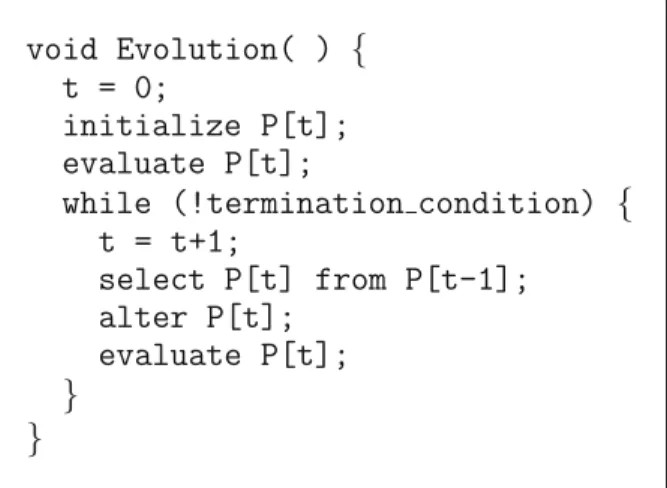
The general structure of an evolutionary algo-rithm is shown in Figure 1. Thus an evolution-ary algorithm for solving an optimization prob-lem is a randomized procedure which maintains a population (set) of so-called chromosomes. Each chromosome represents a potential solu-tion to the given problem instance, and it is im-plemented by some data structure. The popula-tion is iteratively changed, thus giving a series of population versions which are called gener-ations. It is expected that the best chromosome in the last generation represents a near-optimum solution.
void Evolution( ) {
t = 0;
initialize P[t]; evaluate P[t];
while (!termination condition) {
t = t+1;
select P[t] from P[t-1]; alter P[t];
evaluate P[t];
} }
Figure 1.Structure of an evolutionary algorithm.
There are unary genetic operators, called mu-tations, which create new chromosomes ( mu-tants) by a small random change in a single chromosome. There are also higher order oper-ators calledcrossovers, which create new chro-mosomes (children) by combining parts from several (usually two) chromosomes (parents). More fit chromosomes should have more chance to take part in crossovers.
3. Basic Components of the Algorithm
In our algorithm, a chromosome is built as pro-posed in [14], thus it is a list of integers rep-resenting a permutation of customer vertices. This permutation is interpreted as a large ele-mentary cycle, which is obtained from a CVRP-instance solution by concatenating the vehicle routes and by omitting visits to the depot. Note that the same chromosome can in fact repre-sent many different solutions. Still, we use a unique decoding, which is based on the greedy approach. Thus it is assumed that the first ve-hicle visits as many customers from the initial part of the chromosome as it is possible accord-ing to the vehicle capacityC, the second vehicle serves as many customers as possible from the following part of the chromosome, etc. For in-stance, let the vehicle capacity be C =20, and suppose that we have n = 9 customers whose demandsd1,d2,. . .d9are in turn:
2, 4, 7, 5, 3, 5, 8, 6, 1.
Then the chromosome
p = (2 5 8 9 3 7 6 1 4)
is decoded by the greedy approach to the fol-lowing three vehicle routes:
(2 5 8 9) (3 7 6) (1 4).
It is assumed, but not explicitly written, that each route starts and ends in the depot.
In our algorithm, we use the crossover operator called order-crossover (OX) proposed in [23]. First, two cut points are randomly selected, and the chromosome part located between those cut points on the first parent is assigned to the child. The remaining positions are then filled one at a time, starting after the second cut point, by con-sidering the customer vertices in order found
on the second chromosome (wrapping around when the end of the list is reached). For in-stance, let the two parents and the two cut points “|” be as follows:
p1 = (1 2 3|5 4 6 7|8 9), p2 = (4 5 2|1 8 7 6|9 3).
Then the first childc1is:
c1 = (2 1 8|5 4 6 7| 9 3).
If we exchange the roles of the two parentsp1 andp2, we can obtain the second child:
c2 = (3 5 4|1 8 7 6| 9 2).
In our algorithm, we use three different mutation operators, calledremove-and-reinsert(RARM),
swap(SM)andinvert(IM), as proposed in[14],
[23]and [11], respectively. The operators start in the same way by randomly choosing two po-sitions within the chromosome, and then they proceed in different ways. Namely, RARM re-moves the vertex(customer)from the first posi-tion and reinserts it to the second posiposi-tion, SM swaps the vertices at the two positions, while IM inverts the sequence of vertices between the two positions. For instance, let the starting chromo-some be
p = (1 2 3 4 5 6 7 8 9).
Suppose that the randomly chosen positions are 3 and 7. Then the three operators produce in turn the following three mutants:
¯
pRARM = (1 2 4 5 6 7 3 8 9),
¯
pSM = (1 2 7 4 5 6 3 8 9),
¯
pIM = (1 2 7 6 5 4 3 8 9).
4. Overall Design of the Algorithm
The structure of our evolutionary algorithm fol-lows the outline from Section 2, i.e. it is roughly the same as shown in Figure 1. The initial popu-lationP[0]is created by producing random per-mutations according to the uniform probability distribution. A series of generationsP[t]is pro-duced by applying the crossover operator OX and six mutation variants RARMG, RARML, SMG, SML, IMG, IML. Evaluation of chromo-somes is done directly by using the objective function of the CVRP, i.e. the fitness of a chro-mosome is equal to the total transportation cost of the corresponding solution. The algorithm stops when no further improvement is possible or when a prescribed time limit is reached. As already mentioned, our algorithm uses muta-tions in a special way calledrepeated mutations. It means that mutation operators are never ap-plied directly or separately. Instead, they are grouped within special procedures. Such a pro-cedure considers some (or even all) possible mutations of a given chromosome, and finally applies only the best one among considered, i.e. the one that maximally increases the fitness of that chromosome. A separate procedure is built for each of the six variants of mutations. If the number of considered mutations within a repeated-mutations procedure is small, then those mutations are chosen randomly, and the whole procedure is still randomized. However, in the extreme case when all possible mutations are considered, the procedure becomes deter-ministic and equivalent to a local search proce-dure.
Now follows a detailed description of the way how our algorithm transforms one generation of chromosomes P[t-1] into the next generation P[t]. Selection ofP[t]at the beginning of iter-ationtis done trivially: all chromosomes from P[t-1]are inherited. A little bit more compli-cated is the step of alteringP[t]during iteration t, which is accomplished in the following way. • Two “good” chromosomes are chosen from the current population, by using the so-called
tournament selection[17]. The chosen chro-mosomes serve as parents for crossover. A prescribed number of children is generated from the same parents with different ran-domly generated cut points in the OX
opera-tor. Only the most fit child is retained, while the others are discarded.
• The only remaining child is improved by repeated mutations. First, the child is im-proved by applying for instance the RARMG procedure; then the improved child(mutant) is further improved by the same procedure; then the further improved child (mutant’s mutant) is even further improved again by the same procedure, etc. When there is no further improvement, we switch to the next procedure, e.g. RARML,. . .and so on until all procedures are tried.
• The final improved child is inserted into the current population so that it replaces a “sim-ilar” chromosome. Two chromosomes be-ing similar means that relative difference of their fitness measures is below a prescribed threshold. If there is no similar chromo-some, then the improved child replaces a “bad” chromosome chosen by a form of tour-nament selection withelitism[17].
As we see, two consecutive generations differ in only one chromosome. Diversity of solutions within one generation is maintained by avoiding to store similar chromosomes.
Note that our algorithm relies on many parame-ters, which are left free to be adjusted for certain problem instances. Such parameters are: popu-lation size, number of children generated from the same parents within one iteration, number of mutations considered by a repeated-mutations procedure, percent of population to be consid-ered by tournament selection, similarity thresh-old, time limit, etc.
5. Experiments and Results
all possible mutations of a given chromosome, or only a specified number of randomly chosen mutations.
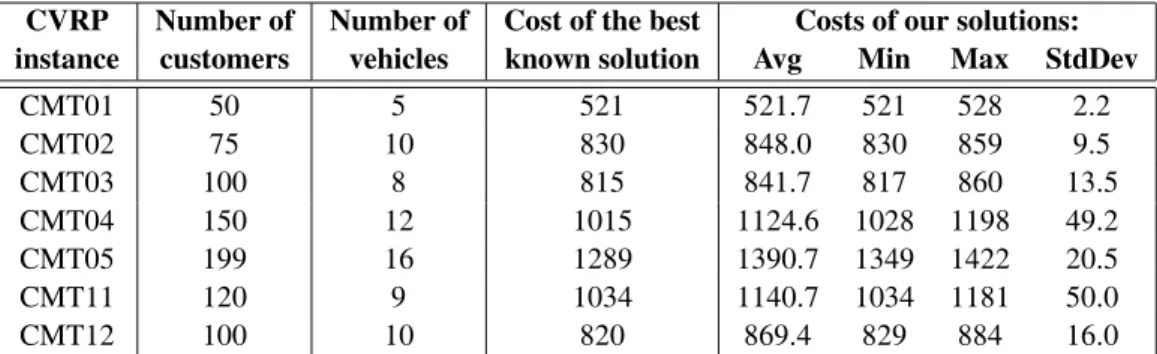
The implemented algorithm has been experi-mentally evaluated on seven benchmark ES-CVRP instances from the so-called Christofides-Mingozzi-Toth library. The whole library is available at the on-line repository [9]. Table 1 gives some basic properties of the considered test examples, including the costs of their opti-mal solutions or best solutions known so far. During a preliminary part of experimenting, we first determined acceptable values for some of the free parameters in our algorithm. Thus the population size was fixed to 30. Similarly, the percentage of population to be considered by tournament selection of good and bad chromo-somes was set to 70% and 15%, respectively. The execution time limit was chosen as 10 min-utes, 45 minutes or 3 hours, depending on the problem instance size. The similarity threshold was lowered, so that only equal integer fitness measures are treated as similar. On the other hand, the number of mutations considered by a repeated-mutations procedure and the number of children of the same parents were left over for dynamic adjustment.
To accomplish the above mentioned dynamic adjustment, we have implemented an additional procedure, which measures the progress of evo-lution and changes the two parameters accord-ingly. The present version of the procedure is quite simple. When the fitness of the best chromosome improves during few iterations, then the number of mutations considered by a repeated-mutations procedure is decreased to enable faster execution of the forthcoming it-erations. Otherwise, the number of mutations
is increased, thus giving more chance for find-ing better solutions in the followfind-ing iterations. The number of children of the same parents is always changed in the opposite direction, in or-der to partially compensate side-effects of the first change.
Of course, the two dynamic parameters can range only within certain prescribed limits. Thus the number of mutations is always kept between 1% and 20% of the total number of all possible mutations, and it is changed with offsets+1% and -10%, respectively. Similarly, the number of children of the same parents may vary from 1 to 100 with steps+5 and -1. Note that we ex-plore only up to 20% of all possible mutations, so that mutation always remains a randomized process. Consequently, within the presented experiments we actually do not use the possi-bility of transforming repeated mutations into something equivalent to local search.
The main part of experimenting has been ac-complished with the parameters already ad-justed as described above. The obtained re-sults are summarized again in Table 1. Each row presents our solutions for one particular problem instance. The shown values can easily be compared with the results obtained by other authors with other metaheuristics. Since our algorithm still relies on random numbers, dif-ferent runs with the same data and parameters can produce different solutions. Table 1 there-fore presents statistical values computed over exactly 10 runs.
As we can see from Table 1, our algorithm solves smaller problem instances to optimality. The obtained best solutions to medium test ex-amples are up to 1.2% worse than the best from
CVRP Number of Number of Cost of the best Costs of our solutions:
instance customers vehicles known solution Avg Min Max StdDev
CMT01 50 5 521 521.7 521 528 2.2
CMT02 75 10 830 848.0 830 859 9.5
CMT03 100 8 815 841.7 817 860 13.5
CMT04 150 12 1015 1124.6 1028 1198 49.2
CMT05 199 16 1289 1390.7 1349 1422 20.5
CMT11 120 9 1034 1140.7 1034 1181 50.0
CMT12 100 10 820 869.4 829 884 16.0
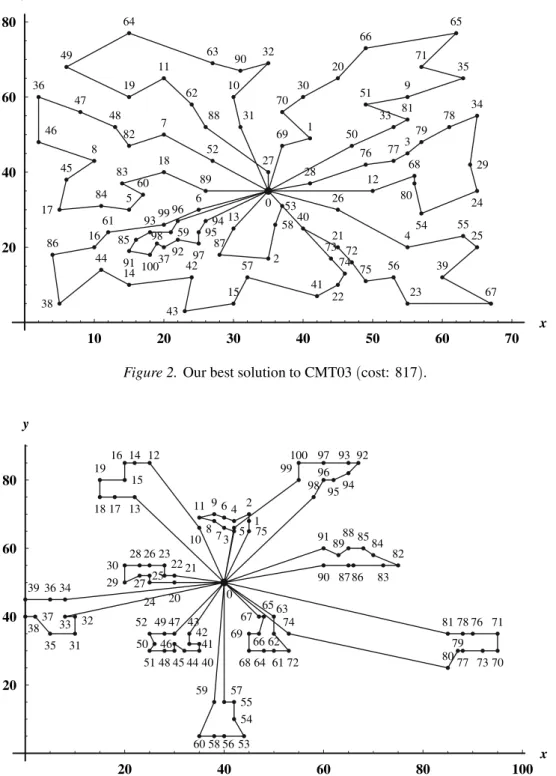
literature. The algorithm is slightly less suc-cessful in solving larger instances, where the relative errors range from 1.2% to 4.7%. Our best result for CMT03, being only 0.25% above the optimum, is visualized in Figure 2. Similarly, Figure 3 depicts the obtained best solution to CMT12 that is 1.1% worse than the corresponding optimal solution. In both figures,
the customers and the depot are shown as points of the plane with given coordinates. Also, the vehicle routes forming the solution are plotted by solid lines.
In the course of experimenting, we have also gained some rough impressions about comput-ing times required by our algorithm. On a PC with a 2.4 GHz Pentium processor, the solution
10 20 30 40 50 60 70 x
20 40 60 80 y 0 1 2 3 4 5 6 7 8 9 10 11 12 13 14 15 16 17 18 19 20 21 22 23 24 25 26 27 28 29 30 31 32 33 34 35 36 37 38 39 40 41 42 43 44 45 46 47 48 49 50 51 52 53 54 55 56 57 58 59 60 61 62 63 64 65 66 67 68 69 70 71 72 73 74 75 76 77 78 79 80 81 82 83 84 85 86 87 88 89 90 91 92 93 94 95 96 97 98 99 100
Figure 2.Our best solution to CMT03(cost: 817).
20 40 60 80 100 x
20 40 60 80 y 0 1 2 3 4 5 6 7 8 9 10 11 12 13 14 15 16 17 18 19 20 21 22 23 24 25 26 27 28 29 30 31 32 33 34 35 36 37 38 39 40 41 42 43 44 45 46 47 48 49 50 51 52 53 54 55 56 57 58 59 60 61 62 63 64 65 66 67 68 69 70 71 72 73 74 75 76 77 78 79 80 81 82 83 84 85 86 87 88 89 90 91 92 93 94 95 96 97 98 99100
is usually reached in 5-10 minutes. Smaller problem instances are often solved faster, i.e. in less than 1 minute. For larger instances, it can happen that the algorithm converges only after 1-2 hours.
It is important to note that our experiments al-ways start from completely random populations of chromosomes, and finish with nearly-optimal solutions. This must be taken into account when comparing our results, specially comput-ing times, with other papers. Namely, the other authors usually start with already good solu-tions obtained by some simpler heuristics, and use evolution only to improve such solutions. Therefore their computations, sometimes run-ning only a few seconds, may seem at the first sight to be more efficient. Still, we believe that our way of measuring performance of an evo-lutionary algorithm is more accurate, since it excludes influences of other algorithms. Start-ing with random chromosomes certainly puts the evolutionary process to a more rigorous test of robustness and efficiency.
6. Conclusion
The most distinguished feature of our evolu-tionary algorithm for solving the vehicle routing problem is its use of repeated mutations. One can say that this feature is very similar to local search. Indeed, through repeated mutations the algorithm in fact explores the neighbourhood of a chosen chromosome consisting of all its mutants.
In spite of this similarity, we believe that our al-gorithm is still different from hybrid alal-gorithms where the mutation operator is replaced by a local-search procedure. Namely, the presented approach is in a way opposite: we do not aban-don mutation, but use it extensively in a manner which is only similar to local search. Thanks to genuine genetic operators and relatively low percentage of mutations considered, our mu-tation process still bears a large dose of non-determinism as it is expected from mutation. The presented results clearly indicate that our evolutionary algorithm is competitive compared to the other metaheuristics, and that our ap-proach based on repeated mutations can as-sure similar performance results as the approach based on local search. Indeed, on the chosen
set of benchmark problem instances, we have obtained nearly-optimal solutions at tolerable computational costs.
Our future plan is to further improve the algo-rithm by developing a more sophisticated pro-cedure for dynamic adjustment of parameters. Also, we plan to try more appropriate chromo-somes or better ways to decode a solution from a chromosome.
References
[1] E. ALBA, B. DORRONSORO, “Solving the vehicle routing problem by using cellular genetic algo-rithms”, in: J. Gottlieb, G. R. Raidl (editors),
Proceedings of the 4th European Conference on Evolutionary Computation in Combinatorial Opti-mization – EvoCOP 2004, Coimbra, Portugal, April 5–7, 2004, LNCS Vol 3004, Springer Verlag, Berlin, 11–20, 2004.
[2] E. ALBA, B. DORRONSORO, “Computing nine new best-so-far solutions for capacitated VRP with a cellular genetic algorithm”,Information Processing Letters, Vol 98, 225–230,(2006).
[3] C. ALABAS-USLU, B. DENGIZ, “A self-adaptive lo-cal search algorithm for the classilo-cal vehicle routing problem”,Expert Systems with Applications, Vol 38 (7), 8990–8998, 2011.
[4] B. M. BAKER, M. A. AYECHEW, “A genetic algo-rithm for the vehicle routing problem”,Computers and Operations Research, Vol 30, 787–800,(2003). [5] J. BERGER, M. BARKAOUI, “A new hybrid genetic algorithm for the capacitated vehicle routing prob-lem”,Journal of the Operational Research Society, Vol 54, 1254–1262,(2003).
[6] P. BEULLENS, L. MUYLDERMANS, D. CATTRYSSE, D. VAN OUDHEUSDEN , “A guided local search heuristic for the capacitated arc routing problem”,
European Journal of Operational Research, Vol 147, 629–643,(2003).
[7] A. BORTFELDT , “A hybrid algorithm for the capacitated vehicle routing problem with three-dimensional loading constraints”, Computers and Operations Research, online 2011.
[8] O. BRAYSY, G. HASLE, W. DULLAERT, “A multi-start local search algorithm for the vehicle routing problem with time windows”,European Journal of Operational Research, Vol 159, 586–605,(2004). [9] B. D. DIAZ, The VRP Web, Languages and
[10] C. DUHAMEL, P. LACOMME, C. PRODHON, “A hy-brid evolutionary local search with depth first search split procedure for the heterogeneous vehicle routing problems”, Engineering Applications of Artificial Intelligence, online 2011.
[11] H-S. HWANG, “An improved model for vehicle rout-ing problem with time constraint based on genetic algorithm”,Computers and Industrial Engineering, Vol 42, 361–369,(2002).
[12] A. JASZKIEWICZ, P. KOMINEK, “Genetic local search with distance preserving recombination operator for a vehicle routing problem”, European Journal of Operational ResearchVol 151, 352–364,(2003). [13] N. JOZEFOWIEZ, F. SEMET, E. TALBI, “An
evolution-ary algorithm for the vehicle routing problem with route balancing”,European Journal of Operational Research, Vol 195(3), 761–769, 2009.
[14] P. LARRANAGA, C. M. H. KUIJPERS, R. H. MURGA, I. INZA, S. DIZDAREVIC, “Genetic algorithms for the travelling salesman problem: a review of rep-resentations and operators”, Artificial Intelligence Review, Vol 13, 129–170,(1999).
[15] S. LIU, W. HUANG, H. MA, “An effective genetic algorithm for the fleet size and mix vehicle rout-ing problems”, Transportation Research Part E: Logistics and Transportation Review, Vol 45, (3), 434–445, 2009.
[16] MESTERD., BRAYSY O., “Active guided evolution strategies for large–scale capacitated vehicle routing problems”, Computers and Operations Research, Vol. 34, 2964–2975,(2007).
[17] MICHALEWICZ Z., Genetic Algorithms + Data
Structures = Evolution Programs, Third Edition, Springer, New York, 1995.
[18] M. J. W. MORGAN, C. L. MUMFORD, “Capacitated vehicle routing – perturbing the landscape to fool an algorithm”, in: D. Corne, Z. Michalewicz(editors),
Proceedings of the IEEE Congress on Evolutionary Computation (CEC), Edinburgh, Scotland, Septem-ber 2–5, 2005, IEEE Press, Piscataway, New Jersey, 2271–2277, 2005.
[19] NAZIFH., LEEL.S., “Optimised crossover genetic algorithm for capacitated vehicle routing problem”,
Applied Mathematical Modelling, online 2011 [20] ULRICH NGUEVEU S., PRINS C., CALVO R., “An
effective memetic algorithm for the cumulative ca-pacitated vehicle routing problem”,Computers and Operations Research, Vol 37 (11), 1877–1885, 2010.
[21] PAPADIMITRIOUC.H., STEIGLITZK.,Combinatorial
Optimization – Algorithms and Complexity, Dover, Mineola, New York, 1998.
[22] F. B. PEREIRA, J. TAVARES, P. MACHADO, E. COSTA, “GVR – a new genetic representation for the vehicle routing problem”, in: O’Neil M. et al. (editors),
Proceedings of the 13th Irish International Confer-ence on Artificial Intelligence and Cognitive Science – AICS 2002, Limerick, Ireland, September 12–13, 2002, LNAI Vol 2464, Springer Verlag, Berlin, 95–102, 2002.
[23] P. PONGCHAROEN, D. J. STEWARDSON, C. HICKS, P. M. BRAIDEN, “Applying designed experiments to optimize the performance of genetic algorithms used for scheduling complex products in the capital goods industry”,Journal of Applied Statistics, Vol 28, No 3&4, 441–455,(2001).
[24] C. PRINS, “A simple and effective evolutionary algorithm for the vehicle routing problem”, Com-puters and Operations Research, Vol 31 (2004), 1985–2002.
[25] C. PRINS, “Two memetic algorithms for heteroge-neous fleet vehicle routing problems”,Engineering Applications of Artificial Intelligence, Vol 22(6), 916–928, 2009.
[26] K. C. TAN, L. H. LEE, K. OU, “Artificial intelligence heuristics in solving the vehicle routing problems with time window constraints”,Engineering Appli-cations of Artificial IntelligenceVol 14, 825–837, (2001).
[27] J. TAVARES, F. B. PEREIRA, P. MACHADO, E. COSTA, “Crossover and diversity – a study about GVR”, in: Barry A.M.(editor), Proceedings of the Bird of a Feather Workshops, 2002 Genetic and Evolutionary Computation Conference – GECCO 2003, Chicago, Illinois, USA, July 12–16, 2003, AAAI Press, Menlo Park, California, 27–33, 2003.
[28] P. TOTH, D. VIGO(EDITORS), The Vehicle Routing Problem, SIAM Monographs on Discrete Mathe-matics and Applications, SIAM, Philadelphia, 2002. [29] Z. URSANI, D. ESSAM, D. CORNFORTH, R. STOCKER, “Localized genetic algorithm for vehicle routing problem with time windows”, Applied Soft Com-puting, Vol 11(8), 5375–5390, 2011.
[30] ZHUK.Q., “A diversity-controlling adaptive genetic algorithm for the vehicle routing problem with time windows”, in: Chen I.R.(editor), Proceedings of 15-th IEEE International Conference on Tools with Artificial Intelligence – ICTAI’03, Sacramento, Cal-ifornia, USA, November 3–5, 2003, IEEE Computer Society, Washington, 176–183, 2003.
Received:December, 2011 Accepted:February, 2012
Contact address: Krunoslav Pulji´c Department of Mathematics University of Zagreb Bijenicka cesta 30ˇ 10000 Zagreb, Croatia e-mail:[email protected]