TECHNICAL UNIVERSITY OF CLUJ-NAPOCA
ACTA TECHNICA NAPOCENSIS
Series: Applied Mathematics, Mechanics, and Engineering Vol. 61, Issue Special, September, 2018
CONSUMER PROTECTION IN ELECTRONIC COMMERCE
A CONCEPTUAL FRAMEWORK BASED ON LITERATURE REVIEW
Mircea RADU, Sorin POPESCU, Dorian UNGURAŞ
Abstract: Electronic commerce occupies 17% of the world's current trade and raises unprecedented challenges including consumer protection. This paper proposes a structured conceptual framework for consumer protection in e-commerce, based on the analysis of literature in the field. More than 100 bibliographic references are identified and filtered, with 30 being considered as most relevant. The reference topics discussed relate to: legislation; authorities and organizations; risks; the protection of personal data being recorded the most important ideas and directions of deployment.
Key words: E-commerce, Online Commerce, Consumer protection, Personal Data Protection, B2C -
Business to Consumer, Risk management in E-commerce, Consumer protection regulations
1. INTRODUCTION
The Statistics Portal [21], analyzing the situation and trends in e-commerce, reports a 4-fold increase in turnover, over the 2014-2021 period, with an increase of nearly 5000 billion USD. Also according to [21], smartphones accounted for 60% of visits to retail websites around the world, and generated 41% of online shopping orders, while desktops accounted for 33% of visits to retail websites in the entire world and generated 50% of online shopping, the difference being covered by tablets.
A major issue of contemporary society related to internet and e-commerce services is the protection of personal data. The entry into force of GDPR has led to major changes in the behavior of those involved in online efforts [10]. According to [13]: “It’s really the bad actors that haven’t been transparent about the way they’re using data that stand to lose. And when data collection and reporting is GDPR-compliant, the data actually becomes more valuable.”
GDPR concerns all interested parties, manufacturers, traders, customers, authorities and consumer associations.
Under the circumstances, adapting legislation on e-commerce and consumer protection is a major challenge.
This paper aims to identify and describe a conceptual framework on consumer protection in the context of electronic commerce. The main topics and the way they are developed in the literature of the last years are identified.
2. RESEARCH METHODOLOGY
Any research involves identifying and describing a conceptual framework in advance. It involves identifying the main concepts and how they are deployed in specific research topics.
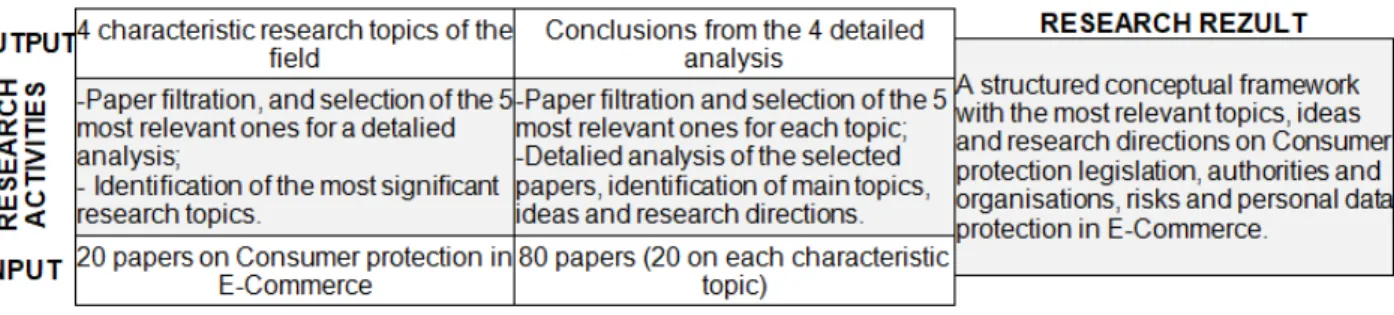
The steps of this research are summarized in Figure 1.
From the analysis of the specialized literature, a few reference papers were selected, from which the main themes resulted on each of the reference subjects.
Fig. 1 Research methodology 3. RESEARCH RESULTS
3.1. E- commerce
WTO definition of e-commerce for its work programme – “the production, distribution, marketing, sale or delivery of goods and services by electronic means”. OECD definition or an e-commerce transaction: “...the sale or purchase of goods or services, conducted over computer networks by methods specifically designed for the purpose of receiving or placing of orders” [22].
According to [8], online trade in Europe increased by 15% to 530 billion EUR in 2016, and an increase of around 14% to over 600 billion EUR was projected for 2017. This
growth is particularly evident in South and East Europe, with 38% of them in Romania, followed by Slovakia and Estonia with 35% growth.
Ecommerce Europe is the association representing 75,000+ companies selling goods and/or services online to consumers in Europe. Assembling the leading national e-commerce associations, it assumes to be the voice of the e-commerce sector in Europe and declare as mission to stimulate cross-border e-commerce through lobbying for better policy tabling the e-commerce sectors [9]. In table 1 we analyze 5 reference papers resulting from the analysis of relevance of the 20 specialized papers.
Table 1. Main topics of consumer protection in E-Commerce
[25 ]
Access to Justice in Transnational B2C E-Commerce
- The electronic market was regulated in the early 2000s;
- The electronic market generates problems that can not be managed by common, unspecific legislation;
- There is a need for a new dedicated and integrated system of regulations. [11
]
European Parliament - Consumer protection in the EU
- There are about 90 mandatory directives and regulations in the EU;
- The EU Consumer Protection Program based on two measures: the European Consumer Agenda and the EU Consumer Programme 2014-2020;
- Four main objectives of the Agenda: increasing consumer safety; enhancing knowledge; enhancing enforcement and providing remedies; aligning key rights and policies with economic challenges.
[ 7 ]
Communication from the
Commission to the European
Parliament and the Council
- GDPR entered into force on May 25, 2018 establishing a set of comprehensive measures reflecting the nature of data protection as a fundamental right; - National Authorities, National Administrations, Specialized Organizations and
Data Operators have participated in specific activities to ensure that the importance and extent of changes made by GDPR are well understood; - Prior to GDPR, only providers of electronic communications services, digital
services and essential service providers were required to send notifications. [18
]
OECD - Consumer
Protection in E-commerce
- Communication, cooperation, development and implementation of joint initiatives ;
- Improve enforcement of consumer protection legislation; - Promoting consumer interests and avoiding risks.
[21 ]
Online-Shopping and E-Commerce worldwide
- In 2021, it is forecasted that 2.14 billion people around the world will purchase goods and services online, rising from 1.66 billion buyers in 2016;
According to the cited papers, consumer protection for e-commerce raises the main topics:
- Specific legislation and regulations;
- Authorities and organizations (organizations and consumer associations);
- Risks and their management;
- Personal data protection in e-commerce. These will be analyzed individually in the following.
An important additional conclusion on e-commerce on a global scale is the need for international cooperation. In order to provide effective consumer protection in this context, it is imperative that national government:
- Facilitate communication, cooperation and, where appropriate, the development and implementation of joint initiatives at international level between governments and stakeholders;
- Improve the capacity of authorities to enforce consumer protection legislation and, where appropriate, cooperate and co-ordinate their investigative and enforcement activities through notification, information exchange, investigative assistance and joint actions.
3.2 Legislation
Increasing and diversifying on-line sales, concluding contracts and formalities on the provision of electronic services require a resumption of existing trade legislation as well as its international harmonization.
Account must therefore be taken of the diversity of the types regarding exchanges of goods and services transmitted electronically, the sale of goods and services using electronic commerce and the trends and innovations that benefit from this form of commerce.
The subject "Legislation" is also topical in the context of anticipating the next steps in using all forms of online commerce [11].
Considering that the e-commerce system expands its use for almost the whole range of services and products by the large mass of consumers, it needs periodic legislative improvements to ensure a higher degree of consumer safety and a clearer regulatory framework to be applied to the economic operator [1].
Table 2 analyzes some reference papers focusing on specific e-commerce legislation and consumer protection.
Table 2. Legislation issues regarding consumer protection in E-Commerce
[11] European Parliament - Consumer protection in the EU
- The EC issued the first consumer protection program in 1975; - Five fundamental consumer rights have been defined by the norms; - Safety is primarily the responsibility of manufacturers.
[23] Manual On Consumer Protection
- Handbook on Consumer Rights and Obligations at UN level through the perspective of country-specific legislation;
- Revised in 2016, the UNGCP emphasizes that ~ consumer protection policies include laws, regulations, rules of the member states.
[24] Research on the Consumer Rights Protection in Online Shopping:
- Empirical analysis on consumer protection in online shopping;
- Consumer protection will improve customer satisfaction and confidence; - Focus on improving the legal system of legislation due to the increased
importance of electronic commerce. [2] 10 Online Business Laws
You Need to Know for Internet Selling [Updated 2018]
- Useful information formulated by the average consumer with reference to the study of legislation of each country, region, part ;
- Existence of multiple forms of payment in e-commerce ; - Online companies tend to be key targets for data theft. [15] Drafting of Myanmar
E-Commerce Law in the works
- In Myanmar the first e-commerce law is adopted as part of its efforts to achieve the goals set by ASEAN (AEC);
- Efforts to have a broad legal framework within a group of states;
- ASEAN is targeting by 2025 an AEC that is highly integrated and coherent.
Consumer protection legislation on online services and transactions primarily protects
services and goods. The normative acts elaborated aim at the correct information of the consumers and their assurance at the moment of making the purchasing decision that the goods and services comply with the legislation related to these types of transactions.
Besides the interests of the consumers, in the elaboration of the normative acts, the companies are also supported in order to increase the efficiency of the trade act or to provide services.
From analyzing the papers it raises the idea that there are a lot of online products and services with a local specific that is also reflected in the area-specific legislation.
At the international level, there are still significant differences in the approach to consumer protection in the light of laws in force across the different countries. An eloquent example of this is that the notion of consumer under EU law does not apply to legal persons.
A good implementation of the legislation leads to improving the quality and attractiveness of
the products and services provided online and to increasing customer satisfaction with this type of trade.
3.3 Authorities and organizations
For any state, it is a major economic interest to increase consumption that supports the production of goods. Supporting the rapidly growing e-commerce system implies the existence of specialized organizational entities that take over the functions of regulating, tracking, assisting and resolving conflicts and representing the interests of consumers.
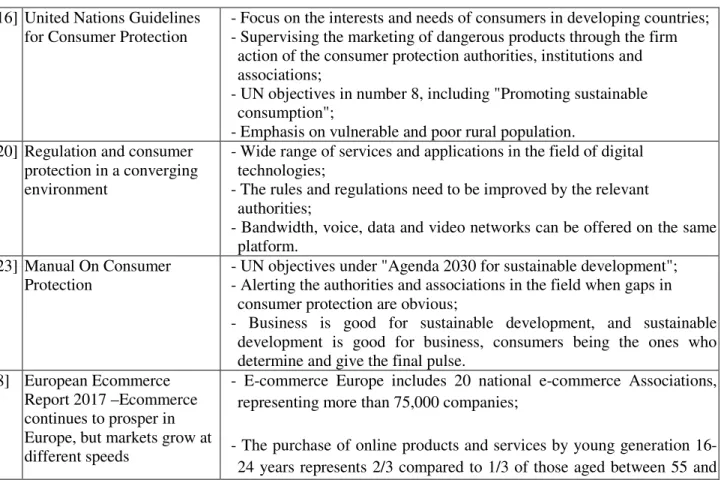
Table 3 analyzes 5 reference papers that highlight, among others, national and international organizations responsible or concerned with consumer protection in e-commerce. Whether they are state bodies, international bodies or consumer associations, they make specific contributions to the functioning of the field and establish together the conduct of economic agents and consumers of e-commerce.
Table 3. Organizations (authorities, organisms and associations) for consumer protection in E-Commerce
[16] United Nations Guidelines for Consumer Protection
- Focus on the interests and needs of consumers in developing countries; - Supervising the marketing of dangerous products through the firm
action of the consumer protection authorities, institutions and associations;
- UN objectives in number 8, including "Promoting sustainable consumption";
- Emphasis on vulnerable and poor rural population. [20] Regulation and consumer
protection in a converging environment
- Wide range of services and applications in the field of digital technologies;
- The rules and regulations need to be improved by the relevant authorities;
- Bandwidth, voice, data and video networks can be offered on the same platform.
[23] Manual On Consumer Protection
- UN objectives under "Agenda 2030 for sustainable development"; - Alerting the authorities and associations in the field when gaps in
consumer protection are obvious;
- Business is good for sustainable development, and sustainable development is good for business, consumers being the ones who determine and give the final pulse.
[8] European Ecommerce Report 2017 –Ecommerce continues to prosper in Europe, but markets grow at different speeds
- E-commerce Europe includes 20 national e-commerce Associations, representing more than 75,000 companies;
The issuance of normative acts on consumer protection is a task of the legislative institutions of each state or unions of states and the international regulations are generally adopted by institutions constituted by the association of the representatives of the participating states. National or regional authorities with consumer protection responsibilities typically take on specific e-commerce tracking. There are also institutions devoted to the specific issues devoted to online commerce.
At European level, the interests of consumers in e-commerce are a priority for both consumer organizations and consumer associations in the member states and for European institutions (Parliament and the European Commission) responsible for issuing the necessary rules throughout the European Union.
Consumer protection under the specific conditions of electronic commerce is a major concern not only for state institutions but also for associations representing consumers. They
exist and operate both at national and international level (E-commerce Europe). The existence of international institutions that monitor the economic activities specific to electronic commerce shows the major economic and political interest shown by all parties involved in this field: large economic operators, governments and non-governmental associations both for the expansion of this type of economic operations but also for the keeping under control theirs.
3.4 Risks
Online services as well as consumer products in the e-commerce market grow both in complexity and in sophistication, with the consequence of increasing and diversifying the risks to which consumers are exposed in this market. They must be protected against unreasonable risks and create imminent harm.
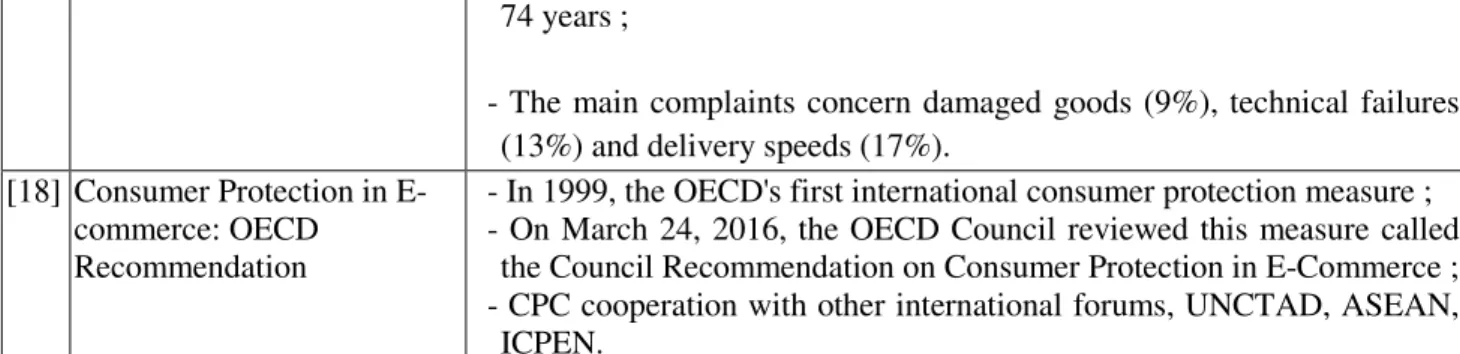
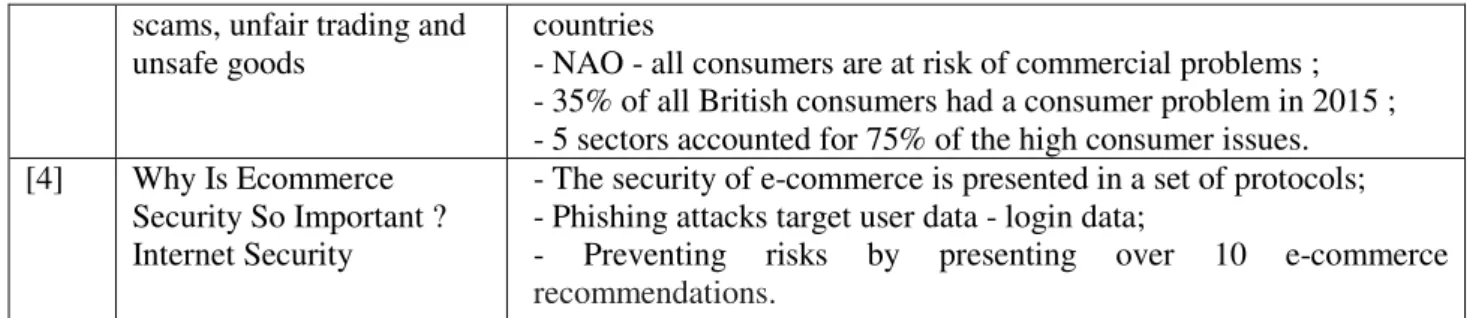
Table 4. Risks in E-Commerce
74 years ;
- The main complaints concern damaged goods (9%), technical failures (13%) and delivery speeds (17%).
[18] Consumer Protection in E-commerce: OECD Recommendation
- In 1999, the OECD's first international consumer protection measure ; - On March 24, 2016, the OECD Council reviewed this measure called
the Council Recommendation on Consumer Protection in E-Commerce ; - CPC cooperation with other international forums, UNCTAD, ASEAN,
ICPEN.
[25] Access to Justice in Transnational E-Commerce
- Access to goods and services without geographical limitation through e-commerce;
- Increasing the percentage of online commerce users also involves increased risks in this;
- 1/3 of EU consumers in 2015 made online shopping. [3] False Advertising and
Consumer Protection Policy
- False advertising by overestimating the value of products or services;
- Life and health risks by not really seeing the features of the products and services presented;
- The use of mathematical calculations demonstrates the influence of false advertising on average consumers.
[12] The Risky Business of E-Commerce
- Risk for both retailers and consumers;
- The risks are associated with possible violations of information security;
- 30% of traders quote PCI and EMV standards as a potential risk; - 65% of retailers worried about their e-commerce initiatives.
Table 4 analyzes 5 reference papers focusing on e-commerce risks from the point of view of consumer protection.
Due to the development of technology that removes geographical boundaries, to prevent the risks to the actors involved in trade, regulatory systems are confronted with the need to permanently update their approach [25]. Conformable [18], governments should require companies by specific methods to easily provide information about themselves, allowing at least localization of the business and its main points of work for law enforcement, regulatory oversight and compliance, including in a cross-border context.
In terms of e-commerce, at EU level, approaches to the risks that may arise in the online commerce type should be seen as prevention measures. On the other hand, more and more consumers in the EU are shopping online and their confidence in e-commerce has increased. However, retailers are still reluctant to expand their online activities.
The reason for their concern is mainly the increased risk of fraud and non-payment, as there are different tax regulations in the different national laws of the different countries applying to contractual obligations, as well as the existence of different consumer protection rules [19].
Measures relating to the risks of electronic commerce through consumer protection must be identified and implemented, including for the new trends in the market for 2018, such as the emergence and use of artificial intelligence, which is decisive in the future on the acquisition of goods and services online [5]. According to the same publications, in 2017, the latest technology tools such as AI (artificial intelligence), AR (augmented reality), or VR (virtual reality) were mainly used by the big
players in the e-commerce market, FMCG (Fast Mover Consumer Goods).
Applying them to marketing departments allows for greater personalization of an online store offer, gives users a completely new shopping experience and allows consumers to analyze their behavior.
Solutions such as chatbots, virtual cabinets, or other virtual product testing methods could soon become a standard in e-commerce. For these reasons, traders wishing to compete on the market should take this trend into account in 2018. [5]
3.5 Protection of personal data
Personal data has become, according to “EU Competition Law, the Consumer Interest and Data Protection” [1] an obvious economic advantage, the beneficiary firms turning them into the core of their service.
In [6] make pertinent references to what the digital era means and its perception of users at the same time as presenting the profile risks. "These companies, with ambition and global reach, swallow up the world economy. In this process, companies adopt versions of Facebook's corporate philosophy - move quickly and break the obstacles ~ without taking into account the impact on people, institutions and democracy."
On May 25, 2018, GDPR-General Data Protection Regulation entered into force.
GDPR applies not only to companies located in the EU, but also applies to companies located outside the EU if they offer goods or services to EU subjects or monitor their behavior.
It therefore applies to all companies that process and hold the personal data of the targeted persons residing in the European Union, irrespective of the location of the company [26].
scams, unfair trading and unsafe goods
countries
- NAO - all consumers are at risk of commercial problems ; - 35% of all British consumers had a consumer problem in 2015 ; - 5 sectors accounted for 75% of the high consumer issues. [4] Why Is Ecommerce
Security So Important ? Internet Security
- The security of e-commerce is presented in a set of protocols; - Phishing attacks target user data - login data;
- Preventing risks by presenting over 10 e-commerce
Table 5 analyzes 5 specialized papers focusing on the protection of GDPR personal data. In conclusion, the emergence of GDPR is an important EU-wide measure meant to be a
shield and protect consumers in trading personal information between big companies.
Table 5. Personal data protection issues
[1] EU Competition Law, the Consumer Interest and Data Protection
- Data exchange affects European competition law and market integration; - Personal data is an obvious economic advantage;
- In 2015 there is a market for unregulated personal data. [10] What does the General
Data Protection Regulation (GDPR) govern?
- Several rights displayed in GDPR are highlighted; - DPA’s supervise the application of data protection law;
- Specialist advice on data protection issues and handling of law infringement complaints in the field.
[26] GDPR Portal - Resource to educate the public about the main elements of the GDPR
- GDPR applies not only to companies located in the EU but also to companies outside the EU for offers of goods or services to EU citizens; - Personal data is any information relating to an identifiable person that
can be identified directly or indirectly;
- Parental agreement to process personal data of children under 16 for online services;
- Designation of DPO (Data Protection Officer) for public authorities and organizations processing personal data.
[14] New law may unbox stronger shield for Ecommerce customers
- Stricter regulations that impose greater responsibility;
- Transparency on how businesses use personal data about customers; - It is necessary to regulate the responsibility for fraudulent sales; - Increased responsibility for defective products sold on platforms. [13] FORBES - How
E-Commerce Brands Need To Adjust In Light Of GDPR
- The US respects the GDPR by managing personal data, otherwise companies will be fined in the amont of 4% of the global income;
- Facebook and Google earned $ 8.8 billion in legal searches on the first day of GDPR activation;
- In 2017, only 21% of U.S. companies had a plan for GDPR.
4. CONCLUSION
Account must therefore be taken of the variety of types of exchanges of goods and services transmitted electronically, the sale of goods and services using electronic commerce, as well as the trends and innovations to which this kind of trade is under suspicion.
The subject is topical by trying to anticipate the next steps in using all forms of online commerce.
Acquisition of goods and online services has become a common practice among many people around the world. Some choose to make online purchases for convenience, others due to the competitive price offered by some e-commerce platforms. Digital buyers can be influenced by a wide range of digital shopping resources such as trademarks and review products. [21]
The subject of consumer protection and e-commerce is therefore present in the light of the main ideas from the analysis of the cited papers. It is a major interest of many states to protect the interests of consumers at the same time as the desire to oblige economic operators to place on the e-commerce market safe and quality products and services.
Quality must be found throughout the structure of goods and services offered for sale by economic agents. The role of public or private profile organizations is to protect the rights and interests of consumers and to provide the necessary support to minimize the risks to which the consumer of goods and online services is exposed.
The final conclusion that emerges from the analyzed papers is that the protection of e-commerce consumers in the following years will have to take into account the technological developments, the continuous diversification of the products and services traded, look forward to the international expansion of this business model, adopt new channels and methods of action and develop trustworthy partnerships both nationally and internationally.
5. REFERENCES
1. Ferretti, F. (2014). EU Competition Law,the Consumer Interest and Data Protection. New York: Springer Cham Heidelberg. 2. Katey, F. (2018). 10 Online Business Laws
You Need to Know for Internet Selling
[Updated 2018]. Retrieved July 5, 2018, from Build your online store with BigCommerce:
https://www.bigcommerce.com/blog/online-business-laws/
3. Andrew, R., & Chris M. , W. (2015). False Advertising and Consumer Protection Policy. Toulouse ; Loughborough: Centre for Economic Policy Research ; cepr.org. 4. BigCommerce. (2018). Why Is Ecommerce
Security So Important? The Importance Of Internet Security:. Retrieved July 5, 2018,
from /www.bigcommerce.com:
https://www.bigcommerce.com/ecommerce-answers/why-online-security-so-important/ 5. Casota, F. (2018, January 30). Care sunt
tendinţele în e-commerce în 2018. De ce
trebuie să ţină cont magazinele online. Retrieved March 19, 2018, from http://www.businessmagazin.ro/analize/com ert/: http://www.businessmagazin.ro/
6. Cojocaru, B. (2018, March 9). Iluziile şi
pericolele erei digitale. Retrieved March 19,
2018, from
http://www.businessmagazin.ro/special: http://www.businessmagazin.ro/
7. Comisia Europeană. (2018, January 24). COMUNICARE A COMISIEI CĂTRE
PARLAMENTUL EUROPEAN
Ș
ICONSILIU. Retrieved July 4, 2018, from FMT:BoldProtecție sporită, noi oportunități - Orientările Comisiei privind aplicarea
directă a Regulamentului general privind protecția datelor de la 25 mai 2018/FMT:
https://eur-lex.europa.eu/legal-content/RO/TXT/HTML/?uri=CELEX%3A 52018DC0043&qid=1517578296944&from =EN
8. Ecommerce, E. (2017, June 26). European
Ecommerce Report 2017 –Ecommerce continues to prosper in Europe, but markets grow at different speeds. Retrieved March 19, 2018, from https://www.ecommerce- europe.eu/press-item/european-ecommerce- report-2017-released-ecommerce-continues- prosper-europe-markets-grow-different-speeds/: https://www.ecommerce-europe.eu/ 9. Europe, E. (2018, March 19). About
Ecommerce Europe. Retrieved March 19, 2018, from https://www.ecommerce-europe.eu/about-ecommerce-europe/:
https://www.ecommerce-europe.eu/
10. European Commisian - GDPR. (2018).
What does the General Data Protection Regulation (GDPR) govern? Retrieved July
4, 2018, from ec.europa.eu:
ec.europa.eu/info/law/law-topic/data- protection/reform/what-does-general-data-protection-regulation-gdpr-govern_en
11. Jana , V. (2015). Consumer protection in the EU. European Parliament: Members' Research Service Directorate-General for Parliamentary Research Services, European Parliament.
12. Jennifer , V. (2017, September 14). The
Risky Business of E-Commerce. Retrieved July 5, 2018, from Consumer Businness Compass:
https://www.bdo.com/blogs/consumer- business-compass/september-2017/the-risky-business-of-e-commerce
13. Jia Wertz, W. (2018, June 30). How
E-Commerce Brands Need To Adjust In Light Of GDPR. Retrieved July 5, 2018, from /www.forbes.com:
https://www.forbes.com/sites/jiawertz/2018/ 06/30/how-e-commerce-brands-need-to-adjust-in-light-of-gdpr/#750a12e22026 14. Mugdha , V. (2018, March 21). New law
may unbox stronger shield for Ecommerce customers. Retrieved July 5, 2018, from The
https://economictimes.indiatimes.com/indust ry/services/retail/new-law-may-unbox-
stronger-shield-for-ecommerce-customers/articleshow/63389687.cms
15. Myanmar Times. (2018, March 2).
Drafting of Myanmar E-Commerce Law in the works. Retrieved July 5, 2018, from
Myanmar Edition:
https://www.mmtimes.com/news/drafting-myanmar-e-commerce-law-works.html 16. NATIONS, UNITED. (2003). United
Nations Guidelines for Consumer Protection. New York: United Nations - Department of Economic and Social Affairs. 17. O’Brien, I., Anna, S. T., Chris, B., Andreas, B., Mark, B., Sergiu, C., et al. (2016). Protecting consumers from scams, unfair trading and unsafe goods. London , UK: National Audit Office ( NAO ) - Department for Business, Energy & Industrial Strategy.
18. OECD, O. f.-o. (2016). Consumer
Protection in E-commerce: OECD Recommendation. Paris: OECD Publishing, Paris,
http://dx.doi.org/10.1787/9789264255258-en.
19. România, R. C. (2017, July 25).
Încrederea în comer
ț
ul electronic, în creș
tere. Retrieved March 19, 2018, from https://ec.europa.eu/romania/news/20172507 _: https://ec.europa.eu/20. Rosalind, S. (2013). Regulation and
consumer protection in a converging environment. Geneva: ITU.
21. Statista - The Statistics Portal. (2018, July 4). Online-Shopping and E-Commerce
worldwide: Statistics & Facts. Retrieved
2018, from E-Commerce›B2C
E-Commerce›E-commerce worldwide -: https://www.statista.com/topics/871/online-shopping/
22. Sven , C. (2017, June 15). UNCTAD -
E-Commerce: Global trends and developments. Retrieved July 4, 2018, from www.unescap.org- Regional Workshop on E-Commerce and Emerging Digital Trade
Agenda, Bangkok, :
/www.unescap.org/sites/default/files/Ecomm
erce%20Global%20Trend%20and%20Devel opment.pdf
23. UNCTAD, U. N. (2016). MANUAL ON CONSUMER PROTECTION. Kenya:
UNITED NATIONS PUBLICATION
UNCTAD/WEB/DITC/CLP/2016/1.
24. Xu, S. (2015). Research on the Consumer Rights Protection in Online Shopping: a Empirical Analysis based on Consumer Credit Law. International Journal of Security and Its Applications - Vol.9, No.12 (2015),, 429-438.
25. Yuthayotin, S. (2015). Access to Justice in Transnational B2C E-Commerce A Multidimensional Analysis of Consumer Protection Mechanisms. New York: Springer Cham Heidelberg.
26. Trunomi. (2018). GDPR Portal. Retrieved July 4, 2018, from www.eugdpr.or:
https://www.eugdpr.org/our-partners.html 27. Laura , B. (2015). Incorporating
Sustainability into Consumer Protection Policy. Geneva: Nelson Mandela Metropolitan University South Africa. 28. Mwenegoha, T. (2015). The Development
of Consumer Protection Laws in Tanzania for Electronic Consumer Contracts. 14 University Drive, ROBINA QLD 4226 AUSTRALIA: Faculty of Law, Bond University.
29. Negrescu, A. (2016, December 5).
Românii descoperă mall-urile virtuale!
Comerţul online românesc bate record după
record. Retrieved March 18, 2018, from http://www.keysfin.com/#!/Pages/News/Ne wsDetails&title=: http://www.keysfin.com/ 30. Corina , E. (2012). DIMENSIONS AND
PERSPECTIVES OF CONSUMER
PROTECTION POLICY IN THE
EUROPEAN UNION. The USV Annals of Economics and Public Administration ; Volume 12,, 39-45.
31. Spencer Weber , W., Jillian G., B., & R.J., A. (n.d.). Consumer Protection in the
United States: An Overview. Retrieved June
6, 2018, from www.luc.edu:
32. Thorun, C., Max , V., Lucia , R., & Anne, K. (2017). Indicators of consumer protection
and empowerment in the digital world. Berlin: © Baramee / Fotolia - ConPolicy – Institute for Consumer Policy.
33. Miron, A. (2018, January 12). România,
cre
ș
teri spectaculoase în comerț
ul online. Retrieved March 19, 2018, from https://www.dcnews.ro/romania-cre-teri-spectaculoase-in-comer-ul-online_574726.html: https://www.dcnews.ro 34. Minister for Jobs, E. a. (2014). THE
EUROPEAN UNION (CONSUMER
INFORMATION, CANCELLATION AND
OTHER RIGHTS) REGULATIONS 2013. Bruxelles: The European Union (Consumer Information, Cancellation and Other Rights) Regulations 2013 (S.I. No. 484 of 2013) give effect to Directive 2011/83/EU on Consumer Rights and were signed into law by the Minister for Jobs, Enterprise and Innovation on 11 Dece.
35. Thorun, C., Max , V., Lucia , R., & Anne, K. (2017). Indicators of consumer protection and empowerment in the digital world.
Berlin: © Baramee / Fotolia - ConPolicy – Institute for Consumer Policy.
Protecția consumatorilor în comerțul electronic: Un cadru conceptual bazat pe analiza literaturii
Rezumat: Comerțul electronic ocupă 17% din comerțul actual al lumii și ridică provocări fără precedent, inclusiv protecția consumatorilor. Acest document propune un cadru conceptual structurat pentru protecția consumatorilor în comerțul electronic, pe baza analizei literaturii în domeniu. Mai mult de 100 de referințe bibliografice sunt identificate și filtrate, 30 fiind considerate cele mai relevante. Subiectele de referință discutate se referă la: legislație; autorități și organizații; riscuri; protecția datelor cu caracter personal fiind înregistrate cele mai importante idei și direcții de implementare.
Mircea RADU, Technical University of Cluj-Napoca, 28 Memorandumului Street, Cluj-Napoca, 400114, Romania, [email protected].
Sorin POPESCU, Prof. Dr. Eng., Technical University of Cluj-Napoca, 28 Memorandumului Street, Cluj-Napoca, 400114, Romania, [email protected].