Refereed paper
Clinical data extraction and feedback in
general practice: a case study from
Australian primary care
Peter Schattner MD MMed FRACGP
Associate Professor, Department of General Practice, School of Primary Health Care, Faculty of Medicine, Nursing and Health Science and board member, Monash Division of General Practice
Mary Saunders BA(Hons) DipEd GDipHlthProm
Program ManagerLeslie Stanger BSc GDip CompSc MBA
Information Management CoordinatorMichele Speak BSc(Hons) DipEd MPH
Program CoordinatorKate Russo DipAppSc (Nursing) BNursing GradDip Adult Ed and Training
Health Promotion Program CoordinatorMonash Division of General Practice, East Bentleigh, Victoria, Australia
ABSTRACT
Background Quality improvement in general prac-tice has increasingly focused on the analysis of its clinical databases to guide its improvement strat-egies. However, general practitioners (GPs) need to be motivated to extract and review their clinical data, and they need skills to do so. This study examines the initial experience of 15 practices in undertaking clinical data extraction and manage-ment and the support they were given by their local division of general practice.
Objectives To explore the uptake of data extrac-tion tools in general practice and understand how divisions of general practice can assist with their uptake.
Method This study was conducted within a single division of general practice within the south-east-ern suburbs of metropolitan Melbourne, Australia. Self-selected practices were offered a data extraction program (‘tool’) free of charge, with ongoing div-ision support. Practice representatives, either GPs, practice nurses or other practice staff members, were given instructions on how to extract data using the data extraction tool. This was followed by dis-cussion with division staff regarding which clinical areas might be focused on. Division staff system-atically recorded information about the experience of the practices and collated their clinical data.
Results Fifteen practices, representing 69 GPs, participated. The practices chose from the following
areas to work on as quality improvement activities: improving data entry; inactivating patient files for those who no longer attended the practice; correct-ing demographic information; diabetes and coronary heart disease management. The recording of data, according to the extraction tool, was found to be incomplete. For example, one-third of the patients who had HbA1cs recorded were on target, i.e. <7%, but nearly half the patients with diabetes did not have HbA1cs recorded at all. About half the patients with coronary heart disease were not reported as taking aspirin and one-third were not on a statin. Nearly half the patients who had attended their practice in the previous 30 months did not have smoking status recorded.
Conclusion While data extraction programs pro-vide GPs with useful tools for examining their clinical databases and identifying clinical practice issues which could be improved, external support, such as that provided by divisions, is helpful. Technical barriers, such as the failure of extraction tools to recognise some data and the failure to comprehensively enter data, are impediments, but in spite of these considerable interest exists in the use of clinical data to improve practice.
Introduction
The increasing computerisation of general practice has facilitated greater use of electronic databases for clinical and administrative purposes.1 These uses include the recall of patients within target groups, such as the over 65s for influenza vaccination and Pap smears for eligible women. Divisions of general prac-tice, which are local organisations funded by the Australian Government (somewhat analogous to pri-mary care trusts in the UK), have also established patient databases to assist general practitioners (GPs). These databases have been used to manage patient recalls, although having a recall system in place is increasingly considered to be the responsibility of the practices themselves.2There has also been interest in searching electronic databases in general practice to identify which aspects of clinical software GPs use and which drugs they commonly prescribe.3
An increased focus by government on population health has lead to the funding of initiatives such as the Australian Primary Care Collaboratives (based on the UK model) which use practice-based data to drive quality improvement. These initiatives have spawned the development of a range data extraction programs, some independent of the GPs’ clinical software, which simplify the review of clinical and practice manage-ment databases. These programs facilitate the analysis of practice data, the identification of lists of cohorts of patients and the measurement of the outcomes of targeted interventions.4–9
Quality improvement in clinical data is promoted by the Royal Australian College of General Practi-tioners (RACGP) which has developed standards for the recording of information in patient records, such as the proportion of all patients that have had their allergy status entered.10
The federal government has introduced a set of National Performance Indicators (NPIs) as a reporting requirement for divisions of general practice in which aggregated data are compared with nominated tar-gets.11There is some debate on whether clinical data-bases should be used to guide ‘pay for performance’ by measuring whether GPs achieve recommended clini-cal targets for some of their patients.
While data aggregation and review at the practice level can improve a GP’s clinical practice,4new pro-grams have also been developed which do database searches while GPs are using electronic health records, offering individualised, within-consultation prompts to undertake a range of clinical management activities.12 At face value, these computer programs might appear to be useful, but they raise a number of questions:
. Why would GPs, who already lead busy professional
lives, want to take on database searching?13
. What support and incentives do GPs need?
. Can divisions of general practice assist?
. Which clinical areas are of most benefit to patients or most likely to lead to quality improvement?
. Finally, which strategies should practices adopt to
make the best use of their data?14–17
This paper outlines the process followed by one division of general practice in promoting the uptake and use of data extraction tools.
Aim of the study
The aims of the current study have been to explore the uptake of data extraction tools in general practice and understand how divisions of general practice can assist with their uptake.
Methods
The setting
This study was conducted within a single division of general practice within the south-eastern suburbs of metropolitan Melbourne, Australia. In 2007, the div-ision purchased data extraction tools to assist prac-tices to analyse their clinical databases. Pracprac-tices were offered ongoing support in using the data extraction tools and in implementing changes in their practices. This support was provided by the division’s Practice Support Team, which comprises a group of staff members each with specific program responsibilities as well as shared knowledge across program areas.
Choosing the data extraction tool
Following a review of the available data extraction programs (often called data extraction tools), the div-ision purchased two which appeared to meet the needs of practices with commonly used clinical software programs. The majority of practices within the div-ision use one brand of clinical software, enabling the selection of a single, compatible data extraction tool for the purpose of this study. The selected program was supplied free of charge to all interested practices.
Practice recruitment
not. Practices were then followed up either by phone calls or opportunistically during practice visits, with a purposeful targeting of those practices known to have clinical software compatible with the data extraction tool. Interested practices were shown a demonstration of the software on a laptop computer and were offered both the extraction tool and ongoing support from the division. Participating practices were asked to sign a consent form allowing the division to collect and collate de-identified clinical data. The new program was given the title Information Management Initiative (IMI). This paper focuses on the work undertaken by the initial group of 15 practices (representing 69 GPs), although recruitment for the IMI program has been ongoing.
Using the data extraction tool
In consultation with division staff, representatives from each practice established the clinical areas they wanted to improve based on their perceived needs and the software capabilities. The practice representatives, either GPs, practice nurses or other practice staff members, were given instructions on how to extract their practice data using the data extraction tool. This was followed by discussion regarding which clinical areas might be focused on. The division produced written reports for the practices with suggestions on how the data might be used to develop improvement strategies. Division staff visited every one to two months to discuss progress and review data with the practice representative. The project officers explained how aggregated data could be used to inform small scale quality improvement exercises (i.e. Plan–Do–Study– Act cycles or ‘PDSAs’).
Evaluation methods
The division’s program officers routinely collected information through their contacts with practices across a range of support activities, including IMI. For each of the 15 IMI practices, data have been collected on: practice characteristics; computer systems; previous participation in the Australian Primary Care Collab-oratives program; the clinical areas chosen for data extraction; the data itself; the PDSAs undertaken and the outcomes of the PDSA process. Both quantitative and qualitative information was entered into a spread-sheet and reviewed to produce a descriptive report.
Results
Participating practices
Fifteen practices initially agreed to participate in IMI and to allow the division to extract and collate de-identified clinical data. Table 1 provides a brief descrip-tion of these practices. The size of the participating practices was mixed, with about half comprising small practices and the other half with groups of three or more GPs. More than half (nine out of 15) employed practice nurses.
Clinical areas chosen for quality
improvement
The practices chose topics from the following areas to work on as quality improvement activities: improving data entry, e.g. in recording allergies, smoking status, height and weight; inactivating patient files for those who no longer attended the practice; correcting demo-graphic information, including missing data fields; diabetes and coronary heart disease.
Table 1 Profile of participating practices (totaln= 15)
Practice profile Number of practices
Solo/group practice
Solo 2
Small group (2–3 GPs) 7 Large group (3+ GPs) 6
Practice nurse (PN) employed
No PN 6
1 PN 6
More than 1 PN 3
Computerisation of medical records
Not fully computerised (‘hybrid’ systems)
7
Fully computerised medical records
8
Key IMI contact with person within practice
Practice nurse 3
GP 9
Practice manager/practice nurse
Demographic and clinical data entry
Baseline data extracted and collated from the partici-pating practices are shown in Tables 2–5. It should be noted that some data refer to all patients currently in the active database (‘totals’) whereas others refer to ‘recent’ patients, these being defined as patients who have visited the practice at least twice within previous 30 months. A ‘visit’ means that an entry has been made in the clinical progress notes.
Among the 15 practices, the ‘recent’ patients were only about half the total number of patients on the database. Nearly half of all recent patients did not have
their smoking status recorded and nearly three-quar-ters of recent patients did not have both their height and weight recorded. Consequently, BMIs could only be calculated for about one-fifth of the patients (Table 2).
Diabetes management
One-third of the patients who had HbA1cs recorded were on target, i.e. <7%, but nearly half the patients with diabetes did not have HbA1cs recorded at all. A similar proportion of these patients did not have their lipids recorded and even fewer lipids were on target compared to HbA1c levels (Table 3).
A Service Incentives Payment (SIP) for diabetes management, which is a government payment on top of that paid for an individual consultation, can be claimed if several, specified clinical items are com-pleted within a ‘cycle of care’. Data extracted from these 15 practices show that some clinical items are
Table 2 Recording data
Totals (patients)
n %
DATA ITEMS Demographic
Total patientsa 195 358
Recent patientsb 100 684 51.5 Date of birth not recorded
(recent)
175 0.2
Gender not recorded (recent) 1092 1.1 ATSI status recorded (recent)c 19 0.0
Allergies/smoking
Allergies – nothing recorded (recent)
30 957 30.7
Smoking status with age >10 – nothing recorded (recent)
44 090 43.8
Height and weight
Height only not recorded (recent)
4176 4.1
Weight only not recorded (recent)
889 0.9
Neither height nor weight recorded (recent)
75 145 74.6
BMIs completed (recent) 20 474 20.3
BP
Total patients aged >18 (recent)
78 733
Age >18 and BP not recorded (recent)
41 018 52.1
awhere total means all the patients on the active database
(i.e. excluding deleted and inactivated patients)
bwhere recent means patients who have attended (or had
notes entered into their files) at least once in the previous 30 months
cATSI = Aboriginal and/or Torres Strait Islander
dBMI = body mass index
Table 3 Diabetes management
Totals (patients)
n %
Diabetes (all recorded on total patients)
Total diabetes population 3879 Undefined diabetes, i.e. type of diabetes not specified
837
Number of diabetes patients whose last recorded HbA1c in previous 12 months was:
<7.0% 1327 34.2
>7.0% and <8.0% 476 12.3 >8.0% and <10.0% 255 6.6
>10.0% 94 2.4
Not recorded 1727 44.5
Diabetes patients whose last cholesterol within last 12 months was:
<4 mmol/l 651 16.8
>4 mmol/l 1414 36.5
Not recorded 1814 46.8
Diabetes patients whose last recorded BP within last 12 months was:
<130/80 1059 27.3
>130/80 1399 36.1
either not being done, not recorded, not correctly recorded or not detected by the data extraction program. These include foot examinations and eye checks (Table 4).
Coronary heart disease management
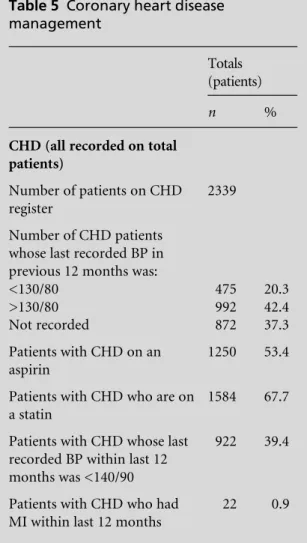
About half the patients with coronary heart disease are not reported as taking aspirin and one-third are not on a statin. Over 40% have blood pressures greater than 130/80 mmHg, the level recommended in clinical practice guidelines. Blood pressure was not recorded, according to the data extraction tool, for over one-third of patients with coronary heart disease (Table 5).
Division support to practices
The division’s Practice Support Team systematically recorded the tasks they undertook to help practices
adopt the data extraction tool. The assistance pro-vided includes:
. explaining and demonstrating how to use the data
extraction software
. developing systems to improve data entry, for
example, by discussing at practice meetings targets for specific areas such as the recording of allergies
. more effective utilisation of clinical software (elec-tronic health records) through a more thorough knowledge of the program itself and by, for example, requesting laboratories to send pathology results in the correct format
. analysing collated data and reflecting on what to do
with them at a practice level (i.e. developing im-provement strategies).
The project officers noted that it was very helpful to have a specific person in the practice who was willing to champion the cause of data extraction and review.
Table 4 Diabetes Service Incentives Payments (SIPs)
Totals (patients)
n %
Diabetes SIP items (all recorded on total patients)
HbA1c >12 months or not recorded
1726 44.6
Eye check >24 months or not recorded
2663 68.7
BMI >6 months or not recorded
2820 72.8
BP >6 months or not recorded 1831 47.3 Foot exam >6 months or not
recorded
3339 86.2
Cholesterol >12 months or not recorded
1816 46.9
Triglycerides >12 months or not recorded
1834 47.3
HDL >12 months or not recorded
1903 49.1
Microalbuminuria >12 months or not recorded
2646 68.3
Smoking status not recorded 1269 32.8
Table 5 Coronary heart disease management
Totals (patients)
n %
CHD (all recorded on total patients)
Number of patients on CHD register
2339
Number of CHD patients whose last recorded BP in previous 12 months was:
<130/80 475 20.3
>130/80 992 42.4
Not recorded 872 37.3
Patients with CHD on an aspirin
1250 53.4
Patients with CHD who are on a statin
1584 67.7
Patients with CHD whose last recorded BP within last 12 months was <140/90
922 39.4
Patients with CHD who had MI within last 12 months
Discussion
Principal findings
This study has shown that data entry is a major issue among these general practices, with a large proportion of patients not having basic information such as drug allergies and smoking status recorded. In spite of their incompleteness, data are available for important clini-cal measures such as HbA1c levels in patients with diabetes mellitus. This study has found that only one-third of patients were at or below the target level of 7.0%. This figure provides a good reason for reflec-tion, even though it is unknown whether the 47% who did not have an HbA1c detected had either better or worse control of their diabetes. A similar principle of achieving clinical targets applies in those with coronary heart disease, with one-third of patients not recorded as being on statins.
Nevertheless, the experience of other Australian and international programs to improve clinical prac-tice by reviewing pracprac-tice data is encouraging. The Australian Primary Care Collaborative and the Primary Care Data Quality and PRIMIS+ projects in the UK have shown that data extraction with feedback can in certain circumstances improve the quality of care.18–20 A recent systematic review of strategies to improve quality in primary care supports this conclusion, with the authors stating that the strongest evidence for improvement is that which is driven at the practice level by health professionals, with support from re-gional networks.21
Initial information collected by this division sug-gests that for practices to successfully manage their clinical data it is important to have a champion, i.e. someone who has the skills and enthusiasm to develop
small-scale improvement strategies which encourage GPs and practice nurses to enter data appropriately and take an interest in reviewing them.
Implications of the findings
As others have found, before GPs can make a lot of sense of their clinical data, the data must in the first place be accurate and complete.22This means not only recording the data, but entering them in the correct field within the clinical software.23For example, unless blood pressure is entered within its specific field rather than in free text within the progress notes, it cannot be detected by data extraction programs. Many of the diabetes ‘cycle of care’ items such as foot examinations are not found unless they are recorded within specific fields in the diabetes module. This requires double handling of information, with a GP or practice nurse having to find data, such as a letter from an eye specialist, in one part of the program and then note it in another.
Unfortunately, technical problems remain with extraction programs not being able to consistently detect data even if they exist in the database.24,25For example, Pap smear tests are not recognised unless a laboratory has sent the results to the GP in a special format called health level seven (HL7).26Further, the result itself cannot be ‘read’ unless it is in atomic form. These shortcomings reflect the failure to compre-hensively implement standards in eHealth.
Limitations of the method
Some limitations to the study include the fact that these 15 practices (out of 60 within this division) volunteered to participate in IMI, and might therefore be slightly atypical. They might be more likely to have practice data champions and be more motivated to examine their own databases. Also, practices in other regions in Australia might have other pressures on them, such as workforce shortages, that result in GPs having less time for or interest in reviewing their data. The 15 practices are being followed up for 12 months to see how successful they have been in making changes to patient care based on data extrac-tion and management.
Conclusion
Data extraction programs provide GPs with useful tools for examining their clinical databases and identifying clinical practice issues to be addressed.
Box 1 What this paper adds
. Data extraction tools can assist GPs to reflect on their clinical practice
. Data review requires accurate and reasonably
complete data entry in the first place
. Improvements in eHealth data transmission
and in data extraction tools are also needed to ensure that clinical data are readily accessible for review within clinical software, e.g. Pap smear results
. Data review is best confined to a few defined
areas where there is a reasonable consensus about appropriate clinical targets
External support, such as that provided by divisions, is advantageous in facilitating and promoting the use of extraction programs for data analysis.
ACKNOWLEDGEMENTS
We thank the staff at the Monash Division of General Practice that have supported IMI and this study, and the general practices that participated.
REFERENCES
1 McInnes DK, Saltman DC and Kidd MR. General practitioners’ use of computers for prescribing and electronic health records: results from a national survey.
Medical Journal of Australia2006;185:88–91.
2 Wan Q, Taggart J, Harris MF et al. Investigation of cardiovascular risk factors in type 2 diabetes in a rural Australian Division of General Practice.Medical Journal of Australia2008;189:86–9.
3 Health Communication Network.HCN General Practice Research Network. 2010. www.hcn.com.au/Products/ GPRN (accessed November 2010).
4 Australian Primary Care Collaboratives. APCC: the model for improvement. 2010. www.apcc.org.au (ac-cessed November 2010).
5 Ayers LR, Beyea SC, Godfrey MM, Harper DC, Nelson EC and Batalden PB. Quality improvement learning collaboratives (erratum appears inQuality Management in Health Care 2006;15:45). Quality Management in Health Care2005;14:234–47.
6 Knight A. The collaborative method. A strategy for improving Australian general practice.Australian Fam-ily Physician2004;33:269–74.
7 Del Fante P, Allan D and Babidge E. Getting the most out of your practice: the Practice Health Atlas and business modelling opportunities. Australian Family Physician
2006;35:34–8.
8 Canning Division of General Practice.Canning Data Extraction Tools. 2010. www.canningdivision.com.au/ dataextraction.html (accessed November 2010). 9 PEN Computer Systems. Clinical Audit Tool (CAT).
2010. www.clinicalaudit.com.au/about (accessed Nov-ember 2010).
10 Royal Australian College of General Practitioners.The RACGP Standards for General Practice(4e). 2010. www. racgp.org.au/standards (accessed November 2010). 11 Primary Health Care Research and Information Service.
National Performance Indicators. 2010. www.phcris. org.au/divisions/reporting/div/list.php (cited November 2010).
12 Knieriemen A. Doctors Control Panel. Doctors practice software utilities. 2010. www.pracsoftutilities.com (cited November 2010).
13 de Lusignan S and van Weel C. The use of routinely collected computer data for research in primary care:
opportunities and challenges.Family Practice2006;23: 253–63.
14 de Lusignan S. An educational intervention, involving feedback of routinely collected computer data, to im-prove cardiovascular disease management in UK pri-mary care.Methods of Information in Medicine 2007; 46:57–62.
15 de Lusignan S, Stephens PN, Adal N and Majeed A. Does feedback improve the quality of computerized medical records in primary care? Journal of the American Medical Informatics Association2002;9:395–401.
16 Penn DL, Burns JR, Georgiou A, Powell Davies PG and Harris MF. Evolution of a register recall system to enable the delivery of better quality of care in general practice.
Health Informatics Journal2004;10:165–76.
17 Treweek S. The potential of electronic medical record systems to support quality improvement work and research in Norwegian general practice. BMC Health Services Research2003;3:10.
18 Australian Primary Care Collaboratives program results. 2010. Found at www.apcc.org.au/about_the_APCC/ program_results (accessed November 2010).
19 The Primary Care Data Quality (PCDQ) Program. 2010. www.medicine.ox.ac.uk/bandolier/booth/mgmt/PCDQ. html (accessed November 2010).
20 University of Nottingham.Primis+. 2010. www.primis. nhs.uk/index.php/about-us (cited November 2010). 21 Phillips C, Pearce C, Hall Set al. Can clinical governance
deliver quality improvement in Australian general prac-tice and primary care? A systematic review of the evidence.Medical Journal of Australia2010;193:602–7. 22 Majeed A, Car J and Sheikh A. Accuracy and
complete-ness of electronic patient records in primary care (edi-torial). Family Practice 2008;25:213–14. doi:10.1093/ fampra/cmn047
23 de Lusignan S, Hague N, Brown A and Majeed A. An educational intervention to improve data recording in the management of ischaemic heart disease in primary care.Journal of Public Health2004;26:34–7.
24 Majeed A. Sources, uses, strengths and limitations of data collected in primary care in England.Health Stat-istics Quarterly2004;21:5–14.
25 Thiru K, Hassey A and Sullivan F. Systematic review of scope and quality of electronic patient record data in primary care.BMJ2003;326:1070.
26 Health Level Seven International. 2010. www.h17.0rg (accessed November 2010).
CONFLICTS OF INTEREST
ADDRESS FOR CORRESPONDENCE
Peter Schattner Associate Professor
Department of General Practice School of Primary Health Care
Faculty of Medicine, Nursing and Health Science Building 1, 270 Ferntree Gully Rd
Notting Hill Victoria 3168 Australia
Email: [email protected]