Solving Time Complexity Issue in Copy-Move
Forgery Detection Thru Pre-processing Techniques
Siti Fadzlun Md Salleh, Mohd Foad Rohani & Mohd Aizaini Maarof
Universiti Tun Hussein Onn Malaysia (UTHM)86400 Parit Raja, Batu Pahat Johor, Malaysia
&
Faculty of Computing Universiti Teknologi Malaysia 81310 UTM Johor Bahru, Johor, Malaysia
Email: [email protected]
Submitted: 23/09/2018. Revised edition: 6/10/2018. Accepted: 20/10/2018. Published online: 21 November 2018
Abstract—Copy-move forgery detection (CMFD) has become a
popular an important research focus in digital image forensic. Copy-move forgery happens when a region in an image is copied and paste into the same image. Apart from the main problem of detection robustness and accuracy, CMFD is struggle with time complexity issue. One of the options to resolve this problem was by including pre-processing step in CMFD pipeline. This paper reviews the importance of pre-processing step, and existing techniques in reducing time complexity of copy-move forgery detection. An experiment using discrete wavelet transform (DWT) as a pre-processing technique was carried out to evaluate the performance of adopting pre-processing technique in CMFD pipeline. The experimental result has shown a significant reduction in processing time with some trade off to detection accuracy.
Keywords—Copy-move forgery, time complexity,
pre-processing, duplicate region detection, discrete wavelet transform
I. INTRODUCTION
Copy-move forgery detection (CMFD) also known as duplication region detection (DRD) is one of the branches in digital image forensic. Copy-move forgery is defined as a forgery where a region in an image is copied and pasted to the same image. It is a very simple forgery process, yet requires a lot of computation time and difficult to detect due to additional modification done to the copied region before being pasted. Modification which involves signal processing
attacks, i.e. blurring, noise adding and jpeg compression may reduce the detection rate in many methods however forgery which involve geometrical transform, i.e. rotation and scaling may cause total detection failure [1].
Taking into consideration on the possibility of many types of modification, many researchers proposed towards developing more robust detection methods which could handles those modifications. The results was encouraging, however it creates another problem which is time complexity. Complex algorithm used to get high accuracy detection has leads to high computational time.
technique in pre-processing step. Initial experimental result and discussion will be presented in Section VI, and Section VII concludes this paper.
II. COPY-MOVE FORGERY DETECTION PROCESS
CMFD techniques are used to authenticate an image by detecting and locating malicious copy-move tampering, if exist. There are two options available in CMFD which are block-based method and keypoint based method. The options are segregated based on how the data is extracted from the image. Most of the CMFD methods proposed by previous research shared the common pipeline which involves 4 important steps including image segmentation, feature extraction, matching and forgery detection. The image segmentation could be done by dividing image into blocks or scanning keypoints in an image. In block-based method, many methods opted to divide image into several overlapping blocks for segmentation of image region. Overlapping blocks, A for image size of MxN and block size is BxB is calculated as;
A = (M-B+1)(N-B+1)
Second step will compute and extract the important features of each block or keypoints and stored in a matrix for matching purpose. In matching process, the arrays of feature set are compared to find similar features. Two feature sets with high similarity is a sign for a duplicated region. The final step is forgery detection where verification is done to reduce the possibility of false matches in the detection image. The final output of this process is the detection map which shows duplicated image region in the image.
III. FACTORS TO TIME COMPLEXITY ISSUE
As the image processing especially image editing software evolve, more manipulations were possible to be done. Forgery is no longer limited to plain copy and then move, instead it involves geometrical transform such as rotation, scaling, flipping, affine transform and etc. before region were pasted to another region in an image. These manipulations were done to adapt and looks coherent with the remaining of the image. Additionally, these manipulations was combined with signal processing attacks or named as post-processing attacks to smoothen any noticeable traces and to complicate forgery to be detected. More post-processing attacks also were taken into consideration such as bright adjustment, color enhancement and in-painting attacks. Earlier researches which handle plain copy-move with JPEG compression, noise or blurring were extended to be able to handle those complicated manipulations.
Robust copy-move forgery detection, which invariant to geometric transformation and signal processing manipulation is highly needed. Unfortunately, robust methods of CMFD
lead to higher complexity and processing time. Many factors contribute to this problem including the image size, block size, huge number of overlapping blocks, large feature vector dimension, method used in feature extraction and method used in block matching process [2]. Details reasons to this time complexity issue and previous solutions have been highlighted in [3]. One of the solutions to this time complexity issue was done thru techniques available in the pre-processing phase.
IV. IMPORTANCE OF PRE-PROCESSING IN CMFD
Pre-processing is a first level of abstraction done to the image to improve the image data by suppresses unwanted distortions or enhances some image features important for further processing. There were some argument on image processing which inquired the quality of image after pre-processed, nonetheless, with proper technique and wisdom image pre-processing may solve problems and bring benefits in image feature detection.
In CMFD, pre-processing really help in reducing time complexity with less impact to the detection accuracy. Some previous works are presented to show the importance of pre-processing techniques in CMFD.
A. Previous Works
The first factor to time complexity issue is a huge number of overlapping blocks due to block size and image size. In order to tackle this, key-point based method is implemented as one of the solutions to reduce number of instance blocks. Instead of dividing image into blocks, keypoint-based method scan the whole image and detect high entropy point without dividing the image into blocks [4-8]. However, working with keypoint- based feature has several weaknesses especially when dealing with small size tampered regions. The main drawback is its sensitive to homogenous region, little structure and repetitive object. Inability to detect homogenous region and little structure will result in missed detection (false negative) while showing repetitive structure as tampered region increase false positive result.
In block-based method, some researcher chose to divide image to non-overlapping block instead of overlapping blocks [9]. Using example of formula in (1) for an overlapping blocks, total overlapping blocks to be processed are 6,820,725. In contrast, for non-overlapping blocks, D is calculated as;
D = MxN /B2 (2)
efficiency. Nevertheless this process may change some pixels’ values and impact the detection result.
The dimension reduction could lower the computation complexity in feature extraction and expedite the sorting and matching processes. Since the features were extracted during feature extraction process, to resolve large feature dimension, enhancements were needed to be done to the feature extraction algorithm itself. As such the solutions were not only to reduce the large feature dimension but also to enhance the method used in feature extraction process.
The basic process in reducing feature vector dimension is by converting a coloured image to grayscale before further analysis [11-15]. This is a popular step during pre-processing stage and usually the first step in CMFD workflow.
Principal Component Analysis (PCA) is a method for simplifying a multidimensional dataset to lower dimension for analysis or visualization. It was first introduced in CMFD domain by [16] to yield a reduced dimension representation. Compared to discrete cosine transform (DCT) [11] which has feature dimension of 256 for 16x16 block size, PCA reduced feature dimension to half of the original size for 8x8 block size. PCA was then used as a tool to reduce the feature vector size which was extracted from the image blocks by many other authors [17, 18].
Other than PCA, Discrete Wavelet Transform (DWT) also has been widely used as method to reduce the dimension of image representation. Li et al. [19] and Myna et al. [20] reduced the image dimension by taking only the low frequency sub-band of DWT before the Singular Value Decomposition (SVD) is applied to the fixed-sized overlapping blocks. With this approach, feature size is reduced ¼ of its original size. Not only the experimental results demonstrated that the proposed approach decrease computational complexity, but it also localize the duplicated regions accurately even when the image was highly compressed or edge processed. Works by [15, 21] DWT for the same reason.
Zimba and Xingming [22] used an improved Discrete Wavelength Transform (DWT) together with PCA Eigenvalue Decomposition (PCA-EVD) in their works. They improved time complexity by reducing the feature vector to 8. In [23] Zimba enhanced his previous works to increase robustness and reduced time complexity by extracting features from all the four sub-bands of DWT, applied PCA-EVD, adopted radix-sort and finally applied SATS to verify duplicated. The proposed algorithm was claimed not only fast but also more robust compared to the algorithms proposed by [24, 25].
[14, 26] used SVD not only to extract unique feature vectors of image blocks, but also to reduce blocks features dimension and increase resistance of noise. Before applying SVD, Yang & Huang transformed image to grayscale and further down sampled image to lower resolution of 128x128. Only the first component of the sv-vector for each block is chosen to be used for matching process. With this sorting complexity and memory space was reduced dramatically. In
2013, after applying 2D-DCT to each block to generate the quantized coefficient, [12] used SVD to extract only the largest singular value from each quantized block to reduce the feature dimension. With this approach, feature size also was reduced ¼ of its original size.
[27-29] proposed adopting Gaussian pyramid decomposition to reduce the image size. Sub-image in low frequency which produced by this process is chosen to reduce the complexity of the detection algorithm and help to improve the detection result when there are some post-processing operation such as JPEG compression and noise contamination. In his works, image is first reduced in dimension by Gaussian pyramid, before the blocks’ features were extracted. Fig. 1 gives the illustration about Gaussian pyramid decomposition used by [28].
Fig. 1.The illustration of Gaussian pyramid decomposition [28]
Hu moment was applied to the fixed sized overlapping blocks of low-frequency image in [27, 28] while in [29] mean of image pixel value in each circle region were calculated and adopted as features. Apart of that, to further reduce the computational complexity, only the first four moments and four features of the circle block were used as the feature for above works respectively.
Apart of that, low-pass filtering also adopted during pre-processing stage by few researcher to improve the detection performances, especially in the case of signal processing attacks. By adopting low-pass filtering, high frequency disturbances or smooth image modification were alleviated thus giving a better detection result [30]. Li et al. utilized Gaussian low-pass filter in both works [13, 31] and followed by other researchers [32] for the same purpose.
V. DISCRETE WAVELET TRANSFORM
Discrete wavelet transform (DWT) is a popular technique adopted in pre-processing step to reduce time complexity. This method is chosen with respect to the following criteria:
Able to reduce the image size without losing important information
Extract the good frequency resolution for low-frequency component
Reduce the number of instance blocks effectively Using wavelet analysis, image information is divided into approximate and detail signal. The approximate sub-signals provides general trend of pixel values while three detail sub-signals are on the horizontal, vertical and diagonal details also extracted. Hard thresholding and soft thresholding could be applied to achieve filtering and compression to the image.
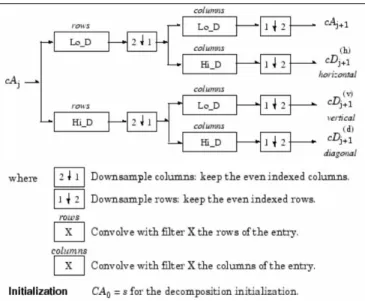
Fig. 2 shows the basic decomposition steps for images using DWT while Fig. 3 describes the reconstruction steps of image. From the fig. low-pass filter is named as Lo_D while high-pass filter is Hi_D. Low-pass filter is use to get the approximate values while high-pass filter is use to get the details signal values.
Fig. 2.The 2D-DWT decomposition steps
Fig. 3.The 2D-DWT Reconstruction steps
Given a signal which put through low-pass filter and high-pass filter, followed by dyadic decimation, it will produces two sets of coefficients: approximation coefficients cA1, and detail coefficients cD1. Then, the approximation coefficients cA1 is splits in two parts using the same scheme, and producing cA2 and cD2, and so on based on the level j. Using 2-D DWT approximation coefficients at level j is decompose into four components which is the approximation at level j + 1 and the details in three sub-signals (horizontal, vertical, and diagonal). Fig. 4 shows the resulting decomposition of an image.
Fig. 4.The The resulting decomposition of image
Since the approximate or low frequency (LL) sub-signals consist most of the image energy, it will be used as an input in feature extraction instead the original image. This will reduce the size of processing to only ¼ of the image.
VI. EXPERIMENTAL SETUP AND RESULTS
An experiment is design to evaluate the efficiency of adopting pre-processing technique in CMFD pipeline. Fig. 5 illustrated the experimental design of this CMFD process. Further explanations are given in the next section.
A. Experimental Setup
block size. Zernike moments is used in this experiment to extract the robust features of blocks. Details of the experimental steps are as follow:
Input Image
Grayscale Conversion
DWT Decomposition (pre-processing)
Image Segmentation
Feature Extraction (Zernike Moments)
Lexicographical Sorting
Matching
Verification
Output Image
Fig. 5.The Experimental Design
1) Grayscale conversion: since dataset consist of RGB image, image is first convert to grayscale image.
2) DWT decomposition: Grayscale image then decompose into 4 sub-band [LL, HL, LH, HH] using DWT. Only approximate sub-signals (LL) is used for next process. 3) Overlapping blocks: sliding window operations to produce overlapping blocks is done to the low-frequency (LL) only.
4) Feature extraction: calculate each block using Zernike Moment feature extraction methods and store to a vector.
5) Lexicographical sorting: Vector is then sort lexicograpical order for next computation.
6) Compute offset: For each pairs of rows vector, calculate the offset value (Δx, Δy).
7) Matching: for all (Δx, Δy)>Threshold, marks the blocks.
8) Verification: If the marked blocks are adjacent, it might be part of duplicate region.
9) Final image: Original and detected forged image will be shown as final result.
B. Experimental Result
Experiment was done using Zernike moment as feature extraction. Fig. 6 (a)-(c) and Fig. 7 (a)-(c) shows the original
image, tampered image and detection result respectively without DWT as pre-processing.
Fig. 6.(a) Original image (b) Tampered image (c) Detection result
Fig. 7.(a) Original image (b) Tampered image (c) Detection result
Fig. 8 (a)-(c) and Fig. 9 (a)-(c) on the other hand, shows the similar set as previous Fig. 6 and Fig. 7 but with DWT adopted in pre-processing stage.
Fig. 8.(a) Original image (b) Tampered image (c) Detection result
Fig. 9. (a) Original image (b) Tampered image (c) Detection result
From the above examples, we could see that the accuracy level has dropped once DWT was applied to the CMFD pipeline. Since morphological process was not implemented in this experiment, a lot of noise was shown.
TABLE I. PROCESSING TIME
Picture Label Without DWT With DWT
Birds 519s 234s
Building 520s 230s
indeed provides a promising result for further enhancement in the CMFD process.
VII.CONCLUSION
Copy-move forgery detection is a part of digital forensic domain. Apart of trying to achieve high detection accuracy, the capability to produce result in near real-time is highly needed. Thus, many methods have been proposed to resolve this issue and one of the options is through implementing pre-processing technique. Experimental result shows that time complexity could be reduced using suitable pre-processing techniques with some price to detection accuracy. This however could be prevented by implementing post-processing techniques to remove the noise. There are still many works to be done in CMFD in order to achieve an efficient and accurate detection result.
ACKNOWLEDGMENT
A high appreciation goes to the Malaysia Ministry of Higher Education (MOHE) as well as Universiti Tun Hussein Onn Malaysia (UTHM) for sponsoring the research studies and also to Universiti Teknologi Malaysia (UTM) for facilitating with convenience research environment in preparing this paper. The reviewers’ comments and suggestions in improving the paper are highly appreciated.
REFERENCES
[1] A. U. Zulkurnain. (2015). Graphics Processing Unit Based Parallel Copy Move Image Forgery Detection Scheme. Master of Computer Science (Information Security), Faculty of Computing, Universiti Teknologi Malaysia, Malaysia. [2] M. A. Sekeh, M. A. Maarof, M. F. Rohani, and M. Motiei.
(2011). Efficient Image Block Matching Algorithm with Two Layer Feature Extraction. Information Technology in Asia (CITA 11), 2011 7th International Conference on, 1-5. [3] S. F. Md Salleh, M. F. Rohani, and M. A. Maarof. (2017).
Copy-move Forgery Detection: A survey on Time Complexity Issues and Solutions. Journal of Theoretical and Applied Information Technology, 95, 2552-2566.
[4] I. Amerini, L. Ballan, R. Caldelli, A. Del Bimbo, and G. Serra. (2011). A SIFT-based Forensic Method for Copy-Move Attack Detection and Transformation Recovery.
Information Forensics and Security, IEEE Transactions on,
6, 1099-1110.
[5] B. Shivakumar and L. D. S. S. Baboo. (2011). Detection of Region Duplication Forgery in Digital Images Using SURF.
IJCSI International Journal of Computer Science Issues, 8. [6] X. Bo, W. Junwen, L. Guangjie, and D. Yuewei. (2010).
Image Copy-move Forgery Detection Based on SURF.
Proceedings of the 2010 International Conference on Multimedia Information Networking and Security.
[7] H. Hailing, G. Weiqiang, and Z. Yu. (2008). Detection of Copy-move Forgery in Digital Images Using SIFT Algorithm. Computational Intelligence and Industrial Application, 2008. PACIIA '08. Pacific-Asia Workshop on, 272-276.
[8] P. Xunyu and L. Siwei. (2010). Detecting Image Region Duplication Using SIFT Features.Acoustics Speech and Signal Processing (ICASSP), 2010 IEEE International Conference on, 1706-1709.
[9] W. Xiaofeng, Z. Xiaoni, L. Zhen, and W. Shangping. (2011). A DWT-DCT Based Passive Forensics Method for Copy-Move Attacks. International Conference on Multimedia Information Networking and Security (MINES), 2011 Third, 304-308.
[10] X. Bi, C.-M. Pun, and X.-C. Yuan. (2016). Multi-Level Dense Descriptor and Hierarchical Feature Matching for Copy–Move Forgery Detection. Information Sciences, 345, 226-242.
[11] J. Fridrich, D. Soukal, and J. Lukas. (2003). Detection of Copy-Move Forgery in Digital Images. Proc. of Digital Forensic Research Workshop.
[12] J. Zhao and J. Guo. (2013). Passive Forensics for Copy-move Image Forgery Using a Method Based on DCT and SVD.
Forensic Science International, 233, 158-166.
[13] L. Li, S. Li, H. Zhu, and X. Wu. (2014). Detecting Copy-move Forgery Under Affine Transforms for Image Forensics.
Computers & Electrical Engineering, 40, 1951-1962. [14] Q.-C. Yang and C.-L. Huang. (2009). Copy-Move Forgery
Detection in Digital Image. Advances in Multimedia Information Processing-PCM 2009. 5879, P. Muneesawang, F. Wu, I. Kumazawa, A. Roeksabutr, M. Liao, and X. Tang, Eds. ed: Springer Berlin Heidelberg, 816-825.
[15] B. Yang, S. Xingming, X. Chen, J. Zhang, and X. Li. (2013).
An Efficient Forensic Method for Copy-move Forgery Detection Based on DWT-FWHT, 22.
[16] A. C. Popescu and H. Farid. (2004). Exposing Digital Forgeries by Detecting Duplicated Image Regions. Dept. Comput. Sci. Dartmouth College, Tech. Rep. TR2004-515. [17] B. Mahdian and S. Saic. (2007). Detection of Copy–move
Forgery Using a Method Based on Blur Moment Invariants.
Forensic Science International, 171, 180-189.
[18] O. M. Al-Qershi and B. E. Khoo. (2016). Copy-move Forgery Detection Using on Locality Sensitive Hashing and k-means Clustering. Information Science and Applications (ICISA) 2016, K. J. Kim and N. Joukov, Eds. ed Singapore: Springer Singapore. 663-672.
[19] L. Guohui, W. Qiong, D. Tu, and S. Shaojie. (2007). A Sorted Neighborhood Approach for Detecting Duplicated Regions in Image Forgeries Based on DWT and SVD.
Multimedia and Expo, 2007 IEEE International Conference on, 1750-1753.
[20] A. N. Myrna, M. G. Venkateshmurthy, and C. G. Patil. (2007). Detection of Region Duplication Forgery in Digital Images Using Wavelets and Log-Polar Mapping. Conference on Computational Intelligence and Multimedia Applications, 2007. International Conference on, 371-377.
[21] Z. Jing, F. Zhanlei, and S. Yuting. (2008). A New Approach for Detecting Copy-move Forgery in Digital Images. 2008 11th IEEE Singapore International Conference on Communication Systems, 362-366.
[22] M. Zimba and S. Xingming. (2011). DWT-PCA (EVD) Based Copy-move Image Forgery Detection. International Journal of Digital Content Technology and its Applications,
5, 251-258.
[23] M. Zimba. (2014). DWT-SATS Based Detection of Image Region Cloning.
Pattern Recognition, 2006. ICPR 2006. 18th International Conference on, 746-749.
[25] H.-J. Lin, C.-W. Wang, and Y.-T. Kao. (2009). Fast Copy-Move Forgery Detection. WSEAS Transactions on Signal Processing, 5, 188-197.
[26] T. Zhang and R.-d. Wang. (2009). Copy-move Forgery Detection Based on SVD in Digital Image. Image and Signal Processing, 2009. CISP '09. 2nd International Congress on, 1-5.
[27] J. Wang, G. Liu, Z. Zhang, Y. Dai, and Z. Wang. (2009). Fast and Robust Forensics for Image Region-Duplication Forgery. Acta Automatica Sinica, 35, 1488-1495.
[28] G. Liu, J. Wang, S. Lian, and Z. Wang. (2011). A Passive Image Authentication Scheme for Detecting Region-Duplication Forgery with Rotation. Journal of Network and Computer Applications, 34, 1557-1565.
[29] W. Junwen, L. Guangjie, L. Hongyuan, D. Yuewei, and W. Zhiquan. (2009). Detection of Image Region Duplication
Forgery Using Model with Circle Block. Multimedia Information Networking and Security, 2009. MINES '09. International Conference on, 25-29.
[30] Y. Heng, Q. Tong, T. Zhenjun, Z. Yan, and M. Hualing. (2011). Detecting Copy-Move Forgery Using Non-Negative Matrix Factorization. Multimedia Information Networking and Security (MINES), 2011 Third International Conference on, 591-594.
[31] L. Li, S. Li, H. Zhu, S.-C. Chu, J. F. Roddick, and J.-S. Pan. (2013). An Efficient Scheme for Detecting Copy-move Forged Images by Local Binary Patterns. Journal of Information Hiding and Multimedia Signal Processing, 4, 46-56.
![Fig. 1. The illustration of Gaussian pyramid decomposition [28]](https://thumb-us.123doks.com/thumbv2/123dok_us/8003502.2121586/3.893.527.786.374.569/fig-illustration-gaussian-pyramid-decomposition.webp)