Diptimayee Mallik et al JMSCR Volume 07 Issue 08 August 2019 Page 97
Original Article
End tidal carbon dioxide (EtCO
2) and hemodyanamic changes following
tourniquet release in lower limb surgery under general anesthesia
Authors
Diptimayee Mallik, Bhavna Sriramka, Sudeep Mohapatra, Megha Khetan*
Department of Anaesthesiology and Critical Care, IMS and SUM hospital, Siksha “O” Anusandhan University (Deemed to be), K8, Kalinga nagar, Bhubaneswar-751003, Odisha, India
*Correspondence Author
Megha Khetan
Department of Anaesthesiology and Critical Care, IMS and SUM hospital, Siksha “O” Anusandhan University (Deemed to be), K8, Kalinga nagar, Bhubaneswar-751003, Odisha, India
Abstract
Utilization of pneumatic tourniquet is a normal practice in most appendage medical procedures for orthopedic, plastic/reconstructive surgery to acquire a bloodless field. this study to analyze the end tidal CO2
and hemodynamic changes following tourniquet release in lower limb surgeries under General anaesthesia. A total of 150 patients of ASA physical status Class I and II, of either sex in the age group of 18 to 55 years who underwent elective surgery on the lower limbs using pneumatic tourniquet , under General anaesthesia were considered, Data collected 4 times during General anaesthesia, 15 minutes after induction of anaesthesia, 30 minutes after inflation of tourniquet, 5minutes after deflation and 15 minutes after deflation of tourniquet. Heart rate during the period of tourniquet inflation it is remains same or slightly increased to a mean of 103.05 ± 15.50 beats/min. But after the tourniquet deflation the heart rate showed a progressive rise. The peak increase was seen immediately after the tourniquet release (after 5 minutes) by 123±16.04 beats/min. During 30 minutes after tourniquet the MAP remains same or may increase slightly to 95.489±2.44 mm Hg which is statistically significant. Then 5 minutes after tourniquet deflation there is sudden and gross decrease in MAP to 85.37±4.88 mmHg. the EtCO2 30 minutes after tourniquet inflation was more or less equal that is 31.316±1.38 mmHg. Then at tourniquet deflation after 5 minutes there is rise of EtCO2 to 41.317±1.913mmHg then it gradually comes to baseline. Heart rate, ETCO2 , and mean arterial
pressure showed minimal change during inflation phase while there occurs significant change after deflation.
Keywords: Tourniquet, EtCO2 ,Hemodyanamic, Tourniquet inflation.
Introduction
Use of pneumatic tourniquet is a routine practice in most limb surgeries for orthopedic, plastic/ reconstructive surgeries to obtain a bloodless field. The pneumatic tourniquet was introduced in 1904 by Cushing to maintain a bloodless field while operating on extremities, Klenerman L[1].
The measurable and high pressure that tourniquet can generate leads to controlled arterial compression and distal circulatory stasis. Prolonged use of tourniquet at a non-optimal pressure has been implicated to cause local and systemic ill effects. While these tourniquets related complications might be relatively benign http://jmscr.igmpublication.org/home/ ISSN (e)-2347-176x ISSN (p) 2455-0450
Diptimayee Mallik et al JMSCR Volume 07 Issue 08 August 2019 Page 98 in young and healthy patients, it may be
devastating in patients with co exiting co-morbidities.
During the period of tourniquet ischemia, the concerned limb depends on anaerobic metabolism brought about by the interruption of arterial blood supply that carries oxygen. Therefore, the anaerobic metabolites accumulates which, will enter the general circulation resulting in reperfusion syndrome on release of tourniquet, this may be manifested as alteration in the blood gas and acid base milieu. Concomitant hemodynamic changes also occur due to opening of an additional vascular bed, which that remains cut off from the systemic circulation until then by the tourniquet exsanguation. Hence, an opinion as to the length of time this potentially destructive instrument can be safely applied is still debatable. The extent or intensity of hemodynamic and metabolic changes depend on the tourniquet phase (inflation / deflation), cuff inflation pressure, duration of inflation, extension of ischemic area, anesthetic method instituted (General, Epidural or Spinal) as well as pre-existing cardiovascular condition of the patient. Most studies concerning tourniquet use have focused on the metabolic, hemodynamic or circulating alteration seen after regional anaesthesia. However, there is a paucity of literature in respect to effect of tourniquet under general anaesthesia. General anaesthesia (GA) modulates the milieu-internal due to its inherent effect on body hemodynamic. Use of tourniquet leading to deliberate regional circulatory arrest modifies these hemodynamic responses. The authors aim to study and analyze the end tidal carbon di oxide (EtCO2)& hemodynamic changes
before and after tourniquet deflation during lower limb surgery under GA.
Materials and Methods
Total 150 patients of either sex of the age group 18 to 55 years having American society of anesthesiologist (ASA) I or II, who underwent surgery on the lower limbs using pneumatic tourniquet were enrolled in surgery. This was after
prior ethical committee clearance and patients expressed (written) consents fully understanding about the procedure and risks associated with outcomes. . Patients with ASA score III or IV; those with known or suspected drug allergy especially to Propofol, egg protein, or soya products, pregnancy and lactating patients, ischemic cardiac disease, cardiac conduction defects, patient with history of seizure or any associated vasospastic diseases were excluded from the study.
Diptimayee Mallik et al JMSCR Volume 07 Issue 08 August 2019 Page 99 The time of induction was noted. The muscle
relaxant vecuronium 0.1mg / kg was given as loading dose and supplemented with 0.05mg / kg at an interval of 15-20 minutes for the total duration of surgery. Patients were on intermittent positive pressure ventilation using nitrous oxide and oxygenin the ratio (2:1). The ventilation was adjusted to obtain EtCO2 between 30-35 mmHg
after intubation & for the total duration of surgery. The limb was then exsanguinated by raising the limb for 5-10 minutes. A pneumatic tourniquet was placed on the thigh as proximal as possible and inflated to a pressure based on limb occlusion pressure (LOP). The time of tourniquet inflation was noted. Surgical procedure was started only after tourniquet inflation. The time of tourniquet deflation was noted and then total tourniquet time was calculated.
These data were collected 4 times during GA; 15 minutes after induction of anaesthesia, 30 minutes after inflation of tourniquet, 5 minutes and finally 15 minutes after deflation of tourniquet. At 15 mins after induction (Prior to application of tourniquet), parameters studied are: HR, NIBP, MAP, EtCO2, Peripheral O2 saturation. An arterial
blood sample drawn in a heparinised syringe and analyzed with ABG machine to estimate values of pH, PaCO2, PaO2. After the end of the operation,
residual effects of muscle relaxants were reversed by giving using inj. Neostigmine 60-80/kg and Inj glycopyrrolate 10/kg. The patient was extubated after return of all protective reflexes. All the parameter are noted at the stipulated times intervals and analyzed.
Results
The age of patients in the present study ranged from 18-55 years with male:female 121:29. As demonstrated in table 1 .The duration of tourniquet ischemia ranged from 30 to 120 minutes. The mean of tourniquet time was 59.99 ± 18.23 minutes. Table 1 also shows tourniquet time distribution, in around 50.7 % cases (76 patients) tourniquet time is 30 - 60 minutes, 28.7 % cases it is 60 - 90 minutes and in rest it is > 90 minutes.
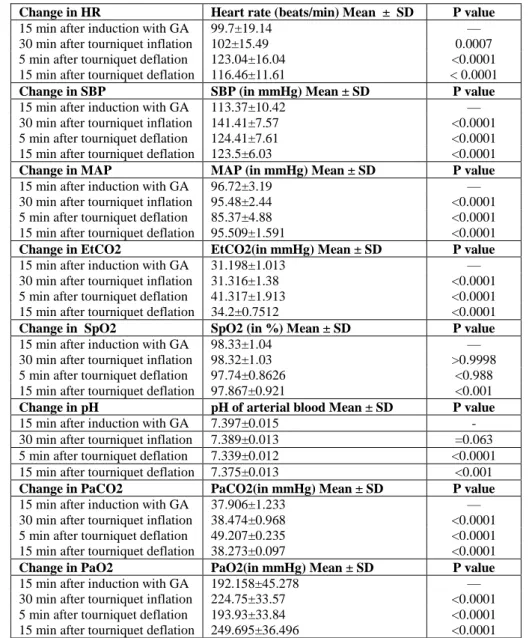
The mean HR before the tourniquet application was 99.7 ± 19.14 beats / min. while the mean value of SBP was 113.37 ± 10.42 mm Hg and MAP was 97.72 ± 3.198 mm Hg. Changes in HR, SBP, MAP, EtCO2, SpO2 pH, PaCO2 & PaO2 with time is shown in table 2. The baseline EtCO2 before the tourniquet application was 31.198 ± 1.013mm Hg. The SpO2 was 98.33 ± 1.04% at the onset of surgery at 15 minutes of induction. Before tourniquet inflation, the pH was 7.397 ± 0.015The changes in PaCO2 & PaO2 of arterial blood is shown on table 2. Table 3 shows correlation of different parameter with tourniquet time (changes in parameters were not having statistically significant). Table 4 showing there is a positive correlation between PaCO2 and EtCO2. Their correlation is statistically significant p value <0.05 by linear regression, whereas a negative correlation was found between EtCO2 and PaO2, but it is again not statistically significant (p =0.0528). The pH also shows a negative correlation with PaCO2 (significance statistically with P value < 0.05) by linear regression. Finally, there was a negative correlation between EtCO2 and MAP with coefficient of correlation value of 0.2492 (not significant) but the negative correlation between EtCO2 and SpO2 (r =0.01630) was found to be not significant (P = 0.8431).
Table. 1: Age and Tourniquet time Distribution
Age (in years) Number of patients
Percentage (%)
18-30 54 36
31-42 69 46
> 42 27 18
Total 150 100
Tourniquet time (minutes)
In numbers of patients
Percentage (%)
30-60 76 50.7
60-90 43 28.7
>90 31 20.6
Diptimayee Mallik et al JMSCR Volume 07 Issue 08 August 2019 Page 100
Table 2: Various parameters with time zone
Change in HR Heart rate (beats/min) Mean ± SD P value
15 min after induction with GA 99.7±19.14 —
30 min after tourniquet inflation 102±15.49 0.0007 5 min after tourniquet deflation 123.04±16.04 <0.0001 15 min after tourniquet deflation 116.46±11.61 < 0.0001
Change in SBP SBP (in mmHg) Mean ± SD P value
15 min after induction with GA 113.37±10.42 —
30 min after tourniquet inflation 141.41±7.57 <0.0001 5 min after tourniquet deflation 124.41±7.61 <0.0001 15 min after tourniquet deflation 123.5±6.03 <0.0001
Change in MAP MAP (in mmHg) Mean ± SD P value
15 min after induction with GA 96.72±3.19 —
30 min after tourniquet inflation 95.48±2.44 <0.0001 5 min after tourniquet deflation 85.37±4.88 <0.0001 15 min after tourniquet deflation 95.509±1.591 <0.0001
Change in EtCO2 EtCO2(in mmHg) Mean ± SD P value
15 min after induction with GA 31.198±1.013 —
30 min after tourniquet inflation 31.316±1.38 <0.0001 5 min after tourniquet deflation 41.317±1.913 <0.0001 15 min after tourniquet deflation 34.2±0.7512 <0.0001
Change in SpO2 SpO2 (in %) Mean ± SD P value
15 min after induction with GA 98.33±1.04 —
30 min after tourniquet inflation 98.32±1.03 >0.9998 5 min after tourniquet deflation 97.74±0.8626 <0.988 15 min after tourniquet deflation 97.867±0.921 <0.001
Change in pH pH of arterial blood Mean ± SD P value
15 min after induction with GA 7.397±0.015 -
30 min after tourniquet inflation 7.389±0.013 =0.063 5 min after tourniquet deflation 7.339±0.012 <0.0001 15 min after tourniquet deflation 7.375±0.013 <0.001
Change in PaCO2 PaCO2(in mmHg) Mean ± SD P value
15 min after induction with GA 37.906±1.233 —
30 min after tourniquet inflation 38.474±0.968 <0.0001 5 min after tourniquet deflation 49.207±0.235 <0.0001 15 min after tourniquet deflation 38.273±0.097 <0.0001
Change in PaO2 PaO2(in mmHg) Mean ± SD P value
15 min after induction with GA 192.158±45.278 —
30 min after tourniquet inflation 224.75±33.57 <0.0001 5 min after tourniquet deflation 193.93±33.84 <0.0001 15 min after tourniquet deflation 249.695±36.496 <0.0001
Table. 3 : Correlation of Different Parameter with Tourniquet Time
Parameters Coefficient of correlation P value
HR 0.0557 0.4983
MAP —0.06263 0.4469
EtCO2 0.02133 0.7956
PaCO2 0.05487 0.5049
pH 0.00061 0.9941
SpO2 —0.0530 0.5194
PaO2 —0.0922 0.2616
Table. 4: Correlation of Different Parameter At 5 minutes after tourniquet deflation
Parameter 1 Parameter 2 Correlation coefficient P value
PaCO2 EtCO2
49.207±0.235 41.317±1.913 0.2064 0.0133
EtCO2 PaO2
41.317±1.913 193.93±33.84 —0.1584 0.0528
PaCO2 pH
49.207±0.235 7.339±0.012 —0.9167 <0.0001
EtCO2 MAP
41.317±1.913 85.37±4.88 —0.2492 0.0021
EtCO2 SpO2
Diptimayee Mallik et al JMSCR Volume 07 Issue 08 August 2019 Page 101
Discussion
In the present study, the period of tissue ischemia ranges from 30-90 minutes with the mean tourniquet ischemia time of 59.99 18.23 minutes. The tourniquet times for various studies were different. For Bourke et al[2], Hirst et al[3], Takahashi et al[4] and for Estabe et al [5] are 67 30 mins, 84 34 mins, 96 2 1 mins and 98 10 mins respectively. Estebe et al[5] emphasized that reperfusion interval is harmful rather than being beneficial. The restarting of circulation will increase lesions at the microcirculatory level, responsible for the ''no reflow'' phenomena. In our study, the surgical duration under tourniquet was between 30-90 minutes. Hence, the evidence of reperfusion injury was not obvious in the present study with the clinical parameters monitored. Girardis et al[6] observed that during tourniquet inflation, HR did not change. In our study, we found a mean change of 4-5 beats/min, which may not have much clinical implication as corroborated from other hemodynamic parameters. However, there was a sudden rise of the HR after the tourniquet deflation observed in our study. This is similar to findings observed by Kaufman et al [7] , The, pattern of change in SBP and MAP were identical to previous study by Girardis et al[6] and Kaufman et al in1982[7]. They demonstrated, following the initial transient increase in arterial pressure, there is a second gradual increase in arterial pressure and heart rate that may be associated with pain. After deflation of tourniquet, there is shift of blood volume, back in to the limb and post ischemic reactive hyperemia, which causes a decrease in the peripheral vascular resistance resulting in a sudden decrease of central venous pressure and MAP by5 minute. This normalizes by around 30 min. [8,9]. The mean arterial pressure (MAP) in our study suddenly decreased after tourniquet deflation to a mean value 14% lower (P <0.05) than at 60 minutes after inflation as also found by Girardis et al[6] and Zaman et al [10].
Since the present study was conducted in general anaesthesia with controlled ventilation, respiratory
rate was kept unaltered different phases of tourniquet. In the present study, the baseline EtCO2 before the tourniquet application was 31.198 ± 1.013mm Hg and the EtCO2 at 30 minutes after tourniquet inflation was equal that is 31.316 ± 1.38 mmHg. The EtCO2 after 5minutes of tourniquet deflation showed a sudden rise to 41.317 ± 1.913mmHg gradually thawing to baseline. Post 15 minutes of deflation it was 34.2 ± 0.7512mmHg, which is statistically significant (p value < 0.05)
Changes in PaCO2, PaO2, SpO2, pH at different
time zones were identical to previous study. Deen et al[11] observed the EtCO2 increased from 30.34 1.25 mmHg to 36.3 0.98 mmHg at 1 minute and to 39.53 1.75mmHg after 3 minutes after releasing tourniquet. They also observed that PaCO2 increased from 36.2 ± 3.7 to 46.6 ± 3.7 mm Hg at 1 minute of tourniquet deflation. Similarly, Patel et al[12] reported that, EtCO2 and PaCO2 increased maximally within 1 min after deflation of of the tourniquet; and while EtCO2 returned to base line by 13mins 7 secs ± 5 mins 7 secs, PaCO2 remained Again, EtCO2 remained nearly twice as long as in spontaneously ventilating group. They hypothesized, patients with adequate spontaneous ventilation respond to the extra CO2 load imposed by tourniquet
deflation after surgery sufficient enough to prevent excessive increases in EtCO2 and will
return EtCO2 to near previous levels within about
3-5 min. Dickson et al[13] in one study found increase that ETCO2 increase ranged from
differently for upper and lower extremity (1 to 12 mm Hg vs. 5 to 18 mm Hg) That was perhaps expected due to the greater skeletal mass of a lower as compared with an upper extremity. The authors suggested monitoring of ETCO2 and
Diptimayee Mallik et al JMSCR Volume 07 Issue 08 August 2019 Page 102 deflation and found pH, and standard blood
bicarbonate decreased, while PaCO2, serum potassium , and lactate (La) increased. The values of PaO2, and O2 saturation did not show
significant changes.
In the present study, the changes in HR and MAP were found to have negative correlation with tourniquet time, which was statistically not significant. The alteration in PaO2 showed a
statistically insignificant negative correlation with the tourniquet time while the recorded data as per pH, PaCO2 and EtCO2 found to have positive
correlation. These are also not statistically significant. Our study corroborates to the findings of Girardis et al[6]; In summary, studies have indicated that the SAP variations observed during tourniquet inflation and after deflation are sustained by significant variations of CO and SVR. The hemodynamic and metabolic changes occurring after tourniquet deflation depend on the time of ischemia and, therefore, the tourniquet inflation period should be as short as possible in patients in poor physical condition. Others like Townsend et al [8] observed this correlation between time of tissue ischemia to changes in EtCO2, PaCO2 and pH has positive correlation, and with PaO2 has negative correlation. Bourke et al [2] studied the respiratory effects of tourniquet deflation under different anesthetic techniques. According to them, the changes in EtCO2 found to have positive correlation with the tourniquet time. These changes mentioned above did not cause any significant clinical problem in our healthy young patients of ASA II and I. Nevertheless, these transient changes can become relevant in certain patients with cardio-respiratory co morbidities. In patients with a head injury, the sudden increase of PaCO2 may worsen intracranial pressure, especially after long periods of tourniquet INF. Sharrock et al in[15], noted the changes in MAP did not correlate with the duration of tourniquet inflation time while. Lee et al [14], found a weak correlation between tourniquet time and excess CO2 elimination.
Dickson et al [13] also did not find any correlation
between the duration of tourniquet inflation time and the increase in EtCO2. However, the tourniquet was inflated for more than one hour in all their cases. LAM et al[3] studied on the changes in cerebral blood flow velocity after release of intraoperative tourniquets in humans by trans-cranial Doppler. Their showed a strongly correlation between tourniquet release and increase in EtCO2, no correlation between tourniquet time and maximum percent change in mean MCA flow velocity (r = 0.176, P = 0.74) and a weak positive correlation with maximum percent change in EtCO2 (r = 0.678, P = 0.14). In the present study, the deviations were due to shorter tourniquet time and physical status of the patients in the study group being ASA II and I. In the present study, showed a positive correlation between PaCO2 and EtCO2 that was statistically significant (p value < 0.05), According to Lee et al
[14]
Diptimayee Mallik et al JMSCR Volume 07 Issue 08 August 2019 Page 103 of ischemia into the general circulation. The
resultant decreases in arterial pH and PaO2 and increases in arterial lactic acid, potassium, PaCO2 and EtCO2 are associated with significant decreases in mean arterial and central venous pressures and increases in heart rate. The clinical significance of these changes is not yet clear. In healthy individuals with ASA I and II, as in the present study, no significant adverse effects have been observed.
Conclusion
Tourniquet application for limb surgery under general anaesthesia also further affects the milieu internal by its inherent property. In patients, some of the changes seen. These is fall in MAP and rise in HR after tourniquet release. This may or may not be significant clinically. Arterial PaCO2 shows an initial rise after deflation of tourniquet followed by a fall. These fluctuations are within normal limits in healthy adult but may be devastating in patients with associated co-morbid conditions. The rise in EtCO2 corresponding changes in PaCO2 is also there. The changes in PaO2 may not be significant statistically. A mild degree of metabolic acidosis seen by small fall in arterial pH. This does not show any on toward harmful effects in the normal healthy patients.
Conflict of Interest (financial, professional, or personal) - None
Writing assistance – None.
References
1. Klenerman L. The tourniquet in surgery. The Journal of Bone and Joint Surgery.1962;44B:937–43.
2. Denis L. Bourke, Marc S. Silberberg, Rafael Ortega, and Marcelle M. Willock, Respiratory Responses Associated with Release of Intraopera tive Tourniquets. ANESTH ANALG 1989:69:541-4
3. Lam A.M., Hirst, R.P., Slee, T.A. changes in cerebral blood flow velocity after release of intraoperative tourniquet in
humans : A transcranial doppler study. Anesth Analg 1990;71: 503-10.
4. Takahashi S, Mizutani T, Sato S. Changes in oxygen consumption and carbon dioxide elimination after tourniquet release in patients breathing spontaneously under epidural anesthesia. Anesthesia and Analgesia1998; 86: 90–4.
5. Estebe JP, Malledant Y. Pneumatic tourniquets in orthopedics.Ann Fr Anesth Reanim 1996 ; 15 : 162-178.
6. Girardis M, Milesi S, Donato S, et al.The hemodynamic and metabolic effects of tourniquet application during knee surgery.
Anesthesia and Analgesia2000; 91: 727– 31.
7. Kaufman RD, Walts LF. Tourniquet-induced hypertension. Br J Anaesth 1982;54:33H.
8. Townsend HS, Goodman SB, Schurman DJ, Hackel A, Brock-Utne JG. Tourniquet release: systemic and metabolic effects.
Acta Anaesthesiologica Scandinavica 1996; 40: 1234–7.
9. Samii K, Elmelik, E. Mourtada, M B., Debeyre J, Rapin M. Intraoperative hemodynamic changes during total knee replacement, Anesthesiology 1979; 50: 239-42.
10.Zaman SM, Islam MM, Chowdhury KK, Rickta D, Ireen ST, Choudhury MR, Alam M. Haemodynamic and end tidal CO2 changes state after inflation and deflation of pneumatic tourniquet on extremities. Mymensingh Med J. 2010 Oct;19(4):524-8.
11.Deen L, Nyst CL, Zuurmond WW. Metabolic changes after tourniquet release. Acta Anaesthesiol Belg. 1982;33(2):107-14.
Diptimayee Mallik et al JMSCR Volume 07 Issue 08 August 2019 Page 104 13.Dickson M, White H, Kinney W, Kambam
JR. Extremity tourniquet deflation increases end-tidal pCO2. Anesth Analg 1990; 70: 457–8.
14.Lee TL, Tweed WA, Bachan S. Oxygen consumption and carbon dioxide elimination after release of unilateral lower limb pneumatic tourniquets. Anesth Analg 1992;75:113–7.