644
Optimal Library Inventory System Using EMID Technology
Sung-Tsun Shih1,Chin-Ming Hsu2, Chian-Yi Chao3 1
Department of Electronic Engineering, Cheng Shiu University, Kaohsiung, Taiwan 2
Department of Information Technology, Kao Yuan University, Kaohsiung, Taiwan 3
Department of Electronic Engineering, Kao Yuan University, Kaohsiung, Taiwan
Abstract: This paper proposes an optimal library inventory system which is based on electromagnetic identification (EMID) technology with the advantages of using electromagnetic (EM) tag and radio frequency identification (RFID) tag. The proposed system is constructed by four processes, including deciding the tag type, finding the optimal tag location for a book, testing the tag readability for multi-layer bookshelves, and connecting a couple of multi-layer bookshelves with multiplexers and updating the tag reading status in the database of the computer terminal. The proposed system is tested at the library of Cheng Shiu University in Taiwan. The quality and quantity of one-side and two-side of antennas applied in reading EMID tags with different time intervals and locations have been tested in the study. According to the experimental results, the designed library inventory system can authenticate the location of a book automatically and can benefit administrating librarians with the capabilities of decreasing the library inventory processing time and reducing the possibility of the books being misplaced.
[Sung-Tsun Shih,Chin-Ming Hsu, Chian-Yi Chao. Optimal Library Inventory System Using EMID Technology. Life Science Journal. 2011;8(4):644-649] (ISSN:1097-8135). http://www.lifesciencesite.com.
Keywords: Library Inventory; electromagnetic identification (EMID); radio frequency identification (RFID).
1. Introduction
Traditionally, library inventory work is a time-consuming and labor-exhausting task because librarians need to keep numerous resources such as books and magazines on their tracks correctly [1]. In order to be well maintained, a library generally would halt their service work for a week or a period of time to search all bookshelves in the library for examining whether the resources are put at their locations or not. This implies that the library inventory work not only includes check-in and check-out but also includes keeping the resources at actual locations [2]. Most of time, however, some resources would be either misplaced or stolen. With the development of information technology, many libraries have adopted barcode-label and electromagnetic (EM)-strip technologies for managing abundant books in the library inventory process. A barcode label with unique identification on a book provides check-in/out management capability while the electromagnetic strip of the book supports the anti-theft capability. The librarian would stick the barcode label and EM strips on the book and apply the computer system with the barcode and magnetization scanner to read the book information and adding/deleting the magnetization on the book. However, the barcode labels could be only stuck on the book with one time, manually scanned, and easily damaged; the EM strips don’t support resource identification capability [3].
In recent years, in order to overcome the weaknesses mentioned above, the wireless radio frequency identification (RFID) technology has
replaced the barcode label and magnetic strip with identification and anti-theft detection capabilities in the library inventory management [4-5]. The fundamental components of a typical RFID system consist of antennas, readers, and tags. The reader firstly sends the wireless radio signal which is then received by the antenna. When the tag perceives the radio signal, it returns the electromagnetic wave back to the reader [6]. Compared with using barcodes in the library inventory management, a RFID tag could be read more than ten-thousand times and could support more convenient and efficient advantages on check-out and return processes.
In the past decade, many universities, such as Cornell Uni., USA [7], Myongji Uni., Korea [8], Uni. of Auckland, New Zealand [9], and City Uni. of New York, USA [10], have done a lot of efforts on their library database managements. At Cornell Uni., the technology of a research library's digital collection would offer information seekers a powerful and easy way to search across existing collections and to retrieve integrated sets of results. At Myongji Uni. (MIU), a metadata system is designed and implemented for MJU library collections, which allows users to search all library materials using one user interface. At Uni. of Auckland, a digital library project is developed and aims at enhancing the IT infrastructure, strategic planning and designing a digitization policy. As for the City Uni. of New York, the library constructs the software usability measurement inventory (SUMI) criteria to evaluate their library database system.
645 In the reviewing some references applying RFID technology in the library inventory managements, Kern [11] described a RFID-based library inventory system which is used for book identification, for self-checkout, for anti-theft control, for inventory control, and for sorting and conveying of library books and AV materials. Chun, Hwang, and Lee [12] proposed an RFID tag search protocol which would protect the privacy of mobile reader holders and is secure enough to against all known major attacks in RFID systems. Sue and Lo [13] applied the RFID technology in a smart book-locating system which has two location modes – single book mode and book list mode. The single book mode provides users to find the bookshelf containing the desired book which was misplaced. The book list mode offers a corresponding list of the bookshelves and the misplaced books in the wrong bookshelves. Golding and Tennant [14] investigated the factors that may affect the read rate of an inventory reader in a library. The investigated factors were read distance, tag location, number of sweeps and sweep direction. Wang [15] studied the RFID-based methodology and approaches that support library services and management, including sensor gate control, circulation, inventory, searches and utilization statistics. The study also discussed barriers, challenges and future work about RFID applications in libraries and concluded that RFID-based technology would improve digital archives and digital humanities in library systems.
Zhang and Shi [16] and Bin Abdullah, etc. [17] are two literatures related to self services of library management systems. Zhang and Shi strongly pointed out that the necessity of the new RFID technology of self-service book borrowing and returning system in library, which would replace the barcode technology and accelerate the library’s self-service process. Bin Abdullah, etc. developed an integrated the RFID system with graphical user interface (GUI) at the host PC. The study aims to develop an automatic library shelf management system to assist the librarians for more efficient shelf management to find any misplaced books on the library shelf. In addition, in the reviewing some other RFID related literatures [18-20], two comments were made: (1) such intelligent plan may not meet the library demand because the system have to consider library internal disturbances such as metal, motion communication electric wave, and wireless network electric wave, which could affect the RFID operation; (2) the proposed inventory system have to be convenient to all readers.
As mentioned above and driven by the advanced ubiquitous computing technology, in this study, the authors proposes an optimal library
inventory system which is based on electromagnetic identification (EMID) technology with the advantages of using electromagnetic (EM) tag and radio frequency identification (RFID) tag. This paper is organized as follows. Section 2 describes the proposed optimal library inventory system based on EMID technology. The experimental results are shown in Section 3. Finally, the conclusions and Discussions are summarized in Section 4.
2. Optimal Library Inventory Technology
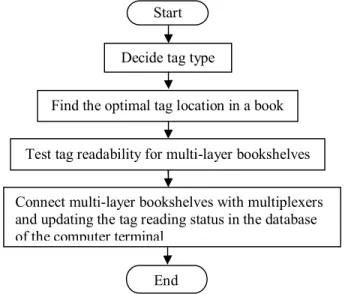
Figure 1 illustrates the flow chart of the optimal library inventory technology which includes four steps: deciding the tag type, finding the optimal tag location for a book, testing the tag readability for multi-layer bookshelves, and connecting couple of multi-layer bookshelves with multiplexers and updating the tag reading status in the database of the computer terminal.
2.1. Deciding Tag Type
In this study, embedded electromagnetic identification (EMID) security strips, as shown in Figure 2, are used for securing and managing the stocks on the library bookshelves. This kind of tags combines the technology of electromagnetic (EM) strips with security advantage and radio frequency identification (RFID) tags with managing distribution advantage. A typical EM long strip tag doesn’t have storing information capability; it can only secure library articles by sensing (attaching and eliminating) the electromagnetic signal on the EM long strip tag. As for the RFID strip tag, it uses the antenna and radio frequency chip to store the identification information. However, its size usually is too large to be applied in the library bookshelves management.
Figure 1. Flow chart of optimal library inventory technology. Decide tag type
Find the optimal tag location in a book
Test tag readability for multi-layer bookshelves
Connect multi-layer bookshelves with multiplexers and updating the tag reading status in the database of the computer terminal
Start
646
2.2. Finding Optimal Tag Location
Figure 3 is the picture of a bookshelf with the width and height of 90 and 19 cm, respectively. Three places, labeled as A, B and C in Figure 3, are used to find the optimal tag location. The place A is located on the left hand side of the bookshelf; the place B is located on the middle of the bookshelf; the place C is located either on the 30 cm from the distance of left and right hand sides of the bookshelf.
2.3. Testing Tag Readability
Figure 4 illustrates the EMID reader (antenna) locations on the bookshelves. As shown in Figure 4(a) one EMID reader is put on the center of the one-sided bookshelf; the other EMID reader is put on the middle part of two-sided bookshelves. The spine of every book is attached an EMID tag strip as illustrated in Figure 5.
2.4. Connecting Multi-Layer Bookshelves
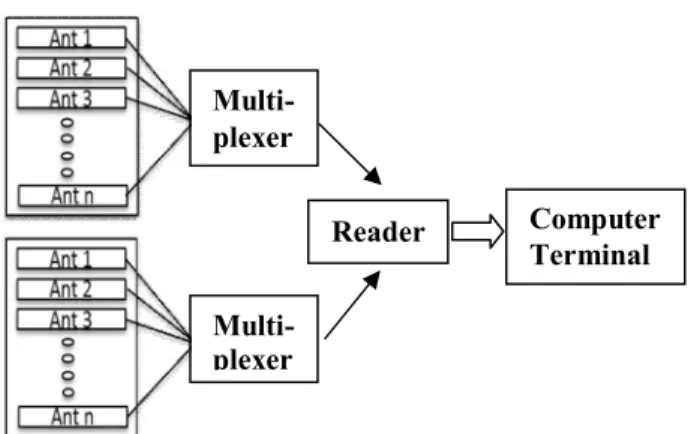
Figure 6 shows antenna’s locations in a multi-layer bookshelf. Figure 7 illustrates the structure of connecting multi-layer bookshelves in a library by using multiplexers. As given in Figure 7, the library computer terminal through multiplexers
and readers obtains antenna’s signals by rolling every EMID tag. After the computer obtained the EMID tag signal, the database of the computer will authenticate the location of the book. This indicates that whether the book is on the bookshelf or not and the library inventory work can be done automatically.
Figure 3. Tag location.
Figure 2. Embedded electromagnetic identification (EMID) security strips; (a) front side; (b) back side.
(a) (b)
Figure 6. Antenna locations in multi-layer bookshelves. Figure 5. EMID tag strip location in the book. Figure 4. Tag Readability; (a) one-sided bookshelf; (b) two-sided bookshelves.
(b) (a)
647 3. Results
In order to minimize the disturbance while under testing, the proposed system is experimented at night during the library closing time interval. Based on the polling inquiry methodology, the system would automatically read every EMID tag individually by switching different multiplexers gradually. On the other side, the user interface of the computer terminal would show the reading status of each EMID tag and the read data is then stored in the database of the computer terminal.
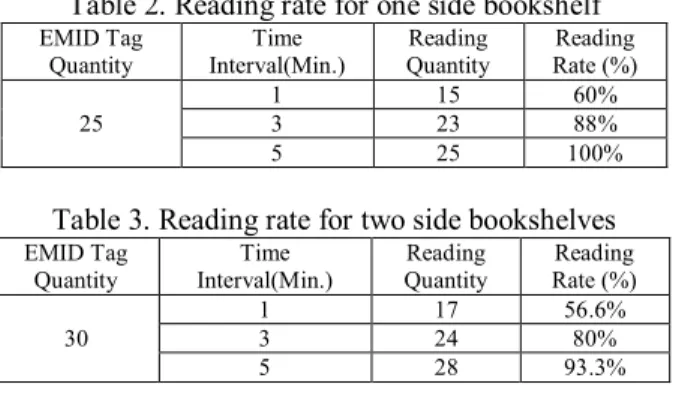
Table 1 shows the reading rate of EMID tags located at A, B, and C places as shown in Figure 3. From Table 1, the reading rate of 30 EMID tag strips at the location A, B, and C are 50%, 100%, and 100%, respectively. This implies that either location B or C gets better reading rate. Table 2 gives the reading rate of 25 EMID tag strips with different measuring time for one-sided bookshelf. From Table 2, the reading rate of 25 EMID tag strips with the time interval of 1, 3, and 5 minutes are 60%, 88%, and 100%, respectively. This implies that measuring time with 5 minute interval gets the best reading rate. Table 3 illustrates the reading rate of 30 EMID tag strips with different measuring time for two-sided bookshelves. From Table 3, the reading rate of 30 EMID tag strips with the time interval of 1, 3, and 5 minutes are 56.6%, 80%, and 93.3%, respectively. This implies that measuring time with 5 minute interval gets the best reading rate.
Figure 8 shows the user interfaces of reading EMID tag strips and administrator’s database management in Chinese at the computer part of the system where the user interface and database are built by C++ codes. There are six main functions shown on the screen of Figure 8(a), including book number, EMID tag number, reading times, starting time, current time, and antenna number. As for Figure 8(b), there are five main functions shown on the screen, including EMID tag number, book title, author’s
name, publisher, and reading status. According to the experimental results, the proposed system with easy operations allows the library administrator can know whether a book is on the bookshelf or not by checking the screen of Figure 8(b) and can accomplish library inventory work efficiently and effectively.
Table 1. Reading rate for different RFID tag locations
EMID Tag Quantity Location Reading Quantity Reading Rate (%) 30 A 15 50% B 30 100% C 30 100% (a)
Figure 8. User interfaces for managing stocks in library; (a) reading EMID tag; (b) book database management.
(b) Figure 7. Connection of multi-layer bookshelves.
Multi- plexer Multi- plexer Reader Computer Terminal
648 Table 2. Reading rate for one side bookshelf
EMID Tag Quantity Time Interval(Min.) Reading Quantity Reading Rate (%) 25 1 15 60% 3 23 88% 5 25 100%
Table 3. Reading rate for two side bookshelves
EMID Tag Quantity Time Interval(Min.) Reading Quantity Reading Rate (%) 30 1 17 56.6% 3 24 80% 5 28 93.3%
4. Conclusions and Discussions
An optimal library inventory system based on EMID technology has been proposed in this study. The main contribution of the proposed system is to improve traditional human labor-based library inventory methodology by decreasing the library inventory processing time and reducing the possibility of the books being misplaced. Compared to the exiting methods, the proposed system supports three distinctive advantages: (1) Using EMID strip tag with the characteristics of small size and high confidentiality can prevent it from being destroyed easily; (2) From the experimental results, the optimal tag reading status can be obtained by finding the best distance between two tags, the best location of a tag in a book, the optimal time interval for reading a tag accurately, and the best tag quantity for a bookshelf; (3) the number of EMID tag readers are minimized by using multiplexers and two-side antennas.
This work can be practically upgraded by considering the trade-offs of the quality and quantity of one-side and two-side of antennas applied in reading EMID tag with different time intervals. In addition, whether the location of the EMID tag in a book is confidential and readable is also another important factor to be considered.
Acknowledgements:
The authors would like to thank the company of Taiwan-EAS-Technology and the library of Cheng Shiu University supporting the EMID tags and measuring environment for us to carry out the experimental tests.
Corresponding Author: Dr. Sung-Tsun Shih
Department of Electronic Engineering, Cheng Shiu University,
Kaohsiung , Taiwan, R.O.C. E-mail: [email protected]
References
1. C. P. Zhu, Z. Wang, J. X. Deng, H. Gu, M.L. Shan, Q. B. Han, H. Z. Yu, S. Zhang. Design of an Intelligent Book Conveyor based on RFID. The 2nd International Conference on Information Science and Engineering, 2010; 1993 – 1996. 2. T.M.W. Shamsudin, M.J.E. Salami, W. Martono.
RFID-Based Intelligent Bookcs Shelving System. The 1st Annual RFID Eurasia, 2007; 1– 5.
3. C. W. Chou. The Application of Radio Frequency Identification Technology to the Library Real-Time Storage Processing. Department of Engineering Science, National Cheng-Kung University. July, 2006.
4. M.S. Selamat, B.Y. Majlis. Challenges in Implementing RFID Tag in a Conventional Library. IEEE International Conference on Semiconductor Electronics, 2006; 258 – 262. 5. F. Cheng. Research for application of RFID in
library. International Conference On Computer and Communication Technologies in Agriculture Engineering, 2010; 1:262 – 264.
6. J. W. Choi, D. I. Oh, I. Y. Song. R-LIM: an Affordable Library Search System Based on RFID. International Conference on Hybrid Information Technology, 2006; 1: 103 – 108. 7. K. Calhoun. Integrated framework for
discovering digital library collections. Journal of Zhejiang University: Science, 2005; 6(11):1318-1326.
8. H. H. Kim. Myongji University digital library project: Implementing a KORMARC/EAD integrated system. Electronic Library, 2003; 21(4): 367-374.
9. R. Holley. Developing a digitisation framework for your organisation. Electronic Library, 2004; 22(6): 518-522.
10. A. Oulanov, E.J.Y. Pajarillo. Usability evaluation of the City University of New York CUNY+ database. Electronic Library, 2001; 19(2): 84-91.
11. C. Kern. Radio-frequency-identification for security and media circulation in libraries. Electronic Library, 2004; 22(4): 317-324. 12. J. Y. Chun, J. Y. Hwang, D. H. Lee. RFID tag
search protocol preserving privacy of mobile reader holders. IEICE Electronics Express, 2011; 8(2): 50-56.
13. K. L. Sue, Y. M. Lo. BLOCS: A Smart Book-Locating System Based on RFID in Libraries. International Conference on Service Systems and Service Management. 2007; 1 – 6.
14. P. Golding, V. Tennant. Performance characterisation for two radio frequency identification inventory readers within a
649 university library environment. International Journal of Radio Frequency Identification Technology and Applications, Special Issue on RFID-Enhanced Technology Intelligence and Management, 2011; 3(1-2):107-123.
15. S. C. Yu. RFID implementation and benefits in libraries. Electronic Library, 2007; 25(1): 54-64. 16. D. Zhang, X. Shi. Self-service management
platform design for library based on RFID. The 2nd International Conference on Artificial Intelligence, Management Science and Electronic Commerce, 2011; 7237 – 7240. 17. A.T. Bin Abdullah, I.B. Ismail, A.B. Ibrahim,
M.Z. Hakim Bin Noor. Library shelf management system using RFID technology.
IEEE International Conference on System Engineering and Technology, 2011; 215 – 218. 18. P. Golding, V. Tennant. Work in Progress:
Performance and Reliability of Radio Frequency Identification (RFID) Library System. International Conference on Multimedia and Ubiquitous Engineering, 2007; 1143 – 1146. 19. I. Ehrenberg, C. Floerkemeier, and S. Sarma.
Inventory Management with an RFID-equipped Mobile Robot. IEEE Conference on CASE, 2007; 1020 – 1026.
20. P.Y. Lau, K.K.-O. Yung and E.K.-N. Yung. A Low-Cost Printed CP Patch Antenna for RFID Smart Bookshelf in Library. IEEE Trans. Industrial Electronics, 2010; 5:1583-1589.