U.S. SECURITIES AND EXCHANGE COMMISSION OFFICE OF INSPECTOR GENERAL
i
Audit of the SEC’s Contracting Officers’
Representative Program
September 18, 2015 Report No. 530
UNITED STATES
SECURITIES AND EXCHANGE COMMISSION
WASHINGTON, D.C. 20549
OFFICE OF INSPECTOR GENERAL
M E M O R A N D U M
September 18, 2015
TO: Jeffery Heslop, Chief Operating Officer
Shira Pavis Minton, Ethics Counsel and Designated Agency Ethics Official
FROM: Carl W. Hoecker, Inspector General
SUBJECT: Audit of the SEC’s Contracting Officer’s Representative Program, Report No. 530 Attached is the Office of Inspector General’s (OIG) final report detailing the results of our audit of the U.S. Securities and Exchange Commission’s (SEC’s) Contacting Officer’s Representative Program. The report contains six recommendations for corrective action that, if fully implemented, should improve the SEC’s COR Program and should help ensure that CORs perform their duties consistently and as required. Implementation of the
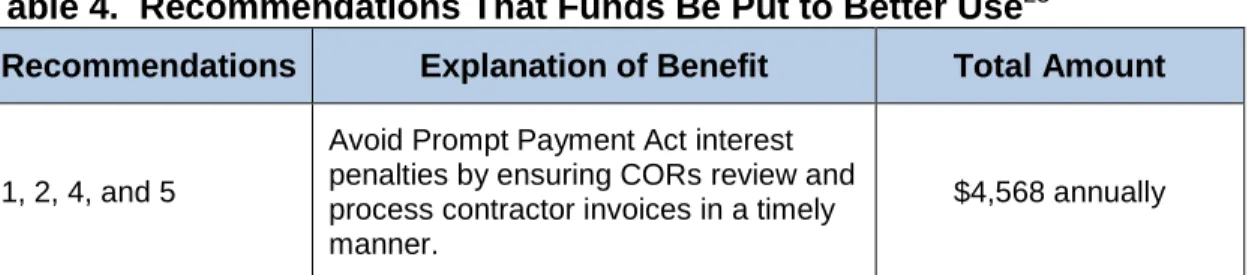
recommendations should also help the agency avoid Prompt Payment Act interest penalties and put about $4,568 annually to better use.
On August 28, 2015, we provided management with a draft of our report for review and comment. In its September 11, 2015, response, management concurred with our recommendations. We have included the response as Appendix V in the final report. Within the next 45 days, please provide the OIG with a written corrective action plan that addresses the recommendations. The corrective action plan should include information such as the responsible official/point of contact, timeframe for completing required actions, and milestones identifying how your offices will address the recommendations. We appreciate the courtesies and cooperation extended to us during the audit. If you have questions, please contact me or Rebecca L. Sharek, Deputy Inspector General for Audits, Evaluations, and Special Projects, Office of Inspector General.
Attachment
cc: Mary Jo White, Chair
Andrew Donahue, Chief of Staff, Office of the Chair
Erica Y. Williams, Deputy Chief of Staff, Office of the Chair Luis A. Aguilar, Commissioner
Paul Gumagay, Counsel, Office of Commissioner Aguilar Daniel M. Gallagher, Commissioner
Page 2
Michael S. Piwowar, Commissioner
Jamie Klima, Counsel, Office of Commissioner Piwowar Kara M. Stein, Commissioner
Robert Peak, Advisor to the Commissioner, Office of Commissioner Stein Anne K. Small, General Counsel, Office of the General Counsel
Timothy Henseler, Director, Office of Legislative and Intergovernmental Affairs John J. Nester, Director, Office of Public Affairs
Vance Cathell, Director, Office of Acquisitions
Judith Blake, Branch Chief, Business Management Office, Office of Acquisitions Kenneth A. Johnson, Chief Financial Officer, Office of Financial Management
Eric I. Bustillo, Regional Director, Office of the Regional Director, Miami Regional Office Sharon Binger, Regional Director, Office of the Regional Director, Philadelphia
Regional Office
Darlene L. Pryor, Management and Program Analyst, Office of the Chief Operating Officer
Executive Summary
Audit of the SEC’s Contracting Officer’s
Representative Program
Report No. 530
September 18, 2015
Why We Did This Audit
Between 2012 and 2014, the U.S. Securities and Exchange Commission (SEC or agency) awarded
1,959 contracts valued at more than $2 billion. Through these awards, the SEC purchased goods and services ranging from legal support services to operational support for the agency’s computer network. The SEC’sOffice of Acquisitions (OA) is responsible for contracting within theSEC. OA’s Contracting Officers (COs) rely on Contracting Officer’s Representatives (CORs) to provide contract oversight and ensure that the Government’s best interests are served. CORs’ effective contract monitoring is essential to proper, cost-effective, and efficient contracting within the SEC, thereby ensuring that the agency receives the goods and services it needs to meet its mission.
What We Recommended
To improve the SEC’s COR Program and help ensure that CORs perform their duties consistently and as required, we are making six recommendations for corrective action. Implementation of these recommendations will help the agency avoid Prompt Payment Act interest penalties and put about $4,568 annually to better use. Additionally, we recommend
improvements to reduce the likelihood that CORs receive appointments to monitor contractors with whom they have a conflict. Management concurred with the recommendations, which will be closed upon completion and verification of corrective action. In addition,
management agreed with and plans to implement our suggestions for
improvements to the COR Nomination/Appointment Form.
What We Found
We reviewed COR contract files, COR nomination/appointment forms, and other evidence of contract monitoring activities for a judgmentally selected sample of 68 of the SEC’s1,959contracts awarded between 2012 and 2014. Sampled contracts included a variety of contract types and amounts monitored by 32 CORs from 3 different SEC locations: theSEC’s Headquarters, the Philadelphia Regional Office, and the Miami Regional Office. We found that theSEC’s COR Program has aided OA’s contract management and includes internal controls to facilitate compliance with Federal requirements and SEC policies and procedures. In addition, CORs generally maintained adequate records and complied with training-related requirements.
However, CORs did not always perform contract monitoring duties consistently and as required. Specifically, CORs did not always (1) review and process contractor invoices in a timely manner, (2) evaluate contractor performance within the prescribed timeframe, or (3) use the SEC’s Contractor Time Management System to track certain contractor labor hours. This occurred, in part, because CORs did not always comply with applicable requirements and COs and COR supervisors did not consistently ensure CORs’ compliance. Other contributing factors include excessive COR workload and untimely communication between CORs and program managers.
Due, in part, to untimely invoice processing, the SEC incurred Prompt Payment Act interest penalties of $9,136 in 2013 and 2014. In addition, contractor performance evaluations were not available in a timely manner for use by the SEC and other Federal agencies when making contracting decisions. Finally, failure to use the Contractor Time Management System when required reduces the SEC’s contract oversight and increases its risk of making improper payments to contractors.
We also found that 151 SEC CORs who filed required financial disclosure reports in 2012, 2013, and 2014 filed the reports late. In addition, a small number of CORs did not file the reports each year. Additionally, some CORs monitored SEC contracts without first disclosing their financial interests. This occurred because nominating officials and COs did not obtain or receive informationabout CORs’ financial disclosure reports before appointing CORs. We did not identify any actual financial conflicts. However, the lack of coordination between nominating officials, OA, and the Office of the Ethics Counsel to ensure CORs complied with financial disclosure and ethics
requirements could result in CORs monitoring contractors with whom CORs have a potential conflict.
Finally, we determined OA could better assess and document COR suitability for effectively monitoring contracts by collecting additional information on the COR Nomination/Appointment Form.
For additional information, contact the Office of Inspector General at (202) 551-6061 or www.sec.gov/about/offices/inspector_general.shtml.
TABLE OF CONTENTS
Executive Summary ...i
Background and Objectives...1
Background ...1
Objectives ...4
Results ...5
Finding 1: CORs Did Not Always Perform Duties Consistently and as Required ...5
Recommendations, Management’s Response, and Evaluation of Management’s Response ...10
Finding 2: CORs Monitoring SEC Contracts Did Not Always Comply With Financial Disclosure and Ethics Requirements ...13
Recommendations, Management’s Response, and Evaluation of Management’s Response ...15
Other Matter of Interest...17
Tables Table 1. Invoices Not Timely Reviewed and Processed by CORs ...8
Table 2. COR Timeliness in Filing OGE Form 450...14
Table 3. Contracts Sampled by SEC Office ...21
Table 4. Recommendations That Funds Be Put to Better Use...24
Appendices Appendix I. Scope and Methodology ...18
Appendix II. Federal Laws, Regulations, and Guidance and SEC Administrative Regulations, Policies, and Procedures...22
Appendix III. Funds Recommended Be Put to Better Use...24
Appendix IV. Management Comments ...25
Appendix V. OIG’s Response to Management Comments...28
ABBREVIATIONS
C.F.R. Code of Federal Regulations
CO Contracting Officer
COR Contracting Officer’s Representative
CPARS Contractor Performance Assessment Reporting System CTMS Contractor Time Management System
FAC-COR Federal Acquisition Certification–Contracting Officer’s Representatives
FAR Federal Acquisition Regulation
Federal requirements Federal laws, regulations, and guidance GAO Government Accountability Office
OA Office of Acquisitions
OEC Office of the Ethics Counsel OFM Office of Financial Management OFPP Office of Federal Procurement Policy
OGE Form 450 or financial Office of Government Ethics Form 450 –Confidential disclosure report Financial Disclosure Report
OIG Office of Inspector General
OP Operating Procedure
PRISM Portable Reusable Integrated Software Module SEC or agency U.S. Securities and Exchange Commission SECR SEC Administrative Regulation
Background and Objectives
Background
The U.S. Securities and Exchange Commission’s (SEC or agency) Office of Acquisitions (OA) is responsible for contracting within the SEC. OA develops procurement and contract administration programs and training for the agency’s
acquisition workforce, which includes Contracting Officers (COs), Contract Specialists, and Contracting Officer’s Representatives (CORs). According to the Federal
Acquisition Regulation (FAR), COs are responsible for “ensuring performance of all necessary actions for effective contracting, ensuring compliance with the terms of the contract, and safeguarding the interests of the United States in its contractual
relationships.”1 Moreover, COs “shall [d]esignate and authorize, in writing and in
accordance with agency procedures, a [COR] on all contracts and orders . . . unless the [CO] retains and executes the COR duties.”2 CORs –
employed in SEC program offices – are required to have the technical knowledge and understanding necessary to monitor contract requirements and oversee day-to-day contract administration. COR responsibilities and duties include:
on-boarding and off-boarding contractors,
accepting contract deliverables in accordance with the terms of the contract,
reviewing and approving contractor invoices,
maintaining adequate records relating to the contract, and
keeping the CO fully informed of problems so that the CO can resolve issues. COR supervisors are responsible for supporting their employees in meeting the
demands of the COR position, familiarizing themselves with CORs’ responsibilities and duties, and considering CORs’ performanceas apart of CORs’ annual performance appraisals.3
The Office of Federal Procurement Policy (OFPP) –a part of the Office of Management and Budget –requires that CORs be trained and have a Federal Acquisition
Certification for CORs (FAC-COR), and that their certification be maintained through continuous learning.4 In addition, the Code of Federal Regulations (C.F.R.) requires
1 FAR, Part 1—Federal Acquisition Regulations System, Subpart 1.6, § 1.602-2 (FAR § 1.602-2). 2
FAR § 1.602-2. For the purposes of this report, the term“COR” refers to CORs and alternateCORs.
3 OA’s
Instructions for CORs and their Supervisors, (February 1, 2009; revised May 24, 2012).
4
OFPP, Developing and Managing the Acquisition Workforce, Policy Letter 05-01, April 15, 2005; and
Revisions to the Federal Acquisition Certification for Contracting Representatives (FAC-COR),
confidential filers, including CORs, to file confidential financial disclosure reports. As such, CORs must submit to their Administrative Contact an Office of Government Ethics Form 450 –Confidential Financial Disclosure Report (OGE Form 450 or financial disclosure report) within 30 days of receiving FAC-COR certification (if the employee is not already an annual filer) and annually thereafter.5
As of December 31, 2014, SEC employees trained and certified as CORs totaled 389;6 359 CORs (or about 92 percent) were located at the SEC’s Headquarters. The
remaining 30 CORs were at the SEC’s 11 regional offices. In 2014, the SEC’s CORs monitored 803 contracts7 valued at more than $1 billion. Through these contracts, the SEC obtained essential goods and services including:
legal support services such as the services of accounting technicians, financial analysts, paralegals, law clerks, and fraud analysts;
market data collection and analysis software that allows SEC staff to collect, monitor, and analyze equity and equity option data disseminated by the various national securities exchanges; and
data center services that sustain operational support of the SEC’s computer
network.
Federal Laws, Regulations, and Guidance. Federal laws, regulations, and guidance (Federal requirements) establish uniform policies and procedures for acquisitions by all executive agencies, to include requirements for COs and CORs. The Federal
Acquisition Regulations System consists of the FAR, which is the primary regulation, and agency acquisition regulations that implement or supplement the FAR. FAR Part 1, Subpart 1.6, “Career Development, Contracting Authority, and Responsibilities,”
establishes CO and COR authority and responsibilities. In addition, OFPP established the Governmentwide framework to create a Federal acquisition workforce and issued several relevant policies. These policies include Developing and Managing the
Acquisition Workforce (Policy Letter 05-01; April 15, 2005) and Revisions to the Federal Acquisition Certification for Contracting Officer’s Representatives (FAC-COR)
(September 6, 2011). Finally, the Prompt Payment Act requires Federal agencies to
5
5 C.F.R. § 2634.903 (2015) -General requirements, filing dates and extensions and 5 C.F.R. § 2634.904 (2015) -Confidential filer defined. Certain executive branch employees report their financial interests using OGE Form 450.
6
Compliance with training and certification requirements does not necessarily mean all 389 CORs were actively monitoring contracts. Rather, they were eligible for nomination to monitor contracts.
7
The SEC awarded various types of contracts and agreements during the period reviewed including, but not limited to, time-and-materials contracts, purchase orders, blanket purchase agreements, indefinite delivery/indefinite quantity contracts, delivery/task orders, firm fixed price contracts, and interagency agreements. For the purposes of this report, we refer to all types of contracts and agreements collectivelyas “contracts.”
pay their bills, including contractor invoices, on a timely basis and to pay interest penalties when payments are late.8
SEC Administrative Regulations, Policies, and Procedures. OA has established SEC administrative regulations, policies, and procedures (SEC policies and
procedures) for contract management, including requirements for COs, CORs, and COR supervisors. On August 12, 2009, OA issued SEC Administrative Regulations (SECR) 10-15, Acquisitions Contract Administration Positions: Contracting Officer’s
Technical Representative (COTR), Inspection and Acceptance Official (IAO), and Point of Contact (POC), Rev. 1. On February 11, 2015, OA issued a revised regulation and retitled it Contracting Officer’s Representative (COR) Requirements (SECR 10-15). SECR 10-15 is the agency’s primary policy for COR duties and responsibilities and establishes uniform procedures for the training, nomination, appointment, and termination of CORs. The document states that (1) OA is responsible for the certification and appointment of CORs, and (2) COs ensure that CORs manage
contracts appropriately and, if not,take action, which may include terminating a COR’s appointment. According to SECR 10-15, supervisors should not nominate the same COR to oversee “more than a few contracts.” Furthermore, it is the CO’s responsibility to “check the number of contracts or [Contractor Personnel] a COR has prior to
approving the nomination. In addition, a COR should not be responsible for more than 50 [Contractor Personnel] without additional staff to support.” Consequently, COR supervisors must work with COs to determine whether alternate CORs are needed based on workload, contract complexity, and the availability of the primary COR because, according to SECR 10-15, “It is impossible for one person to oversee more than a few contracts and do a good job.”9
Additional SEC administrative regulations affecting CORs include:
SECR 10-14, Contract Administration, July 19, 2011;
SECR 10-17, Time-and-Materials and Labor-Hour Contracts, February 18, 2011; and
SECR 10-24, Management and Administration of Service Contracts, Rev. 1, July 25, 2013.
8
Pub. L. 97-177, 96 Stat. 85 (1982)(codified as amended at 31 U.S.C. §§ 3901-3905).
OA also issued Instructions for CORs and their Supervisors, (February 1, 2009; revised May 24, 2012) (OA’s Instructions); a Contract Administration Guide (December 2013, Version 1); and several SEC administrative operating procedures (OP).10
Objectives
The overall objectives of the audit were to:
determine whether SEC CORs complied with applicable Federal requirements and SEC policies and procedures; and
evaluate the effectiveness and consistency of COR contract monitoring activities across the SEC, as well as OA’s oversight ofCORs,during the period reviewed. To gain an understanding of the SEC’s COR Program, we interviewed COs, CORs, COR supervisors, and staff from OA, the Office of the Ethics Counsel (OEC), and the Office of Financial Management (OFM). We also reviewed COR contract files and other evidence of contract monitoring activities for a sample of 68 of the SEC’s
1,959 contracts awarded between January 1, 2012, and December 31, 2014. We sampled contracts monitored by 32 CORs at the SEC’s Headquarters and 2 regional offices (the Philadelphia Regional Office and the Miami Regional Office).
Appendix I includes additional information on our scope and methodology, review of internal controls, and prior audit coverage. Appendix II includes a listing of the Federal requirements and SEC policies and procedures we reviewed.
10
We noted that OA had not updated some policies and procedures in a timely manner to reflect revisions to Federal requirements. Specifically, on September 6, 2011, OFPP issued Revisions to the
Federal Acquisition Certification for Contracting Representatives (FAC-COR). The revisions included:
(1) establishing a three-tiered FAC-COR certification program, and (2) changing the name of the position from “Contracting Officer’s Technical Representative”to “Contracting Officer’s Representative.” OA did not update SECR 10-15 until almost 3 and a half years later, in February 2015. However, OA was aware of the revisions to the Federal requirements and had changed its processes accordingly. In addition, OA officials told us they are updating SECR 10-14 and SECR 10-17 to reflect current Federal requirements, and are determining whether to update other policies.
Results
Finding 1: CORs Did Not Always Perform Duties Consistently
and as Required
We found that CORs did not always perform contract monitoring duties
consistently and as required. Specifically, CORs did not always (1) review and process contractor invoices in a timely manner, (2) complete Contractor
Performance Assessment Reporting System (CPARS) evaluations of contractor performance within the prescribed timeframe, or (3) use the SEC’s Contractor Time Management System (CTMS) to track certain contractor labor hours. This occurred, in part, because CORs did not always comply with applicable Federal requirements and SEC policies and procedures and COs and COR supervisors did not always ensure CORs were knowledgeable of and complied with
applicable requirements. Excessive COR workload, untimely communication between CORs and program managers, and the prioritizing of CORs’other duties were also contributing factors. Due, in part, to untimely invoice
processing, the SEC incurred Prompt Payment Act interest penalties totaling $9,136 in 2013 and 2014: funds the agency could have put to better use. In addition, CPARS evaluations were not available in a timely manner for use by the SEC and other Federal agencies when making contracting decisions based on contractor performance. Finally, failure to use CTMS when required reduces the SEC’s contract oversight and increases its risk of making improper payments to contractors.
Requirements for Processing Invoices, Completing CPARS
Evaluations, and Using CTMS
As described below, Federal requirements and SEC policies and procedures establish specific COR duties and responsibilities, which include processing invoices, completing CPARS evaluations, and using CTMS. Serious or repeated infractions of these
regulations, policies, and procedures could negatively affect the SEC and its contract management. Moreover, SECR 10-15 and OA’s Instructions require COR supervisors to consider a COR’s performance as part of the COR’s annual performance appraisal process. Also, COs must ensure that CORs effectively administer contracts and may take action including, but not limited to, temporarily suspending or terminating a COR’s appointment if the COR fails to perform contract monitoring duties as required.
Requirements for Processing Invoices. The Prompt Payment Act requires agencies to pay invoices within 30 days of receipt, unless otherwise stipulated in the contract, to avoid incurring interest penalties. According to OA’s Contract Administration Guide, CORs are responsible for ensuring contractor invoices receive prompt attention. SECR 10-15 and OA’s Instructions further require CORs to “[r]eview and process all invoices and vouchers…within five days.” Moreover, OFM monitors the agency’s payment
processes to include invoice approvals.11 According to the OFM Reference Guide, if an invoice is not approved after 7 days, OFM will send an e-mail to the invoice approver (that is, the COR). After 14 days, OFM may send an additional notice to the COR and the COR’s supervisor.12
An OFM official told us that OFM continues sending reminder e-mails until delinquent CORs process outstanding invoices for payment.
Requirements for Completing CPARS Evaluations. FAR Subpart 42.1502(a) states that contractor “past performance evaluations shall be prepared at least annually and at the time the work under a contract is completed. Past performance evaluations are required . . . and shall be entered into CPARS, the Governmentwide evaluation
reporting tool for past performance reports on contracts and orders.” CPARS transmits reports to the Past Performance Information Retrieval System, which provides timely and relevant information on contractor performance for use by agencies in source selection.
According to Guidance for the Contractor Performance Assessment Reporting System (CPARS) dated July 2014, “[r]esponsibility for completing quality CPARS evaluations in
a timely manner rests with the Assessing Official (AO) who will be designated in accordance with Agency policy.” The AO is responsible for completing the evaluation no later than 120 calendar days after the end of the contract performance period.
Contractor Per[f]ormance Assessment Reporting System (CPARS), SEC OP 10-27, June 18, 2013 (SEC OP 10-27) designates COs as the SEC’sAssessing Officials and CORs as the SEC’sAssessing Official Representatives. As such, CORs prepare CPARS evaluations, which the COs input in the system.
SEC OP 10-27, which applies to all SEC contracts and orders greater than or equal to $150,000, except contracts and orders for expert witnesses, states that CORs are required to provide timely, accurate, quality, and complete evaluations of contractor performance. COs ensure that CPARS evaluations prepared by CORs are timely and accurate. SEC OP 10-27 also states that OA’s Procurement Operations and Acquisition Policy Branch Chief (now referred to as the Policy, Oversight and Acquisition Programs Branch Chief) is responsible for notifying a COR’s supervisor when evaluations are more than 30 calendar days overdue.
Requirements for Using CTMS. According to FAR Subpart 16.601(c)(1), “A
time-and-materials contract provides no positive profit incentive to the contractor for cost control or labor efficiency. Therefore, appropriate Government surveillance of contractor performance is required to give reasonable assurance that efficient methods and effective cost controls are being used.” Furthermore, pursuant to OA’s Acquisition
11 OFM has enlistedtheU.S. Department of Transportation’sEnterprise Service Center toact as its
Financial Shared Service Provider. The Enterprise Service Center hosts the SEC’score financial management system and is responsible for the data entry of all SEC invoices. When describing the monitoring of invoice approvals, we refer to the actions of both the Enterprise Service Center and OFM as “OFM.”
12 OFM Reference Guide, Chapter 40.04, “Fund Balance with Treasury: Invoice Processing;”
Section 6, “Monitoring of Invoice Approvals.”
Newsflash, N-13-22, dated May 2, 2013, and additional guidance from September 2014, COs are required to insert contract clause 6010.05 –Contractor Time Keeping (May 1, 2013) (contract clause 6010.05), in all SEC time-and-materials contracts and orders for services that require contractors to perform work on-site. The clause requires
contractor employees who work on-site to track their daily work, including entry and exit work hours, in CTMS. CTMS does not replace the contractor’s timekeeping process, but includes administrative functions and report capabilities that allow CORs to view labor hours for a specific contract, and to verify contractor invoices.
CORs Did Not Always Process Invoices, Complete CPARS
Evaluations, or Use CTMS Consistently and as Required
We verified that CORs completed required training, which addressed applicable Federal requirements and SEC policies and procedures. However, we found that CORs did not always process invoices, complete CPARS evaluations, or use CTMS consistently and as required. This occurred, in part, because COs and COR supervisors did not ensure that CORs were knowledgeable of and complied with applicable Federal requirements and SEC policies and procedures. Excessive COR workload, untimely communication between CORs and program managers, and the prioritizing of CORs’other duties were also contributing factors. As a result, the SEC incurred Prompt Payment Act interest penalties, CPARS evaluations were not available in a timely manner for use by the SEC and other Federal agencies, and the SEC was at increased risk for making improper payments to contractors.
CORs Did Not Always Timely Approve Invoices. Although the CORs included in our sample verified contract deliverables, they did not always comply with Federal
requirements and SEC policies and procedures to review and process contractor invoices in a timely manner. Based on the dates shown in Table 1, CORs did not review a total of 913 invoices (or about 19 percent of all 4,797 invoices paid during the period) within 5 days of receipt, as required by SECR 10-15. CORs generally
processed these outstanding invoices between 6 and 30 days of receipt. However, 13 CORs failed to review and process 15 of these invoices within 30 days of receipt, in violation of the Prompt Payment Act. The SEC paid these 15 invoices between 32 and 70 days after receipt.
Two CORs who repeatedly processed invoices late told us that, before processing invoices, they solicited approval from the respective program managers. The CORs indicated that they were sometimes unable to meet the 5-day requirement because the program managers did not always respond timely.
A third COR, who was responsible for 116 of the outstanding invoices shown in Table 1, told us that she was often unable to meet the 5-day requirement because of excessive workload. Functioning as a COR is generally a collateral duty. In addition, although SECR 10-15 and OA’s Instructions state that a COR should not be assigned to “more than a few contracts,”we found that CORs often oversaw many contracts. For
example, one COR from our sample monitored 21 contracts at one time during 2014. Another COR from our sample monitored 40 contracts at one time during 2014.
Notably, the COR responsible for 116 of the outstanding invoices shown in Table 1 did not have an alternate COR to provide back-up support and to assume COR
responsibilities when needed. Similarly, another COR was assigned to monitor 86 contracts during 2014 and did not have an alternate COR. COR supervisors must work with COs to determine where alternate CORs are needed based on workload, contract complexity, and the availability of the primary COR because, according to SECR 10-15, “It is impossible for one person to oversee more than a few contracts and do a good job.”
Table 1. Invoices Not Timely Reviewed and Processed by CORs
Date No. of Outstanding Invoices
(between 6 and 30 days of receipt)
No. of Outstanding Invoices
(in excess of 30 days of receipt)
July 1, 2014 120 1
August 1, 2014 104 0
September 2, 2014 104 4
October 1, 2014 96 0
November 3, 2014 147 2
December 1, 2014 157 3
January 5, 2015 170 5
Totala 898 15
Source: Office of Inspector General (OIG)-generated based on information obtained from OFM. a
OFM processed a total of 4,797 invoices during this period.
According to OFM, violations of the Prompt Payment Act resulted in the SEC incurring interest penalties totaling $9,136 in 2013 and 2014. The agency could have put these funds to better use if effective controls had existed to ensure that CORs timely reviewed and processed invoices. Appendix III includes additional information about Prompt Payment Act interest penalties and our estimate of funds recommended for better use.
CORs Did Not Always Timely Complete CPARS Evaluations. Although we did not identify untimely CPARS evaluations based on our sample, OA’s CPARS system administrator informed us that other CPARS evaluations not included in our sample were delinquent. According to the CPARS system administrator, OA management tasked her with monitoring the submission of evaluations and following-up with CORs who failed to complete timely evaluations. The system administrator e-mails COs weekly and CORs monthly to remind them of CPARS evaluations that are approaching the due date, are due, or are overdue. Beginning in 2015, OA management also receives copies of the e-mails.
The system administrator provided us an e-mail she sent to CORs on April 2, 2015, identifying 92 evaluations not yet initiated in CPARS. Of the 92 evaluations, 68 were overdue, 5 were granted an extension because of a change in the contract period of performance, 8 were due at the time, and 11 were due within 30 days. We obtained the system administrator’s report from August 3, 2015 –4 months later –and determined
that it included 116 evaluations that were due or overdue and required action by CORs. Of those 116 evaluations, 35 were due and 81 were overdue.
As previously discussed, CORs told us that their workload contributed to their inability to effectively perform COR duties, including completing CPARS evaluations, within
prescribed timeframes. OP 10-27 requires OA’s Policy, Oversight and Acquisition Programs Branch Chief, who functions as the agency’s “CPARS Focal Point,”to notify COR supervisors when CPARS evaluations are more than 30 calendar days overdue. The Branch Chief delegated this responsibility to the CPARS system administrator. The CPARS system administrator stated that she did not report delinquent CORs to their supervisors because she did not know who the supervisors were. We determined that COR supervisors’ names are recorded on COR automated nomination forms issued beginning in March 2014 and retainedon OA’s SharePoint site.
COs and CORs did not consistently comply with SEC policies and procedures for timely completing CPARS evaluations, and OA management did not notify CORs’supervisors to address the deficiencies. As a result, evaluations of contractor performance were not always available in a timely manner for use by the SEC and other Federal agencies when making contracting decisions based on contractor performance.
CORs Did Not Always Use CTMS. We found that CORs did not always use CTMS to track contract employee labor-hours for invoicing purposes as required. Specifically, CORs from the SEC’s Miami and Philadelphia regional offices, who managed four time-and-materials task orders from one blanket purchase agreement in our sample, did not use the system. OA awarded the four task orders after it issued Acquisition Newsflash N-13-22 in May 2013. The Newsflash required COs to insert contract clause 6010.05 in all SEC time-and-materials contracts and orders for services that require contractors to perform work on-site, thereby requiring use of CTMS. Although the task orders did not include the contract clause, the blanket purchase agreement did.
With respect to the sampled contracts, the COR from the Miami Regional Office stated that she was unaware of the requirement to use CTMS and tracked contractor time and attendance using the Mass System –the Miami Regional Office’s internal time-keeping system. The COR from the Philadelphia Regional Office stated that he assumed CTMS was not required because the task order did not include the CTMS requirement.
Although we did not identify any inaccuracies in contractor labor hours associated with these four task orders, failure to use CTMS when required reduces the SEC’s contract oversight and increases its risk of making improper payments to contractors.
Recommendations, Management’s Response, and Evaluation of
Management’s Response
To improve the SEC’s COR Program and ensure CORs perform designated and authorized duties consistently and as required, we recommend that:
Recommendation 1: The Office of Acquisitions, in coordination with Contracting Officer’s Representatives’(COR) supervisors, should:
(a) assess current CORs’workload to determine whether it impedes effective contract monitoring activities including, but not limited to, timely processing of invoices and completion of Contractor Performance Assessment Reporting System evaluations;
(b) identify active contracts that do not have an alternate COR, and, based on the complexity of the contract and the primary COR’s workload, appoint an alternate COR; and
(c) require that future assessments of COR workload and contract complexity be documented before aCOR’s appointment tomonitor a contract.
Management’s Response. The Office of Acquisitions concurred with the recommendation and will coordinate with COR supervisors during contract
administration. For current CORs, the Office of Acquisitions will assess the number of contracts assigned, and work with the COR’s supervisor to recommend the
appointment of an alternate COR based on workload and the contract type and complexity. For active contracts that do not have an alternate COR and, based on the complexity of the contract and primary COR workload, the Office of Acquisitions will request an alternate COR. Finally, prior to COR appointment, the Office of Acquisitions will document that the Contracting Officer has determineda COR’s contract workload to be reasonable based on contract type and complexity.
OIG’s Evaluation of Management’s Response. Management’s proposedactions are responsive; therefore, the recommendation is resolved and will be closed upon completion and verification of the actions taken.
Recommendation 2: The Office of Financial Management (OFM) should revise the OFM Reference Guide to require notification of Contracting Officers and earlier
notification of Contracting Officer’s Representatives’(COR) supervisors when CORs fail to process invoices within the required timeframe.
Management’s Response. The Office of Financial Management concurred with the recommendation and will update its policies and procedures accordingly.
OIG’s Evaluation of Management’s Response. Management’s proposedactions are responsive; therefore, the recommendation is resolved and will be closed upon completion and verification of the actions taken.
Recommendation 3: The Office of Acquisitions should develop a procedure to implement the requirement established in Contractor Per[f]ormance Assessment Reporting System (CPARS), SEC OP 10-27, June 18, 2013, to notify Contracting Officer’s Representatives’supervisors when Contractor Performance Assessment Reporting System evaluations are more than 30 calendar days overdue.
Management’s Response. The Office of Acquisitions concurred with the recommendation and will implement a procedure to notify Contracting Officer’s Representatives and their supervisors when Contractor Performance Assessment Reporting System evaluations are more than 30 calendar days overdue. In addition, the Office of Acquisitions will implement a procedure to notify Contracting Officers and their supervisors when Contractor Performance Assessment Reporting System evaluations are overdue.
OIG’s Evaluation of Management’s Response. Management’s proposedactions are responsive; therefore, the recommendation is resolved and will be closed upon completion and verification of the actions taken.
Recommendation 4: The Office of Acquisitions should provide to all Contracting Officer’s Representatives and Contracting Officers refresher training on the Federal requirements and SEC policies and procedures for:
(a) approving contractor invoices within the required timeframe;
(b) completing Contractor Performance Assessment Reporting System evaluations in a timely manner; and
(c) using the SEC’sContractor Time Management System for monitoring on-site contractor time and attendance when required by the contract.
Management’s Response. The Office of Acquisitions concurred with the recommendation and will provide refresher training to Contracting Officer’s
Representatives and Contracting Officers. The training will include timely approval of contractor invoices and use of the Contractor Time Management System to track and monitor contractor labor hours to validate invoices for on-site contractors when required by the contract.
OIG’s Evaluation of Management’s Response. Management’s proposed actions are responsive; therefore, the recommendation is resolved and will be
closed upon completion and verification of the actions taken.
Recommendation 5: The Office of Acquisitions should provide to Contracting Officer’s
Representatives’(CORs) supervisors training on the Federal requirements and SEC policies and procedures for:
(a) the required timeframes for CORs to review and process contractor invoices, and complete Contractor Performance Assessment Reporting System evaluations; and
(b) effective contract monitoring by CORs, including responsibilities for using the SEC’sContractor Time Management System for monitoring on-site contractor time and attendance when required by the contract.
Management’s Response. The Office of Acquisitions concurred with the
recommendation and will provide training to Contracting Officer’s Representatives’ (CORs) on required timeframes for CORs to review and process contractor
invoices and Contractor Performance Assessment Reporting System evaluations, and the use of the Contractor Time Management System when required.
OIG’s Evaluation of Management’s Response. Management’s proposed actions are responsive; therefore, the recommendation is resolved will be closed upon completion and verification of the actions taken.
Finding 2: CORs Monitoring SEC Contracts Did Not Always
Comply With Financial Disclosure and Ethics Requirements
As Federal employees involved in the procurement and acquisition process, CORs must ensure that they do not have financial conflicts of interest with the contractors they oversee. To identify and report potential conflicts, CORs must submit to their Administrative Contact an OGE Form 450 within 30 days of receiving FAC-COR certification (if the employee is not already an annual OGE Form 450 filer) and annually thereafter. However, we found that 151 of the SEC CORs who filed OGE Form 450 in 2012, 2013, and 2014 filed the form late. In addition, a small number of CORs did not file OGE Form 450 as required each year. Some CORs who did not timely file financial disclosure reports monitored SEC contracts without first disclosing their financial interests. This occurred because CORs did not comply with agency policies and procedures. Moreover, nominating officials13 selected, and COs appointed, CORs without ensuring the CORs had complied with financial disclosure and ethics requirements.
Specifically, nominating officials and COs did not always verify that CORs had filed an OGE Form 450 and that a potential conflict of interest with the contractor did not exist. We did not identify any actual financial conflicts based on our review of sampled CORs. However, the lack of coordination between nominating officials, OA, and OEC to ensure that CORs complied with financial disclosure and ethics requirements could result in CORs monitoring contractors with whom CORs have a conflict.
Financial Disclosure Requirements for CORs
Federal employees, including CORs, are prohibited by criminal statute –18 U.S.C. § 208 –from participating in any matter in which they, or any person whose interests are imputed to them,14 have a financial interest if the matter could have a direct and predictable effect on that financial interest.15 Certain executive branch employees use OGE Form 450 to report their financial interests. SECR 10-15 requires CORs, at the time of nomination, to comply with OEC requirements that include having an OGE Form 450 on file. New CORs not previously required to file annually must file OGE Form 450
13 For the purposesof this report, the term “nominatingofficials” includes COR supervisors and program
officials who nominate CORs to monitor SEC contracts. SECR 10-15 defines “program officials” as “SEC managers and supervisors with responsibility over the products or services being procured through contracts and, in most cases, CORs managing them.” Section9, Oversight of CORs and the FAC-COR
Program, of the document indicates that both program officials and COR supervisors can nominate
CORs.
14 The financial interests of an employee’s spouse, minor child, or general partner disqualify an employee
to the same extent as if they were the employee's own interests. Similarly, the financial interests of (1) an organization or entity which the employee serves as officer, director, trustee, general partner or
employee; and (2) a person with whom the employee is negotiating for or has an arrangement concerning prospective employment disqualify an employee. 5 C.F.R. § 2635.402, Disqualifying financial interests.
15
with their Administrative Contact within 30 days of obtaining the FAC-COR certification. In addition, according to OA’s Instructions “[CORs] must abide by the SEC Ethics Office’s financial disclosure and ethics requirements including filing and maintaining an updated OGE Form 450 for as long as [they] have the FAC-COR”certification.
CORs Did Not Always File or Timely File OGE Form 450
Although SEC CORs must file and maintain an updated OGE Form 450, we found that 151 of the SEC CORs who filed OGE Form 450 in 2012, 2013, and 2014 filed the form late. In addition, a small number of CORs did not file OGE Form 450 as required each year. Table 2 shows the number of CORs who filed OGE Form 450 each year, as well as the number who filed late or did not file.
Table 2. COR Timeliness in Filing OGE Form 450
2012 2013 2014
No. of CORs who filed OGE Form 450 286 337 396
No. of CORs who filed latea 70 59 59
Percentage of late filings 24.48% 17.51% 14.90%
No. of CORs who did not file 1 2 4
Source: OIG-generated based on information obtained from OEC. a
Some CORs filed late in more than one year.
Moreover, we found that some of these CORs monitored SEC contracts without first disclosing their financial interests. For example, a COR’s annual OGE Form 450 was due February 15, 2013. He filed it late on March 27, 2013. Despite this, on March 3, 2013, he received an appointment to oversee a contract. In addition, a new COR who obtained the FAC-COR certification in April 2014 and was not an annual filer did not file an OGE Form 450 until 10 months later in February 2015. Nevertheless, in August 2014, she received an appointment to oversee an SEC contract. Another new COR who obtained the FAC-COR certification in April 2014 and was not an annual filer
received an appointment to oversee an SEC contract in June 2014, despite not filing an OGE Form 450 until 3 months later in September 2014. Lastly, a new COR who
obtained the FAC-COR certification on October 28, 2014, was appointed in November 2014 to oversee three contracts before filing his OGE Form 450 on December 3, 2014. Although we did not identify any financial conflicts of interest relating to the contracts we reviewed, the OIG previously investigated a possible conflict of interest on the part of a COR. As reported in the OIG’s Semi-Annual Report to Congress for the period
October 1, 2014, to March 31, 2015, the investigation found that an SEC employee served as a COR while holding stock in the vendor he oversaw. The employee
disclosed the stock holdings on his OGE Form 450. Although the OIG determined that the stock holdings fell within the de minimis monetary exemption to the financial conflict
of interest prohibition in 5 C.F.R. § 2640.202, the employee failed to notify his supervisor or the CO of the potential financial interest.
We recognize that CORs are responsible for complying with Governmentwide and agency ethics requirements, including filing accurate, complete, and timely financial disclosure reports and advising their supervisors and COs of any financial or other conflict of interest that may arise. However, nominating officials are responsible for nominating CORs who can effectively monitor contracts, and for working with COs to determine the appropriate COR to select for the assignment. Finally, OA is responsible for managing the SEC’s COR Program. In that regard, “COs are responsible for
ensuring performance of all necessary actions for effective contracting, and safeguarding the interests of the United States in its contractual relationships.”16
Consistent with COs’responsibilities, SEC policy states that, for serious or repeated infractions of the rules (including noncompliance with financial disclosure requirements), COs may take certain actions, including suspending or terminating a COR’s
appointment. OA’s oversight of the SEC’s COR Program and COs’ability to safeguard the Government’s interests could be improved if nominating officials, OA, and OEC coordinated their efforts to ensure CORs comply with financial disclosure requirements and do not monitor SEC contracts until CORs comply with those requirements. In addition, CORs should certify that (1) they do not have any potential conflicts with the contractor they will oversee prior to appointment, and (2) they understand their
responsibility to report to their supervisor and the Contracting Officer any potential conflicts that arise during their tenure as an appointed COR. This would provide OA with additional assurance that the best interests of the Government are served.
Recommendations, Management’s Response, and Evaluation of
Management’s Response
To improve the SEC’s COR Program and reduce the likelihood that CORs receive appointments to monitor contracts with which they have a conflict and without complying with financial disclosure and ethics requirements, we recommend that:
Recommendation 6: The Office of Acquisitions should work with nominating officials and the Office of the Ethics Counsel to develop a process to:
(a) regularly identify CORs who have not submitted or timely submitted required financial disclosure reports and follow up with these CORs to ensure they comply with ethics requirements;
(b) require CORs to self-certify, before appointment, that they do not have any conflicts with the contractors they will oversee, and that CORs understand they have a continuing responsibility to report to their supervisors and the
Contracting Officers any potential conflicts that arise during their tenure as an appointed COR; and
16
(c) coordinate with CORs’supervisors to take appropriate action, up to and including suspending or terminating CORs’ appointments,until the COR corrects deficiencies in financial disclosure reporting.
Management’s Response. The Office of Acquisitions concurred with the recommendation and will coordinate with the Office of the Ethics Counsel and implement a formal procedure to regularly identify Contacting Officer’s
Representatives (CORs) who have not submitted or timely submitted required financial disclosure reports, and follow up to ensure compliance. In addition, the Office of Acquisitions will change the COR Nomination/Appointment Form to require CORs and alternate CORs to self-certify that they do not have any conflicts with the contractor they will oversee, and self-certify that they will notify their supervisor, Contracting Officer, and the Office of the Ethics Counsel of any circumstances that may create an actual or apparent conflict of interest while serving as a COR or alternate COR. Finally, the Office of Acquisitions will implement internal procedures to take appropriate action, up to and including suspending or terminating an employee’s COR certification and the COR’s work on an active contacts until financial disclosure reporting is completed.
OIG’s Evaluation of Management’s Response. Management’s proposed actions are responsive; therefore, the recommendation is resolved and will be closed upon completion and verification of the action taken.
Other Matter of Interest
SEC COR Nomination/Appointment Form Could Be Improved
The SEC COR Nomination/Appointment Form, SEC-2572, (“nomination form”) documents the nomination and approval of a COR to monitor a contract. Once approved by the CO, the nomination form becomes the COR’s official appointment letter. The form includes information such as the requisition number; contract number; the COR’s name, office, and certification level; and a description of the procurement. However, OA could better assess and document whether a COR is suitable to
effectively monitor a contract by collecting additional information on the nomination form. Although we are not making a formal recommendation, we encourage OA to consider improving the nomination form by including:
the contractor’s name, and
a self-certification that the CO and nominating official have assessed the COR’s
workload and considered whether an alternate COR is needed based on workload, contract complexity, and/or the availability of the primary COR, in accordance with SEC policies and procedures.
By including this information on the nomination form, OA would have additional documented assurance that CORs effectively fulfill their critical role and comply with Federal and agency requirements for ensuring that SEC contractors meet their contract commitments.
Appendix I. Scope and Methodology
We conducted this performance audit from December 2014 through September 2015 in accordance with generally accepted government auditing standards. Those standards require that we plan and perform the audit to obtain sufficient, appropriate evidence to provide a reasonable basis for our findings and conclusions based on our audit
objectives. We believe that the evidence obtained provides a reasonable basis for our findings and conclusions based on our audit objectives.
Scope. The audit covered calendar years 2012 through 2014. We performed fieldwork at the SEC’s Headquarters in Washington, D.C., and at the Philadelphia and Miami regional offices.
Methodology. To address the audit objectives, we interviewed CORs, COs, and COR supervisors, and reviewed:
Federal requirements and SEC policies and procedures for contract
management (see Appendix II);
CPARS and CTMS processes and compliance;
Contractor Personnel List processes and procedures; and
data from the SEC’s contract management system – the Enterprise Service Center’s Portable Reusable Integrated Software Module (PRISM),17 –
and the Federal Acquisition Institute Training Application System (FAITAS).18
We considered OA, OEC, and OFM processes and the incorporation of those processes in the SEC’s COR Program. We also reviewed COR nomination forms, contract files, and evidence of contract monitoring activities for a sample of contracts. In addition, we assessed COR compliance with the requirement to file an OGE
Form 450 during the period reviewed. As part of our review of contract files, we reviewed CORs’OGE Form 450s (maintained by the SEC’s OEC) for 2011,19
2012, 2013, and 2014, and determined whether the reports indicated potential conflicts of interest with the contractors whom CORs oversaw. Finally, using information provided
17 According to SECR 10-15, PRISM is a “web-based contract writing system that provides the tools
needed to effectively support the complete acquisition management lifecycle from initial planning and acquisition through award and closeout.”
18
FAITAS is a learning management system managed by the Federal Acquisition Institute for all civilian Government agencies to provide and track training and certification for acquisition workforce members.
19
Employees are required to report prior year financial interests on OGE Form 450 filed in February of the current year. Although our audit scope was 2012 through 2014, to assess whether annual filers appointed as CORs in January 2012 had an OGE Form 450 on file for the previous year, we reviewed OGE Form 450s from 2011.
by OA and from FAITAS, we verified compliance with CORs’annual training requirements in 2012, 2013, and 2014.
Internal Controls. We obtained an understanding of the internal controls over the SEC’s COR Program and assessed those controls in accordance with Standards for Internal Control in the Federal Government.20 For our review of internal controls, we considered the following:
Control Environment –We evaluated the SEC’s control environment related to the COR
Program. We noted that, although OA had not timely updated the SEC’s primary policy for CORs, OA had recognized and implemented the changes in Federal requirements. OA also established a Policy, Oversight and Acquisition Programs Branch, headed by a Branch Chief, with responsibility for updating COR-related policies and procedures.
Risk Assessment –We assessed risks identified in our internal control review. Those risks related to COR policies and procedures, certification and training, and
performance and oversight of contract monitoring duties. We evaluated each risk as low, medium, or high, and identified the control procedures and activities in place (or lacking) to diminish the risk. We used our assessment of risk to determine auditing procedures and to mitigate our overall audit risk to an acceptable level. In addition, we reviewed OA’s annual self-assessments for 2012, 2013, and 2014 and determined that, each year, OA identified risks for the COR Program and implemented internal controls to address the risks.
Control Activities –We reviewed the SEC’s control activities to ensure adequate and
effective contract monitoring by CORs. We noted that COs can designate Contract Specialists as contract administrators to assist CORs with contract oversight. In addition, OA not only monitors COR training and certification but also maintains an updated list of eligible CORs who have satisfied training and certification requirements.
Information and Communication –We noted that OA had established policies and procedures for the COR Program and is in the process of reviewing and updating them. In addition, OA provided supplemental written guidance and training for new and
experienced CORs. Also, in monitoring COR invoice processing, OFM informs COR supervisors of unprocessed invoices and prepares a monthly analysis for management to highlight payment deficiencies.
Monitoring –We assessed relevant monitoring activities and determined that COs oversee COR activities and provide ongoing consultation and guidance. In addition, OFM monitors the processing and payment of contractor invoices and e-mails reminders to deficient CORs.
As discussed in this report, we found that some internal controls need strengthening. Implementation of our recommendations should address the weaknesses we identified.
20
Standards for Internal Control in the Federal Government, GAO-14-704G, dated September 2014,
Computer-processed Data. The Government Accountability Office’s (GAO) Assessing the Reliability of Computer-Processed Data (GAO-09-680G, July 2009) states that “data
reliability refers to the accuracy and completeness of computer-processed data, given the uses they are intended for. Computer-processed data may be data (1) entered into a computer system or (2) resulting from computer processing.” Furthermore, GAO-09-680G defines “reliability,” “completeness,”and “accuracy”as follows:
“Reliability” means that data are reasonably completeand accurate,meet your intended purposes, and are not subject to inappropriate alteration.
“Completeness” refers to the extent that relevant records are present and the fields in each record are appropriately populated
“Accuracy”refers to the extent that recorded data reflect the actual underlying information.
To establish the population of SEC contracts and select a sample of contracts for review, we relied on a list of contracts for calendar years 2012 through 2014 generated from PRISM by OA staff. We verified the reliability of this data through interviews with CORs and reviews of source documents such as contract files and COR nomination forms. Based on these steps, we determined that the PRISM data were sufficiently reliable for the purposes of the audit. Similarly, we used data from FAITAS to review COR training and certification. Supported by interviews with CORs and information provided by OA, we determined that the FAITAS data were sufficiently reliable for the purposes of the audit.
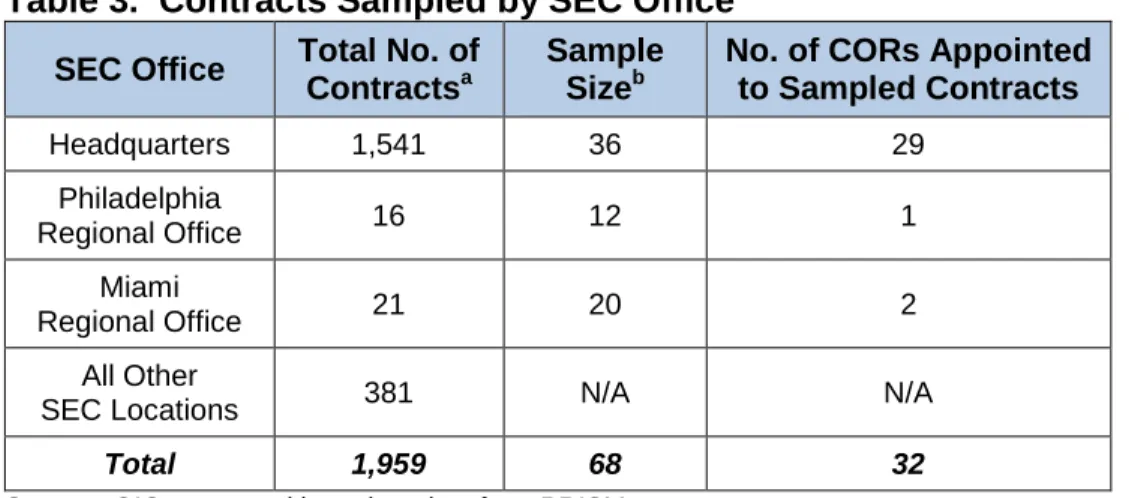
Sampling. We judgmentally sampled 68 of the SEC’s 1,959 contracts awarded
between January 1, 2012, and December 31, 2014.21 As shown in Table 3, our sample consisted of 36 contracts from the SEC’s Headquarters (about 2 percent of all
Headquarters contracts), 12 contracts from the SEC’s Philadelphia Regional Office, and 20 contracts from the Miami Regional Office awarded during the period under review. We judgmentally selected these locations and contracts to ensure that we reviewed a variety of contracts, contract types, and contract amounts. Our sample allowed us to review the activities of 32 CORs (or 8 percent of the SEC’s 389 CORs as of
December 31, 2014).22
21
We selected for review both open and closed SEC contracts awarded between January 1, 2012, and December 31, 2014, but excluded contract modifications.
22 The CORs included in our audit represented 11 of the agency’s 27 divisions and offices, including
2 regional offices (the Philadelphia Regional Office and the Miami Regional Office). The divisions and offices included in the sample were the Division of Economic and Risk Analysis, the Division of
Enforcement, the Office of Compliance Inspections and Examinations, the Office of Equal Employment Opportunity, the Office of Financial Management, the Office of the General Counsel, the Office of Human Resources, the Office of Information Technology, the Office of Minority and Women Inclusion, the Office of the Secretary, and the Office of Security Operations.
Table 3. Contracts Sampled by SEC Office
SEC Office Total No. of Contractsa
Sample Sizeb
No. of CORs Appointed to Sampled Contracts
Headquarters 1,541 36 29
Philadelphia
Regional Office 16 12 1
Miami
Regional Office 21 20 2
All Other
SEC Locations 381 N/A N/A
Total 1,959 68 32
Source: OIG-generated based on data from PRISM. a
Awarded between January 1, 2012, and December 31, 2014. b
We reviewed 100 percent of the contracts from the Philadelphia and Miami regional offices. However, some contracts included multiple awards under one contract number, which we combined into one sample item.
Prior Coverage. During the last 5 years, the SEC OIG issued two reports of particular relevance to this audit. Unrestricted reports are located on the Internet at
http://www.sec.gov/about/offices/oig/inspector_general_audits_reports.shtml.
Audit of SEC’s Controls over Support Service, Expert and Consulting Service Contracts, Report No. 513 (March 29, 2013); and
Review of Select Time-and-Materials and Labor-Hour Contracts, Report No. 487 (December 22, 2010).
In addition, as reported in the OIG’s Semi-Annual Report to Congress for the period October 1, 2014, to March 31, 2015, the OIG investigated a possible conflict of interest regarding an SEC employee who served as a COR and owned securities in the vendor that the employee oversaw. The semi-annual report is located on the Internet at
Appendix II. Federal Laws, Regulations, and
Guidance and SEC Administrative Regulations,
Policies, and Procedures
The Federal requirements and SEC policies and procedures we reviewed included:
Federal Laws, Regulations, and Guidance:
Office of Federal Procurement Policy Act (Pub. L. 93-400, 88 Stat. 796 (1974) (codified as amended at 41 U.S.C. 1101-7313 (2012))).
Prompt Payment Act (Pub. L. 97-177, 96 Stat. 85 (1982) (codified as amended at 31 U.S.C. §§ 3901-3905)).
5 C.F.R. § 2634.903 (2015) -General requirements, filing dates and extensions 5 C.F.R. § 2634.904 (2015) -Confidential filer defined
5 C.F.R. Part 2635, Subpart D - Conflicting Financial Interests (2015) § 2635.401
18 U.S.C. § 208 (2012): Acts affecting a personal financial interest
Federal Acquisition Regulation 1, 2, 4, 8, 12, 13, 16, 17, and 42 (selected Parts and Subparts).
OFPP Policy Letter 05-01, Developing and Managing the Acquisition Workforce, April 15, 2005.
OFPP Memorandum, Revisions to the Federal Acquisition Certification for Contracting Officer’s Representatives (FAC-COR), September 6, 2011.
OFPP Memorandum, Improving the Collection and Use of Information about Contractor Performance and Integrity, March 6, 2013.
OFPP Memorandum, Revisions to the Federal Acquisition Certification in Contracting (FAC-C), May 7, 2014.
United States Government Accountability Office, Standards for Internal Control in the Federal Government, GAO-14-704G, September 2014.
United States Government Accountability Office, Assessing the Reliability of Computer-Processed Data, GAO-09-680G, July 2009.
Guidance for the Contractor Performance Assessment Reporting System (CPARS), July 2014.
SEC Administrative Regulations, Policies, and Procedures:
SECR 10-2 (Rev. 3), SEC Contracting Authority, February 7, 2013.
SECR 10-14 (Change 4), Contract Administration, July 19, 2011.
SECR 10-15 (Rev. 1), Acquisitions Contract Administration Positions: Contracting Officer’s Technical Representative (COTR), Inspection and Acceptance Official (IAO), and Point of Contact (POC), August 12, 2009.
SECR 10-15 (Rev. 2), Contracting Officer’s Representative (COR)
Requirements, February 11, 2015.
SECR 10-17, Time-and-Materials and Labor-Hour Contracts, February 18, 2011.
SECR 10-24 (Rev. 1), Management and Administration of Service Contracts, July 25, 2013.
SECR 10-29 (Rev. 1), Federal Acquisition Certification for Program and Project Managers (FAC-P/PM) Program, January 6, 2015.
Instructions for CORs and their Supervisors, (February 1, 2009; revised May 24, 2012).
U.S. Securities and Exchange Commission, Office of Financial Management,
OFM Reference Guide, Chapter 40.04, “Fund Balance with Treasury: Invoice Processing,”September 26, 2012.
Operating Procedures:
o SEC Operating Procedure Contractor Personnel (CP) List, OP 10-15.1 (Rev. 1), February 11, 2015.
o SEC Interagency Agreements Operating Procedure, OP 10-20, February 24, 2011.
o Contractor Personnel (CP) Entry and Exit, OP 10-22 (Rev. 2), August 1, 2014.
o Management and Administration of Service Contracts, SEC OP 10-24, Rev. 1, July 25, 2013.
o Acquisitions Information Collection and Reporting Systems, SEC OP 10-25, November 21, 2012.
o Contractor Per[f]ormance Assessment Reporting System (CPARS), SEC OP 10-27, June 18, 2013.