International Journal Advances in Social Science and Humanities
Available Online at: www.ijassh.comRESEARCH ARTICLE
Impacts of Climate Change in Crop Production: A Developing
Country Perspective
Abu Russel Md. Repon
1, Sumana Akter
2*1Department of Sociology, University of Rajshahi, Rajshahi 6205, Bangladesh.
2Department of Sociology, Varendra University, Rajshahi 6204, Bangladesh.
*Corresponding Author: Sumana Akter
Abstract
The aim of this study was to explore the impact of climate change on agriculture especially crops production in the rural area of Bangladesh. Both qualitative and quantitative methods were used. Data were collected through using the tools and techniques of social survey and Focus Group Discussion (FGD) along with case study and Key Informant Interview (KII). Respondents were familiar to climate, climate variability and change along with extreme events as well as its frequency and intensity. Climatic events have significant impact on crop production process. It has been reported that production cost has been increased due to climate change and variability while climatic events have mentionable impact on marketing and preservation of the crops.
Keywords:Climate, Climate Change, Agriculture, Crop Production.
Introduction
Agriculture in Bangladesh is influenced by seasonal characteristics and climatic variables such as temperature, rainfall, humidity, day length etc. Mainuddin et al. [1] revealed that production of crops, particularly rice, is often constrained by different climatic hazards such as floods, droughts, soil and water salinity, cyclones and water surges. Mukherji [2] mentioned that Bangladesh is characterized by excessive rainfall and floods during summer and drought conditions.
According to Chowdhury [3], “Bangladesh agriculture is overwhelmingly rain-fed and highly vulnerable to floods, droughts, cyclones, tidal waves as well as river bank erosion”. Biswas [4] mentioned that climatic events like drought, dense fog, hailstorm and heavy rain are the major threats of agricultural production.
Hossain [5] examined the cropping pattern depends on a number of factors such as climate (rain fall, temperature and light), topography of soil, soil condition, etc. Rahman [6] said that farmers, who are aware of the adverse environmental impacts of modern agricultural technology, use lower amounts of
all inputs in order to avoid further environmental damage.
Talukder [7] mentioned about the instability, another major feature of the food security situation in the country. Because of floods, droughts, cyclones and other natural calamities, national agricultural production varies from year to year. Iglesias et al. [8] said “the main risks to agricultural production are imposed by climate change.
These include risks resulting from changes in: water resources and irrigation requirements; agricultural pests and diseases, soil fertility, salinity and erosion, crop’s growth conditions, crop productivity and in crop distribution, optimal conditions for livestock production, land use and increased expenditure in emergency and remediation actions”. Akanda [9] mentioned that Bangladesh agriculture is often affected by natural calamities like floods and droughts. According to Choudhury [10], “Natural calamities are common and agriculture is greatly dependent on nature’s bounty”.
Mahul and Stutley [12] examined that crop production is particularly exposed to adverse natural events such as droughts or floods, and the economic costs of major disasters may even increase further in the future because of climate change. They maintained that the agricultural sector is particularly affected by more frequent and more severe adverse natural events, such as drought, floods, and windstorms, thus reinforcing the systematic component of the adverse natural events.
Ngaira [13] also examined that increased temperatures also causes significant changes in weather patterns with extremes of rainfall and strong winds. Acock and Allen [14] said that the potential interactive effects of Carbon dioxide (CO2) and temperature on rice are also critical for predicting the effects of global climate change on rice. Lampietti et al., [15] mentioned that climate change will create major challenges for agriculture.
Research Methodology
The study was conducted at Bilsha village of
Gurudaspur upazilla (sub-district) under the
district of Natore, Bangladesh. According to
Bangladesh Bureau of Statistics [16], the total
area of Bilsha is 1891 acre, having 797
households.
The study area is wetland in nature, and renowned for crop production especially rice but have been facing climatic issues. In this study agriculture is meant to crops production only. This study was both qualitative and quantitative in nature. Primary data were collected through the mixed methods-
interviewing household heads using
questionnaire as part of social survey, case study and Focus Group Discussion (FGD) including Key Informants Interviews (KII). For administering social survey method, total households were identified on the basis of occupation in the first place.
Following the Krejcie and Morgan [17] chart regarding population and sample size, total 265 (two hundred sixty five) farmer households were selected for collecting data on the basis of the guidance to minimum sample size (95% confidence level, +/- 5% margin of error). Three generations of the farmers were considered as source of data and comparison of those data due to find out the real scenario of the impact of climate, climate change and variability as well as climatic extreme events on agriculture.
Results and Discussion
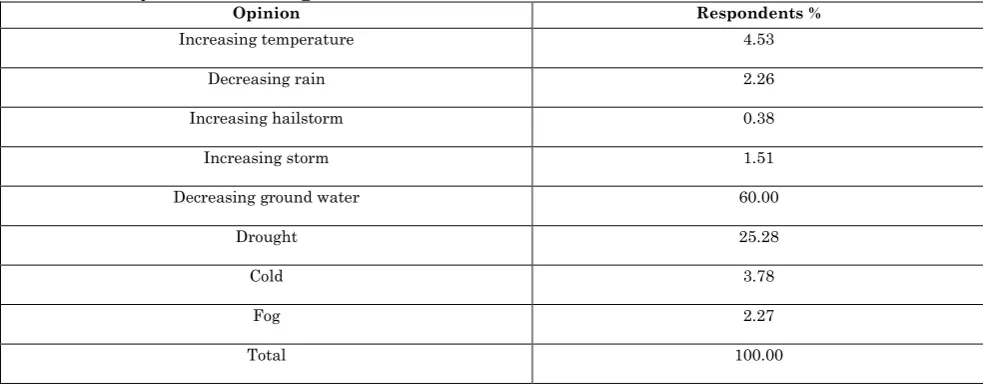
Knowledge about ClimateTable 1: Analysis of knowledge about climate
Opinion Respondents %
Increasing temperature 4.53
Decreasing rain 2.26
Increasing hailstorm 0.38
Increasing storm 1.51
Decreasing ground water 60.00
Drought 25.28
Cold 3.78
Fog 2.27
Total 100.00
Respondents opined that climate change events were found clearly in the study area in different ways. More than four (4.53) percent respondent reported that temperature has been increased, 2.26 percent reported that rain has been decreased, 0.38 percent reported that hailstorm has also been increased in the study area. Increasing storm was opined as 1.51 percent whereas 60.00 percent respondents reported that ground
Frequency and Intensity of Climate Issues
Figure 1: Frequency and intensity of climate issues
Data show that most of the respondents thought frequency of some climate change issues have been increased in the study area which were drought, storm, cold, fog and rain perceiving 30 years of experiences. But 34.72 percent opined that there were no frequencies of climatic events in relation to
climatic variability and change in the study area. Among the respondents, 84.91 percent stated that intensity of different climate change issues has been increased in the study area over the last three decades and this intensity was evident in events like drought, storm, cold, fog and rain.
Table 2: Analysis of opinion on increasing intensity of climate change
Factors Respondents %
Drought 66.04
Storm 11.70
Cold 6.04
Fog 4.52
Rain 11.70
Total 100.00
Pattern of Crops Production
Agricultural production has undergone
mentionable change comparing the
production items, productivity, production intensity and production mixing of the
different varieties 30 years ago. Amon (rice
produced during rainy season), aush (rice
variety), wheat, barley, mustard, sesame,
jute and kaon (local name of millet) were
produced. Among these, jute was more profitable. Rice production is still prevalent as it is the staple food stuff in Bangladesh. Those farmers who cultivated two crops in a
single year, they mostly preferred amon or
aush and wheat or barley or mustard. Kaon was consumed by mixing with rice or as fried kaon by the farmers. Berley was rarely produced in the study area.
These were the crops that helped the respondents maintaining better livelihood and fulfilling the demand of their households in subsistent level as well. Farmers have been producing high yielding varieties (HYV)
and modern varieties of boro (a winter
variety of rice) in the study area. Besides, farmers are also cultivating and growing maize, wheat and jute in the study area. Those who produce boro rice, can produce it
only as the water comes just after harvesting and inundates the wetland. Those who produce maize they can produce either amon
rice or jute after harvesting maize. Those
who produce wheat also can produce either amon rice or jute after harvesting wheat. Thus the agricultural intensification was evident in the study area. These crops were observed by the farmers as well adapted with the climate change. The farmers were seen interested to produce these crops in the study village.
Changing Pattern of Crops Production Introduction of modern agriculture as part of green revolution and climate change adaptation have brought some visible change in crops production in the study area. Production boom and profit making are some mention worthy drivers of change in agriculture.
Usually water, seeds, and agrochemicals like chemical fertilizer, herbicides, pesticides, insecticides, and growth hormones were the major component interventions in the agricultural production. While most of the
farmers have followed traditional
often been experienced germination problem caused by the humidity during rainy season as the study area is a wetland. Due to the high productivity issue as well as climatic
events, multinational corporations and government organizations are supplying seeds to the farmers now a days. (Table 4).
Table 3: Changing pattern of crops production
Activities 30 Years Ago At Present
Seeds preservation At home Packet & Open from market
Seed germination Hari, pitcher (Kolosh) Sack (Bosta), Straw on soil
Sow seeds Natural mud Clay from dry land
Plant sowing Without line With & without line
Weeding Laborer Pesticides
Irrigation River, Pond, Ground water River, Ground water
Use of pesticides Less use Frequent use
Use of fertilizer Less amount Excessive amount
Crop cutting Cutting bottom (Gora) Cutting top (Aga)
Crop crushing Drum, Macha, Rubbing Whooper
Preservation Chatal, Macha, Bosta Modern storehouse:
Macha, Chatal, Golaghor
Climate on Crops Production There were some specific impacts of climate
have been reported on crops production in different ways.
Figure 2: Impact of climate on crops production
Low production per acre was reported as the results of negative impact of climate. Re-plantation was needed due to cold weather, fog and heavy rainfall. Drought hampered rice cultivation through water crisis, impeding the growth of unfield rice or grain, having defected kernel, as well as increasing harmful pests. They also mentioned the negative impact of climate change and variability on crops production namely lowering production, yielding loss, harvesting loss etc. Surface water and ground water level for pumping for agriculture were comparatively much easier 30 years ago. It was generally agreed among the farmers that they had to pipe 70-80 feet down through the soil for pumping water for shallow tube well
for agricultural purposes. But all respondent (100.00%) reported that ground water level has been depleted and lowered to almost 120-150 feet. Ground water depletion has become a growing concern for the agriculturists, serious obstacle for crops production and sustainable environment as well.
Climatic change and events on Crops Production Process
Impacts of climate change on crops production process were mentioned by the respondents. It has further generated less profit and low production per acre in the study area. Impacts have been perceived in different aspects of crop production process evident in Table 4.
Table 4: Impact of climate change on crops production process
Activities Impact Respondents %
Seeds Sowing Fog, Cold 19.62
Plant Raise Fog, Cold, Rain 18.87
Use of Fertilizer Rain, Drought 12.45
Harrowing Rain, Cold 12.08
Crops Cutting Rain, Hailstorm 18.11
Crops Crushing Rain, Storm 18.87
Fog and cold weather created obstacle in sowing seeds that decreased the normal growth of plants. Fog, cold weather and rain created hindrance in plant raise that remained many plants wasted. Rain and drought resulted the mal-functioning and dys-functioning of chemical fertilizer. Rain and cold weather problematized harrowing that delayed the starting of the production cycle, ultimately affected production.
Rain and hailstorm sometimes destroyed crops and also fostered problem on crops cutting. Rain and storm promoted obstacle on crops crushing by delaying and damaging crops. Traditional agriculture is still dependent on the bounty of nature. For example, timely rain in expected level could foster agricultural production by dint of saving production expenses. But still fog, cold weather, drought, storm and hailstorm- some climatic events in the study area, were
mentioned very harmful for the agricultural production in the study area.
Climate Change and New Crops
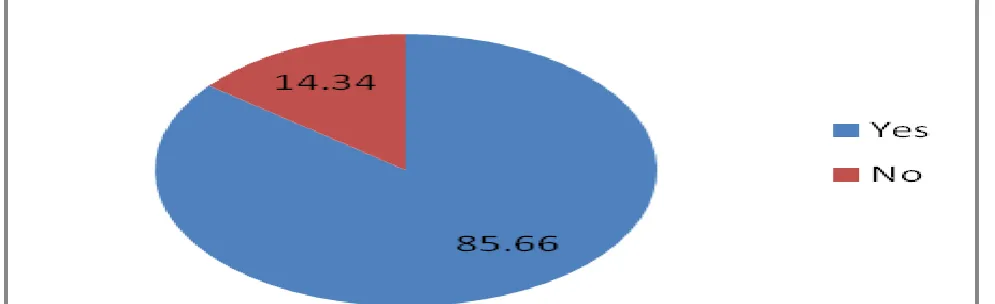
Most of the respondents (85.66%) reported that climate change has significant impact on new crops. Traditional crops especially rice was rare to found in the study area due to less production and productivity in the face of climate change. Crops diversification like
maize, mustard etc. were produced
commercially with various types of High Yielding Varieties (HYV) and Modern Varieties (MV) rice.
These crops were considered best among the peasants and farmers in response to climate change issues. Traditional crops were rarely found in the study area. It was found that 14.34 percent respondents mentioned that new crops and varieties are well tolerated to climate change events (Figure 3).
Figure 3: Impact of climate on new crops
Climate on Expenditure of Crops Production
Expenditure of crops production almost depends on favorable climate.
It was found that expenses in cultivation and production increased for drought, storm, hailstorm etc.
Table 5: Impacts of climate on the expenditure of crops production
Causes Respondents %
Using more plant 16.60
Using more labor 17.36
Using extra hard work 15.47
Over use of fertilizer 14.34
Over use of diesel 13.21
Decline ground water level 17.36
Early cutting 5.66
Total 100.00
Fog with cold weather destroys agricultural plants, further the necessity of more seedlings and plants which increase expenditure of agricultural production. Agriculture during heavy torrential rain is generally labor intensive; Storm also involves more labor for the preparation and
maintenance of agricultural production.
Respondents themselves and their
lowered. This fostered pressure on diesel, shallow machine and electric motors. Early cutting was found in response to the fear of storm and hailstorm during harvest. These phenomena directly resulted in growing agricultural expenses and lowering the profit as well as production of crops in the study area.
Climate on Crops Marketing
Agricultural production was traditionally subsistent in nature. But it has been involved to binary purposes- domestic consumption and production for market. Thus, it has been contributing to the development of the respondents and country’s food security as well.
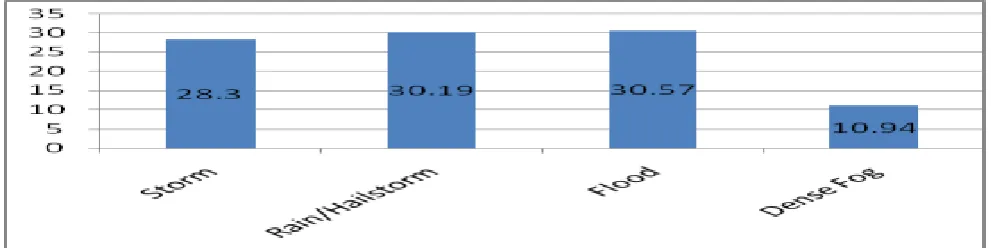
Figure 4: Impact of climate events on crops marketing
The study area being a wetland,
communication for marketing was not good
enough. Storm was experienced as
problematic in the rainy season. As boat was only artefact for transportation, storm could be resulted in capsizing and involved in the loss of life and goods. In the summer season, storm was reported harmful in different ways to rainy season. Sometimes, storm left massacre of homestead, trees, and crops. Rain and hailstorm revealed obstacle in summer season because roads were often become muddy and difficult to use.
Floods were obvious in creating
transportation limitations. Dense fog was
also revealed as problematic for
transportation of the goods and crops. Thus transportation problems, market place problems as well as problem in gathering of buyer and seller in the market places were commonly held hindrances created by the climatic events in the study area. Transportation costs were high which further affects the demand supply chain in the area as well as profit potentiality.
Climate on Crops Preservation
Climate change and events have impacts on crops preservation and it was vivid that 70.19 percent respondents supported this view. While lack of preservation facilities were reported by 11.70 percent respondents, lack of sufficient space was reported by 15.47 percent, break out of insects was mentioned by 13.21 percent, infection problem was told by 11.32 percent, rotten of crops was opined by 10.57 percent and rainfall was mentioned by 7.92 percent.
Space was essential for crops preservation but majority have limited homestead as the study village is in a wetland and clustered. Thus the space needed for crops conservation seemed very critical. Rainfall and dense fog was found major threats for preservation of crops. Among the respondents, 29.81 percent reported that climate has no impact on preservation of crops (Table 6). Because, if people become aware to preserve their crops, they could take relevant preventive measures for preservation of crops.
Table 6: Impact of climate on crops preservation
Opinion Respondents %
Yes (70.19)
Lack of preservation 11.70
Lack of sufficient space 15.47
Insects 13.21
Infection 11.32
Rotten of crops 10.57
Rainfall 7.92
No (29.81) 29.81
Loss of Production over Last Three Decades for Climate Change, Variability and Climatic Events
It was very difficult to measure the financial loss associated with climate issues over three
decades. Nevertheless, most of the
respondents calculated on an average loss in their production time. They confronted more than one calamity. Financial loss was
emanated from storm among the
respondents. Usually storm and hailstorm adversely affected yielding and harvesting of the crops, rendering huge loses. Declining surface water and depletion of ground water level was perceived as the result of drought. Floods were observed just before the harvesting while seedlings and tender plants lost along with houses were also reported. Cold or dense fog was responsible in damaging crops, seed bed and plantation.
Figure 5: Average financial loss (in BDT) in relation to climatic events in a decade
The average loss incurred by drought was calculated as 73,660.00 Bangladeshi taka (BDT). The financial damage was calculated as 75,170.00 taka, 76,755.00 taka, 71,528.00 taka, 76,604.00 taka and 77,679.00 taka associated respectively with flood, storm, cold/dense fog, water crisis and ground water depletion and hailstorm. These indicated the negative impact of climate on agricultural production.
Conclusion
The impact of climate change, variability and climatic events on agricultural production were clear in many ways. Respondents were well known to climate change, its frequency and intensity as well. Climatic impacts on crops production process- seeds sowing, plant raising, harrowing, crops crushing were common. The impact has been perceived as negative on crops production namely
production loss, re-plant raise, and
preservation. Agricultural production cost has been increased due to sudden climatic events through agricultural inputs and equipments. It has also been reported that climate change has impact on crops marketing and preservation.
Overall natural calamities like drought, flood, storm, cold or fog, hailstorm, and declining surface water and ground water depletion are evident in emanating financial loss over the past decades. Farmers have been confronting these climate change issues and events in many ways. They are found reflexive enough in adapting, mitigating and looking for alternatives in crop production with these climatic events. Measures should be taken by the government and stakeholders together regarding how to minimize the loss and maximize the profit in crop production in the face of climate change, variability and sudden climatic extreme events.
References
1. Mainuddin, Khandaker, Rahman, Aminur, Islam, Nazria ,Quasem, Saad (2011) Planning and Costing Agriculture’s Adaptation to Climate Change in the Salinity-Prone Cropping System of Bangladesh, London: International Institute for Environment and Development.
2. Mukherji IN (1974) “Economic Problems and prospects of Bangladesh”, International Studies, 13(2):278-308.
3. Chowdhury M, Sujayet Ullah (1995)
4. Biswas MR (1993) “On Improving the Irrigation Water Market Though Crop Diversification” in M.R. Biswas and M.A.S. Mandal (edi) Irrigation Management for Crop Diversification in Bangladesh, Dhaka: The University Press Limited.
5. Hossain Mosharaff (1991) Agriculture in Bangladesh: Performance Problems and Prospects, Dhaka: University Press Limited. 6. Rahman Sanzidur (2005) “Environmental
impacts of technological change in Bangladesh agriculture: farmers' perceptions, determinants, and effects on resource allocation decisions”, Agricultural Economics,33 (1):107-116.
7. Talukder RK.(2005) “Food Security, Self-sufficiency and Nutrition Gap in Bangladesh”, The Bangladesh Development Studies, XXXI (3 & 4):35-62.
8. Iglesias, Ana Avis, Keesje Benzie, Magnus Fisher, Paul Harley, Mike Hodgson, Nikki Horrocks, Lisa Moneo, Marta, Webb, Jim (2007) Adaptation to Climate Change in the Agricultural Sector, AEA Energy & Environment.
9. Akanda M, Aminul Islam (2008) Process of Agricultural Development in Bangladesh: Field Studies on the Impacts of Evolving Policies and Land Ownership on the Development of Crop Farming, Dhaka: Academic Pres and Publishers Library.
10. Choudhury AKM, Kamaluddin (2008) Land Use
Planning in Bangladesh, Dhaka: AH
Development Publishing House.
11. Mondal Mohammad H (2010) “Crop Agriculture of Bangladesh: Challenges and Opportunities”, Bangladesh Journal of Agricultural Research, 35 (2):235-245.
12. Mahul Olivier, Stutley (2010) Government Support to Agricultural Insurance Challenges and Options for developing Countries, Washington: The World Bank.
13. Ngaira Josephine Khaoma (2007) “Impact of Climate Change on Agriculture in Africa by 2030”, Scientific Research and Essays, 2 (7):238-243.
14. Acock B,Allen LH, Jr (1985) "Crop responses to elevated carbon dioxide concentrations". In B.R. Strain, and J.D. Cure, (edi.), Direct Effects of Increasing Carbon Dioxide on Vegetation, Washington: U. S. Department of Energy.
15. Lampietti Julian A, Lugg David G, Celen Philip Vander Branczik Amelia (2009) The Changing Face of Rural Space: Agriculture and Rural Development in the Western Balkans, Washington: The World Bank.
16. Bangladesh Bureau of Statistics (2001).