ISSN-L: 2501 - 1235 Available on-line at: www.oapub.org/edu
doi: 10.5281/zenodo.2653883 Volume 5 │ Issue 8 │ 2019
AGE DIFFERENTIATION, SPORT SKILL INTERVENTION AND
PHYSICAL FITNESS STATUS OF YOUNG ADULTS
IN A DEVELOPING NATION
Aderonmu Kehinde Adebayoi
PhD, Department of Kinesiology, Health Education and Recreation,
Faculty of Education, Obafemi Awolowo University, Ile-Ife, Nigeria
Abstract:
The purpose of the study was to examine the effect of sport skill acquisition in two selected sports on the physical fitness status of young adolescence. Experimental research design was adopted for the study. The American Alliance for Physical, Health Education, Recreation & Dance (AAPHERD) Youth Fitness Test (1976). A battery test designed to measure both the performance-related and health-related components of physical fitness respectively was administered on 160 participants who took part in an eight week structured exercise intervention using the pre-post- test method. The result revealed a significant effect of the sport skill training intervention on physical fitness status of participants. Thus it could be concluded that basketball and badminton skill training had a significant effect on the physical fitness of adolescent based on their age.
Keywords: sport skill, skill acquisition, training, physical fitness, performance-related components; health-related components
1. Introduction
Age is an important variable that affects motor performance for adolescents. It is a period that is characterize with growth and development challenges, identity formation and the development of positive self-evaluation. They are also faced with the choice of what they will like to become in life and sports the introduction of sports can enhance the desire for acquisition of sport specific skills that may guaranty lifelong participation and a career path in sports. Côté & Hay (2002), in their investigations of elite Australian and Canadian athletes, have identified three distinct stages of sport participation that athletes pass through prior to the attainment of expert performance: the sampling years
(5–12), the specializing years (13–15), and the investment years (16+). The sampling years are typified by the athlete participating in a wide range of different sports. It is during this period that skills such as running, jumping, and throwing that are fundamental to performance in many sports are acquired and refined. In the specializing years, athletes begin to narrow their focus and participate in fewer activities. In the investment years, athletes become devoted to a single sport by making maximal performance in this sport their primary life focus.
Baker, Côté & Abernethy (2003) stated that research on the hierarchy of motor skill development (e.g., Seefeldt, 1980, 1982) supports the approach that sport involvement should progress from a focus on fundamental motor skills in early childhood to more sport-specific skills in adolescence and early adulthood.
Adolescents’ development involves life tasks such as the development of identity, achieving independence from the family while staying connected and fitting into a peer group. The developmental process entails numerous changes which occur from childhood to adulthood. It is also a time when the individual is required to act in accordance with social roles, engaging with peers and members of the opposite sex and to complete the requirements of schooling and making decisions regarding a future career.
Current realities has shown that aside entertainment, sports has become a leading ‘gateway’ to stardom and economic independence as a breakthrough in the world of sports will bring an individual out of obscurity and abject poverty. Also in the recent times, many early and late adolescents are emerging as champions in globally acclaimed sport competitions especially from developed nations. This can only signify that early detection and development had occurred in other to bring out the innate ability of these youngsters. Also, skills are better learnt when the ‘athletes’ are very young as the involvement of children in high performance competitions is on the increase and many world records are being broken while some are being set by these youngsters across sports. Therefore, early identification and development of prospective athletes in their formative years is gradually gaining ground in Nigeria and the philosophy of ‘catching the young’ is becoming the order of the day in the acquisition of sport skills and many age category competitions are springing up.
A great deal of attention has been given to the role of physical activity and physical fitness in the enhancement of psychological health (Whitelaw, Swift, Goodwin & Clark, 2008). Generally, strength training and aerobic training have been proposed as two of the most important types of physical activities to have beneficial effect on self-esteem (Fox, 2000, Larun, Nordheim, Ekeland, Hagen & Heian, 2006). Fox (2000) suggests that weight and resistance training may be superior to endurance training in improving body image and self-esteem. Enhanced physical fitness usually leads to an increase in lean body mass and physical abilities and a decrease in body fat mass, which in turn may affect the way adolescents perceive their physical self. Physical fitness is important throughout life, but it is particularly crucial during childhood and adolescence. Childhood and adolescence are crucial periods of life; since dramatic physical and psychological changes take place at these ages. Likewise, lifestyle and healthy / unhealthy behaviours are established during these years (Hallal, Victoria, Azevedo & Wells, 2006).
A study carried out by Schneider, Dunton & Cooper (2008) involving 146 (n=79 experimental; n = 67 control) although only 120 females were finally analysed – n= 61 (intervention); n = 59 (control). Intent to treat analyses showed that nine month improvement in cardiovascular fitness were significantly larger for the intervention group than the control or comparison group. Participants who increased their fitness did experience enhanced global physical self-concept. In another study, on how perceived sport competence mediates the relationship between childhood motor skill proficiency and adolescent physical activity and physical fitness, involving 276 students. For male and female combined fitness was significantly positive. (Barnett, Morgan, Van Berden, & Beard (2008). Goudas, Dermitzaki, Leondari & Danish (2006) employed a wait-list control group design and how physical Education students tested in seat and reach, seat-up test, results showed gains in physical fitness.
The objective of the study therefore was to determine whether participation in organized programme of badminton and basketball skill training will affect the physical fitness status of in-school adolescents in Nigeria. It was also to determine whether the will be any significant difference on athletes who participated in the skill acquisition programme and those who did not participate.
2. Methodology
2.1 Research Design and Procedures
2.2 Population and Samples
The population for this study consisted of all in school adolescents in junior and senior secondary schools in Osun State. The sample size comprised 160 students. The stratified random (intact-class) sampling technique was adopted in the selection of samples for the study. A Local Government Area (LGA) was selected randomly using balloting method. Out of the nine schools in the LGA, two co-educational secondary schools were selected purposively for the study. The purpose sampling technique was used because of their proximity to the intended facilities and the multi-representation of students from different background which fully represents the target participants. Also, these schools were selected because of The population was two age groups namely; 12-14 year old representing early adolescence and 15-18 year old representing late adolescence drawn from the Junior Secondary School class 2 (JSS2) and the Senior Secondary School 2 (SSS2) classes respectively
The experimental groups were 40 participants each from Atakumosa High School Osu (Basketball), and Ibodi Grammar School, Ibodi (Badminton). The control groups (80 boys and girls) were 40 participants each from another intact-class from the same selected schools. Age differentiation was put into consideration in the selection and these two classes needed for the study. All participants were novice or adolescents that have no knowledge of the skills of the selected sports.
2.3 Instrumentation
The research instruments used to collect data was The American Alliance for Physical, Health Education, Recreation & Dance (AAPHERD) Youth Fitness Test (1976). A battery test designed to measure both the performance-related and health-related components of physical fitness respectively. The Physical Fitness Inventory comprises the following performance-related components; muscular power, muscular strength, agility and speed were selected for the study. The following fitness tests were adapted to measure each; Muscle power (Vertical jump test); Muscle endurance (sit-up test) speed (20 metres sprint test) and Agility (T-Test). Equipment such as stop watches, measuring tape, traffic cones and a wall was used in conducting the tests. The instruments were checked for test re-test reliability and returned a correlation coefficient of 0.84.
The results are sufficient enough to conclude that instruments were adjudged valid and reliable for the present study since they all showed consistency with values above average (i.e. 0.5 mid-values).
2.4 Data Collection
(post-test) to the experimental and control groups respectively. The researcher made use of ten research assistants that are proficient in the selected sports and were trained on how to administer the questionnaires they also assisted in teaching the skills.
2.5 Data Analysis
This involved inferential statistics such as the t-test, and analysis of variance (ANOVA) through SPSS, was used to treat data collected. The level of significance for all analysis was at 0.05.
3. Results
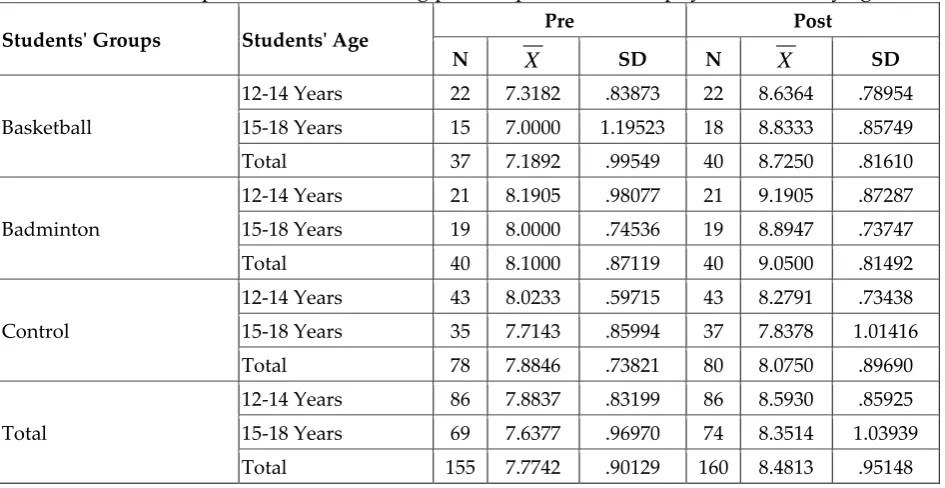
Table 1: Descriptive statistics showing pre and post-treatment physical fitness by age
Students' Groups Students' Age Pre Post
N X SD N X SD
Basketball
12-14 Years 22 7.3182 .83873 22 8.6364 .78954
15-18 Years 15 7.0000 1.19523 18 8.8333 .85749 Total 37 7.1892 .99549 40 8.7250 .81610
Badminton
12-14 Years 21 8.1905 .98077 21 9.1905 .87287
15-18 Years 19 8.0000 .74536 19 8.8947 .73747 Total 40 8.1000 .87119 40 9.0500 .81492
Control
12-14 Years 43 8.0233 .59715 43 8.2791 .73438 15-18 Years 35 7.7143 .85994 37 7.8378 1.01416
Total 78 7.8846 .73821 80 8.0750 .89690
Total
12-14 Years 86 7.8837 .83199 86 8.5930 .85925
15-18 Years 69 7.6377 .96970 74 8.3514 1.03939 Total 155 7.7742 .90129 160 8.4813 .95148
Table 1 present the mean pre and post-treatment physical fitness score of students between ages 12-14 and 15-18 years old in basketball, badminton and control. The overall mean physical fitness score of the age groups in the pre and post-treatments are
X = 7.88 ± .83; 8.59 ± .86 and X = 7.64 ± .97; 8.35 ± 1.04 for ages 12-14 yrs. and 15=18 yrs.
respectively. Analysis of Variance was carried out to determine if there was significant effect of training on physical fitness status of participants by age groupings, the results are presented in Table 2.
Table 2: ANOVA summary table showing difference
in basketball, badminton and control groups physical fitness based on age
Sum of Squares Df Mean Square F Sig.
Pre Post Pre Post Pre Post
Corrected Model 20.966a 33.647a 5 4.193 6.729 6.000 9.396 <.05*
Intercept 8095.073 10614.371 1 8095.073 10614.371 1.158E4 1.482E4 <.05*
Groups 18.279 29.331 2 9.139 14.666 13.077 20.477 <.05* Students’ age group 2.530 1.159 1 2.530 1.159 3.621 1.619 >.05
Groups Students’ age .109 2.725 2 .055 1.363 .078 1.903 >.05 Total 9493.000 11653.000 155
Corrected Total 125.097 143.944 154 * Sig = P < 0.05
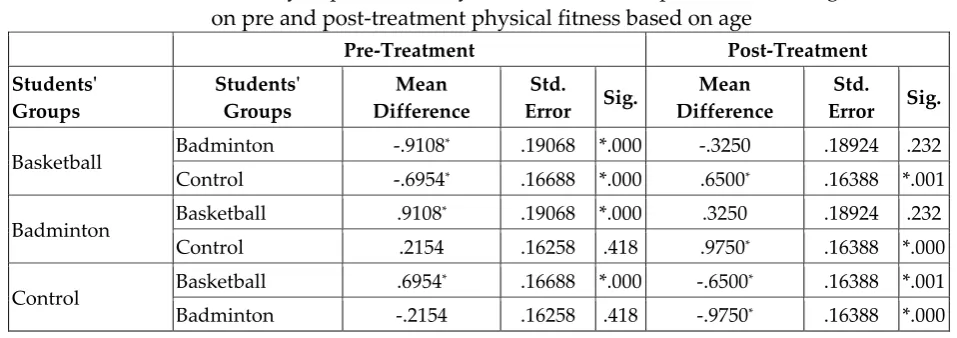
The Multiple-comparison analysis (post-hoc) was attempted to determine where the significant effect lie. Table 12 present a summary of the post hoc analysis.
Table 3: Summary of post hoc analysis on the effect of sport skills training
on pre and post-treatment physical fitness based on age
Pre-Treatment Post-Treatment
Students' Groups
Students' Groups
Mean Difference
Std.
Error Sig.
Mean Difference
Std.
Error Sig.
Basketball Badminton -.9108
* .19068 *.000 -.3250 .18924 .232
Control -.6954* .16688 *.000 .6500* .16388 *.001
Badminton Basketball .9108
* .19068 *.000 .3250 .18924 .232
Control .2154 .16258 .418 .9750* .16388 *.000
Control Basketball .6954
* .16688 *.000 -.6500* .16388 *.001
Badminton -.2154 .16258 .418 -.9750* .16388 *.000
* Sig = P < 0.05
4. Discussion
Thirdly, the result of the analyses showed that there was significant effect of the skill training of badminton and basketball on the physical fitness of adolescents who participated than their counterparts who did not participate in any skill training. This result is consistent with the findings of a study carried out by Schneider, Dunton & Cooper (2008) involving 146 (n=79 experimental; n = 67 control) although only 120 females were finally analyzed – n= 61 (intervention); n = 59 (control). Intent to treat analyses showed that nine month improvement in cardiovascular fitness were significantly larger for the intervention group than the control or comparison group. Also, significant improvement in cardiovascular fitness between intervention groups was reported. Participants who increased their fitness did experience enhanced global physical self-concept.
Several epidemiological and intervention studies (Wareham, Van Sluijs & Ekelund, 2005; Must, & Tybor, 2005, Ortega, Ruiz, Castillo, & Sjostrom, 2008)) have identified the positive role of physical activity and physical fitness on children and adolescents well-being. The interaction effect of gender and age on the physical fitness of adolescents who participated in the badminton and basketball skill training was not significant. However, participants, with reference to this study who participated in badminton and basketball training might have gained physical fitness, skill performance and general motor efficiency of such magnitude capable of stepping up positive feeling about the “body” that had been put to effective and rewarding usage.
4.1 Conclusion and Recommendation
The study concluded that the Physical fitness status of participants was significant affected by the sport skill training programme in both basketball and badminton; however age had significant effect on participants who participated in the sport skilling training programme. Base on the findings of the study effort should be made by coaches and handlers to design suitable and appropriate physical fitness programme and make it part of the training schedules. Athletes should also at all-time engage in proper warm up and endurance exercises before participating in vigorous physical activity
References
Côté, J., & Hay, J. (2002).Children’s involvement in sport: A developmental perspective. In J. M. Silva& D. Stevens (Eds.), Psychological foundations of sport (pp. 484–502). Boston: Merrill.
Côté, J., Baker, J., & Abernethy, B. (2001) Stages of sport participation of expert decision-makers inteam ball sports. In A. Papaioannou, M. Goudas, & Y. Theodorakis (Eds.). In the dawn of the new millennium—Program and Proceedings of the 10th World Congress of Sport Psychology, Vol. 3 (pp.150–152) Thessaloniki, Hellas: Christodoulidi Publishing.
Fox, K. R. (2000). Self-esteem, self-perception and exercise. International Journal of Sport Psychology, 31, 228-240.
Goudas, M., Dermitzaki, E., Leondari, A., & Danish, S. (2006) The effectiveness of teaching a life- skills programme in a physical education context. European Journal of Psychology of Education, 21, 429-438.
Hallal, P. C., Victora, C. G., Azevedo, M. R., & Wells, J. C. (2006). Adolescent physical activity and health: A Systematic Review. Sport Medicine, 36, 1019-1030.
Larun, L., Nordheim, L. V., Ekeland, E., Hagen K. B., & Heian, F. (2006). Exercise in prevention and treatment of anxiety and depression among children and young people. Cochrane DbSyst Rev, pp. 4.
Must, A., & Tybor, D. J. (2005). Physical activity and sedentary behaviour: a review of longitudinal studies of weight and adiposity in youth. International Journal of Obesity (London) 2005, 29 (Suppl-2).S584-96.
Ortega, E. B., Ruiz, J. R., Castillo, M. J., & Sjostrom, M. (2008) Physical fitness in childhood and adolescent: a powerful maker of health. International Journal of Obesity (London) 2008, 32 (1), 1-11
Schneider, M., Dunton, G. F., & Cooper, D. M. (2008) Physical activity and physical self-concept among sedentary adolescent females: an intervention study. Psychol. Sport Exerc 2008, 9 (1): 1-14.
Seefeldt, V. (1980). Developmental motor patterns: implications for elementary school physical fitness. In C. H. Nadeau, W. R. Halliwell, K. M. Newell, & G. C. Roberts (Eds.), psychology of motor behaviour and sport (pp. 314–323). Champaign, IL: Human Kinetics.
Seefeldt, V. (1982). Concept of readiness applied to motor skill acquisition. In R. A. Magill, M. J. Ash & M. J. Smoll (Eds.), children in sport (pp. 31–37). Champaign, IL: Human Kinetics.
Vanhees, L., J. Lefevre, R. Philippaerts, et al. (2005). How to assess physical activity and how to assess physical fitness? European Journal of Cardiovascular Research. 12:102– 114. Pub Med
Creative Commons licensing terms
Authors will retain the copyright of their published articles agreeing that a Creative Commons Attribution 4.0 International License (CC BY 4.0) terms will be applied to their work. Under the terms of this license, no permission is required from the author(s) or publisher for members of the community to copy, distribute, transmit or adapt the article content, providing a proper, prominent and unambiguous attribution to the authors in a manner that makes clear that the materials are being reused under permission of a Creative Commons License. Views, opinions and conclusions expressed in this research article are views, opinions and conclusions of the author(s). Open Access Publishing Group and European Journal of Physical Education and Sport Science shall not be responsible or answerable for any loss, damage or liability caused in relation to/arising out of conflict of interests, copyright violations and inappropriate or inaccurate use of any kind content related or integrated on the research work. All the published works are meeting the Open Access Publishing requirements and can be freely accessed, shared, modified, distributed and used in educational, commercial and