ISSN-L: 2501 - 1235 Available on-line at: www.oapub.org/edu
doi: 10.5281/zenodo.2564830 Volume 5 │ Issue 5 │ 2019
INVESTIGATION OF THE EFFECTS OF CARDIOVASCULAR
AND AEROBIC EXERCISES ON BODY COMPOSITION AND
BLOOD PARAMETERS IN SEDENTARY WOMEN
Şevki Kolukısa,
Aytekin Hamdi Başkani,
Asiye Hande Başkan
Giresun University, Faculty of Sports Sciences,
Giresun, Turkey
Abstract:
Aim: The aim of this study is to investigate the effects of 12-week cardiovascular and aerobic exercise on body composition and some blood parameters in sedentary women.
Materials and methods: The selected 48 sedentary women attending B-fit sports hall in
Giresun province participate in this study. The sedentary women are splitted into two groups and subjected to the cardiovascular (n = 24) and the aerobic exercises (n = 24) one hour three times a week. The intensity of the exercises is arranged according to the case that the heart rate is about 130-140 per minute. Measurements are made by adopting the same measurement methods before and after 12-week exercise thereafter the data are presented in tables using "student’s t-test" and "paired samples statistics".
Results: Results have revealed that the values of body weight, body mass index, body
fat percentage, cholesterol, triglyceride, low density lipoprotein (LDL-C) and waist-to-hip ratio of the subjects are decreased by the end of the 12-week workout. In addition, the high density lipoprotein (HDL-C) values of subjects are found to be increased in
both groups (p <0.05 and p <0.001). Conclusion: The change in cardiovascular exercise
group has been more significant in comparison with the aerobic exercise group. The
cardiovascular and aerobic exercises performed in sedentary women have been found to trigger positive changes in body composition and blood parameters.
Keywords: exercise, blood parameters, aerobic step,Bosu Cardio Traning
1. Introduction
Although benefits of regular physical activities are known, recent researches show that physical activity levels of individuals were found to be less than the recommended levels.
In the 20th century, as technologies and industrialization continue to progress at
a rapid pace, conditions of life have changed in many countries. The sedentary lifestyle, which is potential a negative factor determining these changes causes the development of diseases such as cardiovascular disease, diabetes, obesity, some types of cancer and muscular-skeletal problems (Atan et al., 2012). There is substantial, consistent and strong evidence that physical activity is a deterrent for developing many forms of
cardiovascular disease (Imamoğlu et al., 2005). Cross-sectional studies support a
significant incremental effect of exercise on blood lipids and lipoproteins in women. Observational data provide stronger evidence for lower TG and higher HDL-C levels in physically active individuals (Durstine et al., (2001); Fritz, (1987).
Cardiovascular disease (CVD) is the leading cause of death worldwide. Low
blood levels of high-density lipoprotein cholesterol (HDL-C) are an independent risk factor for CVD (Franceschini, 2001; Boden, 2000). Cross-sectional data provide strong evidence that people who are more physically active have higher HDL-C levels (Williams, 1996; Drygas et al., 2000). Thus, the value of regular aerobic exercise in increasing serum HDL-C level and in reducing the risk of CVD has received widespread acceptance (Rippe et al., 1988). In contrast, results of aerobic exercise studies vary considerably, depending on the exercise program (eg, duration, intensity, or frequency) and characteristics of subjects at baseline (Crouse et al., 1997). Cardiovascular disease in women is the leading cause of mortality in the United States, and less than optimal lipid and lipoprotein levels are major risk factors for CVD (George at al., 2004). There is consolidated evidence that physical activity exerts beneficial effects on several chronic conditions and longevity, on the basis of its proposed biological effects, especially on lipid profiles. Aerobic exercise is efficacious for increasing High density lipoprotein (HDL-C) and decreasing Total Cholesterol (TC), Low density lipoprotein (LDL-C), and Triglyceride (TG) in women (George at al., 2004). High-intensity aerobic training results in improvement in high-density lipoprotein cholesterol (Tambalis et al., 2008).
When literature about effects of exercise on plasma lipids, lipoproteins was
in the high-density lipoprotein cholesterol, whereas reductions in triglycerides, total cholesterol, and low-density lipoprotein cholesterol appeared less often (Tambalis et al., 2008).
It is commonly suggested that the regular exercise positively affects plasma lipid
profiles. However, any change in the plasma lipid profile differs in relation to the type and level of exercise. Physically fit and active individuals tend to have lower levels of lipids than less active individuals (Baygutalp et al., 2016). Koca in one study (2017), aerobic exercise was effective in female with initially high total cholesterol, triglyceride, and LDL-C levels. Çicek et al., (2016) in one study, it was found that 3 months regular cardio exercise decrease the risk of cardiac vascular diseases. It has seen that exercises have a positive effect on lipid and lipoprotein metabolism and CVD. Programs that incorporate multisensory balance training have a potential to induce adaptive responses in neuromuscular system that enhances postural control, balance and functional ability of women. The training using BOSU may help improve static balance and functional ability in women (Nepocatych et al., 2016). We are wondering about the effect of the Bosu cardio exercise in the same phase as the aerobic step exercise.
In this study was to examine the effects of 10 weeks Bosu cardio and aerobics
step exercise on body composition and some blood parameters in sedentary female.
2. Material and Methods
This study was chosen as a sedentary women subject to continue in B-fit sports hall in 2017-2018 in Giresun. This study investigated a group of 48 sedentary women (Bosu Cardio average age 37.26 and aerobic step 35.94). The exercise groups; Bosu Cardio (n=24) and Aerobics Step (n=24) who participated in the study were scheduled for indoor and outdoor activities for an hour a day and three days a week for a period of 12-week exercise program.The intensity of the exercises was decreased gradually and their heart beats were raised up to 130-140 per minute at the end of sessions.
Bosu group exercises included Bosu Step Ups, Bosu Burpees, Bosu Jogging, Bosu
Shuffles, Bosu Jumping Jacks and Bosu Mountain Climbers. Aerobic steps group were composed from general aerobic routines. We also excluded from the studies subjects having specific medical problems in which treatments such diets or drugs assumptions would influence the effect of exercise (egg, history of cancer, hemodialysis treatment, and coronary heart disease).
At the beginning of the study, blood samples were taken from all subjects before
TBF 305 bioelectric impedance analyzer. The waist and hip circumferences were measured using a measuring tape. BMI and waist hip ratio were calculated by standard formulas.
Waist to hip ratio = Hip circumference / Waist circumference.
2.1 Analysis of Data
Analysis was performed using SPSS 22 version. Kolmogorov-Smirnov test was used to evaluate the normality of parameters. Comparison of Age and Height were used in this study with the independent t-test. The difference between pre-test, post-test results was paired sample t-test. A difference was considered as significant when p value was less than 0.05 in 95 % confidence of interval.
3. Results
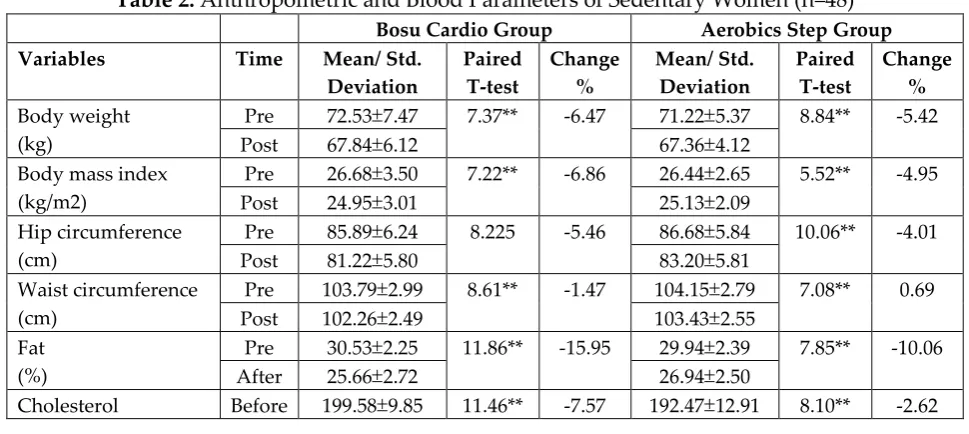
Table 1 contains the Age and Height parameters of females before and after exercises, Table 2 shows us Anthropometric and Blood Parameters, Table 3 shows us Incidence of Cardiovascular Disease Risk.
Table 1: Age and Height Parameters of Sedentary Women (n=48)
Variables Group Mean Std. Deviation Minimum Maximum t-test
Age (year)
Bosu Cardio 37.26 7.02 27 47 0.58
Aerobics Step 35.94 6.94 26 47
Height (cm)
Bosu Cardio 165.26 5.85 155 179 -0.18
Aerobics Step 164.31 4.59 154 169
No significant difference of Age and Height was found between Bosu Cardio group and
Aerobics Step group (p˃0.05).
Table 2: Anthropometric and Blood Parameters of Sedentary Women (n=48)
Bosu Cardio Group Aerobics Step Group
Variables Time Mean/ Std.
Deviation Paired T-test Change % Mean/ Std. Deviation Paired T-test Change % Body weight (kg)
Pre 72.537.47 7.37** -6.47 71.225.37 8.84** -5.42 Post 67.846.12 67.364.12
Body mass index (kg/m2)
Pre 26.683.50 7.22** -6.86 26.442.65 5.52** -4.95 Post 24.953.01 25.132.09
Hip circumference (cm)
Pre 85.896.24 8.225 -5.46 86.685.84 10.06** -4.01 Post 81.225.80 83.205.81
Waist circumference (cm)
Pre 103.792.99 8.61** -1.47 104.152.79 7.08** 0.69 Post 102.262.49 103.432.55
Fat (%)
Pre 30.532.25 11.86** -15.95 29.942.39 7.85** -10.06 After 25.662.72 26.942.50
(mg/100 cc) After 184.4710.01 187.4214.08 Triglyceride
(mg/100 cc)
Before 104.957.98 6.376 -8.13 105.429.08 3.16* -2.94 After 96.418.71 102.329.03
HDL-C (mg/100 cc)
Before 51.053.81 -3.33* 1.82 52.842.98 -8.49** 1.78 After 51.983.67 53.783.09
LDL-C (mg/100 cc)
Before 104.268.36 7.23** -8.38 104.4710.35 4.58 -3.56 After 95.5210.00 100.7511.07
*p<0.05 and **p<0.001
Table 3: Risk of Cardiovascular Diseases before and after Exercise Round in Sedentary Women (n=48)
Variables Group Before mean After mean T-tests Change %
TC/HDL-K Bosu Cardio 3.91 0.71 3.55 0.69 1.37 -9.21 Aerobics Step 3.641.06 3.480.68 2.04 -4.40 LDL-K/HDL-K Bosu Cardio 2.04 0.61 1.84 0.58 1.24 -9.80 Aerobics Step 1.980.70 1.870.71 1.7 -5.56
4. Discussion
The effect of BMI was presented in four categories according to WHO
recommendations: < 18.5 kg/m2 (lean); 18.5-24.9 kg/m2 (normal weight); 25–29.9kg/m2
(overweight) and ≥30 kg/m2 (obese).
The waist to hip ratio was calculated as waist girth divided by the hip girth. It is
statistically proved that men with WHR (Waist to Hip Ratio) of more than 0.90 and women with 0.85 are at greatest risk of health complications (Annamna et al., 2012). Waist Hip Ratio (WHR) above 0.85 for females is important indicators of lifestyle-related health problems throughout the world (Dubbert, 2002). Sedentary women with waist circumference of more than 85cm had almost doubled mortality risk compared to active women with waist circumference below 80 cm (Annamna et al., 2012). In this study, WHR (Waist to Hip Ratio) found before 10 weeks exercise program 0.83 cm and after 0.79 cm in Bosu cardio group and 0.83 cm and after 0.80 cm aerobic steps group. It can be said that the cardiovascular risk ratio has decreased according to the result of this investigation.
Imamoğlu et al. (2002) in sedentary female study, Body weight found before 3
circumference since (p<0.01). These results are similar to those of Imamoğlu (2002) Koca (2017) and Kolukısa & Yılmaz (2016).
Multiple meta-regression analyses demonstrated that subjects with a body mass
index (calculated as weight in kilograms divided by height in meters squared) less than 28 and total cholesterol level of 220 mg/dL [5.7 mmol/L] or more experienced an approximately 2.1-mg/dL (0.054-mmol/L) larger increase in HDL-C level than those with a body mass index of 28 or more and total cholesterol level less than 220 mg/dL (5.7 mmol/L), (Kodama et al., 2007). When we think of effect of exercise which are on plasma lipid and lipoprotein we see that exercıses which have not low and low densıty and enough period (6-8 weeks) reduce body mass, body fat percentage and total serum cholesterol (Dufaux, 1982). We accept that physical activity changes lipid and lipoprotein profıles (Stein, 1990). In this study is about enough density and strength exercise, HDL-C (High Density Lipoprotein-Cholesterol) level raises, LDL-C level falls down (Massarei, 1982). Massarei et al, found that long period of exercıse increases HDL-C with aerobic capacities increase and reduce heart illness risk.
In another study, females who were (60-70%) obese, rode bicycle and made
usual, special and passive gymnastic, for a month. At the end, they couldn’t found significant variance of triglyceride, total cholesterol, LDL-C, was decreased, HDL-C was increased (Sacaklı, 1992).
Yanagibari et al. (1993), investigated 12 weeks walking effect of exercise on
serum lipids and lipoproteins of mıddle aged female. They compared both group females and determıned in both groups an increase in HDL-C and a decrease in total cholesterol and LDL-C.
İmamoğlu et al. (1998) investigated the effect of short time exercise on serum
lipids of sedentary females before and after menopause and determined to increase in HDL-C (27.76 %) and to decrease in LDL-C (20.06%), Total cholesterol (12.96 %) triglyceride (27.76 %). George et al (2004): Reductions of approximately 2%, 3%, and 5%, respectively, were observed for TC, LDL-C, and TG, whereas an increase of 3% was observed for HDL-C.
İmamoğlu et al. (2002) investigated the effect of short time exercise on serum
lipids of sedentary females before and after menopause and they determined an increase in HDL-C (16.49 %) and a decrease in LDL-C (27.65%), total cholesterol (13 %), and triglyceride (31.61%). In this study, was found in Bosu Cardio Group after 10 weeks exercise routine, a decrease of 15.95 % in fat ratio, 7.57 % in cholesterol, 8.13 % in Triglyceride, and 8.38% in LDL-C. However, there were increases of 1.82% in HDL-C. There was in Aerobics Step Group at the after of exercise routine, a decrease of 10.06 % in fat ratio, 2.62% in cholesterol, % 2.94 in Triglyceride, and %3.56 in LDL-C. However,
there were increases of %1.78 in HDL-C (Table 2). Routineof the 10 weeks exercise has
In middle-aged women who prefer recreational aerobic exercise track: pre-test and post-test body weight decreased from 79.20 kg to 72.70 kg (Kolukısa, 2017) The Body Mass Index was 29.26 for the pre-test and 26.22 for the test. Pre-test and post-test Body weight and Body mass index were found to be significant (p <0.001). Regular aerobic exercise modestly increases HDL-C level. It appears the existence of a minimum exercise volume for a significant increase in HDL-C level. Exercise duration per session was the most important element of an exercise prescription. Exercise was more effective in subjects with initially high total cholesterol levels or low body mass index (Kodama et al., 2007). In this study, the same conclusion was found.
Our meta-analysis indicated that the effect of aerobic training resulted in a
2.53-mg/dL (0.065-mmol/L) elevation of net HDL-C change. In a previous observational study, every 1-mg/dL (0.026-mmol/L) increment in HDL-C level was reported to be associated with a 2% and 3% decreased risk of CVD in men and women, respectively. If this observation were applied to our results, the increase in HDL-C level by exercise determined by this analysis would, by a rough estimate, result in a CVD risk reduced by approximately 5.1% in men and 7.6% in women (Kodama et al., 2007). Coroner heart disease risk decreased by %1.5 caused a decrease %1 of HDL-C so that, in this study, decrease of LDL-C and increases of HDL-C have decreased the risk of CHD. A substantial increase in aerobic physical activity within the population might be recommended to reverse adverse lipid abnormalities, especially in subjects with a higher cardiovascular risk. Regular aerobic exercise modestly increases HDL-C level. It appears the existence of a minimum exercise volume for a significant increase in HDL-C level. Exercise duration per session was the most important element of an exercise prescription. Exercise was more effective in subjects with initially high total cholesterol levels or low body mass index (Kodama et al., 2007). This study found similar conclusions.
The periodic risk of heart disease can be estimated by dividing TC to HDL-C. As
a result of the estimation, 4.5-5 levels show important cardiovascular disease risk, 3.8-4 levels show low cardiovascular disease risk (Rosat, 1990; Werner et al., 1990). In another, the risk factor is high if TC/HDL-C ratio is higher than 5; the risk factor is low if the ratio is lower than 3.5 (Edward et al., 1992).
Imamoğlu et al (2005) found cardiovascular risk ratios of 4.53 mg/100cc in
5. Conclusion
In sedentary women, low intensity Bosu Cardio and Aerobics Step exercises have shown the fact that such exercises could be an improvement by the changes of body fat and the blood parameters because it reduces body parameters. The risks for cardiovascular problems are reduced. While doing Cardio Bosu and aerobic step exercise, the nutritional status of sedentary women should be checked. You can increase the effect by adding more exercises or performing the existing exercises for a longer period of time.
References
Annamma M., et al. (2012). Relationship between physical activity, BMI and waist hip ratio among middle aged women in a multiethnic population: A descriptive study, Gulf Medical Journal, ASM,1(S1):S169-S173.
Atan, T. et al. (2012). Physical activity levels of teachers and health professionals in Turkey, Health MED - Volume 6 / Number 6 / 1935-1942.
Baygutalp N. K., et.al. (2016). Acute Effects of Training on Some Biochemical Analyses in Professional Boxers Sub-Title: Biochemical Analyses in Boxers, International Journal of Medicine and Pharmacy June 2016, Vol. 4, No. 1, pp. 39-52
Boden W.E., (2000). High-density lipoprotein cholesterol as an independent risk factor in cardiovascular disease: assessing the data from Framingham to the Veterans Affairs High-Density Lipoprotein Intervention Trial. Am J Cardiol; 86 (12A) 19L- 22L
Çiçek G., İmamoğlu O., Yamaner F., Türk N., (2017). Kardiyo Bosu Egzersizinin Sedanter Kadınlarda Psikolojik Etkileri, Uluslararası Spor, Egzersiz ve Antrenman Bilimi Dergisi, Cilt 3, sayı 3., sh.69-75
Crouse S.F.O., et al. (1997). Training intensity, blood lipids, and apolipoproteins in men with high cholesterol. J Appl Physiol; 82270- 277
Drygas W. et al. (2000). Long-term effects of different physical activity levels on coronary heart disease risk factors in middle-aged men. Int J Sports Med ;21235-241
Dubbert P.M. et al. Obesity, physical inactivity, and risk for cardiovascular disease. Am J Med Sci 2002; 324: 116−126.
Dufaux B., Schmitz, G., Assman, G., Hollman W., (1982). Plasma lipoproteins and
physıcal activity. İnt.J.Sports Med., 3:58-60.
Durstine et al. (2001). Blood Lipid and Lipoprotein Adaptations to Exercise, Sports Medicine, 31(15), 1033-1062.
Franceschini G., (2001). Epidemiologic evidence for high-density lipoprotein cholesterol as a risk factor for coronary artery disease. Am J Cardiol, 88 ((12A)) 9N- 13N Fritz, K. (1987). Effects on Exercise on High Density Lipoproteins and Other
Lipoproteins. Lipid Disorders. 5, 23-31.
George A. et al., (2004). Aerobic Exercise and Lipids and Lipoproteins in Women: A Meta-Analysis of Randomized Controlled Trials, Journal of Women's Health. December, Vol. 13, No. 10: 1148-1164
İmamoğlu, O., Akyol, P. ve Bayram, L. (2002). Sedanter bayanlarda üç aylık egzersizin
fiziksel uygunluk, vücut kompozisyonu ve bazı kan parametreleri üzerine etkisi.
7. Uluslar arası Spor Bilimleri Kongresi, s.19.
Imamoglu, O., et al., (2005). Comparison of lipid and lipoprotein values in men and women differing in training status. Biol of Sport, 22(3):261–70.
Koca F. (2017). The effect of 12 weeks aerobic exercise on blood pressure, heart rates and blood parameters in sedentary females, International Journal of Academic Research, Part A. Applied and Natural Sciences, Vol. 9. No. 1., pp.5-7, DOI: 10.7813/2075-4124.2017/9-1
Kodama S., et al. (2007). Effect of Aerobic Exercise Training on Serum Levels of High-Density Lipoprotein Cholesterol A Meta-analysis, Arch Intern Med.,167(10):999-1008. doi:10.1001/archinte.167.10.999.
Kolukısa, Ş., (2107). Egzersiz Yapan Sedanter Kadınların Fizyolojik Değişimlerinin Araştırılması, Journal of Current Researches on Social Sciences, Vol: 7 (1),pp. 489-496.
Kolukısa, Ş., Yılmaz, E. (2016) Aerobic Fitness Yapan Sedanter Bayanların Fizyolojik Değişimlerinin Araştırılması, Eurasian Academy of Sciences Eurasian Education & Literature Journal 2016 Volume:6 S: 24 - 31
Massarei J. R. L., Pyke F. S., (1982). Physıcal fitness and plasma HDL cholesterol male in
busıness executives. Atherosclerosis. 42(1):77-83
Nepocatych S., et al. (2016). The effects of unstable surface balance training on postural
sway, stability, functional ability and flexibility in women, J. Sports Med. Phys.
Fitness, https://www.safetylit.org/citations/index.php.fuseaction=citations.
Rippe J. M., Ward A., Porcari J. P., Freedson P. S. (1998). Walking for health and Fitness, JAMA, 2592720- 2724
Rosato, Frank D. (1990). Fitness and Wellness the Physical Connection. U.S.A: Memphis State University.
Saçaklı H., (1992). Sağlıklı yaşam için... Bilimsel Metotlarla Zayıflama.s.18, Berkay
Matbaacılık.
Stein R.A., et al., (1990). Effects of different exercıse training ıntensıtıes on lıpoproteın
cholesterol fıctıon ın healthy mıddle-aged men, Am Heart J.119:277-83.
Tambalis K., et al., (2008). Responses of Blood Lipids to Aerobic, Resistance, and
Combined Aerobic With Resistance Exercise Training: A Systematic Review of
Werner, W. K., Hoeger, S., Hoeger, A. (1990). Fitness and Wellness. USA: Colorado. Williams P. T., (1996). High-density lipoprotein cholesterol and other risk factors for
coronary heart disease in female runners. N Engl J Med; 3341298- 1303.
Yanagibori R., et al., (1993). Effects of 12 weeks exercıse walking on serum lipids, lipoproteıns and apoliproteins in middle-aged women-does menopause status
Creative Commons licensing terms