ISSN-L: 2501 - 1235 Available on-line at: www.oapub.org/edu
doi: 10.5281/zenodo.3245320 Volume 5 │ Issue 9 │ 2019
A STUDY ON THE RELATIONSHIP OF TRAIT AND
STATE ANXIETY ON THE PERFORMANCE OF ARCHERS
Sharnpreet Kaur1i,
Shweta Shenoy2
1MPT Sports, MYAS-GNDU,
Department of Sports Sciences and Medicine, Guru Nanak Dev University, Amritsar, Punjab, India
2Head and Dean, PhD, MYAS-GNDU,
Department of Sports Sciences and Medicine, Guru Nanak Dev University, Amritsar, Punjab, India
Abstract:
The main objective of the study to analysis the effect of anxiety on performance of archers and specially the study was aimed at exploring the relationship of both trait and state anxiety. 80 subjects were taken, 34 female (42.5%) and 46 male (57.5%) and questionnaire were filled by researcher after subjects give consent for same. Competitive State Anxiety Inventory 2 (CSAI-2) and State Trait Anxiety Scale were used to assess the state and trait anxiety respectively. To performance FITA round score of archers was used. Result of the study observed a significant negative correlation of trait anxiety and somatic component of CSAI-2 with the performance of archers(p<0.01). Among each other these parameter show positive relation indications. On the other side the increase the age improves the overall scoring and confidence component of the state competitive anxiety scale also shows significant positive correlation with the performance of the players.
Keywords: archers, trait anxiety, state anxiety, performance
1. Introduction
In sports psychology, anxiety is vital component which influences performance.
“Anxiety is by definition a negative feeling state” (Jones & Hanton, 2001). Anxiety occurs as
a result of threat and this threat is “related to the subjective evaluation of a situation, and concerns jeopardy to one’s self-esteem during performance or social situations, physical danger,
or insecurity and uncertainty” (Schwenkmezger & Steffgen, 1989). Anxiety is further
described as state anxiety which can be considered to be more situational in nature and is often associated with arousal of the autonomic nervous system, and trait anxiety which can be thought of as a world view that an individual uses when coping with situations in his or her environment (Spielberger, 1966).
Within the context of sports, anxiety influences the performance. Those individuals who are having low trait anxious and experience high state anxiety would find the anxiety as facilitative to a peak performance; but, those individuals with who are having high trait anxious and experience state anxiety will find it debilitative to athletic performance (Hardy et al., 1996). According to the inverted-U hypothesis model, the relationship between the arousal and performance that as arousal increased performance would increase as well; but, if arousal became too great performance would deteriorate. (Broadhurst, 1957; Hebb, 1955). A theory proposed by Martens, Vealey, and Burton (1990) of competitive anxiety in which perceived threat of a competitive situation act as function in competitive state anxiety. That perceived threat arises because of the uncertainty of the established goal and the importance placed on the performance outcome of the competitive situation. Therefore, an increase in competitive state anxiety in either due to uncertainty or importance of the performance outcome of a competitive event which would lead to an increase in perceived threat. The immensity of the increase in state anxiety was also assumed to depend on the individuals' trait anxiety. As trait anxiety is construct reflected in most models of personality and refers to a relatively stable disposition within the individual to judge a wide range of environmental events as potentially threatening. (Performance psychology, 2011).
effectiveness (Causer J., 2011). Thus the primary purpose of the study investigate the state and trait anxiety relation with the performance in archery population.
An additional aspect of our study is influence of age on the performance as in archery the precise shooting skills are required which draw minimal amount of disturbances while shooting. In comparison of the elite and novice players the heart rate is lesser in elite, activation of the extensor muscle more among the elite, less activation of flexor muscle digitorum while aiming and releasing and less postural sway. These all skills provide the stable position to focus on the aim in elite athlete to achieve maximum and consistent scoring whereas in novice athletes these factor fluctuate the aiming and releasing of the arrow (Musa et al., 2018). Other than the physical factors the mental abilities also contribute such as more confident, using goal setting and being more concentrated skills are identified by the experience athletes in themselves (Goudas et al., 1998; Bebetsos & Antoniou, 2003).
As anxiety leads to self conscious which narrow the attention process and embark inward focus. (Baumeister, 1984; Masters, 1992). This inward focus disturbs the normal, automatic processing of the task and decline the performance. (Baumeister, 1984; Beilock & Carr, 2001; Lewis & Linder, 1997). There is dearth in the literature in relation of trait and state anxiety in archery, in soccer it explained very well. Thus the study is designed with the aim to find out the interrelation of state and trait anxiety effect on the performance of the archers.
2. Methodology
2.1 Participants
This cross sectional study has been carried out on total number of 80 archers, of both sexes 34 female (42.5%) and 46male (57.5%), aged between 16 to 25, who participated in the interuniversity and intercollege archery tournament in Guru Nanak Dev University, Amritsar and Punjabi University, Patiala were recruited in the study. The study was approved by the ethical committee of Guru Nanak Dev University. Participating players did not receive any kind of compensation for their participation.
2.2 Material and Procedure
2.3 Measures
State trait anxiety inventory: this scale was used to assess the trait anxiety developed by Spielberger. A self evaluation questionnaire type state trait inventory scale which consist of 40 questions, questions are like I feel secure, calm. Participants rated each question on a scale from not at all (1) to very much so(4) grading.
Competitive state anxiety inventory scale-2: it is a Linkert type scale, having 27 questions, these are asses situation specific state anxiety. The subtypes of anxiety that are cognitive, somatic and confidence were also measured through it. Scoring of the scale is from 9 to 36 which depict high and low level of each types of anxiety component.
Performance assessment: according to the FITA (World Archery, also and formerly known as FITA from the French Fédération Internationale de Tir à l'Arc), archery scoring from the highest scoring to the lowest one. Arrow should be shooted from a particular final line to standard faces which is of 122cm in diameter and composed of a circle in the center of 24.4cm diameter ringed by four concentric bands, the breadth of each measured radially being 12.2cm. Distance from the shooting line to standard faces is 70m, for both men and women. The colors of target faces are gold, red, and blue, black and white. The most inner centre area is taking 10+ scoring and the scoring follow from 10 to 9,8,7, 6 as the shooting arrow falls outward toward the gold, red colour zones.
3. Result
confidence enhance the performance. Table 2 and figure 1 show correlation of the both state and trait anxiety with the performance.
Table 1: Scoring of state trait anxiety scale and subtypes of the state competitive anxiety inventory-2 scale
Descriptive Statistics Mean SD N
Age 19.66 1.98 80
State-Trait Anxiety Scale 85.53 15.29 80
CSAI-Cognitive 19.53 5.23 80
CSAI-Somatic 17.11 4.89 80
CSAI-Confidence 26.26 4.10 80
Scoring 578.23 124.19 80
Table 1 represents the no of players(N), mean scores and standard deviation (SD) of the age, of state trait anxiety scale and the cognitive, somatic and self-confidence types of the competitive state anxiety inventory 2 scale(CSAI).
Table 2: Correlation of state trait anxiety scale and competitive state anxiety scale with scoring
Table 2 show the p value and Pearson correlation values of the correlation of the age, State trait anxiety scale, cognitive, somatic and self-confidence component of competitive state anxiety inventory-2 scale.
Correlation Matrix Correlation of GAME Scores
Pearson Correlation
P Value N Result
Age .229* 0.041 80 Significant
State-Trait Anxiety Scale -.311** 0.005 80 Significant
CSAI-Cognitive -0.009 0.936 80 Not Significant
CSAI-Somatic -.409** 0.000 80 Significant
CSAI-Confidence .394** 0.000 80 Significant
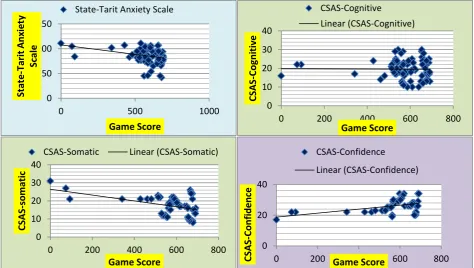
Figure 1: Correlation of the scoring of the state trait anxiety scale subtypes of the CSAI-2 scale cognitive, somatic and self-confidence with the performance of the archers
This figure shows the negative correlation of state trait anxiety scale and somatic component of CSAI-2 with the performance. With the increase in state trait anxiety and somatic scoring, the performance of the players gets declined. On the other positive correlation represent by the confidence with the performance of the archers whereas cognitive type is neutral with the performance.
4. Discussion
The primary aim of the study was to investigate the effect of state and trait anxiety on the performance of the archers. The analysis of the result reported the positive correlation of the age with performance of the players. There was significant improvement in the performance of the players with their increasing age as various factors such as physical, psychological factors and technical skills of shooting gets better with the experiences and repetitive practice. Robazza & Bortoli, 1998 found that the mental factors such as confidence, concentration, positive expectations get improved with the experience. Along with the mental factors, good levels of technical skills in the archers were also necessary to enhance the performance. The skills were to control the postural sway which reduce bow movement while shooting, activation of extensor muscle to focusing on the aim by relaxing flexor muscle compartment. These virtuosities were better in the experience players than the novice and non-medalist players (Musa et al., 2018). As the experience of the players gets increases, psychological and physical skills also get improved. Longo et al, performed an Olympic level study
0 50 100 150
0 500 1000
St at e -T arit A nx ie ty Scale Game Score
State-Tarit Anxiety Scale
0 10 20 30 40
0 200 400 600 800
C SA S-C o gni ti ve Game Score CSAS-Cognitive Linear (CSAS-Cognitive) 0 10 20 30 40
0 200 400 600 800
C SA S-so m at ic Game Score
CSAS-Somatic Linear (CSAS-Somatic)
0 20 40
0 200 400 600 800
and postulated that in the archery the mean age of the peak performance among male population is 25.3 to 26.7 and 23.8 to 25.3 for female population.
The trait anxiety effect on the performance of the archers was analyzed. The results showed negative correlation of the trait anxiety with the performance of the players. It indicated that if the trait anxiety which perceive many situations as menace is found increased in the players, it will adversely affect the performance of the players. Trait anxiety is a personality characteristics which relatively remain same and stable, it get precipitate under the influence of state anxiety in response to certain situations (Cox, 2007). In context of sports, it can be attributed that anxiety may decline the concentration, focus and create hindrance in the performance of the players which may leads to negative feeling of fear, apprehension and self doubts among players. Khan et.al, 2017 have been found as supportive evidence for the effect of anxiety on sports performance and postulated that catecholamine production gets increased in anxiety and stress state which leads to decrease in concentration, feelings of fear, and players find difficulty in decision making. It also influences various other systems of the body.
Martens et al, 1990, explain anxiety is a multidimensional theory and develop the competitive state anxiety inventory-2 scale which assesses the cognitive, somatic and self confidence component of the state anxiety. Cognitive component is negative expectation and worries about the performance, somatic component show the physiological effects. In current study result represents that the somatic component and confidence component of the competitive state anxiety scale shows negative and positive correlation with the performance respectively. Somatic component include physiological symptoms of increase heart rate, palm sweating, shortness of breath, tense muscles and shakiness. These symptoms alter the aim and focus of the shooter which cause detrimental effect on the performance of the players. Temporal sequence of cognitive and somatic component was investigated by Jones, 1995 and found that somatic component rapidly increases as the start of event becomes closer whereas the cognitive component remains stable. According to Hardy et.al, 1996 if physiological arousal levels are too high then there is a steep decline in performance which can only be reversed by a reduction in physiological arousal. Researcher (Kumar, 2013) reported that the increase the level of competitive anxiety will decrease the performance among the archers. Another supportive study by Parnabas, 2015 on the anxiety in hockey population and showed the negative correlation of state competitive anxiety with the performance of players. The overall performance decline with elevating the level of both trait and state anxiety as they are in positive correlation with each other.
6. Conclusions
6.1 Significance and Future directions
The finding of the study can be used in several ways: it will help the coaches, trainer and psychological counselor to modify the practice session and used of coping strategies to deal with the individual with high level of trait anxiety and at pre competitive state. The individual’s ability to increase efficiency in competition level can be improved by repetitive exposure to game that leads to reduced anxiety level and also help the players to cope up with the intensive competition. The other coping strategies involve psychological counseling and mental relaxation techniques will increment the performance and contribute to upliftment of particular game at nation level.
6.2 Future Suggestions
The study can conducted on the large population scale. To assess the trait anxiety and personality domains longitudinal studies can be designed.
6.3 Limitation of the Study Small sample size.
References
Baumeister, R. F. (1984). Choking under pressure: Self-consciousness and paradoxical effects on incentives on skillful performance. Journal of Personality and Social Psychology, 46, 610–620.
Bebetsos, E., & Antoniou, P. (2003). Psychological skills of Greek badminton athletes. Perceptual and Motor Skills, 97(3_suppl), 1289-1296.
Beilock, S. L., & Carr, T. H. (2001). On the fragility of skilled performance: What governs choking under pressure? Journal of Experimental Psychology: General, 130, 701– 725.
Broadhurst, P. L. (1957). Emotionality and the Yerkes-Dodson law. Journal of Experimental Psychology, 54, 345-352.
Causer, J., Holmes, P. S., Smith, N. C., & Williams, A. M. (2011). Anxiety, movement kinematics, and visual attention in elite-level performers. Emotion, 11(3), 595. Cox, R. H. (1998). Sport psychology: Concepts and applications (No. Ed. 4). McGraw-Hill. Goudas, M., Theodorakis, Y., & Karamousalidis, G. (1998). Psychological skills in
basketball: Preliminary study for development of a Greek form of the Athletic Coping Skills Inventory-28. Perceptual and Motor Skills, 86(1), 59-65.
Griffin, M. R. (1971). An Analysis of State and Trait Anxiety Experienced in Sports Competition by Women at Different Age Levels.
Hebb, D. O. (1955). Drives and the CNS (Conceptual Nervous System). Psychological Review, 62, 243-254
Humara, M. (1999). The relationship between anxiety and performance: A cognitive-behavioral perspective. Athletic Insight, 1(2), 1-14.
Jones, G. (1995). More than just a game: Research developments and issues in competitive anxiety in sport. British journal of psychology, 86(4), 449-478.
Jones, G., & Hanton, S. (2001). Pre-competitive feeling states and directional anxiety interpretations. Journal of sports sciences, 19(6), 385-395.
Jones, G., & Swain, A. (1992). Intensity and direction as dimensions of competitive state anxiety and relationships with competitiveness. Perceptual and motor skills, 74(2), 467-472.
Jones, G., Swain, A., & Cale, A. (1991). Genier differences in precompetition temporal fattening ami antecedents of anxiety and self-confidence. Journal of Sport and
Exercise psychology, 13(1), 1-15.
Jones, G., Swain, A., & Hardy, L. (1993). Intensity and direction dimensions of competitive state anxiety and relationships with performance. Journal of sports
sciences, 11(6), 525-532.
Khan, M. K., Khan, A., Khan, S. U., & Khan, S. Effects of Anxiety on Athletic Performance.
Kirby, R. J., & Liu, J. (1999) Precompetition anxiety in Chinese athletes. Perceptual and Motor Skills. 88, 297-303
Kumar, V., Singh, A., Sandhu, J. S., Gupta, N., & Pandey, R. M. (2017). Comparative study of sports competition anxiety among contact and non-contact sports persons.
Lee, K. (2009). Evaluation of attention and relaxation levels of archers in shooting process using brain wave signal analysis algorithms. Sci Sensitivity, 12(3), 341-350.
Lewis, B. P., & Linder, D. E. (1997). Thinking about choking? Attentional processes and paradoxical performance. Personality and Social Psychology Bulletin, 23, 937– 944.
Longo, A. F., Siffredi, C. R., Cardey, M. L., Aquilino, G. D., & Lentini, N. A. (2016). Age of peak performance in Olympic sports: A comparative research among disciplines. Journal of Human Sport and Exercise, 11(1), 31-41.
Martens, R., Vealey, R. S., & Burton, D. (1990). Competitive anxiety in sport. Human kinetics.
Martin, K. A., & Hall, C. R. (1997). Situational and intrapersonal moderators of sport competition state anxiety. Journal of Sport Behavior, 20, 435-446.
Martin, K. A., & Hall, C. R. (1997). Situational and intrapersonal moderators of sport competition state anxiety. Journal of Sport Behavior, 20(4), 435.
Musa, R. M., Abdullah, M. R., Juahir, H., Maliki, A. B. H. M., Mat-Rasid, S. M., Kosni, N. A., ... & Eswaramoorthi, V. (2018). A multidimensional analysis of physiological and mechanical variables among archers of different levels of expertise. Journal of
Fundamental and Applied Sciences, 10(1S), 18-32.
Parnabas, V. (2015). The Level of Competitive State Anxiety and Sport Performance among Hockey Players.
Robazza, C., & Bortoli, L. (1998). Mental preparation strategies of Olympic archers during competition: An exploratory investigation. High Ability Studies, 9(2), 219-235.
Ruis, S., & Stevenson, C. (2004). Precision archery. Human Kinetics.
Schwenkmezger, P., & Steffgen, G. (1989). Anxiety and motor performance.
In Normalities and abnormalities in human movement (Vol. 29, pp. 78-99). Karger
Publishers.
Siwach, R. J., Jaipal. (2003). A study of pre-competitive anxiety of archers in relation to their performance. International journal of research pedagogy and technology in
education and movement sciences , 108-119.
Spielberger, C. D. (1966). Theory and research on anxiety. Anxiety and behavior, 1(3). Swain, A., & Jones, G. (1993). Intensity and frequency dimensions of competitive state
anxiety. Journal of Sports Sciences, 11(6), 533-542.
Swain, A., & Jones, G. (1996). Explaining performance variance: The relative contribution of intensity and direction dimensions of competitive state anxiety. Anxiety, Stress, and Coping, 9(1), 1-18.
Performance psychology, 2011, Science Direct
https://www.sciencedirect.com/topics/neuroscience/trait-anxiety
Creative Commons licensing terms